Physen-Noise2Noise: Physics-Guided Self-Supervised Defocus Deblurring with Bias Correction under Low-Light Conditions
Pith reviewed 2026-06-30 13:11 UTC · model grok-4.3
The pith
A physics-guided self-supervised method corrects biased noise in low-light defocus deblurring using frequency-domain constraints.
A machine-rendered reading of the paper's core claim, the machinery that carries it, and where it could break.
Core claim
The central claim is that by deriving and incorporating a frequency-domain constraint from the defocus imaging process into a Noise2Noise framework via a learnable noise bias parameter, the method can effectively handle biased noise in low-light defocus deblurring, enabling high-quality reconstruction from noisy observations alone.
What carries the argument
The learnable noise bias parameter that encodes the frequency-domain constraint inherent to defocus imaging, allowing joint bias correction and deblurring in the self-supervised training.
If this is right
- The method enables deblurring without clean ground truth images by using multi-frame noisy observations.
- It provides a stable starting point for reconstruction through multi-frame noisy initialization.
- A pretrain-finetune strategy enhances robustness under challenging noise conditions.
- It outperforms state-of-the-art self-supervised approaches in the presence of complex biased noise.
Where Pith is reading between the lines
- This approach could extend to other imaging degradations where physical models provide frequency constraints, such as motion blur.
- Integrating the bias parameter might improve other self-supervised denoising tasks in computer vision.
- Testing on more diverse real-world datasets could reveal limitations in generalization to varying noise distributions.
Load-bearing premise
The frequency-domain constraint inherent to the defocus imaging process can be effectively incorporated via a learnable noise bias parameter to enable joint bias correction and deblurring under realistic low-light conditions.
What would settle it
A direct comparison showing that removing the learnable noise bias parameter leads to significantly worse performance on datasets with known non-zero-mean noise would falsify the central claim.
Figures




read the original abstract
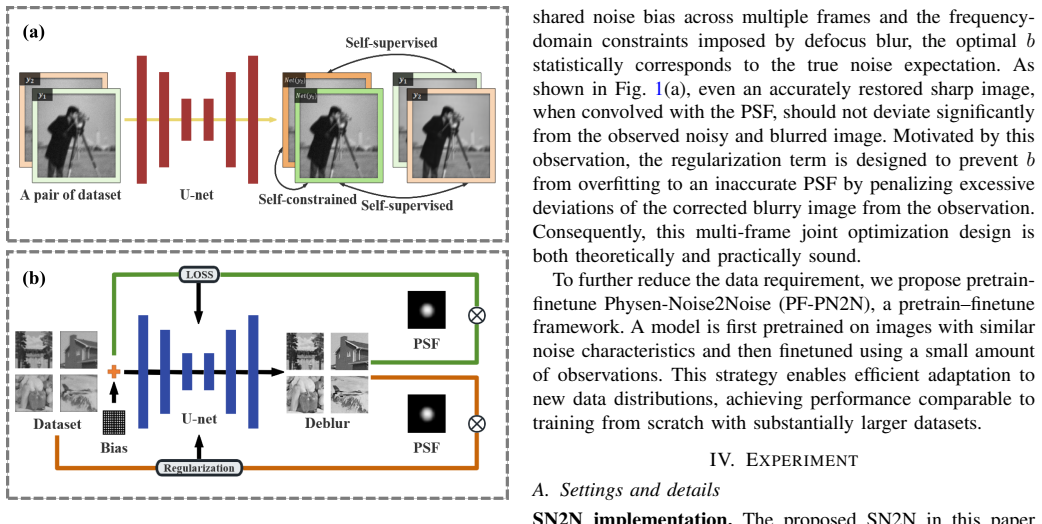
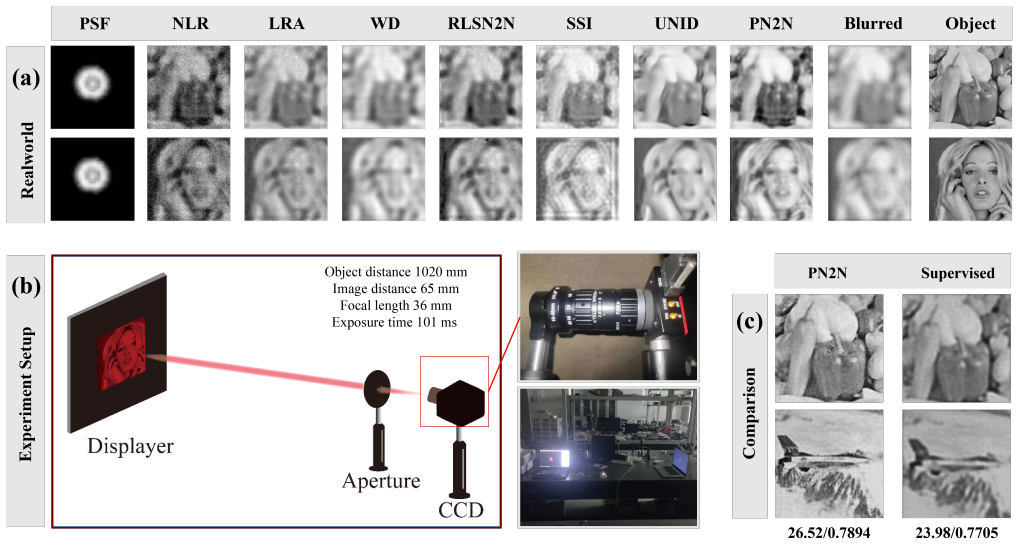
Low-light, long-exposure defocus deblurring remains a challenging problem due to the simultaneous presence of severe blur and complex biased noise. Existing methods typically rely on simplified noise assumptions, which limits their effectiveness under realistic imaging conditions. In this work, we propose Physen-Noise2Noise, a self-supervised deblurring framework guided by the physical model of defocus imaging, which leverages noisy multi-frame observations without requiring clean reference images. Unlike conventional Noise2Noise-based approaches that assume zero-mean noise, we derive a frequency-domain constraint inherent to the defocus imaging process and incorporate it into the learning framework via a learnable noise bias parameter. In addition, a multi-frame noisy initialization strategy is introduced to suppress complex biased noise prior to deblurring, providing a more stable starting point for reconstruction. This formulation explicitly models biased noise and enables joint bias correction and high-frequency detail recovery during training. Furthermore, we develop a pretrain-finetune variant to enhance robustness and generalization under challenging noise conditions. Extensive experiments on both simulation and real-world datasets demonstrate that the proposed method consistently outperforms state-of-the-art self-supervised approaches for defocus deblurring in the presence of complex biased noise.
Editorial analysis
A structured set of objections, weighed in public.
Referee Report
Summary. The manuscript proposes Physen-Noise2Noise, a self-supervised framework for defocus deblurring under low-light conditions with complex biased noise. It leverages noisy multi-frame observations without clean references, derives a frequency-domain constraint from the defocus imaging model, and incorporates this constraint via a learnable noise bias parameter to enable joint bias correction and high-frequency detail recovery. The method also includes a multi-frame noisy initialization strategy and a pretrain-finetune variant. Extensive experiments on simulated and real-world datasets are reported to show consistent outperformance over state-of-the-art self-supervised defocus deblurring approaches.
Significance. If the frequency-domain constraint is shown to be independent of the fitted bias parameter and to correctly handle signal-dependent noise after PSF convolution, the work could advance self-supervised deblurring by providing a physics-informed mechanism for bias correction beyond zero-mean assumptions. The multi-frame initialization and pretrain-finetune components offer practical engineering value for stable training under realistic low-light conditions.
major comments (2)
- Abstract: The central claim that a frequency-domain constraint 'inherent to the defocus imaging process' can be enforced via a single learnable noise bias parameter for joint bias correction requires explicit derivation showing independence from the fitted term. The parameter is determined during training on target data, and low-light noise is typically signal-dependent (Poisson-Gaussian); without demonstrating that the constraint remains valid post-convolution with the defocus PSF, the physics guidance risks being circular.
- Abstract (and method description): The multi-frame initialization and pretrain-finetune steps are presented as suppressing biased noise prior to deblurring, but these do not remove the dependency on the learnable bias parameter for enforcing the constraint. Validation that the overall formulation is not merely empirical fitting is load-bearing for the 'physics-guided' claim.
minor comments (1)
- The abstract would benefit from a concise statement of the assumed noise model and the explicit form of the frequency-domain constraint to allow immediate assessment of its applicability to signal-dependent noise.
Simulated Author's Rebuttal
We thank the referee for the constructive feedback, which highlights important aspects of our physics-guided formulation that require further clarification. We address the major comments point by point below and will revise the manuscript to incorporate explicit derivations and additional validation as requested.
read point-by-point responses
-
Referee: Abstract: The central claim that a frequency-domain constraint 'inherent to the defocus imaging process' can be enforced via a single learnable noise bias parameter for joint bias correction requires explicit derivation showing independence from the fitted term. The parameter is determined during training on target data, and low-light noise is typically signal-dependent (Poisson-Gaussian); without demonstrating that the constraint remains valid post-convolution with the defocus PSF, the physics guidance risks being circular.
Authors: We agree that an explicit derivation is essential to substantiate independence and address potential circularity. In the revised manuscript, we will add a dedicated subsection in the method section providing a step-by-step derivation from the defocus imaging model. This will show that the frequency-domain constraint (arising from the optical transfer function properties) is structurally independent of the additive bias term, which is isolated as a separate learnable parameter. For signal-dependent noise, we will include both theoretical analysis (extending the Poisson-Gaussian model through the linear PSF convolution) and controlled experiments demonstrating that the constraint remains valid post-convolution, with the bias parameter correcting the resulting offset without altering the underlying frequency relationship. These additions will strengthen the physics-guided claim. revision: yes
-
Referee: Abstract (and method description): The multi-frame initialization and pretrain-finetune steps are presented as suppressing biased noise prior to deblurring, but these do not remove the dependency on the learnable bias parameter for enforcing the constraint. Validation that the overall formulation is not merely empirical fitting is load-bearing for the 'physics-guided' claim.
Authors: We acknowledge that the initialization and pretrain-finetune strategies are complementary engineering components and do not replace the need for the constraint. To validate the physics-guided nature, the revised manuscript will include expanded ablation studies: (1) performance comparison with the frequency-domain constraint disabled (reducing to standard Noise2Noise), and (2) analysis of the learned bias parameter's consistency across noise levels and its correlation with the derived constraint rather than arbitrary fitting. These will be supported by quantitative metrics showing that enforcing the constraint yields improvements beyond what initialization alone achieves, confirming the formulation is not purely empirical. revision: yes
Circularity Check
Frequency-domain constraint enforced via learnable (fitted) noise bias parameter reduces to training fit by construction
specific steps
-
fitted input called prediction
[Abstract]
"we derive a frequency-domain constraint inherent to the defocus imaging process and incorporate it into the learning framework via a learnable noise bias parameter"
The constraint is presented as derived from physics, yet is incorporated and enforced solely through a learnable noise bias parameter whose value is determined during training on the target noisy multi-frame data. This reduces the 'derived constraint' to the fitted parameter by construction, so any performance gain from 'joint bias correction' is a statistical fit rather than an independent physical prediction.
full rationale
The paper claims to derive a frequency-domain constraint from the defocus imaging model and incorporate it via a learnable noise bias parameter. This makes the central 'physics-guided' element statistically forced by the fitted parameter on target data rather than an independent first-principles result. No other circular steps (self-citations or ansatzes) are evident from the provided text; the multi-frame initialization and pretrain-finetune are separate. The derivation chain is therefore partially circular at the constraint-enforcement step, consistent with a score of 6.
Axiom & Free-Parameter Ledger
free parameters (1)
- learnable noise bias parameter
axioms (1)
- domain assumption Frequency-domain constraint inherent to the defocus imaging process
Reference graph
Works this paper leans on
-
[1]
Extreme low-light image enhancement for surveil- lance cameras using attention u-net,
S. Ai and J. Kwon, “Extreme low-light image enhancement for surveil- lance cameras using attention u-net,”Sensors, vol. 20, no. 2, p. 495, 2020
2020
-
[2]
Self-inspired learning for denoising live-cell super-resolution microscopy,
L. Qu, S. Zhao, Y . Huang, X. Ye, K. Wang, Y . Liu, X. Liu, H. Mao, G. Hu, W. Chenet al., “Self-inspired learning for denoising live-cell super-resolution microscopy,”Nature Methods, vol. 21, no. 10, pp. 1895– 1908, 2024
1908
-
[3]
Legan: A low-light image enhancement generative adversarial network for industrial internet of smart-cameras,
J. Tao, J. Wang, P. Zhang, J. Zhang, K.-L. Yung, and W. H. Ip, “Legan: A low-light image enhancement generative adversarial network for industrial internet of smart-cameras,”Internet of Things, vol. 25, p. 101054, 2024
2024
-
[4]
Radiometric ccd camera calibration and noise estimation,
G. E. Healey and R. Kondepudy, “Radiometric ccd camera calibration and noise estimation,”IEEE Transactions on Pattern Analysis and Machine Intelligence, vol. 16, no. 3, pp. 267–276, 2002
2002
-
[5]
Tian,Noise analysis in CMOS image sensors
H. Tian,Noise analysis in CMOS image sensors. stanFord university, 2000
2000
-
[6]
High-level numerical simulations of noise in CCD and CMOS photosensors: review and tutorial
M. Konnik and J. Welsh, “High-level numerical simulations of noise in ccd and cmos photosensors: review and tutorial,”arXiv preprint arXiv:1412.4031, 2014
work page internal anchor Pith review Pith/arXiv arXiv 2014
-
[7]
Noise suppres- sion in low-light images through joint denoising and demosaicing,
P. Chatterjee, N. Joshi, S. B. Kang, and Y . Matsushita, “Noise suppres- sion in low-light images through joint denoising and demosaicing,” in CVPR 2011. IEEE, 2011, pp. 321–328
2011
-
[8]
A review of an old dilemma: Demosaicking first, or denoising first?
Q. Jin, G. Facciolo, and J.-M. Morel, “A review of an old dilemma: Demosaicking first, or denoising first?” inproceedings of the IEEE/CVF conference on computer vision and pattern recognition workshops, 2020, pp. 514–515
2020
-
[9]
A case for denoising before demosaicking color filter array data,
S. H. Park, H. S. Kim, S. Lansel, M. Parmar, and B. A. Wandell, “A case for denoising before demosaicking color filter array data,” in2009 Conference Record of the Forty-Third Asilomar Conference on Signals, Systems and Computers. IEEE, 2009, pp. 860–864
2009
-
[10]
Ap-bsn: Self-supervised denoising for real-world images via asymmetric pd and blind-spot network,
W. Lee, S. Son, and K. M. Lee, “Ap-bsn: Self-supervised denoising for real-world images via asymmetric pd and blind-spot network,” in Proceedings of the IEEE/CVF Conference on Computer Vision and Pattern Recognition, 2022, pp. 17 725–17 734
2022
-
[11]
Beyond a gaussian denoiser: Residual learning of deep cnn for image denoising,
K. Zhang, W. Zuo, Y . Chen, D. Meng, and L. Zhang, “Beyond a gaussian denoiser: Residual learning of deep cnn for image denoising,”IEEE transactions on image processing, vol. 26, no. 7, pp. 3142–3155, 2017
2017
-
[12]
Swinir: Image restoration using swin transformer,
J. Liang, J. Cao, G. Sun, K. Zhang, L. Van Gool, and R. Timofte, “Swinir: Image restoration using swin transformer,” inProceedings of the IEEE/CVF international conference on computer vision, 2021, pp. 1833–1844
2021
-
[13]
Masked image training for generalizable deep image denoising,
H. Chen, J. Gu, Y . Liu, S. A. Magid, C. Dong, Q. Wang, H. Pfister, and L. Zhu, “Masked image training for generalizable deep image denoising,” inProceedings of the IEEE/CVF Conference on Computer Vision and Pattern Recognition, 2023, pp. 1692–1703
2023
-
[14]
Normalization-equivariant neural networks with application to image denoising,
S. Herbreteau, E. Moebel, and C. Kervrann, “Normalization-equivariant neural networks with application to image denoising,”Advances in Neural Information Processing Systems, vol. 36, pp. 5706–5728, 2023
2023
-
[15]
From synthetic to real: A calibration-free pipeline for few-shot raw image denoising,
R. Li, C. Liu, Z. Wang, Y . Du, J. Yang, L. Bao, and H. Sun, “From synthetic to real: A calibration-free pipeline for few-shot raw image denoising,” inProceedings of the IEEE/CVF Conference on Computer Vision and Pattern Recognition, 2024, pp. 1106–1114
2024
-
[16]
Learning spatially-variant map models for non-blind image deblurring,
J. Dong, S. Roth, and B. Schiele, “Learning spatially-variant map models for non-blind image deblurring,” inProceedings of the IEEE/CVF conference on computer vision and pattern recognition, 2021, pp. 4886– 4895
2021
-
[17]
Photon limited non-blind deblurring using algorithm unrolling,
Y . Sanghvi, A. Gnanasambandam, and S. H. Chan, “Photon limited non-blind deblurring using algorithm unrolling,”IEEE Transactions on Computational Imaging, vol. 8, pp. 851–864, 2022
2022
-
[18]
Infwide: Image and feature space wiener deconvolution network for non-blind image deblur- ring in low-light conditions,
Z. Zhang, Y . Cheng, J. Suo, L. Bian, and Q. Dai, “Infwide: Image and feature space wiener deconvolution network for non-blind image deblur- ring in low-light conditions,”IEEE Transactions on Image Processing, vol. 32, pp. 1390–1402, 2023
2023
-
[19]
Deep wiener deconvolution: Wiener meets deep learning for image deblurring,
J. Dong, S. Roth, and B. Schiele, “Deep wiener deconvolution: Wiener meets deep learning for image deblurring,”Advances in Neural Infor- mation Processing Systems, vol. 33, pp. 1048–1059, 2020
2020
-
[20]
Learning deep gradient descent optimization for image deconvolution,
D. Gong, Z. Zhang, Q. Shi, A. Van Den Hengel, C. Shen, and Y . Zhang, “Learning deep gradient descent optimization for image deconvolution,” IEEE transactions on neural networks and learning systems, vol. 31, no. 12, pp. 5468–5482, 2020
2020
-
[21]
Prodebnet: projector deblurring using a convolutional neural network,
Y . Kageyama, M. Isogawa, D. Iwai, and K. Sato, “Prodebnet: projector deblurring using a convolutional neural network,”Opt. Express, vol. 28, no. 14, pp. 20 391–20 403, Jul 2020. [Online]. Available: https://opg.optica.org/oe/abstract.cfm?URI=oe-28-14-20391
2020
-
[22]
High-quality blind defocus deblurring of multispectral images with optics and gradient prior,
X.-X. Wei, L. Zhang, and H. Huang, “High-quality blind defocus deblurring of multispectral images with optics and gradient prior,” Opt. Express, vol. 28, no. 7, pp. 10 683–10 704, Mar 2020. [Online]. Available: https://opg.optica.org/oe/abstract.cfm?URI=oe-28-7-10683
2020
-
[23]
Image de- convolution via noise-tolerant self-supervised inversion,
H. Kobayashi, A. C. Solak, J. Batson, and L. A. Royer, “Image de- convolution via noise-tolerant self-supervised inversion,”arXiv preprint arXiv:2006.06156, 2020
-
[24]
Nonblind image deconvolution via leveraging model uncertainty in an untrained deep neural network,
M. Chen, Y . Quan, T. Pang, and H. Ji, “Nonblind image deconvolution via leveraging model uncertainty in an untrained deep neural network,” International Journal of Computer Vision, vol. 130, no. 7, pp. 1770– 1789, 2022
2022
-
[25]
A deep learning method for simultane- ous denoising and missing wedge reconstruction in cryogenic electron tomography,
S. Wiedemann and R. Heckel, “A deep learning method for simultane- ous denoising and missing wedge reconstruction in cryogenic electron tomography,”Nature Communications, vol. 15, no. 1, p. 8255, 2024
2024
-
[26]
Noise modeling for design and simulation of color imaging systems,
H. B. Wach and E. R. Dowski, “Noise modeling for design and simulation of color imaging systems,” inColor and Imaging Conference, vol. 12. Society of Imaging Science and Technology, 2004, pp. 211– 216
2004
-
[27]
Image restoration by wiener deconvolution in limited-view computed tomography,
A. P. Dhawan, R. M. Rangayyan, and R. Gordon, “Image restoration by wiener deconvolution in limited-view computed tomography,”Applied optics, vol. 24, no. 23, pp. 4013–4020, 1985
1985
-
[28]
An iterative technique for the rectification of observed distributions,
L. B. Lucy, “An iterative technique for the rectification of observed distributions,”Astronomical Journal, Vol. 79, p. 745 (1974), vol. 79, p. 745, 1974
1974
-
[29]
Bayesian-based iterative method of image restora- tion,
W. H. Richardson, “Bayesian-based iterative method of image restora- tion,”Journal of the optical society of America, vol. 62, no. 1, pp. 55–59, 1972
1972
-
[30]
Imaging through scattering medium by adaptive non-linear digital processing,
S. Mukherjee and J. Rosen, “Imaging through scattering medium by adaptive non-linear digital processing,”Scientific reports, vol. 8, no. 1, p. 10517, 2018
2018
-
[31]
Noise2inverse: Self-supervised deep convolutional denoising for tomography,
A. A. Hendriksen, D. M. Pelt, and K. J. Batenburg, “Noise2inverse: Self-supervised deep convolutional denoising for tomography,”IEEE Transactions on Computational Imaging, vol. 6, pp. 1320–1335, 2020
2020
-
[32]
Neural blind deconvolution using deep priors,
D. Ren, K. Zhang, Q. Wang, Q. Hu, and W. Zuo, “Neural blind deconvolution using deep priors,” inProceedings of the IEEE/CVF conference on computer vision and pattern recognition, 2020, pp. 3341– 3350
2020
-
[33]
Uncertainty- aware unsupervised image deblurring with deep residual prior,
X. Tang, X. Zhao, J. Liu, J. Wang, Y . Miao, and T. Zeng, “Uncertainty- aware unsupervised image deblurring with deep residual prior,” in Proceedings of the IEEE/CVF conference on computer vision and pattern recognition, 2023, pp. 9883–9892
2023
-
[34]
Robust unsupervised deep learning for nonblind image deconvolution with inaccurate kernels,
X. Qin, Y . Quan, Z. Chen, and H. Ji, “Robust unsupervised deep learning for nonblind image deconvolution with inaccurate kernels,” IEEE Transactions on Neural Networks and Learning Systems, 2025
2025
-
[35]
Deep image prior,
D. Ulyanov, A. Vedaldi, and V . Lempitsky, “Deep image prior,” in Proceedings of the IEEE conference on computer vision and pattern recognition, 2018, pp. 9446–9454
2018
-
[36]
Image deconvolution with deep image and kernel priors,
Z. Wang, Z. Wang, Q. Li, and H. Bilen, “Image deconvolution with deep image and kernel priors,” inProceedings of the IEEE/CVF International Conference on Computer Vision Workshops, 2019, pp. 0–0
2019
-
[37]
Nbd-gap: non-blind image deblurring without clean target images,
N. G. Nair, R. Yasarla, and V . M. Patel, “Nbd-gap: non-blind image deblurring without clean target images,” in2022 IEEE international conference on image processing (ICIP). IEEE, 2022, pp. 3431–3435
2022
-
[38]
Cyclegan with a blur kernel for deconvolution microscopy: Optimal transport geometry,
S. Lim, H. Park, S.-E. Lee, S. Chang, B. Sim, and J. C. Ye, “Cyclegan with a blur kernel for deconvolution microscopy: Optimal transport geometry,”IEEE Transactions on Computational Imaging, vol. 6, pp. 1127–1138, 2020
2020
-
[39]
Noise2void-learning denoising from single noisy images,
A. Krull, T.-O. Buchholz, and F. Jug, “Noise2void-learning denoising from single noisy images,” inProceedings of the IEEE/CVF conference on computer vision and pattern recognition, 2019, pp. 2129–2137
2019
-
[40]
Dropout as a bayesian approximation: Representing model uncertainty in deep learning,
Y . Gal and Z. Ghahramani, “Dropout as a bayesian approximation: Representing model uncertainty in deep learning,” ininternational conference on machine learning. PMLR, 2016, pp. 1050–1059
2016
-
[41]
Noise2Noise: Learning Image Restoration without Clean Data
J. Lehtinen, J. Munkberg, J. Hasselgren, S. Laine, T. Karras, M. Aittala, and T. Aila, “Noise2noise: Learning image restoration without clean data,”arXiv preprint arXiv:1803.04189, 2018
work page internal anchor Pith review Pith/arXiv arXiv 2018
-
[42]
Structure adaptive anisotropic image filtering,
G.-Z. Yang, P. Burger, D. N. Firmin, and S. Underwood, “Structure adaptive anisotropic image filtering,”Image and Vision Computing, vol. 14, no. 2, pp. 135–145, 1996
1996
-
[43]
Kernel regression for image processing and reconstruction,
H. Takeda, S. Farsiu, and P. Milanfar, “Kernel regression for image processing and reconstruction,”IEEE Transactions on image processing, vol. 16, no. 2, pp. 349–366, 2007
2007
-
[44]
Image denoising by sparse 3-d transform-domain collaborative filtering,
K. Dabov, A. Foi, V . Katkovnik, and K. Egiazarian, “Image denoising by sparse 3-d transform-domain collaborative filtering,”IEEE Transactions on image processing, vol. 16, no. 8, pp. 2080–2095, 2007
2080
-
[45]
Multiscale lmmse-based image denoising with optimal wavelet selection,
L. Zhang, P. Bao, and X. Wu, “Multiscale lmmse-based image denoising with optimal wavelet selection,”IEEE Transactions on circuits and systems for video technology, vol. 15, no. 4, pp. 469–481, 2005
2005
-
[46]
Fast gradient-based algorithms for con- strained total variation image denoising and deblurring problems,
A. Beck and M. Teboulle, “Fast gradient-based algorithms for con- strained total variation image denoising and deblurring problems,”IEEE transactions on image processing, vol. 18, no. 11, pp. 2419–2434, 2009
2009
-
[47]
Deep learning on image denoising: An overview,
C. Tian, L. Fei, W. Zheng, Y . Xu, W. Zuo, and C.-W. Lin, “Deep learning on image denoising: An overview,”Neural Networks, vol. 131, pp. 251– 275, 2020
2020
-
[48]
Image denoising in the deep learning era,
S. Izadi, D. Sutton, and G. Hamarneh, “Image denoising in the deep learning era,”Artificial Intelligence Review, vol. 56, no. 7, pp. 5929– 5974, 2023
2023
-
[49]
Image denoising: The deep learning revolution and beyond—a survey paper,
M. Elad, B. Kawar, and G. Vaksman, “Image denoising: The deep learning revolution and beyond—a survey paper,”SIAM Journal on Imaging Sciences, vol. 16, no. 3, pp. 1594–1654, 2023
2023
-
[50]
High-quality self- supervised deep image denoising,
S. Laine, T. Karras, J. Lehtinen, and T. Aila, “High-quality self- supervised deep image denoising,”Advances in neural information processing systems, vol. 32, 2019
2019
-
[51]
Recorrupted-to-recorrupted: Unsupervised deep learning for image denoising,
T. Pang, H. Zheng, Y . Quan, and H. Ji, “Recorrupted-to-recorrupted: Unsupervised deep learning for image denoising,” inProceedings of the IEEE/CVF conference on computer vision and pattern recognition, 2021, pp. 2043–2052
2021
-
[52]
Generalized recorrupted-to- recorrupted: Self-supervised learning beyond gaussian noise,
B. Monroy, J. Bacca, and J. Tachella, “Generalized recorrupted-to- recorrupted: Self-supervised learning beyond gaussian noise,” inPro- ceedings of the Computer Vision and Pattern Recognition Conference, 2025, pp. 28 155–28 164
2025
-
[53]
Neighbor2neighbor: Self- supervised denoising from single noisy images,
T. Huang, S. Li, X. Jia, H. Lu, and J. Liu, “Neighbor2neighbor: Self- supervised denoising from single noisy images,” inProceedings of the IEEE/CVF conference on computer vision and pattern recognition, 2021, pp. 14 781–14 790
2021
-
[54]
Self2self with dropout: Learning self-supervised denoising from single image,
Y . Quan, M. Chen, T. Pang, and H. Ji, “Self2self with dropout: Learning self-supervised denoising from single image,” inProceedings of the IEEE/CVF conference on computer vision and pattern recognition, 2020, pp. 1890–1898
2020
-
[55]
Pixel2pixel: A pixelwise approach for zero-shot single image denoising,
Q. Ma, J. Jiang, X. Zhou, P. Liang, X. Liu, and J. Ma, “Pixel2pixel: A pixelwise approach for zero-shot single image denoising,”IEEE Transactions on Pattern Analysis and Machine Intelligence, 2025
2025
-
[56]
Beating spectral bandwidth limits for large aperture broadband nano-optics,
J. E. Fr ¨och, P. Chakravarthula, J. Sun, E. Tseng, S. Colburn, A. Zhan, F. Miller, A. Wirth-Singh, Q. A. Tanguy, Z. Hanet al., “Beating spectral bandwidth limits for large aperture broadband nano-optics,”Nature communications, vol. 16, no. 1, p. 3025, 2025
2025
-
[57]
Blind and semi-blind deblurring of natural images,
M. S. Almeida and L. B. Almeida, “Blind and semi-blind deblurring of natural images,”IEEE Transactions on image processing, vol. 19, no. 1, pp. 36–52, 2009
2009
-
[58]
J. W. Goodman,Introduction to Fourier optics. Roberts and Company publishers, 2005
2005
-
[59]
Convolutional deblurring for natural imaging,
M. S. Hosseini and K. N. Plataniotis, “Convolutional deblurring for natural imaging,”IEEE Transactions on Image Processing, vol. 29, pp. 250–264, 2019
2019
-
[60]
G. D. Boreman,Modulation transfer function in optical and electro- optical systems. SPIE press Bellingham, Washington, 2001, vol. 4
2001
-
[61]
Phase imaging with an untrained neural network,
F. Wang, Y . Bian, H. Wang, M. Lyu, G. Pedrini, W. Osten, G. Barbas- tathis, and G. Situ, “Phase imaging with an untrained neural network,” Light: Science & Applications, vol. 9, no. 1, p. 77, 2020
2020
-
[62]
Imagenet: A large-scale hierarchical image database,
J. Deng, W. Dong, R. Socher, L.-J. Li, K. Li, and L. Fei-Fei, “Imagenet: A large-scale hierarchical image database,” in2009 IEEE conference on computer vision and pattern recognition. Ieee, 2009, pp. 248–255
2009
-
[63]
Cvg-ugr image database,
Computer Vision Group, University of Granada, “Cvg-ugr image database,” https://ccia.ugr.es/cvg/dbimagenes/, accessed Jan. 22, 2026
2026
discussion (0)
Sign in with ORCID, Apple, or X to comment. Anyone can read and Pith papers without signing in.