QPEs from Warped Disk Collisions with EMRIs: Brightness-Recurrence Diagram and Gravitational-Wave Follow-up
Pith reviewed 2026-06-29 23:53 UTC · model grok-4.3
The pith
Collisions between an extreme-mass-ratio inspiral and a warped accretion disk produce the long-short and strong-weak patterns seen in quasi-periodic eruptions.
A machine-rendered reading of the paper's core claim, the machinery that carries it, and where it could break.
Core claim
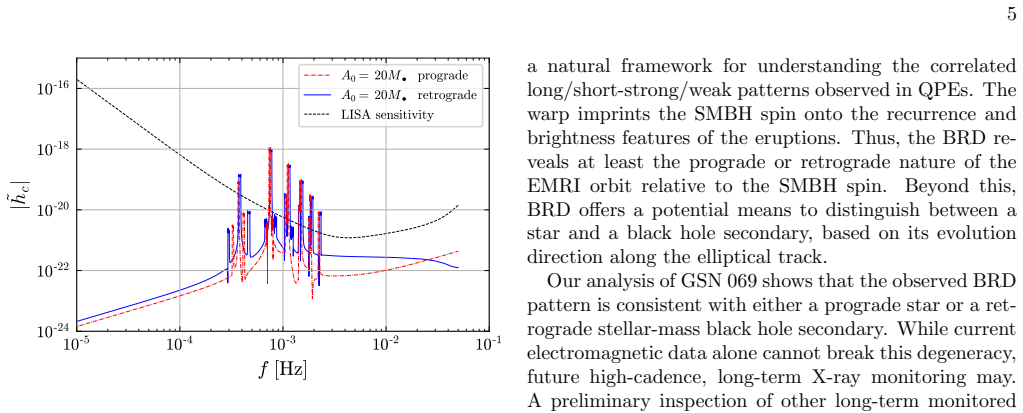
Quasi-periodic eruptions result from an extreme-mass-ratio inspiral colliding with a warped accretion disk; the Brightness-Recurrence Diagram shows the bursts tracing an elliptical trajectory set by the inspiral's apsidal precession, with the ellipse tilt encoding prograde versus retrograde orientation, and this framework reproduces the data for GSN 069 while allowing either a prograde stellar secondary or a retrograde stellar-mass black hole whose orbital decay could bring it within LISA reach in decades.
What carries the argument
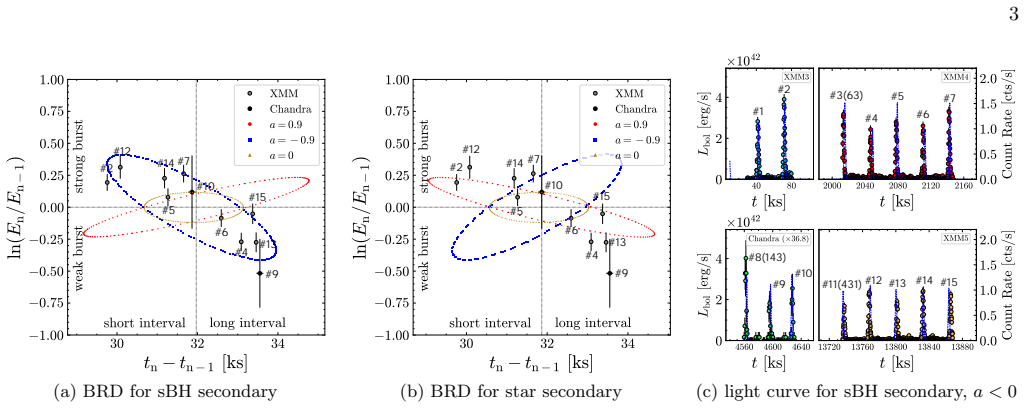
The Brightness-Recurrence Diagram, in which bursts trace an elliptical trajectory driven by the EMRI's apsidal precession, with the tilt of the ellipse encoding prograde versus retrograde orientation relative to the central black hole spin.
Load-bearing premise
The accretion disk is warped after a tidal disruption event in a manner that directly ties the EMRI's apsidal precession to both recurrence time and burst energy.
What would settle it
Future observations of GSN 069 or similar sources showing QPE bursts that fail to trace an elliptical path in the brightness-recurrence diagram, or whose ellipse tilt contradicts independent spin-orientation measurements, would falsify the model.
Figures

read the original abstract
Quasi-Periodic Eruptions (QPEs) display correlated long/short and strong/weak patterns that remain unexplained by existing flat-disk collision models. We propose that these features arise from an extreme-mass-ratio inspiral (EMRI) colliding with a warped accretion disk, likely formed after a tidal disruption event. The warp modulates both recurrence time and burst energy, encoding the disk geometry -- and thus the spin of the central supermassive black hole (SMBH) -- into the X-ray light curve. We introduce the Brightness-Recurrence Diagram (BRD) to visualize this correlation, where QPE bursts trace an elliptical trajectory driven by the EMRI's apsidal precession; the tilt of this ellipse encodes whether the EMRI is prograde or retrograde relative to the SMBH spin. Applying this model to the prototypical QPE source GSN 069 successfully reproduces the observed patterns. The data are consistent with either a prograde stellar secondary or a retrograde stellar-mass black hole. In the stellar-mass black hole scenario, ongoing orbital decay could render the EMRI detectable by LISA within a few decades, facilitating gravitational-wave follow-up and independent multimessenger constraints on the system.
Editorial analysis
A structured set of objections, weighed in public.
Referee Report
Summary. The manuscript proposes that the correlated long/short and strong/weak patterns in quasi-periodic eruptions (QPEs) arise from an extreme-mass-ratio inspiral (EMRI) colliding with a warped accretion disk formed after a tidal disruption event. The warp is argued to modulate both recurrence time and burst energy according to the EMRI's apsidal precession; this correlation is visualized in a new Brightness-Recurrence Diagram (BRD) in which bursts trace an elliptical trajectory whose tilt encodes prograde versus retrograde orientation relative to the central SMBH spin. The model is applied to the prototypical source GSN 069 and claimed to reproduce the observed patterns, with the data consistent with either a prograde stellar secondary or a retrograde stellar-mass black hole; the latter case is said to imply LISA detectability within decades via ongoing orbital decay.
Significance. If the central geometric mechanism holds, the work supplies a concrete link between disk warp geometry (hence SMBH spin) and observable QPE correlations that flat-disk models do not address, while introducing the BRD as a practical diagnostic for EMRI orientation. The forward prediction of LISA detectability constitutes a falsifiable multimessenger implication that could be tested independently of the X-ray data.
major comments (1)
- [Abstract and GSN 069 application] Abstract and the section applying the model to GSN 069: the claim that the model 'successfully reproduces' the observed patterns provides no quantitative fit statistics, error analysis, or comparison against alternative (flat-disk or other) models. Without these, it remains unclear whether the reproduction is a genuine prediction or the result of post-hoc adjustment of warp parameters or precession rates to the same light curve used to define the patterns.
minor comments (1)
- [Abstract] The abstract and introduction would benefit from a brief statement of the key assumptions underlying the warp geometry and apsidal-precession modulation before the BRD is introduced.
Simulated Author's Rebuttal
We thank the referee for the constructive feedback. We address the single major comment below and will revise the manuscript accordingly to strengthen the quantitative support for our claims.
read point-by-point responses
-
Referee: [Abstract and GSN 069 application] Abstract and the section applying the model to GSN 069: the claim that the model 'successfully reproduces' the observed patterns provides no quantitative fit statistics, error analysis, or comparison against alternative (flat-disk or other) models. Without these, it remains unclear whether the reproduction is a genuine prediction or the result of post-hoc adjustment of warp parameters or precession rates to the same light curve used to define the patterns.
Authors: We agree that the current presentation relies on a qualitative match between the observed long/short and strong/weak correlations in GSN 069 and the elliptical trajectories predicted by the BRD. The warp parameters and precession rate are set by the requirement that the EMRI apsidal precession produces the observed recurrence-time modulation while the collision geometry sets the brightness variation; these are not freely adjusted after the fact but are fixed by the disk warp induced by the TDE and the SMBH spin orientation. Nevertheless, we acknowledge the absence of formal statistics. In revision we will add (i) a quantitative comparison of model-predicted versus observed recurrence times and energies with associated uncertainties, (ii) a brief error analysis on the derived warp angle and precession period, and (iii) an explicit side-by-side demonstration that flat-disk models produce no correlated BRD ellipse and therefore cannot account for the observed patterns. These additions will make clear that the reproduction follows from the geometric mechanism rather than post-hoc tuning. revision: yes
Circularity Check
No significant circularity identified
full rationale
The provided abstract and context present the warped-disk EMRI model as a geometric proposal whose modulation of recurrence time and burst energy follows from apsidal precession, with the BRD ellipse tilt offered as a direct consequence. No equations, fitted parameters, or self-citations are quoted that reduce any prediction to an input by construction. The reproduction claim for GSN 069 is stated at the level of pattern matching without visible reduction of outputs to the same data used for fitting. The LISA detectability statement is a forward projection. Per the rules, absence of quotable self-definitional or fitted-input reductions requires score 0; the derivation chain remains self-contained against external benchmarks.
Axiom & Free-Parameter Ledger
Reference graph
Works this paper leans on
-
[1]
By marking in gray the region 13 FIG
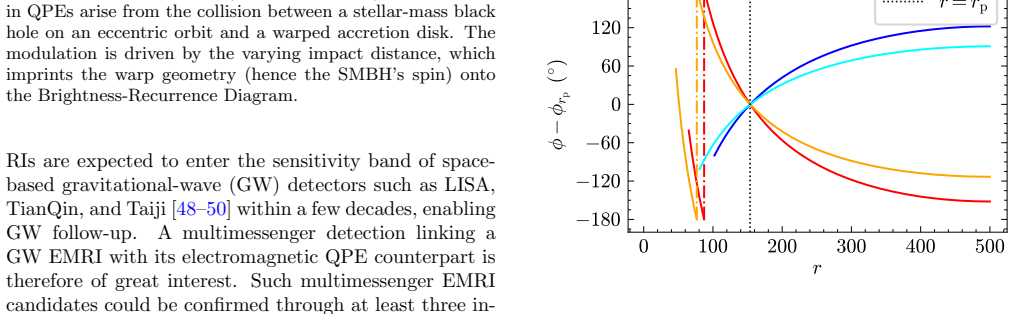
therein). Typical late-stage TDE warp structure (Fig. 2) shows smaller inner-disk inclination and lead- ing/lagging twist phase. This warp structure modulates the EMRI-disk intersection points, naturally producing the observed QPE patterns (see follow). QPE Patterns from Warped Disk Collisions. Given a slightly eccentric orbit, the long/short pattern is m...
-
[2]
Miniutti, R
G. Miniutti, R. D. Saxton, M. Giustini, K. D. Alexander, R. P. Fender, I. Heywood, I. Monageng, M. Coriat, A. K. Tzioumis, A. M. Read, C. Knigge, P. Gandhi, M. L. Pre- torius, and B. Ag´ ıs-Gonz´ alez, Nature (London)573, 381 (2019)
2019
-
[3]
L. Sun, X. Shu, and T. Wang, Astrophys. J.768, 167 (2013)
2013
-
[4]
X. W. Shu, T. G. Wang, N. Jiang, J. X. Wang, L. M. Sun, and H. Y. Zhou, Astrophys. J.837, 3 (2017)
2017
-
[5]
Giustini, G
M. Giustini, G. Miniutti, and R. D. Saxton, Astron. As- trophys.636, L2 (2020)
2020
-
[6]
Arcodia, A
R. Arcodia, A. Merloni, K. Nandra, J. Buchner, M. Sal- vato, D. Pasham, R. Remillard, J. Comparat, G. Lamer, G. Ponti,et al., Nature (London)592, 704 (2021)
2021
-
[7]
Arcodia, Z
R. Arcodia, Z. Liu, A. Merloni, A. Malyali, A. Rau, J. Chakraborty, A. Goodwin, D. Buckley, J. Brink, M. Gromadzki,et al., Astron. Astrophys.684, A64 (2024)
2024
-
[8]
Arcodia, P
R. Arcodia, P. Baldini, A. Merloni, A. Rau, K. Nandra, J. Chakraborty, A. J. Goodwin, M. J. Page, J. Buchner, M. Masterson,et al., Astrophys. J.989, 13 (2025)
2025
-
[9]
Chakraborty, E
J. Chakraborty, E. Kara, M. Masterson, M. Giustini, G. Miniutti, and R. Saxton, Astrophys. J. Lett.921, L40 (2021)
2021
-
[10]
Nicholl, D
M. Nicholl, D. R. Pasham, A. Mummery, M. Guolo, K. Gendreau, G. C. Dewangan, E. C. Ferrara, R. Remil- lard, C. Bonnerot, J. Chakraborty,et al., Nature (Lon- don)634, 804 (2024)
2024
-
[11]
Hern´ andez-Garc´ ıa, J
L. Hern´ andez-Garc´ ıa, J. Chakraborty, P. S´ anchez-S´ aez, C. Ricci, J. Cuadra, B. McKernan, K. E. S. Ford, P. Ar´ evalo, A. Rau, R. Arcodia,et al., Nature Astronomy 9, 895 (2025)
2025
-
[12]
Chakraborty, E
J. Chakraborty, E. Kara, R. Arcodia, J. Buchner, M. Giustini, L. Hern´ andez-Garc´ ıa, I. Linial, M. Mas- terson, G. Miniutti, A. Mummery, C. Panagiotou, E. Quintin, and P. S´ anchez-S´ aez, Astrophys. J. Lett.983, L39 (2025)
2025
-
[13]
S. D. Bykov, M. R. Gilfanov, R. A. Sunyaev, and P. S. Medvedev, Mon. Not. R. Astron. Soc.540, 30 (2025)
2025
-
[14]
Baldini, A
P. Baldini, A. Rau, A. Merloni, B. Trakhtenbrot, R. Ar- codia, M. Giustini, G. Miniutti, S. J. Brennan, M. Frey- berg, P. S´ anchez-S´ aez, I. Grotova, Z. Liu, T. Lian, and K. Nandra, Astron. Astrophys.706, L15 (2026)
2026
-
[15]
L. J. Dai, S. V. Fuerst, and R. Blandford, Mon. Not. R. Astron. Soc.402, 1614 (2010)
2010
-
[16]
J. Xian, F. Zhang, L. Dou, J. He, and X. Shu, Astrophys. J. Lett.921, L32 (2021)
2021
-
[17]
Linial and B
I. Linial and B. D. Metzger, Astrophys. J.957, 34 (2023)
2023
-
[18]
Franchini, M
A. Franchini, M. Bonetti, A. Lupi, G. Miniutti, E. Bor- tolas, M. Giustini, M. Dotti, A. Sesana, R. Arcodia, and T. Ryu, Astron. Astrophys.675, A100 (2023)
2023
-
[19]
Tagawa and Z
H. Tagawa and Z. Haiman, Mon. Not. R. Astron. Soc. 526, 69 (2023)
2023
-
[20]
C. Zhou, L. Huang, K. Guo, Y.-P. Li, and Z. Pan, Phys. Rev. D109, 103031 (2024)
2024
-
[21]
C. Zhou, B. Zhong, Y. Zeng, L. Huang, and Z. Pan, Phys. Rev. D110, 083019 (2024)
2024
-
[22]
C. Zhou, Y. Zeng, and Z. Pan, Astrophys. J.985, 242 (2025)
2025
-
[23]
H. Guo, Z. Yan, Y.-P. Li, J. Chakraborty, P. S´ anchez- S´ aez, L. Hern´ andez-Garc´ ıa, W. Zhang, J. Sun, S.-L. Li, H. Deng, W. Zuo, H. Tagawa, X. Pan, M. Zhang, P. Ar´ evalo, P. Lira, C. Jin, and M. Gu, Astrophys. J. Lett.1000, L57 (2026)
2026
-
[24]
´Sniegowska, M
M. ´Sniegowska, M. Grz¸ edzielski, B. Czerny, and A. Ja- 7 niuk, Astron. Astrophys.672, A19 (2023)
2023
-
[25]
Pan, S.-L
X. Pan, S.-L. Li, X. Cao, G. Miniutti, and M. Gu, As- trophys. J. Lett.928, L18 (2022)
2022
-
[26]
Pan, S.-L
X. Pan, S.-L. Li, and X. Cao, Astrophys. J.952, 32 (2023)
2023
-
[27]
Raj and C
A. Raj and C. J. Nixon, Astrophys. J.909, 82 (2021)
2021
-
[28]
Pan, S.-L
X. Pan, S.-L. Li, X. Cao, B. Liu, and W. Yuan, Astro- phys. J.989, 196 (2025)
2025
-
[29]
King, Mon
A. King, Mon. Not. R. Astron. Soc.493, L120 (2020)
2020
-
[30]
King, Mon
A. King, Mon. Not. R. Astron. Soc.515, 4344 (2022)
2022
-
[31]
King, Mon
A. King, Mon. Not. R. Astron. Soc.520, L63 (2023)
2023
-
[32]
Z. Y. Zhao, Y. Y. Wang, Y. C. Zou, F. Y. Wang, and Z. G. Dai, Astron. Astrophys.661, A55 (2022)
2022
-
[33]
Chen, R.-F
J.-H. Chen, R.-F. Shen, and S.-F. Liu, Astrophys. J.947, 32 (2023)
2023
-
[34]
Wu, Y.-F
X.-J. Wu, Y.-F. Yuan, Y. Luo, and W. Lin, Mon. Not. R. Astron. Soc.529, 1440 (2024)
2024
-
[35]
M. Wang, J. Yin, Y. Ma, and Q. Wu, Astrophys. J.933, 225 (2022)
2022
-
[36]
Ingram, S
A. Ingram, S. E. Motta, S. Aigrain, and A. Karastergiou, Mon. Not. R. Astron. Soc.504, 5512 (2021)
2021
-
[37]
Miniutti, M
G. Miniutti, M. Giustini, R. Arcodia, R. D. Saxton, A. M. Read, S. Bianchi, and K. D. Alexander, Astron. Astro- phys.670, A93 (2023)
2023
-
[38]
Giustini, G
M. Giustini, G. Miniutti, R. Arcodia, A. Goodwin, K. D. Alexander, J. Chakraborty, J. Buchner, P. Kosec, R. Sax- ton, M. Bonetti,et al., Astron. Astrophys.692, A15 (2024)
2024
-
[39]
Sheng, T
Z. Sheng, T. Wang, G. Ferland, X. Shu, C. Yang, N. Jiang, and Y. Chen, Astrophys. J. Lett.920, L25 (2021)
2021
-
[40]
Quintin, N
E. Quintin, N. A. Webb, S. Guillot, G. Miniutti, E. S. Kammoun, M. Giustini, R. Arcodia, G. Soucail, N. Clerc, R. Amato, and C. B. Markwardt, Astron. Astrophys. 675, A152 (2023)
2023
-
[41]
Jiang and Z
N. Jiang and Z. Pan, Astrophys. J. Lett.983, L18 (2025)
2025
-
[42]
Guolo, A
M. Guolo, A. Mummery, T. Wevers, M. Nicholl, S. Gezari, A. Ingram, and D. R. Pasham, Astrophys. J. 985, 146 (2025)
2025
-
[43]
Guolo, A
M. Guolo, A. Mummery, A. Ingram, M. Nicholl, S. Gezari, and E. Nathan, Astrophys. J.992, 114 (2025)
2025
-
[44]
Stone and A
N. Stone and A. Loeb, Phys. Rev. Lett.108, 061302 (2012)
2012
-
[45]
Miniutti, M
G. Miniutti, M. Giustini, R. Arcodia, R. D. Saxton, J. Chakraborty, A. M. Read, and E. Kara, Astron. As- trophys.674, L1 (2023)
2023
-
[46]
Miniutti, A
G. Miniutti, A. Franchini, M. Bonetti, M. Giustini, J. Chakraborty, R. Arcodia, R. Saxton, E. Quintin, P. Kosec, I. Linial, and A. Sesana, Astron. Astrophys. 693, A179 (2025)
2025
-
[47]
Arcodia, I
R. Arcodia, I. Linial, G. Miniutti, A. Franchini, M. Gius- tini, M. Bonetti, A. Sesana, R. Soria, J. Chakraborty, M. Dotti, E. Kara, A. Merloni, G. Ponti, and F. Vincen- telli, Astron. Astrophys.690, A80 (2024)
2024
-
[48]
L. Lui, A. Torres-Orjuela, R. K. Chowdhury, and L. Dai, arXiv preprint , arXiv:2508.07961 (2025)
work page internal anchor Pith review Pith/arXiv arXiv 2025
-
[49]
M. Colpi, K. Danzmann, M. Hewitson, K. Holley- Bockelmann, P. Jetzer, G. Nelemans, A. Petiteau, D. Shoemaker, C. Sopuerta, R. Stebbins,et al., arXiv preprint , arXiv:2402.07571 (2024)
work page internal anchor Pith review Pith/arXiv arXiv 2024
-
[50]
Luo, L.-S
J. Luo, L.-S. Chen, H.-Z. Duan, Y.-G. Gong, S. Hu, J. Ji, Q. Liu, J. Mei, V. Milyukov, M. Sazhin,et al., Classical and Quantum Gravity33, 035010 (2016)
2016
-
[51]
Ruan, Z.-K
W.-H. Ruan, Z.-K. Guo, R.-G. Cai, and Y.-Z. Zhang, International Journal of Modern Physics A35, 2050075 (2020)
2020
-
[52]
C. Zhou, Z. Pan, N. Jiang, and W. Zhao, Mon. Not. R. Astron. Soc.543, 1816 (2025)
2025
-
[53]
Laghi, N
D. Laghi, N. Tamanini, W. Del Pozzo, A. Sesana, J. Gair, S. Babak, and D. Izquierdo-Villalba, Mon. Not. R. As- tron. Soc.508, 4512 (2021)
2021
-
[54]
Y. Zhan, D. Wang, S.-X. Yi, and F.-Y. Wang, Astrophys. J.997, 134 (2026)
2026
-
[55]
Babak, J
S. Babak, J. Gair, A. Sesana, E. Barausse, C. F. Sop- uerta, C. P. L. Berry, E. Berti, P. Amaro-Seoane, A. Pe- titeau, and A. Klein, Phys. Rev. D95, 103012 (2017)
2017
-
[56]
Maselli, N
A. Maselli, N. Franchini, L. Gualtieri, T. P. Sotiriou, S. Barsanti, and P. Pani, Nature Astronomy6, 464 (2022)
2022
-
[57]
A. C´ ardenas-Avenda˜ no and C. F. Sopuerta, arXiv preprint , arXiv:2401.08085 (2024)
-
[58]
S. H. Lubow and G. I. Ogilvie, Astrophys. J.538, 326 (2000)
2000
-
[59]
J. C. B. Papaloizou and D. N. C. Lin, Astrophys. J.438, 841 (1995)
1995
-
[60]
Peng, J.-M
Y.-C. Peng, J.-M. Wang, P. Du, S. Zhai, and Y.-R. Li, Astrophys. J.978, 103 (2025)
2025
-
[61]
N. I. Shakura and R. A. Sunyaev, Astron. Astrophys.24, 337 (1973)
1973
-
[62]
J. M. Bardeen and J. A. Petterson, Astrophys. J. Lett. 195, L65 (1975)
1975
-
[63]
G. I. Ogilvie, Mon. Not. R. Astron. Soc.304, 557 (1999)
1999
-
[64]
J. J. Zanazzi and D. Lai, Mon. Not. R. Astron. Soc.487, 4965 (2019)
2019
-
[65]
See supplemental material at [url will be inserted by publisher] for disk structure derivation, which includes Ref. [65]
-
[66]
J. M. Bardeen, W. H. Press, and S. A. Teukolsky, Astro- phys. J.178, 347 (1972)
1972
-
[67]
Wevers, D
T. Wevers, D. R. Pasham, P. Jalan, S. Rakshit, and R. Arcodia, Astron. Astrophys.659, L2 (2022)
2022
-
[68]
Mummery, arXiv preprint , arXiv:2504.21456 (2025)
A. Mummery, arXiv preprint , arXiv:2504.21456 (2025)
- [69]
- [70]
-
[71]
Linial and R
I. Linial and R. Sari, Astrophys. J.945, 86 (2023)
2023
-
[72]
Linial, B
I. Linial, B. D. Metzger, and E. Quataert, Astrophys. J. 991, 147 (2025)
2025
-
[73]
Radiation-hydrodynamics of star-disc collisions for quasi-periodic eruptions
T. Jankoviˇ c, C. Bonnerot, S. Karpov, and A. Jurca, arXiv preprint , arXiv:2602.02656 (2026)
work page internal anchor Pith review Pith/arXiv arXiv 2026
-
[74]
Huang, I
X. Huang, I. Linial, and Y.-F. Jiang, Astrophys. J.993, 186 (2025)
2025
-
[75]
I. Vurm, I. Linial, and B. D. Metzger, Astrophys. J.983, 40 (2025)
2025
-
[76]
Chakraborty, R
J. Chakraborty, R. Arcodia, E. Kara, G. Miniutti, M. Giustini, A. J. Tetarenko, L. Rhodes, A. Franchini, M. Bonetti, K. B. Burdge, A. J. Goodwin, T. J. Mac- carone, A. Merloni, G. Ponti, R. A. Remillard, and R. D. Saxton, Astrophys. J.965, 12 (2024)
2024
-
[77]
Blanchet, Living Reviews in Relativity17, 2 (2014)
L. Blanchet, Living Reviews in Relativity17, 2 (2014)
2014
-
[78]
Boh´ e, S
A. Boh´ e, S. Marsat, G. Faye, and L. Blanchet, Classical and Quantum Gravity30, 075017 (2013)
2013
-
[79]
Kumar, R
P. Kumar, R. Narayan, and J. L. Johnson, Mon. Not. R. Astron. Soc.388, 1729 (2008)
2008
-
[80]
Shen and C
R.-F. Shen and C. D. Matzner, Astrophys. J.784, 87 (2014)
2014
discussion (0)
Sign in with ORCID, Apple, or X to comment. Anyone can read and Pith papers without signing in.