Spectral properties of non-Hermitian real random matrices with long-range correlations
Pith reviewed 2026-06-29 19:30 UTC · model grok-4.3
The pith
Long-range correlations cause the eigenvalue spectrum of non-Hermitian real random matrices to spread without bound when the decay exponent falls below 1.
A machine-rendered reading of the paper's core claim, the machinery that carries it, and where it could break.
Core claim
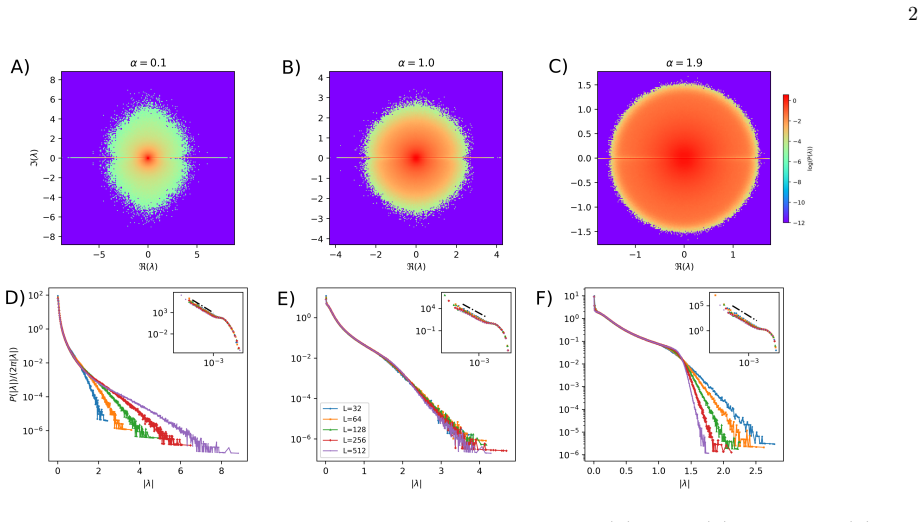
For entry correlations decaying as |r-r'|^{-α}, the circular law is recovered with an effective radius only when α>1; for α<1 the eigenvalue distribution broadens with matrix size and the spectral radius grows according to a power law whose exponents are numerically close to the fluctuation exponents of the extended central limit theorem, while α=1 yields a self-similar density with slowly growing radius; long-range correlations further enhance real-eigenvalue clustering and slow the resorption of the Saturn effect.
What carries the argument
The correlation decay exponent α that controls the transition between bounded and power-law-growing spectral radius.
If this is right
- For α>1 the spectrum remains confined inside an effective circle whose radius is set by the correlation strength.
- For α<1 the outer edge of the spectrum grows as a power of matrix size N.
- The power-law exponents for the spectral radius numerically match the fluctuation exponents of the extended central limit theorem.
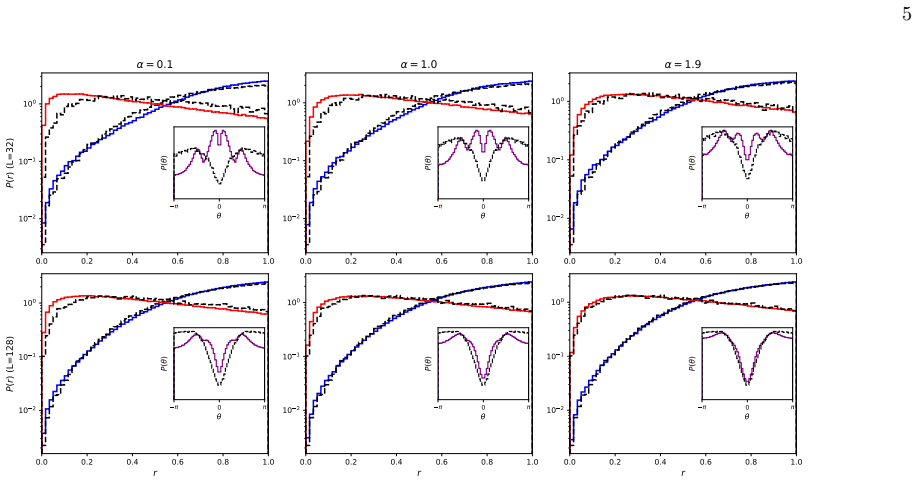
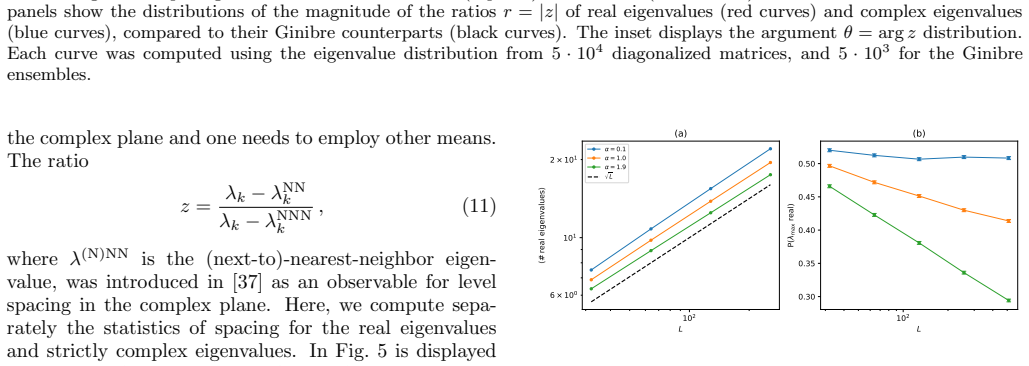
- Real eigenvalues form denser clusters and the Saturn effect disappears more slowly than in the uncorrelated case.
- The α=1 boundary produces a self-similar eigenvalue density whose radius grows only logarithmically or slower.
Where Pith is reading between the lines
- Physical systems whose interactions or couplings decay with exponent α<1 may exhibit matrix-size-dependent spectral widths rather than fixed radii.
- Analytic derivations linking the observed powers directly to the extended central limit theorem could replace the current numerical matching.
- The reported transition suggests a distinct universality class for non-Hermitian matrices with power-law correlations that could be tested in other ensembles.
Load-bearing premise
Finite-size numerical simulations capture the true asymptotic scaling of the spectral radius and eigenvalue density without significant finite-size or boundary artifacts that would alter the reported power-law exponents.
What would settle it
A direct computation on successively larger matrices showing that the spectral radius saturates to a finite value independent of N for α<1, or that the fitted exponents deviate from those of the extended central limit theorem.
Figures




read the original abstract
We investigate the spectral properties of non-Hermitian real random matrices whose entries exhibit long-range correlations decaying as~$|r-r'|^{-\alpha}$. We find a progressive breakdown of the circular law, controlled by the decrease of~$\alpha$. In all cases, the radial eigenvalue density decreases away from the origin. At~$\alpha>1$, an effective radius, reminiscent of the circular law, is retrieved, while instead, for~$\alpha<1$, the eigenvalue distribution broadens with matrix size and its spectral radius grows like a power law, with exponents numerically close to the exponents controlling the magnitude of fluctuations in the extended central limit theorem. The case~$\alpha=1$ appears as a case with self-similar eigenvalue density, and slowly growing spectral radius. Long-range correlations also enhance clustering of real eigenvalues and slow the resorption of the Saturn effect. These results reveal a correlation-driven transition and suggest the emergence of a new universality class for correlated non-Hermitian random matrices.
Editorial analysis
A structured set of objections, weighed in public.
Referee Report
Summary. The manuscript studies the eigenvalue spectra of non-Hermitian real random matrices whose entries have long-range correlations decaying as |r-r'|^(-α). It reports a progressive breakdown of the circular law with decreasing α: for α>1 an effective radius is recovered, while for α<1 the eigenvalue distribution broadens with matrix size N and the spectral radius grows as a power law whose exponents are numerically close to those governing fluctuations in the extended central limit theorem; the α=1 case exhibits self-similar density and slowly growing radius. Long-range correlations are also found to enhance clustering of real eigenvalues and to slow resorption of the Saturn effect, pointing to a correlation-driven transition and a possible new universality class.
Significance. If the reported scalings prove robust, the work identifies a correlation-induced regime in non-Hermitian random matrices that links spectral properties directly to the fluctuation exponents of the extended CLT. The numerical agreement between the spectral-radius exponents and the CLT exponents is a concrete observation that could motivate analytic derivations; the additional remarks on real-eigenvalue clustering and the Saturn effect supply further testable signatures of the long-range regime.
major comments (3)
- [Results for α<1 (abstract and corresponding numerical sections)] The central claim that, for α<1, the spectral radius grows as a power law in N with exponents numerically close to the extended-CLT fluctuation exponents rests entirely on finite-N diagonalizations. No range of matrix sizes, number of realizations, fitting procedure, goodness-of-fit metrics, or convergence checks with increasing N are supplied, so it is impossible to determine whether the reported exponents survive the N→∞ limit or are influenced by the N-dependent effective range of the long-range correlations.
- [Discussion of the α<1 regime] No analytic bound, scaling argument, or continuum-limit construction is given to control the extrapolation of the observed power-law regime. Because the correlation length grows with N, any apparent power-law window could be a transient crossover whose effective exponent drifts at larger N; without such a control the numerical match to the CLT exponents remains provisional.
- [Abstract and § on α>1 case] The abstract states that the radial eigenvalue density decreases away from the origin and that an effective radius is retrieved for α>1, yet the manuscript provides no quantitative definition of this effective radius, no comparison with the standard circular-law radius, and no error estimates on the density profiles, making it difficult to assess how sharply the circular law is recovered or broken.
minor comments (2)
- [Introduction] The notation used for the correlation function |r-r'|^(-α) should be introduced with an explicit definition of the indices r,r' (e.g., row/column indices) already in the introduction.
- [Figure captions] Figure captions for the eigenvalue-density plots should state the matrix sizes, ensemble sizes, and binning parameters used to generate each panel.
Simulated Author's Rebuttal
We thank the referee for the careful and constructive review. We address each major comment below and indicate the revisions that will be incorporated.
read point-by-point responses
-
Referee: [Results for α<1 (abstract and corresponding numerical sections)] The central claim that, for α<1, the spectral radius grows as a power law in N with exponents numerically close to the extended-CLT fluctuation exponents rests entirely on finite-N diagonalizations. No range of matrix sizes, number of realizations, fitting procedure, goodness-of-fit metrics, or convergence checks with increasing N are supplied, so it is impossible to determine whether the reported exponents survive the N→∞ limit or are influenced by the N-dependent effective range of the long-range correlations.
Authors: We agree that the numerical details must be expanded for the claims to be assessable. The revised manuscript will contain a dedicated numerical-methods subsection specifying the matrix sizes (N=128 to 4096), number of realizations (500–2000 per N), least-squares fitting protocol on log-log plots, R² and residual diagnostics, and explicit convergence plots of the fitted exponent versus maximum N. revision: yes
-
Referee: [Discussion of the α<1 regime] No analytic bound, scaling argument, or continuum-limit construction is given to control the extrapolation of the observed power-law regime. Because the correlation length grows with N, any apparent power-law window could be a transient crossover whose effective exponent drifts at larger N; without such a control the numerical match to the CLT exponents remains provisional.
Authors: We acknowledge that no analytic control is supplied and that the power-law regime is observed only at finite N. The revision will add an explicit paragraph stating the provisional nature of the extrapolation, sketching a heuristic scaling argument that relates the correlation decay to the extended-CLT exponents, and noting that a rigorous continuum-limit analysis lies outside the present numerical scope. revision: partial
-
Referee: [Abstract and § on α>1 case] The abstract states that the radial eigenvalue density decreases away from the origin and that an effective radius is retrieved for α>1, yet the manuscript provides no quantitative definition of this effective radius, no comparison with the standard circular-law radius, and no error estimates on the density profiles, making it difficult to assess how sharply the circular law is recovered or broken.
Authors: We accept the need for a quantitative definition. The revised text will define the effective radius (e.g., radius enclosing 99 % of eigenvalues), compare it to the circular-law value √N, and display all radial densities with standard-error bars obtained from the ensemble. revision: yes
- A rigorous analytic bound or continuum-limit construction establishing the power-law growth of the spectral radius for α<1 in the N→∞ limit.
Circularity Check
No circularity: claims rest on direct numerical diagonalization without fitted-parameter loops or self-citation reduction
full rationale
The paper reports eigenvalue statistics obtained from explicit matrix diagonalization of finite-N ensembles with prescribed long-range correlations. The central observations—for α<1 the spectral radius grows as a power law whose exponent is numerically close to an extended-CLT fluctuation exponent—are presented as simulation outputs, not as predictions derived from any fitted model or ansatz that would reduce to the input data by construction. No equations are given that define a quantity in terms of itself, no parameter is fitted on a subset and then relabeled a prediction, and the abstract contains no load-bearing self-citation. The finite-size extrapolation concern raised by the skeptic is a question of numerical convergence, not a circularity in the derivation chain.
Axiom & Free-Parameter Ledger
Reference graph
Works this paper leans on
-
[1]
Sahimi, M. Flow phenomena in rocks: from continuum models to fractals, percolation, cellular automata, and simulated annealing. Rev. Mod. Phys..65, 1393-1534 (1993,10), https://link.aps.org/doi/10.1103/RevModPhys.65.1393
-
[2]
Sagu´ es, F., Sancho, J. & Garcı´ a-Ojalvo, J. Spatiotemporal order out of noise. Rev. Mod. Phys..79, 829-882 (2007,7), https://link.aps.org/doi/10.1103/RevModPhys.79.829
-
[3]
Cross, M. & Hohenberg, P. Pattern formation outside of equilibrium.Rev. Mod. Phys..65, 851-1112 (1993,7), https://link.aps.org/doi/10.1103/RevModPhys.65.851
-
[4]
H. E. Stanley, Introduction to Phase Transitions and Critical Phenomena, Oxford University Press, New York (1987)
1987
-
[5]
Podobnik, B. & Stanley, H. Detrended Cross-Correlation Analysis: A New Method for Analyzing Two Nonstation- ary Time Series.Physical Review Letters.100(2008,2), http://dx.doi.org/10.1103/PhysRevLett.100.084102
-
[6]
Drozdz, S., Jarosz, P., Kwapien, J., Skupien, M., & Watorek, M. (2025). Detrended Cross-Correlations and Their Random Matrix Limit: An Example from the Cryptocurrency Market. Entropy, 27(12), 1236. https://doi.org/10.3390/e27121236
-
[7]
Spectral Graph Theory
Chung, F. Spectral Graph Theory. (American Mathemat- ical Society,1997)
1997
-
[8]
& Vespignani, A
Barrat, A., Barthelemy, M. & Vespignani, A. Dynamical Processes on Complex Networks. (Cambridge University Press,2008)
2008
-
[9]
Potters M, Bouchaud J-P
1. Potters M, Bouchaud J-P. A First Course in Random Matrix Theory: For Physicists, Engineers and Data Sci- entists. Cambridge University Press; 2020
2020
-
[10]
Log-Gases and Random Matrices
Forrester, P. Log-Gases and Random Matrices. (Prince- ton University Press,2010)
2010
-
[11]
& Castillo, I
Rogers, T. & Castillo, I. Cavity approach to the spectral density of non-Hermitian sparse matrices.Phys. Rev. E. 79, 012101 (2009,1)
2009
-
[12]
Patil, N., Aguirre-L´ opez, F. & Bouchaud, J. The spec- tral boundary of block structured random matrices. Journal Of Physics: Complexity.5, 035001 (2024,7), 7 https://doi.org/10.1088/2632-072X/ad5cba
-
[13]
Aceituno, P., Rogers, T. & Schomerus, H. Uni- versal hypotrochoidic law for random matrices with cyclic correlations.Physical Review E.100(2019,7), http://dx.doi.org/10.1103/PhysRevE.100.010302
-
[14]
Baron, J., Jewell, T., Ryder, C. & Galla, T. Eigenvalues of Random Matrices with Gen- eralized Correlations: A Path Integral Ap- proach.Physical Review Letters.128(2022,3), http://dx.doi.org/10.1103/PhysRevLett.128.120601
-
[15]
Dorogovtsev, S., Goltsev, A., Mendes, J. & Samukhin, A. Spectra of complex net- works.Phys. Rev. E.68, 046109 (2003,10), https://link.aps.org/doi/10.1103/PhysRevE.68.046109
-
[16]
Ginibre, J. Statistical Ensembles of Com- plex, Quaternion, and Real Matrices.Journal Of Mathematical Physics.6, 440-449 (1965,3), https://doi.org/10.1063/1.1704292
-
[17]
Bouchaud, J. & Georges, A. Anomalous diffusion in disordered media: Statistical mechanisms, mod- els and physical applications.Physics Reports.195, 127-293 (1990),https://www.sciencedirect.com/ science/article/pii/037015739090099N
-
[18]
Makse, H., Havlin, S., Schwartz, M. & Stanley, H. Method for generating long-range correlations for large systems.Physical Review E.53, 5445-5449 (1996,5), http://dx.doi.org/10.1103/PhysRevE.53.5445
-
[19]
Pan, Zhao Q
Victor Y. Pan, Zhao Q. Chen: The Complexity of the Matrix Eigenproblem. STOC 1999: 507-516
1999
-
[20]
Random matrices: the circu- lar law
Tao, Terence; Vu, Van. Random matrices: the circu- lar law. Commun. Contemp. Math. 10 (2008), no. 2, 261–307
2008
-
[21]
Lehmann, N. & Sommers, H. Eigenvalue statistics of ran- dom real matrices.Phys. Rev. Lett..67, 941-944 (1991,8), https://link.aps.org/doi/10.1103/PhysRevLett.67.941
-
[22]
Edelman, A. The Probability that a Random Real Gaussian Matrix has k Real Eigenvalues, Re- lated Distributions, and the Circular Law.Jour- nal Of Multivariate Analysis.60, 203-232 (1997), https://www.sciencedirect.com/science/ article/pii/S0047259X9691653X
1997
- [23]
-
[24]
Kanzieper, E. & Akemann, G. Statistics of Real Eigenvalues in Ginibre’s Ensemble of Random Real Matrices.Phys. Rev. Lett..95, 230201 (2005,11), https://link.aps.org/doi/10.1103/PhysRevLett.95.230201
-
[25]
Correlation Functions of Asymmetric Real Matrices
Borodin, A. & Sinclair, C. Correlation Func- tions of Asymmetric Real Matrices. (2008), https://arxiv.org/abs/0706.2670
work page internal anchor Pith review Pith/arXiv arXiv 2008
-
[26]
Forrester, P. & Nagao, T. Eigenvalue Statistics of the Real Ginibre Ensem- ble.Phys. Rev. Lett..99, 050603 (2007,8), https://link.aps.org/doi/10.1103/PhysRevLett.99.050603
-
[27]
Will a Large Complex System be Stable?
MAY, R. Will a Large Complex System be Stable?. Nature 238, 413–414 (1972). https://doi.org/10.1038/238413a0
-
[28]
Rider, B. & Sinclair, C. Extremal laws for the real Gini- bre ensemble.The Annals Of Applied Probability.24 (2014,8), http://dx.doi.org/10.1214/13-AAP958
-
[29]
Jinho Baik, Thomas Bothner ”The largest real eigen- value in the real Ginibre ensemble and its relation to the Zakharov–Shabat system,” The Annals of Applied Probability, Ann. Appl. Probab. 30(1), 460-501, (Febru- ary 2020)
2020
-
[30]
On the distribution of the largest real eigenvalue for the real Ginibre ensemble
Poplavskyi, M., Tribe, R. & Zaboronski, O. On the distri- bution of the largest real eigenvalue for the real Ginibre ensemble. (2016), https://arxiv.org/abs/1603.05849
work page internal anchor Pith review Pith/arXiv arXiv 2016
-
[31]
Cipolloni, G., Erd˝ os, L., Schr¨ oder, D. & Xu, Y. Directional extremal statistics for Ginibre eigenval- ues.Journal Of Mathematical Physics.63(2022,10), http://dx.doi.org/10.1063/5.0104290
- [32]
-
[33]
Byun, S. & Forrester, P. Progress on the study of the Ginibre ensembles II: GinOE and GinSE. (2023), https://arxiv.org/abs/2301.05022
-
[34]
Y.V. Fyodorov, & B.A. Khoruzhenko, Nonlinear analogue of the May-Wigner instability transition, Proc. Natl. Acad. Sci. U.S.A. 113 (25) 6827-6832, https://doi.org/10.1073/pnas.1601136113 (2016)
-
[35]
Allesina, S., Grilli, J., Barab´ as, G. et al. Predicting the stability of large structured food webs. Nat Commun 6, 7842 (2015). https://doi.org/10.1038/ncomms8842
-
[36]
Moran, J. & Bouchaud, J. May’s instability in large economies.Physical Review E.100(2019,9), http://dx.doi.org/10.1103/PhysRevE.100.032307
-
[37]
S´ a, L., Ribeiro, P. & Prosen, T. Complex Spac- ing Ratios: A Signature of Dissipative Quan- tum Chaos.Physical Review X.10(2020,4), http://dx.doi.org/10.1103/PhysRevX.10.021019
-
[38]
How many zeros of a random polynomial are real?
Edelman, A. & Kostlan, E. How many ze- ros of a random polynomial are real?. (1995), https://arxiv.org/abs/math/9501224
work page internal anchor Pith review Pith/arXiv arXiv 1995
-
[39]
Majumdar, S., Pal, A. & Schehr, G. Extreme value statistics of correlated random variables: A pedagog- ical review.Physics Reports.840pp. 1-32 (2020,1), http://dx.doi.org/10.1016/j.physrep.2019.10.005
-
[40]
Sompolinsky, H., Crisanti, A. & Som- mers, H. Chaos in Random Neural Net- works.Phys. Rev. Lett..61, 259-262 (1988,7), https://link.aps.org/doi/10.1103/PhysRevLett.61.259
-
[41]
& Bengio, Y
Pascanu, R., Mikolov, T. & Bengio, Y. On the diffi- culty of training recurrent neural networks.Proceedings Of The 30th International Conference On International Conference On Machine Learning - Volume 28. pp. III- 1310–III–1318 (2013)
2013
-
[42]
Rogers, T. Universal sum and product rules for random matrices.Journal Of Mathematical Physics.51(2010,9), http://dx.doi.org/10.1063/1.3481569
discussion (0)
Sign in with ORCID, Apple, or X to comment. Anyone can read and Pith papers without signing in.