Photon position eigenstates in configuration space
Pith reviewed 2026-06-29 21:18 UTC · model grok-4.3
The pith
The eigenfunctions of the Hawton photon position operator in configuration space are given in closed form by linear combinations of complete elliptic integrals K and E.
A machine-rendered reading of the paper's core claim, the machinery that carries it, and where it could break.
Core claim
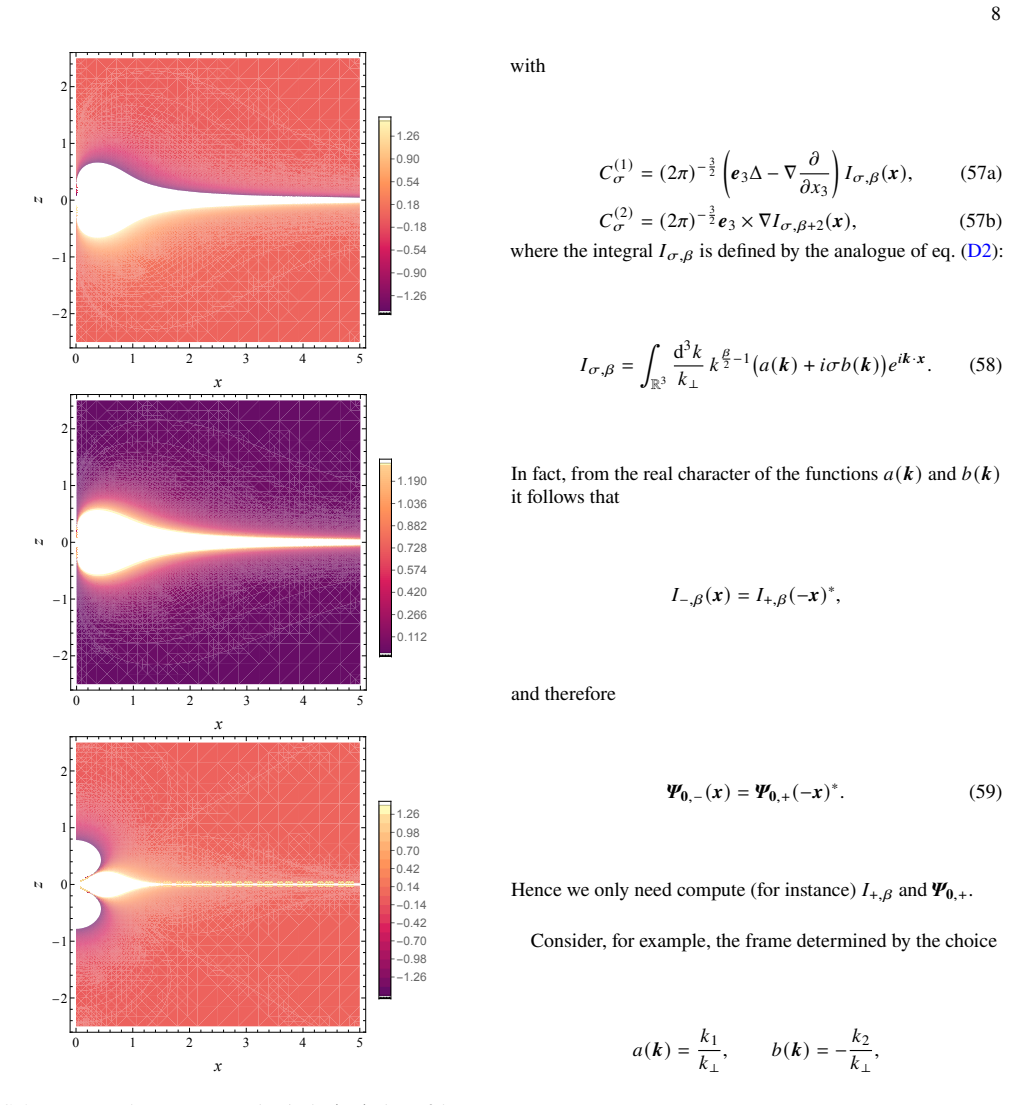
The eigenfunctions of the Hawton photon position operator in the configuration space are derived for the Riemann-Silberstein and Landau-Peierls classes of wave functions. Closed expressions are obtained as linear combinations of the complete elliptic integrals K(κ) and E(κ), where the modulus κ depends on trigonometric functions of the polar angle. These functions diverge not only at the position eigenvalue q but also on a plane containing q, and decay as inverse powers of the distance from q.
What carries the argument
The Fourier-type integral that maps the simple momentum-space eigenfunctions of the Hawton operator to configuration space for the Riemann-Silberstein and Landau-Peierls wave-function classes, producing the elliptic-integral expressions.
If this is right
- The position eigenstates admit explicit analytic use in calculations that require configuration-space photon wave packets.
- Divergence occurs along an entire plane through q rather than at an isolated point.
- The inverse-power decay fixes the asymptotic spatial fall-off of these eigenfunctions.
- The same integral technique yields analogous closed forms for the additional wave-function classes treated in the paper.
Where Pith is reading between the lines
- The plane of divergence may connect to the transversality constraint on the electromagnetic field.
- The elliptic-integral form could enable direct analytic study of photon localization measures in position space.
- The Fourier-integral method used here might extend to other relativistic single-particle operators.
Load-bearing premise
The configuration-space representations are obtained by Fourier-type integrals from the momentum-space eigenfunctions for the specific Riemann-Silberstein and Landau-Peierls classes of wave functions.
What would settle it
Numerical quadrature of the Fourier integral for a chosen direction and comparison of the result against the proposed linear combination of K(κ) and E(κ) at several distances from q.
Figures

read the original abstract
The expressions of the eigenfunctions of the Hawton photon position operator in the configuration space are derived for several classes of wave function, including the Riemann-Silberstein and Landau-Peierls cases. Although these eigenfunctions have a simple form in momentum space, the explicit characterization of their representations in the configuration space is rather more involved. We provide closed expressions of these eigenfunctions in terms of linear combinations of the complete elliptic integrals $K(\kappa)$ and $E(\kappa)$ with modulus $\kappa$ depending on trigonometric functions of the polar angle. We show that they diverge not only at the value $\mathbf q$ of the position eigenvalue, but also on a plane containing $\mathbf q$ and that they decay as inverse powers of the distance from $\mathbf q$.
Editorial analysis
A structured set of objections, weighed in public.
Referee Report
Summary. The manuscript derives the configuration-space representations of eigenfunctions of the Hawton photon position operator for Riemann-Silberstein and Landau-Peierls classes of wave functions (and others). Starting from their simple momentum-space forms, the authors evaluate the requisite Fourier-type integrals to obtain closed expressions as linear combinations of the complete elliptic integrals K(κ) and E(κ), with modulus κ a function of trigonometric functions of the polar angle. They further establish that the eigenfunctions diverge not only at the position eigenvalue q but on an entire plane containing q, and decay as inverse powers of the distance from q.
Significance. If the integral evaluations and analytic continuations hold, the work supplies explicit, usable expressions for photon position eigenstates in configuration space. This is a concrete technical contribution to the study of photon localization, potentially enabling further analytic or numerical investigations of position observables in quantum optics. The appearance of elliptic integrals indicates a non-trivial but exact reduction of the Fourier integrals, which is a positive feature when the derivations are fully documented.
minor comments (3)
- [Abstract] The abstract states that the modulus κ depends on trigonometric functions of the polar angle but does not specify the explicit functional form; including the precise expression for κ already in the abstract (or a short table of cases) would improve immediate readability.
- The manuscript should include a brief verification subsection (e.g., numerical quadrature of the original Fourier integral versus the closed elliptic-integral form for a representative angle) to confirm the claimed reduction, given the complexity of the integral.
- Notation for the position eigenvalue (bold q) and the integration variable should be introduced once with a clear statement of the Fourier convention employed (including any factors of 2π or ħ).
Simulated Author's Rebuttal
We thank the referee for their positive assessment of the manuscript and for recommending minor revision. The summary accurately captures the derivation of closed-form expressions for the Hawton photon position eigenfunctions in configuration space using complete elliptic integrals, along with the identification of planar divergences and inverse-power decay.
Circularity Check
No significant circularity; direct integral derivation
full rationale
The paper obtains configuration-space eigenfunctions via explicit Fourier-type integrals applied to given momentum-space forms for the Riemann-Silberstein and Landau-Peierls classes. The claimed closed forms are linear combinations of complete elliptic integrals K(κ) and E(κ) with κ(φ) trigonometric in the polar angle, together with the divergence and decay properties. No equation reduces by construction to a fitted parameter, self-definition, or load-bearing self-citation; the derivation chain consists of standard integral evaluations whose outputs are independent of the inputs beyond the integral transform itself. The result is therefore self-contained against external benchmarks.
Axiom & Free-Parameter Ledger
axioms (1)
- standard math Complete elliptic integrals K(κ) and E(κ) satisfy the known integral representations and functional equations used to evaluate the configuration-space integrals.
Reference graph
Works this paper leans on
-
[1]
Photon position eigenstates in configuration space
(see also [8, 9, 13]). On the other hand, the concept of photon wave function in configuration (i.e.,𝒙) space (“Konfig- urationsraum”) was already introduced by Landau and Peierls in 1930 [14] without any reference to a position operator, via an inverse Fourier transform. This approach for introducing the photon wave function in the coordinate representat...
work page internal anchor Pith review Pith/arXiv arXiv 1930
-
[2]
In particular,𝒌·𝑄 𝑖𝝍(𝒌)=0for all𝝍∈Hand𝑖=1,2,3
The components 𝑄𝑖 are Hermitian operators onH𝛽. In particular,𝒌·𝑄 𝑖𝝍(𝒌)=0for all𝝍∈Hand𝑖=1,2,3
-
[3]
The components𝑄𝑖 obey the canonical commutation rela- tions [𝑄𝑖, 𝑄 𝑗 ]=0,[𝑄 𝑖, 𝑃 𝑗 ]= ℏ𝛿 𝑖 𝑗,∀𝑖, 𝑗=1,2,3.(26)
-
[4]
As shown in ref
Each𝑄 𝑖 commutes with the helicity operatorΣ. As shown in ref. [3] (see ref. [13] for an alternative deriva- tion),apositionoperatorcanbeconstructedfromanyorthonor- mal right-handed frame{𝑬 𝑖 (𝒌)} 3 𝑖=1 on R3 \ {(0,0, 𝑘 3) |𝑘 3 ≥ 0}such that 𝑬𝑖 (𝒌) ·𝑬 𝑗 (𝒌)=𝛿 𝑖 𝑗,𝑬 1 (𝒌) ×𝑬 2 (𝒌)=𝑬 3 (𝒌)= 𝒌 𝑘 .(27) More precisely, if we define the real orthonormal matrixE...
-
[5]
appendix A)
LP position eigenfunctions: 𝑃𝜌 =𝜋 − 1 2 2𝐸(𝜅 0)cot(2𝜃) −𝐾(𝜅 0)cot𝜃 ,(48a) 𝑃𝜓 =−𝜋 1 2 𝛿𝜃− 𝜋 2 ,(48b) 𝑃𝑧 =𝜋 − 1 2 𝐾(𝜅 0) −2𝐸(𝜅 0) (48c) where 𝐾(𝜅 0) and 𝐸(𝜅 0) are the complete elliptic integrals with modulus𝜅0 =sin𝜃(cf. appendix A)
-
[6]
Note also that, for both the LP and RS eigenfunctions, the functions𝑃𝑖 (𝜃) become singular on the horizontal plane𝜃=𝜋/2 ; see section V for further details
RS position eigenfunctions: 𝑃𝜌 = (2𝑠) − 3 2 2𝐾( 1√ 2 ) sgn𝜃− 𝜋 2 𝐴1𝐾(𝜅 1) +𝐵 1𝐸(𝜅 1)√ 1−𝑠 ,(49a) 𝑃𝜓 = 𝐾( 1√ 2 ) 𝜋 (2𝑠) − 3 2 𝐴2𝐾(𝜅 1) +𝐵 2𝐸(𝜅 1)√ 1−𝑠 ,(49b) 𝑃𝑧 = (2𝑠) − 1 2 4𝐾( 1√ 2 ) 𝐴3𝐾(𝜅 1) +𝐵 3𝐸(𝜅 1)√ 1+𝑠 ,(49c) where 𝑠=|cos𝜃|, sgn(𝑥)=𝑥/|𝑥|is the sign function, 𝐴1 =(1+𝑠 1 2 ) (2−4𝑠 1 2 +10𝑠 2 −5𝑠 5 2 ), 𝐵1 =2𝑠 1 2 (2−5𝑠 2), 𝐴2 =(3𝑠 3 2 −2) (1+𝑠 1 2 ),...
-
[7]
𝑖 𝑥2 3 −𝜌 2 𝑥3 −𝜋𝜌 2𝛿(𝑥 3) # 𝒆𝜌 +𝑟2 1 𝑥3 −𝑖𝜋𝛿(𝑥 3) 𝒆 𝜓 −2𝑖𝜌𝒆 3 .(60a) Its counterpart with helicity−1is easily found from eq. (59): 𝜳0,− (𝒙)= 𝑒𝑖 𝜓 √𝜋 𝑟4 (
Hertz potential𝒁(𝒙, 𝑡): 𝒁(𝒙,0)=−𝜎 ℏ𝑐 2 1 2 𝑟 − 3 2 𝑠− 1 2 (1+𝑠) − 1 2 𝐾(𝜅 1) 𝐾( 1√ 2 ) 𝒆3,(51) with 𝑠 and 𝜅1 as above. At time𝑡 >0 , 𝒁(𝒙, 𝑡) is of the form 𝒁(𝒙, 𝑡)=−𝜎(𝜋ℏ𝑐) 1 2 𝜁(𝒙, 𝑡)𝒆 3. Wehavenotbeenabletoderiveaclosed-formexpressionfor the scalar function𝜁(𝒙, 𝑡) at an arbitrary time𝑡. However, itsTaylorexpansionabout 𝑡=0 canbecomputedasoutlined in appe...
-
[8]
The function𝜳 (1) 0 (𝒙) Fromtheexpressionof 𝑬1 in(29a)andeq. (44b)wemaywrite (ℏ𝑐) − 𝛽 2 𝜳 (1) 0 (𝒙)=(2𝜋) − 3 2 ∫ R3 d3𝑘 𝒌× (𝒌×𝒆 3) 𝑘 𝛽 2 −1 𝑘⊥ 𝑒𝑖𝒌·𝒙 =−(2𝜋) − 3 2 ∇× ∇× 𝐼𝛽 (𝒙)𝒆 3 ,(D1) where 𝐼𝛽 (𝒙):= ∫ R3 d3𝑘 𝑘 𝛽 2 −1 𝑘⊥ 𝑒𝑖𝒌·𝒙 .(D2) Now,fromtheidentity ∇× (∇×𝑨)=∇(∇·𝑨) − △𝑨 itfollows that 𝜳 (1) 0 (𝒙)=(ℏ𝑐) 𝛽 2 (2𝜋) − 3 2 (△𝐼 𝛽)𝒆 3 −∇ 𝜕𝐼 𝛽 𝜕𝑥 3 .(D3) Moreover...
-
[9]
In the two main cases of interest,𝛽=0 and 𝛽=1 , the function 𝐼𝛽 can be expressed in terms of the complete elliptic integral of the first kind𝐾(𝜅)
Expressing the last integral for 𝐼𝛽 in polar coordinates (𝑘 ⊥, 𝜙) and (𝜌, 𝜓) for 𝒌⊥ and 𝒙⊥, respectively, and using the identities (A7) and (A10), we obtain 𝐼𝛽 (𝒙)= 2 𝛽 4 +1√𝜋 Γ 1 2 − 𝛽 4 |𝑥3|− 𝛽 4 ∫ ∞ 0 d𝑘 ⊥ 𝑘 𝛽 4 ⊥ 𝐾 𝛽 4 (|𝑥 3|𝑘 ⊥) ∫ 2𝜋 0 d𝜙 𝑒𝑖𝜌𝑘 ⊥ cos(𝜙−𝜓) = 2 𝛽 4 +2𝜋 3 2 Γ 1 2 − 𝛽 4 |𝑥3|− 𝛽 4 ∫ ∞ 0 d𝑘 ⊥ 𝑘 𝛽 4 ⊥ 𝐾 𝛽 4 (|𝑥 3|𝑘 ⊥)𝐽 0 (𝜌𝑘 ⊥)=𝜋 2 Γ( 1 2 + ...
-
[10]
(29b) and eq
The function𝜳 (2) 0 (𝒙) From the expression of𝑬2 in eq. (29b) and eq. (44b) we have 𝑖𝜳 (2) 0 (𝒙)=−(2𝜋) − 3 2 𝑖 ∫ R3 d3𝑘(𝒌×𝒆 3) 𝑘 𝛽 2 𝑘⊥ 𝑒𝑖𝒌·𝒙 = (ℏ𝑐) 𝛽/2 (2𝜋) 3 2 𝒆3 ×∇𝐼 𝛽+2 (𝒙).(D11) By eq. (D5) with𝛽replaced by𝛽+2we then have 𝐼𝛽+2 (𝒙)=𝜋 2 Γ(1+ 𝛽 4 ) Γ(− 𝛽 4 ) 2 𝑟 𝛽 2 +2 2𝐹1 1+ 𝛽 4 , 1 2 ; 1; sin2 𝜃 =−2 𝛽 2 𝛽𝜋 2 Γ(1+ 𝛽 4 ) Γ(1− 𝛽 4 ) 𝑟 − 𝛽 2 −2 2𝐹1 1+ 𝛽 4...
-
[11]
T. D. Newton and E. P. Wigner, Rev. Mod. Phys.21, 400 (1949)
1949
-
[12]
T. F. Jordan, J. Math. Phys.19, 1382 (1978)
1978
-
[13]
Hawton, Phys
M. Hawton, Phys. Rev. A59, 954 (1999)
1999
-
[14]
Hawton and W
M. Hawton and W. E. Baylis, Phys. Rev. A64, 012101 (2001)
2001
-
[15]
Keller, Phys
O. Keller, Phys. Rep.411, 1 (2005)
2005
-
[16]
Bialynicki-Birula, Phys
I. Bialynicki-Birula, Phys. Rev. Lett.80, 5247 (1998)
1998
-
[17]
Bialynicki-Birula and Z
I. Bialynicki-Birula and Z. Bialynicka-Birula, Phys. Rev. Lett. 108, 140401(5) (2012)
2012
-
[18]
Debierre,The photon wave function in principle and in practice, Ph.D
V. Debierre,The photon wave function in principle and in practice, Ph.D. thesis, École Centrale Marseille (2015)
2015
-
[19]
Dobrski, M
M. Dobrski, M. Przanowski, J. Tosiek, and F. J. Turrubiates, Phys. Rev. A107, 042208 (2023)
2023
-
[20]
Cohen-Tannoudji, J
C. Cohen-Tannoudji, J. Dupont-Roc, and G. Grynberg,Photons and Atoms: Introduction to Quantum Electrodynamics(Wiley, New York, 1989)
1989
-
[21]
Bohm,Quantum Theory(Constable, London, 1954)
D. Bohm,Quantum Theory(Constable, London, 1954)
1954
-
[22]
E.A.Power,Introductory Quantum Electrodynamics(Longmans, London, 1964)
1964
-
[23]
Dobrski, M
M. Dobrski, M. Przanowski, J. Tosiek, and F. J. Turrubiates, Phys. Rev. A104, 042206 (2021)
2021
-
[24]
L. D. Landau and R. Peierls, Z. Phys.62, 188 (1930)
1930
-
[25]
The Photon: its First Hundred Years and the Future,
I. Bialynicki-Birula (2005), invited talk at the conference “The Photon: its First Hundred Years and the Future,” Warsaw and Kazimierz, Poland
2005
-
[26]
Hawton, Phys
M. Hawton, Phys. Rev. A75, 062107 (2007)
2007
-
[27]
J. J. Sakurai,Advanced Quantum Mechanics(Addison-Wesley,
-
[28]
Bialynicki-Birula, Acta Phys
I. Bialynicki-Birula, Acta Phys. Pol. A86, 97 (1994)
1994
-
[29]
Weber, Die partiellen Differential-Gleichungen der mathema- tischen Physik nach Riemann’s Vorlesungen (Friedrich Vieweg und Sohn, Braunschweig, 1901) p
H. Weber, Die partiellen Differential-Gleichungen der mathema- tischen Physik nach Riemann’s Vorlesungen (Friedrich Vieweg und Sohn, Braunschweig, 1901) p. 348, 4th ed
1901
-
[30]
Silberstein, Ann
L. Silberstein, Ann. Phys. (Ger.)22, 579 (1907)
1907
-
[31]
Bialynicki-Birula and Z
I. Bialynicki-Birula and Z. Bialynicki-Birula, J. Phys. A: Math. Theor.46, 053001(52 (2013)
2013
-
[32]
Bialynicki-Birula, inProg
I. Bialynicki-Birula, inProg. Opt., Vol. 36, edited by E. Wolf (Elsevier, Amsterdam, 1996) pp. 245–294
1996
-
[33]
Babaei and A
H. Babaei and A. Mostafazadeh, J. Math. Phys.58, 082302 (2017)
2017
-
[34]
T. V. Marcella, Eur. J. Phys.23, 615–621 (2002)
2002
-
[35]
F. W. J. Olver, D. W. Lozier, R. F. Boisvert, and C. W. Clark, eds.,NIST Handbook of Mathematical Functions(Cambridge University Press, 2010)
2010
discussion (0)
Sign in with ORCID, Apple, or X to comment. Anyone can read and Pith papers without signing in.