ESBMC: A Survey of Its Evolution, Integration, and Future Directions in Formal Software Verification
Pith reviewed 2026-06-29 21:07 UTC · model grok-4.3
The pith
ESBMC has grown from a research prototype for embedded C into an industrially deployed autonomous verification platform integrated with LLMs and AI agents.
A machine-rendered reading of the paper's core claim, the machinery that carries it, and where it could break.
Core claim
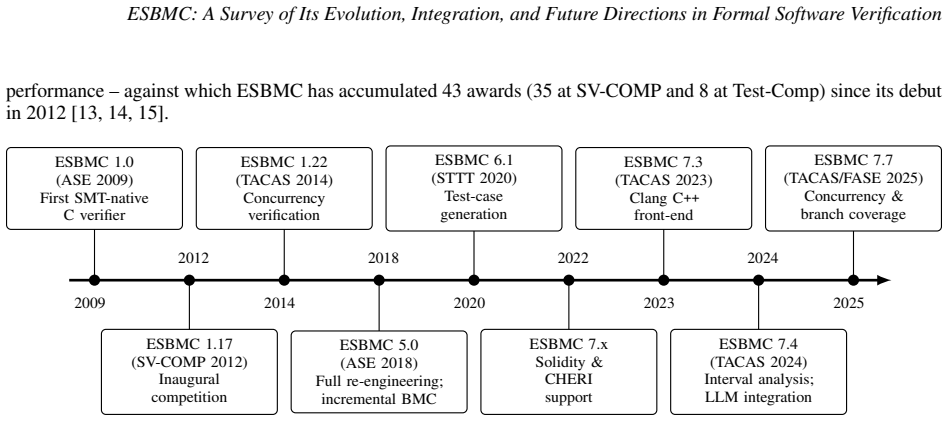
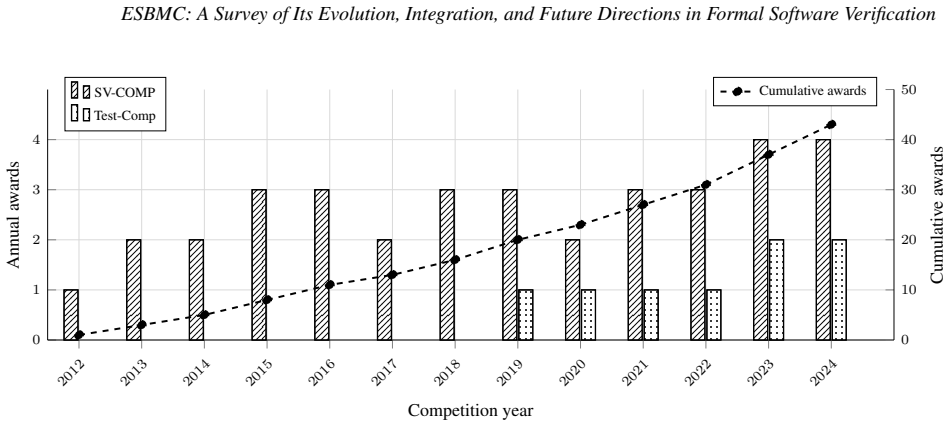
The survey establishes that ESBMC has transformed from its original design for verifying embedded ANSI-C software into one of the most versatile and industrially capable formal verification platforms, achieving the first industrial deployment of an integrated agentic model-checking architecture and thereby operating as a natively autonomous verification kernel rather than a passive backend. The account records 43 awards at SV-COMP and Test-Comp, distinguished paper recognitions, over GBP 9.3 million and EUR 4.98 million in public funding, and its role as a backend for LLM-driven self-healing software and loop invariant generation.
What carries the argument
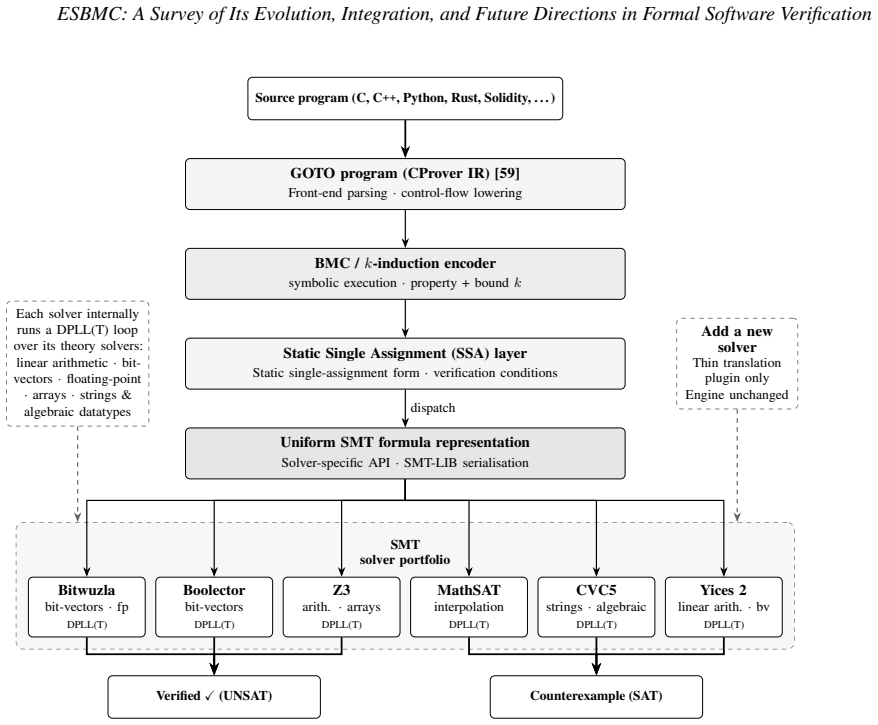
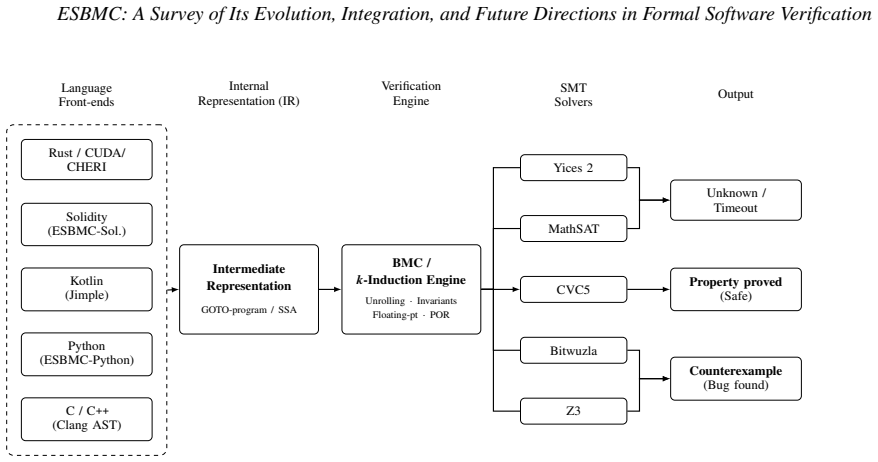
ESBMC, the Efficient SMT-Based Context-Bounded Model Checker, which carries the argument through its successive expansions in language front-ends, solver integrations, and couplings to large language models and autonomous agent architectures.
If this is right
- Further language front-ends could enable cross-language verification tasks without separate tools.
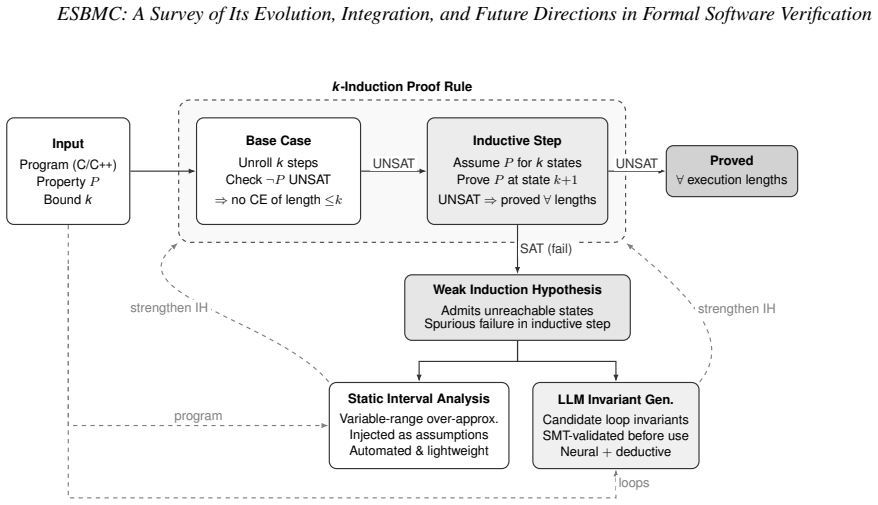
- LLM couplings already support self-healing code and invariant generation as direct applications.
- The agentic architecture shifts verification from reactive checking to proactive, self-directed exploration.
- Addressing the listed challenges in scalability and counterexample intelligibility would widen practical adoption.
- Sustainability of the open-source effort directly affects continued industrial uptake.
Where Pith is reading between the lines
- Similar verification tools could adopt agent-based control loops to reduce manual configuration overhead.
- The documented funding and deployment pattern offers a template for moving other academic model checkers toward industrial use.
- Improvements in counterexample presentation might allow non-experts to act on verification results more quickly.
- Neurosymbolic extensions could combine the existing SMT core with learned heuristics for larger state spaces.
Load-bearing premise
The narrative of steady growth and impact rests on the premise that the cited awards, funding figures, spin-off, and industrial deployments accurately reflect the tool's record without major selection bias or omission.
What would settle it
Evidence that the reported competition awards or industrial deployments have been substantially overstated or that the agentic architecture has not achieved autonomous operation in practice would undermine the central claim of maturation into an industrially capable autonomous kernel.
Figures



read the original abstract
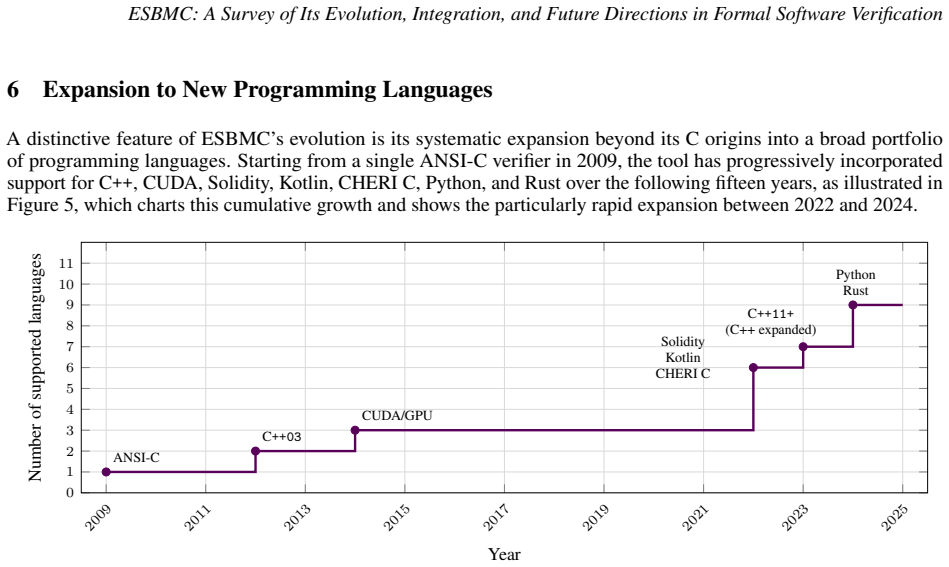
The Efficient SMT-Based Context-Bounded Model Checker (ESBMC) has grown from a research prototype for verifying embedded ANSI-C software into one of the most versatile and industrially capable formal verification platforms available today. Since its first publication in 2009, ESBMC has undergone persistent evolution: expanding its verification techniques, widening its language support to nine front-ends, integrating industrial-strength SMT solvers, and - most recently - coupling with Large Language Models (LLMs) and autonomous AI agents. This survey traces the full trajectory of ESBMC from its original design principles to the state of the art in 2025-2026, documenting 43 awards at SV-COMP and Test-Comp, peer recognition at leading software engineering venues, including a Distinguished Paper Awards at ICSE'11 and ASE'24, a Most Influential Paper Award at ASE'23, and a Best Tool Paper Award at SBSeg'23, its role as a formal verification backend for LLM-driven self-healing software and loop invariant generation, and the first industrial deployment of an integrated agentic model-checking architecture through the NVIDIA-OpenSMA framework, establishing ESBMC as a natively autonomous verification kernel rather than a passive validation backend. We synthesize its economic impact - over GBP 9.3 million and EUR 4.98 million in confirmed public research funding, the VeriBee spin-off, and a defense industrial deployment at Lockheed Martin - and conclude with a structured agenda of open challenges spanning scalability, neurosymbolic verification, counterexample intelligibility, cross-language verification, safety standards compliance, and open-source sustainability.
Editorial analysis
A structured set of objections, weighed in public.
Referee Report
Summary. The paper claims that ESBMC has evolved since 2009 from a research prototype for embedded ANSI-C verification into one of the most versatile and industrially capable formal verification platforms, with expansions to nine language front-ends, SMT solver integrations, LLM and autonomous AI agent couplings, 43 SV-COMP/Test-Comp awards, peer recognitions including Distinguished Paper Awards, over GBP 9.3M and EUR 4.98M in funding, a VeriBee spin-off, industrial deployments at Lockheed Martin and the first agentic model-checking architecture via NVIDIA-OpenSMA, and concludes with an agenda of open challenges in scalability, neurosymbolic verification, and related areas.
Significance. If the documented trajectory, awards, funding, and deployments hold, the survey is significant as a comprehensive case study of how formal verification tools have matured and integrated with AI techniques, offering concrete evidence of industrial adoption and economic impact that can guide future work on autonomous and self-healing systems. The explicit future agenda also contributes by identifying actionable open problems for the field.
major comments (2)
- [Abstract] Abstract: The assertion of 'the first industrial deployment of an integrated agentic model-checking architecture through the NVIDIA-OpenSMA framework' is load-bearing for the central claim that ESBMC is now a 'natively autonomous verification kernel rather than a passive validation backend'. This requires explicit comparison to prior LLM/agent-integrated verification efforts in the literature to substantiate the primacy claim and address risks of incomplete synthesis in the impact narrative.
- [Abstract] Abstract: The synthesis of economic impact via 43 awards, >GBP 9.3 million and EUR 4.98 million funding, and specific deployments underpins the trajectory assessment. The paper should detail the aggregation methodology and source verification for these figures (e.g., in a dedicated methods subsection) to confirm completeness and mitigate selection bias concerns for the overall narrative.
minor comments (2)
- [Abstract] Abstract: The subjective phrasing 'one of the most versatile and industrially capable' would benefit from qualification via comparative metrics against peer tools.
- The list of awards, funding sources, and deployments should be cross-referenced to a consolidated table or appendix for improved readability and traceability.
Simulated Author's Rebuttal
We thank the referee for the constructive comments, which help strengthen the survey's claims on ESBMC's trajectory and impact. We address each major comment below and commit to revisions that enhance transparency and substantiation without altering the documented facts.
read point-by-point responses
-
Referee: [Abstract] The assertion of 'the first industrial deployment of an integrated agentic model-checking architecture through the NVIDIA-OpenSMA framework' is load-bearing for the central claim that ESBMC is now a 'natively autonomous verification kernel rather than a passive validation backend'. This requires explicit comparison to prior LLM/agent-integrated verification efforts in the literature to substantiate the primacy claim and address risks of incomplete synthesis in the impact narrative.
Authors: We agree that the 'first' claim benefits from explicit substantiation. The manuscript's positioning draws from the authors' synthesis of the literature up to 2025-2026, where no prior work describes an integrated agentic architecture deployed industrially via a framework like NVIDIA-OpenSMA. To address the concern directly, we will revise the abstract and add a concise comparative paragraph in Section 5 (or a new subsection) contrasting ESBMC+OpenSMA with prior efforts such as LLM-based invariant generation in other tools, agentic loops in research prototypes, and non-industrial AI couplings. This will clarify the novelty of the industrial integration while preserving the narrative. revision: yes
-
Referee: [Abstract] The synthesis of economic impact via 43 awards, >GBP 9.3 million and EUR 4.98 million funding, and specific deployments underpins the trajectory assessment. The paper should detail the aggregation methodology and source verification for these figures (e.g., in a dedicated methods subsection) to confirm completeness and mitigate selection bias concerns for the overall narrative.
Authors: We concur that methodological transparency is essential for the funding, awards, and deployment figures. The numbers derive from verifiable public sources (SV-COMP/Test-Comp archives, UKRI/EU funding databases, project reports, and direct confirmations from partners like Lockheed Martin and VeriBee), but the current manuscript does not detail the compilation process. We will add a dedicated 'Data Sources and Aggregation Methodology' subsection early in the paper (e.g., after the introduction) that enumerates the sources, inclusion criteria, cross-verification steps, and any limitations to mitigate selection bias concerns. revision: yes
Circularity Check
No circularity: survey is factual historical synthesis without derivations or predictions
full rationale
This is a survey paper with no equations, no fitted parameters, no predictions, and no derivation chain. The narrative recounts ESBMC's history via citations to prior publications, awards, and deployments. No step reduces a claimed result to its own inputs by construction, self-definition, or load-bearing self-citation of unverified theorems. Self-citations are expected in a tool survey and do not create circularity under the rules, as the cited results are external publications rather than internal fits renamed as predictions. The paper is self-contained as a literature synthesis.
Axiom & Free-Parameter Ledger
Reference graph
Works this paper leans on
-
[1]
John Hatcliff, Andrew King, Insup Lee, Alasdair Macdonald, Anura Fernando, Michael Robkin, Eugene Vasserman, Sandy Weininger, and Julian M. Goldman. Rationale and Architecture Principles for Medical Application Platforms. In2012 IEEE/ACM Third International Conference on Cyber-Physical Systems, page 3–12, Beijing, China, April 2012. IEEE. doi: 10.1109/icc...
-
[2]
Dennis, Clare Dixon, and Michael Fisher
Matt Luckcuck, Marie Farrell, Louise A. Dennis, Clare Dixon, and Michael Fisher. Formal Specification and Verification of Autonomous Robotic Systems: A Survey.ACM Computing Surveys, 52(5):1–41, September 2019. ISSN 1557-7341. doi: 10.1145/3342355
-
[3]
Kunjian Song, Nedas Matulevicius, Eddie B. de Lima Filho, and Lucas C. Cordeiro. Esbmc-solidity: an smt-based model checker for solidity smart contracts. InProceedings of the ACM/IEEE 44th International Conference on Software Engineering: Companion Proceedings, ICSE ’22, page 65–69, Pittsburgh, PA, USA, May 2022. ACM. doi: 10.1145/3510454.3516855
-
[4]
Formal Methods: Practice and Experience.ACM Computing Surveys, 41(4):1–36, October 2009
Jim Woodcock, Peter Gorm Larsen, Juan Bicarregui, and John Fitzgerald. Formal Methods: Practice and Experience.ACM Computing Surveys, 41(4):1–36, October 2009. ISSN 1557-7341. doi: 10.1145/1592434. 1592436
-
[5]
Edmund M. Clarke, Thomas A. Henzinger, Helmut Veith, and Roderick Bloem.Handbook of Model Checking. Springer International Publishing, Cham, Switzerland, 2018. ISBN 9783319105758. doi: 10.1007/978-3-319-10575-8
-
[6]
Springer Berlin Heidelberg, Berlin, Heidelberg, 1999
Armin Biere, Alessandro Cimatti, Edmund Clarke, and Yunshan Zhu.Symbolic Model Checking without BDDs, page 193–207. Springer Berlin Heidelberg, Berlin, Heidelberg, 1999. ISBN 9783540490593. doi: 10.1007/3-540-49059-0_14
-
[7]
Spectral Deferred Correction Methods for Ordinary Differential Equations
Edmund Clarke, Armin Biere, Richard Raimi, and Yunshan Zhu. Bounded Model Checking Using Satisfiability Solving.Formal Methods in System Design, 19(1):7–34, July 2001. ISSN 1572-8102. doi: 10.1023/a: 1011276507260
work page doi:10.1023/a: 2001
-
[8]
Lucas Cordeiro, Bernd Fischer, and Joao Marques-Silva. SMT-Based Bounded Model Checking for Embedded ANSI-C Software.IEEE Transactions on Software Engineering, 38(4):957–974, July 2012. ISSN 0098-5589. doi: 10.1109/tse.2011.59
-
[9]
Mikhail R. Gadelha, Felipe R. Monteiro, Jeremy Morse, Lucas C. Cordeiro, Bernd Fischer, and Denis A. Nicole. ESBMC 5.0: an Industrial-Strength C Model Checker. InProceedings of the 33rd ACM/IEEE International Conference on Automated Software Engineering, ASE’18, page 888–891, Manchester, UK, September 2018. ACM. doi: 10.1145/3238147.3240481
-
[10]
Gadelha, Franz Brauße, Rafael S
Kunjian Song, Mikhail R. Gadelha, Franz Brauße, Rafael S. Menezes, and Lucas C. Cordeiro.ESBMC v7.3: Model Checking C++ Programs Using Clang AST, page 141–152. Springer Nature Switzerland, Cham, Switzerland, December 2023. ISBN 9783031493423. doi: 10.1007/978-3-031-49342-3_9
-
[11]
Springer Nature Switzerland, Luxembourg City, Luxembourg, 2024
Rafael Sá Menezes, Mohannad Aldughaim, Farias, et al.ESBMC v7.4: Harnessing the Power of Intervals: (Competition Contribution), page 376–380. Springer Nature Switzerland, Luxembourg City, Luxembourg, 2024. ISBN 9783031572562. doi: 10.1007/978-3-031-57256-2_24
-
[12]
Rafael Menezes et al. ESBMC v7.7: Efficient Concurrent Software Verification with Scheduling, Incremental SMT and Partial Order Reduction. InProceedings of the 31st International Conference on Tools and Algorithms for the Construction and Analysis of Systems (TACAS 2025), Lecture Notes in Computer Science, Hamilton, New Zealand, 2025. Springer. doi: 10.10...
-
[13]
Competition on Software Verification (SV-COMP)
Dirk Beyer. Competition on Software Verification (SV-COMP). InProceedings of the 18th International Conference on Tools and Algorithms for the Construction and Analysis of Systems (TACAS 2012), volume 36 ESBMC: A Survey of Its Evolution, Integration, and Future Directions in Formal Software Verification 7214 ofLecture Notes in Computer Science, pages 504–...
2012
-
[14]
Springer Nature Switzerland, Luxembourg City, Luxembourg, 2024
Dirk Beyer.State of the Art in Software Verification and Witness Validation: SV-COMP 2024, page 299–329. Springer Nature Switzerland, Luxembourg City, Luxembourg, 2024. ISBN 9783031572562. doi: 10.1007/ 978-3-031-57256-2_15
2024
-
[15]
ESBMC: An Industrial-Strength C Model Checker - Competition Results
SSVLab. ESBMC: An Industrial-Strength C Model Checker - Competition Results. https://ssvlab.github. io/esbmc/sv-comp.html, 2024. Accessed: May 2026
2024
-
[16]
Felipe R. Monteiro, Mikhail R. Gadelha, and Lucas C. Cordeiro. Model Checking C++ Programs.Software Testing, Verification and Reliability, 32(1):e1793, September 2021. ISSN 1099-1689. doi: 10.1002/stvr.1793
-
[17]
Farias, Rafael Menezes, and Lucas C
Felipe R. Farias, Rafael Menezes, and Lucas C. Cordeiro. ESBMC-Python: A Bounded Model Checker for Python Programs. InProceedings of the 33rd ACM SIGSOFT International Symposium on Software Testing and Analysis (ISSTA 2024), Vienna, Austria, 2024. ACM. doi: 10.1145/3650212.3685304
-
[18]
Expanding the Rust Formal Verification Ecosys- tem: Welcoming ESBMC
Rust Foundation. Expanding the Rust Formal Verification Ecosys- tem: Welcoming ESBMC. https://rustfoundation.org/media/ expanding-the-rust-formal-verification-ecosystem-welcoming-esbmc/ , 2024. Accessed: May 2026
2024
-
[19]
Norbert Tihanyi, Yiannis Charalambous, Ridhi Jain, Mohamed Amine Ferrag, and Lucas C. Cordeiro. A New Era in Software Security: Towards Self-Healing Software via Large Language Models and Formal Verification. In2025 IEEE/ACM International Conference on Automation of Software Test (AST), pages 136–147, Ottawa, ON, Canada, apr 28 2025. IEEE, IEEE. doi: 10.1...
-
[20]
Cordeiro
Yiannis Charalambous, Edoardo Manino, and Lucas C. Cordeiro. Automated Repair of AI Code with Large Language Models and Formal Verification, 2024
2024
-
[21]
Muhammad A. A. Pirzada, Giles Reger, Ahmed Bhayat, and Lucas C. Cordeiro. LLM-Generated Invariants for Bounded Model Checking Without Loop Unrolling. InProceedings of the 39th IEEE/ACM International Conference on Automated Software Engineering, pages 1395–1407, Sacramento, CA, USA, oct 27 2024. ACM, ACM. doi: 10.1145/3691620.3695512
-
[22]
Weiqi Wang, Marie Farrell, Lucas C. Cordeiro, and Liping Zhao. Supporting software formal verification with large language models: An experimental study. In2025 IEEE 33rd International Requirements Engineering Conference (RE), page 423–431, Reykjavik, Iceland, September 2025. IEEE. doi: 10.1109/re63999.2025.00049
-
[23]
Agentic model checking, 2026
Youcheng Sun, Jiawen Liu, Daniel Kroening, and Jason Xue. Agentic model checking, 2026
2026
-
[24]
Add ESBMC verification harnesses for OpenSMA
Alan Cheng and Lucas C. Cordeiro. NVIDIA-OpenSMA: ESBMC verification harnesses for OpenSMA (vr_sma branch). https://github.com/lucasccordeiro/NVIDIAOpenSMA/commits/vr_sma/, 2025. Repository initialised 30 July 2025 (commit 0dcdcd1); first verification commit 9b8e1a4 (“Add ESBMC verification harnesses for OpenSMA”), April 2026
2025
-
[25]
Guidelines for Performing Systematic Literature Reviews in Software Engineering
Barbara Kitchenham and Stuart Charters. Guidelines for Performing Systematic Literature Reviews in Software Engineering. Technical Report EBSE 2007-001, Keele University and Durham University Joint Report, 2007
2007
-
[26]
Springer Berlin Heidelberg, Berlin, Heidelberg, Germany, 2004
Edmund Clarke, Daniel Kroening, and Flavio Lerda.A Tool for Checking ANSI-C Programs, page 168–176. Springer Berlin Heidelberg, Berlin, Heidelberg, Germany, 2004. ISBN 9783540247302. doi: 10.1007/978-3-540-24730-2_15
-
[27]
Dirk Beyer and M. Erkan Keremoglu. CPAchecker: A tool for configurable software verification. InProceedings of the 23rd International Conference on Computer Aided Verification (CAV 2011), volume 6806 ofLecture Notes in Computer Science, pages 184–190, Snowbird, UT, USA, 2011. Springer. doi: 10.1007/978-3-642-22110-1_16
-
[28]
Ultimate Automizer with array interpolation
Matthias Heizmann, Daniel Dietsch, Vincent Langenfeld, and Andreas Podelski. Ultimate Automizer with array interpolation. InProceedings of the 19th International Conference on Tools and Algorithms for the Construction and Analysis of Systems (TACAS 2013), volume 7795 ofLecture Notes in Computer Science, pages 455–457, Rome, Italy, 2013. Springer
2013
-
[29]
2LS for program analysis
Martin Brain, Saurabh Joshi, Daniel Kroening, and Peter Schrammel. 2LS for program analysis. InProceedings of the 22nd International Conference on Tools and Algorithms for the Construction and Analysis of Systems (TACAS 2016), volume 9636 ofLecture Notes in Computer Science, pages 98–104, Eindhoven, The Netherlands,
2016
-
[30]
doi: 10.1007/978-3-662-49674-9_6
Springer. doi: 10.1007/978-3-662-49674-9_6
-
[31]
Symbiotic 7: Integration of a new slicer
Marek Chalupa, Jan Strejˇcek, and Martin Višˇnovský. Symbiotic 7: Integration of a new slicer. InProceedings of the 26th International Conference on Tools and Algorithms for the Construction and Analysis of Systems (TACAS 2020), volume 12079 ofLecture Notes in Computer Science, pages 413–417, Dublin, Ireland, 2020. Springer. doi: 10.1007/978-3-030-45237-7...
-
[32]
DiVinE 3.0 – an explicit-state LTL model checker
Jiˇrí Barnat et al. DiVinE 3.0 – an explicit-state LTL model checker. InProceedings of the 25th International Conference on Computer Aided Verification (CAV 2013), volume 8044 ofLecture Notes in Computer Science, pages 863–868, Saint Petersburg, Russia, 2013. Springer. doi: 10.1007/978-3-642-39799-8_60
-
[33]
Theta: A framework for abstraction refinement-based model checking
Tamás Tóth, Ákos Hajdu, András Vörös, Zoltán Micskei, and István Majzik. Theta: A framework for abstraction refinement-based model checking. InProceedings of the 17th Conference on Formal Methods in Computer-Aided Design (FMCAD 2017), pages 176–179, Vienna, Austria, 2017. IEEE. doi: 10.23919/fmcad.2017.8102257
-
[34]
Verifying dynamic trait objects in Rust
Alexa VanHattum, Daniel Schwartz-Narbonne, Nathan Chong, and Alberto Griggio. Verifying dynamic trait objects in Rust. InProceedings of the 44th International Conference on Software Engineering: Software Engineering in Practice Track (ICSE-SEIP 2022), pages 321–330, Pittsburgh, PA, USA, 2022. ACM. doi: 10.1145/3510457.3513031
-
[35]
Arie Gurfinkel, Temesghen Kahsai, Anvesh Komuravelli, and Jorge A. Navas. The SeaHorn verification framework. InProceedings of the 27th International Conference on Computer Aided Verification (CAV 2015), volume 9206 ofLecture Notes in Computer Science, pages 343–361, San Francisco, CA, USA, 2015. Springer. doi: 10.1007/978-3-319-21690-4_20
-
[36]
Z3: An Efficient SMT Solver
Leonardo de Moura and Nikolaj Bjørner. Z3: An Efficient SMT Solver. InProceedings of the 14th International Conference on Tools and Algorithms for the Construction and Analysis of Systems (TACAS 200), volume 4963 ofLecture Notes in Computer Science, pages 337–340, Budapest, Hungary, 2008. Springer. doi: 10.1007/ 978-3-540-78800-3_24
2008
-
[37]
Bitwuzla
Aina Niemetz and Mathias Preiner. Bitwuzla. InComputer Aided Verification, page 3–17, Cham, Switzerland,
-
[38]
Springer Nature Switzerland. ISBN 9783031377037. doi: 10.1007/978-3-031-37703-7_1
-
[39]
Schaafsma, and Roberto Sebastiani
Alessandro Cimatti, Alberto Griggio, Bastiaan J. Schaafsma, and Roberto Sebastiani. The MathSAT5 SMT Solver. InProceedings of the 19th International Conference on Tools and Algorithms for the Construction and Analysis of Systems (TACAS 2013), volume 7795 ofLecture Notes in Computer Science, pages 93–107, Rome, Italy, 2013. Springer. doi: 10.1007/978-3-642...
-
[40]
cvc5: A Versatile and Industrial-Strength SMT Solver
Haniel Barbosa et al. cvc5: A Versatile and Industrial-Strength SMT Solver. InProceedings of the 28th International Conference on Tools and Algorithms for the Construction and Analysis of Systems (TACAS 2022), volume 13243 ofLecture Notes in Computer Science, pages 415–442, Munich, Germany, 2022. Springer. doi: 10.1007/978-3-030-99524-9_24
-
[41]
Bruno Dutertre. Yices 2.2. InProceedings of the 26th International Conference on Computer-Aided Verification (CAV 2014), volume 8559 ofLecture Notes in Computer Science, pages 737–744, Vienna, Austria, 2014. Springer. doi: 10.1007/978-3-319-08867-9_49
-
[42]
Edmund M. Clarke and E. Allen Emerson.Design and Synthesis of Synchronization Skeletons Using Branching Time Temporal Logic, page 52–71. Springer-Verlag, Berlin, Heidelberg, Germany, 1982. ISBN 354011212X. doi: 10.1007/bfb0025774
-
[43]
Edmund M. Clarke.Model checking. Springer Berlin Heidelberg, Berlin, Heidelberg, 1997. ISBN 9783540696599. doi: 10.1007/bfb0058022
-
[44]
Bryant. Graph-Based Algorithms for Boolean Function Manipulation.IEEE Transactions on Computers, C–35 (8):677–691, August 1986. ISSN 2326-3814. doi: 10.1109/tc.1986.1676819
-
[45]
Edmund M. Clarke, William Klieber, Miloš Nováˇcek, and Paolo Zuliani.Model Checking and the State Explosion Problem, page 1–30. Springer Berlin Heidelberg, Berlin, Heidelberg, Germany, 2012. ISBN 9783642357466. doi: 10.1007/978-3-642-35746-6_1
-
[46]
Checking Safety Properties Using Induction and a SAT-Solver
Mary Sheeran, Satnam Singh, and Gunnar Stålmarck. Checking Safety Properties Using Induction and a SAT-Solver. InProceedings of the 3rd International Conference on Formal Methods in Computer-Aided Design (FMCAD 2000), volume 1954 ofLecture Notes in Computer Science, pages 108–125, Austin, TX, USA, 2000. Springer. doi: 10.1007/3-540-40922-X_8
-
[47]
Alastair F. Donaldson, Leopold Haller, Daniel Kroening, and Philipp Rümmer.Software Verification Using k-Induction, page 351–368. Springer Berlin Heidelberg, Berlin, Heidelberg, 2011. ISBN 9783642237027. doi: 10.1007/978-3-642-23702-7_26
-
[48]
Robert Nieuwenhuis, Albert Oliveras, and Cesare Tinelli. Solving SAT and SAT Modulo Theories: From an Abstract Davis-Putnam-Logemann-Loveland Procedure to DPLL(T).Journal of the ACM, 53(6):937–977, 2006. doi: 10.1145/1217856.1217859
-
[49]
Springer Berlin Heidelberg, Berlin, Heidelberg, Germany, 2016
Daniel Kroening and Ofer Strichman.Decision Procedures. Springer Berlin Heidelberg, Berlin, Heidelberg, Germany, 2016. ISBN 9783662504970. doi: 10.1007/978-3-662-50497-0. 38 ESBMC: A Survey of Its Evolution, Integration, and Future Directions in Formal Software Verification
-
[50]
Springer Berlin Heidelberg, Berlin, Heidelberg, Germany, 2009
Robert Brummayer and Armin Biere.Boolector: An Efficient SMT Solver for Bit-Vectors and Arrays, page 174–177. Springer Berlin Heidelberg, Berlin, Heidelberg, Germany, 2009. ISBN 9783642007682. doi: 10.1007/978-3-642-00768-2_16
-
[51]
Yakir Vizel, Georg Weissenbacher, and Sharad Malik. Boolean Satisfiability Solvers and Their Applications in Model Checking.Proceedings of the IEEE, 103(11):2021–2035, November 2015. ISSN 1558-2256. doi: 10.1109/jproc.2015.2455034
-
[52]
Springer Berlin Heidelberg, Berlin, Heidelberg, 2016
Rajdeep Mukherjee, Michael Tautschnig, and Daniel Kroening.v2c – A Verilog to C Translator, page 580–586. Springer Berlin Heidelberg, Berlin, Heidelberg, 2016. ISBN 9783662496749. doi: 10.1007/978-3-662-49674-9_ 38
-
[53]
SMT-Based Bounded Model Checking for Embedded ANSI-C Software
Lucas Cordeiro, Bernd Fischer, and Joao Marques-Silva. SMT-Based Bounded Model Checking for Embedded ANSI-C Software. InProceedings of the 24th IEEE/ACM International Conference on Automated Software Engineering (ASE 2009), pages 137–148, Auckland, New Zealand, 2009. IEEE. doi: 10.1109/ASE.2009.17
-
[54]
Proceedings, volume 8413 ofLecture Notes in Computer Science, 2014
Erika Ábrahám and Klaus Havelund, editors.Tools and Algorithms for the Construction and Analysis of Systems: 20th International Conference, TACAS 2014, Held as Part of the European Joint Conferences on Theory and Practice of Software, ETAPS 2014, Grenoble, France, April 5–13, 2014. Proceedings, volume 8413 ofLecture Notes in Computer Science, 2014. Spring...
-
[55]
Mikhail R. Gadelha, Rafael S. Menezes, and Lucas C. Cordeiro. ESBMC 6.1: Automated Test Case Generation Using Bounded Model Checking.International Journal on Software Tools for Technology Transfer, 23(6): 857–861, May 2020. ISSN 1433-2787. doi: 10.1007/s10009-020-00571-2
-
[56]
ESBMC v7.7: Automating Branch Coverage Analysis Using CFG-Based Instrumentation and SMT Solving
Rafael Menezes et al. ESBMC v7.7: Automating Branch Coverage Analysis Using CFG-Based Instrumentation and SMT Solving. InProceedings of the 28th International Conference on Fundamental Approaches to Software Engineering (FASE 2025), Lecture Notes in Computer Science, Hamilton, New Zealand, 2025. Springer. doi: 10.1007/978-3-031-90900-9_15
-
[57]
Cordeiro, Bernd Fischer, and João Marques-Silva
Lucas C. Cordeiro, Bernd Fischer, and João Marques-Silva. Verifying Multi-Threaded Software Using SMT- Based Context-Bounded Model Checking. InProceedings of the 33rd International Conference on Software Engineering (ICSE 2011), pages 331–340, Honolulu, HI, USA, 2011. ACM. doi: 10.1145/1985793.1985839
-
[58]
Verifying Embedded C Software with Timing Constraints Using an Untimed Bounded Model Checker
Raimundo Barreto, Lucas Cordeiro, and Bernd Fischer. Verifying Embedded C Software with Timing Constraints Using an Untimed Bounded Model Checker. In2011 Brazilian Symposium on Computing System Engineering, page 46–52, Los Alamitos, CA, USA, November 2011. IEEE. doi: 10.1109/sbesc.2011.19
-
[59]
Mikhail Y . R. Gadelha, Lucas C. Cordeiro, and Denis A. Nicole. Encoding Floating-Point Numbers Using the SMT Theory in ESBMC: An Empirical Evaluation over the SV-COMP Benchmarks. InProceedings of the 22nd International Workshop on Formal Methods for Industrial Critical Systems (FMICS 2017), volume 10471 ofLecture Notes in Computer Science, pages 91–106, ...
2017
-
[60]
Gadelha, Konstantin Korovin, Giles Reger, and Lucas C
Franz Brauße, Fedor Shmarov, Rafael Menezes, Mikhail R. Gadelha, Konstantin Korovin, Giles Reger, and Lucas C. Cordeiro. ESBMC-CHERI: Towards Verification of C Programs for CHERI Platforms with ESBMC. In Proceedings of the 31st ACM SIGSOFT International Symposium on Software Testing and Analysis (ISSTA 2022), pages 773–776, Seoul, South Korea, July 2022. ...
-
[61]
Phd thesis, The University of Manchester, June 2025
Rafael Sá Menezes.GOTO: a verification framework for CProver tools. Phd thesis, The University of Manchester, June 2025. URL https://ssvlab.github.io/lucasccordeiro/supervisions/phd_thesis_rafael. pdf
2025
-
[62]
LLM For Loop Invariant Generation and Fixing: How Far Are We?, 2025
Mostafijur Rahman Akhond, Saikat Chakraborty, and Gias Uddin. LLM For Loop Invariant Generation and Fixing: How Far Are We?, 2025
2025
-
[63]
Ferreira, Pedro Cruz, Thomas Durieux, and Rui Abreu
João F. Ferreira, Pedro Cruz, Thomas Durieux, and Rui Abreu. Smartbugs: A framework to analyze solidity smart contracts, 2020. URLhttps://arxiv.org/abs/2007.04771
-
[64]
Darren Cofer, Andrew Gacek, John Backes, Michael W. Whalen, Lee Pike, Adam Foltzer, Michal Podhradsky, Gerwin Klein, Ihor Kuz, June Andronick, Gernot Heiser, and Douglas Stuart. A Formal Approach to Constructing Secure Air Vehicle Software.Computer, 51(11):14–23, November 2018. ISSN 1558-0814. doi: 10.1109/mc. 2018.2876051
work page doi:10.1109/mc 2018
-
[65]
Cordeiro, and Vasileios Mavroeidis
Norbert Tihanyi, Tamas Bisztray, Ridhi Jain, Mohamed Amine Ferrag, Lucas C. Cordeiro, and Vasileios Mavroeidis. The FormAI Dataset: Generative AI in Software Security through the Lens of Formal Verification. InProceedings of the 19th International Conference on Predictive Models and Data Analytics in Software Engineering (PROMISE 2023), pages 33–40, San F...
-
[66]
Dubniczky, Ridhi Jain, and Lucas C
Norbert Tihanyi, Tamas Bisztray, Mohamed Amine Ferrag, Bilel Cherif, Richard A. Dubniczky, Ridhi Jain, and Lucas C. Cordeiro. Vulnerability Detection: From Formal Verification to Large Language Models and Hybrid Approaches: A Comprehensive Overview, 2025
2025
-
[67]
Attention is all you need
Ashish Vaswani, Noam Shazeer, Niki Parmar, Jakob Uszkoreit, Llion Jones, Aidan N Gomez, Ł ukasz Kaiser, and Illia Polosukhin. Attention is all you need. In I. Guyon, U. V on Luxburg, S. Bengio, H. Wallach, R. Fergus, S. Vishwanathan, and R. Garnett, editors,Advances in Neural Information Processing Systems, volume 30, Long Beach, CA, USA, 2017. Curran Ass...
2017
-
[68]
Language models are few-shot learners
Tom Brown et al. Language models are few-shot learners. In H. Larochelle, M. Ranzato, R. Hadsell, M.F. Balcan, and H. Lin, editors,Advances in Neural Information Processing Systems, volume 33, pages 1877– 1901, Vancouver, Canada, 2020. Curran Associates, Inc. URLhttps://proceedings.neurips.cc/paper_ files/paper/2020/file/1457c0d6bfcb4967418bfb8ac142f64a-Paper.pdf
1901
-
[69]
Hammond Pearce, Baleegh Ahmad, Benjamin Tan, Brendan Dolan-Gavitt, and Ramesh Karri. Asleep at the Keyboard? Assessing the Security of GitHub Copilot’s Code Contributions.Communications of the ACM, 68(2): 96–105, January 2025. ISSN 1557-7317. doi: 10.1145/3610721
-
[70]
A Survey of Safety and Trustworthiness of Large Language Models through the Lens of Verification and Validation, 2023
Xiaowei Huang, Wenjie Ruan, Wei Huang, Gaojie Jin, Dong, et al. A Survey of Safety and Trustworthiness of Large Language Models through the Lens of Verification and Validation, 2023
2023
-
[71]
Springer Nature Switzerland, Cham, Switzerland, October 2024
Bernhard Beckert, Jonas Klamroth, Wolfram Pfeifer, Patrick Röper, and Samuel Teuber.Towards Combining the Cognitive Abilities of Large Language Models with the Rigor of Deductive Progam Verification, page 242–257. Springer Nature Switzerland, Cham, Switzerland, October 2024. ISBN 9783031753879. doi: 10.1007/978-3-031-75387-9_15
-
[72]
Barrett, and Nina Narodytska
Haoze Wu, Clark W. Barrett, and Nina Narodytska. Lemur: Integrating Large Language Models in Automated Program Verification. InThe Twelfth International Conference on Learning Representations (ICLR 2024), page 7652, Vienna, Austria, 2024. OpenReview.net. URLhttps://openreview.net/forum?id=Q3YaCghZNt
2024
-
[73]
Cordeiro
Lucas C. Cordeiro. Lucas Cordeiro — Systems and Software Verification Laboratory (SSVLab) Personal Page. https://ssvlab.github.io/lucasccordeiro/, 2025. Accessed: May 2026
2025
-
[74]
R&D Investments Spearhead Push to Block Cyber Security Attacks (Soteria consortium, £5.8M)
UK Research and Innovation (UKRI). R&D Investments Spearhead Push to Block Cyber Security Attacks (Soteria consortium, £5.8M). https://www.openaccessgovernment.org/ rd-investments-spearhead-cyber-security-defence/96958/, 2021
2021
-
[75]
ELEGANT — Towards Attestable and Trustworthy Internet-of-Things Infrastructures (H2020 grant agreement No
European Commission. ELEGANT — Towards Attestable and Trustworthy Internet-of-Things Infrastructures (H2020 grant agreement No. 957286). CORDIS — EU Research Results. https://cordis.europa.eu/ project/id/957286, 2021. Accessed: May 2026
2021
-
[76]
Digital Security by Design (DSbD) Programme
UK Research and Innovation (UKRI). Digital Security by Design (DSbD) Programme. https://www.ukri.org/what-we-do/browse-our-areas-of-investment-and-support/ digital-security-by-design/, 2019. Accessed: May 2026
2019
-
[77]
VeriBee: Source Code Security (Research Impact Record)
University of Manchester Research Explorer. VeriBee: Source Code Security (Research Impact Record). https://research.manchester.ac.uk/en/impacts/veribee-source-code-security/ , 2025. Ac- cessed: May 2026
2025
-
[78]
UK SMEs Face Rise in Cyber Attacks with Average Cost £7,960.https://securitybrief
SecurityBrief UK. UK SMEs Face Rise in Cyber Attacks with Average Cost £7,960.https://securitybrief. co.uk/story/uk-smes-face-rise-in-cyber-attacks-with-average-cost-gbp-7-960 , 2024. Ac- cessed: May 2026
2024
-
[79]
The Economic Impacts of Inadequate Infrastructure for Software Testing
Gregory Tassey. The Economic Impacts of Inadequate Infrastructure for Software Testing. Technical Report Planning Report 02-3, National Institute of Standards and Technology (NIST), Gaithersburg, MD, 2002. URL https://www.nist.gov/document/report02-3pdf. Accessed: May 2026
2002
-
[80]
The cost of poor software quality in the US: A 2020 report
Consortium for Information and Software Quality. The cost of poor software quality in the US: A 2020 report. Technical report, CISQ, 2020. URL https://www.it-cisq.org/ the-cost-of-poor-software-quality-in-the-us-a-2020-report/
2020
discussion (0)
Sign in with ORCID, Apple, or X to comment. Anyone can read and Pith papers without signing in.