Hydrodynamic Cooperons in Electron Fluids: Schwinger--Keldysh Derivation and Quantum Corrections to Magnetoresistance
Pith reviewed 2026-06-29 20:21 UTC · model grok-4.3
The pith
Conservation laws force the leading quantum-coherence correction in electron fluids into the spin-two stress sector, renormalizing shear viscosity.
A machine-rendered reading of the paper's core claim, the machinery that carries it, and where it could break.
Core claim
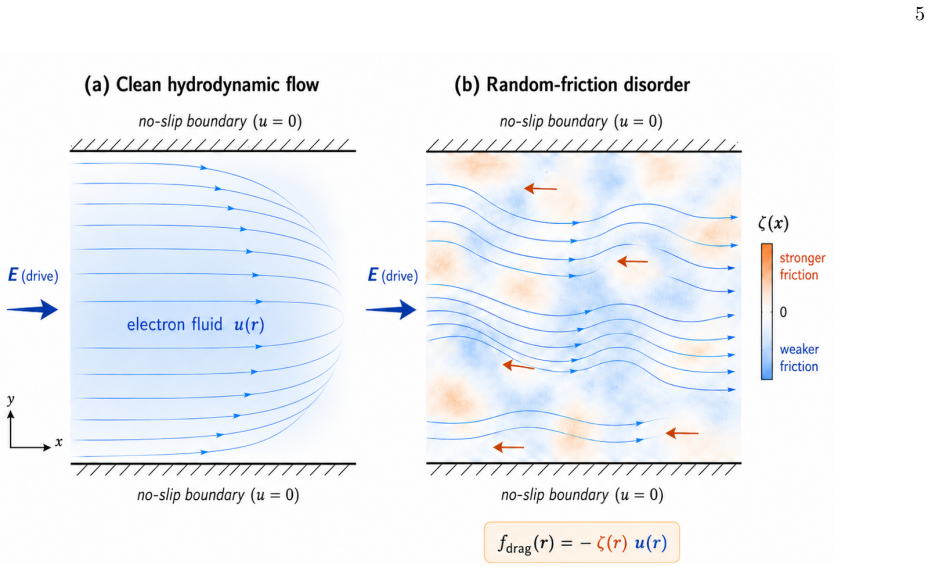
Starting from the clean hydrodynamic fixed point, a minimal random-friction disorder model generates a finite momentum-relaxation time in the self-consistent Born approximation; the disorder-averaged Schwinger-Keldysh theory then yields a hydrodynamic Cooperon whose self-energy corrections are forced by conservation laws into the spin-two stress sector, renormalizing the shear viscosity and thereby modifying both the Gurzhi response and its low-field magnetohydrodynamic signatures.
What carries the argument
The hydrodynamic Cooperon, the disorder-averaged object from the Schwinger-Keldysh theory that encodes self-energy corrections confined to the spin-two stress sector.
If this is right
- The shear viscosity receives a renormalization from the stress self-energy.
- The Gurzhi response is modified by the renormalized viscosity.
- Low-field magnetohydrodynamic signatures acquire corrections from the same stress-sector effect.
- Density and momentum sectors remain protected, with no leading corrections appearing there.
Where Pith is reading between the lines
- The construction supplies a template for treating quantum corrections in other conserved sectors of hydrodynamic theories.
- Similar disorder-averaged Cooperon objects may be definable when different conservation laws or symmetry breakings are considered.
- The approach suggests a route to compute viscosity corrections in hydrodynamic regimes of other two-dimensional materials.
Load-bearing premise
The clean hydrodynamic fixed point plus a minimal random-friction disorder model treated in the self-consistent Born approximation suffices to generate the momentum-relaxation time that enters the disorder-averaged theory.
What would settle it
A measurement of shear viscosity in a 2D electron fluid showing no deviation from classical hydrodynamic predictions when momentum relaxation is introduced would falsify the claim that the stress self-energy supplies the leading correction.
Figures



read the original abstract
We develop a Schwinger--Keldysh effective theory for quantum-interference corrections in a two-dimensional electron system in the hydrodynamic regime. Starting from the clean hydrodynamic fixed point, we introduce a minimal random-friction disorder model that generates a finite momentum-relaxation time within the self-consistent Born approximation. The disorder-averaged theory then allows us to construct a hydrodynamic Cooperon and to compute the associated self-energy corrections to the collective modes. Conservation laws protect the density and momentum sectors, so that the leading quantum-coherence correction is forced into the spin-two stress sector. The associated stress self-energy renormalizes the shear viscosity and modifies both the Gurzhi response and its low-field magnetohydrodynamic signatures.
Editorial analysis
A structured set of objections, weighed in public.
Referee Report
Summary. The manuscript develops a Schwinger-Keldysh effective theory for quantum-interference corrections in two-dimensional electron fluids in the hydrodynamic regime. It begins from the clean hydrodynamic fixed point, introduces a minimal random-friction disorder model treated in the self-consistent Born approximation to produce finite momentum relaxation, constructs a hydrodynamic Cooperon, and computes its self-energy corrections to collective modes. Conservation laws are invoked to protect the density and momentum sectors, forcing the leading correction into the spin-two stress sector; the resulting stress self-energy renormalizes the shear viscosity and alters the Gurzhi response together with low-field magnetohydrodynamic signatures.
Significance. If the derivation is internally consistent, the work supplies a controlled route to quantum-coherence corrections within hydrodynamic electron transport, with direct implications for Gurzhi resistivity and magnetoresistance measurements in high-mobility 2D systems. The Schwinger-Keldysh treatment and the conservation-law protection argument constitute genuine strengths; the introduction of hydrodynamic Cooperons offers a new conceptual object that may be reusable in related problems.
major comments (2)
- [Abstract / disorder-model section] The minimal random-friction disorder model (introduced immediately after the clean fixed point and treated via SCBA) is load-bearing for the entire disorder-averaged construction and the subsequent protection argument. The manuscript must demonstrate explicitly that this model preserves the hydrodynamic continuity equations at the order needed for the Cooperon self-energy and does not omit vertex corrections that could feed back into the spin-2 sector.
- [Hydrodynamic Cooperon self-energy derivation] The statement that conservation laws force the leading correction exclusively into the spin-two stress sector requires an explicit calculation showing that the self-energy vanishes (or is parametrically smaller) in the density and momentum channels. This demonstration should appear in the section deriving the hydrodynamic Cooperon self-energy.
minor comments (2)
- Notation for the hydrodynamic Cooperon and its coupling to the stress tensor should be defined once and used consistently; the current abstract-level description leaves the precise operator content ambiguous.
- A brief comparison of the random-friction model to standard white-noise or Gaussian disorder potentials used in the literature would help readers assess the modeling choice.
Simulated Author's Rebuttal
We thank the referee for the careful reading and constructive suggestions. The points raised identify places where additional explicit demonstrations will improve clarity and rigor. We address each major comment below.
read point-by-point responses
-
Referee: [Abstract / disorder-model section] The minimal random-friction disorder model (introduced immediately after the clean fixed point and treated via SCBA) is load-bearing for the entire disorder-averaged construction and the subsequent protection argument. The manuscript must demonstrate explicitly that this model preserves the hydrodynamic continuity equations at the order needed for the Cooperon self-energy and does not omit vertex corrections that could feed back into the spin-2 sector.
Authors: We agree that an explicit verification strengthens the presentation. In the revised manuscript we will add a dedicated paragraph (or short subsection) immediately after the SCBA treatment of the random-friction model. There we will (i) write the continuity equations for density and momentum, (ii) show that the disorder-averaged self-energy insertions preserve them at the orders entering the Cooperon, and (iii) argue that vertex corrections generated by the minimal disorder do not feed back into the spin-2 sector at leading hydrodynamic order because of the tensor structure of the hydrodynamic vertices and the scalar nature of the friction term. revision: yes
-
Referee: [Hydrodynamic Cooperon self-energy derivation] The statement that conservation laws force the leading correction exclusively into the spin-two stress sector requires an explicit calculation showing that the self-energy vanishes (or is parametrically smaller) in the density and momentum channels. This demonstration should appear in the section deriving the hydrodynamic Cooperon self-energy.
Authors: The conservation-law protection is already invoked in the manuscript, but we accept that an explicit component-wise calculation will make the argument more transparent. In the revised version we will insert, within the hydrodynamic Cooperon self-energy section, a short calculation (or appendix entry) that evaluates the self-energy matrix elements in the density and momentum channels. Using the Ward identities associated with particle-number and momentum conservation, we will show that these components vanish identically (or are suppressed by additional powers of the hydrodynamic gradients), while the spin-2 component remains finite and renormalizes the shear viscosity. revision: yes
Circularity Check
No significant circularity; derivation follows from explicit modeling assumptions without reduction to inputs by construction.
full rationale
The provided abstract and description present an explicit modeling choice—the introduction of a minimal random-friction disorder model within SCBA to generate finite momentum relaxation—followed by disorder averaging, construction of the hydrodynamic Cooperon, and application of conservation laws to locate corrections in the stress sector. No quoted equations or steps demonstrate a result that equals its inputs by definition, a fitted parameter renamed as a prediction, or a load-bearing self-citation chain. The central claims rest on the Schwinger-Keldysh effective theory applied to the chosen disorder model, which is independent of the final viscosity renormalization and magnetoresistance signatures.
Axiom & Free-Parameter Ledger
axioms (2)
- domain assumption A clean hydrodynamic fixed point exists as the starting point for the effective theory.
- domain assumption The self-consistent Born approximation is valid for generating a finite momentum-relaxation time from the random-friction disorder.
invented entities (1)
-
hydrodynamic Cooperon
no independent evidence
Reference graph
Works this paper leans on
-
[1]
P. A. Lee and T. V. Ramakrishnan, Disordered electronic systems, Rev. Mod. Phys.57, 287 (1985)
1985
-
[2]
B. L. Altshuler, A. G. Aronov, and D. E. Khmelnitskii, Effects of electron-electron collisions with small energy transfers on quantum localisation, Journal of Physics C: Solid State Physics15, 7367 (1982)
1982
-
[3]
Hershfield and V
S. Hershfield and V. Ambegaokar, Transport equation for weakly localized electrons, Phys. Rev. B34, 2147 (1986)
1986
-
[4]
Bergmann, Weak localization in thin films: a time- of-flight experiment with conduction electrons, Physics Reports107, 1 (1984)
G. Bergmann, Weak localization in thin films: a time- of-flight experiment with conduction electrons, Physics Reports107, 1 (1984)
1984
-
[5]
R. N. Gurzhi, Minimum of resistance in impurity-free conductors, Soviet Physics JETP17, 521 (1963)
1963
-
[6]
M. J. M. de Jong and L. W. Molenkamp, Hydrodynamic electron flow in high-mobility wires, Physical Review B 51, 13389 (1995)
1995
-
[7]
L. W. Molenkamp and M. J. M. de Jong, Observa- tion of knudsen and gurzhi transport regimes in a two- dimensional wire, Solid-State Electronics37, 551 (1994)
1994
-
[8]
R. N. Gurzhi, A. N. Kalinenko, and A. I. Kopeliovich, Electron-electron collisions and a new hydrodynamic ef- fect in two-dimensional electron gas, Physical Review Letters74, 3872 (1995)
1995
-
[9]
D. A. Bandurin, I. Torre, R. Krishna Kumar, M. Ben Shalom, A. Tomadin, A. Principi, G. H. Au- ton, E. Khestanova, K. S. Novoselov, I. V. Grigorieva, L. A. Ponomarenko, A. K. Geim, and M. Polini, Nega- tive local resistance caused by viscous electron backflow in graphene, Science351, 1055 (2016)
2016
-
[10]
Krishna Kumaret al., Superballistic flow of viscous electron fluid through graphene constrictions, Nature Physics13, 1182 (2017)
R. Krishna Kumaret al., Superballistic flow of viscous electron fluid through graphene constrictions, Nature Physics13, 1182 (2017)
2017
-
[11]
A. I. Berdyugin, S. G. Xu, F. M. D. Pellegrino, R. K. Kumar, A. Principi, I. Torre, M. B. Shalom, T. Taniguchi, K. Watanabe, I. V. Grigorieva, M. Polini, A. K. Geim, and D. A. Bandurin, Measuring hall viscos- ity of graphene’s electron fluid, Science364, 162 (2019), https://www.science.org/doi/pdf/10.1126/science.aau0685
-
[12]
Lucas and K
A. Lucas and K. C. Fong, Hydrodynamics of electrons in graphene, Journal of Physics: Condensed Matter30, 053001 (2018)
2018
-
[13]
B. N. Narozhny, I. V. Gornyi, A. D. Mirlin, and J. Schmalian, Hydrodynamic approach to electronic transport in graphene, Annalen der Physik529, 1700043 (2017)
2017
-
[14]
Fritz and T
L. Fritz and T. Scaffidi, Hydrodynamic electronic trans- port, Annual Review of Condensed Matter Physics15, 17 (2024)
2024
-
[15]
Varnavides, A
G. Varnavides, A. Yacoby, C. Felser, and P. Narang, Charge transport and hydrodynamics in materials, Na- ture Reviews Materials8, 726 (2023)
2023
-
[16]
Effective field theory of dissipative fluids
M. Crossley, P. Glorioso, and H. Liu, Effective field the- ory of dissipative fluids, Journal of High Energy Physics 2017, 095 (2017), arXiv:1511.03646 [hep-th]
work page internal anchor Pith review Pith/arXiv arXiv 2017
-
[17]
Lectures on non-equilibrium effective field theories and fluctuating hydrodynamics
P. Glorioso and H. Liu, Lectures on non-equilibrium effective field theories and fluctuating hydrodynam- ics, Proceedings of ScienceTASI2017, 008 (2018), arXiv:1805.09331 [hep-th]
work page internal anchor Pith review Pith/arXiv arXiv 2018
-
[18]
Kamenev,Field Theory of Non-Equilibrium Systems (Cambridge University Press, 2023)
A. Kamenev,Field Theory of Non-Equilibrium Systems (Cambridge University Press, 2023)
2023
-
[19]
Vollhardt and P
D. Vollhardt and P. W¨ olfle, Diagrammatic, self- consistent treatment of the anderson localization prob- lem ind≤2 dimensions, Phys. Rev. B22, 4666 (1980)
1980
-
[20]
P. S. Alekseev, Negative magnetoresistance in viscous flow of two-dimensional electrons, Physical Review Let- ters117, 166601 (2016)
2016
-
[21]
P. S. Alekseev and A. P. Dmitriev, Viscosity of two- dimensional electrons, Physical Review B102, 241409 (2020)
2020
-
[22]
J. E. Avron, Odd viscosity, Journal of Statistical Physics 92, 543 (1998)
1998
-
[23]
Scaffidi, N
T. Scaffidi, N. Nandi, B. Schmidt, A. P. Mackenzie, and J. E. Moore, Hydrodynamic electron flow and hall vis- cosity, Physical Review Letters118, 226601 (2017)
2017
-
[24]
F. M. D. Pellegrino, I. Torre, and M. Polini, Nonlo- cal transport and the hall viscosity of two-dimensional hydrodynamic electron liquids, Physical Review B96, 195401 (2017)
2017
-
[25]
L. V. Delacr´ etaz and A. Gromov, Transport signatures of the hall viscosity, Physical Review Letters119, 226602 (2017)
2017
-
[26]
Kamenev and A
A. Kamenev and A. Andreev, Electron-electron inter- actions in disordered metals: Keldysh formalism, Phys. Rev. B60, 2218 (1999)
1999
-
[27]
T. C. Wu, Y. Liao, and M. S. Foster, Quantum interfer- ence of hydrodynamic modes in a dirty marginal fermi 18 liquid, Physical Review B106, 155108 (2022)
2022
-
[28]
Jaggi, Electron-fluid model for the dc size effect, Jour- nal of Applied Physics69, 816 (1991)
R. Jaggi, Electron-fluid model for the dc size effect, Jour- nal of Applied Physics69, 816 (1991)
1991
-
[29]
Q. Shi, P. D. Martin, Q. A. Ebner, M. A. Zudov, L. N. Pfeiffer, and K. W. West, Colossal negative magnetore- sistance in a two-dimensional electron gas, Phys. Rev. B 89, 201301(R) (2014)
2014
-
[30]
V. T. Renard, O. A. Tkachenko, V. A. Tkachenko, T. Ota, N. Kumada, J.-C. Portal, and Y. Hi- rayama, Boundary-mediated electron-electron interac- tions in quantum point contacts, Physical Review Letters 100, 186801 (2008)
2008
-
[31]
A. T. Hatke, M. A. Zudov, J. L. Reno, L. N. Pfeiffer, and K. W. West, Giant negative magnetoresistance in high-mobility two-dimensional electron systems, Physical Review B85, 081304 (2012)
2012
-
[32]
G. M. Gusev, A. D. Levin, E. V. Levinson, and A. K. Bakarov, Viscous electron flow in mesoscopic two-dimensional electron gas, AIP Advances8, 025318 (2018)
2018
-
[33]
O. E. Raichev, G. M. Gusev, A. D. Levin, and A. K. Bakarov, Manifestations of classical size effect and elec- tronic viscosity in the magnetoresistance of narrow two- dimensional conductors: Theory and experiment, Phys. Rev. B101, 235314 (2020)
2020
-
[34]
S. A. Hartnoll, A. Lucas, and S. Sachdev,Holographic Quantum Matter(MIT Press, Cambridge, MA, 2018) arXiv:1612.07324 [hep-th]
work page internal anchor Pith review Pith/arXiv arXiv 2018
-
[35]
R. A. Davison, B. Gout´ eraux, and S. A. Hartnoll, Incoherent transport in clean quantum critical met- als, Journal of High Energy Physics2015, 112 (2015), arXiv:1507.07137 [hep-th]
work page internal anchor Pith review Pith/arXiv arXiv 2015
-
[36]
Damle and S
K. Damle and S. Sachdev, Nonzero-temperature trans- port near quantum critical points, Physical Review B56, 8714 (1997)
1997
discussion (0)
Sign in with ORCID, Apple, or X to comment. Anyone can read and Pith papers without signing in.