A note on the exact partition polytope of Frieze and Teng
Pith reviewed 2026-06-29 17:35 UTC · model grok-4.3
The pith
The Frieze-Teng polytope for Exact Partition can be degenerate for some valid instances.
A machine-rendered reading of the paper's core claim, the machinery that carries it, and where it could break.
Core claim
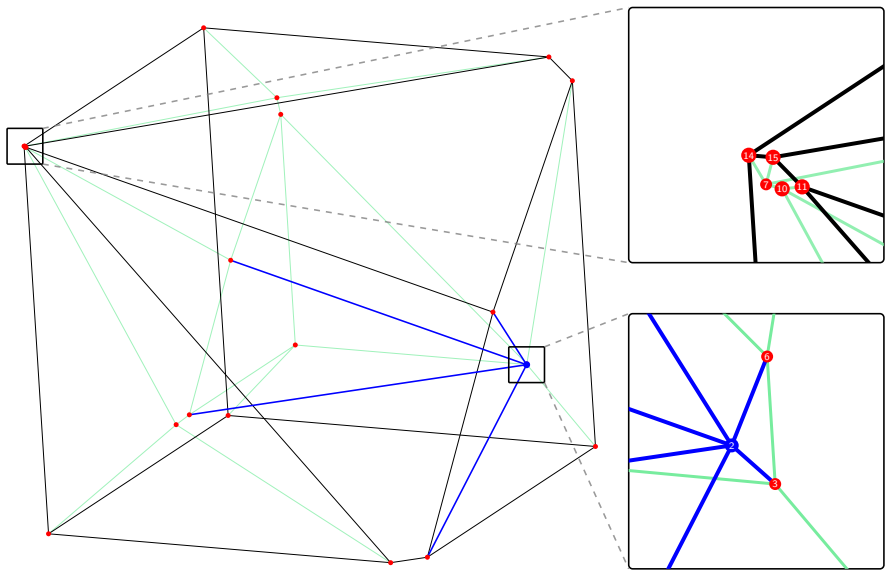
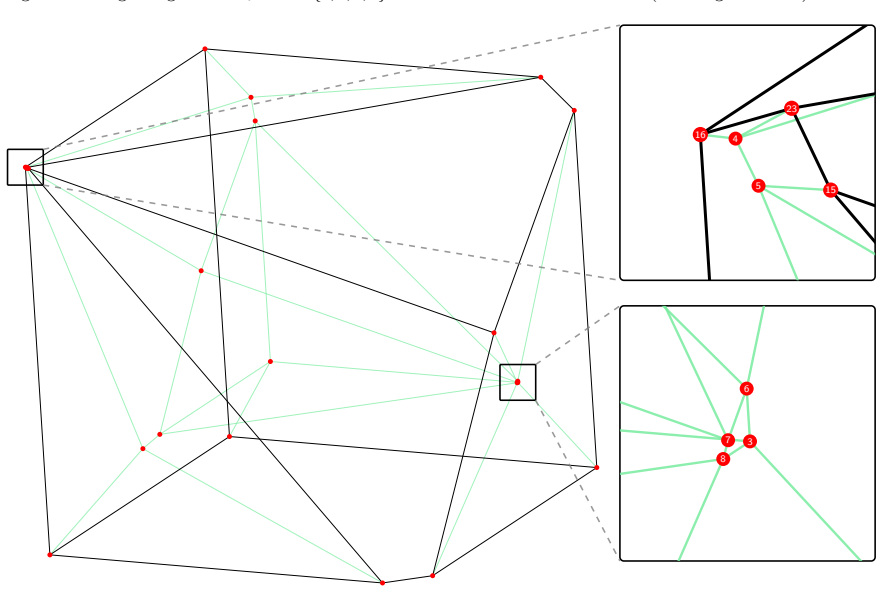
Contrary to the claim by Frieze and Teng, there exist instances of the Exact Partition problem for which the polytope defined by their inequalities is degenerate. The paper exhibits such an instance, describes conditions for degeneracy, and gives explicit details of a small degenerate Frieze-Teng polytope along with a non-degenerate one for an equivalent instance. These degenerate polytopes can be avoided by preprocessing for the purposes of existing complexity results.
What carries the argument
The Frieze-Teng polytope, defined by the inequalities in the Frieze-Teng integer linear programming formulation of Exact Partition, which is shown to be degenerate in some cases.
If this is right
- Degeneracy can occur in the LP relaxation of the Exact Partition formulation.
- Conditions for when degeneracy occurs can be identified.
- Equivalent instances can produce non-degenerate polytopes instead.
- A simple preprocessing step suffices to avoid degenerate cases in complexity analyses.
Where Pith is reading between the lines
- Users of the formulation in algorithms may encounter numerical or pivoting issues on degenerate instances.
- The choice of specific numbers in an Exact Partition instance can change the geometric properties of the relaxation.
- Similar degeneracy phenomena might appear in other partition-related polytope formulations.
Load-bearing premise
The constructed instance is a valid input to the Exact Partition problem and the associated polytope is exactly the one defined by the Frieze-Teng inequalities.
What would settle it
Verification that the presented instance does not produce a degenerate polytope, or is not a valid input, would falsify the central claim.
Figures

read the original abstract
In 1994, Frieze and Teng proposed an integer linear programming formulation of the NP-Complete Exact Partition problem, whose LP-relaxation they claimed was non-degenerate. Contrary to their claim, we show how an instance of Exact Partition can produce a degenerate polytope, and study conditions for which this can happen. We then give details of one of the smallest such degenerate Frieze-Teng polytopes, along with a closely related non-degenerate Frieze-Teng polytope that encodes an equivalent problem. We note that for the purposes of the complexity results in the literature that use their formulation, these degenerate polytopes can be avoided via a simple preprocessing step.
Editorial analysis
A structured set of objections, weighed in public.
Referee Report
Summary. The manuscript constructs an explicit instance of the Exact Partition problem whose Frieze-Teng polytope is degenerate, contrary to the 1994 claim that the LP relaxation is always non-degenerate. It identifies conditions under which degeneracy arises, supplies coordinates and inequality data for one of the smallest degenerate polytopes together with a closely related non-degenerate polytope for an equivalent instance, and observes that a simple preprocessing step removes the degeneracy for downstream complexity arguments.
Significance. If the explicit construction is correct, the note supplies a concrete, checkable counter-example that corrects an inaccuracy in the literature on polyhedral formulations of NP-complete problems. The paired degenerate/non-degenerate examples and the preprocessing observation are directly usable by researchers who rely on the Frieze-Teng formulation for complexity results.
minor comments (1)
- The abstract states that 'details of one of the smallest such degenerate Frieze-Teng polytopes' are given; the main text should explicitly label the section or subsection containing the vertex/facet list and the numerical verification that the polytope is degenerate.
Simulated Author's Rebuttal
We thank the referee for their positive assessment of the manuscript and their recommendation to accept.
Circularity Check
No significant circularity; explicit counter-example construction
full rationale
The paper's central result is an explicit, checkable counter-example instance of Exact Partition together with direct verification that the associated Frieze-Teng polytope is degenerate. This construction is performed from the original problem definition and inequality system; no step reduces a claimed prediction or uniqueness result to a fitted parameter, self-citation chain, or definitional renaming. The preprocessing observation is likewise a direct observation on the input instance rather than a derived claim. The derivation chain is therefore self-contained against external benchmarks.
Axiom & Free-Parameter Ledger
axioms (2)
- domain assumption The Frieze-Teng inequality system is a valid integer programming formulation of Exact Partition.
- standard math Degeneracy is defined by the existence of multiple bases for the same vertex in the LP relaxation.
Reference graph
Works this paper leans on
-
[1]
A. M. Frieze, S.-H. Teng, On the complex- ity of computing the diameter of a polytope, Comput. Complexity 4 (3) (1994) 207–219. doi:10.1007/BF01206636
-
[2]
Narayanan, T
K. Narayanan, T. Stephen, The hardness of monotone eccentricity on polytopes, in: N. Misra, A. Pandey (Eds.), Algorithms and Discrete Applied Mathematics, Springer Nature Switzerland, Cham, 2026, pp. 365–377
2026
-
[3]
R. M. Karp, Reducibility among combinatorial problems, in: Complexity of computer compu- tations(Proc.Sympos., IBMThomasJ.Watson Res. Center, Yorktown Heights, N.Y., 1972), The IBM Research Symposia Series, Plenum, New York-London, 1972, pp. 85–103
1972
-
[4]
Korte, R
B. Korte, R. Schrader, On the existence of fast approximation schemes, in: Nonlinear program- ming, 4 (Madison, Wis., 1980), Academic Press, New York-London, 1981, pp. 415–437
1980
-
[5]
A. E. Black, R. Steiner, Finding short paths on simple polytopes (2026). arXiv:2603.05482. URLhttps://arxiv.org/abs/2603.05482
work page internal anchor Pith review Pith/arXiv arXiv 2026
-
[6]
Narayanan, The complexity of monotone shortest paths on simple polytopes, M.Sc
K. Narayanan, The complexity of monotone shortest paths on simple polytopes, M.Sc. The- sis, Simon Fraser University (2025)
2025
-
[7]
Gawrilow, M
E. Gawrilow, M. Joswig, polymake: a framework for analyzing convex polytopes, in: Polytopes—combinatorics and computation (Oberwolfach, 1997), Vol. 29 of DMV Sem., Birkhäuser, Basel, 2000, pp. 43–73. 7
1997
discussion (0)
Sign in with ORCID, Apple, or X to comment. Anyone can read and Pith papers without signing in.