HyperSim: A Holistic Sim-To-Real Framework For Robust Robotic Manipulation
Pith reviewed 2026-06-29 17:20 UTC · model grok-4.3
The pith
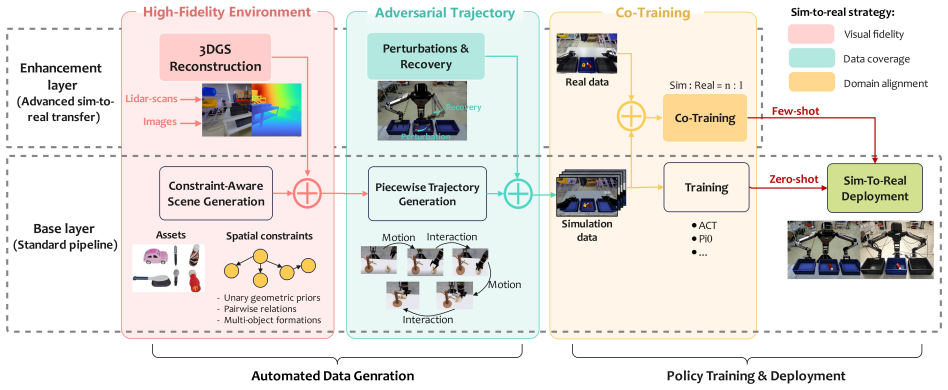
HyperSim uses three pillars to reach 80-95 percent sim-to-real success in robotic manipulation.
A machine-rendered reading of the paper's core claim, the machinery that carries it, and where it could break.
Core claim
HyperSim bridges the sim-to-real gap through high-fidelity environment synthesis to match visual details, adversarial trajectory generation to cover hard cases, and sim-and-real co-training to learn invariant features. Validated on 400 real executions, it delivers 80 percent success with ACT and 95 percent with π0 models, plus 35 percent better robustness to physical perturbations.
What carries the argument
The three core pillars of high-fidelity environment synthesis, adversarial trajectory generation, and sim-and-real co-training that together reduce visual, coverage, and representation gaps between simulation and reality.
If this is right
- The full pipeline produces 80 percent success when transferring ACT policies to physical robots.
- The full pipeline produces 95 percent success when transferring π0 policies to physical robots.
- Policies trained on the generated adversarial trajectories complete tasks at a 35 percent higher rate when facing physical perturbations.
- The combination of the three pillars reduces the effective domain gap enough for reliable deployment after limited real-world fine-tuning.
Where Pith is reading between the lines
- The same three-pillar structure could be applied to other robot skills such as navigation or assembly if the synthesis and co-training steps generalize.
- Future tests could check whether the co-training step still works with far fewer than 400 real executions to further cut data costs.
- The robustness improvement might compound in settings with multiple simultaneous uncertainties like moving obstacles and sensor noise.
Load-bearing premise
The three pillars together close the domain gap for the tested tasks without introducing new failure modes that the 400 real executions do not capture.
What would settle it
Additional real-world trials on the same tasks but with new variations in lighting, object properties, or dynamics that produce success rates well below 80 percent or 95 percent would indicate the claim does not hold.
Figures


read the original abstract
Scaling data volume and diversity is critical for generalizing embodied intelligence. While synthetic data generation offers a scalable alternative to expensive physical data acquisition, transferring robotic manipulation policies from simulation to the real world (sim-to-real) remains a formidable challenge due to the domain gap. This paper presents HyperSim, a holistic framework spanning from synthetic data generation to policy training and seamless real-world deployment. To systematically bridge the sim-to-real gap, HyperSim is realized through three core pillars: high-fidelity environment synthesis, adversarial trajectory generation, and sim-and-real co-training. Collectively, these modules address domain discrepancies by enhancing visual fidelity, expanding data coverage, and enforcing domain-invariant representations. We rigorously validate HyperSim through a large-scale empirical study involving 400 real-world task executions across two representative manipulation models. Assessed across three fine-grained metrics, our complete pipeline achieves remarkable sim-to-real success rates of 80% and 95% with ACT and \pi_{0}, respectively. Furthermore, policies trained on our adversarial trajectories exhibit significantly enhanced robustness against dynamic uncertainties, achieving a 35% higher completion rate under physical perturbations.
Editorial analysis
A structured set of objections, weighed in public.
Referee Report
Summary. The paper presents HyperSim, a holistic sim-to-real framework for robotic manipulation built on three pillars: high-fidelity environment synthesis, adversarial trajectory generation, and sim-and-real co-training. It claims that the complete pipeline achieves 80% success with ACT and 95% with π₀ across 400 real-world executions, plus a 35% robustness gain under perturbations, validated on three fine-grained metrics.
Significance. If the empirical claims hold with proper controls, the three-pillar design could meaningfully advance scalable sim-to-real transfer by jointly addressing visual fidelity, data coverage, and domain invariance. The large-scale real-world validation (400 executions) is a positive feature, but the absence of supporting details prevents assessing whether the gains are attributable to the proposed modules.
major comments (3)
- [Abstract] Abstract: the reported 80%/95% success rates and 35% robustness improvement are presented as aggregate outcomes from 400 executions with no baselines (e.g., non-adversarial or non-co-trained variants), no per-task counts, no variance or statistical tests, and no description of execution sampling. This directly undermines evaluation of whether the three pillars close the domain gap.
- [Abstract] Abstract: the claim that adversarial trajectories yield enhanced robustness lacks any comparison to the non-adversarial baseline on the same tasks and perturbations, making the 35% figure impossible to interpret as evidence for the second pillar.
- [Abstract] Abstract: no discussion of failure modes or whether the full pipeline introduces new ones not captured in the 400 executions, which is load-bearing for the weakest assumption that the pillars are jointly sufficient without side effects.
minor comments (1)
- [Abstract] The notation π₀ should be defined on first use or in a table of symbols for clarity.
Simulated Author's Rebuttal
We thank the referee for the careful reading and for identifying areas where the abstract's presentation of results could be strengthened. We address each major comment below. Where the abstract lacks explicit detail, we will revise it to improve self-containment while ensuring the body of the paper already supplies the supporting analyses.
read point-by-point responses
-
Referee: [Abstract] Abstract: the reported 80%/95% success rates and 35% robustness improvement are presented as aggregate outcomes from 400 executions with no baselines (e.g., non-adversarial or non-co-trained variants), no per-task counts, no variance or statistical tests, and no description of execution sampling. This directly undermines evaluation of whether the three pillars close the domain gap.
Authors: The abstract summarizes headline outcomes; the Experiments section and supplementary material contain the requested controls, including baseline variants without adversarial trajectories or co-training, per-task success counts, standard deviations across runs, and the randomized sampling protocol used for the 400 executions. To make these elements visible at the abstract level, we will add a concise clause referencing the controlled comparisons and statistical reporting. revision: yes
-
Referee: [Abstract] Abstract: the claim that adversarial trajectories yield enhanced robustness lacks any comparison to the non-adversarial baseline on the same tasks and perturbations, making the 35% figure impossible to interpret as evidence for the second pillar.
Authors: The 35% robustness gain is computed from paired experiments that directly compare policies trained with and without the adversarial trajectory module under identical perturbation conditions; these comparisons appear in Section 4.3. We will revise the abstract to explicitly state that the reported improvement is measured against the non-adversarial baseline on the same task set. revision: yes
-
Referee: [Abstract] Abstract: no discussion of failure modes or whether the full pipeline introduces new ones not captured in the 400 executions, which is load-bearing for the weakest assumption that the pillars are jointly sufficient without side effects.
Authors: Failure-mode analysis, including cases where the full pipeline does not improve or introduces new error patterns, is presented in the supplementary material and briefly summarized in the discussion section. The abstract will be updated to note that no novel failure modes attributable to the combined pipeline were observed beyond those already present in the individual components. revision: yes
Circularity Check
No circularity: claims are direct empirical measurements from real executions
full rationale
The paper reports success rates (80%/95%) and robustness gains (35%) as outcomes of 400 real-world task executions across two models. The abstract and provided text contain no equations, no fitted parameters renamed as predictions, no self-citations used to justify uniqueness or ansatzes, and no derivation chain that reduces to its own inputs. The three pillars are presented as engineering components whose joint effect is measured externally rather than derived by construction. This is a standard empirical validation case with no load-bearing circular steps.
Axiom & Free-Parameter Ledger
axioms (1)
- domain assumption Domain discrepancies can be addressed by enhancing visual fidelity, expanding data coverage, and enforcing domain-invariant representations.
Reference graph
Works this paper leans on
-
[1]
OpenVLA: An Open-Source Vision-Language-Action Model
M. Kim, K. Pertsch, S. Karamcheti, T. Xiao, A. Balakrishna, S. Nair, R. Rafailov, E. Foster, G. Lam, P. Sanketi, Q. Vuong, T. Kollar, B. Burch- fiel, R. Tedrake, D. Sadigh, S. Levine, P. Liang, and C. Finn, “Open- vla: An open-source vision-language-action model,”arXiv preprint arXiv:2406.09246, 2024
work page internal anchor Pith review Pith/arXiv arXiv 2024
-
[2]
RDT-1B: a Diffusion Foundation Model for Bimanual Manipulation
S. Liu, L. Wu, B. Li, H. Tan, H. Chen, Z. Wang, K. Xu, H. Su, and J. Zhu, “Rdt-1b: a diffusion foundation model for bimanual manipula- tion,”arXiv preprint arXiv:2410.07864, 2024. TABLE V SPATIALRELATIONCONSTRAINTS Name Description scale(OBJ, RANGE) scale OBJ within the RANGE pose2D(OBJ, RANGE) randomize OBJ 2D pose within the RANGE pose3D(OBJ, RANGE) ran...
work page internal anchor Pith review Pith/arXiv arXiv 2024
-
[3]
Robocasa: Large-scale simulation of ev- eryday tasks for generalist robots,
S. Nasiriany, A. Maddukuri, L. Zhang, A. Parikh, A. Lo, A. Joshi, A. Mandlekar, and Y . Zhu, “Robocasa: Large-scale simulation of ev- eryday tasks for generalist robots,” inRobotics: Science and Systems (RSS), 2024
2024
-
[4]
Robomind: Benchmark on multi-embodiment intelligence normative data for robot manipulation,
K. Wu, C. Hou, J. Liu, Z. Che, X. Ju, Z. Yang, M. Li, Y . Zhao, Z. Xu, G. Yanget al., “Robomind: Benchmark on multi-embodiment intelligence normative data for robot manipulation,” inRobotics: Science and Systems (RSS) 2025. Robotics: Science and Systems Foundation, 2025. [Online]. Available: https://www.roboticsproceedings.org/rss21/p152.pdf
2025
-
[5]
Twinaligner: Visual-dynamic alignment empowers physics-aware real2sim2real for robotic manipulation,
H. Fan, H. Dai, J. Zhang, J. Li, Q. Yan, Y . Zhao, M. Gao, J. Wu, H. Tang, and H. Dong, “Twinaligner: Visual-dynamic alignment empowers physics-aware real2sim2real for robotic manipulation,” 2025. [Online]. Available: https://arxiv.org/abs/2512.19390
-
[6]
$\pi_{0.5}$: a Vision-Language-Action Model with Open-World Generalization
P. Intelligence, K. Black, N. Brown, J. Darpinian, K. Dhabalia, D. Driess, A. Esmail, M. Equi, C. Finn, N. Fusai, M. Y . Galliker, D. Ghosh, L. Groom, K. Hausman, B. Ichter, S. Jakubczak, T. Jones, L. Ke, D. LeBlanc, S. Levine, A. Li-Bell, M. Mothukuri, S. Nair, K. Pertsch, A. Z. Ren, L. X. Shi, L. Smith, J. T. Springenberg, K. Stachowicz, J. Tanner, Q. V...
work page internal anchor Pith review Pith/arXiv arXiv 2025
-
[7]
Gen-0: Embodied foundation models that scale with physical interaction,
G. A. Team, “Gen-0: Embodied foundation models that scale with physical interaction,”Generalist AI Blog, 2025, https://generalistai.com/blog/nov-04-2025-GEN-0
2025
-
[8]
Y . Wang, Z. Xian, F. Chen, T.-H. Wang, Y . Wang, K. Fragkiadaki, Z. Erickson, D. Held, and C. Gan, “Robogen: Towards unleashing infinite data for automated robot learning via generative simulation,” arXiv preprint arXiv:2311.01455, 2023
-
[9]
MimicGen: A Data Generation System for Scalable Robot Learning using Human Demonstrations
A. Mandlekar, S. Nasiriany, B. Wen, I. Akinola, Y . Narang, L. Fan, Y . Zhu, and D. Fox, “Mimicgen: A data generation system for scalable robot learning using human demonstrations,”arXiv preprint arXiv:2310.17596, 2023
work page internal anchor Pith review Pith/arXiv arXiv 2023
-
[10]
Scaling up and distilling down: Language-guided robot skill acquisition,
H. Ha, P. Florence, and S. Song, “Scaling up and distilling down: Language-guided robot skill acquisition,” 2023
2023
-
[11]
Gensim2: Scaling robot data generation with multi-modal and reason- ing llms,
P. Hua, M. Liu, A. Macaluso, Y . Lin, W. Zhang, H. Xu, and L. Wang, “Gensim2: Scaling robot data generation with multi-modal and reason- ing llms,” in8th Annual Conference on Robot Learning
-
[12]
T. Chen, Z. Chen, B. Chen, Z. Cai, Y . Liu, Z. Li, Q. Liang, X. Lin, Y . Ge, Z. Guet al., “Robotwin 2.0: A scalable data generator and benchmark with strong domain randomization for robust bimanual robotic manipulation,”arXiv preprint arXiv:2506.18088, 2025
work page internal anchor Pith review Pith/arXiv arXiv 2025
-
[13]
Ascent: Autonomous skill learning toward complex embodied tasks with foundation models,
H. Wu, Y . Liu, J. Dong, H. Zhang, S. Mao, H. Wang, W. Wu, and S. Zhou, “Ascent: Autonomous skill learning toward complex embodied tasks with foundation models,” in2025 IEEE International Conference on Robotics and Automation (ICRA). IEEE, 2025, pp. 16 752–16 758
2025
-
[14]
Interndata-a1: Pioneering high-fidelity synthetic data for pre-training generalist policy
Y . Tian, Y . Yang, Y . Xie, Z. Cai, X. Shi, N. Gao, H. Liu, X. Jiang, Z. Qiu, F. Yuan, Y . Li, P. Wang, J. Cai, J. Zeng, H. Dong, and J. Pang, “Interndata-a1: Pioneering high-fidelity synthetic data for pre-training generalist policy,” 2025. [Online]. Available: https://arxiv.org/abs/2511.16651
-
[15]
B. Kerbl, G. Kopanas, T. Leimkuehler, and G. Drettakis, “3d gaussian splatting for real-time radiance field rendering,”ACM Trans. Graph., vol. 42, no. 4, Jul. 2023. [Online]. Available: https://doi.org/10.1145/3592433
-
[16]
In: ACM SIGGRAPH 2024 Conference Pa- pers
B. Huang, Z. Yu, A. Chen, A. Geiger, and S. Gao, “2d gaussian splatting for geometrically accurate radiance fields,” inACM SIGGRAPH 2024 Conference Papers, ser. SIGGRAPH ’24. New York, NY , USA: Association for Computing Machinery, 2024. [Online]. Available: https://doi.org/10.1145/3641519.3657428
-
[17]
Pgsr: Planar-based gaussian splatting for efficient and high-fidelity surface reconstruction,
D. Chen, H. Li, W. Ye, Y . Wang, W. Xie, S. Zhai, N. Wang, H. Liu, H. Bao, and G. Zhang, “Pgsr: Planar-based gaussian splatting for efficient and high-fidelity surface reconstruction,”IEEE Transactions on Visualization and Computer Graphics, vol. 31, no. 9, pp. 6100–6111, 2025
2025
-
[18]
Novel demonstration generation with gaussian splatting enables robust one-shot manipulation,
S. Yang, W. Yu, J. Zeng, J. Lv, K. Ren, C. Lu, D. Lin, and J. Pang, “Novel demonstration generation with gaussian splatting enables robust one-shot manipulation,” 2025. [Online]. Available: https://arxiv.org/abs/2504.13175
-
[19]
Coarse-to-fine imitation learning: Robot manipulation from a single demonstration,
E. Johns, “Coarse-to-fine imitation learning: Robot manipulation from a single demonstration,” in2021 IEEE international conference on robotics and automation (ICRA). IEEE, 2021, pp. 4613–4619
2021
-
[20]
Learning multi-stage tasks with one demon- stration via self-replay,
N. Di Palo and E. Johns, “Learning multi-stage tasks with one demon- stration via self-replay,” inConference on Robot Learning. PMLR, 2022, pp. 1180–1189
2022
-
[21]
A. Wei, A. Agarwal, B. Chen, R. Bosworth, N. Pfaff, and R. Tedrake, “Empirical analysis of sim-and-real cotraining of diffusion policies for planar pushing from pixels,” 2025. [Online]. Available: https://arxiv.org/abs/2503.22634
-
[22]
Sim-and-real co-training: A sim- ple recipe for vision-based robotic manipulation,
A. Maddukuri, Z. Jiang, L. Y . Chen, S. Nasiriany, Y . Xie, Y . Fang, W. Huang, Z. Wang, Z. Xu, N. Chernyadev, S. Reed, K. Goldberg, A. Mandlekar, L. Fan, and Y . Zhu, “Sim-and-real co-training: A sim- ple recipe for vision-based robotic manipulation,” inProceedings of Robotics: Science and Systems (RSS), Los Angeles, CA, USA, 2025
2025
-
[23]
Invariance co-training for robot visual generalization,
J. Yang, C. Finn, and D. Sadigh, “Invariance co-training for robot visual generalization,” 2025. [Online]. Available: https://arxiv.org/abs/2512.05230
-
[24]
Gpgs: Geometric priors for 3d gaussian splatting in structural environments,
Z. Xu, W. Chen, S. Wang, Z. Ouyang, S. Bian, and S. Zhou, “Gpgs: Geometric priors for 3d gaussian splatting in structural environments,” in2025 IEEE/RSJ International Conference on Intelligent Robots and Systems (IROS), 2025, pp. 15 695–15 702
2025
-
[25]
O3DE Documentation,
Open 3D Foundation, “O3DE Documentation,” 2021. [Online]. Available: https://docs.o3de.org
2021
discussion (0)
Sign in with ORCID, Apple, or X to comment. Anyone can read and Pith papers without signing in.