Absolutely indecomposable quasi-parabolic G-bundles and the multiplicity of irreducible characters
Pith reviewed 2026-07-01 16:06 UTC · model grok-4.3
The pith
The multiplicity of the tensor product of irreducible characters of finite reductive groups admits a geometric interpretation via absolutely indecomposable quasi-parabolic G-bundles over P^1 equipped with generic additive character varietie
A machine-rendered reading of the paper's core claim, the machinery that carries it, and where it could break.
Core claim
Absolutely indecomposable quasi-parabolic G-bundles over P^1 with generic additive character varieties give a geometric interpretation of the multiplicity of the tensor product of irreducible characters of finite reductive groups.
What carries the argument
Absolutely indecomposable quasi-parabolic G-bundles over P^1 with generic additive character varieties, which carry the geometric data that encodes the character multiplicities.
If this is right
- The multiplicity equals a geometric invariant extracted from the moduli space of these bundles.
- Geometric methods from algebraic geometry become available for computing or bounding character multiplicities.
- The construction extends known results on parabolic vector bundles to general G-bundles.
- Generic additive character varieties parametrize the data needed to read off the multiplicities.
- Indecomposability conditions on the bundles correspond to conditions on the representations being counted.
Where Pith is reading between the lines
- The same bundles might yield interpretations for other representation-theoretic quantities such as fusion coefficients.
- Moduli spaces of these bundles could be compared to known varieties like character varieties or quiver varieties for explicit calculations.
- The interpretation might extend from P^1 to other curves, allowing geometric proofs of identities in character theory.
- Computational geometry software could be used to evaluate the multiplicities for small groups.
Load-bearing premise
The geometry and numerical invariants of these bundles on P^1 directly encode the multiplicities arising in the tensor product of irreducible characters.
What would settle it
For a concrete finite reductive group and pair of irreducible characters, compute the multiplicity algebraically and compare it to the dimension or Euler characteristic of the corresponding moduli space of absolutely indecomposable quasi-parabolic G-bundles with generic additive character; any mismatch disproves the interpretation.
Figures
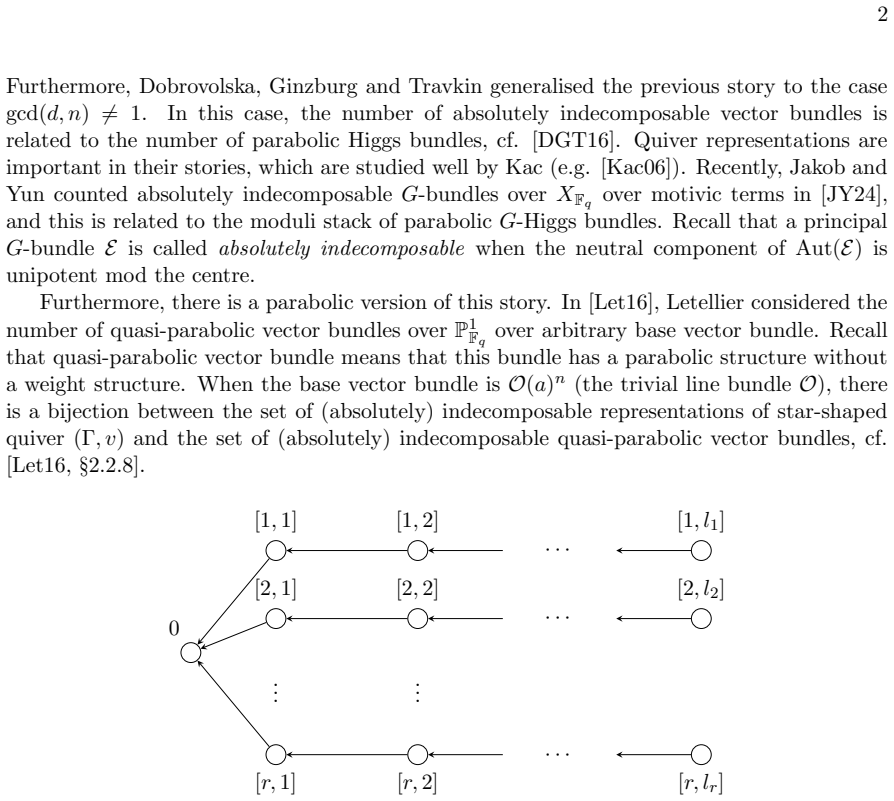
read the original abstract
Absolutely indecomposable vector bundle and parabolic vector bundles are well-studied via quiver representations. In this paper, we study absolutely indecomposable quasi-parabolic $G$-bundles over $\mathbb{P}^1$ with generic additive character varieties. Furthermore, we give a geometric interpretation of the multiplicity of the tensor product of irreducible characters of finite reductive groups using generic additive character varieties.
Editorial analysis
A structured set of objections, weighed in public.
Referee Report
Summary. The manuscript studies absolutely indecomposable quasi-parabolic G-bundles over P^1 equipped with generic additive character varieties, extending known results on absolutely indecomposable vector bundles and parabolic bundles via quiver representations. It claims to furnish a geometric interpretation of the multiplicity of tensor products of irreducible characters of finite reductive groups in terms of these character varieties.
Significance. If the claimed correspondence were established with an explicit invariant (dimension, Euler characteristic, or point count) matching the multiplicity, the work would connect the moduli geometry of bundles on P^1 to the representation theory of finite groups of Lie type. No such explicit link, theorem, or computation is supplied in the manuscript, so the potential significance cannot be evaluated.
major comments (1)
- [Abstract] Abstract: the central claim asserts that the geometry of absolutely indecomposable quasi-parabolic G-bundles over P^1 with generic additive character varieties directly encodes the multiplicity of tensor products of irreducible characters, yet no invariant of the character variety is identified as equaling this multiplicity and no explicit correspondence or theorem establishing the equality is stated.
Simulated Author's Rebuttal
We thank the referee for their report and the opportunity to clarify the presentation of our main claim. We address the single major comment below.
read point-by-point responses
-
Referee: [Abstract] Abstract: the central claim asserts that the geometry of absolutely indecomposable quasi-parabolic G-bundles over P^1 with generic additive character varieties directly encodes the multiplicity of tensor products of irreducible characters, yet no invariant of the character variety is identified as equaling this multiplicity and no explicit correspondence or theorem establishing the equality is stated.
Authors: We acknowledge that the abstract summarizes the geometric interpretation without identifying a concrete invariant of the character variety (such as a dimension, Euler characteristic, or point count) or stating an explicit equality as a theorem. The body of the manuscript constructs the relevant character varieties and develops their relation to the bundles, but we agree that a precise statement linking the multiplicity directly to one of these invariants would make the claimed correspondence fully explicit. We will revise the introduction and abstract accordingly in the next version. revision: yes
Circularity Check
No significant circularity identified
full rationale
The provided abstract and description contain no equations, derivations, or load-bearing steps that reduce by construction to inputs, self-definitions, fitted predictions, or self-citation chains. The central claim is a geometric interpretation via character varieties, presented as a contribution without visible internal reduction to prior fitted values or renamed results within the text. No quotes exhibit the enumerated circularity patterns, so the derivation chain is treated as self-contained against external benchmarks.
Axiom & Free-Parameter Ledger
Reference graph
Works this paper leans on
-
[1]
[Car93] R. W. Carter,Finite groups of Lie type(1993), xii+544. Conjugacy classes and complex characters, Reprint of the 1985 original, A Wiley-Interscience Publication. [Der81] D. I. Deriziotis,Centralizers of semisimple elements in a Chevalley group, Communications in Algebra9(1981), no. 19, 1997–2014. [DGT16] G. Dobrovolska, V. Ginzburg, and R. Travkin,...
work page internal anchor Pith review Pith/arXiv arXiv 1993
-
[2]
Giannini, M
[GKNW] S. Giannini, M. Kamgarpour, G. Nam, and B. Whitbread,Counting points on character varieties, To appear in Mathematical Research Letters. [HLRV11] T. Hausel, E. Letellier, and F. Rodriguez-Villegas,Arithmetic harmonic analysis on character and quiver varieties, Duke Mathematical Journal160(2011), no. 2, 323–400. [HLRV13] T. Hausel, E. Letellier, and...
2011
-
[3]
[HSTZ13] G. Heide, J. Saxl, P. H. Tiep, and A. E. Zalesski,Conjugacy action, induced representations and the Steinberg square for simple groups of Lie type, Proceedings of the London Mathematical Society 106(2013), no. 4, 908–930. [JY24] K. Jakob and Z. Yun,Counting absolutely indecomposableG-bundles, arXiv preprint arXiv:2412.19116 (2024). [Kac06] V. G. ...
-
[4]
Laszlo and C
28 [LS97] Y. Laszlo and C. Sorger,The line bundles on the moduli of parabolicG-bundles over curves and their sections, Annales Scientifiques de l’ ´Ecole Normale Sup´ erieure. Quatri` eme S´ erie30(1997), no. 4, 499–525. [Let05] E. Letellier,Fourier transforms of invariant functions on finite reductive Lie algebras, Lecture Notes in Mathematics, vol. 1859...
1997
-
[5]
Higgs bundles and indecomposable parabolic bundles over the projective line
[Let13a] E. Letellier,Tensor products of unipotent characters of general linear groups over finite fields, Trans- formation Groups18(2013), no. 1, 233–262. [Let13b] E. Letellier,Quiver varieties and the character ring of general linear groups over finite fields, Journal of the European Mathematical Society15(2013), no. 4, 1375–1455. [Let16] E. Letellier,H...
work page internal anchor Pith review Pith/arXiv arXiv 2013
discussion (0)
Sign in with ORCID, Apple, or X to comment. Anyone can read and Pith papers without signing in.