Why Can't They Remember? Uncovering Representation and Retrieval Bottlenecks in Multi-Turn Acoustic Memory
Pith reviewed 2026-07-01 16:09 UTC · model grok-4.3
The pith
Representational trajectory drift, not attention, causes large audio models to forget non-speech sounds across conversation turns.
A machine-rendered reading of the paper's core claim, the machinery that carries it, and where it could break.
Core claim
EnvMem isolates representation and retrieval in multi-turn acoustic tasks and demonstrates that latent embedding trajectories for non-speech sounds drift over successive turns, producing retrieval failures, while interventions on attention allocation produce only marginal recovery.
What carries the argument
The EnvMem benchmark, which uses controlled multi-turn dialogues and post-hoc interventions to separate latent embedding drift from attention allocation.
If this is right
- Training objectives that penalize embedding drift over time should narrow the gap between speech and non-speech retention.
- Attention-only architectural changes are unlikely to fix long-context acoustic memory on their own.
- Data collection for LALMs should prioritize sequences that preserve acoustic embedding stability across turns.
- The same benchmark can be used to compare drift rates across different model scales and training regimes.
Where Pith is reading between the lines
- Similar embedding drift may limit memory for visual or other non-linguistic cues in multimodal models that share the same transformer backbone.
- Regularization terms added during fine-tuning to keep acoustic embeddings anchored could be tested directly on EnvMem.
- If drift accumulates linearly with turn count, shorter context windows or periodic re-embedding steps become practical mitigations.
Load-bearing premise
The EnvMem tasks and interventions cleanly separate representation drift from attention effects without interference from particular model architectures or training histories.
What would settle it
A result in which targeted attention interventions on the same models and tasks produce large, consistent gains in non-speech retention would contradict the limited-role claim for attention.
Figures






read the original abstract
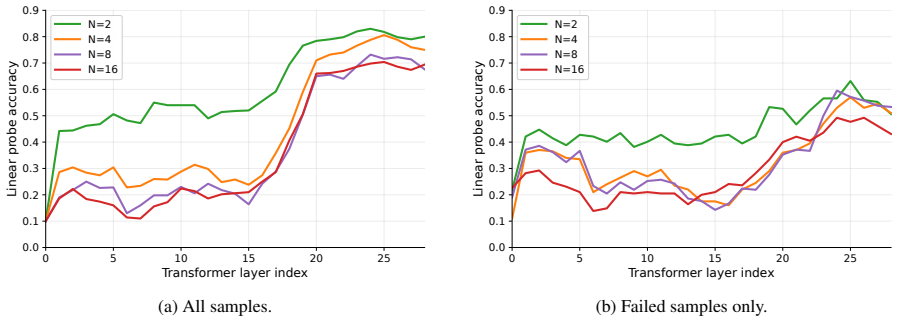
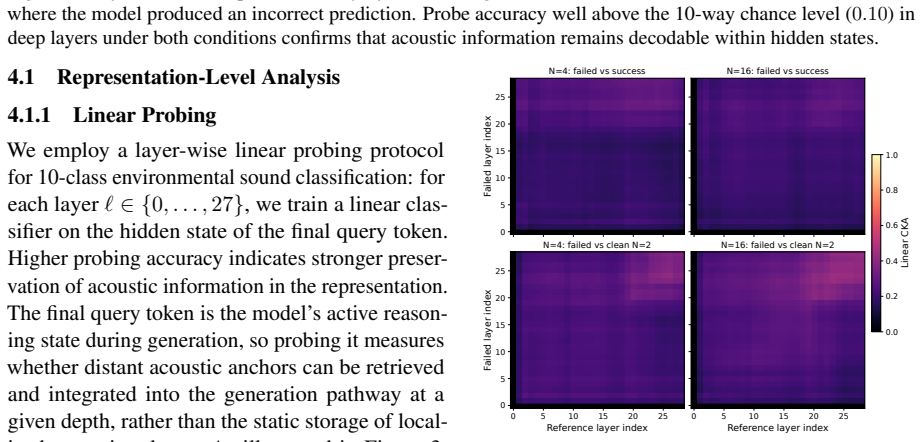
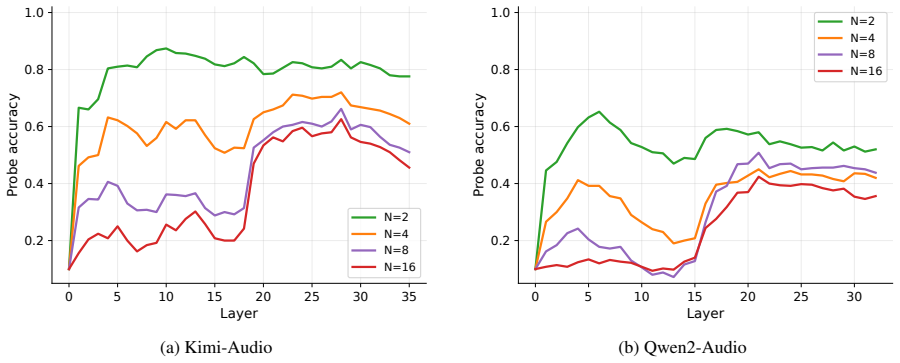
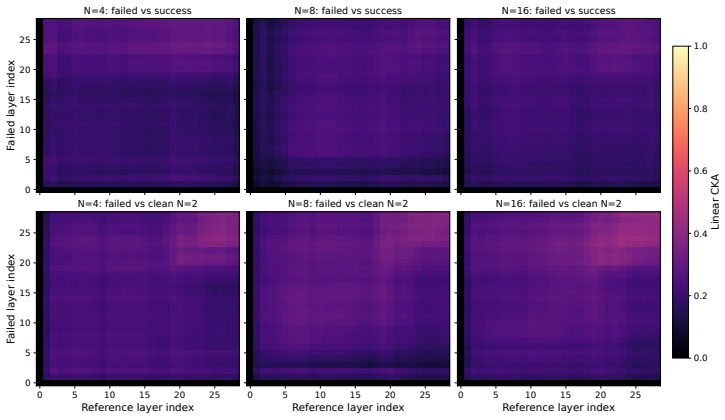
Large audio language models (LALMs) process both speech and environmental acoustic cues, yet struggle to retain non-speech information across multi-turn interactions. The performance gap between semantic (speech) and acoustic (non-speech) understanding remains poorly understood, and the underlying mechanisms of representation and retrieval are still unclear. This work introduces EnvMem, a controlled multi-turn benchmark designed to study this gap and identify the root causes of failures at the representation (i.e., latent embeddings) and retrieval levels (i.e., attention allocation). We further conduct post-hoc interventions to probe representational structure and attention dynamics. Our results reveal representational trajectory drift as the key failure mode, while showing that attention allocation plays a limited role in explaining the observed degradation. Overall, we provide a systematic framework for analyzing and improving non-linguistic memory in long-context LALMs, shedding light on future data and training design for robust acoustic memory modeling.
Editorial analysis
A structured set of objections, weighed in public.
Referee Report
Summary. The paper introduces EnvMem, a controlled multi-turn benchmark for large audio language models (LALMs), to diagnose performance gaps between semantic (speech) and acoustic (non-speech) understanding. Using post-hoc interventions on latent embeddings and attention mechanisms, it identifies representational trajectory drift as the dominant failure mode in retaining non-speech cues across turns, while concluding that attention allocation explains little of the observed degradation. The work positions EnvMem as a framework for analyzing and improving non-linguistic memory in long-context LALMs.
Significance. If the central attribution holds after addressing isolation concerns, the result would offer a concrete diagnostic lens for acoustic memory failures in LALMs and guide future training and data design toward representation stability rather than attention mechanisms. The benchmark itself could become a reusable testbed, provided generality across architectures is demonstrated.
major comments (3)
- [Abstract, §4] Abstract and §4 (Interventions): The claim that post-hoc interventions cleanly isolate representational trajectory drift from retrieval relies on the assumption that attention masking or embedding perturbations do not introduce model-specific confounds or alter the other component. No explicit verification (e.g., embedding similarity checks post-attention edit or ablation across multiple LALMs) is described, leaving the attribution vulnerable to entanglement with pretraining distributions or architecture choices.
- [§3] §3 (EnvMem benchmark): The benchmark tasks are presented as isolating representation vs. retrieval bottlenecks, yet the manuscript provides no quantitative controls (multiple LALMs, intervention side-effect ablations, or statistical tests on degradation trajectories) to rule out task- or model-specific artifacts. This directly affects the load-bearing conclusion that drift is the key failure mode.
- [Results] Results section (trajectory analysis): Without reported error bars, run-to-run variance, or falsification tests (e.g., whether forced attention reallocation recovers performance independently of embedding drift), the statement that attention plays a 'limited role' remains under-supported relative to the strength of the claim.
minor comments (2)
- [§2] Notation for 'trajectory drift' should be defined formally (e.g., via a distance metric on embeddings over turns) rather than left descriptive.
- [Figures] Figure captions for intervention results should include the exact number of models and turns evaluated to allow reproducibility assessment.
Simulated Author's Rebuttal
We thank the referee for the constructive and detailed feedback. We address each major comment point by point below, clarifying our methodological choices and indicating where revisions will be made to strengthen the claims.
read point-by-point responses
-
Referee: [Abstract, §4] Abstract and §4 (Interventions): The claim that post-hoc interventions cleanly isolate representational trajectory drift from retrieval relies on the assumption that attention masking or embedding perturbations do not introduce model-specific confounds or alter the other component. No explicit verification (e.g., embedding similarity checks post-attention edit or ablation across multiple LALMs) is described, leaving the attribution vulnerable to entanglement with pretraining distributions or architecture choices.
Authors: We agree that explicit verification would reinforce the isolation claim. Our interventions were constructed to target distinct mechanisms (direct embedding perturbation for representation, masking for retrieval), and observed differential effects on speech vs. non-speech retention support separation. In revision we will add post-intervention embedding similarity analyses and cosine-distance checks to quantify any cross-component leakage. Experiments were performed on representative open LALMs; we will expand the discussion of architecture dependence and note this as a limitation while adding one additional model ablation where feasible. revision: yes
-
Referee: [§3] §3 (EnvMem benchmark): The benchmark tasks are presented as isolating representation vs. retrieval bottlenecks, yet the manuscript provides no quantitative controls (multiple LALMs, intervention side-effect ablations, or statistical tests on degradation trajectories) to rule out task- or model-specific artifacts. This directly affects the load-bearing conclusion that drift is the key failure mode.
Authors: EnvMem tasks were explicitly designed with matched speech/non-speech content and fixed turn structure to isolate the two bottlenecks. We report trajectory degradation curves that differentiate the two failure modes. We will add statistical significance tests on the drift trajectories and side-effect ablations in the revision. While results focus on the primary evaluated LALMs, the benchmark itself is model-agnostic; we will clarify this and discuss generality as a direction for future work rather than claiming exhaustive coverage. revision: partial
-
Referee: [Results] Results section (trajectory analysis): Without reported error bars, run-to-run variance, or falsification tests (e.g., whether forced attention reallocation recovers performance independently of embedding drift), the statement that attention plays a 'limited role' remains under-supported relative to the strength of the claim.
Authors: We will revise the results section to report error bars, run-to-run variance, and add falsification experiments that test forced attention reallocation while holding embeddings fixed. These additions will provide direct evidence for the limited explanatory power of attention allocation relative to representational drift. revision: yes
Circularity Check
No circularity; empirical benchmark and interventions are independent of claims
full rationale
The paper introduces EnvMem as a new controlled benchmark and applies post-hoc interventions to measure representational drift versus attention effects. No equations, fitted parameters, or derivations are presented in the abstract or described text. The central claim (drift as dominant failure mode) is framed as an empirical observation from the benchmark results rather than a mathematical reduction to inputs or a self-citation chain. No self-definitional loops, renamed known results, or load-bearing self-citations appear. This is a standard empirical analysis setup with no evidence that any prediction reduces to its own construction.
Axiom & Free-Parameter Ledger
Reference graph
Works this paper leans on
-
[1]
Qwen2-audio technical report.Preprint, arXiv:2407.10759. Wenqian Cui, Dianzhi Yu, Xiaoqi Jiao, Ziqiao Meng, Guangyan Zhang, Qichao Wang, Steven Y Guo, and Irwin King. 2025. Recent advances in speech lan- guage models: A survey. InProceedings of the 63rd Annual Meeting of the Association for Computational Linguistics (Volume 1: Long Papers), pages 13943– 1...
work page internal anchor Pith review Pith/arXiv arXiv 2025
-
[2]
Style amnesia: Investigating speaking style degradation and mitigation in multi-turn spoken lan- guage models.arXiv preprint arXiv:2512.23578. Nelson F Liu, Kevin Lin, John Hewitt, Ashwin Paran- jape, Michele Bevilacqua, Fabio Petroni, and Percy Liang. 2024. Lost in the middle: How language mod- els use long contexts.Transactions of the association for co...
work page internal anchor Pith review Pith/arXiv arXiv 2024
-
[3]
Roles must alternate strictly: odd turns are "user", even turns are"assistant"
-
[4]
It must not imply location, setting, environment, sound, or scene
Turn 1 in "turns" must describe an ordinary daily task or concern. It must not imply location, setting, environment, sound, or scene
-
[5]
Turns 2–15 should be natural casual conversation that drifts away from turn 1 without abrupt topic jumps
-
[6]
Turn 16 in both variants must be exactly <PROBE_PLACEHOLDER>with role"user". 5."semantic_parallel" should closely mirror the style and trajectory of"turns", but turn 1 must embed one concrete text-only fact suitable for later probing (e.g., a name, number, weekday, date, room number, or item count)
-
[7]
Do not include any environment or scene cues any- where in turns 1–15 of either variant
-
[8]
Keep wording conversational, concise, and varied across samples; avoid repeating the same dialogue structure. Forbidden words in turns 1–15 of either variant: rain, sunny, weather, outside, inside, noisy, quiet, loud, echo, background, cafe, restaurant, office, home, street, traffic, dog, cat, baby, music, engine, car, wind, thunder, fire, wave, sea, stor...
work page 2019
discussion (0)
Sign in with ORCID, Apple, or X to comment. Anyone can read and Pith papers without signing in.