Temperature-resolved sensitivities of ⁵⁶{rm Ni} production to helium-burning reactions in pair-instability supernovae
Pith reviewed 2026-07-01 16:16 UTC · model grok-4.3
The pith
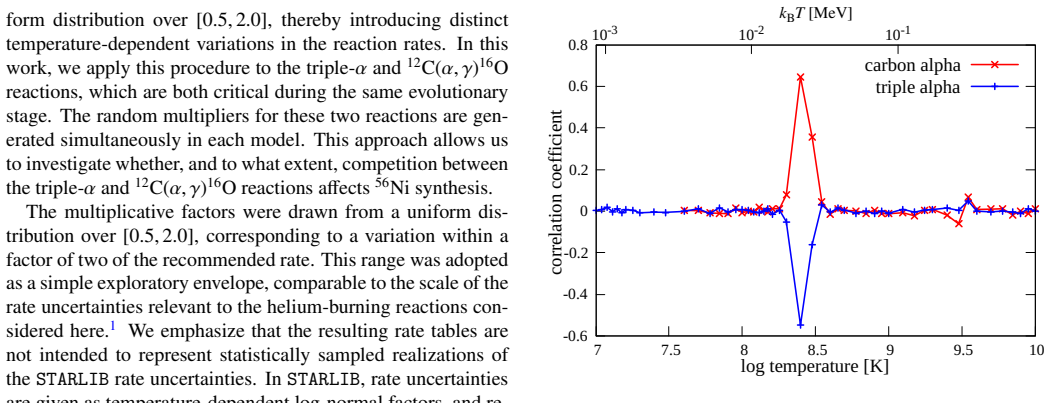
Helium-burning reaction rates most strongly affect nickel-56 production in pair-instability supernovae at temperatures near 250 million kelvin.
A machine-rendered reading of the paper's core claim, the machinery that carries it, and where it could break.
Core claim
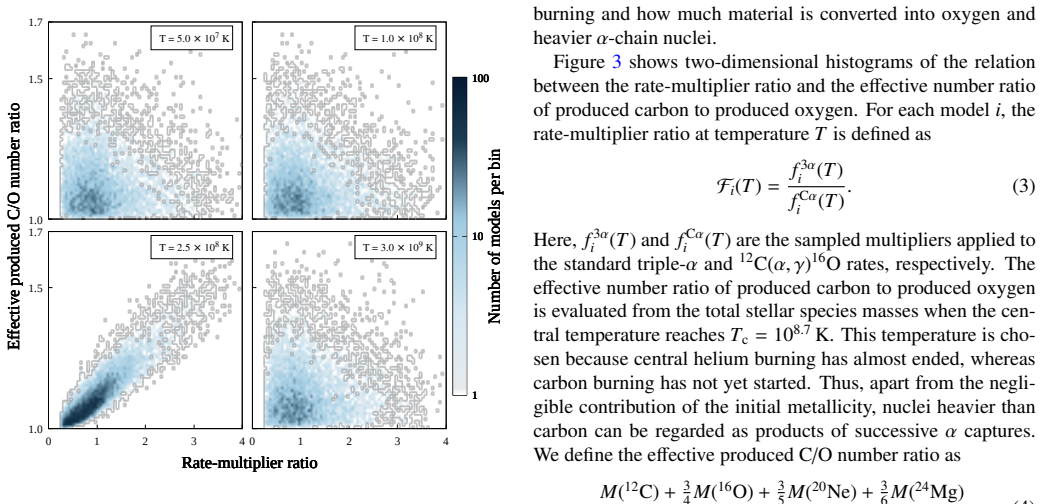
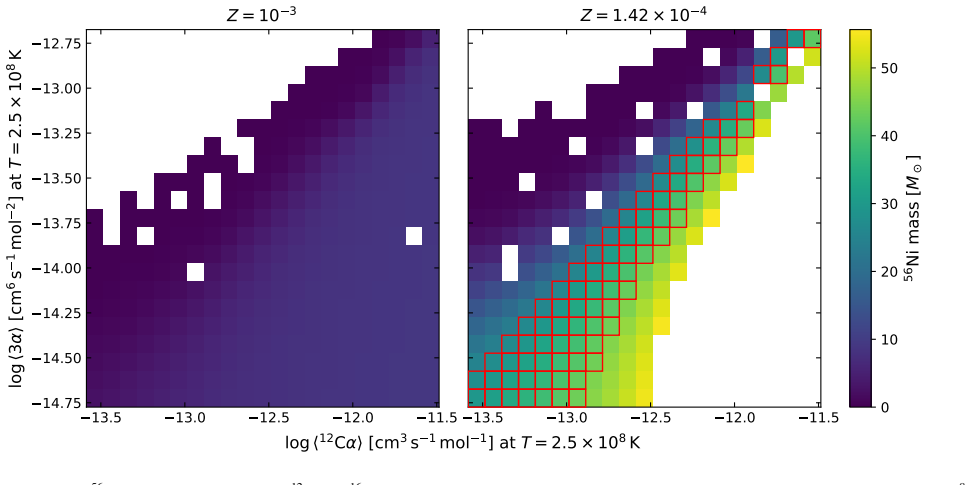
By performing thousands of MESA calculations of pair-instability supernovae with varied multipliers on the triple-alpha and 12C(alpha,gamma)16O rates, the authors demonstrate that 56Ni production exhibits its strongest sensitivity to both reactions at T approximately 2.5 times 10^8 K, with opposite correlation signs, because this is the temperature at which the ratio of the sampled rate multipliers is most clearly imprinted on the pre-carbon-burning C/O composition.
What carries the argument
Temperature-resolved Monte Carlo sampling of helium-burning rate multipliers within pair-instability supernova progenitor calculations.
If this is right
- The pre-carbon-burning C/O ratio directly encodes the ratio of the two helium-burning rate multipliers evaluated at 2.5 times 10^8 K.
- The final 56Ni yield traces back to this narrow temperature window rather than to conditions at higher temperatures.
- PISN nucleosynthesis therefore functions as a probe of low-energy helium-burning rates inside a specific temperature interval.
- Opposite correlation signs imply that coordinated changes in the two rates can produce larger net shifts in the yield than either rate alone.
- The temperature-resolved approach isolates which segment of each rate curve controls the outcome.
Where Pith is reading between the lines
- The same sampling method could be applied to other explosion channels to locate rate sensitivities in different temperature windows.
- If the C/O imprint is observationally confirmed, abundance patterns in metal-poor stars could indirectly constrain the low-temperature behavior of these rates.
- Models of the subsequent explosive phase could be simplified by fixing the C/O ratio according to the helium-rate ratio at the identified temperature.
- Uncertainties from convective mixing or other reactions might still shift the location of peak sensitivity once included.
Load-bearing premise
The assumption that varying only the two helium-burning rates in MESA models while holding all other inputs fixed isolates the temperature-dependent sensitivity without other nuclear or mixing uncertainties dominating the 56Ni yield variation.
What would settle it
A calculation in which the 56Ni yield variation stays large when the rates at 2.5 times 10^8 K are held fixed, or becomes insensitive when only those rates are varied, would falsify the dominance of that temperature regime.
Figures
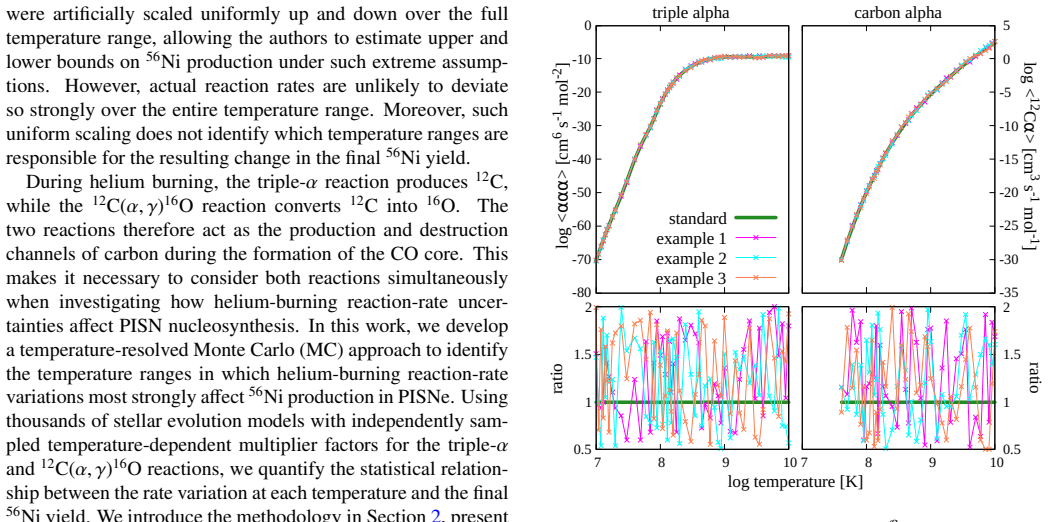
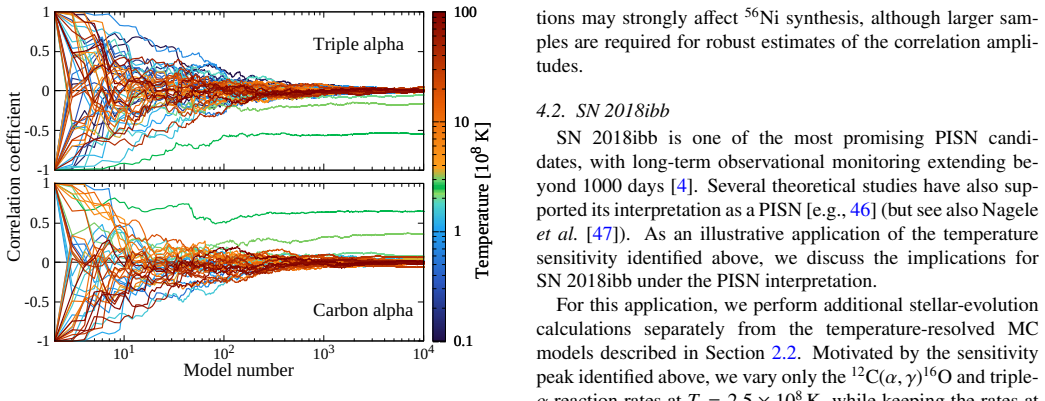
read the original abstract
We propose a temperature-resolved Monte Carlo (MC) approach to identify the temperature regimes in which low-energy helium-burning reaction rates most strongly affect nucleosynthesis in very massive stars that undergo pair-instability supernovae (PISNe). By performing MC simulations of PISNe, we quantify how temperature-dependent variations in key helium-burning reaction rates, i.e., the triple-$\alpha$ and $^{12}{\rm C}(\alpha,\gamma)^{16}{\rm O}$ rates, influence $^{56}{\rm Ni}$ synthesis. Thousands of stellar evolution calculations using $\texttt{MESA}$ reveal that both the $^{12}{\rm C}(\alpha,\gamma)^{16}{\rm O}$ and triple-$\alpha$ reactions exhibit their strongest sensitivity at $T \simeq 2.5 \times 10^{8}\,{\rm K}$, but with opposite correlation signs. We show that this temperature corresponds to the regime in which the ratio of the sampled rate multipliers is most clearly imprinted on the pre-carbon-burning C/O composition. This demonstrates that PISN nucleosynthesis can probe helium-burning reaction rates in specific low-temperature regimes.
Editorial analysis
A structured set of objections, weighed in public.
Referee Report
Summary. The paper proposes a temperature-resolved Monte Carlo method using thousands of MESA stellar evolution runs to quantify how temperature-dependent variations in the triple-α and 12C(α,γ)16O rates affect 56Ni yields in pair-instability supernovae. It reports that both reactions show peak sensitivity at T ≃ 2.5 × 10^8 K (with opposite correlation signs) because this regime imprints the ratio of sampled rate multipliers most clearly on the pre-carbon-burning C/O composition.
Significance. If the isolation of the two helium-burning rates holds and the temperature peak is robust, the result offers a concrete way to link specific low-temperature nuclear regimes to observable PISN nucleosynthesis outcomes, potentially aiding constraints on helium-burning rates from supernova yields or chemical evolution models.
major comments (2)
- [Methods] Methods (MC sampling and temperature binning): the central claim that the sensitivity peak at T ≃ 2.5 × 10^8 K is a genuine imprint of the rate-multiplier ratio on the C/O ratio (rather than an artifact of post-hoc binning or the restricted parameter space) requires explicit verification that the temperature-dependent multiplier sampling and binning choices do not shift or create the reported peak location; without this, the temperature-specific correlation cannot be taken as robust.
- [Methods] Methods (isolation of helium rates): the assumption that varying only the triple-α and 12C(α,γ)16O rates while holding all other inputs fixed cleanly isolates the temperature-dependent sensitivity is load-bearing, yet the manuscript does not quantify whether comparable 56Ni variations arise from rates active at higher temperatures (e.g., 12C+12C, 16O+16O) or from convective mixing parameters; if unaddressed, the reported peak could be an artifact of the restricted parameter space.
minor comments (1)
- [Abstract] Abstract and §3: the phrasing 'the ratio of the sampled rate multipliers is most clearly imprinted' should be accompanied by a quantitative metric (e.g., correlation coefficient or variance explained) rather than qualitative description.
Simulated Author's Rebuttal
We thank the referee for their constructive comments, which help clarify the robustness of our temperature-resolved Monte Carlo analysis. We respond to each major comment below.
read point-by-point responses
-
Referee: [Methods] Methods (MC sampling and temperature binning): the central claim that the sensitivity peak at T ≃ 2.5 × 10^8 K is a genuine imprint of the rate-multiplier ratio on the C/O ratio (rather than an artifact of post-hoc binning or the restricted parameter space) requires explicit verification that the temperature-dependent multiplier sampling and binning choices do not shift or create the reported peak location; without this, the temperature-specific correlation cannot be taken as robust.
Authors: We appreciate the referee's emphasis on verifying that the reported peak is not an artifact of our post-hoc temperature binning or sampling choices. To address this, we performed additional tests using alternative bin widths (0.05 dex and 0.15 dex) and different Monte Carlo sampling strategies for the rate multipliers (including uniform vs. log-uniform distributions). These checks confirm that the sensitivity peak location remains stable near 2.5 × 10^8 K across variations. We will incorporate these verification results, including new supplementary figures, into the revised manuscript. revision: yes
-
Referee: [Methods] Methods (isolation of helium rates): the assumption that varying only the triple-α and 12C(α,γ)16O rates while holding all other inputs fixed cleanly isolates the temperature-dependent sensitivity is load-bearing, yet the manuscript does not quantify whether comparable 56Ni variations arise from rates active at higher temperatures (e.g., 12C+12C, 16O+16O) or from convective mixing parameters; if unaddressed, the reported peak could be an artifact of the restricted parameter space.
Authors: We acknowledge that our approach restricts variations to the two helium-burning rates to isolate their temperature-dependent imprint on the pre-carbon C/O ratio. While rates such as 12C+12C and 16O+16O act at higher temperatures and convective mixing can alter yields, our focus is specifically on the helium-burning regime that sets the initial C/O composition for PISN nucleosynthesis. We will add a dedicated discussion paragraph citing literature estimates of the relative impact of these other parameters and explicitly note the limitations of the restricted parameter space. A full multi-rate study lies beyond the present scope but would be a natural extension. revision: partial
Circularity Check
No significant circularity detected
full rationale
The paper performs Monte Carlo variations of the triple-α and 12C(α,γ)16O rates inside the external MESA code to map temperature-dependent effects on 56Ni yields. The reported peak sensitivity at T ≃ 2.5 × 10^8 K is an output of those numerical experiments rather than a quantity defined in terms of itself or recovered by construction from a fitted parameter. No load-bearing step reduces to a self-citation chain or an ansatz smuggled from prior work by the same authors; the derivation remains self-contained against the external stellar-evolution framework.
Axiom & Free-Parameter Ledger
axioms (2)
- domain assumption MESA stellar evolution code accurately captures the structural response of very massive stars to helium-burning rate changes
- domain assumption Other nuclear rates and mixing parameters remain fixed while only triple-alpha and 12C(alpha,gamma)16O are varied
Reference graph
Works this paper leans on
-
[1]
Barkat, G
Z. Barkat, G. Rakavy, and N. Sack, Physical Review Let- ters18, 379 (1967)
1967
-
[2]
C. L. Fryer, S. E. Woosley, and A. Heger, Astrophysical Journal550, 372 (2001), arXiv:astro-ph/0007176 [astro- ph]
work page internal anchor Pith review Pith/arXiv arXiv 2001
-
[3]
How Massive Single Stars End their Life
A. Heger, C. L. Fryer, S. E. Woosley, N. Langer, and D. H. Hartmann, Astrophysical Journal591, 288 (2003), arXiv:astro-ph/0212469 [astro-ph]
work page internal anchor Pith review Pith/arXiv arXiv 2003
-
[4]
S. Schulze, C. Fransson, A. Kozyreva, T.-W. Chen, O. Yaron, A. Jerkstrand, A. Gal-Yam, J. Sollerman, L. Yan, T. Kangas, G. Leloudas, C. M. B. Omand, S. J. Smartt, Y . Yang, M. Nicholl, N. Sarin, Y . Yao, T. G. Brink, A. Sharon, A. Rossi, P. Chen, Z. Chen, A. Cikota, K. De, A. J. Drake, A. V . Filippenko, C. Fremling, L. Fréour, J. P. U. Fynbo, A. Y . Q. H...
-
[5]
C. Tur, A. Heger, and S. M. Austin, Astrophysical Journal 702, 1068 (2009), arXiv:0809.0291 [astro-ph]
work page internal anchor Pith review Pith/arXiv arXiv 2009
-
[6]
C. Tur, A. Heger, and S. M. Austin, Astrophysical Journal 718, 357 (2010), arXiv:0908.4283 [astro-ph.SR]
work page internal anchor Pith review Pith/arXiv arXiv 2010
-
[7]
Evolutionary implications of the new triple-alpha nuclear reaction rate for low mass stars
A. Dotter and B. Paxton, Astronomy and Astrophysics 507, 1617 (2009), arXiv:0905.2397 [astro-ph.SR]
work page internal anchor Pith review Pith/arXiv arXiv 2009
-
[8]
T. Suda, R. Hirschi, and M. Y . Fujimoto, Astrophysical Journal741, 61 (2011), arXiv:1107.4984 [astro-ph.SR]
work page internal anchor Pith review Pith/arXiv arXiv 2011
-
[9]
Y . Kikuchi, M.-a. Hashimoto, M. Ono, and R. Fukuda, Progress of Theoretical and Experimental Physics2015, 063E01 (2015), arXiv:1410.7476 [astro-ph.SR]
work page internal anchor Pith review Pith/arXiv arXiv 2015
-
[10]
A. Tanikawa, T. J. Moriya, N. Tominaga, and N. Yoshida, Monthly Notices of the Royal Astronomical Society519, L32 (2023), arXiv:2204.09402 [astro-ph.HE]
-
[11]
F. Tognini, G. Valle, M. Dell’Omodarme, S. Degl’Innocenti, and P. G. Prada Moroni, Astronomy and Astrophysics679, A75 (2023), arXiv:2310.05745 [astro-ph.SR]
- [12]
-
[13]
R. J. deBoer, J. Görres, M. Wiescher, R. E. Azuma, A. Best, C. R. Brune, C. E. Fields, S. Jones, M. Pig- natari, D. Sayre, K. Smith, F. X. Timmes, and E. Uberseder, Reviews of Modern Physics89, 035007 (2017), arXiv:1709.03144 [nucl-ex]
work page internal anchor Pith review Pith/arXiv arXiv 2017
-
[14]
H. O. U. Fynbo, C. A. Diget, U. C. Bergmann, M. J. G. Borge, J. Cederkäll, P. Dendooven, L. M. Fraile, S. Fran- choo, V . N. Fedosseev, B. R. Fulton, W. Huang, J. Huikari, H. B. Jeppesen, A. S. Jokinen, P. Jones, B. Jonson, U. Köster, K. Langanke, M. Meister, T. Nilsson, G. Ny- man, Y . Prezado, K. Riisager, S. Rinta-Antila, O. Teng- blad, M. Turrion, Y ....
2005
-
[15]
T. Kibédi, B. Alshahrani, A. E. Stuchbery, A. C. Larsen, A. Görgen, S. Siem, M. Guttormsen, F. Giacoppo, A. I. Morales, E. Sahin, G. M. Tveten, F. L. B. Garrote, L. C. Campo, T. K. Eriksen, M. Klintefjord, S. Mahar- ramova, H. T. Nyhus, T. G. Tornyi, T. Renstrøm, and W. Paulsen, Physical Review Letters125, 182701 (2020), arXiv:2009.10915 [nucl-ex]
-
[16]
The Low Detection Rate of Pair Instability Supernovae and the Effect of the Core Carbon Fraction
K. Takahashi, Astrophysical Journal863, 153 (2018), arXiv:1807.05373 [astro-ph.HE]
work page internal anchor Pith review Pith/arXiv arXiv 2018
-
[17]
H. Kawashimo, R. Sawada, Y . Suwa, T. J. Moriya, A. Tanikawa, and N. Tominaga, Monthly Notices of the Royal Astronomical Society531, 2786 (2024), arXiv:2306.01682 [astro-ph.SR]
-
[18]
Modules for Experiments in Stellar Astrophysics (MESA)
B. Paxton, L. Bildsten, A. Dotter, F. Herwig, P. Lesaffre, and F. Timmes, Astrophysical Journal Supplement Series 192, 3 (2011), arXiv:1009.1622 [astro-ph.SR]
work page internal anchor Pith review Pith/arXiv arXiv 2011
-
[19]
B. Paxton, M. Cantiello, P. Arras, L. Bildsten, E. F. Brown, A. Dotter, C. Mankovich, M. H. Montgomery, D. Stello, F. X. Timmes, and R. Townsend, Astro- physical Journal Supplement Series208, 4 (2013), arXiv:1301.0319 [astro-ph.SR]
work page internal anchor Pith review Pith/arXiv arXiv 2013
-
[20]
Modules for Experiments in Stellar Astrophysics (MESA): Binaries, Pulsations, and Explosions
B. Paxton, P. Marchant, J. Schwab, E. B. Bauer, L. Bild- sten, M. Cantiello, L. Dessart, R. Farmer, H. Hu, N. Langer, R. H. D. Townsend, D. M. Townsley, and F. X. Timmes, Astrophysical Journal Supplement Series220, 15 (2015), arXiv:1506.03146 [astro-ph.SR]
work page internal anchor Pith review Pith/arXiv arXiv 2015
-
[21]
B. Paxton, J. Schwab, E. B. Bauer, L. Bildsten, S. Blin- nikov, P. Duffell, R. Farmer, J. A. Goldberg, P. Marchant, E. Sorokina, A. Thoul, R. H. D. Townsend, and F. X. Timmes, Astrophysical Journal Supplement Series234, 34 (2018), arXiv:1710.08424 [astro-ph.SR]
work page internal anchor Pith review Pith/arXiv arXiv 2018
-
[22]
B. Paxton, R. Smolec, J. Schwab, A. Gautschy, L. Bild- sten, M. Cantiello, A. Dotter, R. Farmer, J. A. Gold- berg, A. S. Jermyn, S. M. Kanbur, P. Marchant, A. Thoul, R. H. D. Townsend, W. M. Wolf, M. Zhang, and F. X. Timmes, Astrophysical Journal Supplement Series243, 10 (2019), arXiv:1903.01426 [astro-ph.SR]
work page internal anchor Pith review Pith/arXiv arXiv 2019
-
[23]
A. S. Jermyn, E. B. Bauer, J. Schwab, R. Farmer, W. H. Ball, E. P. Bellinger, A. Dotter, M. Joyce, P. Marchant, J. S. G. Mombarg, W. M. Wolf, T. L. Sunny Wong, G. C. Cinquegrana, E. Farrell, R. Smolec, A. Thoul, M. Cantiello, F. Herwig, O. Toloza, L. Bildsten, R. H. D. Townsend, and F. X. Timmes, Astrophysical Journal Sup- plement Series265, 15 (2023), ar...
-
[24]
F. J. Rogers and A. Nayfonov, Astrophysical Journal576, 1064 (2002)
2002
-
[25]
Saumon, G
D. Saumon, G. Chabrier, and H. M. van Horn, Astrophys- ical Journal Supplement Series99, 713 (1995)
1995
-
[26]
A. W. Irwin, The freeeos code for calculating the equation of state for stellar interiors (2004)
2004
-
[27]
F. X. Timmes and F. D. Swesty, Astrophysical Journal Supplement Series126, 501 (2000)
2000
-
[28]
A. Y . Potekhin and G. Chabrier, Contributions to Plasma Physics50, 82 (2010), arXiv:1001.0690 [physics.plasm- ph] . 7
work page internal anchor Pith review Pith/arXiv arXiv 2010
-
[29]
C. A. Iglesias and F. J. Rogers, Astrophysical Journal412, 752 (1993)
1993
-
[30]
C. A. Iglesias and F. J. Rogers, Astrophysical Journal464, 943 (1996)
1996
- [31]
-
[32]
J. R. Buchler and W. R. Yueh, Astrophysical Journal210, 440 (1976)
1976
-
[33]
S. Cassisi, A. Y . Potekhin, A. Pietrinferni, M. Catelan, and M. Salaris, Astrophysical Journal661, 1094 (2007), astro- ph/0703011
-
[34]
R. H. Cyburt, A. M. Amthor, R. Ferguson, Z. Meisel, K. Smith, S. Warren, A. Heger, R. D. Hoffman, T. Rauscher, A. Sakharuk, H. Schatz, F. K. Thielemann, and M. Wiescher, Astrophysical Journal Supplement Se- ries189, 240 (2010)
2010
-
[35]
G. M. Fuller, W. A. Fowler, and M. J. Newman, Astro- physical Journal293, 1 (1985)
1985
-
[36]
T. Oda, M. Hino, K. Muto, M. Takahara, and K. Sato, Atomic Data and Nuclear Data Tables56, 231 (1994)
1994
-
[37]
K. Langanke and G. Martínez-Pinedo, Nuclear Physics A 673, 481 (2000), nucl-th/0001018
work page internal anchor Pith review Pith/arXiv arXiv 2000
-
[38]
A. I. Chugunov, H. E. Dewitt, and D. G. Yakovlev, Phys- ical Review D76, 025028 (2007), arXiv:0707.3500
work page internal anchor Pith review Pith/arXiv arXiv 2007
-
[39]
N. Itoh, H. Hayashi, A. Nishikawa, and Y . Kohyama, As- trophysical Journal Supplement Series102, 411 (1996)
1996
-
[40]
P. Marchant, M. Renzo, R. Farmer, K. M. W. Pappas, R. E. Taam, S. E. de Mink, and V . Kalogera, Astrophysical Jour- nal882, 36 (2019), arXiv:1810.13412 [astro-ph.HE]
-
[41]
A. L. Sallaska, C. Iliadis, A. E. Champange, S. Goriely, S. Starrfield, and F. X. Timmes, Astrophysical Jour- nal Supplement Series207, 18 (2013), arXiv:1304.7811 [astro-ph.SR]
work page internal anchor Pith review Pith/arXiv arXiv 2013
-
[42]
Angulo, M
C. Angulo, M. Arnould, M. Rayet, P. Descouvemont, D. Baye, C. Leclercq-Willain, A. Coc, S. Barhoumi, P. Aguer, C. Rolfs, R. Kunz, J. W. Hammer, A. Mayer, T. Paradellis, S. Kossionides, C. Chronidou, K. Spy- rou, S. degl’Innocenti, G. Fiorentini, B. Ricci, S. Za- vatarelli, C. Providencia, H. Wolters, J. Soares, C. Grama, J. Rahighi, A. Shotter, and M. Lam...
1999
-
[43]
R. Kunz, M. Fey, M. Jaeger, A. Mayer, J. W. Hammer, G. Staudt, S. Harissopulos, and T. Paradellis, Astrophysi- cal Journal567, 643 (2002)
2002
-
[44]
N. Nishimura, C. Fröhlich, and T. Rauscher, Monthly Notices of the Royal Astronomical Society546, stag152 (2026), arXiv:2511.01859 [astro-ph.SR]
-
[45]
K. Takahashi, T. Yoshida, H. Umeda, K. Sumiyoshi, and S. Yamada, Monthly Notices of the Royal Astronomi- cal Society456, 1320 (2016), arXiv:1511.03040 [astro- ph.SR]
work page internal anchor Pith review Pith/arXiv arXiv 2016
-
[46]
A. Kozyreva, L. Shingles, P. Baklanov, A. Mironov, and F. R. N. Schneider, Astronomy and Astrophysics689, A60 (2024), arXiv:2405.20009 [astro-ph.HE]
- [47]
-
[48]
F. Gabrielli, A. Lapi, L. Boco, C. Ugolini, G. Costa, C. Sgalletta, K. Shepherd, U. N. Di Carlo, A. Bressan, M. Limongi, and M. Spera, Monthly Notices of the Royal Astronomical Society534, 151 (2024), arXiv:2408.16823 [astro-ph.HE]
-
[49]
F. Simonato, S. Torniamenti, M. Mapelli, G. Io- rio, L. Boco, F. De Domenico-Langer, and C. Sgal- letta, Astronomy and Astrophysics703, A215 (2025), arXiv:2505.07959 [astro-ph.HE] . 8
discussion (0)
Sign in with ORCID, Apple, or X to comment. Anyone can read and Pith papers without signing in.