Constraining Gravitational Wave Memory with Hierarchical Inference
Pith reviewed 2026-06-29 15:29 UTC · model grok-4.3
The pith
Hierarchical Bayesian inference on current binary black hole events constrains the memory enhancement factor to a value consistent with general relativity.
A machine-rendered reading of the paper's core claim, the machinery that carries it, and where it could break.
Core claim
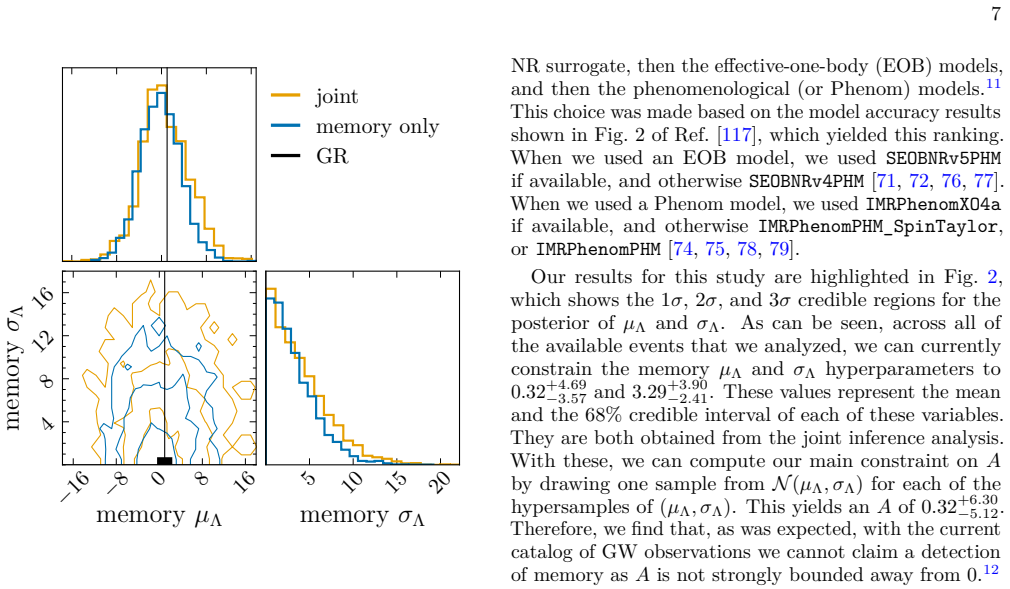
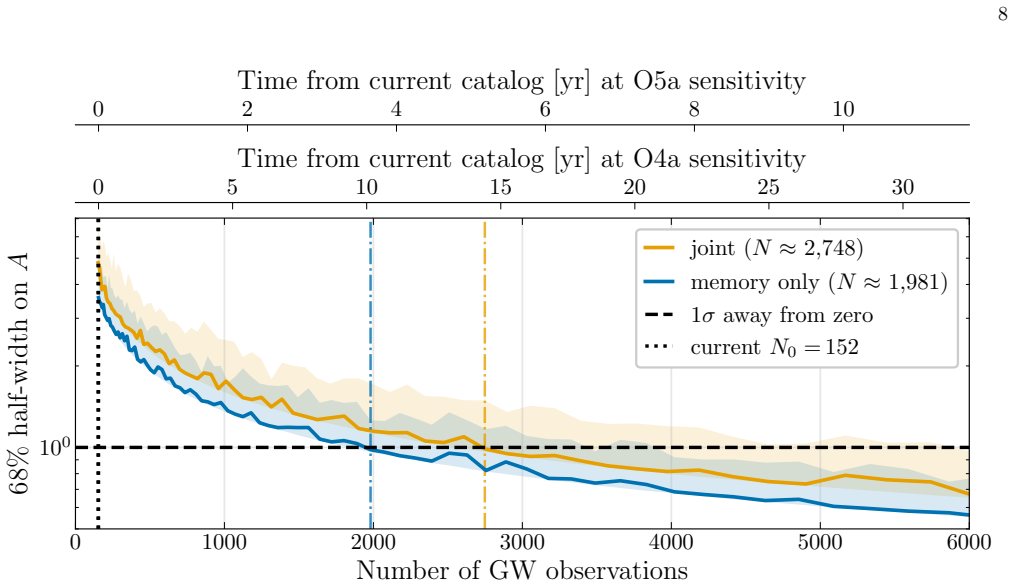
Using hierarchical Bayesian inference on the catalog of binary black hole observations, the memory enhancement factor is measured to be 0.26 with uncertainties of minus 4.08 to plus 4.09 at the 68 percent credible interval, consistent with its general relativity value of 1. The work forecasts that approximately 2000 detections will be needed to constrain the memory enhancement factor away from zero at the 1 sigma level.
What carries the argument
The memory enhancement factor, the constant that multiplies the supermomentum flux contribution to the gravitational wave strain, constrained through hierarchical inference on the population of events.
If this is right
- Current observations remain consistent with the general relativity prediction for the memory effect but do not yet yield a detection.
- The hierarchical method combines information from many events in a way that is robust to certain prior choices.
- Constraints on the memory effect will tighten as the number of detections grows.
- The same population-level approach can be applied to test other nonlinear predictions of gravity.
Where Pith is reading between the lines
- The framework could be extended to search for deviations in other strong-field nonlinear effects once more events accumulate.
- If the factor is found away from 1 with larger catalogs, it could point either to new physics or to unaccounted waveform or selection systematics.
- Next-generation detectors with higher event rates might reach the required sample size faster than current instruments.
Load-bearing premise
The hierarchical model is assumed to correctly incorporate all selection effects, waveform modeling uncertainties, and noise properties of the catalog such that any residual bias does not systematically shift the inferred memory enhancement factor.
What would settle it
Future data with a few thousand events producing a posterior on the memory enhancement factor that excludes 1 at high significance would test whether the general relativity prediction holds under the model.
Figures

read the original abstract
With the multitude of gravitational wave observations that have been made in the past ten years, probing the dynamical and nonlinear nature of strong gravity is becoming more and more feasible. One promising way to test the nonlinear nature of Einstein's theory of general relativity (GR) is through the gravitational wave null memory effect: a nonlinear prediction of GR which corresponds to initially comoving observers being permanently displaced due to a burst of gravitational radiation. Previous studies have shown that, while it is unlikely that the memory effect will be observed in a single event by the LIGO-Virgo-KAGRA (LVK) detectors, evidence for memory in the population of LVK events should be attainable after $\sim$2,000 gravitational wave detections. These works, however, largely relied on Bayes factors to perform their memory analyses: an approach that can depend sensitively on the analysis priors and, when naively multiplied across many events, can even favor incorrect conclusions. In this work, using the GWTC-5.0 catalog of binary black hole observations, we instead perform hierarchical Bayesian inference -- which is not subject to the issues associated with Bayes factors -- to measure the evidence for memory in current LVK observations. We find that we can constrain what we call the memory enhancement factor -- the constant appearing in front of the contribution to the strain from the supermomentum flux -- to $0.26_{-4.08}^{+4.09}$ (with $\pm$ values denoting the 68\% credible interval), consistent with its GR value of 1. We also forecast that $\sim$2,000 detections will be needed to constrain the memory enhancement factor away from zero at the $1\sigma$ level.
Editorial analysis
A structured set of objections, weighed in public.
Referee Report
Summary. The paper claims that hierarchical Bayesian inference applied to the GWTC-5.0 binary black hole catalog constrains the memory enhancement factor (the constant prefactor on the supermomentum-flux contribution to the strain) to 0.26_{-4.08}^{+4.09} (68% credible interval), consistent with its GR value of 1, while previous Bayes-factor approaches are shown to be prior-sensitive; it further forecasts that ~2000 detections will be required to exclude zero at 1σ.
Significance. If the hierarchical model is correctly specified, the work supplies a prior-independent population-level test of a nonlinear GR prediction that improves on earlier Bayes-factor analyses. The explicit forecast supplies a concrete observational target. The manuscript does not report machine-checked proofs or fully reproducible code, but the hierarchical formulation itself is a methodological strength.
major comments (2)
- [Abstract] Abstract: the reported 68% interval 0.26_{-4.08}^{+4.09} includes zero and negative values; this renders the statement of consistency with the GR value of 1 true but uninformative, and the claim that the data support the GR prediction therefore requires additional quantitative support (e.g., a Bayes factor or posterior odds relative to a no-memory model) that is not supplied.
- [Abstract] Abstract (and the hierarchical-model description): the central result and the 2000-event forecast rest on the assumption that the hierarchical likelihood fully marginalizes over catalog selection effects, waveform modeling uncertainties, and detector noise such that no residual systematic shifts the memory-enhancement-factor posterior; no validation tests, sensitivity analyses, or explicit checks against injected memory signals are described, making this assumption load-bearing for both the numerical constraint and the scaling projection.
minor comments (1)
- The abstract refers to "previous studies" on Bayes-factor analyses but does not supply the corresponding citations in the excerpt provided.
Simulated Author's Rebuttal
We thank the referee for their constructive comments on our manuscript. We address each major comment below and outline the revisions we will make to strengthen the presentation of our results.
read point-by-point responses
-
Referee: [Abstract] Abstract: the reported 68% interval 0.26_{-4.08}^{+4.09} includes zero and negative values; this renders the statement of consistency with the GR value of 1 true but uninformative, and the claim that the data support the GR prediction therefore requires additional quantitative support (e.g., a Bayes factor or posterior odds relative to a no-memory model) that is not supplied.
Authors: We agree that the broad posterior renders the consistency statement with the GR value of 1 somewhat uninformative on its own. The central contribution of the work is the demonstration that hierarchical inference yields a prior-independent posterior on the memory enhancement factor. To supply the requested quantitative support, we will compute and report the posterior odds between the model with free memory enhancement factor and a no-memory model (enhancement factor fixed at zero) and include this comparison in the revised abstract and results section. revision: yes
-
Referee: [Abstract] Abstract (and the hierarchical-model description): the central result and the 2000-event forecast rest on the assumption that the hierarchical likelihood fully marginalizes over catalog selection effects, waveform modeling uncertainties, and detector noise such that no residual systematic shifts the memory-enhancement-factor posterior; no validation tests, sensitivity analyses, or explicit checks against injected memory signals are described, making this assumption load-bearing for both the numerical constraint and the scaling projection.
Authors: The hierarchical likelihood is formulated to marginalize over per-event parameters while incorporating selection effects through the detection probability term and using the standard GWTC-5.0 posterior samples that already account for waveform and noise modeling. We acknowledge, however, that the manuscript would benefit from explicit validation. In the revision we will add a dedicated subsection presenting sensitivity analyses to selection effects, waveform uncertainties, and injection-recovery tests with simulated memory signals to confirm that no residual systematics bias the memory-enhancement-factor posterior or the scaling forecast. revision: yes
Circularity Check
No significant circularity detected
full rationale
The paper derives its central posterior constraint (0.26_{-4.08}^{+4.09} on the memory enhancement factor) via hierarchical Bayesian inference applied directly to the external GWTC-5.0 catalog. This is an independent data-driven measurement rather than a self-fit, self-definition, or reduction to prior inputs by construction. The ~2000-event forecast is a forward projection under stated model assumptions and does not collapse to any fitted subset or self-citation chain. No load-bearing self-citations, ansatz smuggling, or renaming of known results appear in the derivation; the analysis remains self-contained against external benchmarks.
Axiom & Free-Parameter Ledger
free parameters (1)
- memory enhancement factor =
0.26 with 68% interval -4.08 to +4.09
axioms (1)
- domain assumption The gravitational wave memory effect can be parameterized by a single constant multiplier on the supermomentum flux contribution to the strain.
Reference graph
Works this paper leans on
-
[1]
Hyperpriors that are used in the population analysis
Primary mass The primary mass is supported on[ mmin,m max] = [3, 300]M⊙and described by a three-component mixture 10 TABLE I. Hyperpriors that are used in the population analysis. All hyperparameters carry independent uniform priors except for the mass-mixture weights, which are instead drawn from a flat Dirichlet. The bounds on the memory hyperparameters...
-
[2]
Mass ratio The mass ratioq≡m2/m1≤1follows a power law conditioned on the primary mass, p(q|m1,β)∝qβ onq∈[m min/m1,1],(A7) with the lower edge enforcingm2≥mmin = 3M⊙
-
[3]
For this we use a flatΛCDM cosmology with H0 = 67.90km/s/Mpc and Ωm = 0.3065, consistent with Planck 2015 [107], and restrict the support toz∈[0,2.5]
Redshift The redshift distribution scales as a power law in1 +z that is multiplied by the differential comoving volume per source-frame time, p(z|λz)∝(1 +z)λz−1dVc dz ,(A8) where the factor of(1 +z)−1converts the detector-frame rate of mergers to the source frame. For this we use a flatΛCDM cosmology with H0 = 67.90km/s/Mpc and Ωm = 0.3065, consistent wit...
2015
-
[4]
non-independently but identically distributed
Spin tilts The cosines of the spin tilt angles, cosθ1,cosθ2 ∈ [−1, 1], are jointly modeled as a mixture between an isotropic component uniform on[−1, 1]2 with density1/4, and a product of[−1, 1]-truncated Gaussians with shared meanµθand widthσθ, p(cosθ1,cosθ2|Λθ) = fiso 4 (A9) + (1−fiso) 2∏ i=1 N[−1,1](cosθi|µθ,σθ). This is the “non-independently but iden...
-
[5]
Spin magnitudes The two dimensionless spin magnitudesχi are modeled using independent and identically distributed truncated Gaussians on[0,1], p(χi|µχ,σχ) =N [0,1](χi|µχ,σχ), i∈{1,2},(A10) with shared mean and width across the two components. 11
-
[6]
(3.17), which is evaluated as a Monte-Carlo average over the LVK Collaboration’s cu- mulative O1–O4a simulated-injection campaign [108, 109]
Selection function Possible selection effects are accounted for through the detection efficiencyξ(Λ)in Eq. (3.17), which is evaluated as a Monte-Carlo average over the LVK Collaboration’s cu- mulative O1–O4a simulated-injection campaign [108, 109]. Both this Monte-Carlo sum and the per-eventN-sample sums approximatingLi(Λ)in Eq. (3.16) are combined with s...
-
[7]
The Confrontation between General Relativity and Experiment
Clifford M. Will, “The Confrontation between General Relativity and Experiment,” Living Rev. Rel.17, 4 (2014), arXiv:1403.7377 [gr-qc]
work page internal anchor Pith review Pith/arXiv arXiv 2014
-
[8]
GWTC-4.0: Tests of General Relativity. I. Overview and General Tests
A. G. Abacet al.(LIGO Scientific, VIRGO, KAGRA), “GWTC-4.0: Tests of General Relativity. I. Overview and General Tests,” (2026), arXiv:2603.19019 [gr-qc]
work page internal anchor Pith review Pith/arXiv arXiv 2026
-
[9]
GWTC-4.0: Tests of General Relativity. II. Parameterized Tests
A. G. Abacet al.(LIGO Scientific, VIRGO, KAGRA), “GWTC-4.0: Tests of General Relativity. II. Parameter- ized Tests,” (2026), arXiv:2603.19020 [gr-qc]
work page internal anchor Pith review Pith/arXiv arXiv 2026
-
[10]
GWTC-4.0: Tests of General Relativity. III. Tests of the Remnants
A. G. Abacet al.(LIGO Scientific, VIRGO, KAGRA), “GWTC-4.0: Tests of General Relativity. III. Tests of the Remnants,” (2026), arXiv:2603.19021 [gr-qc]
work page internal anchor Pith review Pith/arXiv arXiv 2026
-
[11]
The Ultraviolet Behavior of Einstein Gravity,
Marc H. Goroff and Augusto Sagnotti, “The Ultraviolet Behavior of Einstein Gravity,” Nucl. Phys. B266, 709– 736 (1986)
1986
-
[12]
Radiation of gravitational waves by a cluster of superdense stars,
Y. B. Zel’dovich and A. G. Polnarev, “Radiation of gravitational waves by a cluster of superdense stars,” Sov. Astron.18, 17 (1974)
1974
-
[13]
Nonlinear nature of gravitation and gravitational wave experiments,
D. Christodoulou, “Nonlinear nature of gravitation and gravitational wave experiments,” Phys. Rev. Lett.67, 1486–1489 (1991)
1991
-
[14]
Hereditary effects in gravitational radiation,
Luc Blanchet and Thibault Damour, “Hereditary effects in gravitational radiation,” Phys. Rev. D46, 4304–4319 (1992)
1992
-
[15]
Christodoulou’s nonlinear gravitational wave memory: Evaluation in the quadrupole approximation,
Alan G. Wiseman and Clifford M. Will, “Christodoulou’s nonlinear gravitational wave memory: Evaluation in the quadrupole approximation,” Phys. Rev. D44, R2945– R2949 (1991)
1991
-
[16]
Gravitational-wave bursts with memory: The christodoulou effect,
Kip S. Thorne, “Gravitational-wave bursts with memory: The christodoulou effect,” Phys. Rev. D45, 520–524 (1992)
1992
-
[17]
Evidence for a New Soft Graviton Theorem
Freddy Cachazo and Andrew Strominger, “Evidence for a New Soft Graviton Theorem,” (2014), arXiv:1404.4091 [hep-th]
work page internal anchor Pith review Pith/arXiv arXiv 2014
-
[18]
Sabrina Pasterski, Andrew Strominger, and Alexander Zhiboedov, “New Gravitational Memories,” JHEP12, 053 (2016), arXiv:1502.06120 [hep-th]
work page internal anchor Pith review Pith/arXiv arXiv 2016
-
[19]
Center-of-mass angular momentum and memory effect in asymptotically flat spacetimes
David A. Nichols, “Center-of-mass angular momentum and memory effect in asymptotically flat spacetimes,” Phys. Rev. D98, 064032 (2018), arXiv:1807.08767 [gr- qc]
work page internal anchor Pith review Pith/arXiv arXiv 2018
-
[20]
Persistent gravitational wave observables: general framework,
Éanna É. Flanagan, Alexander M. Grant, Abraham I. Harte, and David A. Nichols, “Persistent gravitational wave observables: general framework,” Phys. Rev. D99, 084044 (2019), arXiv:1901.00021 [gr-qc]
-
[21]
Persistent gravitational wave observables: Nonlinear plane wave spacetimes,
Éanna É. Flanagan, Alexander M. Grant, Abraham I. Harte, and David A. Nichols, “Persistent gravitational wave observables: Nonlinear plane wave spacetimes,” Phys. Rev. D101, 104033 (2020), arXiv:1912.13449 [gr- qc]
-
[22]
Persis- tent gravitational wave observables: Curve deviation in asymptotically flat spacetimes,
Alexander M. Grant and David A. Nichols, “Persis- tent gravitational wave observables: Curve deviation in asymptotically flat spacetimes,” Phys. Rev. D105, 024056 (2022), [Erratum: Phys.Rev.D 107, 109902 (2023)], arXiv:2109.03832 [gr-qc]
-
[23]
Persistent gravitational wave ob- servables: Nonlinearities in (non-)geodesic deviation,
Alexander M. Grant, “Persistent gravitational wave ob- servables: Nonlinearities in (non-)geodesic deviation,” (2023), arXiv:2401.00047 [gr-qc]
-
[24]
SMARR’S ZERO FREQUENCY LIMIT CALCULATION,
P. N. Payne, “SMARR’S ZERO FREQUENCY LIMIT CALCULATION,” Phys. Rev. D28, 1894–1897 (1983)
1983
-
[25]
Luc Blanchet,Contribution à l’étude du rayonnement gravitationnel émis par un système isolé, Thèse d’habilitation à diriger des recherches, Université Pierre et Marie Curie (Paris VI), Paris, France (1990)
1990
-
[26]
A perturbative and gauge invariant treatment of gravitational wave memory
Lydia Bieri and David Garfinkle, “Perturbative and gauge invariant treatment of gravitational wave memory,” Phys. Rev. D89, 084039 (2014), arXiv:1312.6871 [gr-qc]
work page internal anchor Pith review Pith/arXiv arXiv 2014
-
[27]
A review of gravitational memory and BMS frame fixing in numerical relativity,
Keefe Mitmanet al., “A review of gravitational memory and BMS frame fixing in numerical relativity,” Class. Quant. Grav.41, 223001 (2024), arXiv:2405.08868 [gr- qc]
-
[28]
Note on the Bondi- Metzner-Sachs group,
E. T. Newman and R. Penrose, “Note on the Bondi- Metzner-Sachs group,” J. Math. Phys.7, 863–870 (1966)
1966
-
[29]
Symplectic Geometry of Radiative Modes and Conserved Quantities at Null Infinity,
A. Ashtekar and M. Streubel, “Symplectic Geometry of Radiative Modes and Conserved Quantities at Null Infinity,” Proc. Roy. Soc. Lond. A376, 585–607 (1981)
1981
-
[30]
Linkages in general relativity,
Robert P. Geroch and J. Winicour, “Linkages in general relativity,” J. Math. Phys.22, 803–812 (1981)
1981
-
[31]
Angular momentum at null infinity,
T. Dray and M. Streubel, “Angular momentum at null infinity,” Class. Quant. Grav.1, 15–26 (1984). 12
1984
-
[32]
GEODESIC DEVIATION AT NULL INFINITYANDTHEPHYSICALEFFECTSOFVERY LONG WAVE GRAVITATIONAL RADIATION,
M. Ludvigsen, “GEODESIC DEVIATION AT NULL INFINITYANDTHEPHYSICALEFFECTSOFVERY LONG WAVE GRAVITATIONAL RADIATION,” Gen. Rel. Grav.21, 1205–1212 (1989)
1989
-
[33]
Éanna É. Flanagan and David A. Nichols, “Observer de- pendence of angular momentum in general relativity and its relationship to the gravitational-wave memory effect,” Phys. Rev. D92, 084057 (2015), [Erratum: Phys.Rev.D 93, 049905 (2016)], arXiv:1411.4599 [gr-qc]
work page internal anchor Pith review Pith/arXiv arXiv 2015
-
[34]
Infrared photons and gravitons,
Steven Weinberg, “Infrared photons and gravitons,” Phys. Rev.140, B516–B524 (1965)
1965
-
[35]
On BMS Invariance of Gravitational Scattering
Andrew Strominger, “On BMS Invariance of Gravitational Scattering,” JHEP07, 152 (2014), arXiv:1312.2229 [hep-th]
work page internal anchor Pith review Pith/arXiv arXiv 2014
-
[36]
Gravitational Memory, BMS Supertranslations and Soft Theorems
Andrew Strominger and Alexander Zhiboedov, “Gravi- tational Memory, BMS Supertranslations and Soft The- orems,” JHEP01, 086 (2016), arXiv:1411.5745 [hep-th]
work page internal anchor Pith review Pith/arXiv arXiv 2016
-
[37]
Fixing the BMS frame of numerical relativity waveforms,
Keefe Mitmanet al., “Fixing the BMS frame of numerical relativity waveforms,” Phys. Rev. D104, 024051 (2021), arXiv:2105.02300 [gr-qc]
-
[38]
Fixing the BMS frame of numerical relativity waveforms with BMS charges,
Keefe Mitmanet al., “Fixing the BMS frame of numerical relativity waveforms with BMS charges,” Phys. Rev. D 106, 084029 (2022), arXiv:2208.04356 [gr-qc]
-
[39]
Andrew Strominger,Lectures on the Infrared Structure of Gravity and Gauge Theory(2017) arXiv:1703.05448 [hep-th]
work page internal anchor Pith review Pith/arXiv arXiv 2017
-
[40]
Lectures on Celestial Holography,
Ana-Maria Raclariu, “Lectures on Celestial Holography,” (2021), arXiv:2107.02075 [hep-th]
-
[41]
Sabrina Pasterski, Monica Pate, and Ana-Maria Raclariu, “Celestial Holography,” inSnowmass 2021 (2021) arXiv:2111.11392 [hep-th]
-
[42]
Lectures on celestial amplitudes,
Sabrina Pasterski, “Lectures on celestial amplitudes,” Eur. Phys. J. C81, 1062 (2021), arXiv:2108.04801 [hep- th]
-
[43]
Infrared finite scattering theory in quantum field theory and quantum gravity,
Kartik Prabhu, Gautam Satishchandran, and Robert M. Wald, “Infrared finite scattering theory in quantum field theory and quantum gravity,” Phys. Rev. D106, 066005 (2022), arXiv:2203.14334 [hep-th]
-
[44]
J. Aasiet al.(LIGO Scientific), “Advanced LIGO,” Class. Quant. Grav.32, 074001 (2015), arXiv:1411.4547 [gr-qc]
work page internal anchor Pith review Pith/arXiv arXiv 2015
-
[45]
Advanced Virgo: a 2nd generation interferometric gravitational wave detector
F. Acerneseet al.(VIRGO), “Advanced Virgo: a second- generation interferometric gravitational wave detector,” Class. Quant. Grav.32, 024001 (2015), arXiv:1408.3978 [gr-qc]
work page internal anchor Pith review Pith/arXiv arXiv 2015
-
[46]
Overview of KAGRA: De- tector design and construction history,
T. Akutsuet al.(KAGRA), “Overview of KAGRA: De- tector design and construction history,” PTEP2021, 05A101 (2021), arXiv:2005.05574 [physics.ins-det]
-
[47]
Detecting gravitational-wave memory with LIGO: implications of GW150914
Paul D. Lasky, Eric Thrane, Yuri Levin, Jonathan Black- man, and Yanbei Chen, “Detecting gravitational-wave memory with LIGO: implications of GW150914,” Phys. Rev. Lett.117, 061102 (2016), arXiv:1605.01415 [astro- ph.HE]
work page internal anchor Pith review Pith/arXiv arXiv 2016
-
[48]
Measuring gravitational-wave memory in the first LIGO/Virgo gravitational-wave transient catalog,
Moritz Hübner, Colm Talbot, Paul D. Lasky, and Eric Thrane, “Measuring gravitational-wave memory in the first LIGO/Virgo gravitational-wave transient catalog,” Phys. Rev. D101, 023011 (2020), arXiv:1911.12496 [astro-ph.HE]
-
[49]
Forecasts for detecting the gravitational-wave memory effect with Advanced LIGO and Virgo,
Oliver M. Boersma, David A. Nichols, and Patricia Schmidt, “Forecasts for detecting the gravitational-wave memory effect with Advanced LIGO and Virgo,” Phys. Rev. D101, 083026 (2020), arXiv:2002.01821 [astro- ph.HE]
-
[50]
Moritz Hübner, Paul Lasky, and Eric Thrane, “Mem- ory remains undetected: Updates from the second LIGO/Virgo gravitational-wave transient catalog,” Phys. Rev. D104, 023004 (2021), arXiv:2105.02879 [gr-qc]
-
[51]
Alexander M. Grant and David A. Nichols, “Outlook for detecting the gravitational-wave displacement and spin memory effects with current and future gravitational- wave detectors,” Phys. Rev. D107, 064056 (2023), [Erra- tum: Phys.Rev.D 108, 029901 (2023)], arXiv:2210.16266 [gr-qc]
-
[52]
Shun Yin Cheung, Paul D. Lasky, and Eric Thrane, “Does spacetime have memories? Searching for gravitational-wave memory in the third LIGO-Virgo- KAGRA gravitational-wave transient catalogue,” Class. Quant. Grav.41, 115010 (2024), arXiv:2404.11919 [gr- qc]
-
[53]
Gravitational-wave memory: waveforms and phenomenology
Colm Talbot, Eric Thrane, Paul D. Lasky, and Fuhui Lin, “Gravitational-wave memory: waveforms and phenomenology,” Phys. Rev. D98, 064031 (2018), arXiv:1807.00990 [astro-ph.HE]
work page internal anchor Pith review Pith/arXiv arXiv 2018
-
[54]
Hierarchical test of general relativity with grav- itational waves,
Maximiliano Isi, Katerina Chatziioannou, and Will M. Farr, “Hierarchical test of general relativity with grav- itational waves,” Phys. Rev. Lett.123, 121101 (2019), arXiv:1904.08011 [gr-qc]
-
[55]
On combining information from multiple gravitational wave sources
Aaron Zimmerman, Carl-Johan Haster, and Katerina Chatziioannou, “On combining information from multi- ple gravitational wave sources,” Phys. Rev. D99, 124044 (2019), arXiv:1903.11008 [astro-ph.IM]
work page internal anchor Pith review Pith/arXiv arXiv 2019
-
[56]
Maximiliano Isi, Will M. Farr, and Katerina Chatziioan- nou, “Comparing Bayes factors and hierarchical inference for testing general relativity with gravitational waves,” Phys. Rev. D106, 024048 (2022), arXiv:2204.10742 [gr- qc]
-
[57]
Fortifying gravitational-wave tests of general relativity against astrophysical assumptions,
Ethan Payne, Maximiliano Isi, Katerina Chatziioannou, and Will M. Farr, “Fortifying gravitational-wave tests of general relativity against astrophysical assumptions,” Phys. Rev. D108, 124060 (2023), arXiv:2309.04528 [gr- qc]
-
[58]
A. G. Abacet al.(LIGO Scientific, VIRGO, KAGRA), “GWTC-4.0: UpdatingtheGravitational-WaveTransient Catalog with Observations from the First Part of the Fourth LIGO-Virgo-KAGRA Observing Run,” (2025), arXiv:2508.18082 [gr-qc]
work page internal anchor Pith review Pith/arXiv arXiv 2025
-
[59]
The gravitational-wave memory effect
Marc Favata, “The gravitational-wave memory effect,” Class. Quant. Grav.27, 084036 (2010), arXiv:1003.3486 [gr-qc]
work page internal anchor Pith review Pith/arXiv arXiv 2010
-
[60]
Gravitational memory in binary black hole mergers
Denis Pollney and Christian Reisswig, “Gravitational memory in binary black hole mergers,” Astrophys. J. Lett.732, L13 (2011), arXiv:1004.4209 [gr-qc]
work page internal anchor Pith review Pith/arXiv arXiv 2011
-
[61]
Computationofdisplacement and spin gravitational memory in numerical relativity,
Keefe Mitman, Jordan Moxon, Mark A. Scheel, Saul A. Teukolsky, Michael Boyle, Nils Deppe, Lawrence E. Kid- der, andWilliamThrowe,“Computationofdisplacement and spin gravitational memory in numerical relativity,” Phys. Rev. D102, 104007 (2020), arXiv:2007.11562 [gr- qc]
-
[62]
The SXS Collaboration catalog of binary black hole simulations,
Michael Boyleet al., “The SXS Collaboration catalog of binary black hole simulations,” Class. Quant. Grav.36, 195006 (2019), arXiv:1904.04831 [gr-qc]
-
[63]
Cauchy-characteristic extraction in numerical relativity
Nigel T. Bishop, Roberto Gomez, Luis Lehner, and Jeffrey Winicour, “Cauchy-characteristic extraction in numericalrelativity,”Phys.Rev.D54,6153–6165(1996), arXiv:gr-qc/9705033
work page internal anchor Pith review Pith/arXiv arXiv 1996
-
[64]
High-powered Gravitational News
Nigel T. Bishop, Roberto Gomez, Luis Lehner, Manoj Maharaj, and Jeffrey Winicour, “High powered grav- 13 itational news,” Phys. Rev. D56, 6298–6309 (1997), arXiv:gr-qc/9708065
work page internal anchor Pith review Pith/arXiv arXiv 1997
-
[65]
Cauchy-characteristic matching
Nigel T. Bishop, Roberto Gomez, Luis Lehner, Bela Szilagyi, Jeffrey Winicour, and Richard A. Isaacson, “Cauchy characteristic matching,” inBlack Holes, Gravi- tational Radiation and the Universe: Essays in Honor of C.V. Vishveshwara, edited by Bala R. Iyer and B. Bhawal (1998) pp. 383–408, arXiv:gr-qc/9801070
work page internal anchor Pith review Pith/arXiv arXiv 1998
-
[66]
C. Reisswig, N. T. Bishop, D. Pollney, and B. Szilagyi, “Characteristic extraction in numerical relativity: binary black hole merger waveforms at null infinity,” Class. Quant. Grav.27, 075014 (2010), arXiv:0912.1285 [gr- qc]
work page internal anchor Pith review Pith/arXiv arXiv 2010
-
[67]
Unambiguous determination of gravitational waveforms from binary black hole mergers
C. Reisswig, N. T. Bishop, D. Pollney, and B. Szilagyi, “Unambiguous determination of gravitational waveforms from binary black hole mergers,” Phys. Rev. Lett.103, 221101 (2009), arXiv:0907.2637 [gr-qc]
work page internal anchor Pith review Pith/arXiv arXiv 2009
-
[68]
A Characteristic Extraction Tool for Gravitational Waveforms
M. C. Babiuc, B. Szilagyi, J. Winicour, and Y. Zlo- chower, “A Characteristic Extraction Tool for Gravi- tational Waveforms,” Phys. Rev. D84, 044057 (2011), arXiv:1011.4223 [gr-qc]
work page internal anchor Pith review Pith/arXiv arXiv 2011
-
[69]
Spectral Characteristic Evolution: A New Algorithm for Gravitational Wave Propagation
Casey J. Handmer and B. Szilagyi, “Spectral Charac- teristic Evolution: A New Algorithm for Gravitational Wave Propagation,” Class. Quant. Grav.32, 025008 (2015), arXiv:1406.7029 [gr-qc]
work page internal anchor Pith review Pith/arXiv arXiv 2015
-
[70]
Gauge Invariant Spectral Cauchy Characteristic Extraction
Casey J. Handmer, Béla Szilágyi, and Jeffrey Wini- cour, “Gauge Invariant Spectral Cauchy Characteristic Extraction,” Class. Quant. Grav.32, 235018 (2015), arXiv:1502.06987 [gr-qc]
work page internal anchor Pith review Pith/arXiv arXiv 2015
-
[71]
Spectral Cauchy Characteristic Extraction of strain, news and gravitational radiation flux
Casey J. Handmer, Béla Szilágyi, and Jeffrey Winicour, “Spectral Cauchy Characteristic Extraction of strain, news and gravitational radiation flux,” Class. Quant. Grav.33, 225007 (2016), arXiv:1605.04332 [gr-qc]
work page internal anchor Pith review Pith/arXiv arXiv 2016
-
[72]
Improved Cauchy-characteristic evolution system for high-precision numerical relativity waveforms,
Jordan Moxon, Mark A. Scheel, and Saul A. Teukolsky, “Improved Cauchy-characteristic evolution system for high-precision numerical relativity waveforms,” Phys. Rev. D102, 044052 (2020), arXiv:2007.01339 [gr-qc]
-
[73]
SpECTRE Cauchy- characteristic evolution system for rapid, precise wave- form extraction,
Jordan Moxon, Mark A. Scheel, Saul A. Teukolsky, Nils Deppe, Nils Fischer, Francois Hébert, Lawrence E. Kidder, and William Throwe, “SpECTRE Cauchy- characteristic evolution system for rapid, precise wave- form extraction,” Phys. Rev. D107, 064013 (2023), arXiv:2110.08635 [gr-qc]
-
[74]
Effective-one-body model for black-hole binaries with generic mass ratios and spins
Andrea Taracchiniet al., “Effective-one-body model for black-hole binaries with generic mass ratios and spins,” Phys. Rev. D89, 061502 (2014), arXiv:1311.2544 [gr-qc]
work page internal anchor Pith review Pith/arXiv arXiv 2014
-
[75]
Yi Pan, Alessandra Buonanno, Andrea Taracchini, Lawrence E. Kidder, Abdul H. Mroué, Harald P. Pfeiffer, Mark A. Scheel, and Béla Szilágyi, “Inspiral-merger- ringdown waveforms of spinning, precessing black-hole binaries in the effective-one-body formalism,” Phys. Rev. D89, 084006 (2014), arXiv:1307.6232 [gr-qc]
work page internal anchor Pith review Pith/arXiv arXiv 2014
-
[76]
A simple model of complete precessing black-hole-binary gravitational waveforms
Mark Hannam, Patricia Schmidt, Alejandro Bohé, Leïla Haegel, Sascha Husa, Frank Ohme, Geraint Pratten, and Michael Pürrer, “Simple Model of Complete Precessing Black-Hole-Binary Gravitational Waveforms,” Phys. Rev. Lett.113, 151101 (2014), arXiv:1308.3271 [gr-qc]
work page internal anchor Pith review Pith/arXiv arXiv 2014
-
[77]
Alejandro Bohéet al., “Improved effective-one-body model of spinning, nonprecessing binary black holes for the era of gravitational-wave astrophysics with ad- vanced detectors,” Phys. Rev. D95, 044028 (2017), arXiv:1611.03703 [gr-qc]
work page internal anchor Pith review Pith/arXiv arXiv 2017
-
[78]
Serguei Ossokineet al., “Multipolar Effective-One-Body Waveforms for Precessing Binary Black Holes: Construc- tion and Validation,” Phys. Rev. D102, 044055 (2020), arXiv:2004.09442 [gr-qc]
-
[79]
Surrogate models for precessing binary black hole simulations with unequal masses
Vijay Varma, Scott E. Field, Mark A. Scheel, Jonathan Blackman, Davide Gerosa, Leo C. Stein, Lawrence E. Kidder, and Harald P. Pfeiffer, “Surrogate models for precessing binary black hole simulations with un- equal masses,” Phys. Rev. Research.1, 033015 (2019), arXiv:1905.09300 [gr-qc]
work page internal anchor Pith review Pith/arXiv arXiv 2019
-
[80]
Geraint Prattenet al., “Computationally efficient models for the dominant and subdominant harmonic modes of precessing binary black holes,” Phys. Rev. D103, 104056 (2021), arXiv:2004.06503 [gr-qc]
work page internal anchor Pith review Pith/arXiv arXiv 2021
discussion (0)
Sign in with ORCID, Apple, or X to comment. Anyone can read and Pith papers without signing in.