BlackHoleWeather -- Chaotic cold accretion across the meso-scale: Variability and kinematics
Pith reviewed 2026-06-29 17:04 UTC · model grok-4.3
The pith
Inner black hole feeding rates converge despite different meso-scale turbulence regimes.
A machine-rendered reading of the paper's core claim, the machinery that carries it, and where it could break.
Core claim
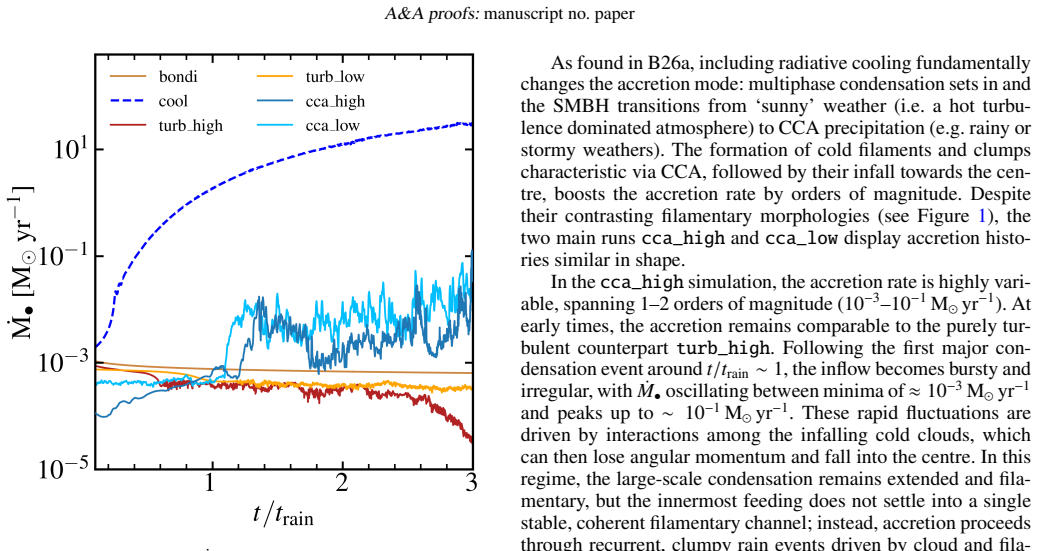
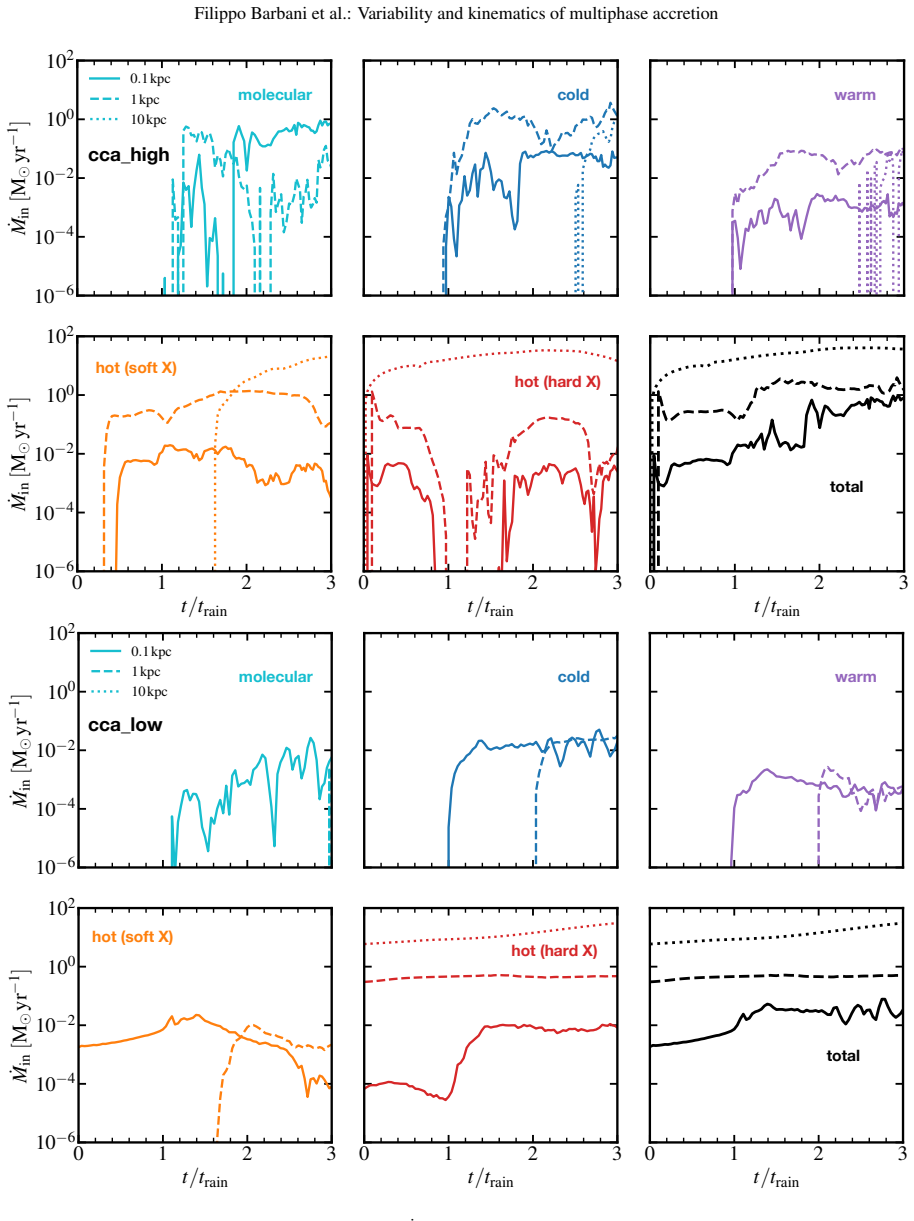
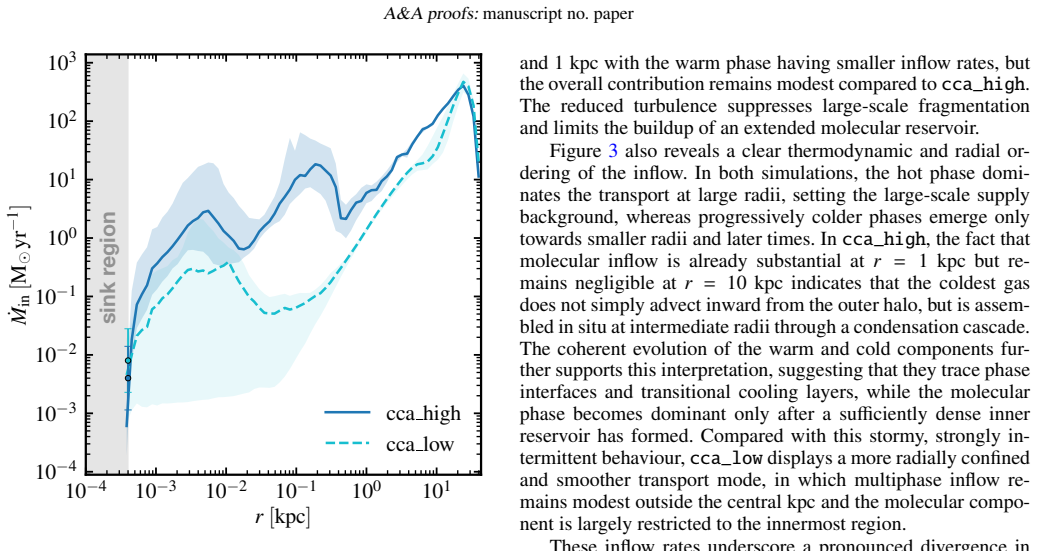
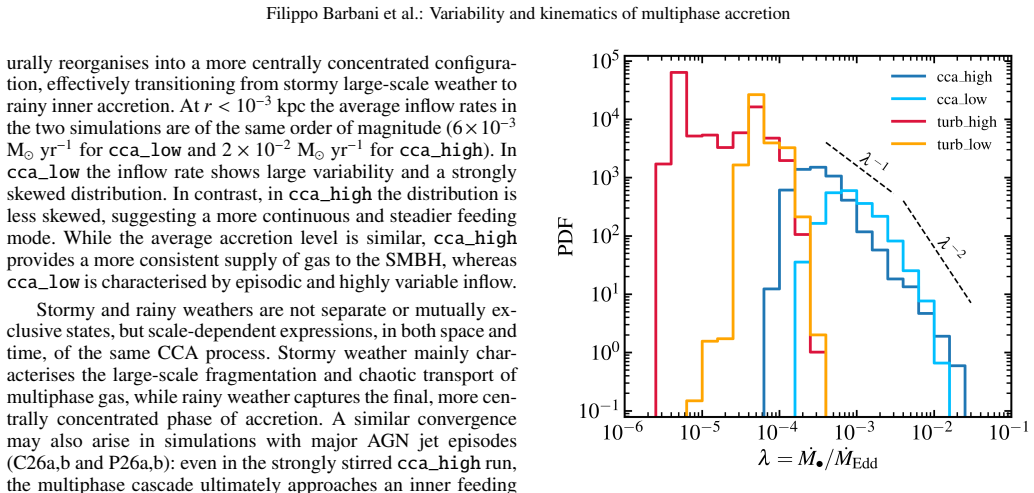
Accretion onto supermassive black holes proceeds through chaotic cold accretion in which multiphase clouds and filaments condense out of hot gas and feed the black hole stochastically. In the simulations the rates remain super-Bondi, vary by up to ~2 dex, and peak at low Eddington ratios. The two turbulent regimes diverge at meso-scales in inflow enhancement and kinematics, yet the innermost feeding rates remain similar, showing that SMBH accretion is not directly supply-limited by macro-scale weather.
What carries the argument
Chaotic cold accretion (CCA) across the meso-scale (0.1-1 kpc), diagnosed by the C-ratio (t_cool/t_eddy ≈1) that marks the gateway of condensation in soft X-ray gas and the k-plot of line broadening versus shift that reveals the kinematic distinction between regimes.
If this is right
- Accretion rate distributions indicate a maintenance-mode state for the black hole.
- Power spectra of the accretion rate follow a broken power law with pink noise on long and intermediate timescales and a steeper red-noise tail at high frequencies from parsec-scale collisional damping.
- The weather distinction between regimes is strongest on meso-scales, where the stormy case produces broader, overlapping multiphase kinematics.
- The C-ratio and k-plot together capture the CCA modes that link halo rain to inner feeding.
Where Pith is reading between the lines
- Black hole growth models may use average feeding rates without needing to resolve every detail of macro-scale turbulence.
- Adding magnetic fields or cosmic rays in future runs could test whether the convergence of innermost rates survives.
- Observers might search for similar accretion variability signatures in X-ray data from galaxy groups that differ in their turbulent weather.
Load-bearing premise
Hydrodynamic simulations with driven subsonic turbulence in a stratified galaxy group capture the dominant physics of meso-scale gas transport without magnetic fields, cosmic rays, or self-consistent AGN feedback.
What would settle it
If X-ray or kinematic observations of real galaxy groups reveal that innermost accretion rates differ substantially between systems with strong versus weak large-scale turbulence, the convergence of feeding rates would be falsified.
Figures



read the original abstract
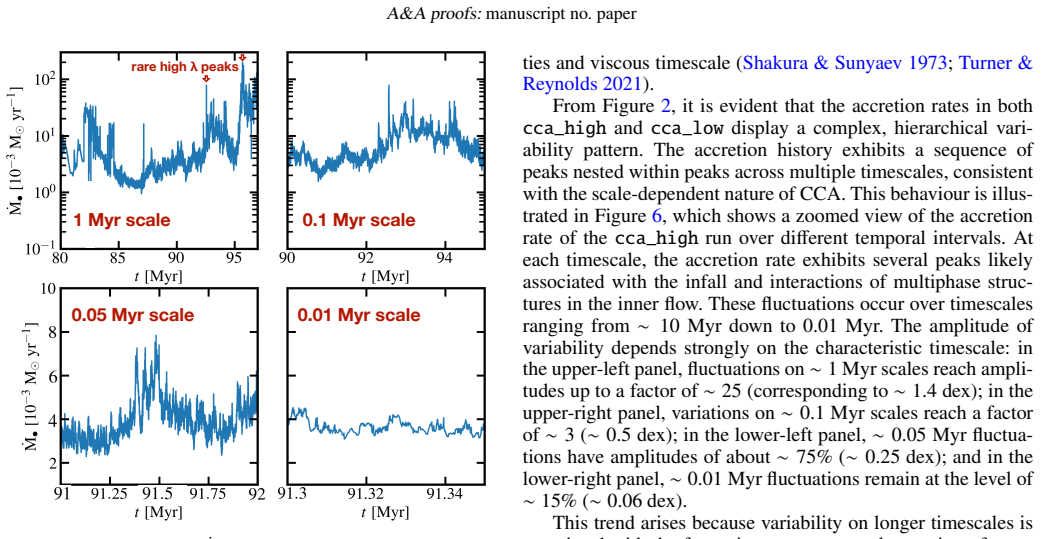
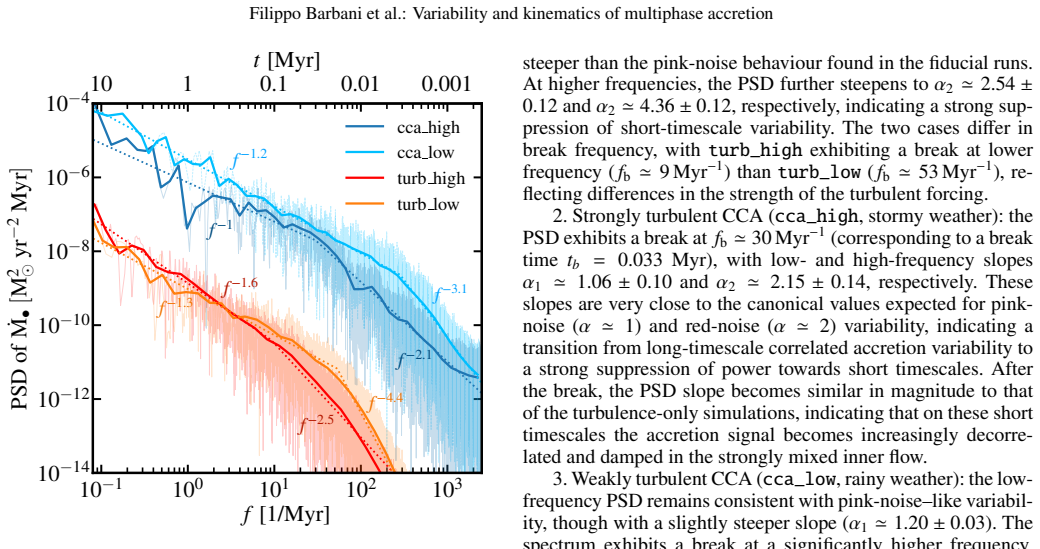
Accretion onto supermassive black holes (SMBHs) in realistic halos is time-variable, governed by turbulence, cooling, and multiphase condensation. In chaotic cold accretion (CCA), clouds and filaments condense out of the hot gas and feed the SMBH stochastically. We investigate how turbulence regulates the variability, radial transport, and kinematics of CCA, focusing on the meso-scale connecting halo rain to inner inflow. We analyse 3D hydrodynamic simulations with a GPU-accelerated code, including cooling and driven subsonic turbulence in a stratified galaxy group, resolving scales from kpc to sub-pc and probing two turbulent weather regimes. In both regimes, SMBH accretion proceeds through CCA, remains super-Bondi, and varies by up to $\sim 2$ dex. The runs diverge mainly at meso-scales: strong stirring sustains fragmented feeding and clear inflow enhancement at 0.1-1 kpc, whereas weaker turbulence yields a smoother central cascade. Yet innermost feeding rates remain similar, implying SMBH accretion is not directly supply-limited by macro-scale weather. Accretion rate distributions peak at low Eddington ratios, indicating maintenance-mode state. Accretion rate power spectra follow a broken power law, with pink noise on long/intermediate timescales and a steeper red-noise tail at high frequencies, consistent with parsec-scale collisional damping. CCA modes are captured by two complementary diagnostics: the $\mathcal{C}$-ratio ($\equiv t_{\rm cool}/t_{\rm eddy}$) $\approx 1$ identifies soft X-ray gas as the gateway of condensation, while the k-plot (line broadening vs. shift) shows that the weather distinction is strongest on meso-scales, where the stormy regime produces broader, overlapping multiphase kinematics than the rainy regime. The meso-scale bridges halo rain and micro-scale CCA feeding, regulating spatial transport, kinematic imprint, and temporal coherence of SMBH growth.
Editorial analysis
A structured set of objections, weighed in public.
Referee Report
Summary. The paper presents results from two 3D hydrodynamic simulations of chaotic cold accretion (CCA) in a stratified galaxy group, with driven subsonic turbulence of different strengths. It finds that while the meso-scale (0.1-1 kpc) feeding differs between the 'stormy' and 'rainy' regimes, the innermost SMBH accretion rates are similar, both super-Bondi and variable by up to 2 dex. The accretion rate distributions and power spectra are analyzed, along with the C-ratio diagnostic for condensation and the k-plot for kinematics, concluding that meso-scale weather regulates but does not limit the micro-scale accretion.
Significance. If the similarity in innermost rates holds, this work would be significant for understanding the decoupling of SMBH feeding from large-scale gas dynamics in galaxy groups, supporting the maintenance-mode accretion picture. The resolution from kpc to sub-pc and the use of complementary diagnostics (C-ratio and k-plot) are strengths. However, the hydrodynamic nature limits the generality.
major comments (2)
- [Abstract] Abstract: the central claim that 'innermost feeding rates remain similar' is not accompanied by quantitative values, error bars, or a direct comparison between the two regimes; this is load-bearing for the implication that SMBH accretion is not supply-limited by macro-scale weather.
- [Abstract] Abstract: the simulations omit magnetic fields and cosmic rays, which are known to affect thermal instability and radial transport at meso-scales; without testing their impact on the similarity of inner rates, the robustness of the conclusion is uncertain. A suggested test is to rerun with MHD to check if the inner accretion rates remain comparable.
minor comments (2)
- [Abstract] The two turbulence regimes are referred to as 'strong stirring' and 'weaker turbulence' but the specific driving amplitudes or Mach numbers are not specified in the abstract.
- The power spectrum is described as broken power law with pink noise on long timescales and red-noise tail; a reference to the exact frequency ranges or the break point would improve clarity.
Simulated Author's Rebuttal
We thank the referee for their constructive feedback and positive assessment of the work's significance. We address each major comment below with proposed revisions where appropriate.
read point-by-point responses
-
Referee: [Abstract] Abstract: the central claim that 'innermost feeding rates remain similar' is not accompanied by quantitative values, error bars, or a direct comparison between the two regimes; this is load-bearing for the implication that SMBH accretion is not supply-limited by macro-scale weather.
Authors: We agree that the abstract would be strengthened by including quantitative values. In the revised manuscript, we will update the abstract to report the time-averaged innermost accretion rates (in Eddington units) for both the stormy and rainy regimes, including their standard deviations and a direct statement of their similarity (within ~0.2 dex on average). These values are already quantified in the main text (Section 3.2 and Figure 3) and will be cross-referenced. revision: yes
-
Referee: [Abstract] Abstract: the simulations omit magnetic fields and cosmic rays, which are known to affect thermal instability and radial transport at meso-scales; without testing their impact on the similarity of inner rates, the robustness of the conclusion is uncertain. A suggested test is to rerun with MHD to check if the inner accretion rates remain comparable.
Authors: We acknowledge that magnetic fields and cosmic rays can influence thermal instability and meso-scale transport. Our study deliberately focuses on pure hydrodynamics to isolate the role of turbulence strength in CCA. Performing additional MHD runs to test robustness is beyond the scope of this work due to the substantial computational resources required and would form the basis of a follow-up study. We will revise the discussion section to explicitly note this limitation and its implications for the generality of the hydrodynamic results. revision: partial
- The impact of magnetic fields and cosmic rays on whether innermost accretion rates remain similar across regimes, as this would require new MHD simulations that are not feasible in the current study.
Circularity Check
No significant circularity; results are direct simulation outputs
full rationale
The paper reports outcomes from two 3D hydrodynamic simulations (cooling + driven subsonic turbulence in stratified setup) that differ only in turbulence strength. Innermost feeding rates, power spectra, C-ratio (defined as t_cool/t_eddy), and k-plot diagnostics are computed post hoc from the simulation data rather than fitted to or defined in terms of the target accretion rates. The claim that rates remain similar (hence not supply-limited) follows from direct comparison of the two runs. No self-definitional steps, fitted inputs renamed as predictions, or load-bearing self-citation chains appear in the derivation; the work is self-contained against external benchmarks.
Axiom & Free-Parameter Ledger
free parameters (1)
- turbulence driving amplitude
axioms (1)
- domain assumption Hydrodynamic equations with radiative cooling and externally driven subsonic turbulence suffice to model multiphase gas dynamics from kpc to sub-pc scales in a stratified galaxy group.
Reference graph
Works this paper leans on
-
[1]
L., & Georgakakis, A
Aird, J., Coil, A. L., & Georgakakis, A. 2018, MNRAS, 474, 1225
2018
-
[2]
L., Moustakas, J., et al
Aird, J., Coil, A. L., Moustakas, J., et al. 2012, ApJ, 746, 90
2012
-
[3]
Reynolds, C. S. 2006, Monthly Notices of the Royal Astro- nomical Society, 372, 21 Anglés-Alcázar, D., Quataert, E., Hopkins, P. F., et al. 2021, ApJ, 917, 53 Arévalo, P. & Uttley, P. 2006, MNRAS, 367, 801
2006
-
[4]
D., & Capetti, A
Balmaverde, B., Baldi, R. D., & Capetti, A. 2008, Astronomy & Astrophysics, 486, 119
2008
-
[5]
2026, A&A, Submitted
Barbani, F., Gaspari, M., Cammelli, V ., & et al. 2026, A&A, Submitted
2026
-
[6]
2023, MNRAS, 524, 4091
Barbani, F., Pascale, R., Marinacci, F., et al. 2023, MNRAS, 524, 4091
2023
-
[7]
2025, A&A, 697, A121
Barbani, F., Pascale, R., Marinacci, F., et al. 2025, A&A, 697, A121
2025
-
[8]
S., Devriendt, J., & Slyz, A
Beckmann, R. S., Devriendt, J., & Slyz, A. 2019, MNRAS, 483, 3488
2019
-
[9]
Best, P. N. & Heckman, T. M. 2012, MNRAS, 421, 1569
2012
-
[10]
1952, MNRAS, 112, 195
Bondi, H. 1952, MNRAS, 112, 195
1952
-
[11]
& Hoyle, F
Bondi, H. & Hoyle, F. 1944, MNRAS, 104, 273
1944
-
[12]
Booth, C. M. & Schaye, J. 2009, MNRAS, 398, 53
2009
-
[13]
Bourne, M. A. & Sijacki, D. 2021, MNRAS, 506, 488
2021
-
[14]
Bourne, M. A. & Yang, H.-Y . K. 2023, Galaxies, 11, 73
2023
-
[15]
Butcher, J. C. 2008, Numerical Methods for Ordinary Differen- tial Equations, 2nd edn. (John Wiley & Sons)
2008
-
[16]
& Teyssier, R
Cattaneo, A. & Teyssier, R. 2007, MNRAS, 376, 1547
2007
-
[17]
W., Donahue, M., V oit, G
Cavagnolo, K. W., Donahue, M., V oit, G. M., & Sun, M. 2009, ApJS, 182, 12 Di Matteo, T., Springel, V ., & Hernquist, L. 2005, Nature, 433, 604
2009
-
[18]
2025, arXiv e-prints, arXiv:2510.25156
Dunn, T., McElroy, R., Krumpe, M., et al. 2025, arXiv e-prints, arXiv:2510.25156
-
[19]
2014, Journal of Paral- lel and Distributed Computing, 74
Edwards, H., Trott, C., & Sunderland, D. 2014, Journal of Paral- lel and Distributed Computing, 74
2014
-
[20]
C., Johnstone, R
Fabian, A. C., Johnstone, R. M., Sanders, J. S., et al. 2008, Na- ture, 454, 968
2008
-
[21]
2017, A&A, 601, A143
Fiore, F., Feruglio, C., Shankar, F., et al. 2017, A&A, 601, A143
2017
-
[22]
2024, A&A, 686, A36
Fiore, F., Gaspari, M., Luminari, A., Tozzi, P., & de Arcangelis, L. 2024, A&A, 686, A36
2024
-
[23]
2025, A&A, 698, A121
Fournier, M., Grete, P., Brüggen, M., et al. 2025, A&A, 698, A121
2025
-
[24]
D., Earl, N., Novack, A
French, K. D., Earl, N., Novack, A. B., et al. 2023, ApJ, 950, 153
2023
-
[25]
2015, A&A, 579, A62
Gaspari, M., Brighenti, F., & Temi, P. 2015, A&A, 579, A62
2015
-
[26]
2014, ApJ, 783, L10
Gaspari, M., Brighenti, F., Temi, P., & Ettori, S. 2014, ApJ, 783, L10
2014
-
[27]
& Churazov, E
Gaspari, M. & Churazov, E. 2013, A&A, 559, A78
2013
-
[28]
L., et al
Gaspari, M., McDonald, M., Hamer, S. L., et al. 2018, ApJ, 854, 167
2018
-
[29]
Gaspari, M., Ruszkowski, M., & Oh, S. P. 2013, MNRAS, 432, 3401
2013
-
[30]
2012, ApJ, 746, 94
Gaspari, M., Ruszkowski, M., & Sharma, P. 2012, ApJ, 746, 94
2012
-
[31]
& S˛ adowski, A
Gaspari, M. & S˛ adowski, A. 2017, ApJ, 837, 149
2017
-
[32]
2017, MNRAS, 466, 677
Gaspari, M., Temi, P., & Brighenti, F. 2017, MNRAS, 466, 677
2017
-
[33]
2020, Nature Astronomy, 4, 10
Gaspari, M., Tombesi, F., & Cappi, M. 2020, Nature Astronomy, 4, 10
2020
-
[34]
2021, MNRAS, 505, 4702
Ge, C., Luo, R., Sun, M., et al. 2021, MNRAS, 505, 4702
2021
-
[35]
Gitti, M., Brighenti, F., & McNamara, B. R. 2012, Advances in Astronomy, 2012, 950641
2012
-
[36]
Godunov, S. K. 1959, Math. Sbornik, 47, 271
1959
-
[37]
C., Miller, J
Grete, P., Dolence, J. C., Miller, J. M., et al. 2023, The Interna- tional Journal of High Performance Computing Applications, 37, 465
2023
-
[38]
W., & Beckwith, K
Grete, P., O’Shea, B. W., & Beckwith, K. 2018, ApJ, 858, L19
2018
-
[39]
2025, ApJ, 987, 122
Grete, P., Scannapieco, E., Brüggen, M., & Pan, L. 2025, ApJ, 987, 122
2025
-
[40]
M., Quataert, E., & Springel, V
Guo, M., Stone, J. M., Quataert, E., & Springel, V . 2025, ApJ, 987, 202
2025
-
[41]
2015, EPL (Europhysics Let- ters), 111, 44002
Herault, J., Pétrélis, F., & Fauve, S. 2015, EPL (Europhysics Let- ters), 111, 44002
2015
-
[42]
1990, ApJ, 356, 359
Hernquist, L. 1990, ApJ, 356, 359
1990
-
[43]
C., Edge, A
Hlavacek-Larrondo, J., Fabian, A. C., Edge, A. C., et al. 2013, Monthly Notices of the Royal Astronomical Society, 431, 1638
2013
-
[44]
S., Nandra, K., Clerc, N., & Gaspari, M
Hofmann, F., Sanders, J. S., Nandra, K., Clerc, N., & Gaspari, M. 2016, A&A, 585, A130
2016
-
[45]
F., Gurvich, A
Hopkins, P. F., Gurvich, A. B., Shen, X., et al. 2023, MNRAS, 525, 2241
2023
-
[46]
F., Wetzel, A., Kereš, D., et al
Hopkins, P. F., Wetzel, A., Kereš, D., et al. 2018, MNRAS, 477, 1578
2018
-
[47]
Iapichino, L., Federrath, C., & Klessen, R. S. 2017, MNRAS, 469, 3641 Ivezi´c, Ž. & MacLeod, C. 2014, in IAU Symposium, V ol. 304, Multiwavelength AGN Surveys and Studies, ed. A. M. Mick- aelian & D. B. Sanders, 395–398 Juráˇnová, A., Werner, N., Gaspari, M., et al. 2019, MNRAS, 484, 2886 Juráˇnová, A., Werner, N., Nulsen, P. E. J., et al. 2020, MNRAS, 499, 5163
2017
-
[48]
C., Chojnowski, S
Keel, W. C., Chojnowski, S. D., Bennert, V . N., et al. 2012, MN- RAS, 420, 878
2012
-
[49]
C., Bechtold, J., & Siemiginowska, A
Kelly, B. C., Bechtold, J., & Siemiginowska, A. 2009, ApJ, 698, 895
2009
-
[50]
& Nixon, C
King, A. & Nixon, C. 2015, MNRAS, 453, L46
2015
-
[51]
& Pounds, K
King, A. & Pounds, K. 2015, ARA&A, 53, 115
2015
-
[52]
King, A. R. & Pringle, J. E. 2006, MNRAS, 373, L90 Article number, page 19 of 20 A&A proofs:manuscript no. paper
2006
-
[53]
R., Pringle, J
King, A. R., Pringle, J. E., & Hofmann, J. A. 2008, MNRAS, 385, 1621
2008
-
[54]
1941, Akademiia Nauk SSSR Doklady, 30, 301
Kolmogorov, A. 1941, Akademiia Nauk SSSR Doklady, 30, 301
1941
-
[55]
Kormendy, J. & Ho, L. C. 2013, ARA&A, 51, 511
2013
-
[56]
& Inutsuka, S.-I
Koyama, H. & Inutsuka, S.-I. 2000, ApJ, 532, 980
2000
-
[57]
Kravtsov, A. V . & Borgani, S. 2012, ARA&A, 50, 353
2012
-
[58]
M., Cales, S., Moran, E
LaMassa, S. M., Cales, S., Moran, E. C., et al. 2015, ApJ, 800, 144
2015
-
[59]
2025, A&A, 694, A115
Lepore, M., Pinto, C., Tozzi, P., et al. 2025, A&A, 694, A115
2025
-
[60]
1969, Nature, 223, 690
Lynden-Bell, D. 1969, Nature, 223, 690
1969
-
[61]
2025, A&A, 693, A173
Lyu, B., Wu, X.-B., Pang, Y ., et al. 2025, A&A, 693, A173
2025
-
[62]
M., Morganti, R., Oosterloo, T
Maccagni, F. M., Morganti, R., Oosterloo, T. A., & Mahony, E. K. 2014, A&A, 571, A67
2014
-
[63]
M., Serra, P., Gaspari, M., et al
Maccagni, F. M., Serra, P., Gaspari, M., et al. 2021, A&A, 656, A45
2021
-
[64]
L., Green, P
MacLeod, C. L., Green, P. J., Anderson, S. F., et al. 2019, ApJ, 874, 8
2019
-
[65]
McCourt, M., Sharma, P., Quataert, E., & Parrish, I. J. 2012, MNRAS, 419, 3319
2012
-
[66]
R., & Tremblay, G
McDonald, M., Gaspari, M., McNamara, B. R., & Tremblay, G. R. 2018, ApJ, 858, 45
2018
-
[67]
2011, ApJ, 734, 95
Reynolds, C. 2011, ApJ, 734, 95
2011
-
[68]
M., Koerding, E., Knigge, C., Uttley, P., & Fender, R
McHardy, I. M., Koerding, E., Knigge, C., Uttley, P., & Fender, R. P. 2006, Nature, 444, 730
2006
-
[69]
McNamara, B. R. & Nulsen, P. E. J. 2012, New Journal of Physics, 14, 055023
2012
-
[70]
R., Russell, H
McNamara, B. R., Russell, H. R., Nulsen, P. E. J., et al. 2016, ApJ, 830, 79
2016
-
[71]
A., Brusa, M., et al
Mehdipour, M., Kriss, G. A., Brusa, M., et al. 2023, A&A, 670, A183
2023
-
[72]
2023, A&A, 678, A42
Morganti, R., Murthy, S., Oosterloo, T., et al. 2023, A&A, 678, A42
2023
-
[73]
F., Edelson, R., Baumgartner, W., & Gandhi, P
Mushotzky, R. F., Edelson, R., Baumgartner, W., & Gandhi, P. 2011, ApJ, 743, L12
2011
-
[74]
F., Frenk, C
Navarro, J. F., Frenk, C. S., & White, S. D. 1997, ApJ, 490, 493
1997
-
[75]
2025, Nature Astron- omy, 9, 449
Olivares, V ., Picquenot, A., Su, Y ., et al. 2025, Nature Astron- omy, 9, 449
2025
-
[76]
2019, A&A, 631, A22
Olivares, V ., Salome, P., Combes, F., et al. 2019, A&A, 631, A22
2019
-
[77]
L., et al
Olivares, V ., Salomé, P., Hamer, S. L., et al. 2022, A&A, 666, A94
2022
-
[78]
A., et al
Omoruyi, O., Tremblay, G., Baum, S. A., et al. 2026, ApJ, 997, 114
2026
-
[79]
& Papadakis, I
Paolillo, M. & Papadakis, I. 2025, Nuovo Cimento Rivista Serie, 48, 537
2025
-
[80]
& Pu, H.-Y
Piana, O. & Pu, H.-Y . 2025, Universe, 11, 78
2025
discussion (0)
Sign in with ORCID, Apple, or X to comment. Anyone can read and Pith papers without signing in.