BlackHoleWeather -- Chaotic cold accretion across the meso-scale: Morphology and thermodynamics
Pith reviewed 2026-06-29 16:51 UTC · model grok-4.3
The pith
Modest turbulence variations can switch a hot halo from extended stormy cold gas accretion to compact rainy accretion around the supermassive black hole.
A machine-rendered reading of the paper's core claim, the machinery that carries it, and where it could break.
Core claim
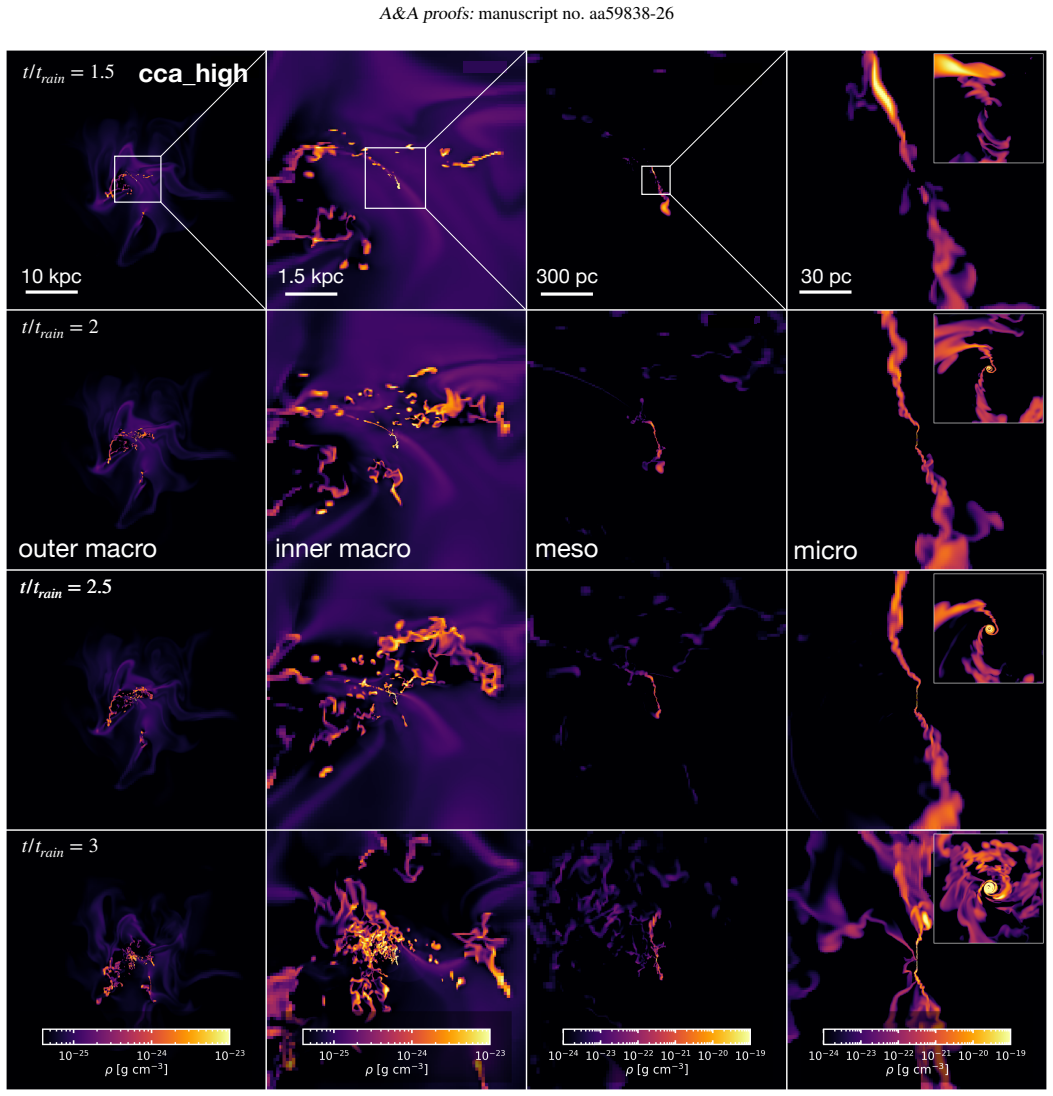
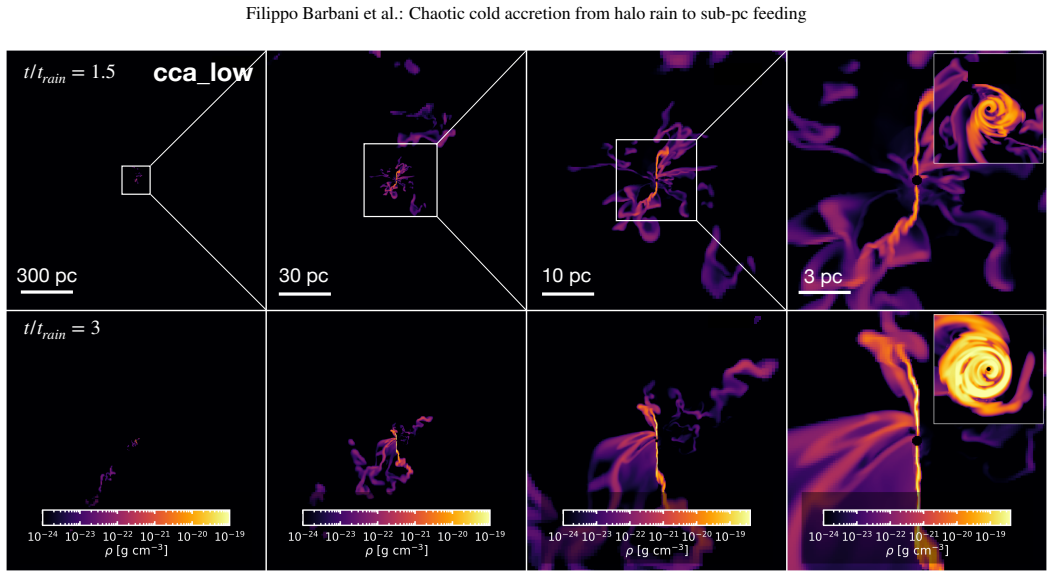
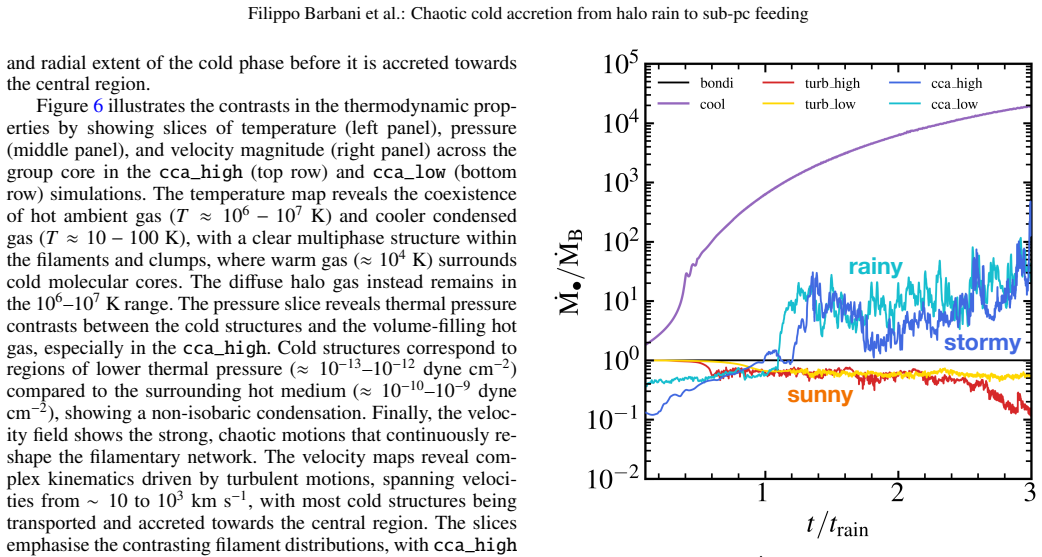
In simulations of a hot intragroup halo with driven subsonic turbulence, the gas becomes thermally unstable and forms multiphase structures. Strong stirring creates an extended filament-rich rain to kpc radii that delays central accretion, while weak stirring yields compact rain mostly within 100 pc. The black hole accretion rate shows recurrent boosts up to 100 times the Bondi baseline in both cases, with only weak variation between regimes, indicating regulation by multiphase coupling efficiency rather than condensed mass alone.
What carries the argument
Turbulence level controlling the morphology of chaotic cold accretion, shifting between stormy extended and rainy centralized states via nonlinear thermal instability.
If this is right
- The same halo can display different black hole weather states with only modest turbulence differences.
- Black hole feeding rates are boosted similarly despite large differences in cold gas distribution.
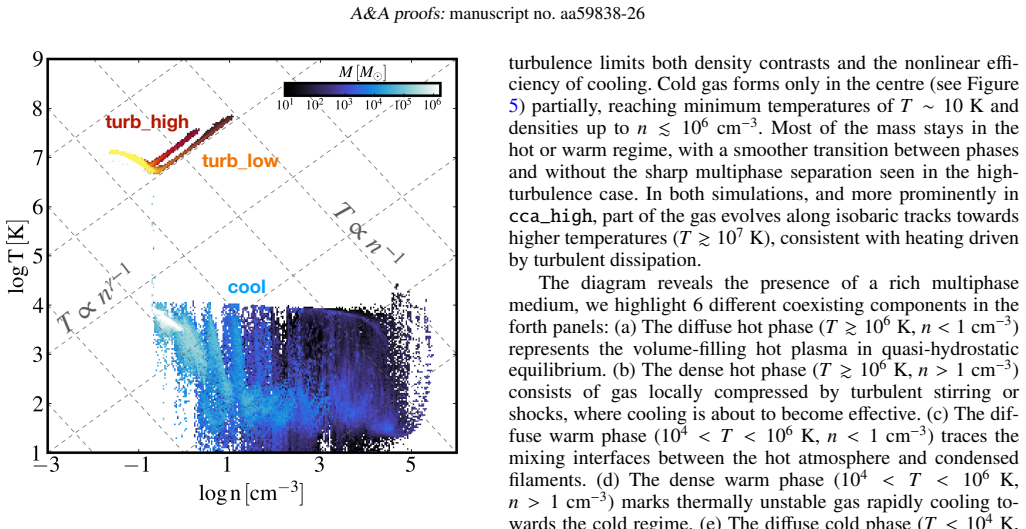
- Multiphase condensation spans 8-10 orders of magnitude in temperature and density.
- At small scales, inflow involves a clumpy rotating torus.
- Provides baseline for multiphase CCA interpretation.
Where Pith is reading between the lines
- Observed filament lengths in galaxy groups could serve as proxies for turbulence strength.
- Including magnetic fields in future models might change the threshold between stormy and rainy regimes.
- The weak dependence of accretion rate on turbulence suggests a robust self-regulation mechanism across environments.
- This framework could extend to cluster-scale halos to predict AGN variability.
Load-bearing premise
The driven subsonic turbulence and radiative cooling in the hydrodynamic simulations represent the primary drivers of thermal instability and gas condensation in real halos.
What would settle it
Finding a galaxy group halo with measured low turbulence but extended cold filaments out to kpc scales, or high turbulence with only central cold gas, would contradict the predicted morphology shift.
Figures





read the original abstract
Supermassive black holes (SMBHs) self-regulate galaxies, groups, and clusters, yet the pathway transporting gas from halo scales to sub-pc radii remains debated. In hot stratified atmospheres, subsonic turbulence can trigger nonlinear thermal instability and a multiphase condensation cascade, producing chaotic time-variable BH `weather'. A key missing link is how the meso-scale connects halo rain to nuclear inflow. We study turbulence-driven condensation and chaotic cold accretion (CCA) in a group-scale halo, quantifying how the stirring level shapes multiphase morphology, thermodynamics, and SMBH feeding. We ran 3D hydrodynamic hyper-zoom simulations with a GPU-accelerated code, including cooling and driven subsonic turbulence in a hot intragroup halo. Two endpoint runs bracket weak and strong stirring, capturing distinct BH weather states. In both regimes the atmosphere becomes thermally unstable and develops a multiphase medium spanning 8-10 dex in temperature and density. Strong stirring delays cold gas accretion and sustains an extended filament-rich rain pattern to kpc radii (`stormy' CCA), with broader thermodynamic distributions beyond the nucleus. Weak stirring triggers earlier condensation but yields a more compact rain, with most cold gas confined within 100 pc (`rainy' CCA). At micro-scales the inflow is partly mediated by a clumpy rotating torus. Despite large differences in condensed cold mass, the BH accretion rate is recurrently boosted by up to 100x above the hot-mode Bondi baseline and varies weakly between the weather regimes, indicating that feeding is regulated primarily by how efficiently multiphase structures couple to the central inflow. Modest turbulence changes are sufficient to shift the same hot halo between stormy (extended) and rainy (centralized) BH weather, providing a quantitative multiscale baseline for interpreting multiphase CCA and SMBH feeding.
Editorial analysis
A structured set of objections, weighed in public.
Referee Report
Summary. The manuscript presents 3D hydrodynamic simulations of a group-scale hot halo with cooling and driven subsonic turbulence at two endpoint stirring amplitudes. It reports that strong stirring produces extended filamentary 'stormy' CCA while weak stirring yields compact 'rainy' CCA, with both regimes developing multiphase gas over 8-10 dex in T and rho; despite large differences in cold mass, the central BH accretion rate is recurrently boosted by up to 100x above the hot-mode Bondi value and varies only weakly between regimes, implying regulation by multiphase inflow coupling. The work positions modest turbulence variations as sufficient to shift the same halo between these weather states, offering a multiscale baseline for CCA and SMBH feeding.
Significance. If the hydro results prove robust, the quantitative comparison of morphology, thermodynamics, and feeding across stirring levels supplies a useful meso-scale reference for interpreting multiphase condensation and nuclear inflow in stratified halos. The direct numerical experiments (two endpoint runs) and the finding of similar accretion boosts despite differing cold-gas distributions are strengths that could aid observational interpretation of CCA.
major comments (2)
- [Abstract / simulation description] The central claim that turbulence amplitude alone controls the shift between extended-filament ('stormy') and compact ('rainy') CCA morphologies rests on pure hydrodynamics plus cooling; the simulation setup omits magnetic fields, which are known to modify the nonlinear thermal instability threshold, condensation geometry, and cold-gas coupling via anisotropic conduction and tension. This omission is load-bearing for the generalization to a 'quantitative multiscale baseline' because the reported distinction may not persist when these effects are included.
- [Abstract / results] The reported accretion-rate boosts (up to 100x) and weak variation between regimes are presented without reference to numerical resolution, convergence tests, or error analysis; given that the morphology and thermodynamic distributions are the primary observables, it is unclear whether the differences between the weak- and strong-stirring cases are numerically converged.
minor comments (1)
- The phrase 'hyper-zoom simulations' and the GPU-accelerated code are mentioned without a specific reference or method citation; adding this would improve reproducibility.
Simulated Author's Rebuttal
We thank the referee for the constructive comments. We respond point by point to the major comments below.
read point-by-point responses
-
Referee: [Abstract / simulation description] The central claim that turbulence amplitude alone controls the shift between extended-filament ('stormy') and compact ('rainy') CCA morphologies rests on pure hydrodynamics plus cooling; the simulation setup omits magnetic fields, which are known to modify the nonlinear thermal instability threshold, condensation geometry, and cold-gas coupling via anisotropic conduction and tension. This omission is load-bearing for the generalization to a 'quantitative multiscale baseline' because the reported distinction may not persist when these effects are included.
Authors: We agree that the simulations are purely hydrodynamic and that magnetic fields can alter thermal instability thresholds, condensation geometry, and cold-gas dynamics. The manuscript presents a controlled hydrodynamical experiment isolating the role of turbulence amplitude. We will revise the abstract, introduction, and discussion to explicitly qualify the results as a hydrodynamic baseline and to note that the stormy/rainy distinction may change once MHD effects are included. revision: yes
-
Referee: [Abstract / results] The reported accretion-rate boosts (up to 100x) and weak variation between regimes are presented without reference to numerical resolution, convergence tests, or error analysis; given that the morphology and thermodynamic distributions are the primary observables, it is unclear whether the differences between the weak- and strong-stirring cases are numerically converged.
Authors: Both runs employed identical numerical resolution chosen to capture the cooling length across the reported dynamic range. No dedicated convergence study was reported in the submitted manuscript. We will add a methods paragraph describing the grid resolution and arguing that the qualitative morphology shift and order-of-magnitude accretion boost are robust at this resolution, while acknowledging that quantitative accretion-rate values would benefit from explicit convergence tests. revision: partial
- Whether the reported distinction between stormy and rainy CCA morphologies persists once magnetic fields, anisotropic conduction, and tension are included, as this requires new MHD simulations.
Circularity Check
No significant circularity: claims emerge from direct numerical experiments
full rationale
The paper's central claims about turbulence-driven shifts between stormy and rainy CCA states are outputs of two endpoint 3D hydrodynamic simulations that evolve cooling and driven subsonic turbulence from initial conditions in a stratified halo. No load-bearing step reduces by construction to a fitted parameter, self-citation chain, or renamed input; the morphology, thermodynamic distributions, and accretion rates are measured directly from the evolved fields rather than presupposed. The multiscale baseline is therefore an independent result of the numerical setup, not a self-referential reduction.
Axiom & Free-Parameter Ledger
free parameters (2)
- turbulence stirring amplitude
- cooling function implementation
axioms (2)
- domain assumption Subsonic turbulence triggers nonlinear thermal instability and multiphase condensation cascade
- domain assumption Initial hot stratified intragroup atmosphere
Reference graph
Works this paper leans on
-
[1]
E., Mantz, A
Abdulla, Z., Carlstrom, J. E., Mantz, A. B., et al. 2019, ApJ, 871, 195
2019
-
[2]
Balbus, S. A. & Hawley, J. F. 1998, Reviews of Modern Physics, 70, 1
1998
-
[3]
2026, A&A, Submitted
Barbani, F., Gaspari, M., Cammelli, V ., & et al. 2026, A&A, Submitted
2026
-
[4]
2023, MNRAS, 524, 4091
Barbani, F., Pascale, R., Marinacci, F., et al. 2023, MNRAS, 524, 4091
2023
-
[5]
2025, A&A, 697, A121
Barbani, F., Pascale, R., Marinacci, F., et al. 2025, A&A, 697, A121
2025
-
[6]
1952, MNRAS, 112, 195
Bondi, H. 1952, MNRAS, 112, 195
1952
-
[7]
& Hoyle, F
Bondi, H. & Hoyle, F. 1944, MNRAS, 104, 273
1944
-
[8]
Booth, C. M. & Schaye, J. 2009, MNRAS, 398, 53 Brüggen, M., Scannapieco, E., & Grete, P. 2023, ApJ, 951, 113
2009
-
[9]
Butcher, J. C. 2008, Numerical Methods for Ordinary Differen- tial Equations, 2nd edn. (John Wiley & Sons)
2008
-
[10]
C., et al
Cammelli, V ., Monaco, P., Tan, J. C., et al. 2025, MNRAS, 536, 851
2025
-
[11]
2025, A&A, 700, A197
Castignani, G., Combes, F., Salomé, P., Edge, A., & Jablonka, P. 2025, A&A, 700, A197
2025
-
[12]
& Teyssier, R
Cattaneo, A. & Teyssier, R. 2007, MNRAS, 376, 1547
2007
-
[13]
W., Donahue, M., V oit, G
Cavagnolo, K. W., Donahue, M., V oit, G. M., & Sun, M. 2009, ApJS, 182, 12
2009
-
[14]
K., Schive, H.-Y ., ZuHone, J., & Gas- pari, M
Chen, S.-S., Yang, H.-Y . K., Schive, H.-Y ., ZuHone, J., & Gas- pari, M. 2024, arXiv e-prints, arXiv:2412.13595
-
[15]
S., Su, K.-Y ., Narayan, R., & Natarajan, P
Cho, H., Prather, B. S., Su, K.-Y ., Narayan, R., & Natarajan, P. 2024, ApJ, 977, 200 Di Matteo, T., Springel, V ., & Hernquist, L. 2005, Nature, 433, 604
2024
-
[16]
2015, ApJ, 805, 177
Donahue, M., Connor, T., Fogarty, K., et al. 2015, ApJ, 805, 177
2015
-
[17]
2014, MNRAS, 444, 1453 Dupourqué, S., Clerc, N., Pointecouteau, E., et al
Dubois, Y ., Pichon, C., Welker, C., et al. 2014, MNRAS, 444, 1453 Dupourqué, S., Clerc, N., Pointecouteau, E., et al. 2024, A&A, 687, A58
2014
-
[18]
Eckert, D., Gaspari, M., Gastaldello, F., Le Brun, A. M. C., & O’Sullivan, E. 2021, Universe, 7, 142
2021
-
[19]
2014, Journal of Paral- lel and Distributed Computing, 74
Edwards, H., Trott, C., & Sunderland, D. 2014, Journal of Paral- lel and Distributed Computing, 74
2014
-
[20]
S., Davis, T
Elford, J. S., Davis, T. A., Ruffa, I., et al. 2024, MNRAS, 528, 319
2024
-
[21]
2024, MNRAS, 527, 1317
Eskenasy, R., Olivares, V ., Su, Y ., & Li, Y . 2024, MNRAS, 527, 1317
2024
-
[22]
Fabian, A. C. 1994, ARA&A, 32, 277
1994
-
[23]
Fabian, A. C. 2012, ARA&A, 50, 455
2012
-
[24]
C., Johnstone, R
Fabian, A. C., Johnstone, R. M., Sanders, J. S., et al. 2008, Na- ture, 454, 968 Ferrière, K. M. 2001, Reviews of Modern Physics, 73, 1031
2008
-
[25]
Field, G. B. 1965, ApJ, 142, 531
1965
-
[26]
2017, A&A, 601, A143
Fiore, F., Feruglio, C., Shankar, F., et al. 2017, A&A, 601, A143
2017
-
[27]
2015, ApJ, 813, 117
Fogarty, K., Postman, M., Connor, T., Donahue, M., & Mous- takas, J. 2015, ApJ, 813, 117
2015
-
[28]
W., & O’Shea, B
Fournier, M., Grete, P., Brüggen, M., Glines, F. W., & O’Shea, B. W. 2024, A&A, 691, A239
2024
-
[29]
2025, A&A, 698, A121
Fournier, M., Grete, P., Brüggen, M., et al. 2025, A&A, 698, A121
2025
-
[30]
2015, A&A, 579, A62
Gaspari, M., Brighenti, F., & Temi, P. 2015, A&A, 579, A62
2015
-
[31]
& Churazov, E
Gaspari, M. & Churazov, E. 2013, A&A, 559, A78
2013
-
[32]
L., et al
Gaspari, M., McDonald, M., Hamer, S. L., et al. 2018, ApJ, 854, 167
2018
-
[33]
Gaspari, M., Ruszkowski, M., & Oh, S. P. 2013, MNRAS, 432, 3401
2013
-
[34]
2012, ApJ, 746, 94
Gaspari, M., Ruszkowski, M., & Sharma, P. 2012, ApJ, 746, 94
2012
-
[35]
& S˛ adowski, A
Gaspari, M. & S˛ adowski, A. 2017, ApJ, 837, 149
2017
-
[36]
2017, MNRAS, 466, 677
Gaspari, M., Temi, P., & Brighenti, F. 2017, MNRAS, 466, 677
2017
-
[37]
2020, Nature Astronomy, 4, 10
Gaspari, M., Tombesi, F., & Cappi, M. 2020, Nature Astronomy, 4, 10
2020
-
[38]
Godunov, S. K. 1959, Math. Sbornik, 47, 271
1959
-
[39]
C., Miller, J
Grete, P., Dolence, J. C., Miller, J. M., et al. 2023, The Interna- tional Journal of High Performance Computing Applications, 37, 465
2023
-
[40]
W., & Beckwith, K
Grete, P., O’Shea, B. W., & Beckwith, K. 2018, ApJ, 858, L19
2018
-
[41]
2025, ApJ, 987, 122
Grete, P., Scannapieco, E., Brüggen, M., & Pan, L. 2025, ApJ, 987, 122
2025
-
[42]
M., Kim, C.-G., & Quataert, E
Guo, M., Stone, J. M., Kim, C.-G., & Quataert, E. 2023, ApJ, 946, 26
2023
-
[43]
M., Quataert, E., & Kim, C.-G
Guo, M., Stone, J. M., Quataert, E., & Kim, C.-G. 2024, ApJ, 973, 141
2024
-
[44]
1990, ApJ, 356, 359 Hitomi Collaboration, Aharonian, F., Akamatsu, H., et al
Hernquist, L. 1990, ApJ, 356, 359 Hitomi Collaboration, Aharonian, F., Akamatsu, H., et al. 2016, Nature, 535, 117
1990
-
[45]
S., Nandra, K., Clerc, N., & Gaspari, M
Hofmann, F., Sanders, J. S., Nandra, K., Clerc, N., & Gaspari, M. 2016, A&A, 585, A130
2016
-
[46]
F., Gurvich, A
Hopkins, P. F., Gurvich, A. B., Shen, X., et al. 2023, MNRAS, 525, 2241
2023
-
[47]
F., Wetzel, A., Kereš, D., et al
Hopkins, P. F., Wetzel, A., Kereš, D., et al. 2018, MNRAS, 477, 1578
2018
-
[48]
G., Starkenburg, T
Iyer, K. G., Starkenburg, T. K., Bryan, G. L., et al. 2025, ApJ, 994, 174
2025
-
[49]
J., Babul, A., Davé, R., Cui, W., & Rennehan, D
Jennings, F. J., Babul, A., Davé, R., Cui, W., & Rennehan, D. 2025, MNRAS, 536, 145 Juráˇnová, A., Werner, N., Nulsen, P. E. J., et al. 2020, MNRAS, 499, 5163
2025
-
[50]
& Gaspari, M
Khatri, R. & Gaspari, M. 2016, MNRAS, 463, 655
2016
-
[51]
2020, MNRAS, 492, 2095
Kim, D.-W., Traynor, L., Paggi, A., et al. 2020, MNRAS, 492, 2095
2020
-
[52]
& Pounds, K
King, A. & Pounds, K. 2015, ARA&A, 53, 115
2015
-
[53]
Kormendy, J. & Ho, L. C. 2013, ARA&A, 51, 511
2013
- [54]
-
[55]
Kravtsov, A. V . & Borgani, S. 2012, ARA&A, 50, 353
2012
-
[56]
Li, J., Emonts, B. H. C., Cai, Z., et al. 2021, ApJ, 922, L29
2021
-
[57]
1969, Nature, 223, 690
Lynden-Bell, D. 1969, Nature, 223, 690
1969
-
[58]
M., Morganti, R., Oosterloo, T
Maccagni, F. M., Morganti, R., Oosterloo, T. A., & Mahony, E. K. 2014, A&A, 571, A67
2014
-
[59]
M., Morganti, R., Oosterloo, T
Maccagni, F. M., Morganti, R., Oosterloo, T. A., Oonk, J. B. R., & Emonts, B. H. C. 2018, A&A, 614, A42
2018
-
[60]
M., Serra, P., Gaspari, M., et al
Maccagni, F. M., Serra, P., Gaspari, M., et al. 2021, A&A, 656, A45
2021
-
[61]
Marinacci, F., Grand, R. J. J., Pakmor, R., et al. 2017, MNRAS, 466, 3859
2017
-
[62]
McCourt, M., Sharma, P., Quataert, E., & Parrish, I. J. 2012, MNRAS, 419, 3319
2012
-
[63]
R., & Tremblay, G
McDonald, M., Gaspari, M., McNamara, B. R., & Tremblay, G. R. 2018, ApJ, 858, 45
2018
-
[64]
J., Gaspari, M., et al
McKinley, B., Tingay, S. J., Gaspari, M., et al. 2022, Nature Astronomy, 6, 109
2022
-
[65]
McNamara, B. R. & Nulsen, P. E. J. 2012, New Journal of Physics, 14, 055023
2012
-
[66]
2023, A&A, 678, A42
Morganti, R., Murthy, S., Oosterloo, T., et al. 2023, A&A, 678, A42
2023
-
[67]
& Ostriker, J
Naab, T. & Ostriker, J. P. 2017, ARA&A, 55, 59
2017
-
[68]
Nandra, K., Barret, D., Barcons, X., et al. 2013, arXiv e-prints, arXiv:1306.2307
work page internal anchor Pith review Pith/arXiv arXiv 2013
-
[69]
F., Frenk, C
Navarro, J. F., Frenk, C. S., & White, S. D. 1997, ApJ, 490, 493 Article number, page 22 of 23 Filippo Barbani et al.: Chaotic cold accretion from halo rain to sub-pc feeding
1997
-
[70]
2025, Nature Astron- omy, 9, 449
Olivares, V ., Picquenot, A., Su, Y ., et al. 2025, Nature Astron- omy, 9, 449
2025
-
[71]
2019, A&A, 631, A22
Olivares, V ., Salome, P., Combes, F., et al. 2019, A&A, 631, A22
2019
-
[72]
L., et al
Olivares, V ., Salomé, P., Hamer, S. L., et al. 2022, A&A, 666, A94
2022
-
[73]
2023, ApJ, 954, 56
Olivares, V ., Su, Y ., Forman, W., et al. 2023, ApJ, 954, 56
2023
-
[74]
K., Di Mascolo, L., et al
Orlowski-Scherer, J., Haridas, S. K., Di Mascolo, L., et al. 2022, A&A, 667, L6 O’Sullivan, E., Rajpurohit, K., Schellenberger, G., et al. 2024, ApJ, 970, 65
2022
-
[75]
Piana, O., Dayal, P., V olonteri, M., & Choudhury, T. R. 2021, MNRAS, 500, 2146
2021
-
[76]
& Pu, H.-Y
Piana, O. & Pu, H.-Y . 2025, Universe, 11, 78
2025
-
[77]
2019, MNRAS, 490, 3196
Pillepich, A., Nelson, D., Springel, V ., et al. 2019, MNRAS, 490, 3196
2019
-
[78]
S., Werner, N., et al
Pinto, C., Sanders, J. S., Werner, N., et al. 2015, A&A, 575, A38
2015
-
[79]
& Soker, N
Pizzolato, F. & Soker, N. 2005, ApJ, 632, 821
2005
-
[80]
2025, ApJ, 984, 120
Rajpurohit, K., Deb, T., Kolokythas, K., et al. 2025, ApJ, 984, 120
2025
discussion (0)
Sign in with ORCID, Apple, or X to comment. Anyone can read and Pith papers without signing in.