Cyberbullying Governance on Social Media: A Unified Framework from Content Identification to Intervention
Pith reviewed 2026-06-29 17:02 UTC · model grok-4.3
The pith
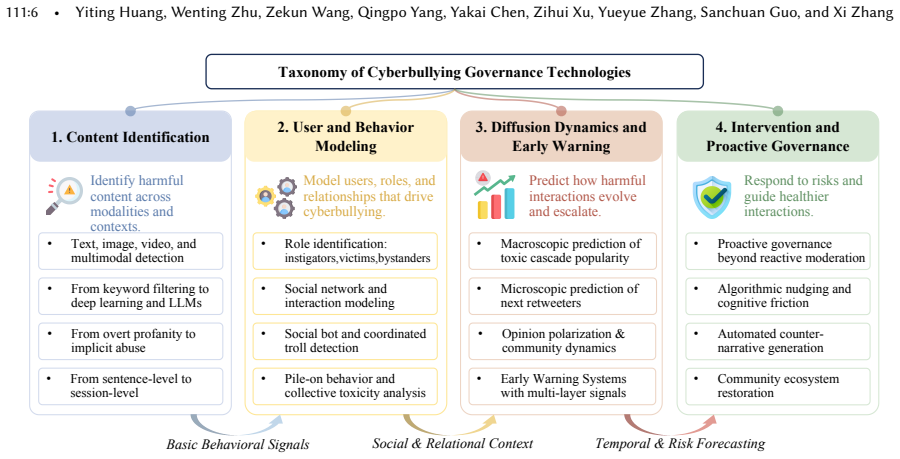
Cyberbullying governance requires shifting from isolated post detection to a continuous four-stage framework covering identification, behavior, diffusion, and intervention.
A machine-rendered reading of the paper's core claim, the machinery that carries it, and where it could break.
Core claim
The paper proposes a unified full-lifecycle governance framework that integrates four interconnected stages—Content Identification, User and Behavior Modeling, Diffusion Dynamics and Early Warning, and Intervention and Governance—drawn from existing literature on cyberbullying and adjacent topics, replacing the prevailing focus on passive post-level detection with continuous and proactive moderation.
What carries the argument
The four interconnected stages that together form the full-lifecycle governance framework.
If this is right
- Detection systems must expand beyond single posts to track user trajectories over time.
- Early-warning tools should use network diffusion patterns rather than content alone.
- Intervention design should be coordinated with identification and modeling stages instead of treated separately.
- Evaluation metrics and datasets need to cover the entire pipeline rather than isolated components.
Where Pith is reading between the lines
- Platform operators could use the staged model to coordinate teams that currently handle detection and user support in isolation.
- New datasets that link individual posts to user histories and network cascades would be needed to validate the connections between stages.
- The framework's emphasis on proactive steps suggests testing whether early intervention at the diffusion stage reduces overall harm more than later-stage content removal.
Load-bearing premise
Existing research from the four separate stages can be combined into one working proactive system without new experiments that test how the stages actually connect.
What would settle it
An experiment that implements the full four-stage pipeline on real platform data and shows no measurable reduction in bullying incidents or spread compared with current detection-only tools.
Figures






read the original abstract
The proliferation of social media platforms and online communities has inadvertently catalyzed the spread of cyberbullying, hate speech, and other forms of online toxicity, making the effective governance of such harm a critical societal and computational challenge. While significant strides have been made in automating content moderation, existing research predominantly treats cyberbullying governance as passive, isolated detection at the post level. This reductionist view overlooks the continuous behavioral dynamics of users, the structural diffusion of toxic events, and the critical need for proactive mitigation. To bridge these gaps, this paper proposes a unified full-lifecycle governance framework that shifts the paradigm of cyberbullying governance from isolated static detection toward integrated, continuous, and proactive moderation. Drawing on cyberbullying research and adjacent fields, we systematically synthesize the state-of-the-art literature across four interconnected stages: (1) Content Identification, (2) User and Behavior Modeling, (3) Diffusion Dynamics and Early Warning, and (4) Intervention and Governance. Furthermore, we review available datasets and evaluation practices, and discuss emerging challenges including multimodality, explainability, algorithmic fairness, and the dual-use risks of generative AI, providing a roadmap for future research toward a safer and more resilient digital ecosystem.
Editorial analysis
A structured set of objections, weighed in public.
Referee Report
Summary. The paper claims that existing cyberbullying governance research is predominantly limited to passive, isolated post-level detection, overlooking continuous behavioral dynamics, structural diffusion, and proactive mitigation needs. It proposes a unified full-lifecycle governance framework synthesizing SOTA literature across four interconnected stages—(1) Content Identification, (2) User and Behavior Modeling, (3) Diffusion Dynamics and Early Warning, and (4) Intervention and Governance—while also reviewing datasets, evaluation practices, and discussing challenges including multimodality, explainability, algorithmic fairness, and generative AI dual-use risks.
Significance. If the interconnections between stages can be substantiated, the framework could help shift the field from reactive detection to integrated proactive governance. A notable strength is the systematic per-stage literature synthesis combined with the review of available datasets and evaluation practices, which provides a structured reference point for future work. The discussion of emerging challenges also offers a clear roadmap.
major comments (2)
- [Framework proposal section] Framework proposal section: The central claim that the four stages form an 'interconnected' proactive full-lifecycle system is asserted via a high-level diagram and categorization, but the manuscript contains no cross-stage analysis, data-flow mapping, simulation, or citations to empirical studies showing that linking the stages yields measurable governance improvements over isolated post-level detection. This directly undermines the 'unified' and 'proactive' descriptors.
- [Literature synthesis across stages] Literature synthesis across stages: While individual stage reviews are presented, the paper does not examine or cite evidence for practical integration mechanisms (e.g., how outputs from Content Identification feed into Diffusion Early Warning or Intervention), leaving the 'full-lifecycle' integration at the conceptual level without substantiation.
minor comments (1)
- [Abstract and introduction] Abstract and introduction: The phrase 'systematically synthesize' is used without stating explicit inclusion/exclusion criteria or search methodology for the literature review, which would improve reproducibility of the synthesis.
Simulated Author's Rebuttal
We thank the referee for the constructive feedback and for recognizing the value of the systematic per-stage synthesis, dataset review, and discussion of emerging challenges. The manuscript is a literature synthesis proposing a conceptual framework rather than an empirical validation study; this scope informs our responses to the major comments on substantiation of interconnections.
read point-by-point responses
-
Referee: [Framework proposal section] The central claim that the four stages form an 'interconnected' proactive full-lifecycle system is asserted via a high-level diagram and categorization, but the manuscript contains no cross-stage analysis, data-flow mapping, simulation, or citations to empirical studies showing that linking the stages yields measurable governance improvements over isolated post-level detection. This directly undermines the 'unified' and 'proactive' descriptors.
Authors: We agree that the manuscript does not include new cross-stage analysis, data-flow mappings, simulations, or empirical studies quantifying improvements from stage integration. The framework is advanced as a conceptual organizing structure derived from synthesizing existing literature across the four stages, with interconnections motivated by the logical progression from content detection to user modeling, diffusion, and intervention as reflected in the broader research landscape. We will revise the framework proposal section to explicitly characterize the interconnections as conceptual and aspirational, clarify that 'unified' and 'proactive' refer to the proposed paradigm shift rather than demonstrated outcomes, and emphasize the need for future empirical work to validate integration benefits. revision: partial
-
Referee: [Literature synthesis across stages] While individual stage reviews are presented, the paper does not examine or cite evidence for practical integration mechanisms (e.g., how outputs from Content Identification feed into Diffusion Early Warning or Intervention), leaving the 'full-lifecycle' integration at the conceptual level without substantiation.
Authors: The per-stage literature reviews are the primary contribution, and the manuscript outlines potential interconnections at the framework level without providing detailed data-flow examples or dedicated citations to studies demonstrating practical handoffs between stages. This reflects the current state of the field, where most work remains stage-isolated. We will revise the literature synthesis and framework sections to note this limitation more explicitly, reference any available cross-cutting studies where they exist in the cited literature, and position the full-lifecycle view as a high-level proposal to guide future integration research rather than a substantiated operational system. revision: partial
Circularity Check
No circularity: conceptual synthesis of literature stages with no derivations or fitted predictions.
full rationale
The paper is a review and high-level framework proposal that synthesizes existing SOTA literature into four stages (Content Identification, User/Behavior Modeling, Diffusion/Early Warning, Intervention) without any equations, parameter fitting, predictions, or self-citation chains. The central claim of a 'unified full-lifecycle' framework is a categorization and diagram-level assertion, not a derivation that reduces to its inputs by construction. No load-bearing steps match the enumerated circularity patterns; the absence of mathematical content makes circularity analysis inapplicable. This is the expected outcome for a non-derivational review paper.
Axiom & Free-Parameter Ledger
Reference graph
Works this paper leans on
-
[1]
Arwa E Abulwafa. 2022. A survey of deep learning algorithms and its applications.Nile Journal of Communication and Computer Science3, 1 (2022), 28–49
2022
-
[2]
Farah Adeeba, Muhammad Irfan Yousuf, Izza Anwer, Sardar Umair Tariq, Abdullah Ashfaq, and Malik Naqeeb. 2024. Addressing cyberbullying in Urdu tweets: A comprehensive dataset and detection system.PeerJ Computer Science10 (2024), e1963
2024
-
[3]
Sahana V
Et al. Sahana V. 2023. A Systematic Literature Review on Cyberbullying in Social Media: Taxonomy, Detection Approaches, Datasets, And Future Research Directions.International Journal on Recent and Innovation Trends in Computing and Communication(2023)
2023
-
[4]
Reem ALBayari and Sherief Abdallah. 2022. Instagram-based benchmark dataset for cyberbullying detection in Arabic text.Data7, 7 (2022), 83
2022
-
[5]
Haifa Saleh Alfurayj, Dewan Md Farid, Cristina Luna-Jiménez, and Syaheerah Lebai Lutfi. 2026. CYBY24 and Step-Wise Model for Thread-Based Fine-Grained Cyberbullying Detection.IEEE Access(2026)
2026
-
[6]
Haifa Saleh Alfurayj, Belén F Hurtado, Syaheerah Lebai Lutfi, and Toqir A Rana. 2024. Exploring bystander contagion in cyberbully detection: A systematic review.Journal of Ambient Intelligence and Humanized Computing(2024), 1–17
2024
-
[7]
Haifa Saleh Alfurayj, Ng Sui Yee, and Syaheerah Lebai Lutfi. 2023. Bystanders unveiled: Introducing a comprehensive cyberbullying corpus with bystander information. InTENCON 2023-2023 IEEE Region 10 Conference (TENCON). IEEE, 1012–1017
2023
-
[8]
Ashwaq Alsoubai, Jinkyung Park, Sarvech Qadir, Gianluca Stringhini, Afsaneh Razi, and Pamela J Wisniewski. 2024. Systemization of Knowledge (SoK): Creating a Research Agenda for Human-Centered Real-Time Risk Detection on Social Media Platforms. InProceedings of the 2024 CHI Conference on Human Factors in Computing Systems. 1–21
2024
-
[9]
Ariel Flint Ashery, Luca Maria Aiello, and Andrea Baronchelli. 2025. Emergent social conventions and collective bias in LLM populations. Science Advances11, 20 (2025), eadu9368
2025
-
[10]
Sivadi Balakrishna, Yerrakula Gopi, and Vijender Kumar Solanki. 2022. Comparative analysis on deep neural network models for detection of cyberbullying on Social Media.Ingeniería Solidaria18, 1 (2022), 1–33
2022
-
[11]
Agathe Balayn, Jie Yang, Zoltan Szlavik, and Alessandro Bozzon. 2021. Automatic identification of harmful, aggressive, abusive, and offensive language on the web: A survey of technical biases informed by psychology literature.ACM Transactions on Social Computing (TSC)4, 3 (2021), 1–56
2021
-
[12]
Michele Banko, Brendon MacKeen, and Laurie Ray. 2020. A unified taxonomy of harmful content. InProceedings of the fourth workshop on online abuse and harms. 125–137
2020
-
[13]
Siddhi Bansal and Tushar Punjabi. 2021. Comparison of different supervised machine learning classifiers to predict credit card approvals. International Research Journal of Engineering and Technology8, 3 (2021), 1339–1348
2021
-
[14]
Peng Bao, Rong Yan, and Caipiao Yang. 2024. Popularity prediction via modeling temporal dependencies on dynamic evolution process. TKDE36, 11 (2024), 6828–6838
2024
-
[15]
Jennifer Bayzick, April Kontostathis, and Lynne Edwards. 2011. Detecting the presence of cyberbullying using computer software. (2011)
2011
-
[16]
David M Blei and John D Lafferty. 2006. Dynamic topic models. InProceedings of the 23rd international conference on Machine learning. 113–120
2006
-
[17]
David M Blei, Andrew Y Ng, and Michael I Jordan. 2003. Latent dirichlet allocation.Journal of machine Learning research3, Jan (2003), 993–1022
2003
-
[18]
Vincent D Blondel, Jean-Loup Guillaume, Renaud Lambiotte, and Etienne Lefebvre. 2008. Fast unfolding of communities in large networks.Journal of statistical mechanics: theory and experiment2008, 10 (2008), P10008
2008
-
[19]
Helena Bonaldi, Yi-Ling Chung, Gavin Abercrombie, and Marco Guerini. 2024. NLP for counterspeech against hate: A survey and how-to guide. InFindings of the association for computational linguistics: NAACL 2024. 3480–3499
2024
-
[20]
Simon Bourigault, Sylvain Lamprier, and Patrick Gallinari. 2016. Representation learning for information diffusion through social networks: an embedded cascade model. InProceedings of the Ninth ACM international conference on Web Search and Data Mining. 573–582
2016
-
[21]
Ceren Budak, Divyakant Agrawal, and Amr El Abbadi. 2011. Limiting the spread of misinformation in social networks. InProceedings of the 20th international conference on World wide web. 665–674
2011
-
[22]
Qi Cao, Huawei Shen, Keting Cen, Wentao Ouyang, and Xueqi Cheng. 2017. Deephawkes: Bridging the gap between prediction and understanding of information cascades. InProceedings of the 2017 ACM on Conference on Information and Knowledge Management. 1149–1158
2017
-
[23]
Qi Cao, Huawei Shen, Jinhua Gao, Bingzheng Wei, and Xueqi Cheng. 2020. Popularity prediction on social platforms with coupled graph neural networks. InProceedings of the 13th international conference on web search and data mining. 70–78
2020
-
[24]
Tommaso Caselli, Valerio Basile, Jelena Mitrović, Inga Kartoziya, and Michael Granitzer. 2020. I feel offended, don’t be abusive! implicit/explicit messages in offensive and abusive language. InProceedings of the twelfth language resources and evaluation conference. 6193–6202. Proc. ACM Meas. Anal. Comput. Syst., Vol. 37, No. 4, Article 111. Publication d...
2020
-
[25]
Tommy KH Chan, Christy MK Cheung, and Zach WY Lee. 2021. Cyberbullying on social networking sites: A literature review and future research directions.Information & Management58, 2 (2021), 103411
2021
-
[26]
Chang and Cristian Danescu-Niculescu-Mizil
Jonathan P. Chang and Cristian Danescu-Niculescu-Mizil. 2019. Trouble on the Horizon: Forecasting the Derailment of Online Conversations as they Develop. InProceedings of the 2019 Conference on Empirical Methods in Natural Language Processing and the 9th International Joint Conference on Natural Language Processing (EMNLP-IJCNLP), Kentaro Inui, Jing Jiang...
2019
-
[27]
Charalampos Chelmis and Mengfan Yao. 2019. Minority report: Cyberbullying prediction on instagram. InProceedings of the 10th ACM conference on web science. 37–45
2019
-
[28]
Cong Chen, Wei Qu, Si Su, Yukun Feng, and Tao Li. 2025. A comprehensive review of llm-based content moderation: Advancements, challenges, and future directions.Knowledge-Based Systems(2025), 114689
2025
-
[29]
Emily Chen et al. 2024. Affective polarization and dynamics of information spread in online networks.npj Complexity(2024)
2024
-
[30]
Shangheng Chen, Shengsheng Qian, Quan Fang, Jun Hu, and Changsheng Xu. 2025. A Large-Scale Dataset for Short-Video Topic Peak Prediction and a Large Heterogeneous Graph Model. InProceedings of the 33rd ACM International Conference on Multimedia. 7998–8007
2025
-
[31]
Weilong Chen, Chenghao Huang, Weimin Yuan, Xiaolu Chen, Wenhao Hu, Xinran Zhang, and Yanru Zhang. 2022. And-tag contrastive vision-and-language transformer for social media popularity prediction. InProceedings of the 30th ACM International Conference on Multimedia. 7008–7012
2022
-
[32]
Xueqin Chen, Kunpeng Zhang, Fan Zhou, Goce Trajcevski, Ting Zhong, and Fengli Zhang. 2019. Information cascades modeling via deep multi-task learning. InSIGIR. 885–888
2019
-
[33]
Xueqin Chen, Fan Zhou, Kunpeng Zhang, Goce Trajcevski, Ting Zhong, and Fengli Zhang. 2019. Information diffusion prediction via recurrent cascades convolution. InICDE. IEEE, 770–781
2019
-
[34]
Xi Chen, Xiangmin Zhou, Jeffrey Chan, Lei Chen, Timos Sellis, and Yanchun Zhang. 2020. Event popularity prediction using influential hashtags from social media.TKDE34, 10 (2020), 4797–4811
2020
-
[35]
Justin Cheng, Lada Adamic, P Alex Dow, Jon Michael Kleinberg, and Jure Leskovec. 2014. Can cascades be predicted?. InProceedings of the 23rd international conference on World wide web. 925–936
2014
-
[36]
Xueqi Cheng, Xiaohui Yan, Yanyan Lan, and Jiafeng Guo. 2014. BTM: Topic modeling over short texts.IEEE Transactions on Knowledge and Data Engineering26, 12, 2928–2941
2014
-
[37]
Zhangtao Cheng, Wenxue Ye, Leyuan Liu, Wenxin Tai, and Fan Zhou. 2023. Enhancing information diffusion prediction with self- supervised disentangled user and cascade representations. InProceedings of the 32nd ACM International Conference on Information and Knowledge Management. 3808–3812
2023
-
[38]
Zhangtao Cheng, Fan Zhou, Xovee Xu, Kunpeng Zhang, Goce Trajcevski, Ting Zhong, and Philip S Yu. 2024. Information cascade popularity prediction via probabilistic diffusion.IEEE Transactions on Knowledge and Data Engineering(2024)
2024
-
[39]
Arijit Ghosh Chowdhury, Aniket Didolkar, Ramit Sawhney, and Rajiv Shah. 2019. ARHNet-leveraging community interaction for detection of religious hate speech in Arabic. InProceedings of the 57th annual meeting of the association for computational linguistics: student research workshop. 273–280
2019
-
[40]
Carlin Chun Fai Chu, Calvin Chun Ho Tong, Chun Hung Chiu, David Po Kin Chan, and Simon Ching Lam. 2026. Privacy-Aware Code-Mixed Cyberbullying Dataset for Session-Based Analysis.Data11, 3 (2026), 51
2026
-
[41]
Yun-Shiuan Chuang, Agam Goyal, Nikunj Harlalka, et al. 2024. Simulating opinion dynamics with networks of LLM-based agents. In Findings of the Association for Computational Linguistics: NAACL 2024. 3326–3346
2024
-
[42]
Yi-Ling Chung and Jonathan Bright. 2024. On the effectiveness of adversarial robustness for abuse mitigation with counterspeech. In Proceedings of the 2024 Conference of the North American Chapter of the Association for Computational Linguistics: Human Language Technologies (Volume 1: Long Papers). 6988–7002
2024
-
[43]
Yi-Ling Chung, Elizaveta Kuzmenko, Serra Sinem Tekiroglu, and Marco Guerini. 2019. CONAN-COunter NArratives through Nichesourcing: a Multilingual Dataset of Responses to Fight Online Hate Speech. InProceedings of the 57th Annual Meeting of the Association for Computational Linguistics. 2819–2829
2019
-
[44]
Stefano Cirillo, Domenico Desiato, Giuseppe Polese, Giandomenico Solimando, Vijayan Sugumaran, and Shanmugam Sundaramurthy
-
[45]
Exploring the Ability of Emerging Large Language Models to Detect Cyberbullying in Social Posts Through New Prompt-Based Classification Approaches.Information Processing & Management62, 3 (2025), 104043. doi:10.1016/j.ipm.2024.104043
-
[46]
Nisha CM and N Thangarasu. 2023. Deep learning algorithms and their relevance: A review.International Journal of Data Informatics and Intelligent Computing2, 4 (2023), 1–10
2023
-
[47]
Maral Dadvar, Dolf Trieschnigg, and Franciska De Jong. 2014. Experts and machines against bullies: A hybrid approach to detect cyberbullies. InCanadian conference on artificial intelligence. Springer, 275–281
2014
-
[48]
Xiangqin Dai, Mohd Najwadi Yusoff, Xiangguang Dai, Yi Yang, Minkang Liu, and Bingli Zhu. 2023. A review of cyberbullying detection techniques and exploration of governance strategies. In2023 2nd International Conference on Machine Learning, Cloud Computing and Intelligent Mining (MLCCIM). IEEE, 314–321. Proc. ACM Meas. Anal. Comput. Syst., Vol. 37, No. 4,...
2023
-
[49]
Morris H DeGroot. 1974. Reaching a consensus.J. Amer. Statist. Assoc.69, 345 (1974), 118–121
1974
-
[50]
Ashkan Dehghan, Kinga Siuta, Agata Skorupka, Akshat Dubey, Andrei Betlen, David Miller, Wei Xu, Bogumił Kamiński, and Paweł Prałat. 2023. Detecting bots in social-networks using node and structural embeddings.Journal of Big Data10, 1 (2023), 119
2023
-
[51]
Aditya Desai, Shashank Kalaskar, Omkar Kumbhar, and Rashmi Dhumal. 2021. Cyber bullying detection on social media using machine learning. InITM Web of Conferences, Vol. 40. EDP Sciences, 03038
2021
-
[52]
Lucas Dixon, John Li, Jeffrey Sorensen, Nithum Thain, and Lucy Vasserman. 2018. Measuring and mitigating unintended bias in text classification. InProceedings of the 2018 AAAI/ACM Conference on AI, Ethics, and Society. 67–73
2018
-
[53]
Zhiwen Dong, Zhongda Wu, and Xiaotong Sun. 2025. Follow the herd or your heart? The role of trait mindfulness in adolescents’ responses to observed cyberbullying.Personality and Individual Differences243 (2025), 113228
2025
-
[54]
David Dukić, Dominik Keča, and Dominik Stipić. 2020. Are you human? Detecting bots on Twitter using BERT. In2020 IEEE 7th International Conference on Data Science and Advanced Analytics (DSAA). IEEE, 631–636
2020
-
[55]
Mai ElSherief, Caleb Ziems, David Muchlinski, Vaishnavi Anupindi, Jordyn Seybolt, Munmun De Choudhury, and Diyi Yang. 2021. Latent hatred: A benchmark for understanding implicit hate speech. InProceedings of the 2021 conference on empirical methods in natural language processing. 345–363
2021
-
[56]
Yue Fan et al. 2025. Modeling public opinion dynamics in social networks using a GAN-SEIR framework.Social Network Analysis and Mining(2025). doi:10.1007/s13278-025-01426-x
-
[57]
Margherita Fanton, Helena Bonaldi, Serra Sinem Tekiroğlu, and Marco Guerini. 2021. Human-in-the-Loop for Machine Generation of Counter-Narratives. InProceedings of the 16th Conference of the European Chapter of the Association for Computational Linguistics: Main Volume. 2839–2849
2021
-
[58]
Shanshan Feng, Gao Cong, Arijit Khan, Xiucheng Li, Yong Liu, and Yeow Meng Chee. 2018. Inf2vec: Latent representation model for social influence embedding. In2018 IEEE 34th International Conference on Data Engineering (ICDE). IEEE, 941–952
2018
-
[59]
Shangbin Feng, Zhaoxuan Tan, Rui Li, and Minnan Luo. 2022. Heterogeneity-aware twitter bot detection with relational graph transformers. InProceedings of the AAAI conference on artificial intelligence, Vol. 36. 3977–3985
2022
-
[60]
Shangbin Feng, Herun Wan, Ningnan Wang, Jundong Li, and Minnan Luo. 2021. Twibot-20: A comprehensive twitter bot detection benchmark. InProceedings of the 30th ACM international conference on information & knowledge management. 4485–4494
2021
-
[61]
Shangbin Feng, Herun Wan, Ningnan Wang, and Minnan Luo. 2021. BotRGCN: Twitter bot detection with relational graph convolutional networks. InProceedings of the 2021 IEEE/ACM international conference on advances in social networks analysis and mining. 236–239
2021
-
[62]
Shangbin Feng, Herun Wan, Ningnan Wang, Zhaoxuan Tan, Minnan Luo, and Yulia Tsvetkov. 2024. What does the bot say? opportunities and risks of large language models in social media bot detection. InProceedings of the 62nd Annual Meeting of the Association for Computational Linguistics (Volume 1: Long Papers). 3580–3601
2024
-
[63]
Shanshan Feng, Kaiqi Zhao, Lanting Fang, Kaiyu Feng, Wei Wei, Xutao Li, and Ling Shao. 2022. H-Diffu: hyperbolic representations for information diffusion prediction.TKDE35, 9 (2022), 8784–8798
2022
-
[64]
Paula Fortuna and Sérgio Nunes. 2018. A Survey on Automatic Detection of Hate Speech in Text.ACM Computing Surveys (CSUR)51 (2018), 1 – 30. https://api.semanticscholar.org/CorpusID:52184457
2018
-
[65]
Mirko Franco, Ombretta Gaggi, and Claudio E Palazzi. 2025. Integrating content moderation systems with large language models. ACM Transactions on the Web19, 2 (2025), 1–21
2025
-
[66]
Ove Frank and David Strauss. 1986. Markov graphs.Journal of the american Statistical association81, 395 (1986), 832–842
1986
-
[67]
Noah E Friedkin and Eugene C Johnsen. 1990. Social influence and opinions.Journal of Mathematical Sociology15, 3-4 (1990), 193–206
1990
- [68]
-
[69]
Chen Gao, Xiaochong Lan, Nian Li, Yuan Yuan, Jingtao Ding, Zhilun Zhou, Fengli Xu, and Yong Li. 2024. Large language models empowered agent-based modeling and simulation: A survey and perspectives.Humanities and Social Sciences Communications11, 1 (2024), 1–24
2024
-
[70]
Silvia García-Méndez and Francisco de Arriba-Pérez. 2024. Promoting Security and Trust on Social Networks: Explainable Cyberbullying Detection Using Large Language Models in a Stream-Based Machine Learning Framework. In2024 11th International Conference on Social Networks Analysis, Management and Security (SNAMS). IEEE, 25–32. doi:10.1109/SNAMS64316.2024.10883785
-
[71]
Suyu Ge, Lu Cheng, and Huan Liu. 2021. Improving cyberbullying detection with user interaction. InProceedings of the Web Conference
2021
-
[72]
Tarleton Gillespie. 2020. Content moderation, AI, and the question of scale.Big Data & Society7, 2 (2020)
2020
-
[73]
Vasu Goel, Dhruv Sahnan, Subhabrata Dutta, Anil Bandhakavi, and Tanmoy Chakraborty. 2023. Hatemongers ride on echo chambers to escalate hate speech diffusion.PNAS nexus2, 3 (2023), pgad041
2023
-
[74]
Robert Gorwa, Reuben Binns, and Christian Katzenbach. 2020. Algorithmic content moderation: Technical and political challenges in the automation of platform governance.Big Data & Society7, 1 (2020)
2020
-
[75]
Amit Goyal, Francesco Bonchi, and Laks VS Lakshmanan. 2010. Learning influence probabilities in social networks. InProceedings of the third ACM international conference on Web search and data mining. 241–250. Proc. ACM Meas. Anal. Comput. Syst., Vol. 37, No. 4, Article 111. Publication date: August 2018. Cyberbullying Governance on Social Media: A Unified...
2010
-
[76]
Maarten Grootendorst. 2022. BERTopic: Neural topic modeling with a class-based TF-IDF procedure.arXiv preprint arXiv:2203.05794 (2022)
work page internal anchor Pith review Pith/arXiv arXiv 2022
-
[77]
Anisha Gupta, Apeksha Mittal, and Rachna Jain. 2025. A novel sarcasm detection approach for text-image data: Leveraging multimodal fusion and weighted latent factors.Information Fusion123 (2025), 103266
2025
-
[78]
Aabhaas Gupta, Wenxi Yang, Divya Sivakumar, Yasin N Silva, Deborah L Hall, and Maria Camila Nardini Barioni. 2020. Temporal Properties of Cyberbullying on Instagram.(2020). (2020)
2020
-
[79]
Mara Hamlett, Grace Powell, Yasin N Silva, and Deborah Hall. 2022. A labeled dataset for investigating cyberbullying content patterns in instagram. InProceedings of the international AAAI conference on web and social media, Vol. 16. 1251–1258
2022
-
[80]
David Hartmann, Lisa Pohlmann, Shu-Min Wang, and Bettina Berendt. 2025. A systematic review of echo chamber research: comparative analysis of conceptualizations, operationalizations, and varying outcomes.Journal of Computational Social Science8 (2025), 52
2025
discussion (0)
Sign in with ORCID, Apple, or X to comment. Anyone can read and Pith papers without signing in.