Transient axion streams from disrupted miniclusters
Pith reviewed 2026-06-29 11:29 UTC · model grok-4.3
The pith
Axion streams from minicluster disruptions dilute by factors up to 10^{-9}, so observable dense streams near the Sun arise only from rare recent nearby events.
A machine-rendered reading of the paper's core claim, the machinery that carries it, and where it could break.
Core claim
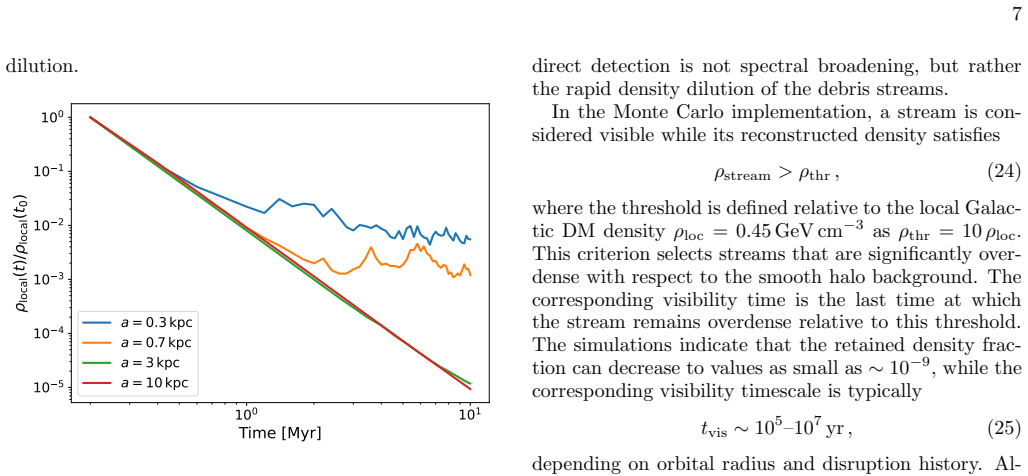
The central claim is that the kinetic energy of the stripped debris from minicluster disruptions typically exceeds its residual self-gravitational binding energy at formation, so that subsequent evolution is dominated by anisotropic free expansion and orbital shear. As a result, stream densities can decrease by factors as large as ∼10^{-9} over Galactic timescales, strongly suppressing the steady-state abundance of dense streams near the Solar circle. At the Solar radius, only a small fraction of realizations yields a nonzero encounter probability over a 10 year exposure, implying that observable streams are dominated by rare recent and nearby disruption events rather than by a persistent po
What carries the argument
Large-scale Monte Carlo treatment of repeated stellar flybys combined with tracer reconstruction of the stripped debris, which follows phase-space evolution to show dominance of free expansion and orbital shear.
If this is right
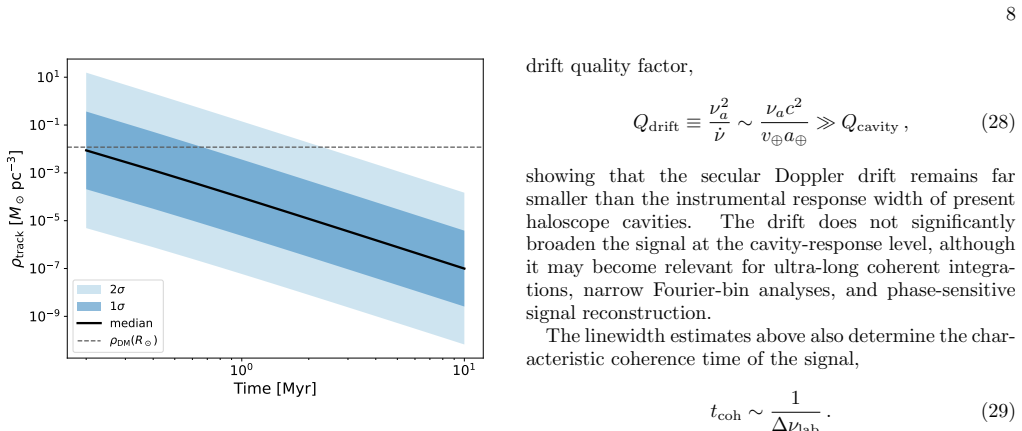
- Stream densities decrease by factors up to ∼10^{-9}, suppressing the steady-state abundance of dense streams near the Solar circle.
- At the Solar radius only a small fraction of realizations shows nonzero encounter probability over a 10-year exposure.
- Observable streams are dominated by rare recent and nearby disruption events rather than long-lived overdense substructure.
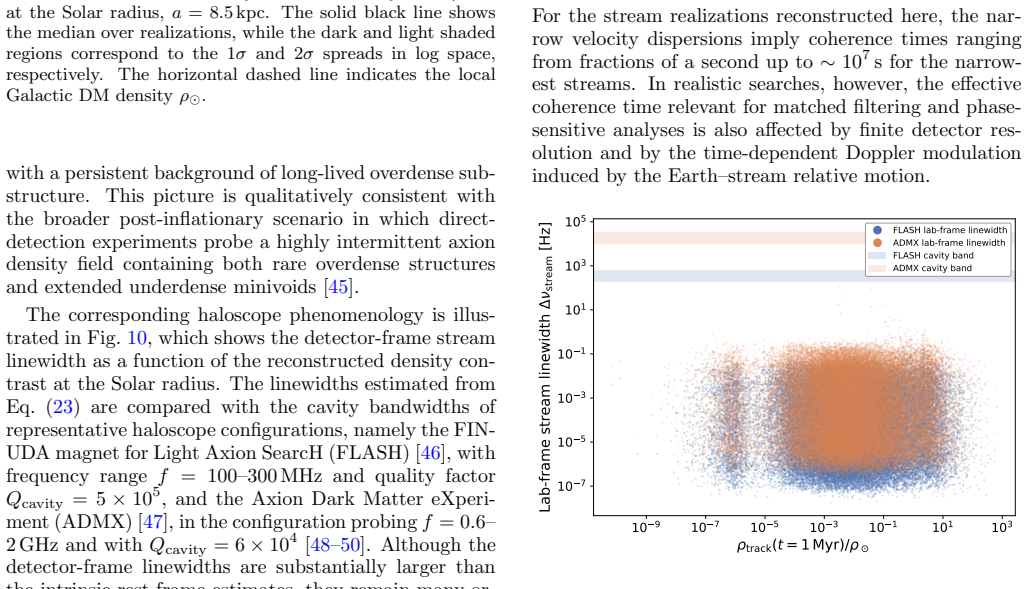
- Streams produce detector-frame linewidths ∼10^{-7}-10^{1} Hz, many orders of magnitude narrower than current haloscope cavity bandwidths.
- The Doppler drift of the streams remains well below the cavity response width for representative haloscope configurations.
Where Pith is reading between the lines
- Haloscope search strategies could shift toward looking for transient narrow-line signals from recent disruptions instead of assuming a steady dense population.
- The local dark matter distribution near the Sun may appear more uniform than expected if minicluster contributions are heavily diluted by shear and expansion.
- Including residual self-gravity in future models could test whether the dilution rate changes enough to allow more persistent streams.
Load-bearing premise
The kinetic energy of the stripped debris typically exceeds its residual self-gravitational binding energy at formation, allowing evolution to be dominated by anisotropic free expansion and orbital shear rather than remaining bound.
What would settle it
A simulation or observation that finds a persistent population of dense, long-lived axion streams near the Solar circle whose densities do not drop by large factors over Galactic timescales.
Figures
read the original abstract
We investigate the formation and evolution of axion streams generated by the tidal disruption of axion miniclusters through stellar encounters in the Milky Way halo. Combining a large-scale Monte Carlo treatment of repeated stellar flybys with a tracer reconstruction of the stripped debris, we follow the phase-space evolution of the streams across a broad range of galactocentric radii and assess their contribution to the local dark matter distribution. We find that the kinetic energy of the stripped debris typically exceeds its residual self-gravitational binding energy at formation, so that the subsequent evolution is dominated by anisotropic free expansion and orbital shear. As a result, stream densities can decrease by factors as large as $\sim10^{-9}$ over Galactic timescales, strongly suppressing the steady-state abundance of dense streams near the Solar circle. At the Solar radius, only a small fraction of realizations yields a nonzero encounter probability over a 10 year exposure, implying that observable streams are dominated by rare recent and nearby disruption events rather than by a persistent population of long-lived overdense substructure. Despite this rapid dilution, the streams remain dynamically cold and produce detector-frame linewidths many orders of magnitude narrower than the cavity bandwidths of current haloscope experiments. For representative haloscope configurations, we find characteristic stream linewidths in the range $\Delta\nu_{\rm stream}\sim10^{-7}-10^{1}\,{\rm Hz}$, while the corresponding Doppler drift remains well below the cavity response width.
Editorial analysis
A structured set of objections, weighed in public.
Referee Report
Summary. The manuscript uses Monte Carlo modeling of repeated stellar flybys on axion miniclusters combined with tracer-particle reconstruction of stripped debris to follow stream phase-space evolution across galactocentric radii. It reports that kinetic energy typically exceeds residual self-gravitational binding energy, enabling anisotropic free expansion plus orbital shear that dilutes stream densities by factors up to ~10^{-9} over Galactic times; this suppresses the steady-state population of dense streams near the Solar circle, so that detectable encounters are dominated by rare recent nearby events. The streams remain dynamically cold, yielding detector-frame linewidths Δ u_stream ~ 10^{-7}–10^1 Hz that are far narrower than haloscope cavity bandwidths.
Significance. If the central dilution result holds after validation, the work would meaningfully constrain axion direct-detection strategies by showing that persistent overdense streams are rare near the Sun and that experiments must account for transient, cold streams from recent disruptions. The Monte Carlo plus tracer approach enables broad radial coverage and produces concrete, falsifiable predictions for encounter rates and linewidths that can be tested against future data or higher-resolution simulations.
major comments (3)
- [Abstract] Abstract: the central claim that stream densities decrease by factors as large as ~10^{-9} rests on the assertion that 'the kinetic energy of the stripped debris typically exceeds its residual self-gravitational binding energy at formation'; no histogram, cumulative distribution, or fraction of realizations satisfying KE/binding > 1 is reported, nor is sensitivity to minicluster density or impact parameter quantified.
- [Methods] Methods (tracer reconstruction): the reconstruction is stated to capture the initial potential energy of the stripped component, yet no comparison to full N-body integrations or convergence test with respect to tracer number is provided; this directly affects whether the free-expansion regime (and consequent dilution) is robust.
- [Results] Results (Solar-radius encounter probabilities): the statement that 'only a small fraction of realizations yields a nonzero encounter probability over a 10 year exposure' is load-bearing for the conclusion that observable streams are dominated by rare recent events, but no error bars, bootstrap uncertainties, or variation with Monte Carlo sample size are given.
minor comments (2)
- [Abstract] The abstract quotes specific linewidth ranges (Δ u_stream ~10^{-7}–10^1 Hz) without indicating whether these are medians, 68 % intervals, or extrema across the Monte Carlo ensemble.
- [Discussion] Notation for the Doppler drift and cavity response width is introduced without an explicit equation relating them to the stream velocity dispersion.
Simulated Author's Rebuttal
We thank the referee for their careful and constructive review. We address each major comment below and indicate the revisions planned for the manuscript.
read point-by-point responses
-
Referee: [Abstract] Abstract: the central claim that stream densities decrease by factors as large as ~10^{-9} rests on the assertion that 'the kinetic energy of the stripped debris typically exceeds its residual self-gravitational binding energy at formation'; no histogram, cumulative distribution, or fraction of realizations satisfying KE/binding > 1 is reported, nor is sensitivity to minicluster density or impact parameter quantified.
Authors: We agree that explicit quantitative support for this key assertion is needed. In the revised manuscript we will add a histogram of the KE-to-binding-energy ratio across all Monte Carlo realizations, report the fraction of cases satisfying KE/binding > 1, and include a brief discussion of sensitivity to minicluster density and impact parameter. revision: yes
-
Referee: [Methods] Methods (tracer reconstruction): the reconstruction is stated to capture the initial potential energy of the stripped component, yet no comparison to full N-body integrations or convergence test with respect to tracer number is provided; this directly affects whether the free-expansion regime (and consequent dilution) is robust.
Authors: Full N-body integrations over the full Monte Carlo ensemble are computationally prohibitive. We have, however, performed convergence tests on tracer number for a representative subset of disruptions; these tests confirm that the reported dilution factors stabilize at the tracer counts employed. We will add these tests and a short justification of the tracer method to the Methods section. revision: partial
-
Referee: [Results] Results (Solar-radius encounter probabilities): the statement that 'only a small fraction of realizations yields a nonzero encounter probability over a 10 year exposure' is load-bearing for the conclusion that observable streams are dominated by rare recent events, but no error bars, bootstrap uncertainties, or variation with Monte Carlo sample size are given.
Authors: We will add bootstrap uncertainties on the encounter probabilities and discuss variation with Monte Carlo sample size in the revised Results section to strengthen this claim. revision: yes
Circularity Check
No significant circularity; derivation from Monte Carlo simulations and tracer evolution is self-contained
full rationale
The paper's central claims on stream dilution, density drop by ~10^{-9}, and encounter probabilities derive from explicit numerical modeling of stellar flybys combined with tracer-particle reconstruction of debris phase-space evolution. No load-bearing step reduces by construction to a fitted parameter, self-defined quantity, or self-citation chain; the KE > binding-energy condition is stated as an input assumption whose consequences are then simulated rather than derived tautologically from the target observables. The derivation chain therefore remains independent of the reported results.
Axiom & Free-Parameter Ledger
axioms (2)
- domain assumption Standard assumptions about stellar densities, velocities, and encounter rates in the Milky Way halo are sufficient for the Monte Carlo modeling of repeated flybys.
- domain assumption Tracer particle reconstruction accurately captures the phase-space evolution of stripped axion debris without requiring full self-gravitating N-body integration.
Forward citations
Cited by 1 Pith paper
-
From Rags to Jeans: Axion Miniclusters from Early matter domination
Temperature-dependent axion mass fluctuations in early matter domination source order-unity axion overdensities by equality, yielding two distinct regions in the nonlinear spectrum and estimated minicluster masses.
Reference graph
Works this paper leans on
-
[1]
Weinberg, Phys
S. Weinberg, Phys. Rev. Lett.40, 223 (1978)
1978
-
[2]
Wilczek, Phys
F. Wilczek, Phys. Rev. Lett.40, 279 (1978)
1978
-
[3]
R. D. Peccei and H. R. Quinn, Phys. Rev. Lett.38, 1440 (1977)
1977
-
[4]
R. D. Peccei and H. R. Quinn, Phys. Rev. D16, 1791 (1977)
1977
-
[5]
D. J. E. Marsh, Phys. Rept.643, 1 (2016), arXiv:1510.07633 [astro-ph.CO]
work page internal anchor Pith review Pith/arXiv arXiv 2016
-
[6]
The landscape of QCD axion models
L. Di Luzio, M. Giannotti, E. Nardi, and L. Visinelli, Phys. Rept.870, 1 (2020), arXiv:2003.01100 [hep-ph]
work page internal anchor Pith review Pith/arXiv arXiv 2020
-
[7]
Arza et al., (2026), arXiv:2603.03433 [hep-ph]
A. Arza et al., (2026), arXiv:2603.03433 [hep-ph]
-
[8]
C. J. Hogan and M. J. Rees, Phys. Lett. B205, 228 (1988)
1988
-
[9]
E. W. Kolb and I. I. Tkachev, Phys. Rev. D49, 5040 (1994), arXiv:astro-ph/9311037
work page internal anchor Pith review Pith/arXiv arXiv 1994
-
[10]
E. W. Kolb and I. I. Tkachev, Phys. Rev. Lett.71, 3051 (1993), arXiv:hep-ph/9303313 [hep-ph]
work page internal anchor Pith review Pith/arXiv arXiv 1993
-
[11]
I. I. Tkachev, JETP Lett.101, 1 (2015), arXiv:1411.3900 [astro-ph.HE]
work page internal anchor Pith review Pith/arXiv arXiv 2015
-
[12]
Tidal streams from axion miniclusters and direct axion searches
P. Tinyakov, I. Tkachev, and K. Zioutas, JCAP01, 035 (2016), arXiv:1512.02884 [astro-ph.CO]
work page internal anchor Pith review Pith/arXiv arXiv 2016
-
[13]
Axion cosmology with long-lived domain walls
T. Hiramatsu, M. Kawasaki, K. Saikawa, and T. Sekiguchi, JCAP01, 001 (2013), arXiv:1207.3166 [hep-ph]
work page internal anchor Pith review Pith/arXiv arXiv 2013
-
[14]
Production of dark matter axions from collapse of string-wall systems
T. Hiramatsu, M. Kawasaki, K. Saikawa, and T. Sekiguchi, Phys. Rev. D85, 105020 (2012), [Erra- tum: Phys.Rev.D 86, 089902 (2012)], arXiv:1202.5851 [hep-ph]
work page internal anchor Pith review Pith/arXiv arXiv 2012
-
[15]
Axion dark matter: strings and their cores
L. Fleury and G. D. Moore, JCAP01, 004 (2016), arXiv:1509.00026 [hep-ph]
work page internal anchor Pith review Pith/arXiv arXiv 2016
-
[16]
V. B. . Klaer and G. D. Moore, JCAP11, 049 (2017), arXiv:1708.07521 [hep-ph]
work page internal anchor Pith review Pith/arXiv arXiv 2017
-
[17]
Axions from Strings: the Attractive Solution
M. Gorghetto, E. Hardy, and G. Villadoro, JHEP07, 151 (2018), arXiv:1806.04677 [hep-ph]
work page internal anchor Pith review Pith/arXiv arXiv 2018
-
[18]
M. Buschmann, J. W. Foster, and B. R. Safdi, Phys. Rev. Lett.124, 161103 (2020), arXiv:1906.00967 [astro- ph.CO]
-
[19]
M. Gorghetto, E. Hardy, and G. Villadoro, SciPost Phys. 10, 050 (2021), arXiv:2007.04990 [hep-ph]
-
[20]
M. Buschmann, J. W. Foster, A. Hook, A. Peterson, D. E. Willcox, W. Zhang, and B. R. Safdi, Nature Com- mun.13, 1049 (2022), arXiv:2108.05368 [hep-ph]
- [21]
-
[22]
K. Saikawa, J. Redondo, A. Vaquero, and M. Kaltschmidt, JCAP10, 043 (2024), arXiv:2401.17253 [hep-ph]
-
[23]
M. Fairbairn, D. J. E. Marsh, J. Quevillon, and S. Rozier, Phys. Rev. D97, 083502 (2018), arXiv:1707.03310 [astro-ph.CO]
-
[24]
Axion minicluster power spectrum and mass function
J. Enander, A. Pargner, and T. Schwetz, JCAP12, 038 (2017), arXiv:1708.04466 [astro-ph.CO]
work page internal anchor Pith review Pith/arXiv arXiv 2017
-
[25]
Early seeds of axion miniclusters
A. Vaquero, J. Redondo, and J. Stadler, JCAP04, 012 (2019), arXiv:1809.09241 [astro-ph.CO]
work page internal anchor Pith review Pith/arXiv arXiv 2019
- [26]
- [27]
- [28]
-
[29]
L. Visinelli and J. Redondo, Phys. Rev. D101, 023008 (2020), arXiv:1808.01879 [astro-ph.CO]
- [30]
-
[31]
A. M. Green and S. P. Goodwin, Mon. Not. Roy. Astron. Soc.375, 1111 (2007), arXiv:astro-ph/0604142
work page internal anchor Pith review Pith/arXiv arXiv 2007
- [32]
- [33]
-
[34]
I. DSouza and C. Gordon, Phys. Rev. D109, 123035 (2024), arXiv:2402.03236 [astro-ph.GA]
- [35]
- [36]
-
[37]
S. Collazo, M. F. Mestre, and C. R. Arg¨ uelles, Astron. Astrophys.699, A315 (2025), arXiv:2505.15550 [astro- ph.GA]
- [38]
-
[39]
Sikivie, Phys
P. Sikivie, Phys. Rev. Lett.51, 1415 (1983), [Erratum: Phys.Rev.Lett. 52, 695 (1984)]
1983
-
[40]
Sikivie, Phys
P. Sikivie, Phys. Rev. D32, 2988 (1985), [Erratum: Phys.Rev.D 36, 974 (1987)]
1985
-
[41]
C. A. J. O’Hare and A. M. Green, Phys. Rev. D95, 063017 (2017), arXiv:1701.03118 [astro-ph.CO]
work page internal anchor Pith review Pith/arXiv arXiv 2017
- [42]
-
[43]
Bhura et al., (2026), arXiv:2603.13194 [hep-ph]
U. Bhura et al., (2026), arXiv:2603.13194 [hep-ph]
-
[44]
ADAMOS: Axion Daily Modulation Searches for Dark Matter at 20 GHz
M. Maroudas, T.-S. Cezar, A. Gardikiotis, and D. Horns, (2026), arXiv:2603.18006 [hep-ex]
work page internal anchor Pith review Pith/arXiv arXiv 2026
-
[45]
B. Eggemeier, C. A. J. O’Hare, G. Pierobon, J. Redondo, and Y. Y. Y. Wong, Phys. Rev. D107, 083510 (2023), arXiv:2212.00560 [hep-ph]
-
[46]
D. Alesini et al., Phys. Dark Univ.42, 101370 (2023), arXiv:2309.00351 [physics.ins-det]
-
[47]
S. J. Asztalos et al. (ADMX), Phys. Rev. D64, 092003 (2001)
2001
-
[48]
A Search for Invisible Axion Dark Matter with the Axion Dark Matter Experiment
N. Du et al. (ADMX), Phys. Rev. Lett.120, 151301 (2018), arXiv:1804.05750 [hep-ex]
work page internal anchor Pith review Pith/arXiv arXiv 2018
-
[49]
C. Bartram et al. (ADMX), Rev. Sci. Instrum.94, 044703 (2023), arXiv:2110.10262 [hep-ex]
- [50]
discussion (0)
Sign in with ORCID, Apple, or X to comment. Anyone can read and Pith papers without signing in.