Automated Heuristic Design for Network Operations
Pith reviewed 2026-06-29 09:43 UTC · model grok-4.3
The pith
Automated heuristic design tools can generate Low-Density Parity Check decoders for 5G that match the performance of production systems.
A machine-rendered reading of the paper's core claim, the machinery that carries it, and where it could break.
Core claim
Automated Heuristic Design frameworks can be integrated with network operation tasks, and when applied to Low-Density Parity Check decoding in 5G, they produce heuristics that perform on par with state-of-the-art solutions currently implemented in production systems.
What carries the argument
Automated Heuristic Design (AHD) frameworks that employ AI to automatically generate heuristics tailored to a target problem such as LDPC decoding.
If this is right
- Network operators could reduce dependence on manual expert knowledge when creating heuristics for protocol-stack tasks.
- AHD offers a repeatable process for rapidly generating new heuristics whenever system parameters or requirements change.
- For LDPC decoding specifically, AHD achieves parity with deployed solutions, indicating that similar automation may apply to other decoding or error-correction problems.
Where Pith is reading between the lines
- If the integration challenges are solved, AHD could be applied to additional network problems such as scheduling or congestion control.
- The approach might shorten the time between identifying a new network optimization need and deploying a working heuristic.
- Success in one 5G component raises the question of whether AHD can handle cross-layer interactions where multiple heuristics must operate together.
Load-bearing premise
The 5G decoding task and chosen AHD framework are representative enough that the integration challenges can be overcome in other network settings.
What would settle it
A direct comparison in which the same AHD framework is run on a second network task such as resource allocation or routing and the generated heuristics fall short of existing human-designed baselines under realistic traffic loads.
Figures

read the original abstract
Network operation relies on heuristics to solve many tasks rapidly and efficiently across the protocol stack. These heuristics are the result of thorough human-driven design rooted in expert knowledge of the target system and problem. Recently, approaches powered by Artificial Intelligence have shown promising results in devising solutions that outperform long-established heuristics in classical problems. We explore the possibility of applying such Automated Heuristic Design (AHD) frameworks to network environments by (i) discussing the general integration of AHD with network operation and the associated challenges, as well as (ii) proposing a practical implementation of AHD for a specific networking task, i.e., 5G decoding. Initial results show how modern AHD tools can devise heuristics for Low-Density Parity Check decoding on par with state-of-the-art solutions implemented in production systems.
Editorial analysis
A structured set of objections, weighed in public.
Referee Report
Summary. The manuscript explores the integration of Automated Heuristic Design (AHD) frameworks into network operations, discussing associated challenges and proposing a practical implementation for 5G LDPC decoding. It claims that initial results show AHD tools can produce heuristics for LDPC decoding that perform on par with state-of-the-art solutions in production systems.
Significance. If the performance parity claim holds under rigorous evaluation, the work could meaningfully advance automation of heuristic design across the networking protocol stack, reducing dependence on manual expert tuning. The discussion of integration challenges offers a structured starting point for applying AHD in operational environments.
major comments (1)
- [Abstract] Abstract: the central claim that AHD heuristics achieve performance 'on par with state-of-the-art solutions implemented in production systems' is unsupported by any reported data, error bars, baselines, code parameters, channel conditions, metrics (BER/throughput/latency), or implementation overhead details, preventing assessment of whether equivalence holds.
Simulated Author's Rebuttal
We thank the referee for the constructive comment on the abstract. We address the concern directly below and will revise the manuscript accordingly.
read point-by-point responses
-
Referee: [Abstract] Abstract: the central claim that AHD heuristics achieve performance 'on par with state-of-the-art solutions implemented in production systems' is unsupported by any reported data, error bars, baselines, code parameters, channel conditions, metrics (BER/throughput/latency), or implementation overhead details, preventing assessment of whether equivalence holds.
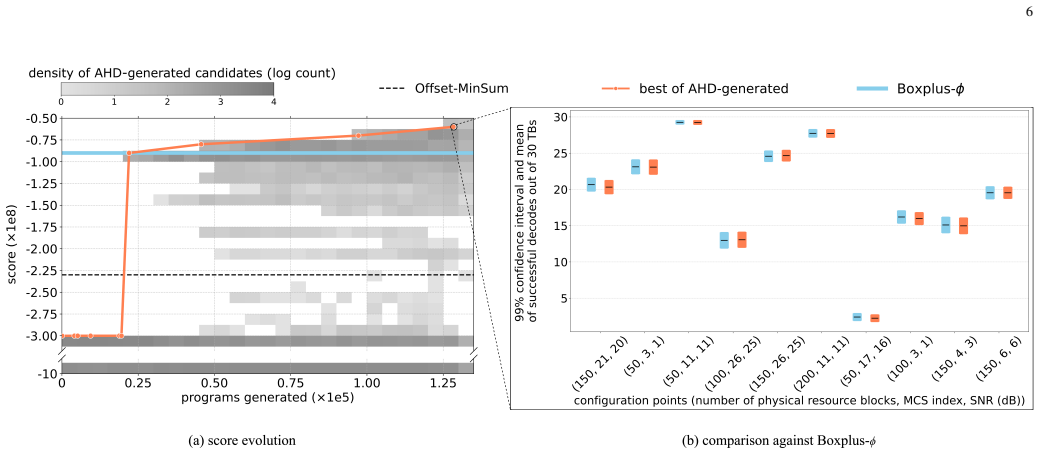
Authors: We agree that the abstract, as currently worded, does not include the quantitative details needed to support the claim. The full manuscript (Section 4) reports the experimental evaluation using standard 5G LDPC code parameters (e.g., rate-1/2 codes of length 1024), AWGN channel conditions at multiple SNR points, and metrics including BER curves and decoding throughput (in Mbps) on a reference platform. The AHD-generated heuristics match or come within 0.1 dB of the production baseline decoder across the tested range, with comparable latency. To resolve the issue, we will revise the abstract to explicitly summarize these key results, baselines, and conditions, and we will add a brief note on implementation overhead. Error bars from repeated trials will also be referenced. revision: yes
Circularity Check
No circularity: paper presents empirical proposal without derivation chain
full rationale
The manuscript discusses AHD integration challenges and reports initial empirical results on LDPC decoding parity with production systems. No equations, first-principles derivations, fitted parameters renamed as predictions, or self-citation load-bearing uniqueness theorems appear. The central claim is an empirical observation rather than a mathematical reduction, rendering the listed circularity patterns inapplicable. The derivation chain is empty and thus self-contained by default.
Axiom & Free-Parameter Ledger
Reference graph
Works this paper leans on
-
[1]
Learning heuristics with different rep- resentations for stochastic routing,
Y .-H. Jia, Y . Mei, and M. Zhang, “Learning heuristics with different rep- resentations for stochastic routing,”IEEE Transactions on Cybernetics, vol. 53, no. 5, pp. 3205–3219, 2023
2023
-
[2]
Computers can learn from the heuristic designs and master internet congestion control,
C.-Y . Yen, S. Abbasloo, and H. J. Chao, “Computers can learn from the heuristic designs and master internet congestion control,” inACM SIGCOMM ’23. ACM, 2023, p. 255–274
2023
-
[3]
Towards provably performant congestion control,
A. Agarwal, V . Arun, D. Ray, R. Martins, and S. Seshan, “Towards provably performant congestion control,” inNSDI 24. USENIX Association, Apr. 2024, pp. 951–978
2024
-
[4]
Constrained multi-agent reinforcement learning for task offloading in wireless edge networks,
A. Fox, F. D. Pellegrini, and E. Altman, “Constrained multi-agent reinforcement learning for task offloading in wireless edge networks,” inNeurIPS 2025 Workshop: AI and ML for Next-Generation Wireless Communications and Networking, 2025
2025
-
[5]
Robust channel representation for wireless: A multi-task masked contrastive approach,
B. Guler, G. Geraci, and H. Jafarkhani, “Robust channel representation for wireless: A multi-task masked contrastive approach,” inNeurIPS 2025 Workshop: AI and ML for Next-Generation Wireless Communica- tions and Networking, 2025
2025
-
[6]
Physics-informed neural networks for wireless channel estimation with limited pilot signals,
A. Javid and N. G. Prelcic, “Physics-informed neural networks for wireless channel estimation with limited pilot signals,” inNeurIPS 2025 Workshop: AI and ML for Next-Generation Wireless Communications and Networking, 2025
2025
-
[7]
Mathematical discoveries from program search with large language models,
B. Romera-Paredes, M. Barekatain, A. Novikov, M. Balog, M. P. Kumar, E. Dupont, F. J. R. Ruiz, J. S. Ellenberg, P. Wang, O. Fawzi, P. Kohli, and A. Fawzi, “Mathematical discoveries from program search with large language models,”Nature, vol. 625, no. 7995, pp. 468–475, Jan. 2024
2024
-
[8]
Evolution of heuristics: towards efficient automatic algorithm design using large language model,
F. Liu, X. Tong, M. Yuan, X. Lin, F. Luo, Z. Wang, Z. Lu, and Q. Zhang, “Evolution of heuristics: towards efficient automatic algorithm design using large language model,” ser. ICML’24. JMLR.org, 2024
2024
-
[9]
Reevo: large language models as hyper-heuristics with reflective evo- lution,
H. Ye, J. Wang, Z. Cao, F. Berto, C. Hua, H. Kim, J. Park, and G. Song, “Reevo: large language models as hyper-heuristics with reflective evo- lution,” ser. NIPS ’24, 2024
2024
-
[10]
Llm4ad: Large language model for algorithm design
F. L. et al., “Llm4ad: Large language model for algorithm design.” [Online]. Available: https://github.com/Optima-CityU/llm4ad/tree/main/ example/circle packing
-
[11]
Sionna: An Open-Source Li- brary for Next-Generation Physical Layer Research,
J. Hoydis, S. Cammerer, F. A. Aoudia, A. Vem, N. Binder, G. Marcus, and A. Keller, “Sionna: An open-source library for next-generation physical layer research,” 2023. [Online]. Available: https://arxiv.org/abs/2203.11854 BIOGRAPHIES Reza Namvaris a PhD student at IMDEA Networks Institute and UC3M. He holds an MSc in Software Engineering from Shiraz Univer...
discussion (0)
Sign in with ORCID, Apple, or X to comment. Anyone can read and Pith papers without signing in.