Contact, conflict, or opportunity? Out-group exposure creates tie opportunity, not tolerance
Pith reviewed 2026-06-29 09:34 UTC · model grok-4.3
The pith
Greater classroom diversity strengthens same-gender friendship preferences while leaving ethnic and socioeconomic preferences unchanged.
A machine-rendered reading of the paper's core claim, the machinery that carries it, and where it could break.
Core claim
Using a multilevel model based on the Wallenius hypergeometric distribution to separate preference from opportunity structure, the analysis shows that preferences for same-ethnicity and same-socioeconomic-status friends remain stable across different classroom compositions, while same-gender preference increases with greater gender diversity, consistent with conflict theory rather than contact or pure opportunity explanations.
What carries the argument
A multilevel model based on the Wallenius hypergeometric distribution that estimates individual tie preferences while correcting for the finite and asymmetric pool of potential ties in each classroom.
If this is right
- Classroom composition changes do not reduce ethnic or socioeconomic in-group preferences.
- Greater gender balance in classes can increase same-gender friendship bias.
- Observed cross-group interactions may rise with diversity even if underlying preferences do not shift toward tolerance.
- Interventions aimed at reducing prejudice through exposure may need to target gender differently from other attributes.
Where Pith is reading between the lines
- Similar patterns might appear in other bounded social settings like workplaces or neighborhoods if the opportunity structure is similarly modeled.
- Policies increasing diversity without addressing preferences could lead to more segregated friend groups along gender lines.
- The finding raises the question of whether the gender effect would persist or reverse at very high levels of diversity.
Load-bearing premise
The statistical model accurately separates students' true preferences from the mere availability of different types of peers in each classroom.
What would settle it
Repeating the analysis on new classroom data where same-gender preference does not increase with higher opposite-gender proportions would contradict the central finding.
Figures

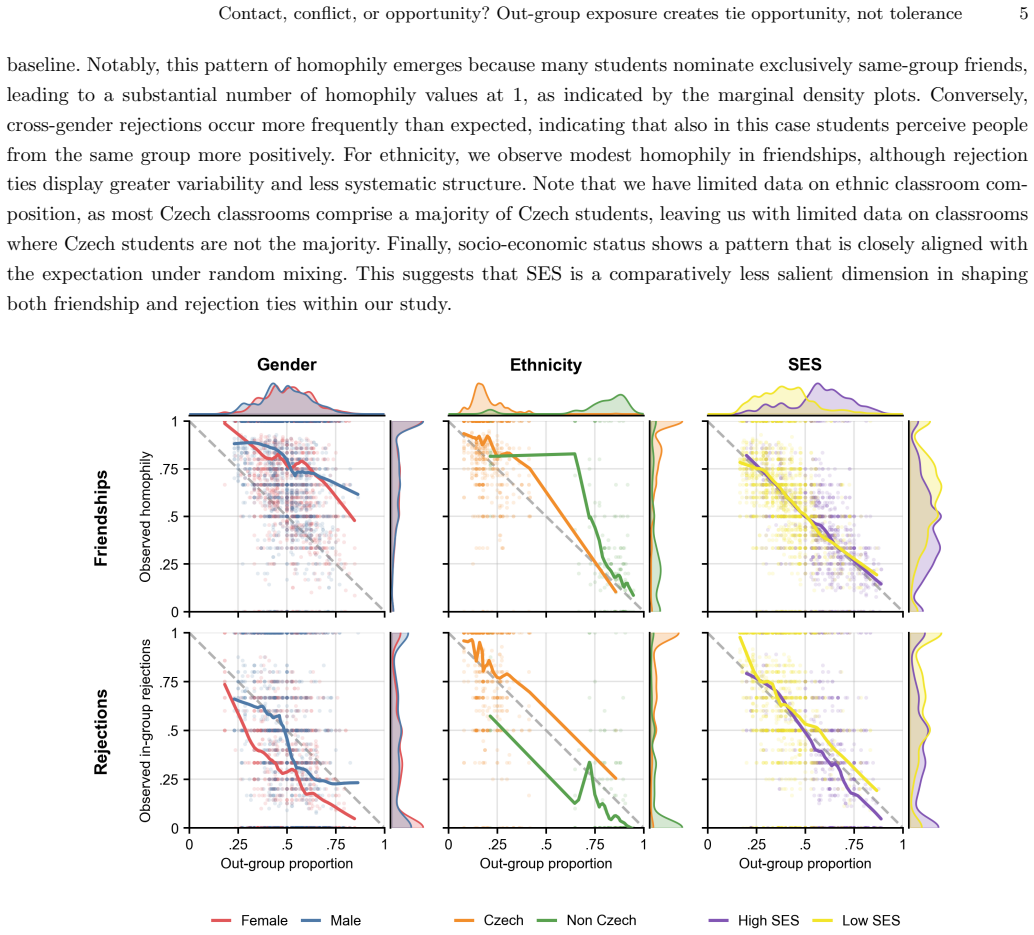
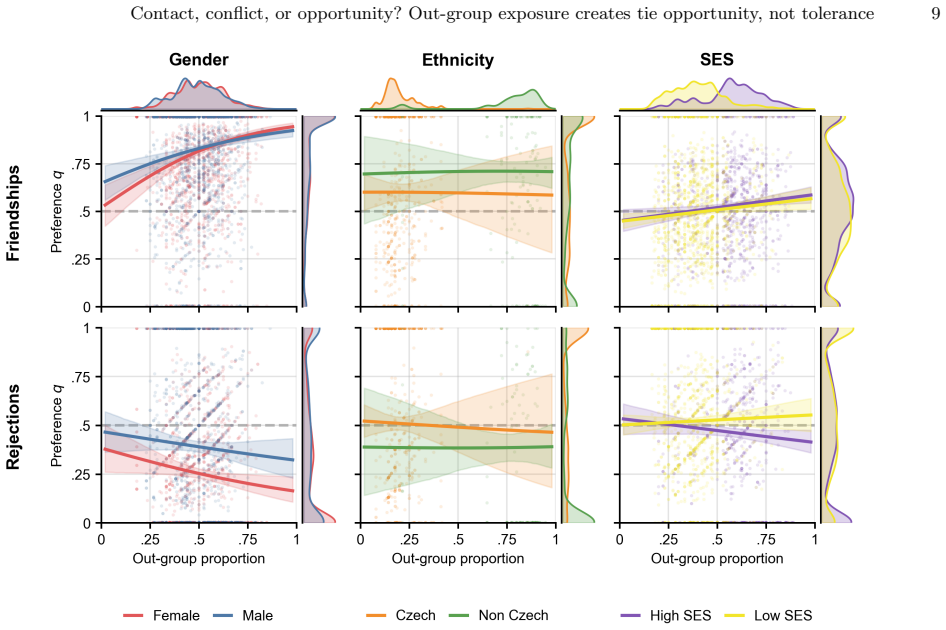
read the original abstract
Three theories offer competing predictions about how people respond to growing diversity in their social environment. Contact theory suggests more exposure to out-groups reduces prejudice; conflict theory predicts a stronger in-group preference; structural opportunity theory argues that shifts in behaviour only reflect changes in the opportunity structure rather than in underlying preference. We test these predictions using friendship and rejection nominations from nearly 5,000 students in 228 classrooms, across gender, ethnicity, and socio-economic status. We estimate individual preference using a multilevel model based on the Wallenius hypergeometric distribution, which accounts for the finite, asymmetric pool of potential ties. Results show that for ethnicity and socio-economic status, preferences are largely unaffected by classroom composition. For gender, however, same-gender preference strengthens as the out-group increases, supporting conflict theory. This means greater diversity does not necessarily change the intrinsic preference of students toward out-group peers, but creates more opportunities for cross-group interactions.
Editorial analysis
A structured set of objections, weighed in public.
Referee Report
Summary. The paper tests three theories (contact, conflict, opportunity) on how out-group exposure affects tie formation using friendship and rejection nominations from ~5000 students across 228 classrooms. It applies a multilevel model based on the Wallenius hypergeometric distribution to recover individual-level preference parameters net of finite/asymmetric opportunity structure, reporting that ethnicity and SES preferences are largely invariant to classroom composition while same-gender preference strengthens with out-group share (supporting conflict theory). The abstract concludes that diversity mainly creates cross-group opportunities without altering intrinsic preferences except in the gender case.
Significance. If the Wallenius multilevel model successfully isolates composition-independent preferences, the results provide a clear empirical separation of opportunity from preference shifts and a dimension-specific finding (gender vs. ethnicity/SES) that could inform theories of intergroup relations and school integration policy. The use of rejection nominations alongside friendships is a strength for capturing negative ties.
major comments (2)
- [Abstract] Abstract (model description): The central claim that preferences are unaffected for ethnicity/SES and strengthen for gender rests entirely on the multilevel Wallenius hypergeometric model correctly recovering preference parameters net of opportunity. No information is given on estimation details, convergence diagnostics, model comparison (e.g., vs. standard hypergeometric or logistic alternatives), or sensitivity to unmodeled features such as reciprocity or degree heterogeneity. This is load-bearing for distinguishing the three theories.
- [Abstract] Abstract (results reporting): The manuscript reports that 'preferences are largely unaffected' for ethnicity and SES and that same-gender preference 'strengthens' for gender, but provides no quantitative details on effect sizes, confidence intervals, or how 'largely unaffected' and 'strengthens' are defined (e.g., slope significance or magnitude thresholds in the multilevel model). Without these, the dimension-specific contrast cannot be evaluated.
minor comments (1)
- [Abstract] The abstract states 'nearly 5,000 students' without exact N or response rate; this should be stated precisely in the methods section.
Simulated Author's Rebuttal
We thank the referee for their constructive comments on our manuscript. We address each major comment below and will revise the manuscript to improve transparency on the modeling approach and results reporting.
read point-by-point responses
-
Referee: [Abstract] Abstract (model description): The central claim that preferences are unaffected for ethnicity/SES and strengthen for gender rests entirely on the multilevel Wallenius hypergeometric model correctly recovering preference parameters net of opportunity. No information is given on estimation details, convergence diagnostics, model comparison (e.g., vs. standard hypergeometric or logistic alternatives), or sensitivity to unmodeled features such as reciprocity or degree heterogeneity. This is load-bearing for distinguishing the three theories.
Authors: The abstract is length-constrained, but the full Methods section describes the multilevel Wallenius hypergeometric model and its use to isolate preferences net of opportunity structure. We will expand the Methods (and add an appendix if needed) with estimation details such as the optimization algorithm, convergence diagnostics (e.g., gradient and Hessian checks), formal model comparisons against standard hypergeometric and logistic alternatives, and sensitivity analyses for reciprocity and degree heterogeneity. These additions will make the load-bearing aspects explicit and strengthen the distinction among the three theories. revision: yes
-
Referee: [Abstract] Abstract (results reporting): The manuscript reports that 'preferences are largely unaffected' for ethnicity and SES and that same-gender preference 'strengthens' for gender, but provides no quantitative details on effect sizes, confidence intervals, or how 'largely unaffected' and 'strengthens' are defined (e.g., slope significance or magnitude thresholds in the multilevel model). Without these, the dimension-specific contrast cannot be evaluated.
Authors: We agree that the abstract would benefit from greater quantitative precision. In the revision we will update the abstract to report the key interaction coefficients (with 95% confidence intervals) from the multilevel model and explicitly define the thresholds used (non-significant slopes for 'largely unaffected'; statistically significant positive interaction for 'strengthens'). The main text already contains these estimates in tables and figures; the abstract will now summarize them to allow direct evaluation of the dimension-specific contrast. revision: yes
Circularity Check
No significant circularity; model uses external distribution on independent nomination data
full rationale
The paper's derivation applies a multilevel model based on the Wallenius hypergeometric distribution (a pre-existing statistical construct) to external friendship/rejection nomination data from 5000 students. Preference parameters are estimated from the data after accounting for finite opportunity structure; reported invariance for ethnicity/SES and strengthening for gender are outputs of this fit, not inputs redefined as results. No self-definitional steps, fitted inputs renamed as predictions, or load-bearing self-citations appear in the provided text. The central distinction between theories rests on the model's separation of preference from opportunity, which is not constructed from the target claims themselves.
Axiom & Free-Parameter Ledger
axioms (1)
- domain assumption The Wallenius hypergeometric distribution accurately models tie formation given finite asymmetric pools of potential friends.
Reference graph
Works this paper leans on
-
[1]
G. W. Allport.The Nature of Prejudice. Addison-Wesley, 1954
1954
-
[2]
Monophily in social networks introduces similarity among friends-of-friends
K. M. Altenburger and J. Ugander. “Monophily in social networks introduces similarity among friends-of-friends”. In:Nature human behaviour2.4 (2018), pp. 284–290
2018
-
[3]
A general approximation to nested Bayes factors with informed priors
F. Bartoˇ s and E.-J. Wagenmakers. “A general approximation to nested Bayes factors with informed priors”. In: Stat12.1 (2023), e600
2023
-
[4]
The influence of classroom ethnic composition on same-and other-ethnicity peer nomina- tions in middle school
A. D. Bellmore et al. “The influence of classroom ethnic composition on same-and other-ethnicity peer nomina- tions in middle school”. In:Social development16.4 (2007), pp. 720–740
2007
-
[5]
P. M. Blau.Inequality and heterogeneity: A primitive theory of social structure. Free Press, 1977
1977
-
[6]
Race prejudice as a sense of group position
H. Blumer. “Race prejudice as a sense of group position”. In:Pacific sociological review1.1 (1958), pp. 3–7
1958
-
[7]
Ethnic diversity fosters the social integration of refugee students
Z. Boda et al. “Ethnic diversity fosters the social integration of refugee students”. In:Nature Human Behaviour 7.6 (2023), pp. 881–891
2023
-
[8]
Attribute consolidation and friendship segregation in classrooms
S. B¨ oller and H. Kruse. “Attribute consolidation and friendship segregation in classrooms”. In:Social Networks (2025)
2025
-
[9]
Manager skill and portfolio size with respect to a benchmark
A. Bolshakov and L. B. Chincarini. “Manager skill and portfolio size with respect to a benchmark”. In:European Financial Management26.1 (2020), pp. 176–197
2020
-
[10]
A limited memory algorithm for bound constrained optimization
R. H. Byrd, P. Lu, J. Nocedal, and C. Zhu. “A limited memory algorithm for bound constrained optimization”. In:SIAM Journal on scientific computing16.5 (1995), pp. 1190–1208
1995
-
[11]
Stan: A probabilistic programming language
B. Carpenter et al. “Stan: A probabilistic programming language”. In:Journal of statistical software76 (2017), pp. 1–32
2017
-
[12]
Configuration models as an urn problem
G. Casiraghi and V. Nanumyan. “Configuration models as an urn problem”. In:Scientific reports11.1 (2021), p. 13416
2021
-
[13]
Promoting friendship diversity in ethnically diverse schools: The role of school climate
M. Chan and A. D. Benner. “Promoting friendship diversity in ethnically diverse schools: The role of school climate”. In:Journal of Youth and Adolescence(2025)
2025
-
[14]
Hate crime towards minoritized groups increases as they increase in size-based rank
M. Cikara, V. Fouka, and M. Tabellini. “Hate crime towards minoritized groups increases as they increase in size-based rank”. In:Nature Human Behaviour6.11 (2022), pp. 1537–1544. 16 M. N. Cartier van Dissel, T. Lintner, S. Martin-Gutierrez and F. Karimi
2022
-
[15]
LOWESS: A program for smoothing scatterplots by robust locally weighted regression
W. S. Cleveland. “LOWESS: A program for smoothing scatterplots by robust locally weighted regression”. In: The American Statistician35.1 (1981), p. 54
1981
-
[16]
An economic model of friendship: Homophily, minorities, and segre- gation
S. Currarini, M. O. Jackson, and P. Pin. “An economic model of friendship: Homophily, minorities, and segre- gation”. In:Econometrica77.4 (2009), pp. 1003–1045
2009
-
[17]
The weighted likelihood ratio, sharp hypotheses about chances, the order of a Markov chain
J. M. Dickey and B. P. Lientz. “The weighted likelihood ratio, sharp hypotheses about chances, the order of a Markov chain”. In:The Annals of Mathematical Statistics(1970), pp. 214–226
1970
-
[18]
hyperFA* IR: A hypergeometric approach to fair rankings with finite candi- date pool
M. N. Cartier van Dissel et al. “hyperFA* IR: A hypergeometric approach to fair rankings with finite candi- date pool”. In:Proceedings of the 2025 ACM Conference on Fairness, Accountability, and Transparency. 2025, pp. 2112–2126
2025
-
[19]
The paradox of second-order homophily in networks
A. Evtushenko and J. Kleinberg. “The paradox of second-order homophily in networks”. In:Scientific Reports 11.1 (2021), p. 13360
2021
-
[20]
Fog.Biased Urn Theory
A. Fog.Biased Urn Theory. Vignette for the R package BiasedUrn. June 2024
2024
-
[21]
Calculation methods for Wallenius’ noncentral hypergeometric distribution
A. Fog. “Calculation methods for Wallenius’ noncentral hypergeometric distribution”. In:Communications in Statistics—Simulation and Computation®37.2 (2008), pp. 258–273
2008
-
[22]
Sampling methods for Wallenius’ and Fisher’s noncentral hypergeometric distributions
A. Fog. “Sampling methods for Wallenius’ and Fisher’s noncentral hypergeometric distributions”. In:Commu- nications in Statistics—Simulation and Computation®37.2 (2008), pp. 241–257
2008
-
[23]
Gender development in adolescence
N. L. Galambos, S. A. Berenbaum, and S. M. McHale. “Gender development in adolescence”. In:Handbook of Adolescent Psychology1 (2009), pp. 305–357
2009
-
[24]
Calculation of Gauss quadrature rules
G. H. Golub and J. H. Welsch. “Calculation of Gauss quadrature rules”. In:Mathematics of computation23.106 (1969), pp. 221–230
1969
-
[25]
Ethnic segregation and inter-ethnic relationships in Hungarian schools
T. Hajdu, G. Kertesi, and G. K´ ezdi. “Ethnic segregation and inter-ethnic relationships in Hungarian schools”. In:On education. Journal for research and debate4.11 (2021)
2021
-
[26]
Intergroup contact and intergroup conflict
M. Hewstone et al. “Intergroup contact and intergroup conflict”. In:Peace and Conflict: Journal of Peace Psychology20.1 (2014), pp. 39–53
2014
-
[27]
The intensification of gender-related role expectations during early adolescence
J. P. Hill and M. E. Lynch. “The intensification of gender-related role expectations during early adolescence”. In:Girls at Puberty: Biological and Psychosocial Perspectives. Ed. by J. Brooks-Gunn and A. C. Petersen. New York: Plenum Press, 1983, pp. 201–228
1983
-
[28]
Not next to you: Peer rejection, sociodemographic characteristics and the moderating effects of classroom composition
S. Hjalmarsson, P. Fallesen, and S. Plenty. “Not next to you: Peer rejection, sociodemographic characteristics and the moderating effects of classroom composition”. In:Journal of youth and adolescence52.6 (2023), pp. 1191– 1205
2023
-
[29]
Stochastic blockmodels: First steps
P. W. Holland, K. B. Laskey, and S. Leinhardt. “Stochastic blockmodels: First steps”. In:Social networks5.2 (1983), pp. 109–137
1983
-
[30]
Similarity in socioeconomic background and peer influence in educational trajectories
L. Hovestadt et al. “Similarity in socioeconomic background and peer influence in educational trajectories”. In: Journal of Adolescence(2025)
2025
-
[31]
School racial composition and adolescent racial homophily
K. Joyner and G. Kao. “School racial composition and adolescent racial homophily”. In:Social science quarterly (2000), pp. 810–825
2000
-
[32]
Homophily within and across groups
A. K. Rizi, R. Michielan, C. Stegehuis, and M. Kivel¨ a. “Homophily within and across groups”. In:Nature communications(2025)
2025
-
[33]
Homophily influences ranking of minorities in social networks
F. Karimi et al. “Homophily influences ranking of minorities in social networks”. In:Scientific reports8.1 (2018), p. 11077
2018
-
[34]
The significance of cross-racial/ethnic friendships: associations with peer victim- ization, peer support, sociometric status, and classroom diversity
Y. Kawabata and N. R. Crick. “The significance of cross-racial/ethnic friendships: associations with peer victim- ization, peer support, sociometric status, and classroom diversity.” In:Developmental Psychology47.6 (2011), p. 1763
2011
-
[35]
Bayesian evaluation of inequality and equality constrained hypotheses for contingency tables
I. Klugkist, O. Laudy, and H. Hoijtink. “Bayesian evaluation of inequality and equality constrained hypotheses for contingency tables.” In:Psychological methods15.3 (2010), p. 281. Contact, conflict, or opportunity? Out-group exposure creates tie opportunity, not tolerance 17
2010
-
[36]
Konr´ adov´ a.Vietnamci v ˇ cesk´ ych ˇ skol´ ach
I. Konr´ adov´ a.Vietnamci v ˇ cesk´ ych ˇ skol´ ach. Bachelor thesis, Technical University of Liberec. 2012
2012
-
[37]
Homophily in strong versus weak social ties across adolescence
T. Kretschmer et al. “Homophily in strong versus weak social ties across adolescence”. In:Social Forces(2025)
2025
-
[38]
Homophily and minority-group size explain perception biases in social networks
E. Lee et al. “Homophily and minority-group size explain perception biases in social networks”. In:Nature Human Behaviour3.10 (2019), pp. 1078–1087
2019
-
[39]
Ukrainian refugees struggling to integrate into Czech school social networks
T. Lintner, T. Divi´ ak, K. ˇSeˇdov´ a, and P. Hlado. “Ukrainian refugees struggling to integrate into Czech school social networks”. In:Humanities and Social Sciences Communications10.1 (2023), pp. 1–11
2023
-
[40]
How affective relationships and classroom norms shape perceptions of aggressor, victim, and defender roles
T. Lintner, A. Klocek, I. Ropovik, and L. Kollerov´ a. “How affective relationships and classroom norms shape perceptions of aggressor, victim, and defender roles”. In:Aggressive Behavior51.1 (2025), e70020
2025
-
[41]
Relational and interactional dynamic network data from Czech lower-secondary school stu- dents
T. Lintner et al. “Relational and interactional dynamic network data from Czech lower-secondary school stu- dents”. In:Data in Brief51 (2023), p. 109641
2023
-
[42]
Lintner and K
T. Lintner and K. ˇSeˇdov´ a.Peer social networks in Czech lower-secondary classrooms. Mendeley Data. 2021
2021
-
[43]
A note on Gauss—Hermite quadrature
Q. Liu and D. A. Pierce. “A note on Gauss—Hermite quadrature”. In:Biometrika81.3 (1994), pp. 624–629
1994
-
[44]
E. E. Maccoby.The Two Sexes: Growing Up Apart, Coming Together. Cambridge, MA: Harvard University Press, 1998
1998
-
[45]
Patterns of gender development
C. L. Martin and D. N. Ruble. “Patterns of gender development”. In:Annual Review of Psychology61 (2010), pp. 353–381
2010
-
[46]
A simple preference aggregation rule explains how multidimensional identities shape social networks
S. Martin-Gutierrez, M. N. Cartier van Dissel, and F. Karimi. “A simple preference aggregation rule explains how multidimensional identities shape social networks”. In:Communications Physics(2026)
2026
-
[47]
Intersectional inequalities in social ties
S. Martin-Gutierrez, M. N. Cartier van Dissel, and F. Karimi. “Intersectional inequalities in social ties”. In: Science Advances11.45 (2025), eadu9025
2025
-
[48]
Bayesian hierarchical models
A. E. McGlothlin and K. Viele. “Bayesian hierarchical models”. In:Jama320.22 (2018), pp. 2365–2366
2018
-
[49]
Understanding intergroup contact in educational contexts: Opportunities and limits
S. McKeown, J. Dixon, et al. “Understanding intergroup contact in educational contexts: Opportunities and limits”. In:Social and Personality Psychology Compass(2025)
2025
-
[50]
Birds of a feather: Homophily in social networks
M. McPherson, L. Smith-Lovin, and J. M. Cook. “Birds of a feather: Homophily in social networks”. In:Annual Review of Sociology27 (2001), pp. 415–444
2001
-
[51]
Same-gender versus cross-gender friendship conceptions: Similar or different?
C. M. Mehta and J. Strough. “Same-gender versus cross-gender friendship conceptions: Similar or different?” In: Developmental Review29.3 (2009), pp. 201–220
2009
-
[52]
A longitudinal multilevel analysis of contextual opportunities and cross- ethnic friendships
R. Meleady, C. Seger, and D. Abrams. “A longitudinal multilevel analysis of contextual opportunities and cross- ethnic friendships”. In:Journal of Personality and Social Psychology(2026)
2026
-
[53]
Bayesian variable selection in linear regression
T. J. Mitchell and J. J. Beauchamp. “Bayesian variable selection in linear regression”. In:Journal of the american statistical association83.404 (1988), pp. 1023–1032
1988
-
[54]
Gauss-Hermite quadrature approximation for estimation in generalised linear mixed models
J. Pan and R. Thompson. “Gauss-Hermite quadrature approximation for estimation in generalised linear mixed models”. In:Computational statistics18.1 (2003), pp. 57–78
2003
-
[55]
Multiscale mixing patterns in networks
L. Peel, J.-C. Delvenne, and R. Lambiotte. “Multiscale mixing patterns in networks”. In:Proceedings of the National Academy of Sciences115.16 (2018), pp. 4057–4062
2018
-
[56]
Intergroup contact theory
T. F. Pettigrew. “Intergroup contact theory”. In:Annual Review of Psychology49 (1998), pp. 65–85
1998
-
[57]
Recent advances in intergroup contact theory
T. F. Pettigrew, L. R. Tropp, U. Wagner, and O. Christ. “Recent advances in intergroup contact theory”. In: International Journal of Intercultural Relations35.3 (2011), pp. 271–280
2011
-
[58]
Efficient Laplacian and adaptive Gaussian quadrature algorithms for multilevel generalized linear mixed models
J. C. Pinheiro and E. C. Chao. “Efficient Laplacian and adaptive Gaussian quadrature algorithms for multilevel generalized linear mixed models”. In:Journal of Computational and Graphical Statistics15.1 (2006), pp. 58–81
2006
-
[59]
Beyond black and white: The present and future of multiracial friendship segregation
L. Quillian and M. E. Campbell. “Beyond black and white: The present and future of multiracial friendship segregation”. In:American Sociological Review68.4 (2003), pp. 540–566
2003
-
[60]
Maximum likelihood estimation of limited and discrete dependent variable models with nested random effects
S. Rabe-Hesketh, A. Skrondal, and A. Pickles. “Maximum likelihood estimation of limited and discrete dependent variable models with nested random effects”. In:Journal of Econometrics128.2 (2005), pp. 301–323. 18 M. N. Cartier van Dissel, T. Lintner, S. Martin-Gutierrez and F. Karimi
2005
-
[61]
An introduction to exponential random graph (p*) models for social networks
G. Robins, P. Pattison, Y. Kalish, and D. Lusher. “An introduction to exponential random graph (p*) models for social networks”. In:Social networks29.2 (2007), pp. 173–191
2007
-
[62]
Unveiling homophily beyond the pool of opportunities
S. Sajjadi, S. Martin-Gutierrez, and F. Karimi. “Unveiling homophily beyond the pool of opportunities”. In: arXiv preprint arXiv:2401.13642(2024)
-
[63]
Ethnic composition and friendship segregation: Differential effects for adolescent natives and immigrants
S. Smith, F. Van Tubergen, I. Maas, and D. A. McFarland. “Ethnic composition and friendship segregation: Differential effects for adolescent natives and immigrants”. In:American Journal of Sociology121.4 (2016), pp. 1223–1272
2016
-
[64]
Tabery et al.SYRI – v´ yzkum na ˇ skol´ ach
P. Tabery et al.SYRI – v´ yzkum na ˇ skol´ ach. CSDA, Version 2.0. 2024
2024
-
[65]
Thorne.Gender Play: Girls and Boys in School
B. Thorne.Gender Play: Girls and Boys in School. New Brunswick, NJ: Rutgers University Press, 1993
1993
-
[66]
Vaˇ skov´ a.Vliv vrstevnick´ e skupiny na participaci ˇ z´ ak ˚ u na v´ yukov´ e komunikaci
K. Vaˇ skov´ a.Vliv vrstevnick´ e skupiny na participaci ˇ z´ ak ˚ u na v´ yukov´ e komunikaci. Bachelor thesis, Masaryk University. 2019
2019
-
[67]
SciPy 1.0: Fundamental Algorithms for Scientific Computing in Python
P. Virtanen et al. “SciPy 1.0: Fundamental Algorithms for Scientific Computing in Python”. In:Nature Methods 17 (2020), pp. 261–272
2020
-
[68]
Bayesian hypothesis testing for psychologists: A tutorial on the Savage–Dickey method
E.-J. Wagenmakers, T. Lodewyckx, H. Kuriyal, and R. Grasman. “Bayesian hypothesis testing for psychologists: A tutorial on the Savage–Dickey method”. In:Cognitive psychology60.3 (2010), pp. 158–189
2010
-
[69]
K. T. Wallenius.Biased sampling: the noncentral hypergeometric probability distribution. Tech. rep. Stanford University, 1963
1963
-
[70]
Weisberg.Applied linear regression
S. Weisberg.Applied linear regression. Vol. 528. John Wiley & Sons, 2005
2005
-
[71]
Perceptions of diversity and intergroup friendships in secondary schools
M. R. Witkow, A. Bellmore, and S. Graham. “Perceptions of diversity and intergroup friendships in secondary schools”. In:Developmental Psychology(2025). Contact, conflict, or opportunity? Out-group exposure creates tie opportunity, not tolerance 1 Supplementary Information: Contact, Conflict, or Opportunity? Group Sizes and Intergroup Preference in Networ...
2025
discussion (0)
Sign in with ORCID, Apple, or X to comment. Anyone can read and Pith papers without signing in.