History-aware adaptive reduced-order models via incremental singular value decomposition
Pith reviewed 2026-06-29 13:38 UTC · model grok-4.3
The pith
Incremental singular value decomposition enables history-aware adaptive reduced-order models that update bases online from full-order snapshots.
A machine-rendered reading of the paper's core claim, the machinery that carries it, and where it could break.
Core claim
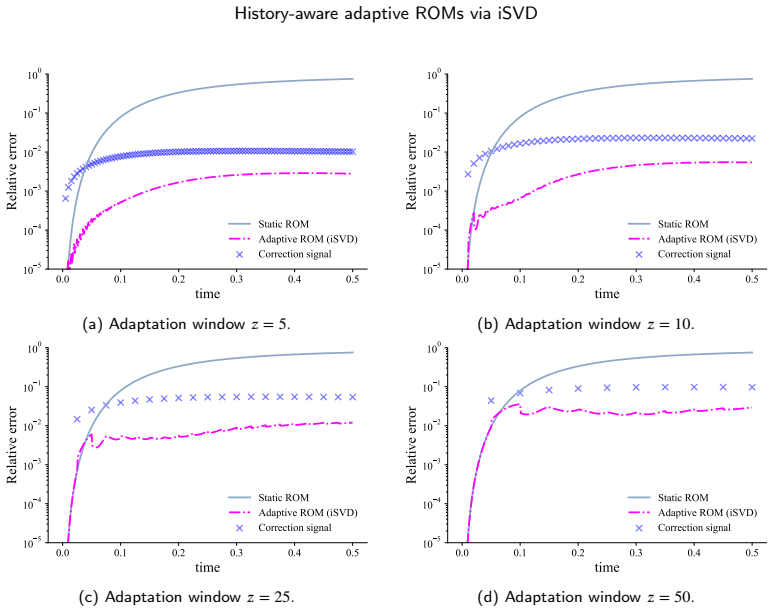
The iSVD adaptive ROM framework updates the reduced basis online using correction snapshots from full-order evaluations, naturally propagating changes through the basis to reduced operators and hyper-reduction machinery, while retaining an encoded history of the observed dynamics through its evolving singular structure; this yields stronger performance than non-history-aware adaptation on nonlinear problems of increasing complexity including the RDE.
What carries the argument
Incremental singular value decomposition (iSVD) for online basis adaptation, which encodes prior dynamics in its singular structure and automatically updates all reduced operators.
If this is right
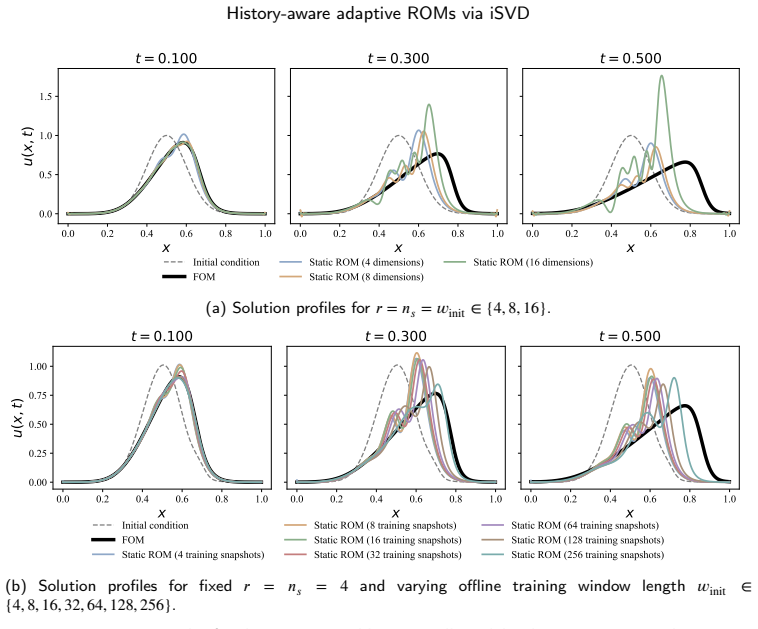
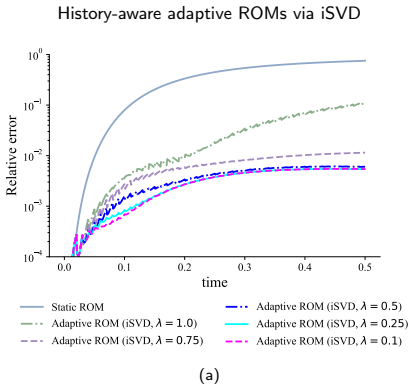
- History-aware iSVD updates outperform instantaneous basis updates on the Burgers equation.
- The performance advantage persists through the compressible Sod shock tube and RDE cases.
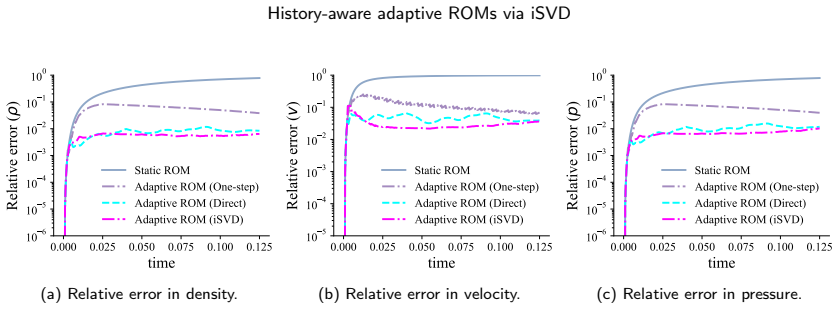
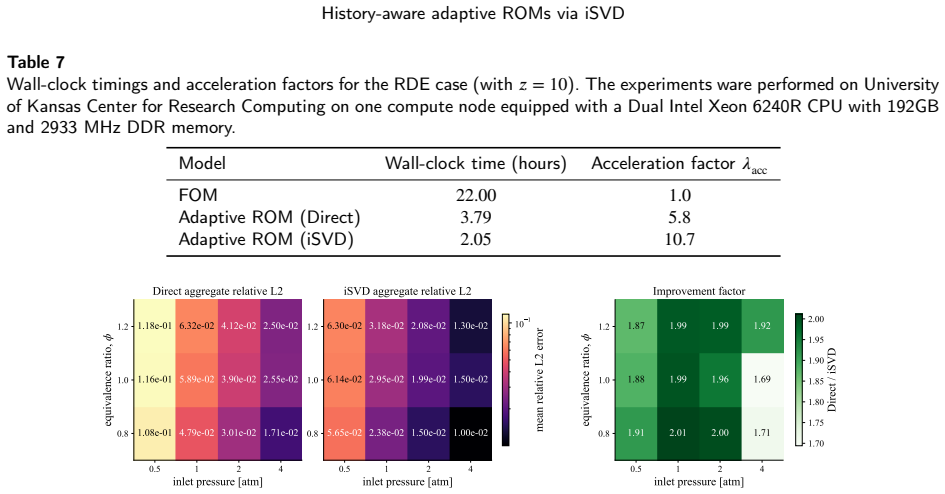
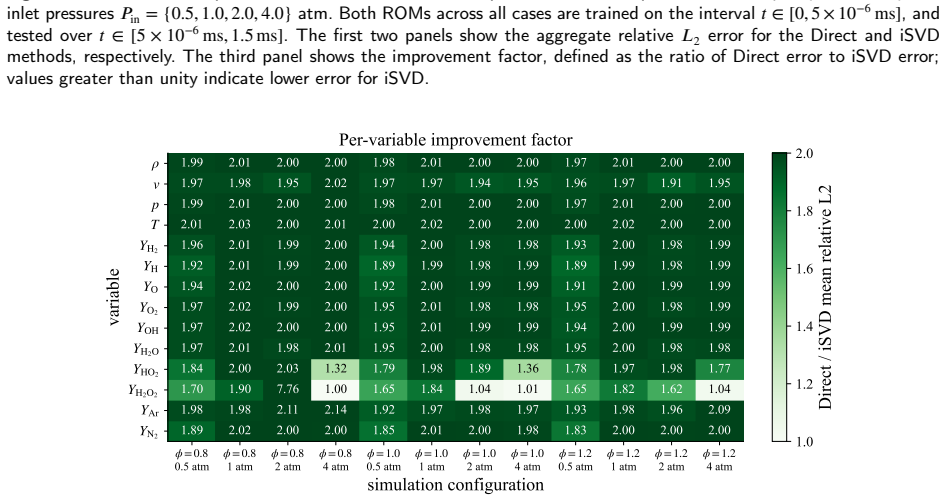
- On the RDE problem the iSVD ROM exceeds the direct adaptive ROM baseline in both accuracy and efficiency.
- The iSVD update step itself is negligible in cost; the dominant online expense is acquiring correction snapshots.
- The method supports ROMs that remain predictive over horizons orders of magnitude longer than the initial training window.
Where Pith is reading between the lines
- The history-encoding property of iSVD could be paired with error estimators to trigger snapshots only when needed.
- The same incremental mechanism might transfer to other matrix-factorization-based adaptation schemes in dynamical systems.
- Longer predictive horizons open the possibility of using these ROMs inside real-time optimization loops without periodic full retraining.
Load-bearing premise
Occasional full-order evaluations can be obtained at a frequency sufficient to keep the adapted basis accurate while their cost remains lower than the savings from using the ROM.
What would settle it
A controlled RDE run in which the frequency of full-order snapshot corrections is successively lowered until the iSVD ROM error exceeds that of the direct adaptive ROM baseline would falsify the claimed efficiency gain.
Figures






read the original abstract
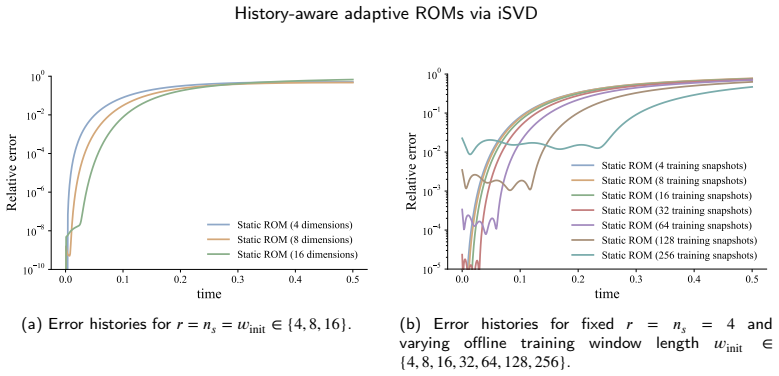
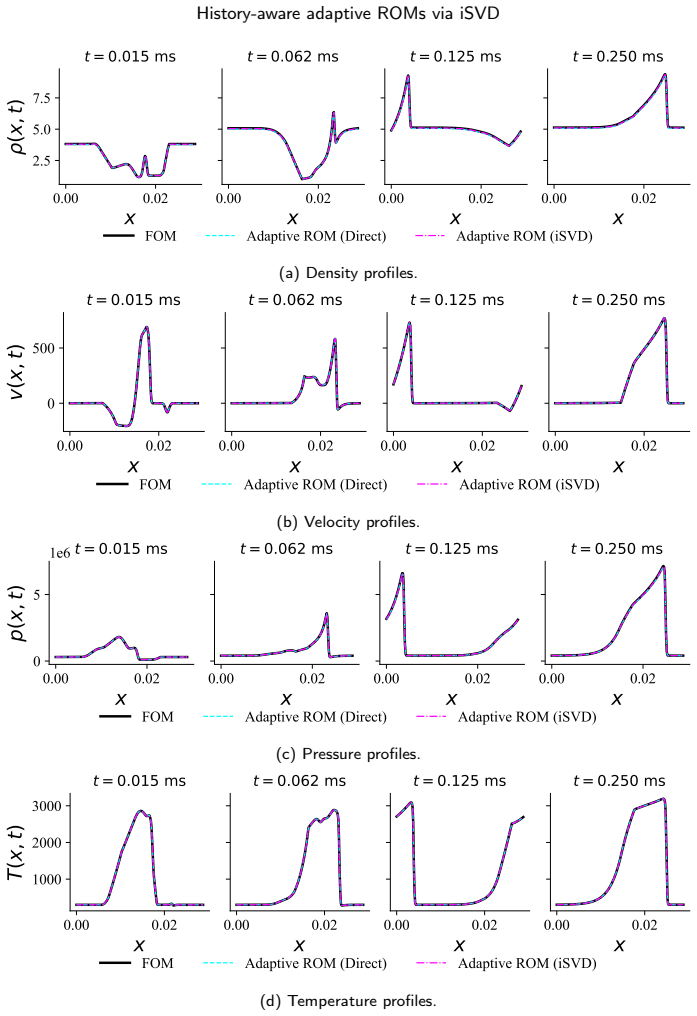
Reduced-order models (ROMs) can accelerate high-dimensional dynamical simulations, but their accuracy often deteriorates when online dynamics leave the regime represented by offline training data. We develop a projection-based adaptive ROM framework based on incremental singular value decomposition (iSVD), in which occasional full-order operator evaluations provide correction snapshots for online basis updates. The intrusive ROMs considered here are fully parameterized by the basis, so each update naturally propagates to reduced operators and hyper-reduction machinery. Through its evolving singular structure, iSVD retains an encoded history of the observed dynamics and is history-aware in this sense. We study the method on three nonlinear problems of increasing complexity: the one-dimensional viscous Burgers equation, the Sod shock tube, and a stiff one-dimensional ten-species rotating detonation engine (RDE). The Burgers problem is used to analyze the method and compare iSVD with alternative basis adaptation rules, showing that history-aware updates outperform instantaneous updates and that iSVD gives the strongest overall performance. The Sod and RDE cases demonstrate that these advantages persist in more challenging compressible-flow settings. For the RDE problem, the iSVD adaptive ROM improves upon the current state-of-the-art Direct adaptive ROM baseline in both predictive accuracy and computational efficiency. A cost analysis shows that the dominant online cost comes from interacting with the full-order model to obtain correction snapshots, while the iSVD update itself is negligible. These results identify iSVD as an effective mechanism for online learning of reduced subspaces and suggest a path toward ROMs that remain predictive over horizons several orders of magnitude longer than their initial training window.
Editorial analysis
A structured set of objections, weighed in public.
Referee Report
Summary. The paper develops a projection-based adaptive reduced-order model (ROM) framework that uses incremental singular value decomposition (iSVD) to update the reduced basis online via occasional full-order model (FOM) correction snapshots. The approach is history-aware because iSVD encodes prior dynamics in its singular structure; updates propagate automatically to reduced operators and hyper-reduction. Numerical studies on the 1D viscous Burgers equation, Sod shock tube, and a stiff 10-species rotating detonation engine (RDE) show that iSVD outperforms instantaneous-update and direct-adaptive baselines, with the RDE case reporting gains in both predictive accuracy and online efficiency over the state-of-the-art Direct adaptive ROM.
Significance. If the efficiency claim holds, the work supplies a concrete, history-retaining mechanism for extending ROM horizons by orders of magnitude beyond the initial training window on nonlinear compressible flows. The Burgers analysis and the RDE demonstration on a stiff multi-species problem constitute useful evidence that incremental SVD can serve as an effective online subspace learner while keeping the adaptation cost negligible relative to FOM snapshot acquisition.
major comments (1)
- [Abstract and §5] Abstract and §5 (RDE results): the headline claim that iSVD improves both accuracy and computational efficiency over Direct adaptive ROM rests on the unquantified assumption that the frequency of required FOM correction snapshots remains low enough to produce net savings. No scaling relation, worst-case bound, or explicit count of snapshots versus simulation horizon or shock strength is provided, so the efficiency advantage cannot be verified from the reported data.
minor comments (1)
- [§3] Notation for the iSVD update rule and the definition of the correction snapshot selection criterion should be stated explicitly in the methods section rather than left implicit from the algorithm box.
Simulated Author's Rebuttal
We thank the referee for the careful reading and the focus on the efficiency claims. We address the major comment below and will revise the manuscript to improve transparency.
read point-by-point responses
-
Referee: [Abstract and §5] Abstract and §5 (RDE results): the headline claim that iSVD improves both accuracy and computational efficiency over Direct adaptive ROM rests on the unquantified assumption that the frequency of required FOM correction snapshots remains low enough to produce net savings. No scaling relation, worst-case bound, or explicit count of snapshots versus simulation horizon or shock strength is provided, so the efficiency advantage cannot be verified from the reported data.
Authors: We agree that the efficiency comparison would be strengthened by explicit quantification. In the RDE experiments, iSVD and the Direct adaptive ROM employ the identical adaptation schedule and therefore the same number and frequency of FOM correction snapshots; the measured wall-clock savings arise because the iSVD update itself is negligible relative to the Direct update cost, as stated in the cost analysis of §5. In the revised manuscript we will add the precise number of snapshots acquired, the total simulation horizon (in time steps and physical time), and the resulting snapshot frequency for the RDE case. We do not supply a general scaling relation or worst-case bound on required snapshot frequency, because the work is empirical and the necessary frequency is problem-dependent; we will explicitly note this scope limitation in the revised §5. revision: partial
Circularity Check
No circularity; method and claims are independently defined and empirically evaluated
full rationale
The paper introduces an iSVD-based adaptive ROM framework whose basis updates are defined directly from occasional FOM snapshots and incremental SVD mechanics. No derivation step reduces to a fitted parameter renamed as prediction, no self-citation is invoked as a uniqueness theorem or load-bearing premise, and no ansatz is smuggled via prior work. The RDE efficiency claim rests on observed snapshot costs versus ROM savings in the reported experiments rather than on any self-referential construction. The derivation chain is therefore self-contained against external benchmarks.
Axiom & Free-Parameter Ledger
Reference graph
Works this paper leans on
-
[1]
P.Benner,S.Gugercin,K.Willcox,Asurveyofprojection-basedmodelreductionmethodsforparametricdynamicalsystems,SIAMReview 57 (4) (2015) 483–531.doi:10.1137/130932715
-
[2]
A. C. Antoulas, C. A. Beattie, S. Gügencın, Interpolatory Methods for Model Reduction, SIAM, Philadelphia, PA, 2020.doi:10.1137/1. 9781611976083
work page doi:10.1137/1 2020
-
[3]
C. W. Rowley, S. T. M. Dawson, Model reduction for flow analysis and control, Annual Review of Fluid Mechanics 49 (2017) 387–417. doi:10.1146/annurev-fluid-010816-060042
-
[4]
K.Carlberg,M.Barone,H.Antil,Galerkinv.least-squaresPetrov–Galerkinprojectioninnonlinearmodelreduction,JournalofComputational Physics 330 (2017) 693–734.doi:10.1016/j.jcp.2016.10.033
-
[5]
B.Peherstorfer,K.Willcox,Data-drivenoperatorinferencefornonintrusiveprojection-basedmodelreduction,ComputerMethodsinApplied Mechanics and Engineering 306 (2016) 196–215.doi:10.1016/j.cma.2016.03.025
-
[6]
C. Huang, K. Duraisamy, C. L. Merkle, Component-based reduced order modeling of large-scale complex systems, Frontiers in Physics 10 (2022) 900064.doi:10.3389/fphy.2022.900064
-
[7]
C.W.Rowley,T.Colonius,R.M.Murray,ModelreductionforcompressibleflowsusingPODandGalerkinprojection,PhysicaD:Nonlinear Phenomena 189 (1–2) (2004) 115–129.doi:10.1016/j.physd.2003.03.001
-
[8]
M. F. Barone, I. Kalashnikova, D. J. Segalman, H. K. Thornquist, Stable Galerkin reduced order models for linearized compressible flow, Journal of Computational Physics 228 (6) (2009) 1932–1946.doi:10.1016/j.jcp.2008.11.015
-
[9]
Arnold-Medabalimi, C
N. Arnold-Medabalimi, C. Huang, K. Duraisamy, Large-eddy simulation and challenges for projection-based reduced-order modeling of a gas turbine model combustor, International Journal of Spray and Combustion Dynamics 14 (1–2) (2022) 153–175.doi:10.1177/ 17568277221100650
2022
-
[10]
J. L. Lumley, The structure of inhomogeneous turbulent flows, in: A. M. Yaglom, V. I. Tatarski (Eds.), Atmospheric Turbulence and Radio Wave Propagation, Nauka, Moscow, 1967, pp. 166–178
1967
-
[11]
Turbulence and the dynamics of coherent structures. I. Coherent structures,
L. Sirovich, Turbulence and the dynamics of coherent structures. I–III, Quarterly of Applied Mathematics 45 (3) (1987) 561–590, parts I–III have separate DOIs: 10.1090/qam/910462, 10.1090/qam/910463, 10.1090/qam/910464
-
[12]
P. Holmes, J. L. Lumley, G. Berkooz, Turbulence, Coherent Structures, Dynamical Systems and Symmetry, Cambridge University Press, Cambridge, UK, 1996.doi:10.1017/CBO9780511622700
-
[13]
A. Hedayat, A. Padovan, K. Duraisamy, Toward adaptive non-intrusive reduced-order models: Design and challenges, arXiv preprint arXiv:2602.11378 (2026).doi:10.48550/arXiv.2602.11378
-
[14]
C.Huang,K.Duraisamy,Predictivereducedordermodelingofchaoticmulti-scaleproblemsusingadaptivelysampledprojections,Journalof Computational Physics 491 (2023) 112356.doi:10.1016/j.jcp.2023.112356
-
[15]
Breaking the Kolmogorov barrier with nonlinear model reduction,
B. Peherstorfer, Breaking the Kolmogorov barrier with nonlinear model reduction, Notices of the American Mathematical Society 69 (5) (2022) 725–733.doi:10.1090/noti2475
-
[16]
K. Lee, K. T. Carlberg, Model reduction of dynamical systems on nonlinear manifolds using deep convolutional autoencoders, Journal of Computational Physics 404 (2020) 108973.doi:10.1016/j.jcp.2019.108973
-
[17]
S. Fresca, L. Dede’, A. Manzoni, A comprehensive deep learning-based approach to reduced order modeling of nonlinear time-dependent parametrized PDEs, Journal of Scientific Computing 87 (2) (2021) 61.doi:10.1007/s10915-021-01462-7
-
[18]
Y. Kim, Y. Choi, D. Widemann, T. Zohdi, A fast and accurate physics-informed neural network reduced order model with shallow masked autoencoder, Journal of Computational Physics 451 (2022) 110841.doi:10.1016/j.jcp.2021.110841
-
[19]
P. Conti, G. Gobat, S. Fresca, A. Manzoni, A. Frangi, Reduced order modeling of parametrized systems through autoencoders and SINDy approach, Computer Methods in Applied Mechanics and Engineering 411 (2023) 116072.doi:10.1016/j.cma.2023.116072
-
[20]
S.E.Otto,G.R.Macchio,C.W.Rowley,Learningnonlinearprojectionsforreduced-ordermodelingofdynamicalsystemsusingconstrained autoencoders, Chaos: An Interdisciplinary Journal of Nonlinear Science 33 (11) (2023) 113130.doi:10.1063/5.0169688
-
[21]
J. Barnett, C. Farhat, Quadratic approximation manifold for mitigating the Kolmogorov barrier in nonlinear projection-based model order reduction, Journal of Computational Physics 464 (2022) 111348.doi:10.1016/j.jcp.2022.111348
-
[22]
R. Geelen, S. Wright, K. Willcox, Operator inference for non-intrusive model reduction with quadratic manifolds, Computer Methods in Applied Mechanics and Engineering 403 (2023) 115717.doi:10.1016/j.cma.2022.115717
-
[23]
M. Ohlberger, S. Rave, Nonlinear reduced basis approximation of parameterized evolution equations via the method of freezing, Comptes Rendus Mathematique 351 (23–24) (2013) 901–906.doi:10.1016/j.crma.2013.10.028
-
[24]
C. W. Rowley, I. G. Kevrekidis, J. E. Marsden, K. Lust, Reduction and reconstruction for self-similar dynamical systems, Nonlinearity 16 (4) (2003) 1257–1275.doi:10.1088/0951-7715/16/4/304
-
[25]
J. Reiss, P. Schulze, J. Sesterhenn, V. Mehrmann, The shifted proper orthogonal decomposition: a mode decomposition for multiple transport phenomena, SIAM Journal on Scientific Computing 40 (3) (2018) A1322–A1344.doi:10.1137/17M1140571
-
[26]
N.J.Nair,M.Balajewicz,Transportedsnapshotmodelorderreductionapproachforparametric,steady-statefluidflowscontainingparameter- dependent shocks, International Journal for Numerical Methods in Engineering 117 (12) (2019) 1234–1262.doi:10.1002/nme.5998
-
[27]
D.Rim,B.Peherstorfer,K.T.Mandli,Manifoldapproximationsviatransportedsubspaces:modelreductionfortransport-dominatedproblems, SIAM Journal on Scientific Computing 45 (1) (2023) A170–A199.doi:10.1137/20M1316998
-
[28]
M. A. Mirhoseini, M. J. Zahr, Model reduction of convection-dominated partial differential equations via optimization-based implicit feature tracking, Journal of Computational Physics 473 (2023) 111739.doi:10.1016/j.jcp.2022.111739
-
[29]
Online adaptive model reduction for nonlinear systems via low-rank updates,
B. Peherstorfer, K. Willcox, Online adaptive model reduction for nonlinear systems via low-rank updates, SIAM Journal on Scientific Computing 37 (4) (2015) A2123–A2150.doi:10.1137/140989169
-
[30]
B. Peherstorfer, Model reduction for transport-dominated problems via online adaptive bases and adaptive sampling, SIAM Journal on Scientific Computing 42 (5) (2020) A2803–A2836.doi:10.1137/19M1257275. Hedayat et al.:Preprint submitted to ElsevierPage 48 of 50 History-aware adaptive ROMs via iSVD
-
[31]
A. Mohaghegh, C. Huang, Feature-guided sampling strategy for adaptive model order reduction of convection-dominated problems, Journal of Computational Physics 545 (2026) 114468.doi:10.1016/j.jcp.2025.114468
-
[32]
D.Amsallem,C.Farhat,Interpolationmethodforadaptingreduced-ordermodelsandapplicationtoaeroelasticity,AIAAJournal46(7)(2008) 1803–1813.doi:10.2514/1.35374
-
[33]
D. Amsallem, C. Farhat, An online method for interpolating linear parametric reduced-order models, SIAM Journal on Scientific Computing 33 (5) (2011) 2169–2198.doi:10.1137/100813051
-
[34]
D.Amsallem,M.J.Zahr,C.Farhat,Nonlinearmodelorderreductionbasedonlocalreduced-orderbases,InternationalJournalforNumerical Methods in Engineering 92 (10) (2012) 891–916.doi:10.1002/nme.4371
-
[35]
B. Peherstorfer, D. Butnaru, K. Willcox, H.-J. Bungartz, Localized discrete empirical interpolation method, SIAM Journal on Scientific Computing 36 (1) (2014) A168–A192.doi:10.1137/130924408
-
[36]
Dynamic data-driven reduced-order models,
B. Peherstorfer, K. Willcox, Dynamic data-driven reduced-order models, Computer Methods in Applied Mechanics and Engineering 291 (2015) 21–41.doi:10.1016/j.cma.2015.03.018
-
[37]
R. Singh, W. I. T. Uy, B. Peherstorfer, Lookahead data-gathering strategies for online adaptive model reduction of transport-dominated problems, Chaos: An Interdisciplinary Journal of Nonlinear Science 33 (11) (2023) 113112.doi:10.1063/5.0169392
-
[38]
On-the-fly reduced order modeling of passive and reactive species via time-dependent manifolds,
D. Ramezanian, A. G. Nouri, H. Babaee, On-the-fly reduced order modeling of passive and reactive species via time-dependent manifolds, Computer Methods in Applied Mechanics and Engineering 382 (2021) 113882.doi:10.1016/j.cma.2021.113882
-
[39]
P. Patil, H. Babaee, Real-time reduced-order modeling of stochastic partial differential equations via time-dependent subspaces, Journal of Computational Physics 415 (2020) 109511.doi:10.1016/j.jcp.2020.109511
-
[40]
K. S. Jung, C. E. Lacey, H. Babaee, J. H. Chen, Accelerating high-fidelity simulations of chemically reacting flows using reduced-order modeling with time-dependent bases, Computer Methods in Applied Mechanics and Engineering 437 (2025) 117758.doi:10.1016/j. cma.2025.117758
work page doi:10.1016/j 2025
-
[41]
V. Zucatti, M. J. Zahr, An adaptive, training-free reduced-order model for convection-dominated problems based on hybrid snapshots, International Journal for Numerical Methods in Fluids 96 (2) (2024) 189–208.doi:10.1002/fld.5240
-
[42]
F. Bai, Y. Wang, A reduced order modeling method based on GNAT-embedded hybrid snapshot simulation, Mathematics and Computers in Simulation 199 (2022) 100–132.doi:10.1016/j.matcom.2022.03.006
-
[43]
L.Feng,G.Fu,Z.Wang,AFOM/ROMhybridapproachforacceleratingnumericalsimulations,JournalofScientificComputing89(3)(2021) 61.doi:10.1007/s10915-021-01668-9
-
[44]
K. Carlberg, Adaptiveℎ-refinement for reduced-order models, International Journal for Numerical Methods in Engineering 102 (5) (2015) 1192–1210.doi:10.1002/nme.4800
-
[45]
P. A. Etter, K. T. Carlberg, Online adaptive basis refinement and compression for reduced-order models via vector-space sieving, Computer Methods in Applied Mechanics and Engineering 364 (2020) 112931.doi:10.1016/j.cma.2020.112931
-
[46]
M.Yano,T.Huang,M.J.Zahr,Agloballyconvergentmethodtoacceleratetopologyoptimizationusingon-the-flymodelreduction,Computer Methods in Applied Mechanics and Engineering 375 (2021) 113635.doi:10.1016/j.cma.2020.113635
-
[47]
P. Comon, G. H. Golub, Tracking a few extreme singular values and vectors in signal processing, Proceedings of the IEEE 78 (8) (1990) 1327–1343.doi:10.1109/5.58320
-
[48]
doi:10.1109/JPROC.2018.2847041
L.Balzano,Y.Chi,Y.M.Lu,StreamingPCAandsubspacetracking:themissingdatacase,ProceedingsoftheIEEE106(8)(2018)1293–1310. doi:10.1109/JPROC.2018.2847041
-
[49]
J. R. Bunch, C. P. Nielsen, Updating the singular value decomposition, Numerische Mathematik 31 (2) (1978) 111–129.doi:10.1007/ BF01397471
1978
-
[50]
M. Brand, Incremental singular value decomposition of uncertain data with missing values, in: European Conference on Computer Vision (ECCV), Springer, 2002, pp. 707–720.doi:10.1007/3-540-47969-4_47
-
[51]
M. Brand, Fast low-rank modifications of the thin singular value decomposition, Linear Algebra and its Applications 415 (1) (2006) 20–30. doi:10.1016/j.laa.2005.07.021
-
[52]
T. P. Krasulina, The method of stochastic approximation for the determination of the least eigenvalue of a symmetrical matrix, USSR Computational Mathematics and Mathematical Physics 9 (6) (1969) 189–195.doi:10.1016/0041-5553(69)90135-9
-
[53]
The Noisy Power Method: A Meta Algorithm with Applications
M. Hardt, E. Price, The noisy power method: a meta algorithm with applications, in: Advances in Neural Information Processing Systems (NeurIPS), Vol. 27, 2014.doi:10.48550/arXiv.1311.2495
work page internal anchor Pith review Pith/arXiv arXiv doi:10.48550/arxiv.1311.2495 2014
-
[54]
Z. Allen-Zhu, Y. Li, First efficient convergence for streaming𝑘-PCA: a global, gap-free, and near-optimal rate, in: IEEE Annual Symposium on Foundations of Computer Science (FOCS), 2017, pp. 487–492.doi:10.1109/FOCS.2017.51
-
[55]
E. Oja, Simplified neuron model as a principal component analyzer, Journal of Mathematical Biology 15 (3) (1982) 267–273.doi: 10.1007/BF00275687
-
[56]
704–711.doi:10.1109/ALLERTON.2010.5706976
L.Balzano,R.Nowak,B.Recht,Onlineidentificationandtrackingofsubspacesfromhighlyincompleteinformation,in:48thAnnualAllerton Conference on Communication, Control, and Computing, 2010, pp. 704–711.doi:10.1109/ALLERTON.2010.5706976
-
[57]
L. Balzano, S. J. Wright, On GROUSE and incremental SVD, in: 2013 IEEE 5th International Workshop on Computational Advances in Multi-Sensor Adaptive Processing (CAMSAP), 2013, pp. 1–4.doi:10.1109/CAMSAP.2013.6713992
-
[58]
B. Yang, Projection approximation subspace tracking, IEEE Transactions on Signal Processing 43 (1) (1995) 95–107.doi:10.1109/78. 365290
work page doi:10.1109/78 1995
-
[59]
Y.Chi,Y.C.Eldar,R.Calderbank,PETRELS:parallelsubspaceestimationandtrackingbyrecursiveleastsquaresfrompartialobservations, IEEE Transactions on Signal Processing 61 (23) (2013) 5947–5959.doi:10.1109/TSP.2013.2282910
-
[60]
R. Zimmermann, B. Peherstorfer, K. Willcox, Geometric subspace updates with applications to online adaptive nonlinear model reduction, SIAM Journal on Matrix Analysis and Applications 39 (1) (2018) 234–261.doi:10.1137/17M1123286
-
[61]
A. Mohaghegh, C. Huang, Self adaptive reduced order modeling framework for rotating detonation engine simulations, in: AIAA SCITECH 2026 Forum, Orlando, FL, 2026.doi:10.2514/6.2026-1204. Hedayat et al.:Preprint submitted to ElsevierPage 49 of 50 History-aware adaptive ROMs via iSVD
-
[62]
K. Carlberg, C. Bou-Mosleh, C. Farhat, Efficient non-linear model reduction via a least-squares petrov–galerkin projection and com- pressive tensor approximations, International Journal for Numerical Methods in Engineering 86 (2) (2011) 155–181.arXiv:https: //onlinelibrary.wiley.com/doi/pdf/10.1002/nme.3050,doi:https://doi.org/10.1002/nme.3050. URLhttps:/...
-
[63]
Carlberg, C
K. Carlberg, C. Farhat, J. Cortial, D. Amsallem, The gnat method for nonlinear model reduction: Effective implementation and application to computational fluid dynamics and turbulent flows, Journal of Computational Physics 242 (2013) 623–647.doi:https://doi.org/10. 1016/j.jcp.2013.02.028. URLhttps://www.sciencedirect.com/science/article/pii/S0021999113001472
2013
-
[64]
URLhttps://www.sciencedirect.com/science/article/pii/S0045782520301754
E.J.Parish,C.R.Wentland,K.Duraisamy,Theadjointpetrov–galerkinmethodfornon-linearmodelreduction,ComputerMethodsinApplied Mechanics and Engineering 365 (2020) 112991.doi:https://doi.org/10.1016/j.cma.2020.112991. URLhttps://www.sciencedirect.com/science/article/pii/S0045782520301754
-
[65]
S. Chaturantabut, D. C. Sorensen, Nonlinear model reduction via discrete empirical interpolation, SIAM Journal on Scientific Computing 32 (5) (2010) 2737–2764.arXiv:https://doi.org/10.1137/090766498,doi:10.1137/090766498. URLhttps://doi.org/10.1137/090766498
-
[66]
C. Huang, C. R. Wentland, K. Duraisamy, C. Merkle, Model reduction for multi-scale transport problems using model-form preserving least- squaresprojectionswithvariabletransformation,JournalofComputationalPhysics448(2022)110742.doi:https://doi.org/10.1016/ j.jcp.2021.110742. URLhttps://www.sciencedirect.com/science/article/pii/S0021999121006379
-
[67]
Z. Drmač, S. Gugercin, A new selection operator for the discrete empirical interpolation method—improved a priori error bound and extensions, SIAM Journal on Scientific Computing 38 (2) (2016) A631–A648.arXiv:https://doi.org/10.1137/15M1019271,doi: 10.1137/15M1019271. URLhttps://doi.org/10.1137/15M1019271
-
[68]
Balzano, On the equivalence of oja’s algorithm and grouse, in: International Conference on Artificial Intelligence and Statistics, PMLR, 2022, pp
L. Balzano, On the equivalence of oja’s algorithm and grouse, in: International Conference on Artificial Intelligence and Statistics, PMLR, 2022, pp. 7014–7030
2022
-
[69]
A. Mohaghegh, C. Huang, Compflowlab: A python code to develop and prototype new data-driven models for challenging compressible flow problems with shocks and chemical reactions (05 2026).doi:10.13140/RG.2.2.36810.12483
-
[70]
Boris,A.Cohen, Weakand strongignition.i
E.Oran, T.Young,J. Boris,A.Cohen, Weakand strongignition.i. numericalsimulationsof shocktubeexperiments, CombustionandFlame 48 (1982) 135–148.doi:https://doi.org/10.1016/0010-2180(82)90123-7. URLhttps://www.sciencedirect.com/science/article/pii/0010218082901237
-
[71]
C. Huang, R. G. Camacho, Investigations of parametric reduced order modeling framework for rotating detonation engines, in: AIAA SCITECH 2024 Forum, Orlando, FL, 2024.doi:10.2514/6.2024-2038. Hedayat et al.:Preprint submitted to ElsevierPage 50 of 50
discussion (0)
Sign in with ORCID, Apple, or X to comment. Anyone can read and Pith papers without signing in.