Formation of bound composite vortices of a singly-quantized ¹S₀ vortex and half-quantized ³P₂ vortices in the ¹S₀-³P₂ coexisting phase in neutron stars
Pith reviewed 2026-06-29 09:24 UTC · model grok-4.3
The pith
Josephson coupling binds two half-quantized vortices and one singly-quantized vortex into a composite at the neutron star crust-core boundary.
A machine-rendered reading of the paper's core claim, the machinery that carries it, and where it could break.
Core claim
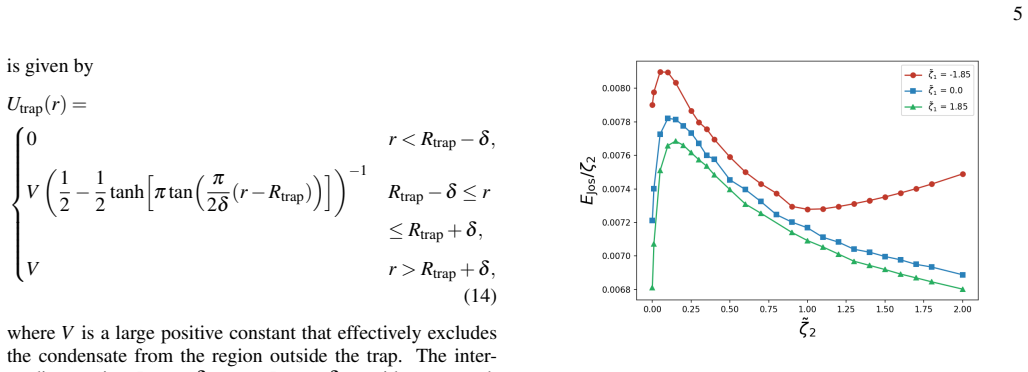
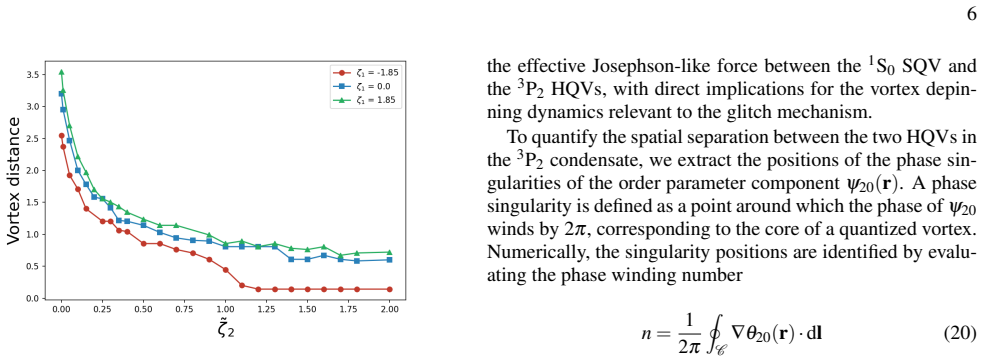
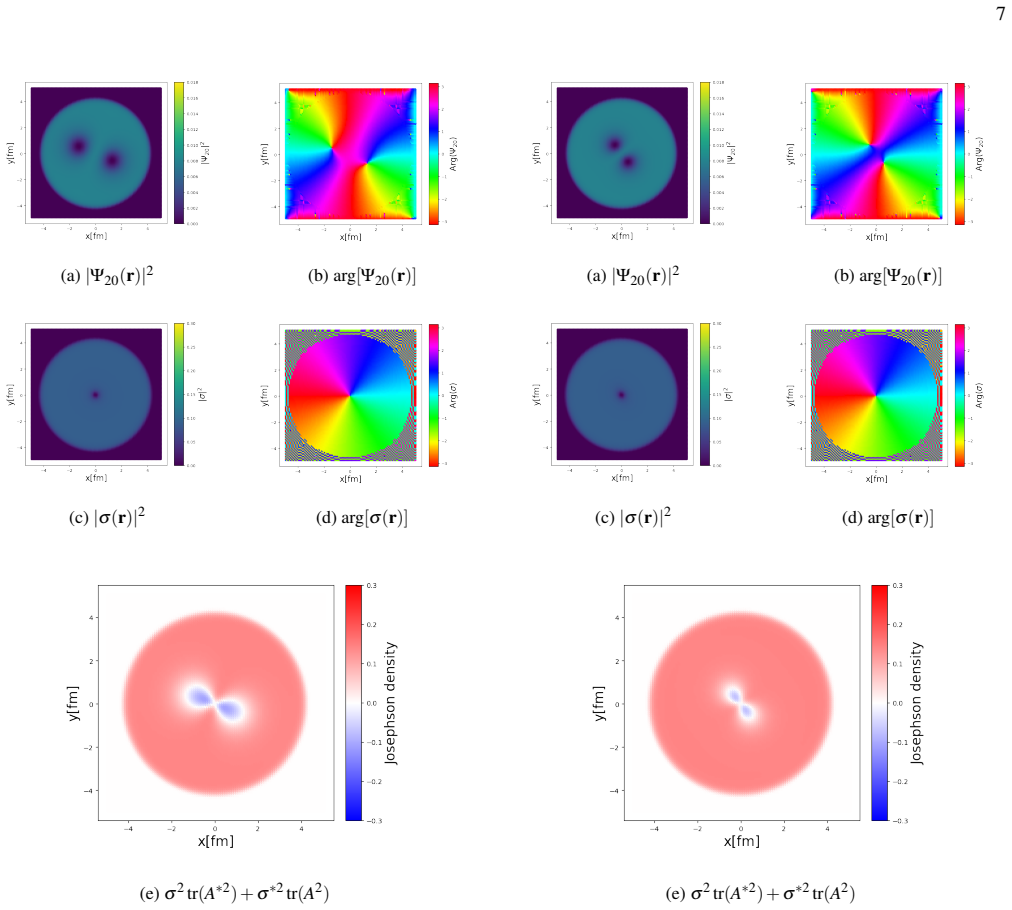
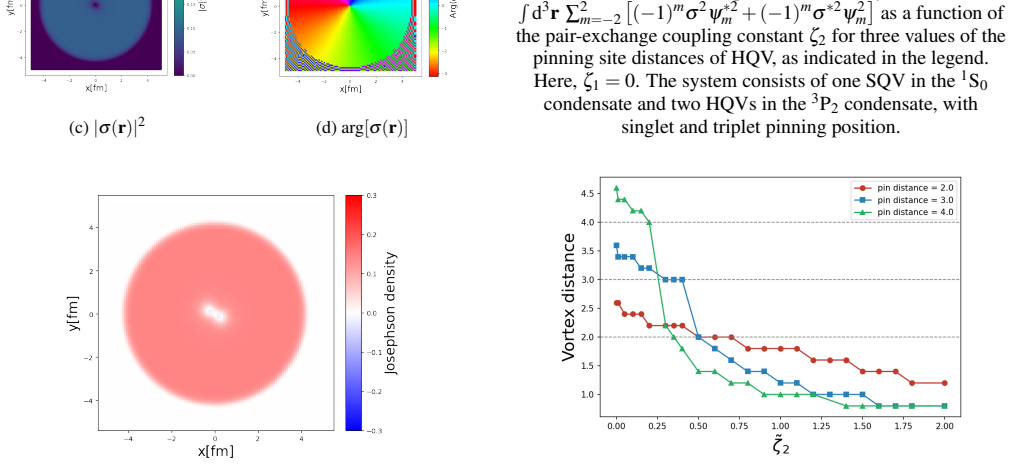
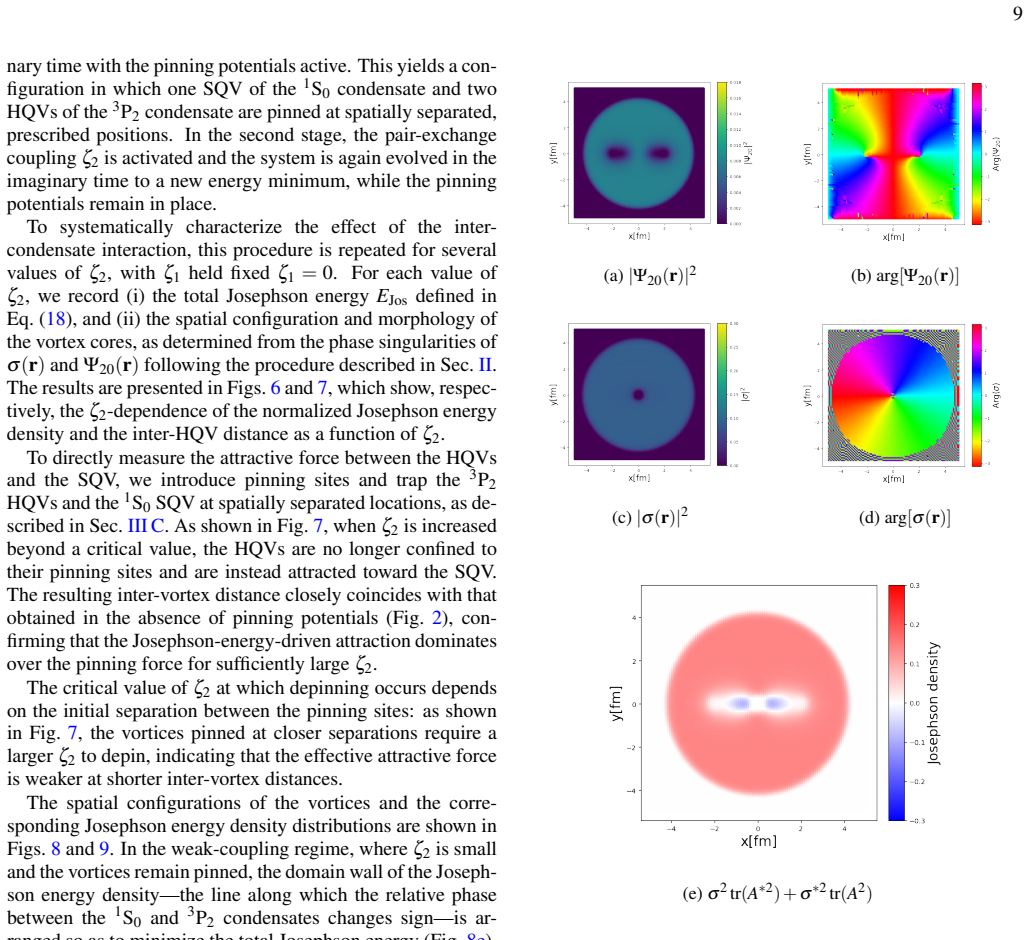
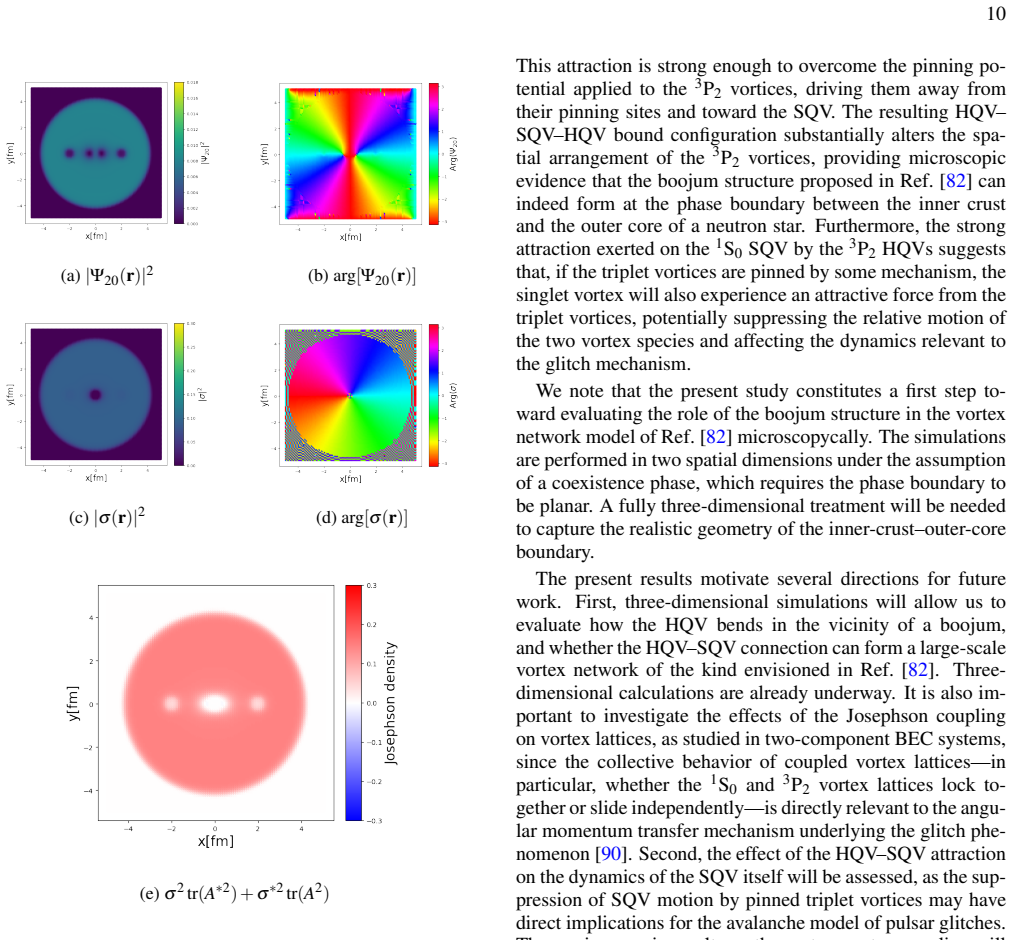
The Josephson term induces a strong attractive interaction between the two HQVs and the SQV, which dominates over the density-density coupling. When pinning potentials are applied to the HQVs and the SQV at spatially separated locations, this attraction is found to be sufficiently strong to drive vortex depinning. These results suggest that two HQVs and one SQV can form a tightly bound composite vortex at the crust-core boundary.
What carries the argument
The Josephson coupling term in the coupled Gross-Pitaevskii equations for the 1S0 and 3P2 condensates, which generates phase-dependent attraction between the vortices.
If this is right
- The Josephson attraction dominates the density-density interaction under the simulated conditions.
- Pinning forces at spatially separated sites are overcome, resulting in depinning.
- Two half-quantized vortices and one singly-quantized vortex form a tightly bound composite.
- The composite forms at the crust-core boundary in the coexistence phase and may participate in a vortex network relevant to glitches.
Where Pith is reading between the lines
- The binding may enable vortices to migrate across the crust-core interface more readily than independent pinning would allow.
- Analogous phase-coupling effects could appear in other multi-component superfluid systems with similar coexistence regions.
- Full three-dimensional simulations with realistic density profiles would test whether the composite remains stable away from the two-dimensional approximation.
Load-bearing premise
The two-dimensional Gross-Pitaevskii model with the chosen density-density and Josephson coupling strengths accurately captures the energetics and dynamics of the real three-dimensional neutron-star crust-core interface.
What would settle it
A simulation identical in every respect except with the Josephson coupling constant set to zero, in which the vortices remain pinned at their separated locations rather than binding.
Figures

read the original abstract
Pulsar glitches are believed to originate from the dynamics of quantized vortices in the neutron superfluid interior. The outer core of a neutron star hosts a $^3\text{P}_2$ spin-triplet superfluid, whose half-integer quantum vortices (HQVs) are qualitatively different from the $^1\text{S}_0$ singly quantized vortices (SQVs) in the inner crust. It has recently been proposed that the coupling between these two vortex species gives rise to a large-scale vortex network, providing a candidate mechanism for the diversity of observed pulsar glitch phenomena. Using the Gross--Pitaevskii equations for the $^1\text{S}_0$ and $^3\text{P}_2$ condensates, we perform two-dimensional simulations of one SQV and two HQVs in a coexistence phase near the crust-core boundary, varying the density--density and Josephson coupling constants. We find that the Josephson term, arising from the relative phase between the two condensates, induces a strong attractive interaction between the two HQVs and the SQV, which dominates over the density--density coupling. When pinning potentials are applied to the HQVs and the SQV at spatially separated locations, this attraction is found to be sufficiently strong to drive vortex depinning. These results suggest that two HQVs and one SQV can form a tightly bound composite vortex at the crust-core boundary, with implications for the glitch mechanism in neutron stars.
Editorial analysis
A structured set of objections, weighed in public.
Referee Report
Summary. The manuscript uses two-dimensional Gross-Pitaevskii simulations of one singly-quantized ^1S_0 vortex and two half-quantized ^3P_2 vortices in a coexistence phase. It reports that the Josephson coupling term produces a strong attractive interaction that dominates the density-density coupling and is sufficient to drive depinning when pinning potentials are placed at spatially separated sites, implying that the three vortices can form a tightly bound composite at the crust-core boundary with possible implications for pulsar glitch mechanisms.
Significance. If the modeling assumptions hold, the work supplies a dynamical mechanism for cross-interface vortex binding that emerges from the Josephson term rather than being inserted by hand, extending recent proposals for large-scale vortex networks in neutron-star interiors. The explicit demonstration that attraction can overcome separated pinning sites is a concrete, falsifiable outcome of the chosen equations.
major comments (3)
- [Abstract and simulation-setup paragraph] Abstract and simulation-setup paragraph: the central claim that Josephson-induced attraction drives depinning (and thus bound composites) at the crust-core boundary rests on 2D scalar GPEs. The ^3P_2 superfluid is described by a spin-triplet tensor order parameter, the interface contains strong 3D density gradients and possible entrainment, and pinning is realized by ad-hoc potentials rather than lattice structure; these choices are load-bearing for the astrophysical extrapolation.
- [Abstract] Abstract: the density-density and Josephson coupling constants are varied as free parameters to obtain the reported attraction and depinning. No justification for the explored range against microscopic calculations is given, and the outcome is stated to depend on the chosen strengths; this parameter dependence directly controls the 'sufficiently strong' conclusion.
- [Abstract (results on pinning)] Abstract (results on pinning): the depinning result is shown only for the parameter regime explored, with no error bars, convergence tests with respect to grid size or time step, or 3D checks described. These omissions affect the robustness of the claim that the attraction 'dominates' and produces a 'tightly bound' composite.
minor comments (1)
- [Introduction] Notation for the two condensates is introduced in the abstract but would benefit from a short reminder of the underlying pairing channels when first used in the main text.
Simulated Author's Rebuttal
We thank the referee for the constructive comments. We respond point by point below, clarifying the scope of our effective model while acknowledging its limitations. Where appropriate we indicate revisions to the manuscript.
read point-by-point responses
-
Referee: [Abstract and simulation-setup paragraph] Abstract and simulation-setup paragraph: the central claim that Josephson-induced attraction drives depinning (and thus bound composites) at the crust-core boundary rests on 2D scalar GPEs. The ^3P_2 superfluid is described by a spin-triplet tensor order parameter, the interface contains strong 3D density gradients and possible entrainment, and pinning is realized by ad-hoc potentials rather than lattice structure; these choices are load-bearing for the astrophysical extrapolation.
Authors: We agree that the simulations employ two-dimensional scalar Gross-Pitaevskii equations as an effective description. The Josephson term is introduced phenomenologically to capture the leading phase-dependent coupling between the condensates. While the ^3P_2 order parameter is tensorial and the interface is three-dimensional, the 2D setup isolates the vortex-binding mechanism driven by the Josephson interaction near the crust-core boundary. We have added a dedicated paragraph in the introduction that explicitly states these approximations, references prior effective-model studies, and notes that entrainment and full tensor dynamics are left for future work. The ad-hoc pinning potentials are chosen precisely to demonstrate that the attraction can overcome spatially separated pinning sites; a lattice realization would be a natural extension but is not required to establish the existence of the binding effect. revision: partial
-
Referee: [Abstract] Abstract: the density-density and Josephson coupling constants are varied as free parameters to obtain the reported attraction and depinning. No justification for the explored range against microscopic calculations is given, and the outcome is stated to depend on the chosen strengths; this parameter dependence directly controls the 'sufficiently strong' conclusion.
Authors: The coupling constants are varied to map the regime in which the Josephson term dominates the density-density interaction, consistent with the central claim. We have now included citations to microscopic estimates of the Josephson coupling strength in the ^1S_0-^3P_2 coexistence region and have added a sentence stating that the reported depinning occurs when the Josephson coefficient exceeds a threshold set by the density-density term. This makes the parameter dependence explicit rather than implicit. revision: yes
-
Referee: [Abstract (results on pinning)] Abstract (results on pinning): the depinning result is shown only for the parameter regime explored, with no error bars, convergence tests with respect to grid size or time step, or 3D checks described. These omissions affect the robustness of the claim that the attraction 'dominates' and produces a 'tightly bound' composite.
Authors: We have performed additional runs and now report in the revised manuscript that the depinning outcome is robust under grid refinement (halved and doubled spatial resolution) and time-step reduction. Error estimates on the measured vortex trajectories are included. Three-dimensional simulations with the full tensor order parameter remain outside the present scope. revision: partial
- Full three-dimensional simulations that incorporate the tensor structure of the ^3P_2 order parameter, realistic density gradients, entrainment, and a microscopic pinning lattice
Circularity Check
No circularity: results emerge from explicit 2D GPE simulations with free parameters
full rationale
The paper solves the two-component Gross-Pitaevskii equations numerically in 2D, treating density-density and Josephson couplings as variable inputs that are scanned. The reported attraction, depinning, and composite formation are direct outputs of those integrations under applied pinning potentials; they are not presupposed by definition, fitted to the target observable, or justified solely by self-citation. No load-bearing step reduces to an input by construction. The model simplifications (2D, scalar order parameters, phenomenological couplings) raise questions of physical fidelity but do not constitute circularity in the derivation chain.
Axiom & Free-Parameter Ledger
free parameters (2)
- density-density coupling constant
- Josephson coupling constant
axioms (1)
- domain assumption Gross-Pitaevskii equations provide a valid mean-field description of the ^1S0 and ^3P2 superfluids near the crust-core boundary.
Reference graph
Works this paper leans on
-
[1]
J. M. Lattimer and M. Prakash, Physics Reports621, 127 (2016), memorial V olume in Honor of Gerald E. Brown
2016
-
[2]
Haskell and A
B. Haskell and A. Sedrakian, Superfluidity and superconduc- tivity in neutron stars, inThe Physics and Astrophysics of Neutron Stars, edited by L. Rezzolla, P. Pizzochero, D. I. Jones, N. Rea, and I. Vidaña (Springer International Publish- ing, Cham, 2018) pp. 401–454
2018
-
[3]
Özel and P
F. Özel and P. Freire, Annual Review of Astronomy and As- trophysics54, 401 (2016)
2016
-
[4]
M. C. Miller, F. K. Lamb, A. J. Dittmann, S. Bogdanov, Z. Ar- zoumanian, K. C. Gendreau, S. Guillot, W. C. G. Ho, J. M. Lattimer, M. Loewenstein, S. M. Morsink, P. S. Ray, M. T. Wolff, C. L. Baker, T. Cazeau, S. Manthripragada, C. B. Mark- wardt, T. Okajima, S. Pollard, I. Cognard, H. T. Cromartie, E. Fonseca, L. Guillemot, M. Kerr, A. Parthasarathy, T. T...
2021
-
[5]
T. E. Riley, A. L. Watts, P. S. Ray, S. Bogdanov, S. Guillot, S. M. Morsink, A. V . Bilous, Z. Arzoumanian, D. Choudhury, J. S. Deneva, K. C. Gendreau, A. K. Harding, W. C. G. Ho, J. M. Lattimer, M. Loewenstein, R. M. Ludlam, C. B. Mark- wardt, T. Okajima, C. Prescod-Weinstein, R. A. Remillard, M. T. Wolff, E. Fonseca, H. T. Cromartie, M. Kerr, T. T. Pen-...
2021
-
[6]
D. Page, M. Prakash, J. M. Lattimer, and A. W. Steiner, Phys. Rev. Lett.106, 081101 (2011)
2011
-
[7]
P. S. Shternin, D. G. Yakovlev, C. O. Heinke, W. C. G. Ho, and D. J. Patnaude, Monthly Notices of the Royal Astronomical Society: Letters412, L108 (2011)
2011
-
[8]
Neutron Stars in the Laboratory
V . Graber, N. Andersson, and M. Hogg, Int. J. Mod. Phys. D 26, 1730015 (2017), arXiv:1610.06882 [astro-ph.HE]
work page internal anchor Pith review Pith/arXiv arXiv 2017
-
[9]
A. Sedrakian and J. W. Clark, Eur. Phys. J. A55, 167 (2019), arXiv:1802.00017 [nucl-th]
-
[10]
Spin effects in superfluidity, neutron matter and neutron stars
A. Sedrakian and P. B. Rau, Spin effects in superfluidity, neu- tron matter and neutron stars (2026), arXiv:2604.02782 [astro- ph.HE]
work page internal anchor Pith review Pith/arXiv arXiv 2026
-
[11]
J. A. S. M. A. Alpar, S. A. Langer, Astrophys. J.282, 533 (1984)
1984
-
[12]
Fujiwara, K
M. Fujiwara, K. Hamaguchi, N. Nagata, and M. E. Ramirez- Quezada, Journal of Cosmology and Astroparticle Physics 2024(03), 051
2024
- [13]
-
[14]
D. H. Staelin and E. C. Reifenstein, Science162, 1481 (1968), https://www.science.org/doi/pdf/10.1126/science.162.3861.1481
-
[15]
L. M., V . A., and M. B., Nature220, 340 (1968), https://www.nature.com/articles/220340a0
1968
-
[16]
Antonopoulou, B
D. Antonopoulou, B. Haskell, and C. M. Espinoza, Rept. Prog. Phys.85, 126901 (2022)
2022
- [17]
-
[18]
P. W. Anderson and N. Itoh, Nature256, 25 (1975)
1975
-
[19]
K. S. Cheng, D. Pines, M. A. Alpar, and J. Shaham, ApJ330, 835 (1988)
1988
-
[20]
Warszawski and A
L. Warszawski and A. Melatos, MNRAS415, 1611 (2011)
2011
-
[21]
Mochizuki and T
Y . Mochizuki and T. Izuyama, Astrophys. J.440, 263 (1995)
1995
-
[22]
Y . S. Mochizuki, K. Oyamatsu, and T. Izuyama, The Astro- physical Journal489, 848 (1997)
1997
-
[23]
Mochizuki, T
Y . Mochizuki, T. Izuyama, and I. Tanihata, The Astrophysical Journal521, 281 (1999). 12
1999
-
[24]
Haensel, A
P. Haensel, A. Potekhin, and D. Yakovlev,Neutron Stars 1: Equation of State and Structure, Astrophysics and Space Sci- ence Library (Springer New York, 2007)
2007
-
[25]
Andersson, K
N. Andersson, K. Glampedakis, W. C. G. Ho, and C. M. Es- pinoza, Phys. Rev. Lett.109, 241103 (2012)
2012
-
[26]
Chamel, Phys
N. Chamel, Phys. Rev. Lett.110, 011101 (2013)
2013
-
[27]
Warszawski and A
L. Warszawski and A. Melatos, Mon. Not. R. Astrn. Soc.428, 1911 (2012)
1911
-
[28]
Piekarewicz, F
J. Piekarewicz, F. J. Fattoyev, and C. J. Horowitz, Phys. Rev. C90, 015803 (2014)
2014
-
[29]
Antonelli, A
M. Antonelli, A. Montoli, and P. M. Pizzochero, Insights into the physics of neutron star interiors from pulsar glitches, inAs- trophysics in the XXI Century with Compact Stars(WORLD SCIENTIFIC, 2022) Chap. Chapter 7, pp. 219–281
2022
-
[30]
P. S. Ray, S. Guillot, W. C. G. Ho, M. Kerr, T. Enoto, K. C. Gendreau, Z. Arzoumanian, D. Altamirano, S. Bogdanov, R. Campion, D. Chakrabarty, J. S. Deneva, G. K. Jaisawal, R. Kozon, C. Malacaria, T. E. Strohmayer, and M. T. Wolff, The Astrophysical Journal879, 130 (2019)
2019
-
[31]
R. Dib, V . M. Kaspi, and F. P. Gavriil, The Astrophysical Jour- nal673, 1044 (2008)
2008
-
[32]
Amundsen and E
L. Amundsen and E. Ostgaard, Nucl. Phys.A442, 163 (1985)
1985
-
[33]
Takatsuka and R
T. Takatsuka and R. Tamagaki, Prog. Theor. Phys. Suppl.112, 27 (1993)
1993
-
[34]
J. A. Sauls, Superfluidity in the interiors of neutron stars, inTiming Neutron Stars, edited by H. Ögelman and E. P. J. van den Heuvel (Springer Netherlands, Dordrecht, 1989) pp. 457–490
1989
-
[35]
Baldo, J
M. Baldo, J. Cugnon, A. Lejeune, and U. Lombardo, Nucl. Phys.A536, 349 (1992)
1992
-
[36]
Triplet pairing in beta-stable neutron star matter
O. Elgaroy, L. Engvik, M. Hjorth-Jensen, and E. Osnes, Nucl. Phys.A607, 425 (1996), arXiv:nucl-th/9604032 [nucl-th]
work page internal anchor Pith review Pith/arXiv arXiv 1996
-
[37]
V . A. Khodel, V . V . Khodel, and J. W. Clark, Phys. Rev. Lett. 81, 3828 (1998), arXiv:nucl-th/9807034 [nucl-th]
work page internal anchor Pith review Pith/arXiv arXiv 1998
-
[38]
3P_2-3F_2 pairing in neutron matter with modern nucleon-nucleon potentials
M. Baldo, O. Elgaroey, L. Engvik, M. Hjorth-Jensen, and H. J. Schulze, Phys. Rev.C58, 1921 (1998), arXiv:nucl-th/9806097 [nucl-th]
work page internal anchor Pith review Pith/arXiv arXiv 1921
-
[39]
V . V . Khodel, V . A. Khodel, and J. W. Clark, Nucl. Phys.A679, 827 (2001), arXiv:nucl-th/0001006 [nucl-th]
work page internal anchor Pith review Pith/arXiv arXiv 2001
-
[40]
M. V . Zverev, J. W. Clark, and V . A. Khodel, Nucl. Phys. A720, 20 (2003), arXiv:nucl-th/0301028 [nucl-th]
work page internal anchor Pith review Pith/arXiv arXiv 2003
-
[41]
Nuclear pairing from microscopic forces: singlet channels and higher-partial waves
S. Maurizio, J. W. Holt, and P. Finelli, Phys. Rev.C90, 044003 (2014), arXiv:1408.6281 [nucl-th]
work page internal anchor Pith review Pith/arXiv arXiv 2014
-
[42]
S. K. Bogner, R. J. Furnstahl, and A. Schwenk, Prog. Part. Nucl. Phys.65, 94 (2010), arXiv:0912.3688 [nucl-th]
work page internal anchor Pith review Pith/arXiv arXiv 2010
-
[43]
Triplet Pairing in pure neutron matter
S. Srinivas and S. Ramanan, Phys. Rev.C94, 064303 (2016), arXiv:1606.09053 [nucl-th]
work page internal anchor Pith review Pith/arXiv arXiv 2016
-
[44]
Tabakin, Phys
F. Tabakin, Phys. Rev.174, 1208 (1968)
1968
-
[45]
Hoffberg, A
M. Hoffberg, A. E. Glassgold, R. W. Richardson, and M. Ru- derman, Phys. Rev. Lett.24, 775 (1970)
1970
-
[46]
Tamagaki, Progress of Theoretical Physics44, 905 (1970), https://academic.oup.com/ptp/article- pdf/44/4/905/5386708/44-4-905.pdf
R. Tamagaki, Progress of Theoretical Physics44, 905 (1970), https://academic.oup.com/ptp/article- pdf/44/4/905/5386708/44-4-905.pdf
1970
-
[47]
T. Takatsuka and R. Tamagaki, Progress of Theoretical Physics Supplement112, 27 (1993), https://academic.oup.com/ptps/article- pdf/doi/10.1143/PTP.112.27/5205856/112-27.pdf
-
[48]
Takatsuka, Progress of Theoretical Physics47, 1062 (1972), https://academic.oup.com/ptp/article- pdf/47/3/1062/5443245/47-3-1062.pdf
T. Takatsuka, Progress of Theoretical Physics47, 1062 (1972), https://academic.oup.com/ptp/article- pdf/47/3/1062/5443245/47-3-1062.pdf
1972
-
[49]
R. W. Richardson, Phys. Rev. D5, 1883 (1972)
1972
-
[50]
Sauls and J
J. Sauls and J. Serene, Phys. Rev. D17, 1524 (1978)
1978
-
[51]
Magnetic Properties of Quantized Vortices in Neutron $^3P_2$ Superfluids in Neutron Stars
K. Masuda and M. Nitta, Phys. Rev. C93, 035804 (2016), arXiv:1512.01946 [nucl-th]
work page internal anchor Pith review Pith/arXiv arXiv 2016
-
[52]
Phase structure of neutron $^{3}P_{2}$ superfluids in strong magnetic fields in neutron stars
S. Yasui, C. Chatterjee, and M. Nitta, Phys. Rev. C99, 035213 (2019), arXiv:1810.04901 [nucl-th]
work page internal anchor Pith review Pith/arXiv arXiv 2019
- [53]
-
[54]
Muzikar, J
P. Muzikar, J. A. Sauls, and J. W. Serene, Phys. Rev. D21, 1494 (1980)
1980
-
[55]
J. A. Sauls, D. L. Stein, and J. W. Serene, Phys. Rev. D25, 967 (1982)
1982
-
[56]
K. Masuda and M. Nitta, PTEP2020, 013D01 (2020), arXiv:1602.07050 [nucl-th]
-
[57]
L. B. Leinson, MNRAS498, 304 (2020)
2020
-
[58]
M. Kobayashi and M. Nitta, Phys. Rev. C105, 035807 (2022), arXiv:2203.09300 [nucl-th]
-
[59]
M. Kobayashi and M. Nitta, Phys. Rev. C107, 045801 (2023), arXiv:2209.07205 [nucl-th]
-
[60]
S. Yasui and M. Nitta, Phys. Rev. C101, 015207 (2020), arXiv:1907.12843 [nucl-th]
- [61]
-
[62]
P. F. Bedaque, G. Rupak, and M. J. Savage, Phys. Rev.C68, 065802 (2003), arXiv:nucl-th/0305032 [nucl-th]
work page internal anchor Pith review Pith/arXiv arXiv 2003
-
[63]
L. B. Leinson, Phys. Lett.B702, 422 (2011), arXiv:1107.4025 [nucl-th]
work page internal anchor Pith review Pith/arXiv arXiv 2011
-
[64]
L. B. Leinson, Phys. Rev.C85, 065502 (2012), arXiv:1206.3648 [nucl-th]
work page internal anchor Pith review Pith/arXiv arXiv 2012
-
[65]
L. B. Leinson, Phys. Rev.C87, 025501 (2013), arXiv:1301.5439 [nucl-th]
work page internal anchor Pith review Pith/arXiv arXiv 2013
-
[66]
P. F. Bedaque and A. N. Nicholson, Phys. Rev.C87, 055807 (2013), [Erratum: Phys. Rev.C89,no.2,029902(2014)], arXiv:1212.1122 [nucl-th]
work page internal anchor Pith review Pith/arXiv arXiv 2013
-
[67]
Bedaque and S
P. Bedaque and S. Sen, Phys. Rev. C89, 035808 (2014)
2014
-
[68]
P. F. Bedaque and S. Reddy, Phys. Lett.B735, 340 (2014), arXiv:1307.8183 [nucl-th]
work page internal anchor Pith review Pith/arXiv arXiv 2014
-
[69]
P. F. Bedaque, A. N. Nicholson, and S. Sen, Phys. Rev.C92, 035809 (2015), arXiv:1408.5145 [nucl-th]
work page internal anchor Pith review Pith/arXiv arXiv 2015
-
[70]
L. B. Leinson, Phys. Rev.C81, 025501 (2010), arXiv:0912.2164 [astro-ph.SR]
work page internal anchor Pith review Pith/arXiv arXiv 2010
-
[71]
L. B. Leinson, Phys. Lett.B689, 60 (2010), arXiv:1001.2617 [astro-ph.SR]
work page internal anchor Pith review Pith/arXiv arXiv 2010
-
[72]
L. B. Leinson, Phys. Rev.C82, 065503 (2010), arXiv:1012.5387 [hep-ph]
work page internal anchor Pith review Pith/arXiv arXiv 2010
-
[73]
L. B. Leinson, Phys. Rev.C83, 055803 (2011), arXiv:1007.2803 [hep-ph]
work page internal anchor Pith review Pith/arXiv arXiv 2011
-
[74]
L. B. Leinson, Phys. Rev.C84, 045501 (2011), arXiv:1110.2145 [nucl-th]
work page internal anchor Pith review Pith/arXiv arXiv 2011
-
[75]
$^3P_2$ Superfluids Are Topological
T. Mizushima, K. Masuda, and M. Nitta, Phys. Rev. B95, 140503 (2017), arXiv:1607.07266 [cond-mat.supr-con]
work page internal anchor Pith review Pith/arXiv arXiv 2017
-
[76]
T. Mizushima, S. Yasui, and M. Nitta, Phys. Rev. Res.2, 013194 (2020), arXiv:1908.07944 [nucl-th]
-
[77]
T. Mizushima, S. Yasui, D. Inotani, and M. Nitta, Phys. Rev. C104, 045803 (2021), arXiv:2108.01256 [nucl-th]
- [78]
- [79]
-
[80]
Masaki, T
Y . Masaki, T. Mizushima, and M. Nitta, inEncyclopedia of Condensed Matter Physics (Second Edition), V ol. 2 (Elsevier,
discussion (0)
Sign in with ORCID, Apple, or X to comment. Anyone can read and Pith papers without signing in.