Measuring anyon dispersion with tunneling probes
Pith reviewed 2026-06-29 09:59 UTC · model grok-4.3
The pith
Tunneling probes extract the dispersion of mobile anyons via interference patterns and momentum thresholds in fractional Chern insulators.
A machine-rendered reading of the paper's core claim, the machinery that carries it, and where it could break.
Core claim
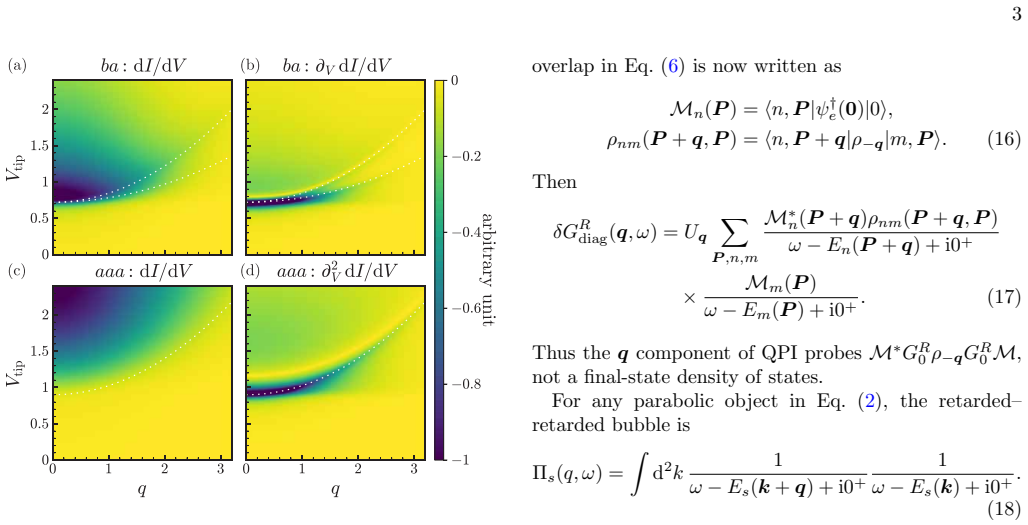
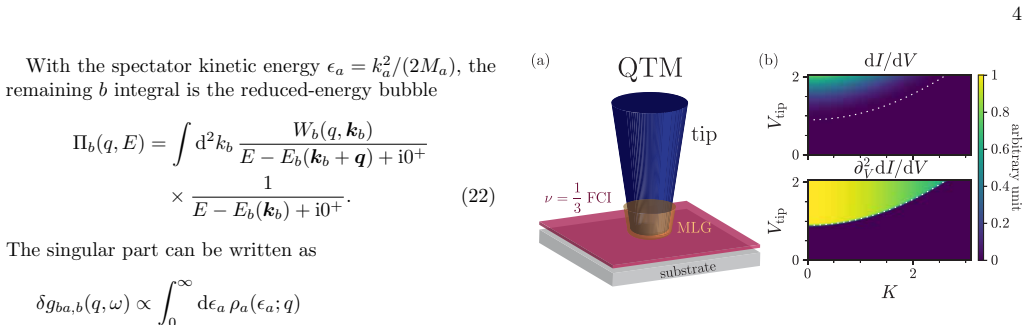
We show how tunneling probes can measure this motion. In scanning tunneling spectroscopy, weak disorder produces spatially oscillating quasiparticle-interference patterns whose branches reveal the dispersion of fractionalized constituents. In quantum twisting microscopy, planar momentum-conserving tunneling selects the total momentum of the injected electron, so the continuum thresholds of fractionalized electron spectra encode the dispersion of the constituent anyons. The resulting spectra distinguish compact electron-like excitations, bound anyon molecules, and unbound anyon continuum.
What carries the argument
Quasiparticle-interference branches from weak disorder in STS and momentum-selected continuum thresholds in QTM that encode anyon dispersion.
If this is right
- Anyon dispersion in FCIs becomes directly measurable from experimental tunneling spectra.
- Spectra can differentiate compact electron-like excitations from bound anyon molecules and unbound anyon continua.
- Doped FCI ground states, including possible superconductors, can be characterized through the measured anyon motion.
- The approach provides access to the dynamics of fractionalized quasiparticles beyond their topological data and global quantum numbers.
Where Pith is reading between the lines
- The same tunneling signatures could be used to track anyon dispersion in other lattice realizations of topological order.
- Dispersion data might allow quantitative tests of theoretical predictions for anyon pairing or condensation energies.
- Combining these probes with doping control could map phase boundaries in the anyon gas as a function of density and dispersion.
Load-bearing premise
Weak disorder produces spatially oscillating quasiparticle-interference patterns whose branches directly encode anyon dispersion without being dominated by other scattering or localization effects.
What would settle it
If measured QPI branch slopes in an FCI fail to match the expected anyon dispersion or if QTM spectra lack distinct thresholds separating compact, bound, and unbound excitations, the mapping would not hold.
Figures

read the original abstract
Anyons are usually characterized by their topological data and their fractional quantum numbers under global symmetries. In lattice systems such as fractional Chern insulators (FCI), they are also mobile quasiparticles. Their motion controls the possible ground states of the dilute anyon gas obtained by doping an FCI, including possible superconducting states. We show how tunneling probes can measure this motion. In scanning tunneling spectroscopy, weak disorder produces spatially oscillating quasiparticle-interference patterns whose branches reveal the dispersion of fractionalized constituents. In quantum twisting microscopy, planar momentum-conserving tunneling selects the total momentum of the injected electron, so the continuum thresholds of fractionalized electron spectra encode the dispersion of the constituent anyons. The resulting spectra distinguish compact electron-like excitations, bound anyon molecules, and unbound anyon continuum.
Editorial analysis
A structured set of objections, weighed in public.
Referee Report
Summary. The manuscript proposes using scanning tunneling spectroscopy (STS) and quantum twisting microscopy (QTM) to measure the dispersion of mobile anyons in fractional Chern insulators. In STS, weak disorder is claimed to generate spatially oscillating quasiparticle-interference (QPI) patterns whose branches encode the dispersion of fractionalized constituents. In QTM, momentum-conserving planar tunneling selects the injected electron's total momentum, allowing continuum thresholds in the fractionalized spectra to reveal anyon dispersion. The resulting spectra are said to distinguish compact electron-like excitations, bound anyon molecules, and unbound anyon continua.
Significance. If the proposed spectral mappings can be derived and validated, the work would supply an experimentally accessible route to anyon mobility in lattice systems. This is significant because anyon dispersion controls the ground states of dilute anyon gases obtained by doping FCIs, including candidate superconducting phases. The approach builds on established tunneling techniques and offers a concrete way to distinguish excitation types.
major comments (2)
- [Abstract] Abstract (STS paragraph): the assertion that weak disorder produces interpretable QPI patterns whose branches directly reveal anyon dispersion is load-bearing for the central claim, yet no derivation is supplied showing why multi-anyon creation, mutual statistics, or localization effects remain subdominant or how the branch-extraction formula incorporates fractional charge.
- [Abstract] Abstract (QTM paragraph): the claim that continuum thresholds encode the dispersion of constituent anyons rests on momentum selection but supplies no model Hamiltonian, dispersion relation, or threshold formula demonstrating that the thresholds are set by anyon rather than electron dispersion.
minor comments (1)
- [Abstract] The abstract is concise but would benefit from a brief statement of the minimal assumptions (e.g., interaction strength or disorder regime) needed for the QPI branches to remain clean.
Simulated Author's Rebuttal
We thank the referee for their careful reading, positive assessment of significance, and constructive comments on the abstract. We address each major comment below. The main text contains the requested derivations; we revise the abstract to reference them explicitly and clarify key assumptions.
read point-by-point responses
-
Referee: [Abstract] Abstract (STS paragraph): the assertion that weak disorder produces interpretable QPI patterns whose branches directly reveal anyon dispersion is load-bearing for the central claim, yet no derivation is supplied showing why multi-anyon creation, mutual statistics, or localization effects remain subdominant or how the branch-extraction formula incorporates fractional charge.
Authors: The main text (Sections 3–4) derives the QPI from the anyon Green's function in weak disorder: the leading oscillatory term arises from single-anyon propagation, with fractional charge entering the interference phase via the Aharonov-Bohm factor e^{i 2π (e*/e) Φ}. Multi-anyon processes are suppressed by the charge gap and disorder strength (explicitly shown via perturbative expansion); mutual statistics modify the phase but leave branch locations unchanged for the dominant term; localization is avoided by the weak-disorder assumption (mean free path longer than wavelength). We revise the abstract to note these points and cite the sections. revision: yes
-
Referee: [Abstract] Abstract (QTM paragraph): the claim that continuum thresholds encode the dispersion of constituent anyons rests on momentum selection but supplies no model Hamiltonian, dispersion relation, or threshold formula demonstrating that the thresholds are set by anyon rather than electron dispersion.
Authors: Section 5 introduces the lattice model Hamiltonian for the doped FCI, writes the anyon dispersion E_a(q) = v|q| + ..., and derives the threshold: for momentum-conserving tunneling of an electron with total momentum k, the onset is min_q [E_a(q) + E_a(k - q)] (or the bound-state variant), which is set by anyon velocities rather than the electron band. We revise the abstract to reference this derivation and the explicit threshold condition. revision: yes
Circularity Check
No circularity: proposal relies on physical assumptions about disorder and tunneling, not self-referential derivations or fits
full rationale
The paper is a forward-looking proposal for measuring anyon dispersion via STS QPI and QTM continuum thresholds. No equations, fitted parameters, or predictions are presented that reduce to inputs by construction. The central claim rests on the (unproven here) assumption that weak disorder yields clean, interpretable branches encoding anyon dispersion, but this is an external physical assumption rather than a definitional or self-citation loop. No self-citations are load-bearing for the method itself, and the work is self-contained as a suggestion without renaming known results or smuggling ansatze.
Axiom & Free-Parameter Ledger
axioms (1)
- domain assumption Mobile anyons exist as quasiparticles in fractional Chern insulators and their motion determines the ground states of the dilute anyon gas.
Forward citations
Cited by 1 Pith paper
-
Superconductivity and non-Fermi liquid metals in a charge-1/3 anyon fluid
Doping a fractional Chern insulator yields an anyon fluid that can form an SC* superconductor with residual Z2 order or a non-Fermi liquid Z3 orthogonal metal.
Reference graph
Works this paper leans on
-
[1]
R. B. Laughlin, Phys. Rev. Lett.50, 1395 (1983)
1983
-
[2]
Arovas, J
D. Arovas, J. R. Schrieffer, and F. Wilczek, Phys. Rev. Lett.53, 722 (1984)
1984
-
[3]
Y. Zeng, Z. Xia, K. Kang, J. Zhu, P. Kn¨ uppel, C. Vaswani, K. Watanabe, T. Taniguchi, K. F. Mak, and J. Shan, Nature622, 69 (2023)
2023
- [4]
-
[5]
Z. Lu, T. Han, Y. Yao, A. P. Reddy, J. Yang, J. Seo, K. Watanabe, T. Taniguchi, L. Fu, and L. Ju, Nature 626, 759 (2024)
2024
-
[6]
Z. Lu, T. Han, Y. Yao, Z. Hadjri, J. Yang, J. Seo, L. Shi, S. Ye, K. Watanabe, T. Taniguchi, and L. Ju, Nature 6 637, 1090 (2025)
2025
-
[7]
S. H. Aronson, T. Han, Z. Lu, Y. Yao, J. P. Butler, K. Watanabe, T. Taniguchi, L. Ju, and R. C. Ashoori, Phys. Rev. X15, 031026 (2025)
2025
- [8]
-
[9]
E. M. Spanton, A. A. Zibrov, H. Zhou, T. Taniguchi, K. Watanabe, M. P. Zaletel, and A. F. Young, Science 360, 62 (2018), arXiv:1706.06116 [cond-mat.str-el]
work page internal anchor Pith review Pith/arXiv arXiv 2018
-
[10]
Y.-C. Tsui, M. He, T. Wang, K. Watanabe, T. Taniguchi, M. P. Zaletel, and A. Yazdani (2025), aPS Global Physics Summit 2025, contributed talk
2025
- [11]
- [12]
-
[13]
M.-L. Schleith, T. Soejima, and E. Khalaf, Anyon dis- persion from non-uniform magnetic field on the sphere (2025), arXiv:2506.11211
-
[14]
K. Iyer, A. Feuerpfeil, V. Cr´ epel, N. Regnault, and C. Mora, Dispersion of anyon Bloch bands (2026), arXiv:2604.24859
work page internal anchor Pith review Pith/arXiv arXiv 2026
- [15]
-
[16]
J. Y. Lee, C. Wang, M. P. Zaletel, A. Vishwanath, and Y.-C. He, Phys. Rev. X8, 031015 (2018), arXiv:1802.09538
work page internal anchor Pith review Pith/arXiv arXiv 2018
-
[17]
T. Wang, X.-Y. Song, M. P. Zaletel, and T. Senthil, Emergent QED3 at the bosonic Laughlin state to super- fluid transition (2025), arXiv:2507.07611
- [18]
- [19]
-
[20]
F. Xu, Z. Sun, J. Li, C. Zheng, C. Xu, J. Gao, T. Jia, Y. Su, K. Watanabe, T. Taniguchi, B. Tong, L. Lu, J. Jia, Z. Shi, S. Jiang, J. Lin, Y. Zhang, Y. Zhang, S. Lei, X. Liu, and T. Li, Signatures of unconventional superconductivity near reentrant and fractional quan- tum anomalous Hall insulators (2025), arXiv:2504.06972 [cond-mat.mes-hall]
work page internal anchor Pith review Pith/arXiv arXiv 2025
-
[21]
R. B. Laughlin, Phys. Rev. Lett.60, 2677 (1988)
1988
-
[22]
R. B. Laughlin, Science242, 525 (1988)
1988
-
[23]
Y.-H. Chen, F. Wilczek, E. Witten, and B. I. Halperin, Int. J. Mod. Phys. B3, 1001 (1989)
1989
-
[24]
Lee and M
D.-H. Lee and M. P. A. Fisher, Phys. Rev. Lett.63, 903 (1989)
1989
-
[25]
B. I. Halperin, Phys. Rev. B45, 5504 (1992)
1992
- [26]
- [27]
- [28]
-
[29]
P. A. Nosov, Z. Han, and E. Khalaf, Phys. Rev. Lett. 136, 106501 (2026), arXiv:2506.02108 [cond-mat.str-el]
work page internal anchor Pith review Pith/arXiv arXiv 2026
-
[30]
F. Pichler, C. Kuhlenkamp, M. Knap, and A. Vish- wanath, Newton2, 100340 (2026), arXiv:2506.08000 [cond-mat.str-el]
-
[31]
T. Wang and M. P. Zaletel, Chiral superconductivity near a fractional Chern insulator (2025), arXiv:2507.07921
-
[32]
Z.-D. Fan, A. Vishwanath, and Z. Wang, Hidden weak- pairing superconductivity of non-interacting anyons obeying 1/3 statistics (2026), arXiv:2605.19036 [cond- mat.str-el]
work page internal anchor Pith review Pith/arXiv arXiv 2026
-
[33]
Z. D. Shi and T. Senthil, Non-Abelian topological su- perconductivity from melting Abelian fractional Chern insulators (2025), arXiv:2512.17996
work page internal anchor Pith review Pith/arXiv arXiv 2025
-
[34]
M. F. Crommie, C. P. Lutz, and D. M. Eigler, Nature 363, 524 (1993)
1993
-
[35]
Hasegawa and P
Y. Hasegawa and P. Avouris, Phys. Rev. Lett.71, 1071 (1993)
1993
-
[36]
J. E. Hoffman, K. McElroy, D.-H. Lee, K. M. Lang, H. Eisaki, S. Uchida, and J. C. Davis, Science297, 1148 (2002)
2002
-
[37]
McElroy, R
K. McElroy, R. W. Simmonds, J. E. Hoffman, D.-H. Lee, J. Orenstein, H. Eisaki, S. Uchida, and J. C. Davis, Na- ture422, 592 (2003)
2003
-
[38]
Wang and D.-H
Q.-H. Wang and D.-H. Lee, Phys. Rev. B67, 020511 (2003)
2003
-
[39]
Capriotti, D
L. Capriotti, D. J. Scalapino, and R. D. Sedgewick, Phys. Rev. B68, 014508 (2003)
2003
-
[40]
Pereg-Barnea and M
T. Pereg-Barnea and M. Franz, Phys. Rev. B68, 180506 (2003)
2003
-
[41]
Hanaguri, S
T. Hanaguri, S. Niitaka, K. Kuroki, and H. Takagi, Sci- ence328, 474 (2010)
2010
-
[42]
Roushan, J
P. Roushan, J. Seo, C. V. Parker, Y. S. Hor, D. Hsieh, D. Qian, A. Richardella, M. Z. Hasan, R. J. Cava, and A. Yazdani, Nature460, 1106 (2009)
2009
-
[43]
Mallet, I
P. Mallet, I. Brihuega, S. Bose, M. M. Ugeda, J. M. G´ omez-Rodr´ ıguez, K. Kern, and J. Y. Veuillen, Phys. Rev. B86, 045444 (2012)
2012
-
[44]
Simon, C
L. Simon, C. Bena, F. Vonau, M. Cranney, and D. Aubel, J. Phys. D: Appl. Phys.44, 464010 (2011)
2011
-
[45]
C. Bena, C. R. Phys.17, 302 (2016)
2016
-
[46]
Avraham, J
N. Avraham, J. Reiner, A. Kumar-Nayak, N. Morali, R. Batabyal, B. Yan, and H. Beidenkopf, Adv. Mater. 30, 1707628 (2018)
2018
-
[47]
S. C. Morampudi, A. M. Turner, F. Pollmann, and F. Wilczek, Phys. Rev. Lett.118, 227201 (2017)
2017
-
[48]
Inbar, J
A. Inbar, J. Birkbeck, J. Xiao, T. Taniguchi, K. Watan- abe, B. Yan, Y. Oreg, A. Stern, E. Berg, and S. Ilani, Nature614, 682 (2023)
2023
-
[49]
J. Xiao, A. Inbar, J. Birkbeck, N. Gershon, Y. Zamir, Y. Vituri, T. Taniguchi, K. Watanabe, E. Berg, and S. Ilani, Nature653, 68 (2026), arXiv:2506.20738
work page internal anchor Pith review arXiv 2026
-
[50]
Anyon molecules in fractional quantum Hall states
T. Wang and M. P. Zaletel, Anyon molecules in fractional quantum Hall states (2026), arXiv:2604.09798 [cond- mat.mes-hall]
work page internal anchor Pith review Pith/arXiv arXiv 2026
-
[51]
Q. Xu, G. Ji, Y. Wang, H. Q. Trung, and B. Yang, Phys. Rev. B112, 235112 (2025)
2025
-
[52]
Gattu and J
M. Gattu and J. K. Jain, Phys. Rev. Lett.135, 236601 (2025)
2025
- [53]
- [54]
discussion (0)
Sign in with ORCID, Apple, or X to comment. Anyone can read and Pith papers without signing in.