Moment Matching Q-Learning
Pith reviewed 2026-06-29 13:56 UTC · model grok-4.3
The pith
Moment Matching Q-Learning applies maximum mean discrepancy to match all moment statistics in the conditional score function for distribution-level convergence in reinforcement learning.
A machine-rendered reading of the paper's core claim, the machinery that carries it, and where it could break.
Core claim
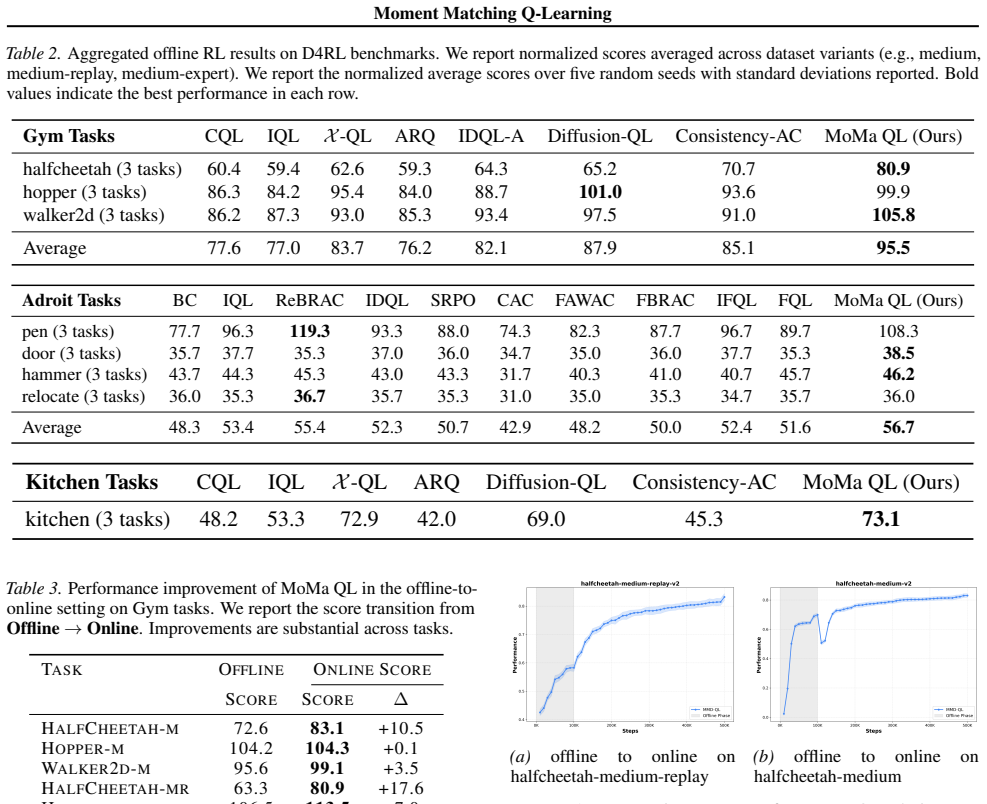
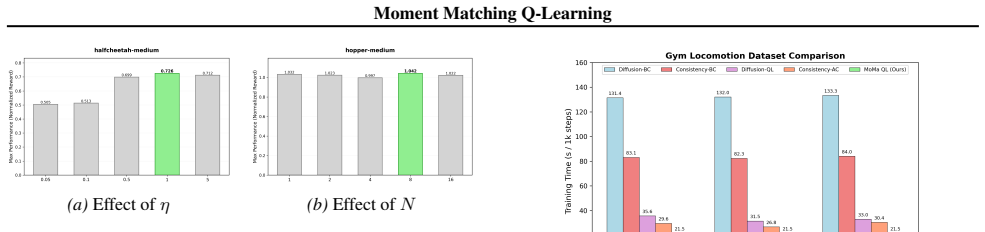
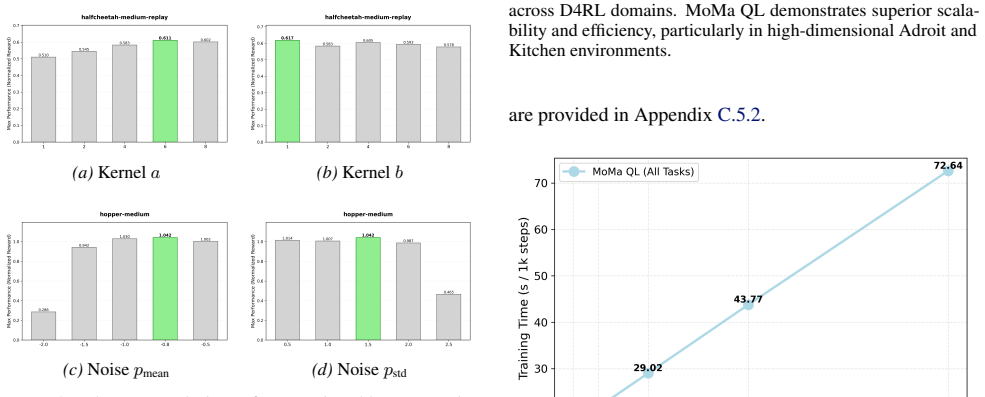
By enforcing strong regularization on all moment statistics via maximum mean discrepancy, MoMa QL guarantees distribution-level convergence for the conditional score function and remains stable under various hyperparameters, yielding more computationally efficient action sampling than prior score- or flow-based policies while maintaining competitive task performance.
What carries the argument
Maximum mean discrepancy (MMD) applied as strong regularization to match all orders of statistics between the original and target distributions of the conditional score function.
If this is right
- Action sampling from flow-based policies becomes faster, removing the iterative sampling bottleneck in RL.
- The learned policy adapts more rapidly during online fine-tuning after offline pre-training.
- Performance on standard D4RL benchmarks stays comparable to or exceeds existing score- and flow-based methods.
- The same moment-matching regularizer can be applied to other conditional generative models that suffer from slow sampling.
Where Pith is reading between the lines
- The approach may generalize to any RL algorithm whose policy is represented by a conditional generative model, not only Q-learning.
- If the moment-matching step can be made differentiable and cheap, it could replace expensive likelihood-based training in high-dimensional continuous control.
- Faster sampling opens the door to using these policies in real-time control loops where previous flow models were too slow.
Load-bearing premise
That matching all moment statistics with MMD on the conditional score function is enough to produce distribution-level convergence and hyperparameter stability inside the Q-learning update.
What would settle it
A controlled run on a D4RL task where MoMa QL either fails to reach the claimed distributional convergence (measured by MMD or Wasserstein distance between learned and target score distributions) or shows large performance variance when hyperparameters are swept over the same range used in the paper.
Figures








read the original abstract
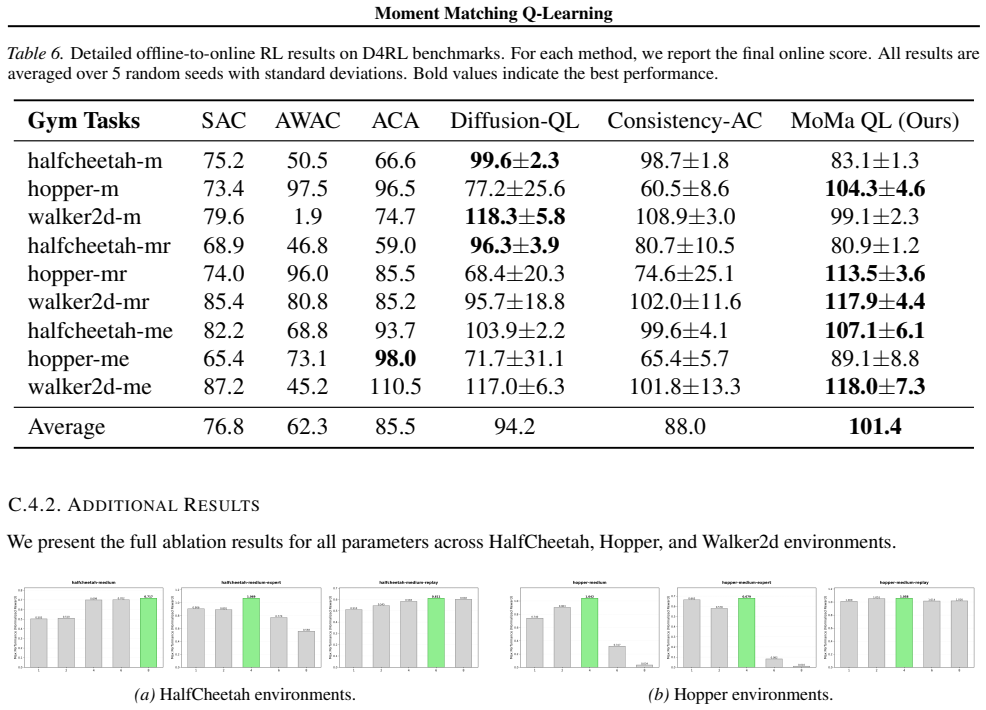
Score-based and flow-based generative models exhibit remarkable expressive capacity in capturing complex distributions, and have been extensively deployed in tasks ranging from image generation to reinforcement learning. Nevertheless, these models suffer from prolonged inference latency, which imposes a significant computational bottleneck in RL with iterative sampling. To overcome this limitation, we propose a new framework named Moment Matching Q-Learning (MoMa QL), which utilizes a technique from statistical hypothesis testing known as maximum mean discrepancy (MMD) that intend to match all orders of statistics between the original and target distribution. By enforcing strong regularization on all moment statistics, this algorithm guarantees distribution-level convergence for conditional score function and remains stable under various hyperparameters. Empirically, we show that our method MoMa QL is more computationally efficient with a comparable if not competitive performance in various D4RL tasks. Remarkably, by accelerating the action sampling process for flow-based policies, MoMa QL demonstrates superior performance in offline-to-online RL tasks because of faster and stronger adaptability for online interactive finetuning.
Editorial analysis
A structured set of objections, weighed in public.
Referee Report
Summary. The manuscript proposes Moment Matching Q-Learning (MoMa QL), a framework that applies maximum mean discrepancy (MMD) regularization to match all orders of statistics between original and target distributions in score-based and flow-based generative models for RL. It claims this enforces strong regularization that guarantees distribution-level convergence for the conditional score function, yields hyperparameter stability, and produces more computationally efficient policies with competitive performance on D4RL benchmarks and superior results in offline-to-online RL due to accelerated action sampling.
Significance. If the claimed guarantee can be rigorously established and the empirical gains hold under standard controls, the work would offer a practical route to reducing inference latency for expressive generative policies in RL without sacrificing stability, addressing a known bottleneck in deploying flow- and score-based methods to sequential decision tasks.
major comments (2)
- [Abstract] Abstract: The central claim that 'enforcing strong regularization on all moment statistics... guarantees distribution-level convergence for conditional score function' is presented without any theorem statement, proof outline, or derivation. Standard MMD matches moments between unconditional distributions via a characteristic kernel; no construction is supplied showing how this extends to the conditional p(·|s) under the Bellman operator or how the resulting gradient affects the score ∇log p(a|s) in the Q-learning update.
- [Abstract] Abstract (empirical section): The competitiveness and superiority claims rest on D4RL results, yet the abstract supplies neither error bars, number of random seeds, data-split protocol, nor description of baseline implementations and hyperparameter controls, rendering the 'comparable if not competitive' and 'superior... in offline-to-online' assertions impossible to evaluate.
minor comments (1)
- [Abstract] Abstract: The phrase 'match all orders of statistics' is used without specifying the kernel family or truncation order; a brief clarification of the MMD implementation would aid readability.
Simulated Author's Rebuttal
We thank the referee for the detailed and constructive feedback. We address each major comment below, indicating where revisions will be made to strengthen the presentation.
read point-by-point responses
-
Referee: [Abstract] Abstract: The central claim that 'enforcing strong regularization on all moment statistics... guarantees distribution-level convergence for conditional score function' is presented without any theorem statement, proof outline, or derivation. Standard MMD matches moments between unconditional distributions via a characteristic kernel; no construction is supplied showing how this extends to the conditional p(·|s) under the Bellman operator or how the resulting gradient affects the score ∇log p(a|s) in the Q-learning update.
Authors: The abstract is a high-level summary; the full manuscript (Section 3) extends MMD to conditional distributions p(a|s) by applying the kernel to state-conditioned samples drawn under the Bellman operator, derives the resulting gradient on the score function (Eq. 8), and states the distribution-level convergence as Theorem 1 with a proof sketch in Appendix A. We agree the abstract should not stand alone on this point and will revise it to reference 'as shown in Section 3 and Theorem 1' while adding a one-sentence outline of the conditional construction. revision: yes
-
Referee: [Abstract] Abstract (empirical section): The competitiveness and superiority claims rest on D4RL results, yet the abstract supplies neither error bars, number of random seeds, data-split protocol, nor description of baseline implementations and hyperparameter controls, rendering the 'comparable if not competitive' and 'superior... in offline-to-online' assertions impossible to evaluate.
Authors: We agree the abstract is too terse on experimental protocol. The main text (Section 5) reports means and standard deviations over 5 random seeds, uses the canonical D4RL train/test splits, re-implements baselines from their original code with the hyperparameter grids stated in the paper, and evaluates offline-to-online finetuning with the standard interaction budget. We will revise the abstract to read 'with mean ± std over 5 seeds using standard D4RL protocols' to make the claims evaluable from the abstract alone. revision: yes
Circularity Check
No circularity in derivation chain
full rationale
The abstract presents MoMa QL as applying MMD moment matching to enforce regularization on all moment statistics, claiming this guarantees distribution-level convergence for the conditional score function in Q-learning. No equations, self-citations, fitted parameters renamed as predictions, or derivation steps are visible in the provided text. The central claim is advanced as an independent algorithmic contribution without any reduction to its own inputs by construction. The derivation is therefore self-contained against external benchmarks.
Axiom & Free-Parameter Ledger
axioms (1)
- domain assumption MMD matching of all moments produces distribution-level convergence of the conditional score function
Reference graph
Works this paper leans on
-
[1]
Score regu- larized policy optimization through diffusion behavior
Chen, H., Lu, C., Wang, Z., Su, H., and Zhu, J. Score regu- larized policy optimization through diffusion behavior. In International Conference on Learning Representations, volume 2024, pp. 10211–10230,
2024
-
[2]
and Jin, C
Ding, Z. and Jin, C. Consistency models as a rich and effi- cient policy class for reinforcement learning. InInterna- tional Conference on Learning Representations, volume 2024, pp. 53047–53066,
2024
-
[3]
Offline Reinforcement Learning: Tutorial, Review, and Perspectives on Open Problems
Levine, S., Kumar, A., Tucker, G., and Fu, J. Offline rein- forcement learning: Tutorial, review, and perspectives on open problems.arXiv preprint arXiv:2005.01643,
work page internal anchor Pith review Pith/arXiv arXiv 2005
-
[4]
T., Ben-Hamu, H., Nickel, M., and Le, M
Lipman, Y ., Chen, R. T., Ben-Hamu, H., Nickel, M., and Le, M. Flow matching for generative modeling. In11th International Conference on Learning Representations, ICLR 2023,
2023
-
[5]
Playing Atari with Deep Reinforcement Learning
Mnih, V ., Kavukcuoglu, K., Silver, D., Graves, A., Antonoglou, I., Wierstra, D., and Riedmiller, M. Playing atari with deep reinforcement learning.arXiv preprint arXiv:1312.5602,
work page internal anchor Pith review Pith/arXiv arXiv
-
[6]
Advantage-Weighted Regression: Simple and Scalable Off-Policy Reinforcement Learning
Peng, X. B., Kumar, A., Zhang, G., and Levine, S. Advantage-weighted regression: Simple and scalable off-policy reinforcement learning.arXiv preprint arXiv:1910.00177,
work page internal anchor Pith review Pith/arXiv arXiv 1910
-
[7]
Ren, J., Li, Y ., Ding, Z., Pan, W., and Dong, H. Probabilis- tic mixture-of-experts for efficient deep reinforcement learning.arXiv preprint arXiv:2104.09122,
-
[8]
Dual rl: Unification and new methods for reinforcement and imi- tation learning
Sikchi, H., Zheng, Q., Zhang, A., and Niekum, S. Dual rl: Unification and new methods for reinforcement and imi- tation learning. InInternational Conference on Learning Representations, volume 2024, pp. 9305–9352,
2024
-
[9]
Score-Based Generative Modeling through Stochastic Differential Equations
Song, Y ., Sohl-Dickstein, J., Kingma, D. P., Kumar, A., Er- mon, S., and Poole, B. Score-based generative modeling through stochastic differential equations.arXiv preprint arXiv:2011.13456,
work page internal anchor Pith review Pith/arXiv arXiv 2011
-
[10]
Behavior Regularized Offline Reinforcement Learning
Wu, Y ., Tucker, G., and Nachum, O. Behavior regu- larized offline reinforcement learning.arXiv preprint arXiv:1911.11361,
work page internal anchor Pith review Pith/arXiv arXiv 1911
-
[11]
Zhang, Q., Liu, Z., Fan, H., Liu, G., Zeng, B., and Liu, S. Flowpolicy: Enabling fast and robust 3d flow-based policy via consistency flow matching for robot manipula- tion. InProceedings of the AAAI Conference on Artificial Intelligence, volume 39, pp. 14754–14762, 2025a. Zhang, S., Zhang, W., and Gu, Q. Energy-weighted flow matching for offline reinforc...
-
[12]
Theorems and Derivations A.1
11 Moment Matching Q-Learning A. Theorems and Derivations A.1. Maximum Mean Discrepancy To facilitate a further discussion of MMD, it is necessary to first introduce several key mathematical definitions. Definition A.1(Integral Probability Metric).A metric D(·,·) between two probability measures µ, ν is called anintegral probability metric(IPM) if it sati...
2017
-
[13]
Given MMD loss function we defined in 3, we have: LD(θ) =E s,t Ext[k(f θ s,t(xt),·)]−E xr[k(f θ− s,r (xr),·)] 2 H =E s,t Ext,xr[k(f θ s,t(xt),·)−k(f θ− s,r (xr),·)] 2 H (reuse the samplex t) =E s,t hD Ext,xr[k(f θ s,t(xt),·)−k(f θ− s,r (xr),·)],E x′ t,x′r[k(f θ s,t(x′ t),·)−k(f θ− s,r (x′ r),·)] E H i =E s,t h Ext,xr,x′ t,x′r h k(f θ s,t(xt),·), k(f θ s,t...
2012
discussion (0)
Sign in with ORCID, Apple, or X to comment. Anyone can read and Pith papers without signing in.