Pocket-Dentist: On-Device Dental Image Understanding via Efficient Multimodal Large Language Models
Pith reviewed 2026-06-29 08:50 UTC · model grok-4.3
The pith
Compact 2B vision-language models match larger VLMs on dental tasks after lightweight adaptation while using far less compute.
A machine-rendered reading of the paper's core claim, the machinery that carries it, and where it could break.
Core claim
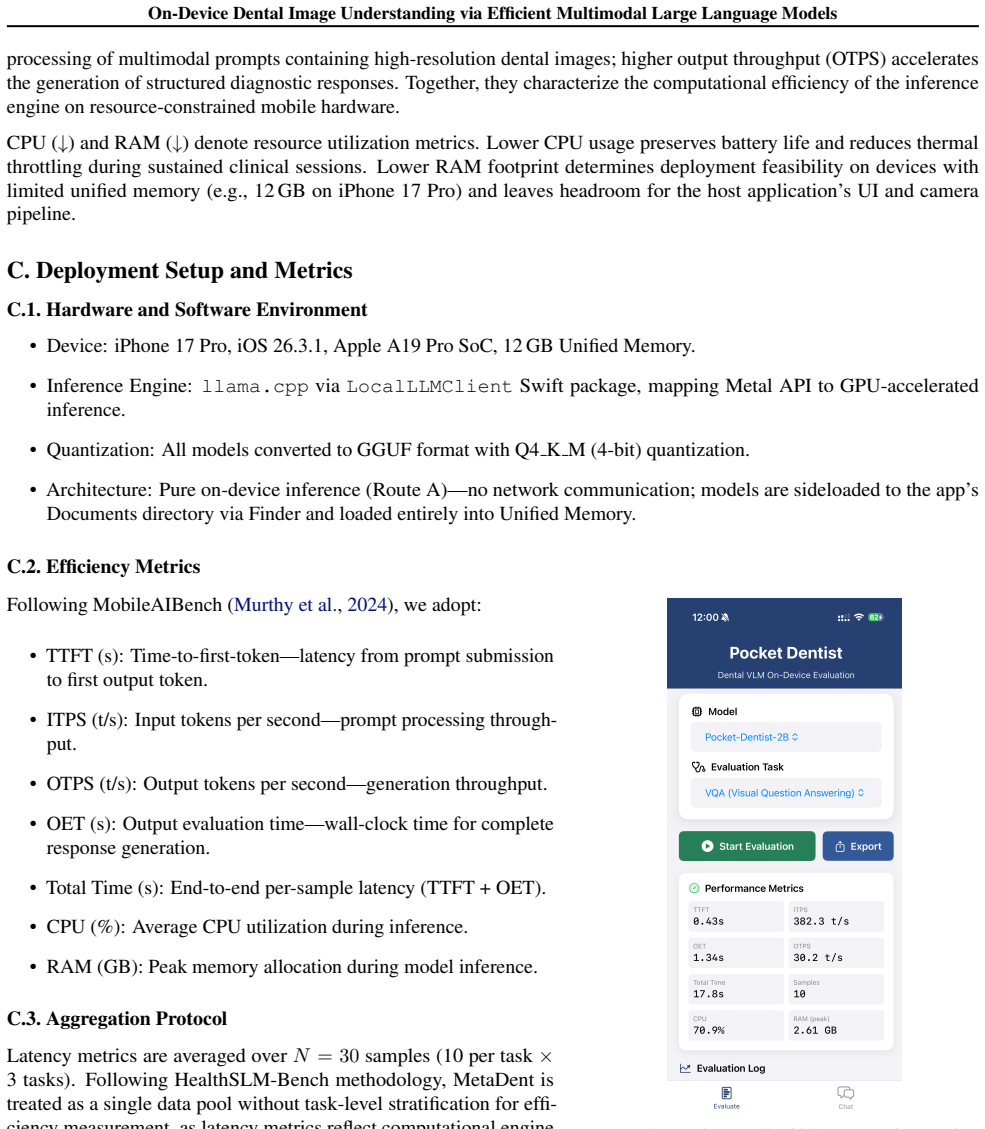
Compact VLMs such as 2B-parameter models become competitive with much larger VLMs on most metrics after lightweight adaptation while requiring substantially lower computational costs in dental image understanding. The Pocket-Dentist-2B model, when run locally on an iPhone 17 Pro, processed each sample in 4.31 seconds, cutting latency by 4.9 times and memory use by 2.3 times relative to a 7B baseline.
What carries the argument
The Pocket-Dentist benchmark that unifies three patient datasets, five task types, and seven metrics to measure both accuracy and computational cost for dental multimodal question answering, paired with lightweight adaptation of compact VLMs.
If this is right
- On-device inference on consumer phones becomes feasible for dental image tasks.
- Patient images can stay local, supporting privacy-preserving prescreening.
- Latency drops to 4.31 seconds per sample and memory drops by 2.3 times versus 7B models.
- Timely screening becomes available in settings without cloud access or specialist hardware.
Where Pith is reading between the lines
- The same lightweight adaptation pattern may transfer to other medical image domains that need on-device processing.
- Consumer apps for preliminary dental checks could run entirely on phones without sending data elsewhere.
- Lower memory and latency could reduce battery drain in mobile health tools.
Load-bearing premise
The three datasets spanning about 1,159 patients together with the five tasks and seven metrics adequately represent the needs of practical dental prescreening outside specialist centers.
What would settle it
A new, more diverse dental image collection where the adapted 2B model falls well behind larger models on accuracy metrics even though its compute advantage remains.
Figures

read the original abstract
Evaluations of dental vision-language models remain fragmented across datasets, task definitions and metrics, and often ignore their computational cost. This limits their widespread deployment for dental screening outside specialist centres, where timely inference, limited hardware, and local handling of patient images are vital for practical, privacy-preserving clinical prescreening. Here we present Pocket-Dentist, an efficiency-aware benchmark for dental multimodal question answering that brings together three datasets spanning approximately 1,159 patients from BRAR and MetaDent, five task types and seven metrics. Across 14 typical VLMs, our results reveal an interesting observation: compact VLMs, such as 2B-parameter models, become competitive with much larger VLMs on most metrics after lightweight adaptation while requiring substantially lower computational costs in dental image understanding. Deployed locally on an iPhone 17 Pro, our finetuned compact VLM Pocket-Dentist-2B processed each sample in 4.31 s, reducing latency by 4.9x and memory use by 2.3x compared with a 7B baseline. Our project page is available at https://2026-icml.github.io/pocket-dentist-icml.
Editorial analysis
A structured set of objections, weighed in public.
Referee Report
Summary. The paper introduces Pocket-Dentist, an efficiency-aware benchmark for dental multimodal question answering. It aggregates three datasets from BRAR and MetaDent covering approximately 1,159 patients, defines five task types and seven metrics, and evaluates 14 VLMs. The key finding is that compact 2B-parameter VLMs, after lightweight adaptation, become competitive with much larger VLMs on most metrics while requiring substantially lower computational costs. The work also demonstrates on-device deployment of a finetuned 2B model on an iPhone 17 Pro, achieving 4.31 seconds per sample, 4.9x latency reduction, and 2.3x memory reduction compared to a 7B baseline.
Significance. If the results hold, this benchmark could promote the use of efficient, on-device VLMs for dental prescreening, addressing privacy and hardware constraints outside specialist centers. The unification of datasets and focus on efficiency is valuable. The on-device results provide concrete evidence of practicality. However, the significance hinges on whether the datasets adequately represent real-world variability in dental imaging.
major comments (2)
- [Abstract] Abstract and evaluation setup: The abstract states high-level competitiveness and latency numbers without detailed per-metric tables, error bars, statistical tests, or full adaptation procedures; the central claim that 2B models become competitive on most metrics cannot be verified from the provided text alone.
- [Datasets] Datasets: The three datasets spanning approximately 1,159 patients from BRAR and MetaDent are aggregated without detailing demographic coverage, pathology rarity, imaging device variation, or out-of-distribution cases typical in non-specialist settings. Since the central claim requires that the five task types and seven metrics on these datasets suffice to establish competitiveness for practical dental prescreening, this is load-bearing and risks that the observed 4.9x latency and 2.3x memory gains may not generalize.
minor comments (1)
- [Abstract] The project page URL references 2026-ICML, which appears inconsistent with current conference timelines.
Simulated Author's Rebuttal
We thank the referee for the detailed and constructive report. We address each major comment below, clarifying the manuscript content and indicating revisions where they strengthen the work without altering its core claims.
read point-by-point responses
-
Referee: [Abstract] Abstract and evaluation setup: The abstract states high-level competitiveness and latency numbers without detailed per-metric tables, error bars, statistical tests, or full adaptation procedures; the central claim that 2B models become competitive on most metrics cannot be verified from the provided text alone.
Authors: The abstract is intentionally concise to highlight the main contributions and on-device results. The full manuscript contains the requested details: Section 4 presents per-metric tables with error bars across all 14 VLMs and five task types; Section 3.2 describes the lightweight adaptation procedures (including hyperparameters and training protocol); and statistical comparisons are reported via paired t-tests in the supplementary material. We have revised the abstract to explicitly reference these sections and tables so readers can locate the supporting evidence immediately. revision: partial
-
Referee: [Datasets] Datasets: The three datasets spanning approximately 1,159 patients from BRAR and MetaDent are aggregated without detailing demographic coverage, pathology rarity, imaging device variation, or out-of-distribution cases typical in non-specialist settings. Since the central claim requires that the five task types and seven metrics on these datasets suffice to establish competitiveness for practical dental prescreening, this is load-bearing and risks that the observed 4.9x latency and 2.3x memory gains may not generalize.
Authors: We agree that explicit characterization of the aggregated data strengthens the benchmark. We have added a new subsection (Section 3.1.1) that summarizes available demographic information, imaging device types, and pathology distributions drawn from the original BRAR and MetaDent publications. We also expanded the limitations paragraph in Section 5 to acknowledge that the current collection may under-represent certain out-of-distribution cases encountered in non-specialist settings and that further multi-center validation would be valuable. The efficiency gains themselves are measured on the same data distribution used for evaluation, so they remain valid within the reported scope; we do not claim universal generalization beyond the benchmark. revision: yes
Circularity Check
No circularity: empirical benchmarking with no derivations or self-referential reductions
full rationale
The paper consists entirely of empirical benchmarking: it aggregates three existing datasets (~1,159 patients), defines five task types and seven metrics, evaluates 14 VLMs (including lightweight adaptation of 2B models), and reports measured latency/memory on an iPhone 17 Pro. No equations, fitted parameters renamed as predictions, uniqueness theorems, ansatzes, or derivation chains appear in the provided text. The central observation (compact VLMs competitive after adaptation) is a direct empirical finding from the benchmark runs, not a reduction to prior inputs by construction. Self-citations, if present, are not load-bearing for any mathematical claim. This is a standard non-circular empirical study.
Axiom & Free-Parameter Ledger
axioms (1)
- domain assumption The three datasets from BRAR and MetaDent with approximately 1,159 patients provide sufficient coverage for the five task types in dental image understanding.
Reference graph
Works this paper leans on
-
[1]
doi: 10.1177/ 00220345261424242
ISSN 0022-0345, 1544-0591. doi: 10.1177/ 00220345261424242. Lu, Z., Li, X., Cai, D., Yi, R., Liu, F., Liu, W., et al. De- mystifying Small Language Models for Edge Deploy- ment. InProceedings of the 63rd Annual Meeting of the Association for Computational Linguistics (Volume 1: Long Papers), pp. 14747–14764, Vienna, Austria,
-
[2]
SmolVLM: Redefining small and efficient multimodal models
Association for Computational Linguistics. doi: 10.18653/v1/2025.acl-long.718. Marafioti, A., Zohar, O., Farr´e, M., Noyan, M., Bakouch, E., Cuenca, P., et al. SmolVLM: Redefining small and effi- cient multimodal models. arXiv preprint, 2025. https: //doi.org/10.48550/arXiv.2504.05299. Moor, M., Huang, Q., Wu, S., Yasunaga, M., Dalmia, Y ., Leskovec, J., ...
work page internal anchor Pith review Pith/arXiv arXiv doi:10.18653/v1/2025.acl-long.718 2025
-
[3]
PMC-VQA: Visual Instruction Tuning for Medical Visual Question Answering
URL https://openreview.net/forum? id=SkeHuCVFDr. Zhang, X., Wu, C., Zhao, Z., Lin, W., Zhang, Y ., Wang, Y ., et al. PMC-VQA: Visual Instruction Tun- ing for Medical Visual Question Answering. arXiv preprint, 2023. https://doi.org/10.48550/ arXiv.2305.10415. 10 On-Device Dental Image Understanding via Efficient Multimodal Large Language Models A. Prompt T...
work page internal anchor Pith review Pith/arXiv arXiv 2023
discussion (0)
Sign in with ORCID, Apple, or X to comment. Anyone can read and Pith papers without signing in.