Recoil-regulated extreme mass-ratio inspirals in AGN disks
Pith reviewed 2026-06-29 06:30 UTC · model grok-4.3
The pith
Recoil kicks from mergers and binary interactions repeatedly eject stellar-mass black holes from AGN disks, suppressing extreme mass-ratio inspirals except in young systems.
A machine-rendered reading of the paper's core claim, the machinery that carries it, and where it could break.
Core claim
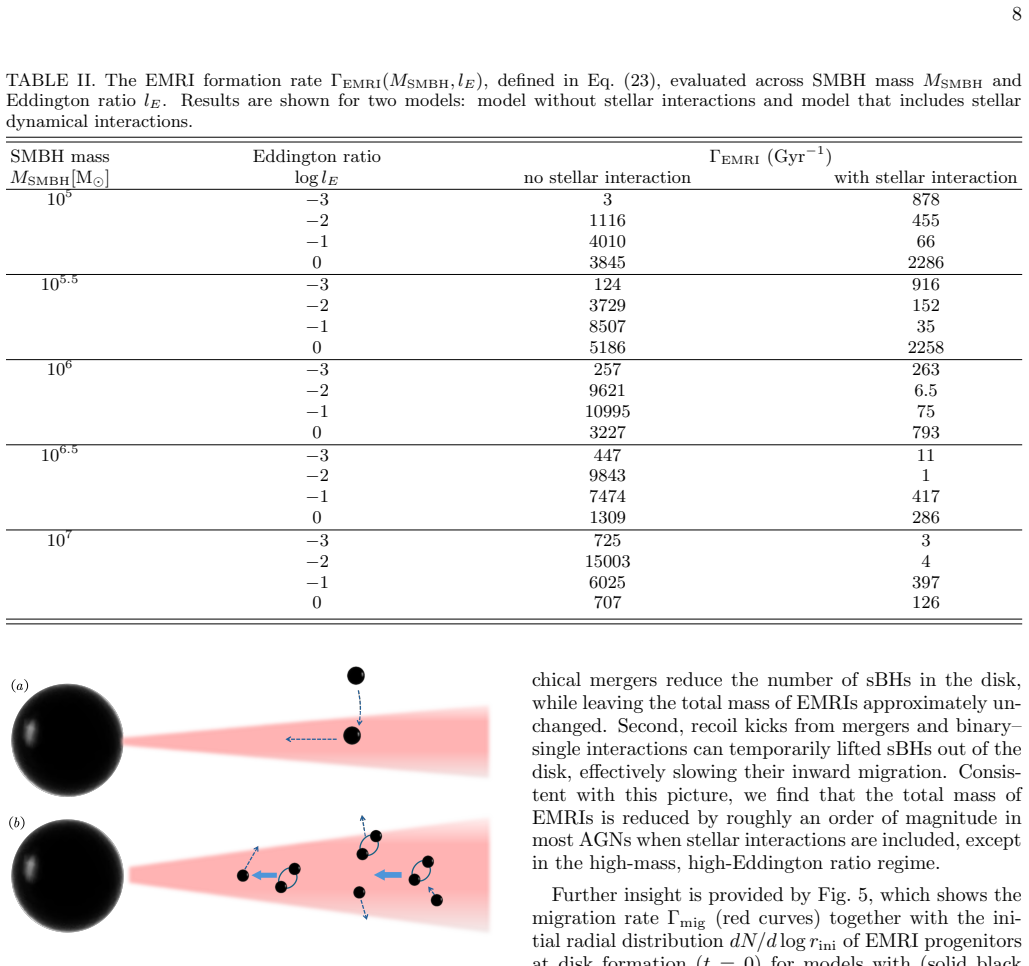
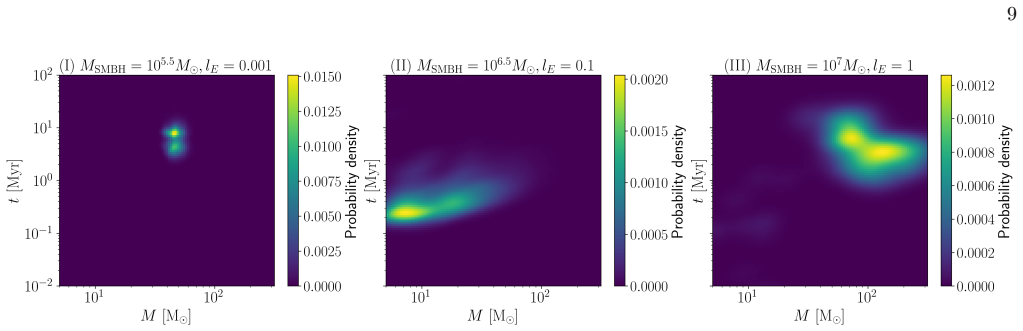
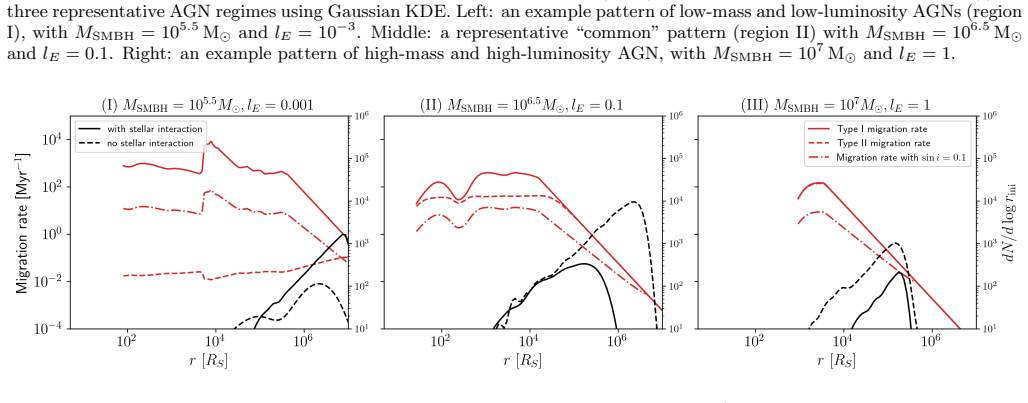
Using semi-analytical AGN disk models combined with Monte Carlo simulations across supermassive black hole masses of 10^5 to 10^7 solar masses and Eddington ratios of 10^{-3} to 1, recoil kicks from mergers and binary-single interactions repeatedly lift stellar-mass black holes out of the disk plane, temporarily interrupting migration and strongly suppressing EMRI formation in much of parameter space. Detectable EMRIs are therefore preferentially produced in young AGNs, typically within ~10-20 Myr of disk formation, and often involve merger-grown secondary black holes, yielding LISA detection rates of ~1-30 yr^{-1}.
What carries the argument
Recoil kicks from mergers and binary-single interactions that lift stellar-mass black holes out of the AGN disk plane and interrupt migration.
If this is right
- Detectable EMRIs form preferentially in AGN disks younger than about 20 million years.
- Many EMRIs involve secondary black holes that have already grown through prior mergers.
- LISA is expected to detect 1 to 30 EMRIs per year from this channel.
- The observable population is dominated by low-mass AGNs and is sensitive to the demographics of faint active nuclei.
- EMRI observations can probe both AGN disk physics and the low-mass AGN population.
Where Pith is reading between the lines
- EMRI detections could serve as a clock for AGN disk ages and lifetimes.
- The predicted rates imply that the fraction of young AGNs in the local universe sets the overall EMRI yield.
- Similar recoil-regulated migration may operate in other gaseous environments around compact objects.
- EMRI properties such as mass ratios or eccentricities might distinguish disk models once a sample is in hand.
Load-bearing premise
Semi-analytical AGN disk models combined with Monte Carlo simulations accurately capture the migration, binary formation, and recoil dynamics without requiring full hydrodynamic or N-body verification.
What would settle it
A hydrodynamic or N-body simulation of an AGN disk in which recoil kicks from mergers and binary encounters fail to lift a substantial fraction of stellar-mass black holes out of the plane would falsify the suppression mechanism.
Figures



read the original abstract
Extreme mass-ratio inspirals (EMRIs) are among the primary targets of future space-based gravitational-wave observatories, such as LISA, TianQin, and Taiji. Active galactic nucleus (AGN) disks provide a gas-rich environment in which stellar-mass black holes can migrate toward central supermassive black holes and form EMRIs. Previous studies of this ``wet'' channel have largely neglected stellar interactions within the disk. Here we show that binary formation, hierarchical mergers, and recoil kicks fundamentally regulate wet EMRI formation in AGN disks. Using semi-analytical AGN disk models combined with Monte Carlo simulations across supermassive black hole masses of $10^5$--$10^7M_\odot$ and Eddington ratios of $10^{-3}$-1, we find that recoil kicks from mergers and binary--single interactions repeatedly lift stellar-mass black holes out of the disk plane, temporarily interrupting migration and strongly suppressing EMRI formation in much of parameter space. Detectable EMRIs are therefore preferentially produced in young AGNs, typically within $\sim$ 10-20Myr of disk formation, and often involve merger-grown secondary black holes. We predict LISA detection rates of $\sim$ 1-30yr$^{-1}$, with the observable population dominated by low-mass AGNs and sensitive to the poorly constrained demographics of faint active nuclei. Our results identify stellar interactions as a key ingredient in the evolution of compact objects in AGN disks and show that future EMRI observations can probe both AGN disk physics and the low-mass AGN population.
Editorial analysis
A structured set of objections, weighed in public.
Referee Report
Summary. The paper claims that recoil kicks from hierarchical mergers and binary-single encounters in AGN disks repeatedly lift stellar-mass black holes out of the midplane, interrupting Type-I/II migration and strongly suppressing EMRI formation except in young AGNs (within ~10-20 Myr of disk formation). Using semi-analytical disk models plus Monte Carlo sampling over SMBH masses 10^5-10^7 M_⊙ and Eddington ratios 10^{-3}-1, the authors predict that detectable EMRIs are preferentially produced by merger-grown secondaries in low-mass AGNs and yield LISA rates of ~1-30 yr^{-1}.
Significance. If the modeling of vertical excursions holds, the work identifies stellar interactions as a dominant regulator of the wet EMRI channel, supplies concrete, falsifiable predictions for LISA event rates and demographics, and links EMRI observations to the poorly constrained population of faint AGNs. The Monte Carlo exploration across parameter space is a strength that allows the young-AGN preference to be stated quantitatively.
major comments (2)
- [semi-analytical disk models and Monte Carlo implementation] The central suppression result rests on the semi-analytical prescriptions for post-recoil vertical damping and re-capture (described in the disk-model and migration sections). These prescriptions use analytic expressions for scale height, surface density, and gas-drag restoring force; if they systematically underestimate the vertical damping rate relative to 3D hydrodynamics (as the skeptic note suggests), the time spent out of the plane is overestimated and the claimed strong suppression in older AGNs does not follow.
- [results on detection rates] The predicted LISA rates (1-30 yr^{-1}) and the dominance of young, low-mass AGNs are obtained after integrating over the adopted ranges of Eddington ratio and SMBH mass; no convergence tests or sensitivity runs with respect to the vertical-damping parameters or the young-AGN timescale cutoff are reported, leaving the quantitative rates vulnerable to the modeling choice flagged above.
minor comments (2)
- [methods] Notation for the recoil velocity distribution and the binary-single encounter rate should be defined explicitly in the methods section rather than referenced only to external works.
- [figures] Figure captions for the Monte Carlo output panels should state the exact number of realizations and the binning used for the age and mass distributions.
Simulated Author's Rebuttal
We thank the referee for their thorough review and valuable feedback on our manuscript. We address the major comments point by point below, proposing revisions where appropriate to enhance the robustness of our results.
read point-by-point responses
-
Referee: The central suppression result rests on the semi-analytical prescriptions for post-recoil vertical damping and re-capture (described in the disk-model and migration sections). These prescriptions use analytic expressions for scale height, surface density, and gas-drag restoring force; if they systematically underestimate the vertical damping rate relative to 3D hydrodynamics (as the skeptic note suggests), the time spent out of the plane is overestimated and the claimed strong suppression in older AGNs does not follow.
Authors: Our model employs standard semi-analytical prescriptions for AGN disk structure and gas drag that are widely used in the literature for similar problems. While we recognize that 3D hydrodynamical simulations could provide more precise damping rates, conducting such simulations across the full Monte Carlo parameter space is not feasible. We have adopted damping timescales that are conservative with respect to the suppression effect. In the revised manuscript, we will add a new subsection discussing the potential uncertainties arising from the semi-analytical approximation, including references to relevant hydrodynamical studies, and argue that the qualitative conclusion of suppression in older AGNs remains valid even under variations in damping rates. revision: partial
-
Referee: The predicted LISA rates (1-30 yr^{-1}) and the dominance of young, low-mass AGNs are obtained after integrating over the adopted ranges of Eddington ratio and SMBH mass; no convergence tests or sensitivity runs with respect to the vertical-damping parameters or the young-AGN timescale cutoff are reported, leaving the quantitative rates vulnerable to the modeling choice flagged above.
Authors: We concur that sensitivity analyses would better quantify the dependence on these parameters. Accordingly, we will conduct additional Monte Carlo runs in the revised paper, varying the vertical damping timescale by factors of 0.5 and 2, and the young-AGN cutoff from 5 to 30 Myr. The results of these tests will be presented, demonstrating that the predicted rate range of 1-30 yr^{-1} and the preference for young, low-mass AGNs are robust to these variations. revision: yes
Circularity Check
No significant circularity; derivation relies on external semi-analytical models and Monte Carlo sampling.
full rationale
The paper's central results on recoil-regulated EMRI suppression and LISA rates are obtained by running Monte Carlo simulations that incorporate standard recoil kick physics and semi-analytical AGN disk prescriptions across stated parameter ranges. These inputs are drawn from prior literature on disk structure and gravitational-wave recoil rather than being fitted or defined within the present work to produce the output quantities. No equations reduce a claimed prediction to a fitted parameter by construction, no uniqueness theorems are imported from the authors' own prior papers, and the simulation outputs remain falsifiable against independent hydrodynamic or N-body benchmarks. The derivation chain is therefore self-contained against external benchmarks.
Axiom & Free-Parameter Ledger
free parameters (3)
- Eddington ratio range
- SMBH mass range
- Young AGN timescale
axioms (2)
- domain assumption Semi-analytical AGN disk models accurately represent gas-driven migration and disk structure.
- standard math Standard recoil kick velocities from binary mergers apply without modification in the disk environment.
Forward citations
Cited by 1 Pith paper
-
Dynamics of Relativistic Binaries in Structured and Stochastic Environments: A Lagrange-Fourier-Hansen Framework
A new framework projects perturbations onto resonant frequencies via Hansen coefficients to produce efficient coupled ODEs for orbital elements in GW-driven relativistic binaries, demonstrated on tidal fields and accr...
Reference graph
Works this paper leans on
-
[1]
changing- look
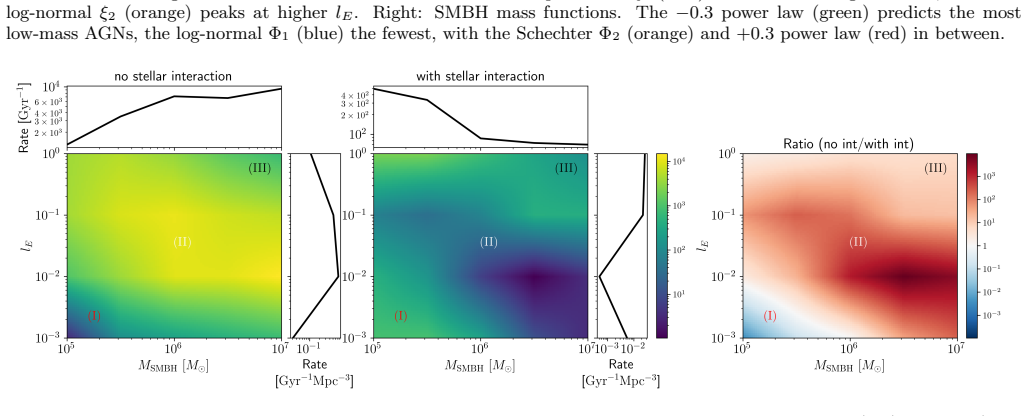
=−2.81, log(M ∗SMBH/M⊙) = 8.46, α=−0.30. The third and fourth models are simple power law models adopted from [41], assuming an AGN fraction fAGN = 0.01: Φ3(MSMBH) = 10 −4 Mpc−3 MSMBH 3×10 6M⊙ −0.3 ,(21) Φ4(MSMBH) = 2×10 −5 Mpc−3 MSMBH 3×10 6M⊙ +0.3 .(22) These four models are shown in the right panel of Fig. 1, exhibiting substantial differences at the l...
-
[2]
M. Colpi, K. Danzmann, M. Hewitson, K. Holley- Bockelmann, P. Jetzer, G. Nelemans, A. Petiteau, D. Shoemaker, C. Sopuerta, R. Stebbins,et al., arXiv preprint arXiv:2402.07571 (2024)
work page internal anchor Pith review Pith/arXiv arXiv 2024
-
[3]
The Laser Interferometer Space Antenna: Unveiling the Millihertz Gravitational Wave Sky
J. Baker, J. Bellovary, P. L. Bender, E. Berti, R. Cald- well, J. Camp, J. W. Conklin, N. Cornish, C. Cut- ler, R. DeRosa,et al., arXiv preprint arXiv:1907.06482 (2019)
work page internal anchor Pith review Pith/arXiv arXiv 1907
-
[4]
Luo, L.-S
J. Luo, L.-S. Chen, H.-Z. Duan, Y.-G. Gong, S. Hu, J. Ji, Q. Liu, J. Mei, V. Milyukov, M. Sazhin,et al., Classical and Quantum Gravity33, 035010 (2016)
2016
-
[5]
Mei, Y.-Z
J. Mei, Y.-Z. Bai, J. Bao, E. Barausse, L. Cai, E. Canuto, B. Cao, W.-M. Chen, Y. Chen, Y.-W. Ding, et al., Progress of Theoretical and Experimental Physics 2021, 05A107 (2021)
2021
-
[6]
Hu and Y.-L
W.-R. Hu and Y.-L. Wu, Natl. Sci. Rev.4, 685 (2017)
2017
-
[7]
W.-H. Ruan, Z.-K. Guo, R.-G. Cai, and Y.-Z. Zhang, International Journal of Modern Physics A35, 2050075 (2020), https://doi.org/10.1142/S0217751X2050075X
-
[8]
Amaro-Seoane, J
P. Amaro-Seoane, J. R. Gair, M. Freitag, M. C. Miller, I. Mandel, C. J. Cutler, and S. Babak, Classical and Quantum Gravity24, R113 (2007)
2007
- [9]
-
[10]
Drasco and S
S. Drasco and S. A. Hughes, Physical Review D—Particles, Fields, Gravitation, and Cosmology73, 024027 (2006)
2006
-
[11]
Barack and C
L. Barack and C. Cutler, Physical Review D69, 082005 (2004)
2004
-
[12]
Barack and C
L. Barack and C. Cutler, Physical Review D—Particles, Fields, Gravitation, and Cosmology75, 042003 (2007)
2007
-
[13]
Tahura, H
S. Tahura, H. Khalvati, and H. Yang, Physical Review D109, 124025 (2024)
2024
-
[14]
C´ ardenas-Avenda˜ no and C
A. C´ ardenas-Avenda˜ no and C. F. Sopuerta, inRecent Progress on Gravity Tests: Challenges and Future Per- spectives(Springer, 2024) pp. 275–359
2024
-
[15]
Barausse, V
E. Barausse, V. Cardoso, and P. Pani, Physical Review D89, 104059 (2014)
2014
-
[16]
Barausse, V
E. Barausse, V. Cardoso, and P. Pani, inJournal of Physics: Conference Series, Vol. 610 (IOP Publishing,
-
[17]
J. R. Gair, S. Babak, A. Sesana, P. Amaro-Seoane, E. Barausse, C. P. Berry, E. Berti, and C. Sopuerta, in Journal of Physics: Conference Series, Vol. 840 (IOP Publishing, 2017) p. 012021
2017
-
[18]
Laghi, N
D. Laghi, N. Tamanini, W. Del Pozzo, A. Sesana, J. Gair, S. Babak, and D. Izquierdo-Villalba, Monthly Notices of the Royal Astronomical Society508, 4512 (2021)
2021
-
[19]
G.-L. Li, Y. Tang, and Y.-L. Wu, SCIENCE CHINA Physics, Mechanics & Astronomy65, 100412 (2022)
2022
-
[20]
Duque, C
F. Duque, C. F. Macedo, R. Vicente, and V. Cardoso, Physical Review Letters133, 121404 (2024)
2024
-
[21]
Derdzinski, D
A. Derdzinski, D. D’Orazio, P. Duffell, Z. Haiman, and A. MacFadyen, Monthly Notices of the Royal Astronom- ical Society501, 3540 (2021)
2021
-
[22]
Derdzinski, D
A. Derdzinski, D. D’Orazio, P. Duffell, Z. Haiman, and A. MacFadyen, Monthly Notices of the Royal Astronom- ical Society486, 2754 (2019)
2019
-
[23]
Derdzinski and L
A. Derdzinski and L. Mayer, Monthly Notices of the Royal Astronomical Society521, 4522 (2023)
2023
-
[24]
A. P. Lightman and S. L. Shapiro, Astrophysical Jour- nal, vol. 211, Jan. 1, 1977, pt. 1, p. 244-262.211, 244 (1977)
1977
-
[25]
Amaro-Seoane, Living Reviews in Relativity21, 4 (2018)
P. Amaro-Seoane, Living Reviews in Relativity21, 4 (2018)
2018
-
[26]
J. G. Hills, Nature331, 687 (1988)
1988
-
[27]
M. C. Miller, M. Freitag, D. P. Hamilton, and V. M. Lauburg, The Astrophysical Journal631, L117 (2005)
2005
-
[28]
X. Chen, A. Sesana, P. Madau, and F. Liu, The Astro- physical Journal729, 13 (2011)
2011
-
[29]
J. N. Bode and C. Wegg, Monthly Notices of the Royal Astronomical Society438, 573 (2014)
2014
-
[30]
S. Naoz, S. C. Rose, E. Michaely, D. Melchor, E. Ramirez-Ruiz, B. Mockler, and J. D. Schnittman, The Astrophysical Journal Letters927, L18 (2022)
2022
-
[31]
Mazzolari, M
G. Mazzolari, M. Bonetti, A. Sesana, R. M. Colombo, M. Dotti, G. Lodato, and D. Izquierdo-Villalba, Monthly Notices of the Royal Astronomical Society516, 1959 (2022)
1959
-
[32]
Baruteau, J
C. Baruteau, J. Cuadra, and D. Lin, The Astrophysical Journal726, 28 (2010)
2010
-
[33]
Y.-P. Li, A. M. Dempsey, S. Li, H. Li, and J. Li, The Astrophysical Journal911, 124 (2021)
2021
-
[34]
J. Li, D. Lai, and L. Rodet, The Astrophysical Journal 934, 154 (2022)
2022
-
[35]
Rowan, T
C. Rowan, T. Boekholt, B. Kocsis, and Z. Haiman, Monthly Notices of the Royal Astronomical Society524, 2770 (2023)
2023
-
[36]
Cui, W.-B
Q. Cui, W.-B. Han, and Z. Pan, Physical Review D111, 103044 (2025)
2025
- [37]
-
[38]
Duque, S
F. Duque, S. Kejriwal, L. Sberna, L. Speri, and J. Gair, Physical Review D111, 084006 (2025)
2025
-
[39]
Y.-P. Li, H. Yang, and Z. Pan, Physical Review D111, 063074 (2025)
2025
-
[40]
Levin, Monthly Notices of the Royal Astronomical Society374, 515 (2007)
Y. Levin, Monthly Notices of the Royal Astronomical Society374, 515 (2007)
2007
-
[41]
Pan and H
Z. Pan and H. Yang, Physical Review D103, 103018 (2021)
2021
-
[42]
Z. Pan, Z. Lyu, and H. Yang, Physical Review D104, 063007 (2021)
2021
-
[43]
Z. Pan, Z. Lyu, and H. Yang, Physical Review D105, 083005 (2022)
2022
- [44]
- [45]
- [46]
-
[47]
J. Samsing, I. Bartos, D. J. D’Orazio, Z. Haiman, B. Kocsis, N. W. C. Leigh, B. Liu, M. E. Pessah, and H. Tagawa, Nature (London)603, 237 (2022), arXiv:2010.09765 [astro-ph.HE]
-
[48]
L. Xue, H. Tagawa, Z. Haiman, and I. Bartos, Physical Review D112, 063034 (2025)
2025
-
[49]
Sirko and J
E. Sirko and J. Goodman, Monthly Notices of the Royal Astronomical Society341, 501 (2003)
2003
-
[50]
H. Whitehead, C. Rowan, and B. Kocsis, arXiv preprint arXiv:2505.23899 (2025)
- [51]
-
[52]
Gangardt, A
D. Gangardt, A. A. Trani, C. Bonnerot, and D. Gerosa, Monthly Notices of the Royal Astronomical Society530, 3689 (2024)
2024
-
[53]
K. D. Kanagawa, H. Tanaka, and E. Szuszkiewicz, The Astrophysical Journal861, 140 (2018)
2018
-
[54]
P. C. Peters, Physical Review136, B1224 (1964)
1964
-
[55]
M. Katz, L. Speri, C. Chapman-Bird, A. J. K. Chua, N. Warburton, and S. Hughes, FastEMRIWaveforms
-
[56]
A. J. Chua, M. L. Katz, N. Warburton, and S. A. Hughes, Physical Review Letters126, 051102 (2021)
2021
-
[57]
M. L. Katz, A. J. Chua, L. Speri, N. Warburton, and S. A. Hughes, Physical Review D104, 064047 (2021)
2021
-
[58]
Speri, M
L. Speri, M. L. Katz, A. J. Chua, S. A. Hughes, N. War- burton, J. E. Thompson, C. E. Chapman-Bird, and J. R. Gair, Frontiers in Applied Mathematics and Statistics 9, 1266739 (2024)
2024
-
[59]
C. E. Chapman-Bird, L. Speri, Z. Nasipak, O. Burke, M. L. Katz, A. Santini, S. Kejriwal, P. Lynch, J. Mathews, H. Khalvati,et al., arXiv preprint arXiv:2506.09470 (2025)
work page internal anchor Pith review Pith/arXiv arXiv 2025
-
[60]
Babak, J
S. Babak, J. Gair, A. Sesana, E. Barausse, C. F. Sop- uerta, C. P. Berry, E. Berti, P. Amaro-Seoane, A. Pe- titeau, and A. Klein, Physical Review D95, 103012 (2017). 15
2017
-
[61]
Laser Interferometer Space Antenna
P. Amaro-Seoane, H. Audley, S. Babak, J. Baker, E. Ba- rausse, P. Bender, E. Berti, P. Binetruy, M. Born, D. Bortoluzzi,et al., arXiv preprint arXiv:1702.00786 (2017)
work page internal anchor Pith review Pith/arXiv arXiv 2017
-
[62]
T. T. Ananna, A. K. Weigel, B. Trakhtenbrot, M. J. Koss, C. M. Urry, C. Ricci, R. C. Hickox, E. Treister, F. E. Bauer, Y. Ueda,et al., The Astrophysical Journal Supplement Series261, 9 (2022)
2022
-
[63]
J. A. Kollmeier, C. A. Onken, C. S. Kochanek, A. Gould, D. H. Weinberg, M. Dietrich, R. Cool, A. Dey, D. J. Eisenstein, B. T. Jannuzi,et al., The Astrophysi- cal Journal648, 128 (2006)
2006
-
[64]
Tagawa, Z
H. Tagawa, Z. Haiman, and B. Kocsis, The Astrophys- ical Journal898, 25 (2020)
2020
-
[65]
Bartos, B
I. Bartos, B. Kocsis, Z. Haiman, and S. M´ arka, The Astrophysical Journal835, 165 (2017)
2017
-
[66]
J. E. Greene and L. C. Ho, The Astrophysical Journal 667, 131 (2007)
2007
-
[67]
J. E. Greene and L. C. Ho, The Astrophysical Journal 704, 1743 (2009)
2009
-
[68]
Shankar, D
F. Shankar, D. H. Weinberg, and J. Miralda-Escud´ e, The Astrophysical Journal690, 20 (2008)
2008
-
[69]
A. W. Graham, S. P. Driver, P. D. Allen, and J. Liske, Monthly Notices of the Royal Astronomical Society378, 198 (2007)
2007
-
[70]
Advection-Dominated Accretion: Underfed Black Holes and Neutron Stars
R. Narayan and I. Yi, arXiv preprint astro-ph/9411059 (1994)
work page internal anchor Pith review Pith/arXiv arXiv 1994
-
[71]
A. A. Esin, J. E. McClintock, and R. Narayan, The Astrophysical Journal489, 865 (1997)
1997
-
[72]
L. C. Ho, Annu. Rev. Astron. Astrophys.46, 475 (2008)
2008
-
[73]
Yuan and R
F. Yuan and R. Narayan, Annual Review of Astronomy and Astrophysics52, 529 (2014)
2014
-
[74]
Narayan, R
R. Narayan, R. Mahadevan, and E. Quataert, Theory of Black Hole Accretion Disks , 148 (1998)
1998
-
[75]
Liu and E
B. Liu and E. Meyer-Hofmeister, Astronomy & Astro- physics372, 386 (2001)
2001
-
[76]
R. S. Nemmen, T. Storchi-Bergmann, and M. Eracleous, Monthly Notices of the Royal Astronomical Society438, 2804 (2014)
2014
-
[77]
Kormendy and L
J. Kormendy and L. C. Ho, Annual Review of Astron- omy and Astrophysics51, 511 (2013)
2013
-
[78]
Aghanimet al., Astron
N. Aghanimet al., Astron. Astrophys641, A6 (2020)
2020
-
[79]
Satyapal, N
S. Satyapal, N. Abel, N. Secrest, A. Singh, and S. El- lison, Active Galactic Nuclei: What’s in a Name? , 82 (2016)
2016
-
[80]
L. F. Sartori, K. Schawinski, E. Treister, B. Trakhten- brot, M. Koss, M. Shirazi, and K. Oh, Monthly Notices of the Royal Astronomical Society454, 3722 (2015)
2015
discussion (0)
Sign in with ORCID, Apple, or X to comment. Anyone can read and Pith papers without signing in.