DELOS: Detecting Shallow Transits in Kepler Photometry Using a Contrastive-Learning Framework
Pith reviewed 2026-06-29 01:07 UTC · model grok-4.3
The pith
A contrastive-learning framework improves detection of shallow transits in Kepler data by 15.5 percent over BLS in low-SNR conditions.
A machine-rendered reading of the paper's core claim, the machinery that carries it, and where it could break.
Core claim
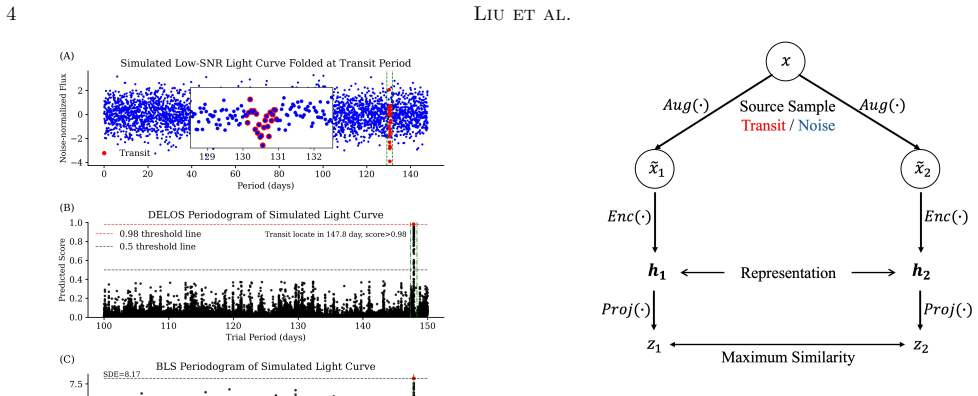
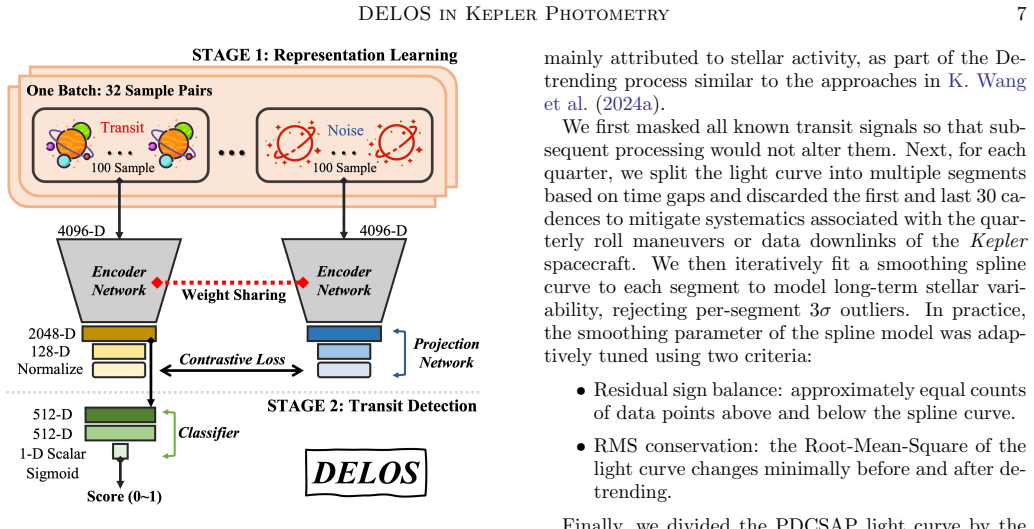
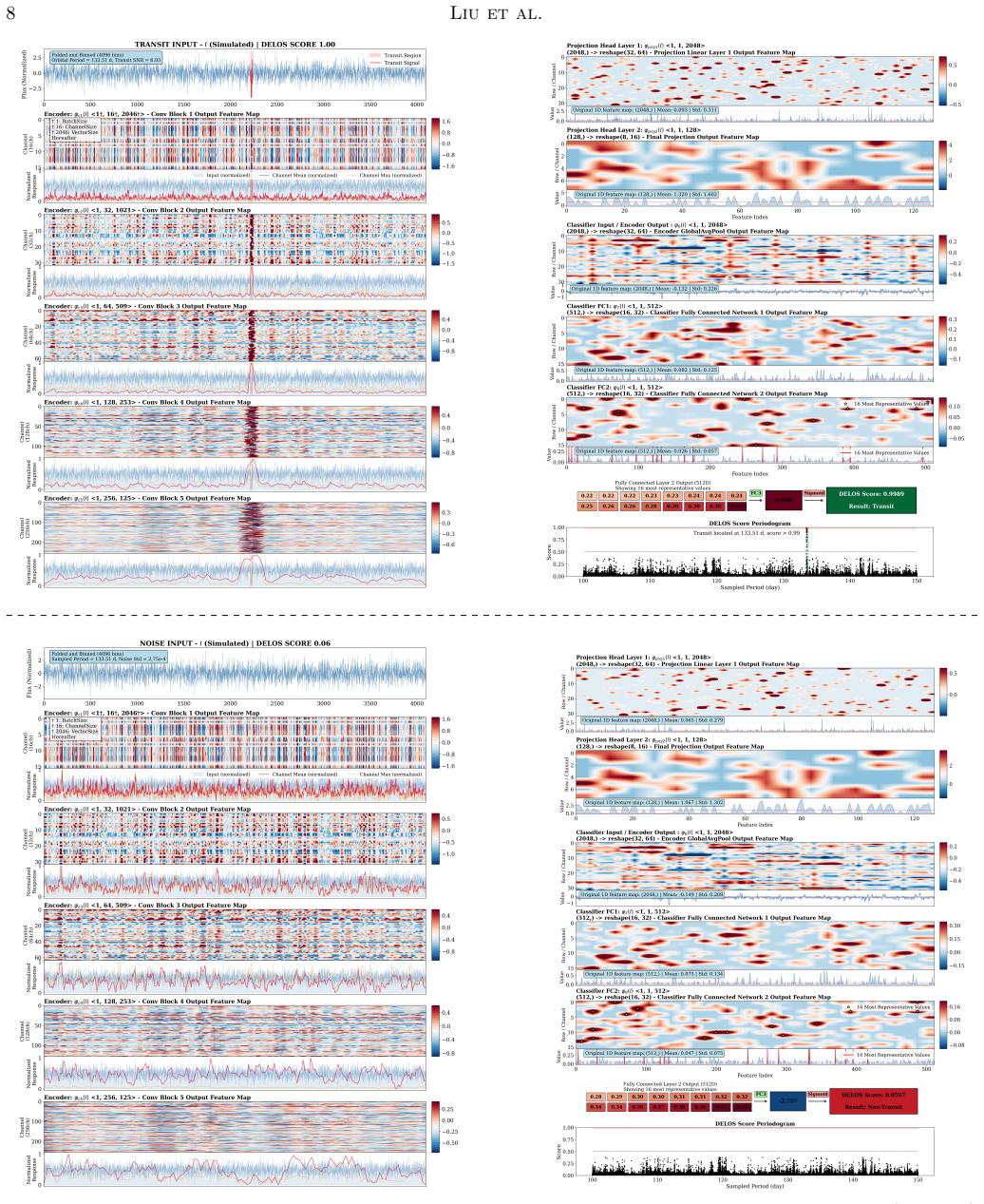
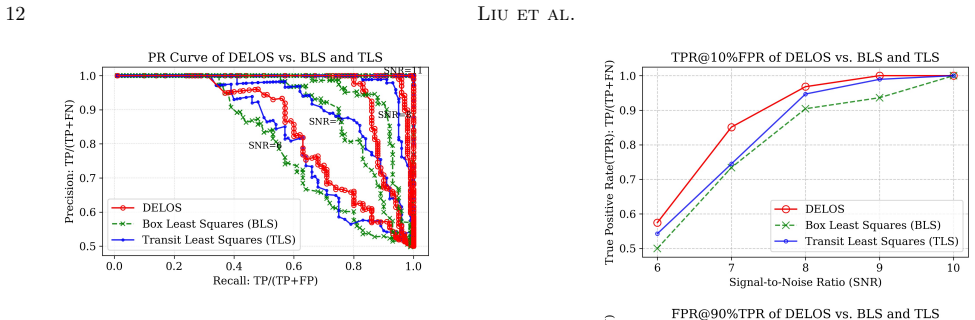
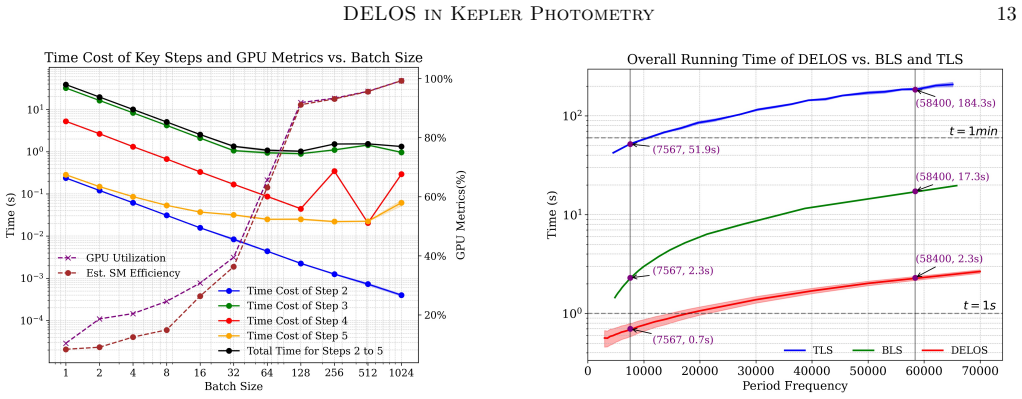
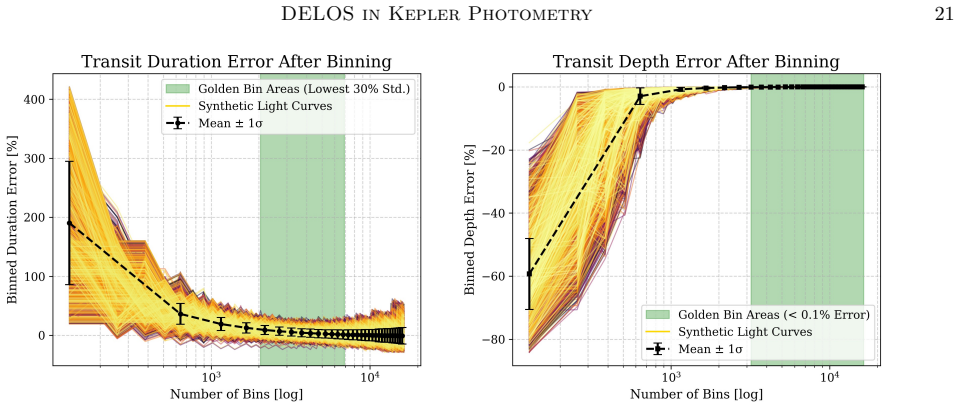
DELOS uses GPU-accelerated phase folding and optimized binning together with a custom one-dimensional convolutional encoder trained contrastively on 20 million synthetic light curves that embed realistic transit models and Kepler-like noise; the encoder produces a transit-likeness score for each folded curve, yielding a periodogram that improves combined precision-recall by 15.5 percent relative to BLS and 11.25 percent relative to TLS specifically in the low-SNR regime, recovers every known shallow signal in the tested range, and accelerates the search by factors of 3-5 over BLS and 74-80 over TLS.
What carries the argument
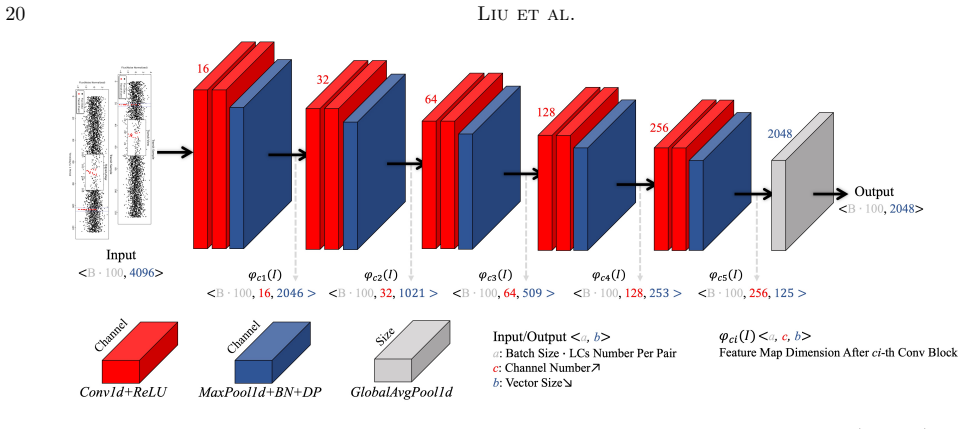
A one-dimensional convolutional encoder trained via contrastive learning to score how closely an optimized phase-binned light curve matches a transit model.
If this is right
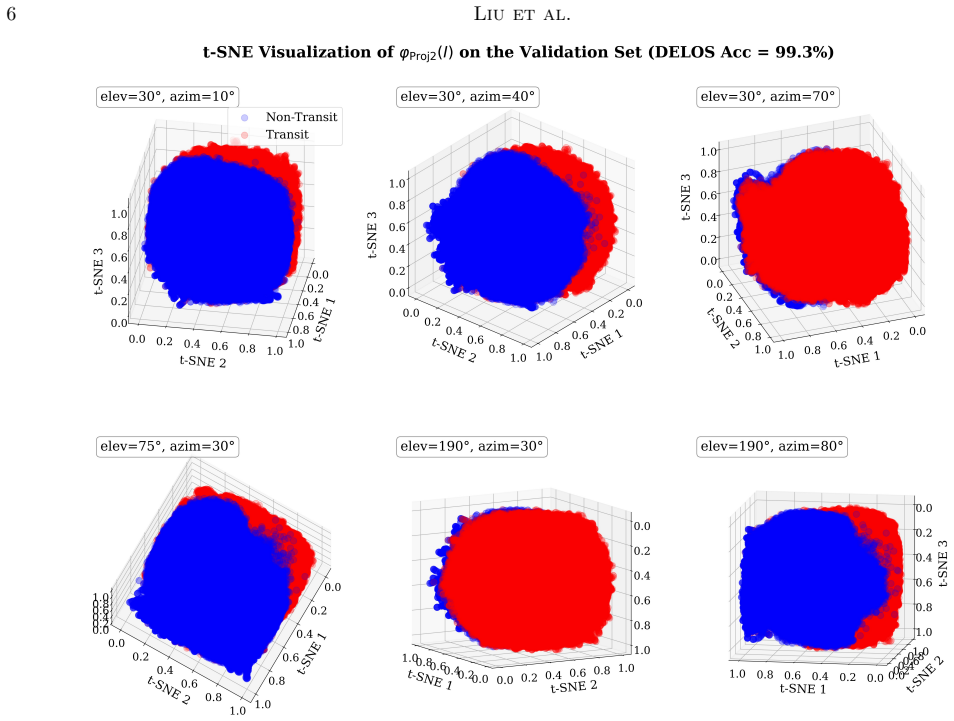
- DELOS reaches 99.3 percent accuracy on a held-out synthetic validation set.
- The framework recovers all known shallow intermediate-to-long-period transit signals present in the tested Kepler validation sample.
- Search speed increases by factors of approximately 3-5 relative to BLS and 74-80 relative to TLS.
- The same scoring approach is presented as directly extensible to transit searches in K2, TESS, PLATO, and Earth 2.0 photometry.
Where Pith is reading between the lines
- If the synthetic training distribution matches real Kepler noise statistics, the encoder may surface additional shallow candidates that current pipelines miss.
- Training the same contrastive encoder on periods longer than 150 days would provide a direct test of scalability toward terrestrial-planet detection.
- Replacing threshold-crossing pre-filters with full score periodograms could reduce missed detections in large-scale surveys.
Load-bearing premise
The 20 million synthetic light curves with realistic transit models and Kepler-like noise properties capture the statistical features of actual Kepler photometry well enough for the encoder to generalize.
What would settle it
An injection-recovery experiment performed directly on real Kepler light curves in the 100-150 day range that shows DELOS recovering fewer confirmed low-SNR transits or producing lower combined precision-recall than BLS or TLS.
Figures

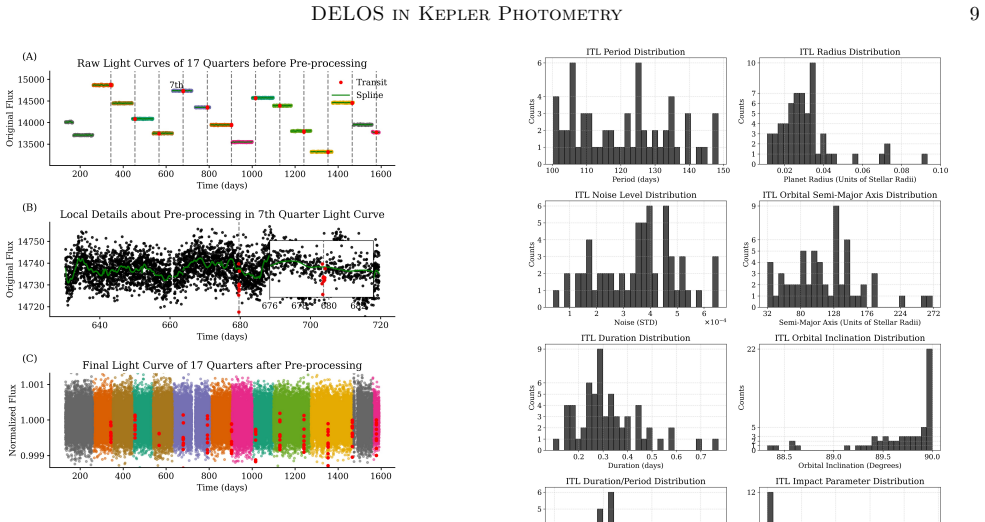
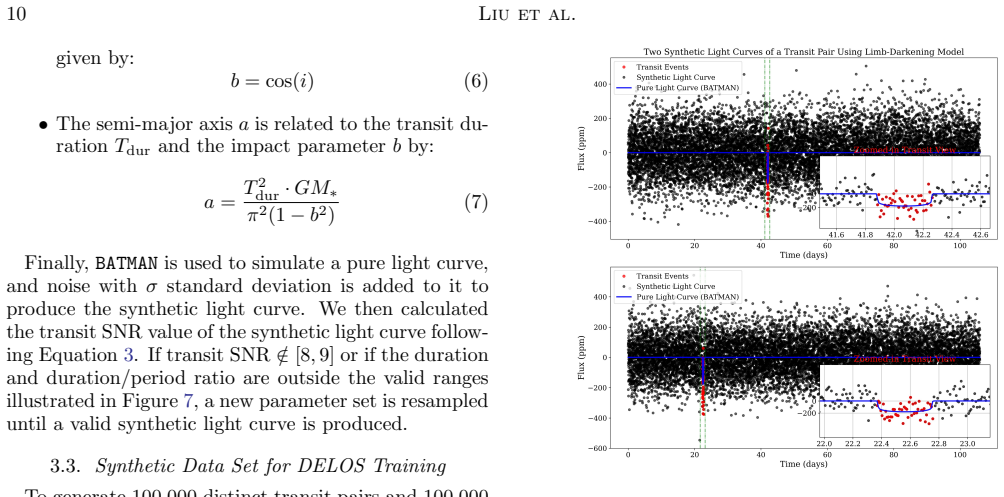




read the original abstract
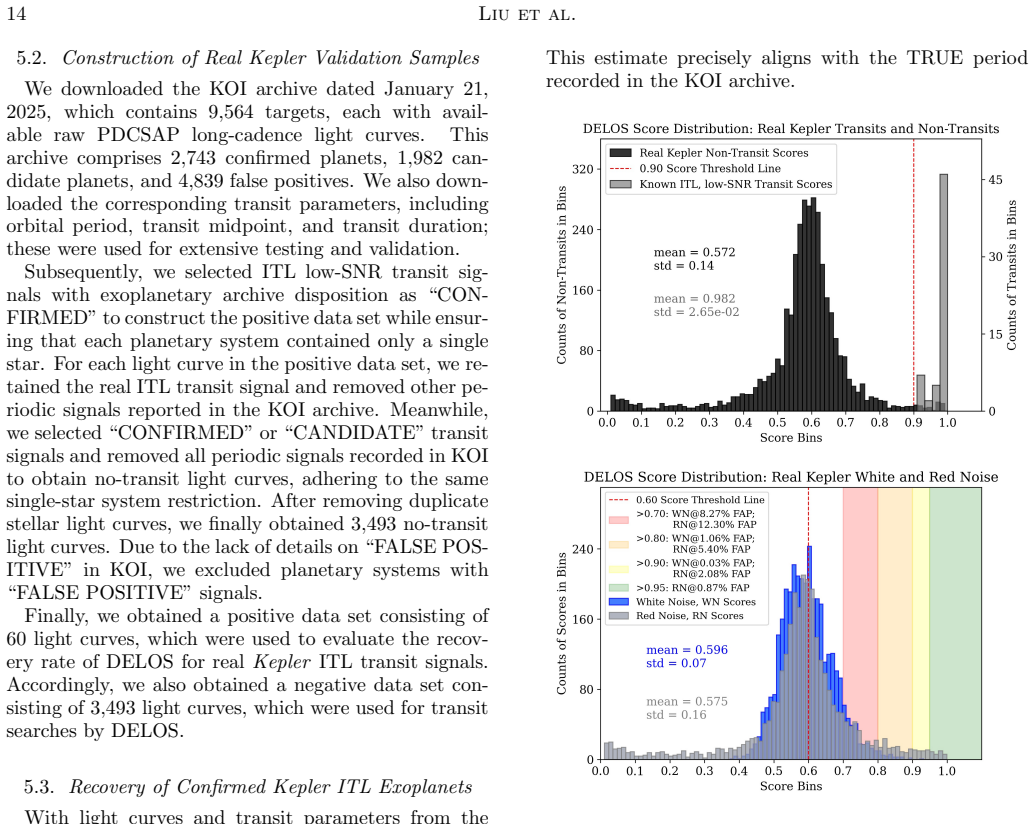
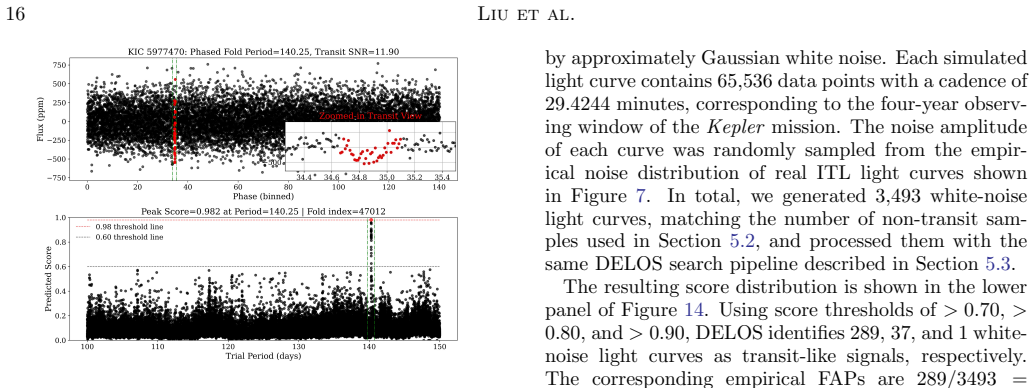
We present DEtection in phase-folded Light curves with cOntrastive Scoring (DELOS), a contrastive-learning-based framework designed to search for shallow transits in Kepler photometry. DELOS combines GPU-accelerated phase folding, optimized phase binning, and a custom one-dimensional convolutional encoder to assign a transit-likeness score to each folded light curve, thereby producing a score periodogram over trial periods without relying on pre-detected threshold-crossing events. Focusing on intermediate-to-long-period signals with orbital periods of 100-150 days, DELOS was trained on 20 million synthetic light curves generated with realistic transit models and Kepler-like noise properties, achieving a validation accuracy of 99.3 percent on the synthetic validation set. In controlled injection-recovery experiments, DELOS improves the combined precision-recall performance by 15.5 percent relative to Box-fitting Least Squares (BLS) and 11.25 percent relative to Transit Least Squares (TLS) in the low Signal-to-Noise Ratios (low-SNR) regime. It also accelerates the search by factors of approximately 3-5 and 74-80 compared with BLS and TLS, respectively. Applied to a selected Kepler validation sample, DELOS recovered all known shallow intermediate-to-long-period transit signals in the tested period range. These results demonstrate that DELOS provides an efficient and sensitive framework for low-SNR transit searches and represents a practical step toward future searches for longer-period terrestrial planets in Kepler, K2, TESS, PLATO, and Earth 2.0 data. Accordingly, this work is intended as a methodological development and validation study, with the detailed astrophysical validation of newly identified candidates deferred to future work.
Editorial analysis
A structured set of objections, weighed in public.
Referee Report
Summary. The paper introduces DELOS, a contrastive-learning framework using a 1D convolutional encoder for detecting shallow transits in Kepler photometry at periods of 100-150 days. Trained on 20 million synthetic light curves with realistic transit models and Kepler-like noise, it reports 99.3% validation accuracy on synthetics. Injection-recovery tests show 15.5% and 11.25% gains in combined precision-recall over BLS and TLS in the low-SNR regime, with speedups of ~3-5x and 74-80x. On a selected Kepler validation sample, it recovers all known shallow intermediate-to-long-period signals. The work positions itself as a methodological study deferring astrophysical validation of new candidates.
Significance. If the generalization from synthetics holds, DELOS could provide an efficient tool for low-SNR transit searches in Kepler and future missions like PLATO. Strengths include the scale of the synthetic training set, direct quantitative comparisons to BLS/TLS, reported computational accelerations, and explicit recovery of known real signals. The contrastive-learning approach and GPU-accelerated phase folding represent a practical methodological contribution for handling shallow transits.
major comments (2)
- [Abstract / real-data validation] Abstract and results on real-data application: recovery of all known signals in the selected Kepler validation sample is reported, but no quantitative metrics (e.g., precision-recall, false-positive rate, or detection efficiency) are provided for the real photometry itself. This leaves the claimed performance gains (15.5%/11.25%) supported only by synthetic injection-recovery and weakens the assertion that DELOS is a 'sensitive framework' for actual Kepler data.
- [Methods / synthetic data generation] Methods / training data description: the central generalization claim rests on the 20 million synthetic light curves capturing 'Kepler-like noise properties' for the 100-150 day range, yet no explicit tests or metrics are given for how well non-stationary systematics, pixel correlations, or gap patterns in real Kepler data are reproduced by the noise model.
minor comments (2)
- [Results / injection-recovery experiments] Specify the exact SNR thresholds or range used to define the 'low-SNR regime' in the injection-recovery comparisons.
- [Methods] The phase binning scheme and 1D convolutional encoder hyperparameters are listed as free parameters; providing their specific values or ranges would improve reproducibility.
Simulated Author's Rebuttal
We thank the referee for the positive assessment and recommendation of minor revision. We address each major comment below with honest responses and indicate planned changes to the manuscript.
read point-by-point responses
-
Referee: [Abstract / real-data validation] Abstract and results on real-data application: recovery of all known signals in the selected Kepler validation sample is reported, but no quantitative metrics (e.g., precision-recall, false-positive rate, or detection efficiency) are provided for the real photometry itself. This leaves the claimed performance gains (15.5%/11.25%) supported only by synthetic injection-recovery and weakens the assertion that DELOS is a 'sensitive framework' for actual Kepler data.
Authors: We agree that the absence of quantitative metrics on real photometry limits the strength of claims about performance on actual Kepler data. The real-data test was designed as a qualitative sanity check confirming recovery of all known signals in a curated sample, consistent with the paper's framing as a methodological study that defers full astrophysical validation. We will revise the abstract, results, and discussion sections to explicitly state that performance gains are quantified only on synthetics, clarify the scope of the real-data test, and add available details such as sample size and any observed false-positive behavior where possible. A complete precision-recall analysis on unlabeled real data is not feasible without additional ground-truth efforts outside this work's scope. revision: partial
-
Referee: [Methods / synthetic data generation] Methods / training data description: the central generalization claim rests on the 20 million synthetic light curves capturing 'Kepler-like noise properties' for the 100-150 day range, yet no explicit tests or metrics are given for how well non-stationary systematics, pixel correlations, or gap patterns in real Kepler data are reproduced by the noise model.
Authors: The synthetic noise is constructed from established Kepler noise models in the literature, including components for correlated noise and observational gaps drawn from real data distributions. We acknowledge that explicit quantitative validation (e.g., power-spectrum comparisons or gap statistics) is not currently presented. We will expand the methods section with additional description of the noise-generation procedure and any internal consistency checks performed during dataset creation. Adding new comparative figures or metrics would require further analysis not present in the current manuscript. revision: yes
Circularity Check
No circularity; performance metrics independent of model parameters
full rationale
The paper's central claims rest on injection-recovery tests using held-out synthetic light curves (20M training set, separate validation) compared against independent standard algorithms BLS and TLS, plus recovery of known real signals. These quantities are not defined in terms of the DELOS encoder's outputs or fitted parameters, nor do they rely on self-citations or ansatzes imported from prior author work. The derivation chain is self-contained against external benchmarks.
Axiom & Free-Parameter Ledger
free parameters (2)
- phase binning scheme
- 1D convolutional encoder hyperparameters
axioms (1)
- domain assumption Synthetic light curves with Kepler-like noise accurately represent the statistical properties of real photometry for 100-150 day periods.
Reference graph
Works this paper leans on
-
[1]
2015, TensorFlow: Large-Scale Machine Learning on Heterogeneous Systems, https://www.tensorflow.org/
Abadi, M., Agarwal, A., Barham, P., et al. 2015, TensorFlow: Large-Scale Machine Learning on Heterogeneous Systems, https://www.tensorflow.org/
2015
-
[2]
Beaulieu, J.-P., Bennett, D. P., Fouqu´ e, P., et al. 2006, Nature, 439, 437, doi: 10.1038/nature04441
-
[3]
J., Koch, D., Basri, G., et al
Borucki, W. J., Koch, D., Basri, G., et al. 2010, Science, 327, 977, doi: 10.1126/science.1185402
-
[4]
Borucki, W. J., Koch, D. G., Batalha, N., et al. 2012, The Astrophysical Journal, 745, 120, doi: 10.1088/0004-637X/745/2/120
-
[5]
Boufleur, R. C., Emilio, M., Pacheco, E. J., de La Reza, J. R., & da Rocha, J. C. 2014, in IAU Symposium, Vol. 293, Formation, Detection, and Characterization of Extrasolar Habitable Planets, ed. N. Haghighipour, 410–412, doi: 10.1017/S1743921313013288
-
[6]
Bromley, J., Guyon, I., LeCun, Y., S¨ ackinger, E., & Shah, R. 1993, in Proceedings of the 6th International Conference on Neural Information Processing Systems, NIPS’93 (San Francisco, CA, USA: Morgan Kaufmann Publishers Inc.), 737–744, doi: 10.5555/2987189.2987282
-
[7]
Burke, C. J., Christiansen, J. L., Mullally, F., et al. 2015, The Astrophysical Journal, 809, 8, doi: 10.1088/0004-637X/809/1/8
-
[8]
Campbell, B., Walker, G. A. H., & Yang, S. 1988, The Astrophysical Journal, 331, 902, doi: 10.1086/166608
-
[9]
Carter, J. A., & Agol, E. 2013, The Astrophysical Journal, 765, 132, doi: 10.1088/0004-637X/765/2/132
-
[10]
Charbonneau, D., Brown, T. M., Latham, D. W., & Mayor, M. 2000, The Astrophysical Journal, 529, L45, doi: 10.1086/312457
-
[11]
Chaushev, A., Raynard, L., Goad, M. R., et al. 2019, Monthly Notices of the Royal Astronomical Society, 488, 5232, doi: 10.1093/mnras/stz2058
-
[12]
2004, Astronomy & Astrophysics, 425, L29, doi: 10.1051/0004-6361:200400056
Chauvin, G., Lagrange, A.-M., Dumas, C., et al. 2004, Astronomy & Astrophysics, 425, L29, doi: 10.1051/0004-6361:200400056
-
[13]
doi: 10.1109/ICCV48922.2021.00951
Chen, X., Xie, S., & He, K. 2021, in 2021 IEEE/CVF International Conference on Computer Vision (ICCV), 9620–9629, doi: 10.1109/ICCV48922.2021.00950
-
[14]
Chintarungruangchai, P., & Jiang, I.-G. 2019, Publications of the Astronomical Society of the Pacific, 131, 064502, doi: 10.1088/1538-3873/ab13d3
-
[15]
Chopra, S., Hadsell, R., & LeCun, Y. 2005, in 2005 IEEE Computer Society Conference on Computer Vision and Pattern Recognition (CVPR’05), Vol. 1, 539–546 vol. 1, doi: 10.1109/CVPR.2005.202
-
[16]
2011, Astronomy & Astrophysics, 529, A75, doi: 10.1051/0004-6361/201116451
Claret, A., & Bloemen, S. 2011, Astronomy & Astrophysics, 529, A75, doi: 10.1051/0004-6361/201116451
-
[17]
Collaboration, A., Price-Whelan, A. M., Lim, P. L., et al. 2022, The Astrophysical Journal, 935, 167, doi: 10.3847/1538-4357/ac7c74 Collier Cameron, A., Pollacco, D., Street, R. A., et al. 2006, Monthly Notices of the Royal Astronomical Society, 373, 799, doi: 10.1111/j.1365-2966.2006.11074.x
work page internal anchor Pith review doi:10.3847/1538-4357/ac7c74 2022
-
[18]
2021, The Astronomical Journal, 163, 23, doi: 10.3847/1538-3881/ac3482
Cui, K., Liu, J., Feng, F., & Liu, J. 2021, The Astronomical Journal, 163, 23, doi: 10.3847/1538-3881/ac3482
-
[19]
Dattilo, A., Vanderburg, A., Shallue, C. J., et al. 2019, The Astronomical Journal, 157, 169, doi: 10.3847/1538-3881/ab0e12
-
[20]
Dressing, C. D., & Charbonneau, D. 2013, The Astrophysical Journal, 767, 95, doi: 10.1088/0004-637X/767/1/95
-
[21]
Dressing, C. D., & Charbonneau, D. 2015, The Astrophysical Journal, 807, 45, doi: 10.1088/0004-637X/807/1/45
-
[22]
Foreman-Mackey, D., Hogg, D. W., & Morton, T. D. 2014, The Astrophysical Journal, 795, 64, doi: 10.1088/0004-637X/795/1/64
-
[23]
2013, The Astrophysical Journal, 766, 81, doi: 10.1088/0004-637X/766/2/81 24Liu et al
Fressin, F., Torres, G., Charbonneau, D., et al. 2013, The Astrophysical Journal, 766, 81, doi: 10.1088/0004-637X/766/2/81 24Liu et al
-
[24]
1980, Biological Cybernetics, 36, 193, doi: 10.1007/BF00344251
Fukushima, K. 1980, Biological Cybernetics, 36, 193, doi: 10.1007/BF00344251
-
[25]
Ge, J., Zhang, H., Deng, H., & Howell, S. B. 2022a, The Innovation, 3, doi: 10.1016/j.xinn.2022.100271
-
[26]
2022b, arXiv:2206.06693, doi: https://doi.org/10.48550/arXiv.2206.06693
Ge, J., Zhang, H., Zand, W., & Deng, H. 2022b, arXiv:2206.06693, doi: https://doi.org/10.48550/arXiv.2206.06693
-
[27]
2022c, in Space Telescopes and Instrumentation 2022: Optical, Infrared, and Millimeter Wave, ed
Ge, J., Zhang, H., Zhang, Y., et al. 2022c, in Space Telescopes and Instrumentation 2022: Optical, Infrared, and Millimeter Wave, ed. L. E. Coyle, S. Matsuura, & M. D. Perrin, Vol. 12180, International Society for Optics and Photonics (SPIE), 1218015, doi: 10.1117/12.2630656
-
[28]
2024a, Chinese Journal of Space Science, 44, 400, doi: 10.11728/cjss2024.03.yg05
Ge, J., Chen, W., Chen, Y., et al. 2024a, Chinese Journal of Space Science, 44, 400, doi: 10.11728/cjss2024.03.yg05
-
[29]
2024b, in Space Telescopes and Instrumentation 2024: Optical, Infrared, and Millimeter Wave, ed
Ge, J., Zhang, H., Zhang, Y., et al. 2024b, in Space Telescopes and Instrumentation 2024: Optical, Infrared, and Millimeter Wave, ed. L. E. Coyle, S. Matsuura, & M. D. Perrin, Vol. 13092, International Society for Optics and Photonics (SPIE), 1309218, doi: 10.1117/12.3018669
-
[30]
2020, in Proceedings of the 34th International Conference on Neural Information Processing Systems, NIPS ’20 (Red
Grill, J.-B., Strub, F., Altch´ e, F., et al. 2020, in Proceedings of the 34th International Conference on Neural Information Processing Systems, NIPS ’20 (Red
2020
-
[31]
Hook, NY, USA: Curran Associates Inc.), doi: 10.5555/3495724.3497510
-
[32]
He, K., Fan, H., Wu, Y., Xie, S., & Girshick, R. 2020, in 2020 IEEE/CVF Conference on Computer Vision and Pattern Recognition (CVPR), 9726–9735, doi: 10.1109/CVPR42600.2020.00975
-
[33]
He, K., Zhang, X., Ren, S., & Sun, J. 2015, in 2015 IEEE International Conference on Computer Vision (ICCV), 1026–1034, doi: 10.1109/ICCV.2015.123
-
[34]
Deep Residual Learning for Image Recognition
He, K., Zhang, X., Ren, S., & Sun, J. 2016, in 2016 IEEE Conference on Computer Vision and Pattern Recognition (CVPR), 770–778, doi: 10.1109/CVPR.2016.90
-
[35]
Henry, G. W., Marcy, G. W., Butler, R. P., & Vogt, S. S. 2000, The Astrophysical Journal Letters, 529, L41, doi: 10.1086/312458
-
[36]
Hinton, G., Chen, T., Kornblith, S., & Norouzi, M. 2020, in Proceedings of the 37th International Conference on Machine Learning, ICML’20 (JMLR.org), doi: 10.5555/3524938.3525087
-
[37]
2019, Astronomy & Astrophysics, 623, A39, doi: 10.1051/0004-6361/201834672
Hippke, M., & Heller, R. 2019, Astronomy & Astrophysics, 623, A39, doi: 10.1051/0004-6361/201834672
-
[38]
B., Sobeck, C., Haas, M., et al
Howell, S. B., Sobeck, C., Haas, M., et al. 2014, Publications of the Astronomical Society of the Pacific, 126, 398, doi: 10.1086/676406
-
[39]
Jenkins, J. M., Caldwell, D. A., & Borucki, W. J. 2002, The Astrophysical Journal, 564, 495, doi: 10.1086/324143
-
[40]
Jenkins, J. M., Caldwell, D. A., Chandrasekaran, H., et al. 2010b, The Astrophysical Journal Letters, 713, L87, doi: 10.1088/2041-8205/713/2/L87
-
[41]
Jenkins, J. M., Twicken, J. D., Batalha, N. M., et al. 2015, The Astronomical Journal, 150, 56, doi: 10.1088/0004-6256/150/2/56
-
[42]
2020, in Proceedings of the 34th International Conference on Neural Information Processing Systems, NIPS ’20 (Red
Khosla, P., Teterwak, P., Wang, C., et al. 2020, in Proceedings of the 34th International Conference on Neural Information Processing Systems, NIPS ’20 (Red
2020
-
[43]
Hook, NY, USA: Curran Associates Inc.), doi: 10.5555/3495724.3497291
-
[44]
Konacki, M., Torres, G., Jha, S., & Sasselov, D. D. 2003, Nature, 421, 507, doi: 10.1038/nature01379 Kov´ acs, G., Zucker, S., & Mazeh, T. 2002, Astronomy & Astrophysics, 391, 369, doi: 10.1051/0004-6361:20020802
-
[45]
2015, Publications of the Astronomical Society of the Pacific, 127, 1161, doi: 10.1086/683602
Kreidberg, L. 2015, Publications of the Astronomical Society of the Pacific, 127, 1161, doi: 10.1086/683602
work page internal anchor Pith review doi:10.1086/683602 2015
-
[46]
LeCun, Y., Boser, B., Denker, J. S., et al. 1989, Neural Computation, 1, 541, doi: 10.1162/neco.1989.1.4.541
-
[47]
Lecun, Y., Bottou, L., Bengio, Y., & Haffner, P. 1998, Proceedings of the IEEE, 86, 2278, doi: 10.1109/5.726791
-
[48]
2025, Nature Astronomy, 9, 608, doi: 10.1038/s41550-025-02484-z
Liu, T., Quan, Y., Su, Y., et al. 2025, Nature Astronomy, 9, 608, doi: 10.1038/s41550-025-02484-z
-
[49]
Malik, A., Moster, B. P., & Obermeier, C. 2021, Monthly Notices of the Royal Astronomical Society, 513, 5505, doi: 10.1093/mnras/stab3692
-
[50]
2002, The Astrophysical Journal Letters, 580, L171, doi: 10.1086/345520
Mandel, K., & Agol, E. 2002, The Astrophysical Journal Letters, 580, L171, doi: 10.1086/345520
-
[51]
1995, Nature, 378, 355, doi: 10.1038/378355a0
Mayor, M., & Queloz, D. 1995, Nature, 378, 355, doi: 10.1038/378355a0
-
[52]
McCauliff, S. D., Jenkins, J. M., Catanzarite, J., et al. 2015, The Astrophysical Journal, 806, 6, doi: 10.1088/0004-637X/806/1/6
-
[53]
Misra, I., & van der Maaten, L. 2020, in 2020 IEEE/CVF Conference on Computer Vision and Pattern Recognition (CVPR), 6706–6716, doi: 10.1109/CVPR42600.2020.00674 NASA Exoplanet Archive. 2025, KOI Cumulative Table, IPAC, doi: 10.26133/NEA4
-
[54]
2014, Astronomy & Astrophysics, 561, A138, doi: 10.1051/0004-6361/201220860
Ofir, A. 2014, Astronomy & Astrophysics, 561, A138, doi: 10.1051/0004-6361/201220860
-
[55]
Olmschenk, G., Silva, S. I., Rau, G., et al. 2021, The Astronomical Journal, 161, 273, doi: 10.3847/1538-3881/abf4c6 DELOS in Kepler Photometry25
-
[56]
P., Ansdell, M., Ioannou, Y., et al
Osborn, H. P., Ansdell, M., Ioannou, Y., et al. 2020, Astronomy & Astrophysics, 633, A53, doi: 10.1051/0004-6361/201935345
-
[57]
Panahi, A., & Zucker, S. 2021, Publications of the Astronomical Society of the Pacific, 133, 024502, doi: 10.1088/1538-3873/abd9ab
-
[58]
Paszke, A., Gross, S., Massa, F., et al. 2019, in Advances in Neural Information Processing Systems 32, 8024–8035, doi: 10.5555/3454287.3455008
-
[59]
A., Palafox, L., & Griffith, C
Pearson, K. A., Palafox, L., & Griffith, C. A. 2018, Monthly Notices of the Royal Astronomical Society, 474, 478, doi: 10.1093/mnras/stx2761
-
[60]
Petigura, E. A., Howard, A. W., & Marcy, G. W. 2013a, Proceedings of the National Academy of Science, 110, 19273, doi: 10.1073/pnas.1319909110
-
[61]
Petigura, E. A., Marcy, G. W., & Howard, A. W. 2013b, The Astrophysical Journal, 770, 69, doi: 10.1088/0004-637X/770/1/69
-
[62]
Gallagher, S. C. 2008, The Astrophysical Journal Supplement Series, 175, 191, doi: 10.1086/523644
-
[63]
2021, Monthly Notices of the Royal Astronomical Society, 502, 2845, doi: 10.1093/mnras/stab203
Rao, S., Mahabal, A., Rao, N., & Raghavendra, C. 2021, Monthly Notices of the Royal Astronomical Society, 502, 2845, doi: 10.1093/mnras/stab203
-
[64]
2014, Experimental Astronomy, 38, page range, doi: 10.1007/s10686-014-9383-4
Rauer, H., Catala, C., Aerts, C., et al. 2014, Experimental Astronomy, 38, page range, doi: 10.1007/s10686-014-9383-4
-
[65]
2022, in Europlanet Science Congress 2022, doi: 10.5194/epsc2022-453
Rauer, H., Aerts, C., Deleuil, M., et al. 2022, in Europlanet Science Congress 2022, doi: 10.5194/epsc2022-453
-
[66]
2008, Astronomy & Astrophysics, 492, 617, doi: 10.1051/0004-6361:200810148
Renner, S., Rauer, H., Erikson, A., et al. 2008, Astronomy & Astrophysics, 492, 617, doi: 10.1051/0004-6361:200810148
-
[67]
Ricker, G. R., Winn, J. N., Vanderspek, R., et al. 2014, Journal of Astronomical Telescopes, Instruments, and Systems, 1, 014003, doi: 10.1117/1.JATIS.1.1.014003
work page internal anchor Pith review doi:10.1117/1.jatis.1.1.014003 2014
-
[68]
Schanche, N., Cameron, A. C., H´ ebrard, G., et al. 2018, Monthly Notices of the Royal Astronomical Society, 483, 5534, doi: 10.1093/mnras/sty3146
-
[69]
2022, Monthly Notices of the Royal Astronomical Society, 513, 2732, doi: 10.1093/mnras/stac960
Shahaf, S., Zackay, B., Mazeh, T., Faigler, S., & Ivashtenko, O. 2022, Monthly Notices of the Royal Astronomical Society, 513, 2732, doi: 10.1093/mnras/stac960
-
[70]
Shallue, C. J., & Vanderburg, A. 2018, The Astronomical Journal, 155, 94, doi: 10.3847/1538-3881/aa9e09
-
[71]
2020, arXiv e-prints, arXiv:2011.10944, doi: 10.48550/arXiv.2011.10944
Shi, H., Luo, D., Tang, S., Wang, J., & Zhuang, Y. 2020, arXiv e-prints, arXiv:2011.10944, doi: 10.48550/arXiv.2011.10944
-
[72]
Smith, J. C., Stumpe, M. C., Cleve, J. E. V., et al. 2012, Publications of the Astronomical Society of the Pacific, 124, 1000, doi: 10.1086/667697
work page internal anchor Pith review doi:10.1086/667697 2012
-
[73]
1969, Proceedings of the IEEE, 57, 724, doi: 10.1109/PROC.1969.7051
Staelin, D. 1969, Proceedings of the IEEE, 57, 724, doi: 10.1109/PROC.1969.7051
-
[74]
Stumpe, M. C., Smith, J. C., Cleve, J. E. V., et al. 2012, Publications of the Astronomical Society of the Pacific, 124, 985, doi: 10.1086/667698
work page internal anchor Pith review doi:10.1086/667698 2012
-
[75]
Thompson, S. E., Coughlin, J. L., Hoffman, K., et al. 2018, The Astrophysical Journal Supplement Series, 235, 38, doi: 10.3847/1538-4365/aab4f9
-
[76]
VanderPlas, J. T. 2018, The Astrophysical Journal Supplement Series, 236, doi: 10.3847/1538-4365/aab766 von Braun, K., & Ciardi, D. R. 2007, Proceedings of the International Astronomical Union, 3, 93–100, doi: 10.1017/S1743921308016451
work page internal anchor Pith review doi:10.3847/1538-4365/aab766 2018
-
[77]
2024a, Monthly Notices of the Royal Astronomical Society, 528, 4053, doi: 10.1093/mnras/stae245
Wang, K., Ge, J., Willis, K., Wang, K., & Zhao, Y. 2024a, Monthly Notices of the Royal Astronomical Society, 528, 4053, doi: 10.1093/mnras/stae245
-
[78]
2024b, Monthly Notices of the Royal Astronomical Society, 534, 1913, doi: 10.1093/mnras/stae2155
Wang, K., Ge, J., Willis, K., et al. 2024b, Monthly Notices of the Royal Astronomical Society, 534, 1913, doi: 10.1093/mnras/stae2155
-
[79]
2019, The Astronomical Journal, 158, 25, doi: 10.3847/1538-3881/ab21d6
Yu, L., Vanderburg, A., Huang, C., et al. 2019, The Astronomical Journal, 158, 25, doi: 10.3847/1538-3881/ab21d6
-
[80]
2018, The Astronomical Journal, 155, 147, doi: 10.3847/1538-3881/aaae05
Zucker, S., & Giryes, R. 2018, The Astronomical Journal, 155, 147, doi: 10.3847/1538-3881/aaae05
discussion (0)
Sign in with ORCID, Apple, or X to comment. Anyone can read and Pith papers without signing in.