A New Cartwheel-like Collisional Ring Galaxy
Pith reviewed 2026-06-29 06:41 UTC · model grok-4.3
The pith
A new Cartwheel-type ring galaxy, the Eridanus Wheel, formed by a head-on collision with an early-type galaxy.
A machine-rendered reading of the paper's core claim, the machinery that carries it, and where it could break.
Core claim
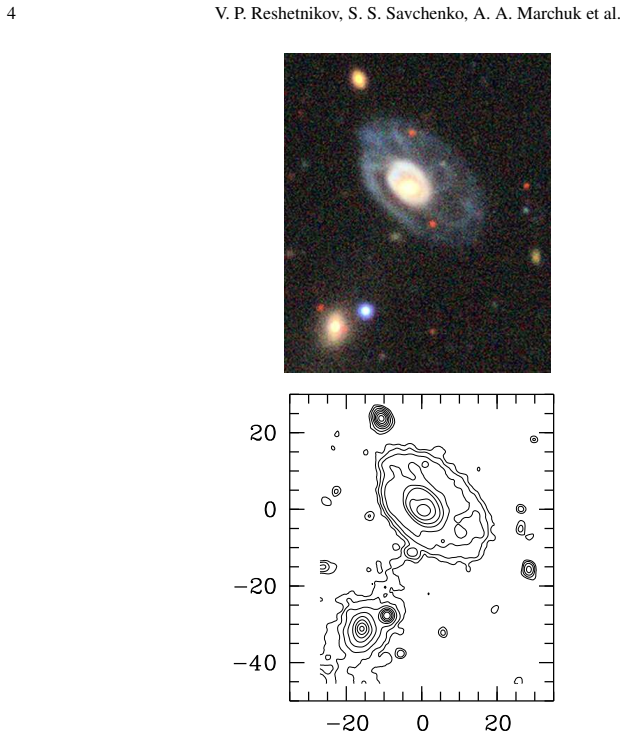
The Eridanus Wheel is a giant late-type galaxy whose observed ring-plus-spokes morphology is most likely the result of a relatively recent head-on collision with an early-type galaxy, as indicated by its resemblance to the Cartwheel and the connecting optical bridge.
What carries the argument
The head-on collisional ring formation process that generates expanding density waves producing the inner ring, outer ring, and spokes between them.
If this is right
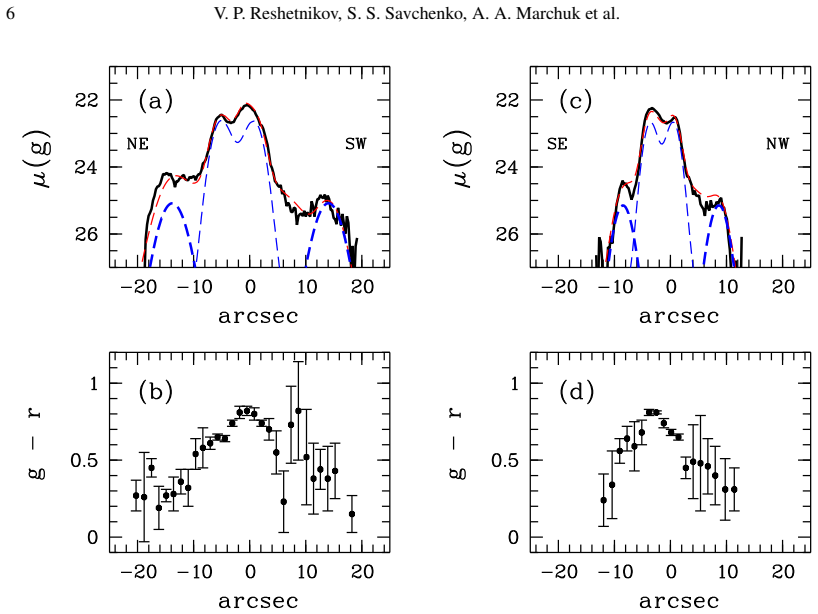
- The galaxy exhibits a strong radial color gradient consistent with its late-type classification.
- Further evolution will lead to a galaxy with a low surface brightness disk.
- The system acts as a laboratory for studying star formation in propagating density waves.
- Such objects result from strong external perturbations on the star-gas disk.
Where Pith is reading between the lines
- Follow-up spectroscopy could confirm the physical association and measure the collision timescale.
- Comparison with simulations of ring galaxies could test the intruder identification.
- This discovery increases the known sample of Cartwheel-like systems for population studies.
Load-bearing premise
The ring and spoke structure plus the optical bridge result from a collision with the projected nearby early-type galaxy, based on visual similarity without supporting dynamical or kinematic data.
What would settle it
Measurement of the companion galaxy's redshift differing significantly from 0.0856, or absence of velocity gradients indicating expansion in the rings.
Figures

read the original abstract
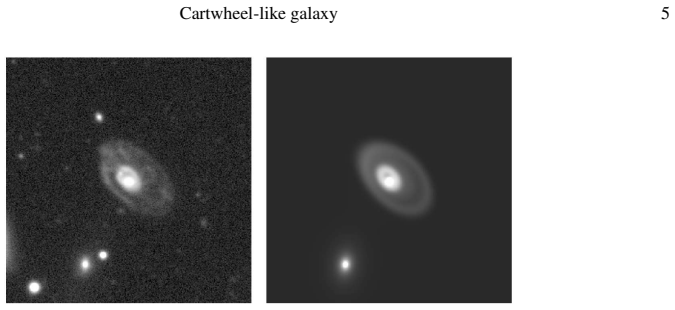
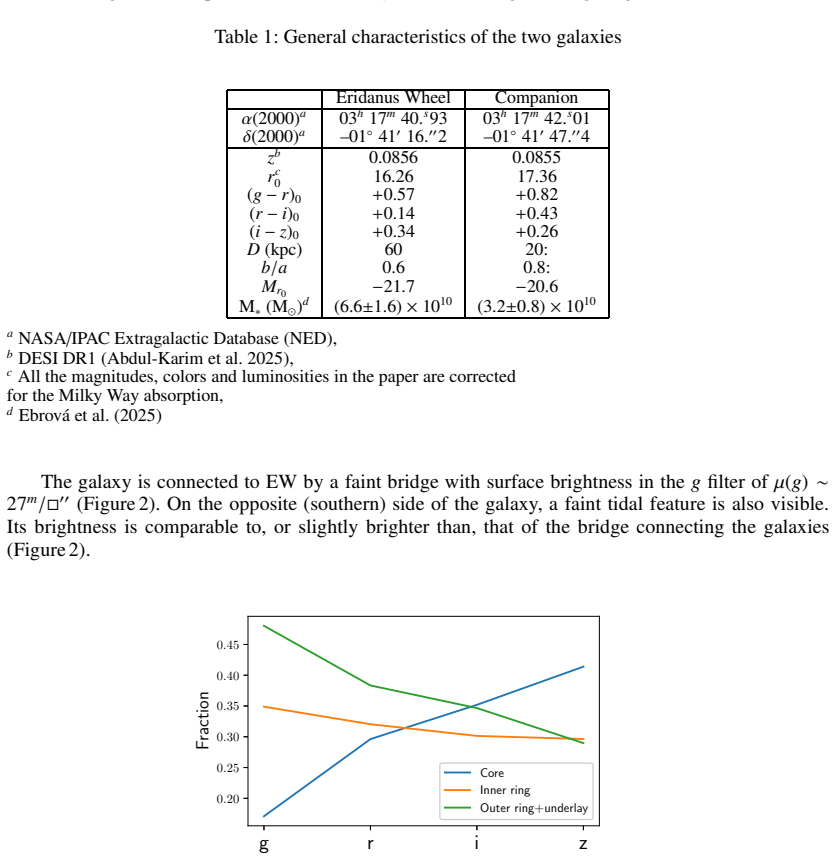
We report the discovery of a new Cartwheel-type collisional ring galaxy, PGC\,1112751, which we named ``Eridanus Wheel'' (EW). Such systems result from head-on collisions between galaxies and are of considerable interest as laboratories for studying star formation in propagating density waves and the response of the star-gas disk of galaxies to strong external perturbations. During a systematic visual inspection of fields from the DESI Legacy Imaging Surveys, we identified a galaxy at a redshift of $z=0.0856$ whose morphology closely resembles that of the famous Cartwheel Galaxy. EW exhibits a well-defined inner ring and a more diffuse outer ring, with so-called ``spokes'' visible in the region between them. The ring galaxy and its possible intruder are connected by a faint optical bridge. The projected distance between the centers of the galaxies is about 60 kpc. Using data from the DESI Legacy Surveys, we performed a photometric study of galaxies in the $griz$ filters. We conclude that the Eridanus Wheel is a giant late-type galaxy with a strong radial color gradient, whose observed morphology is most likely explained by a relatively recent head-on collision with an early-type galaxy. The further evolution of this object will most likely lead to the formation of a galaxy with a low surface brightness disk.
Editorial analysis
A structured set of objections, weighed in public.
Referee Report
Summary. The paper reports the discovery of a new Cartwheel-type collisional ring galaxy candidate, PGC 1112751 ('Eridanus Wheel'), identified via visual inspection of DESI Legacy Imaging Surveys at redshift z=0.0856. The galaxy shows an inner ring, diffuse outer ring, spokes, and a faint optical bridge to a possible intruder at ~60 kpc projected separation. Photometry in griz filters indicates a giant late-type galaxy with strong radial color gradient, interpreted as resulting from a recent head-on collision with an early-type galaxy that may evolve into a low surface brightness disk system.
Significance. If the collisional origin is substantiated, the object adds a new example to the limited sample of Cartwheel analogs, serving as a laboratory for density-wave star formation and disk perturbation responses. The systematic visual search of public surveys demonstrates an efficient method for identifying rare morphological types. The work is observational and does not include machine-checked proofs or parameter-free derivations, but the photometric dataset from DESI Legacy Surveys is publicly accessible and could support follow-up analyses.
major comments (3)
- [Abstract] Abstract and conclusion: The assertion that the observed morphology 'is most likely explained by a relatively recent head-on collision with an early-type galaxy' rests on visual analogy to the Cartwheel and the ~60 kpc projected separation, yet no redshift is reported for the companion, no line-of-sight velocity difference is measured, and no N-body or hydrodynamical simulation is presented to test whether a collision at the inferred mass ratio and separation reproduces the ring radii, spoke contrast, or bridge surface brightness.
- [Photometric study] Photometric study section: The classification as a collisional ring galaxy and the radial color gradient claim lack quantitative metrics such as measured ring radii with uncertainties, spoke surface-brightness contrasts, or statistical comparison (e.g., via CAS parameters or Fourier decomposition) to the Cartwheel or other confirmed ring galaxies; the analysis relies on qualitative description of imaging without error bars or formal fitting.
- [Conclusion] Conclusion: The prediction that further evolution 'will most likely lead to the formation of a galaxy with a low surface brightness disk' is presented without reference to specific simulations or analytic models that map the current morphology and inferred collision parameters onto that evolutionary outcome.
minor comments (2)
- [Abstract] The source of the reported redshift z=0.0856 (e.g., SDSS, DESI, or other catalog) is not stated, which affects reproducibility of the distance and physical scale calculations.
- Consider including a table of aperture or integrated magnitudes and colors for both the ring galaxy and the companion to facilitate direct comparison with other ring-galaxy samples.
Simulated Author's Rebuttal
We thank the referee for their thoughtful review and for highlighting areas where the manuscript can be clarified. We respond to each major comment below and indicate where revisions will be made.
read point-by-point responses
-
Referee: [Abstract] Abstract and conclusion: The assertion that the observed morphology 'is most likely explained by a relatively recent head-on collision with an early-type galaxy' rests on visual analogy to the Cartwheel and the ~60 kpc projected separation, yet no redshift is reported for the companion, no line-of-sight velocity difference is measured, and no N-body or hydrodynamical simulation is presented to test whether a collision at the inferred mass ratio and separation reproduces the ring radii, spoke contrast, or bridge surface brightness.
Authors: We agree that the collisional interpretation remains morphological and suggestive at this stage. The manuscript is an observational discovery paper based on public imaging; no spectroscopic data for the companion were available, and no new simulations were performed. We will revise the abstract and relevant sections to describe the system as a strong candidate whose morphology is consistent with a recent head-on collision, explicitly noting the absence of a measured redshift or velocity offset for the companion and the lack of dynamical modeling. revision: partial
-
Referee: [Photometric study] Photometric study section: The classification as a collisional ring galaxy and the radial color gradient claim lack quantitative metrics such as measured ring radii with uncertainties, spoke surface-brightness contrasts, or statistical comparison (e.g., via CAS parameters or Fourier decomposition) to the Cartwheel or other confirmed ring galaxies; the analysis relies on qualitative description of imaging without error bars or formal fitting.
Authors: The referee correctly notes that the current analysis is largely qualitative. The DESI Legacy Surveys imaging permits approximate measurement of ring radii, but the low surface brightness of the outer ring and spokes limits precise contrast measurements and formal structural decomposition without deeper data. We will add estimated ring radii (with uncertainties derived from the imaging) and a brief comparison of basic morphological parameters to the Cartwheel where feasible, while acknowledging that full CAS or Fourier analysis lies beyond the scope of the available dataset. revision: partial
-
Referee: [Conclusion] Conclusion: The prediction that further evolution 'will most likely lead to the formation of a galaxy with a low surface brightness disk' is presented without reference to specific simulations or analytic models that map the current morphology and inferred collision parameters onto that evolutionary outcome.
Authors: This evolutionary statement draws from the established literature on Cartwheel-like systems. We will revise the conclusion to include citations to relevant N-body and hydrodynamical studies of ring-galaxy evolution that support the expectation of a low-surface-brightness disk remnant, and we will qualify the prediction accordingly. revision: yes
- Absence of a measured redshift or velocity difference for the companion galaxy, which would require new spectroscopic observations not present in the current study.
- Lack of N-body or hydrodynamical simulations to test the proposed collision scenario, which is outside the scope of this observational discovery paper.
Circularity Check
No circularity: purely observational discovery report with no derivations or fitted predictions
full rationale
The paper reports the visual identification and photometric analysis of a galaxy from external DESI Legacy Surveys data. It contains no equations, no fitted parameters, no predictions derived from models, and no self-citations that serve as load-bearing premises for any derivation. The central claim rests on morphological analogy and color gradients observed in survey imaging, which are independent of any internal construction or reduction to prior author results. This is a standard observational note with no derivation chain to inspect for circularity.
Axiom & Free-Parameter Ledger
axioms (1)
- domain assumption Ring galaxies with spokes and bridges are produced by head-on collisions
Reference graph
Works this paper leans on
-
[1]
Abdul-Karim M., Adame A.G., Aguado D., et al., 2026, , submitted (arXiv:2503.14745)
work page internal anchor Pith review Pith/arXiv arXiv 2026
-
[2]
Amram P., Mendes de Oliveira C., Boulesteix J., Balkowski C., 1998, A&A, 330, 881
1998
-
[3]
Appleton P.N., Struck-Marcell C., 1996, Fund. Cosm. Phys., 16, 111
1996
-
[4]
Barway S., Mayya Y.D., Robleto-Or\'us A., 2020, MNRAS, 497, 44
2020
-
[5]
Charmandaris V., Appleton P.N., Marston A.P., 1993, ApJ, 414, 154
1993
-
[6]
et al., 2011, ApJ, 741, 80
Conn B.C., Pasquali A., Pompei E. et al., 2011, ApJ, 741, 80
2011
-
[7]
et al., 2019, AJ, 157, id.168
Dey A., Schlegel D.J., Lang D. et al., 2019, AJ, 157, id.168
2019
-
[8]
Ditrani F.R., Longhetti M., Fossati M., Wolter A., 2024, A&A, 688, A89
2024
-
[9]
Ebrov\'a I., B\'ilek M., Eli\'a s ek J., 2025, A&A, 704, A232
2025
-
[10]
Erwin P., 2015, ApJ, 799, 226
2015
-
[11]
Few J.M.A., Madore B.F., 1986, MNRAS, 222, 673
1986
-
[12]
et al., 2007, AJ, 134, 579
Fukugita M., Nakamura O., Okamura S. et al., 2007, AJ, 134, 579
2007
-
[13]
Hernquist L., Weil M.L., 1993, MNRAS, 261, 804
1993
-
[14]
Higdon J.L., 1996, ApJ, 467, 241
1996
-
[15]
Horellou C., Combes F., 2001, Ap&SS, 276, 1141
2001
-
[16]
Lynds R., Toomre A., 1976, ApJ, 209, 382
1976
-
[17]
Madore B.F., Nelson E., Petrillo K., 2009, ApJS, 181, 572
2009
-
[18]
et al., 2008, MNRAS, 383, 1223
Mapelli M., Moore B., Ripamonti E. et al., 2008, MNRAS, 383, 1223
2008
-
[19]
Mondal Ch., Barway S., 2025, A&A, 698, L25
2025
-
[20]
et al., 2018, MNRAS, 473, 585
Renaud F., Athanassoula E., Amram P. et al., 2018, MNRAS, 473, 585
2018
-
[21]
Romano R., Mayya Y.D., Vorobyov E.I., 2008, AJ, 136, 1259
2008
-
[22]
Smirnov D.V., Reshetnikov V.P., 2022, MNRAS, 516, 3692
2022
-
[23]
Struck C., 2010, MNRAS, 403, 1516
2010
-
[24]
Struck-Marcell C., Higdon J.L., 1993, ApJ, 411, 108
1993
-
[25]
Theys J.C., Spiegel E.A., 1977, ApJ, 212, 616
1977
-
[26]
Struck-Marcell C., 1994, ApJ, 433, 631
Wallin J.F. Struck-Marcell C., 1994, ApJ, 433, 631
1994
-
[27]
Theodore von Karman Anniversary volume, California Institute of Technology, Pasadena, California, p
Zwicky F., 1941, In: Contribution to Applied Mechanics and Related Subjects. Theodore von Karman Anniversary volume, California Institute of Technology, Pasadena, California, p. 137
1941
-
[28]
@esa (Ref
\@ifclassloaded agu2001 natbib The agu2001 class already includes natbib coding, so you should not add it explicitly Type <Return> for now, but then later remove the command natbib from the document \@ifclassloaded aguplus natbib The aguplus class already includes natbib coding, so you should not add it explicitly Type <Return> for now, but then later rem...
-
[29]
@stdbsttrue NAT@ctr \@lbibitem[ NAT@ctr ] \@lbibitem[#1]#2 \@extra@b@citeb \@ifundefined br@#2\@extra@b@citeb \@namedef br@#2 \@nameuse br@#2\@extra@b@citeb \@ifundefined b@#2\@extra@b@citeb @num @parse #2 [ @natanchorstart #2\@extra@b@citeb \@biblabel @num @natanchorend] @ifcmd#1(@)(@)\@nil #2 @lbibitem\@undefined @lbibitem\@lbibitem \@lbibitem[#1]#2 @lb...
-
[30]
@open @close @open @close and [1] URL: #1 \@ifundefined chapter * \@mkboth \@ifundefined NAT@sectionbib * \@mkboth * \@mkboth\@gobbletwo \@ifclassloaded amsart * \@ifclassloaded amsbook * \@ifundefined bib@heading @heading NAT@ctr thebibliography [1] @ \@biblabel NAT@ctr \@bibsetup #1 NAT@ctr 0 @openbib .11em \@plus.33em \@minus.07em 4000 4000 `\.=1000 \@...
discussion (0)
Sign in with ORCID, Apple, or X to comment. Anyone can read and Pith papers without signing in.