MAMMOTH-Grism: Gas-phase Metallicity Gradients of Star-forming Galaxies in Protocluster Environments at Cosmic Noon
Pith reviewed 2026-06-29 06:38 UTC · model grok-4.3
The pith
Protocluster galaxies at z~2.3 show inverted metallicity gradients far more often than field galaxies.
A machine-rendered reading of the paper's core claim, the machinery that carries it, and where it could break.
Core claim
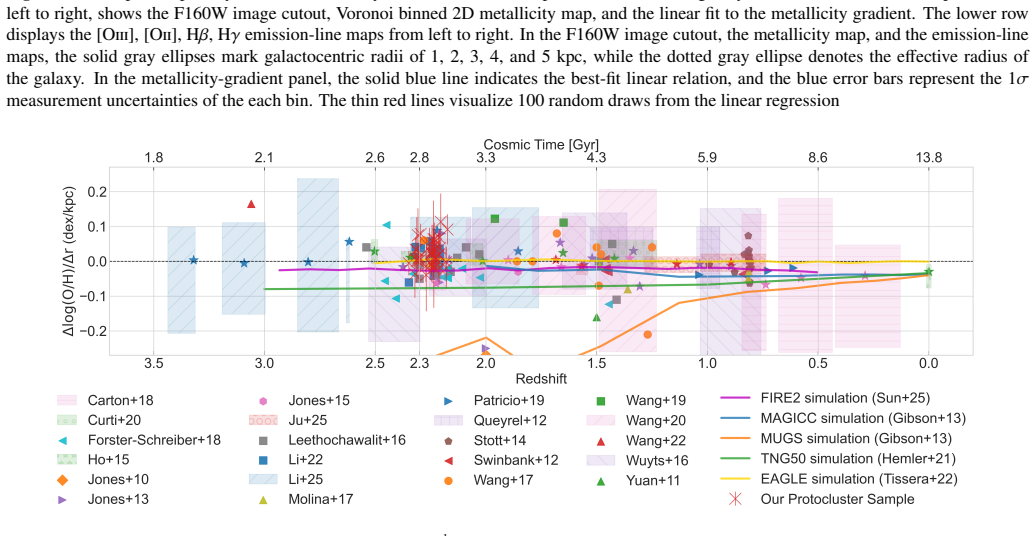
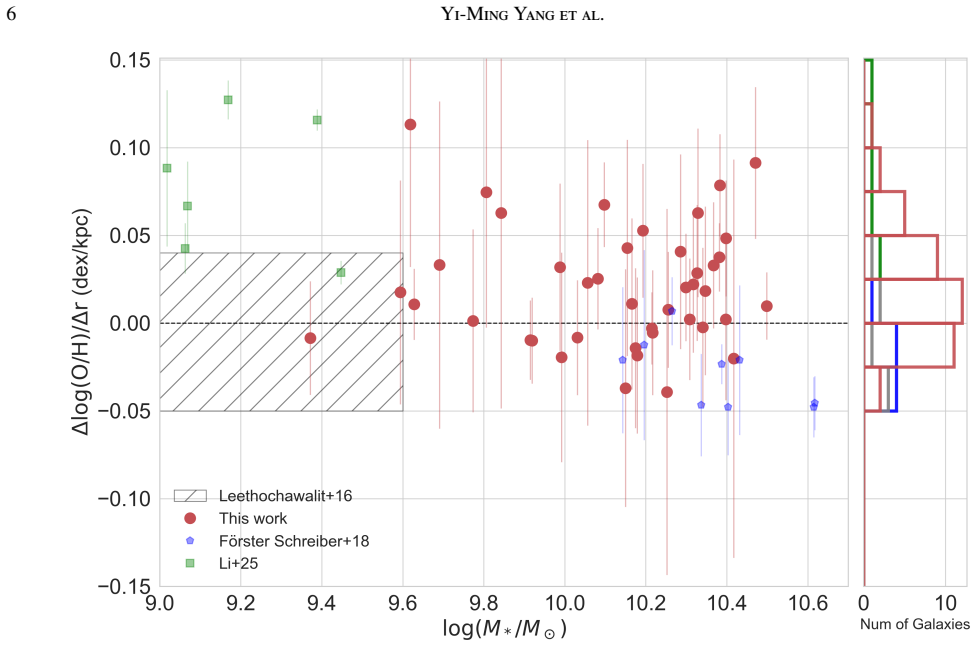
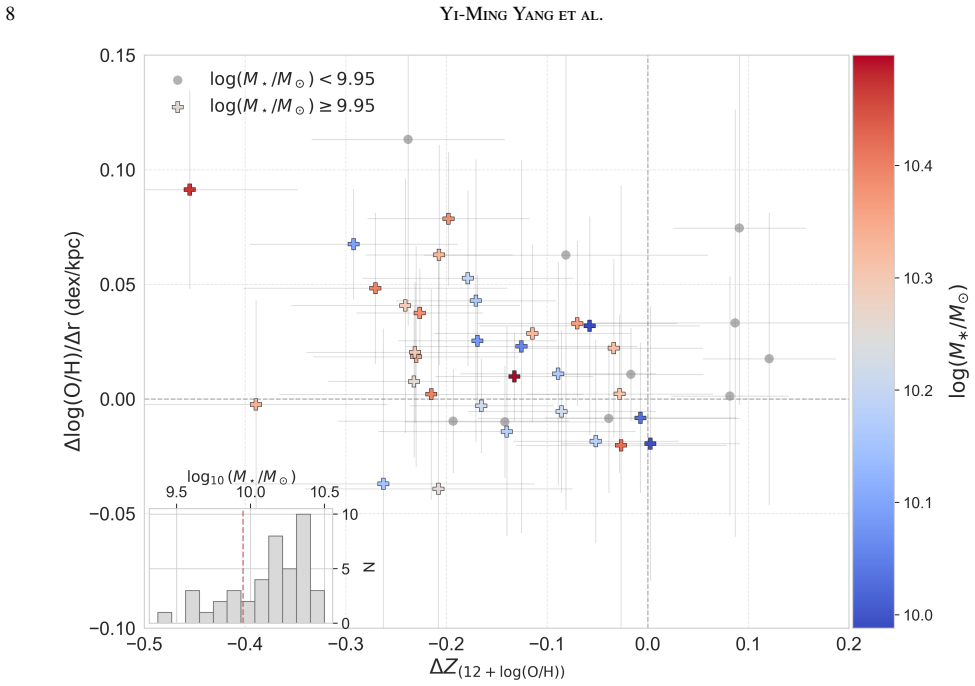
Spatially resolved gas-phase metallicity gradients for 42 star-forming galaxies in three massive protoclusters at z ∼ 2.3, derived from HST slitless grism spectroscopy, show that the majority (29 of 42, ∼69%) exhibit positive (inverted) metallicity gradients, a fraction significantly higher than observed in field galaxies of similar mass and redshift. These positive gradients correlate strongly with galaxies that are metal-deficient relative to the field mass-metallicity relation, particularly among the massive population. The trends indicate that galaxies in dense protocluster environments experience substantial enhanced inflows of pristine gas toward their central regions that dilute centr
What carries the argument
Spatially resolved gas-phase metallicity gradients from HST slitless grism spectroscopy, used to map how metal abundance changes with galactic radius.
If this is right
- Protocluster environments drive enhanced inflows of pristine gas that dilute central metallicities and create inverted gradients.
- The association between inverted gradients and metal-deficient galaxies is strongest among the more massive protocluster members.
- Environmental effects actively regulate gas accretion and chemical redistribution inside galaxies during the peak epoch of cosmic star formation.
- The overall fraction of inverted gradients reaches about 69 percent in these protoclusters, well above field rates.
Where Pith is reading between the lines
- Numerical models of galaxy growth may need to increase the efficiency of central pristine-gas delivery inside overdensities to match the observed gradient statistics.
- The same environmental gas flows could alter the timing or mode of quenching in protocluster galaxies relative to the field.
- Higher-resolution follow-up spectra could test whether the reported gradient slopes remain stable when measured with different techniques.
Load-bearing premise
Grism spectroscopy yields unbiased spatially resolved metallicity gradients and the protocluster sample can be compared fairly to field galaxies at matching mass and redshift without major selection or measurement differences.
What would settle it
A larger or independent survey finding that the fraction of positive metallicity gradients is not significantly higher in protoclusters than in matched field galaxies at the same redshift and mass would falsify the claimed environmental difference.
Figures

read the original abstract
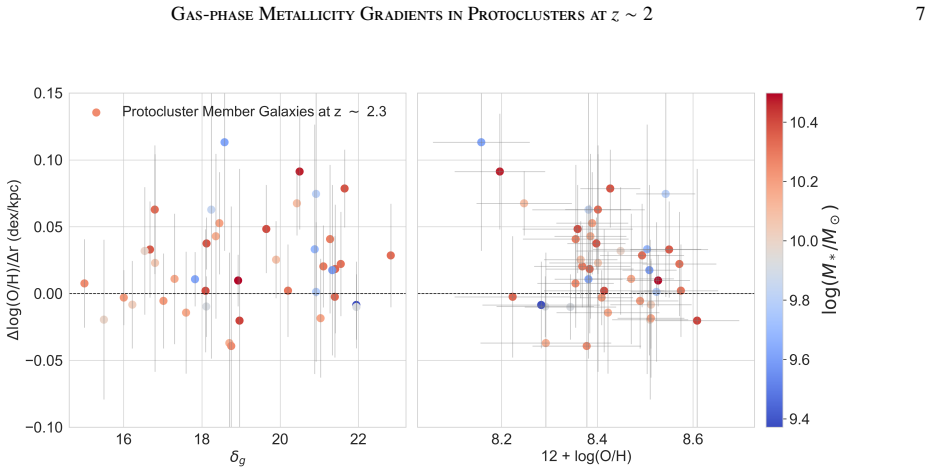
Environment plays a crucial role in shaping galaxy formation, yet the impact of overdensities on the internal chemical structure of galaxies at cosmic noon is still under debate. Here, we present spatially resolved gas-phase metallicity gradients for 42 star-forming galaxies in three massive protoclusters at $z \sim 2.3$, derived fromHubble Space Telescope (HST) slitless grism spectroscopy from the MAMMOTH-Grism survey. We find that the majority (29 of 42, $\sim$69%) of these protocluster members exhibit positive (inverted) metallicity gradients, a fraction significantly higher than observed in field galaxies of similar mass and redshift. By examining correlations with global properties, we show that these positive gradients are strongly associated with galaxies that are metal-deficient relative to the field mass-metallicity relation, particularly among the massive population ($\log(M_*/M_\odot) > 9.95$). These trends suggest that galaxies in dense protocluster environments experience substantial, enhanced inflows of pristine gas toward their central regions, which dilute the central metallicity and produce the observed inverted gradients. Our results provide observational evidence that environmental effects actively regulate gas accretion and chemical redistribution during the peak epoch of cosmic star formation.
Editorial analysis
A structured set of objections, weighed in public.
Referee Report
Summary. The paper measures spatially resolved gas-phase metallicity gradients for 42 star-forming galaxies in three massive protoclusters at z~2.3 using HST slitless grism spectroscopy from the MAMMOTH-Grism survey. It reports that 29/42 (~69%) show positive (inverted) gradients, a significantly higher fraction than in field galaxies of similar mass and redshift; these inverted gradients correlate with galaxies lying below the field mass-metallicity relation (especially at log(M*/M⊙)>9.95), which the authors interpret as evidence for enhanced pristine-gas inflows diluting central metallicities in dense environments.
Significance. If robust, the result supplies direct observational evidence that protocluster environments at cosmic noon actively regulate gas accretion and chemical redistribution, extending field-galaxy studies to overdense regions during the peak of cosmic star formation. The sample size (42 galaxies) and uniform grism dataset are strengths that enable a statistical contrast with field populations.
major comments (2)
- [Data reduction and gradient measurement section] The central claim (69% positive gradients and the environmental contrast) rests on the accuracy of 2D metallicity maps extracted from slitless grism spectra. The data-analysis section does not report forward-modeling of mock galaxies with known input gradients through the full grism pipeline (including PSF convolution, wavelength-dependent dispersion, continuum subtraction, and neighbor contamination) to quantify residual bias in the sign or magnitude of the measured gradients.
- [Results and comparison to field galaxies] The comparison to field samples requires explicit demonstration that gradient measurements are performed identically and that selection effects (mass, SFR, redshift, and completeness) are matched. Without a table or figure showing the field sample properties and measurement methodology side-by-side with the protocluster sample, it is unclear whether the reported fraction difference could arise from systematic differences in how gradients are derived.
minor comments (2)
- [Abstract] The abstract states the 29/42 fraction but does not quote typical gradient slopes, uncertainties, or the statistical test used to claim the fraction is 'significantly higher' than the field; adding these numbers would improve clarity.
- [Methods] Notation for metallicity (e.g., 12+log(O/H) or Z/Z⊙) and the exact radial range over which gradients are fitted should be stated consistently in the methods and results sections.
Simulated Author's Rebuttal
We thank the referee for the constructive report and the opportunity to improve the manuscript. We address each major comment below, agreeing that additional validation and explicit comparisons will strengthen the presentation of our results.
read point-by-point responses
-
Referee: [Data reduction and gradient measurement section] The central claim (69% positive gradients and the environmental contrast) rests on the accuracy of 2D metallicity maps extracted from slitless grism spectra. The data-analysis section does not report forward-modeling of mock galaxies with known input gradients through the full grism pipeline (including PSF convolution, wavelength-dependent dispersion, continuum subtraction, and neighbor contamination) to quantify residual bias in the sign or magnitude of the measured gradients.
Authors: We agree that forward-modeling through the full pipeline is the most direct way to quantify any residual bias in gradient sign or magnitude. In the revised manuscript we will add an appendix presenting mock galaxies with known input gradients that are injected into the real grism frames, processed through the identical reduction steps (PSF convolution, dispersion, continuum subtraction, and neighbor masking), and recovered with the same metallicity mapping code. This will demonstrate that the sign of the gradients is reliably recovered with only small systematic offsets in magnitude. revision: yes
-
Referee: [Results and comparison to field galaxies] The comparison to field samples requires explicit demonstration that gradient measurements are performed identically and that selection effects (mass, SFR, redshift, and completeness) are matched. Without a table or figure showing the field sample properties and measurement methodology side-by-side with the protocluster sample, it is unclear whether the reported fraction difference could arise from systematic differences in how gradients are derived.
Authors: We will add a new table (and supporting text) that lists the stellar-mass, SFR, and redshift distributions of the protocluster sample alongside the field comparison samples, together with a concise statement that the gradient extraction pipeline, metallicity calibration, and spatial binning choices are identical to those used in the cited field studies. This will make the selection matching and methodological equivalence explicit. revision: yes
Circularity Check
No circularity: direct observational count from grism spectra
full rationale
The paper reports an empirical fraction (29/42 galaxies with positive gradients) derived from HST slitless grism spectroscopy. No equations, fitted parameters, or self-citations are used to derive this fraction; it is a direct measurement and comparison to field samples. The derivation chain is self-contained and does not reduce to its own inputs by construction.
Axiom & Free-Parameter Ledger
axioms (2)
- domain assumption HST slitless grism spectroscopy yields reliable spatially resolved gas-phase metallicity gradients for star-forming galaxies at z~2.3
- domain assumption The protocluster sample selection and field comparison sample are matched in mass and redshift without significant bias
Reference graph
Works this paper leans on
-
[1]
2017, Monthly Notices of the Royal Astronomical Society, 469, 151, doi: 10.1093/mnras/stx789
Belfiore, F., Maiolino, R., Tremonti, C., et al. 2017, Monthly Notices of the Royal Astronomical Society, 469, 151, doi: 10.1093/mnras/stx789
-
[2]
1996, A&AS, 117, 393, doi: 10.1051/aas:1996164
Bertin, E., & Arnouts, S. 1996, A&AS, 117, 393, doi: 10.1051/aas:1996164
-
[3]
Bian, F., Kewley, L. J., & Dopita, M. A. 2018, ApJ, 859, 175, doi: 10.3847/1538-4357/aabd74
-
[4]
2019, Grizli: Grism redshift and line analysis software, Astrophysics Source Code Library, record ascl:1905.001
Brammer, G. 2019, Grizli: Grism redshift and line analysis software, Astrophysics Source Code Library, record ascl:1905.001. http://ascl.net/1905.001
2019
-
[5]
2021, gbrammer/grizli: Release 2021, 1.3.2, Zenodo, doi: 10.5281/zenodo.5012699
Brammer, G., & Matharu, J. 2021, gbrammer/grizli: Release 2021, 1.3.2, Zenodo, doi: 10.5281/zenodo.5012699
-
[6]
Bruzual, G., & Charlot, S. 2003, MNRAS, 344, 1000, doi: 10.1046/j.1365-8711.2003.06897.x
-
[7]
2016, The Astrophysical Journal, 833, 135, doi: 10.3847/1538-4357/833/2/135
Cai, Z., Fan, X., Peirani, S., et al. 2016, The Astrophysical Journal, 833, 135, doi: 10.3847/1538-4357/833/2/135
-
[8]
2017, The Astrophysical Journal, 837, 71, doi: 10.3847/1538-4357/aa5d14
Cai, Z., Fan, X., Yang, Y ., et al. 2017, The Astrophysical Journal, 837, 71, doi: 10.3847/1538-4357/aa5d14
-
[9]
The Dust Content and Opacity of Actively Star-Forming Galaxies
Calzetti, D., Armus, L., Bohlin, R. C., et al. 2000, ApJ, 533, 682, doi: 10.1086/308692
work page internal anchor Pith review doi:10.1086/308692 2000
-
[10]
Cappellari, M., & Copin, Y . 2003, MNRAS, 342, 345, doi: 10.1046/j.1365-8711.2003.06541.x
-
[11]
Carnall, A. C., McLure, R. J., Dunlop, J. S., & Davé, R. 2018, MNRAS, 480, 4379, doi: 10.1093/mnras/sty2169
work page internal anchor Pith review doi:10.1093/mnras/sty2169 2018
-
[12]
2018, Monthly Notices of the Royal Astronomical Society, 478, 4293, doi: 10.1093/mnras/sty1343
Carton, D., Brinchmann, J., Contini, T., et al. 2018, Monthly Notices of the Royal Astronomical Society, 478, 4293, doi: 10.1093/mnras/sty1343
-
[13]
2003, Publications of the Astronomical Society of the Pacific, 115, 763, doi: 10.1086/376392
Chabrier, G. 2003, PASP, 115, 763, doi: 10.1086/376392
work page internal anchor Pith review doi:10.1086/376392 2003
-
[14]
2017, The Astrophysical Journal, 844, L23, doi: 10.3847/2041-8213/aa7e7b
Chiang, Y .-K., Overzier, R., & Gebhardt, K. 2017, The Astrophysical Journal, 844, L23, doi: 10.3847/2041-8213/aa7e7b
-
[15]
L., Aird, J., Reddy, N., et al
Coil, A. L., Aird, J., Reddy, N., et al. 2015, ApJ, 801, 35, doi: 10.1088/0004-637X/801/1/35
-
[16]
2010, Nature, 467, 811, doi: 10.1038/nature09451
Cresci, G., Mannucci, F., Maiolino, R., et al. 2010, Nature, 467, 811, doi: 10.1038/nature09451
-
[17]
2020, MNRAS, 492, 821, doi: 10.1093/mnras/stz3379
Curti, M., Maiolino, R., Cirasuolo, M., et al. 2020, MNRAS, 492, 821, doi: 10.1093/mnras/stz3379
-
[18]
2025, Monthly Notices of the Royal Astronomical Society, 544, 2365, doi: 10.1093/mnras/staf1772
Daikuhara, K., Kodama, T., Kusakabe, H., et al. 2025, Monthly Notices of the Royal Astronomical Society, 544, 2365, doi: 10.1093/mnras/staf1772
-
[19]
2018, Monthly Notices of the Royal Astronomical Society, 473, 1930, doi: 10.1093/mnras/stx2482
El-Badry, K., Quataert, E., Wetzel, A., et al. 2018, Monthly Notices of the Royal Astronomical Society, 473, 1930, doi: 10.1093/mnras/stx2482
-
[20]
2013, emcee: The MCMC Hammer, Astrophysics Source Code Library, record ascl:1303.002
Foreman-Mackey, D., Conley, A., Meierjurgen Farr, W., et al. 2013, emcee: The MCMC Hammer, Astrophysics Source Code Library, record ascl:1303.002
2013
-
[21]
2013, Astronomy & Astrophysics, 554, A47, doi: 10.1051/0004-6361/201321239
Bailin, J. 2013, Astronomy & Astrophysics, 554, A47, doi: 10.1051/0004-6361/201321239
-
[22]
Hemler, Z. S., Torrey, P., Qi, J., et al. 2021, Monthly Notices of the Royal Astronomical Society, 506, 3024, doi: 10.1093/mnras/stab1803
-
[23]
T., Kudritzki, R.-P., Kewley, L
Ho, I. T., Kudritzki, R.-P., Kewley, L. J., et al. 2015, Monthly Notices of the Royal Astronomical Society, 448, 2030, doi: 10.1093/mnras/stv067
-
[24]
2010, The Astrophysical Journal Letters, 725, L176, doi: 10.1088/2041-8205/725/2/L176
Jones, T., Ellis, R., Jullo, E., & Richard, J. 2010, The Astrophysical Journal Letters, 725, L176, doi: 10.1088/2041-8205/725/2/L176
-
[25]
Jones, T., Ellis, R. S., Richard, J., & Jullo, E. 2013, The Astrophysical Journal, 765, 48, doi: 10.1088/0004-637X/765/1/48
-
[26]
Jones, T., Wang, X., Schmidt, K. B., et al. 2015, The Astronomical Journal, 149, 107, doi: 10.1088/0004-6256/149/3/107
-
[27]
2025, The Astrophysical Journal Letters, 978, L39, doi: 10.3847/2041-8213/ada150
Ju, M., Wang, X., Jones, T., et al. 2025, The Astrophysical Journal Letters, 978, L39, doi: 10.3847/2041-8213/ada150
-
[28]
Juneau, S., Dickinson, M., Alexander, D. M., & Salim, S. 2011, ApJ, 736, 104, doi: 10.1088/0004-637X/736/2/104
-
[29]
2014, ApJ, 788, 88, doi: 10.1088/0004-637X/788/1/88
Juneau, S., Bournaud, F., Charlot, S., et al. 2014, ApJ, 788, 88, doi: 10.1088/0004-637X/788/1/88
-
[30]
Leethochawalit, N., Jones, T. A., Ellis, R. S., et al. 2016, ApJ, 820, 84, doi: 10.3847/0004-637X/820/2/84
-
[31]
2022, The Astrophysical Journal Letters, 929, L8, doi: 10.3847/2041-8213/ac626f
Li, Z., Wang, X., Cai, Z., et al. 2022, The Astrophysical Journal Letters, 929, L8, doi: 10.3847/2041-8213/ac626f
-
[32]
2025, The Astrophysical Journal Supplement Series, 280, 62, doi: 10.3847/1538-4365/adfa70
Li, Z., Cai, Z., Wang, X., et al. 2025, The Astrophysical Journal Supplement Series, 280, 62, doi: 10.3847/1538-4365/adfa70
-
[33]
2011, The Astronomical Journal, 142, 51, doi: 10.1088/0004-6256/142/2/51
Graczyk, D. 2011, The Astronomical Journal, 142, 51, doi: 10.1088/0004-6256/142/2/51
-
[34]
Ma, X., Hopkins, P. F., Feldmann, R., et al. 2017, Monthly Notices of the Royal Astronomical Society, 466, 4780, doi: 10.1093/mnras/stx034
-
[35]
2019, A&A Rv, 27, 3, doi: 10.1007/s00159-018-0112-2
Maiolino, R., & Mannucci, F. 2019, The Astronomy and Astrophysics Review, 27, 3, doi: 10.1007/s00159-018-0112-2
-
[36]
2016, Astronomy and Astrophysics, 595, A97, doi: 10.1051/0004-6361/201628751
Merlin, E., Bourne, N., Castellano, M., et al. 2016, Astronomy and Astrophysics, 595, A97, doi: 10.1051/0004-6361/201628751
-
[37]
Molina, J., Ibar, E., Swinbank, A. M., et al. 2017, Monthly Notices of the Royal Astronomical Society, 466, 892, doi: 10.1093/mnras/stw3120
-
[38]
Oppenheimer, B. D., & Davé, R. 2008, Monthly Notices of the Royal Astronomical Society, 387, 577, doi: 10.1111/j.1365-2966.2008.13280.x Patrício, V ., Richard, J., Carton, D., et al. 2019, Monthly Notices of the Royal Astronomical Society, 489, 224, doi: 10.1093/mnras/stz2114
-
[39]
Peng, C. Y ., Ho, L. C., Impey, C. D., & Rix, H.-W. 2002, AJ, 124, 266, doi: 10.1086/340952
work page internal anchor Pith review doi:10.1086/340952 2002
-
[40]
Peng, Y .-j., & Maiolino, R. 2014, MNRAS, 443, 3643, doi: 10.1093/mnras/stu1288 Gas-phaseMetallicityGradients inProtoclusters atz∼2 11
-
[41]
2012, Astronomy & Astrophysics, 539, A93, doi: 10.1051/0004-6361/201117718
Queyrel, J., Contini, T., Kissler-Patig, M., et al. 2012, Astronomy & Astrophysics, 539, A93, doi: 10.1051/0004-6361/201117718
-
[42]
Rupke, D. S. N., Kewley, L. J., & Barnes, J. E. 2010, The Astrophysical Journal Letters, 710, L156, doi: 10.1088/2041-8205/710/2/L156 Sánchez, S. F., Rosales-Ortega, F. F., Iglesias-Páramo, J., et al. 2014, Astronomy & Astrophysics, 563, A49, doi: 10.1051/0004-6361/201322343
-
[43]
Sanders, R. L., Shapley, A. E., Jones, T., et al. 2021, The Astrophysical Journal, 914, 19, doi: 10.3847/1538-4357/abf4c1
-
[44]
Schreiber, N. M. F., Renzini, A., Mancini, C., et al. 2018, The Astrophysical Journal Supplement Series, 238, 21, doi: 10.3847/1538-4365/aadd49
-
[45]
Shi, D. D., Cai, Z., Fan, X., et al. 2021, The Astrophysical Journal, 915, 32, doi: 10.3847/1538-4357/abfec0
-
[46]
Shimakawa, R., Koyama, Y ., Röttgering, H. J. A., et al. 2018, Monthly Notices of the Royal Astronomical Society, 481, 5630, doi: 10.1093/mnras/sty2618
-
[47]
C., Papovich, C., Momcheva, I., et al
Simons, R. C., Papovich, C., Momcheva, I., et al. 2021, The Astrophysical Journal, 923, 203, doi: 10.3847/1538-4357/ac28f4
-
[48]
2010, The Astrophysical Journal, 714, 1096, doi: 10.1088/0004-637X/714/2/1096
Stanghellini, L., & Haywood, M. 2010, The Astrophysical Journal, 714, 1096, doi: 10.1088/0004-637X/714/2/1096
-
[49]
Galaxy Metallicity Gradients in the Reionization Epoch from the FIRE-2 Simulations
Sun, X., Wang, X., Jiang, F., et al. 2025, arXiv e-prints, arXiv:2510.08997, doi: 10.48550/arXiv.2510.08997
work page internal anchor Pith review Pith/arXiv arXiv doi:10.48550/arxiv.2510.08997 2025
-
[50]
2025, The Astrophysical Journal, 986, 179, doi: 10.3847/1538-4357/addab5
Sun, X., Wang, X., Ma, X., et al. 2025, The Astrophysical Journal, 986, 179, doi: 10.3847/1538-4357/addab5
-
[51]
Swinbank, A. M., Sobral, D., Smail, I., et al. 2012, Monthly Notices of the Royal Astronomical Society, 426, 935, doi: 10.1111/j.1365-2966.2012.21774.x
-
[52]
B., Rosas-Guevara, Y ., Sillero, E., et al
Tissera, P. B., Rosas-Guevara, Y ., Sillero, E., et al. 2022, Monthly Notices of the Royal Astronomical Society, 511, 1667, doi: 10.1093/mnras/stab3644
-
[53]
2014, Monthly Notices of the Royal Astronomical Society, 438, 1894, doi: 10.1093/mnras/stt2340
Torres-Flores, S., Scarano, S., Mendes de Oliveira, C., et al. 2014, Monthly Notices of the Royal Astronomical Society, 438, 1894, doi: 10.1093/mnras/stt2340
-
[54]
2024, Astronomy & Astrophysics, 691, A19, doi: 10.1051/0004-6361/202449855
Venturi, G., Carniani, S., Parlanti, E., et al. 2024, Astronomy & Astrophysics, 691, A19, doi: 10.1051/0004-6361/202449855
-
[55]
2023, The Astrophysical Journal, 951, 66, doi: 10.3847/1538-4357/acd633
Wang, K., Wang, X., & Chen, Y . 2023, The Astrophysical Journal, 951, 66, doi: 10.3847/1538-4357/acd633
-
[56]
Wang, X., Jones, T. A., Treu, T., et al. 2017, ApJ, 837, 89, doi: 10.3847/1538-4357/aa603c —. 2019, ApJ, 882, 94, doi: 10.3847/1538-4357/ab3861 —. 2020, ApJ, 900, 183, doi: 10.3847/1538-4357/abacce
-
[57]
2022, ApJ, 926, 70, doi: 10.3847/1538-4357/ac3974
Wang, X., Li, Z., Cai, Z., et al. 2022, ApJ, 926, 70, doi: 10.3847/1538-4357/ac3974
-
[58]
2016, ApJ, 827, 74, doi: 10.3847/0004-637X/827/1/74
Wuyts, E., Wisnioski, E., Fossati, M., et al. 2016, ApJ, 827, 74, doi: 10.3847/0004-637X/827/1/74
-
[59]
2026, ApJ, 997, 95, doi: 10.3847/1538-4357/ae27cf
Yang, Y ., Wang, X., He, X., et al. 2026, ApJ, 997, 95, doi: 10.3847/1538-4357/ae27cf
-
[60]
Yuan, T.-T., Kewley, L. J., & Rich, J. 2013, ApJ, 767, 106, doi: 10.1088/0004-637X/767/2/106
-
[61]
Zheng, X. Z., Cai, Z., An, F. X., Fan, X., & Shi, D. D. 2021, Monthly Notices of the Royal Astronomical Society, 500, 4354, doi: 10.1093/mnras/staa2882
-
[62]
Zhou, H., Wang, X., Malkan, M. A., et al. 2025, The Astrophysical Journal, 993, 231, doi: 10.3847/1538-4357/ae0649
discussion (0)
Sign in with ORCID, Apple, or X to comment. Anyone can read and Pith papers without signing in.