Deep Binarized Photonic Reservoir Computing for Ultrafast Multimedia Signal Processing
Pith reviewed 2026-06-28 23:40 UTC · model grok-4.3
The pith
A deep photonic reservoir computing system processes multimedia signals at gigabit-per-second rates and reaches state-of-the-art accuracy on video, image and speech tasks.
A machine-rendered reading of the paper's core claim, the machinery that carries it, and where it could break.
Core claim
A binarized deep photonic reservoir computing architecture built from DMD modulation, optical scattering, and CMOS detection achieves state-of-the-art multimedia recognition at gigabit-per-second rates when intra- and inter-layer physical hyper-parameters are chosen to balance memory retention and dynamical response across layers.
What carries the argument
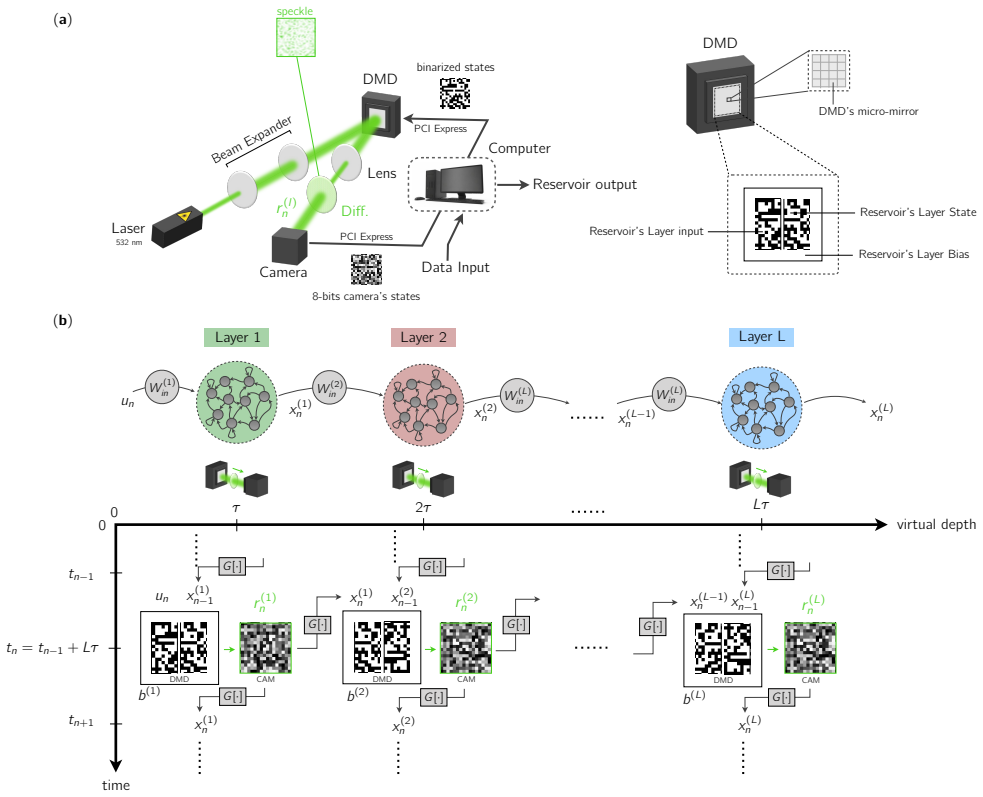
Time-multiplexed deep photonic reservoir layers whose intra- and inter-layer hyper-parameters are tuned to balance memory retention with dynamical response.
Load-bearing premise
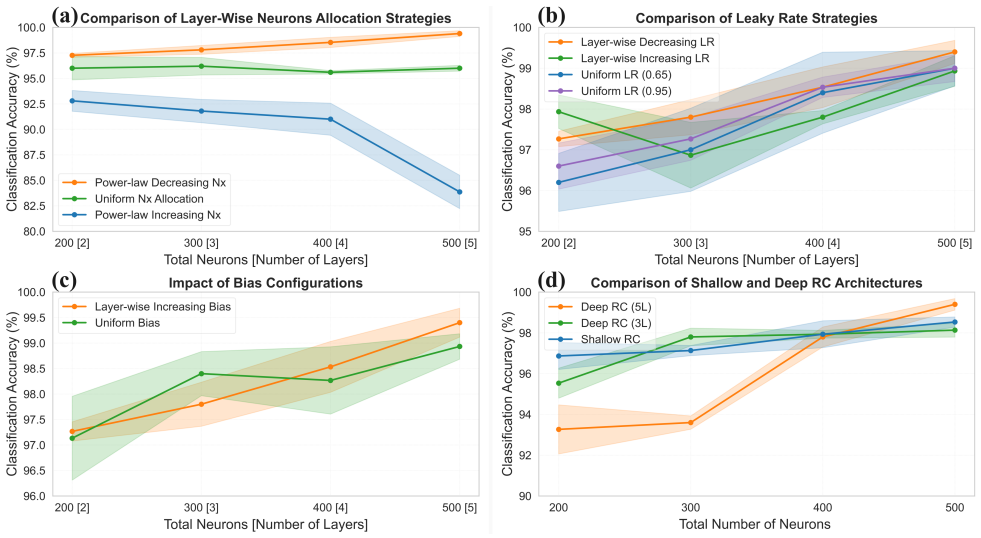
Tuning the physical hyper-parameters of the photonic layers can balance memory retention and dynamical response enough to improve feature extraction.
What would settle it
Recognition accuracy measured on the same tasks and at the same speed both with and without the reported hyper-parameter optimization.
Figures

read the original abstract
We present a deep photonic neural network architecture based on ultrafast binary optical modulation from a digital micro-mirror device (DMD), optical scattering in random medium, high-speed photodetection with a CMOS sensor, and time-multiplexed deep layer structure. Operating at Gigabit-per-second (Gb/s) processing rates, our system based on the reservoir computing (RC) framework achieves state-of-the-art performance across various multimedia tasks, including video, image and speech recognition. We show that the careful optimization of key physical intra- and inter-layer hyper-parameters can significantly enhance the deep photonic RC system ability to extract relevant temporal and spatial features via balancing memory retention and dynamical response of individual layers. This approach paves the way for highly scalable hierarchical photonic reservoir computing systems for high-throughput real-time multimedia signal processing.
Editorial analysis
A structured set of objections, weighed in public.
Referee Report
Summary. The manuscript presents a deep photonic reservoir computing architecture based on DMD binarized optical modulation, random medium scattering, high-speed CMOS readout, and time-multiplexed layers. It claims Gb/s processing rates with state-of-the-art performance on video, image, and speech recognition tasks, attributing gains to optimization of physical intra- and inter-layer hyper-parameters that balance memory retention and dynamical response across layers.
Significance. If the performance claims and the role of hyper-parameter optimization are substantiated with quantitative benchmarks, the work would be significant for hardware photonic RC implementations, offering a path to scalable, ultrafast hierarchical systems for real-time multimedia processing.
major comments (2)
- [Abstract] Abstract: The central claim of state-of-the-art performance across multimedia tasks is stated without any quantitative metrics, baselines, error bars, dataset specifications, or comparisons, so the claim cannot be evaluated from the manuscript.
- [Abstract] Abstract: The assertion that optimization of physical hyper-parameters 'significantly enhance[s]' feature extraction 'via balancing memory retention and dynamical response of individual layers' is presented without supporting measurements, analysis of memory capacity, or layer-wise response data, leaving the load-bearing mechanism unverified.
Simulated Author's Rebuttal
We thank the referee for their constructive comments. We address each point below and will revise the abstract accordingly to improve evaluability and support for the stated claims.
read point-by-point responses
-
Referee: [Abstract] Abstract: The central claim of state-of-the-art performance across multimedia tasks is stated without any quantitative metrics, baselines, error bars, dataset specifications, or comparisons, so the claim cannot be evaluated from the manuscript.
Authors: We agree that the abstract would benefit from quantitative support. The main text provides full results with metrics, baselines, error bars, and dataset specifications for the video, image, and speech tasks. In the revised manuscript we will update the abstract to include representative performance numbers, processing rates, and brief baseline comparisons so the claim is directly evaluable. revision: yes
-
Referee: [Abstract] Abstract: The assertion that optimization of physical hyper-parameters 'significantly enhance[s]' feature extraction 'via balancing memory retention and dynamical response of individual layers' is presented without supporting measurements, analysis of memory capacity, or layer-wise response data, leaving the load-bearing mechanism unverified.
Authors: We acknowledge that the abstract states the mechanism without immediate reference to supporting data. The manuscript contains the relevant memory-capacity measurements and layer-wise response analyses. We will revise the abstract to include a concise reference to these results, thereby linking the claim to the supporting evidence already present in the paper. revision: yes
Circularity Check
No circularity: empirical experimental claims with no derivation reducing to inputs
full rationale
The paper describes an experimental deep photonic RC architecture using DMD binarization, scattering, CMOS readout and time-multiplexing. SOTA performance claims rest on reported empirical testing across tasks, not on any mathematical derivation, fitted parameter renamed as prediction, or self-citation chain. Hyper-parameter optimization is presented as a physical tuning step to balance memory and dynamics; this is a standard experimental procedure and does not reduce by construction to the target performance metric. No equations, uniqueness theorems, or ansatzes are invoked that collapse to prior fitted quantities or self-referential definitions. The central claims remain externally falsifiable via replication on the described hardware.
Axiom & Free-Parameter Ledger
Reference graph
Works this paper leans on
-
[1]
& Markram, H
Maass, W., Natschläger, T. & Markram, H. Real-time computing without stable states: A new framework for neural computation based on perturbations.Neural computation14, 2531–2560 (2002)
2002
-
[2]
& Haas, H
Jaeger, H. & Haas, H. Harnessing nonlinearity: Predicting chaotic systems and saving energy in wireless communication. Science304, 78–80 (2004)
2004
-
[3]
& Jaeger, H
Lukoševiˇcius, M. & Jaeger, H. Reservoir computing approaches to recurrent neural network training.Comput. Sci. Rev.3, 127–149 (2009)
2009
-
[4]
& Massar, S
Antonik, P., Haelterman, M. & Massar, S. Online training for high-performance analogue readout layers in photonic reservoir computers.Cogn. Comput.9, 297–306 (2017). 5.Tanaka, G.et al.Recent advances in physical reservoir computing: A review.Neural Networks115, 100–123 (2019)
2017
-
[5]
communications2, 468 (2011)
Appeltant, L.et al.Information processing using a single dynamical node as complex system.Nat. communications2, 468 (2011)
2011
-
[6]
communications8, 2204 (2017)
Du, C.et al.Reservoir computing using dynamic memristors for temporal information processing.Nat. communications8, 2204 (2017). 12/14
2017
-
[7]
advances7, eabg1455 (2021)
Sun, L.et al.In-sensor reservoir computing for language learning via two-dimensional memristors.Sci. advances7, eabg1455 (2021)
2021
-
[8]
D., Soriano, M
Haynes, N. D., Soriano, M. C., Rosin, D. P., Fischer, I. & Gauthier, D. J. Reservoir computing with a single time-delay autonomous boolean node.Phys. Rev. E91, 020801 (2015). 10.Torrejon, J.et al.Neuromorphic computing with nanoscale spintronic oscillators.Nature547, 428–431 (2017)
2015
-
[9]
Jiang, W.et al.Physical reservoir computing using magnetic skyrmion memristor and spin torque nano-oscillator.Appl. Phys. Lett.115(2019)
2019
-
[10]
& Soriano, M
Van der Sande, G., Brunner, D. & Soriano, M. C. Advances in photonic reservoir computing.Nanophotonics6, 561–576 (2017)
2017
-
[11]
Lugnan, A.et al.Photonic neuromorphic information processing and reservoir computing.APL Photonics5, 020901 (2020)
2020
-
[12]
Commun.15, 2056 (2024)
Yan, M.et al.Emerging opportunities and challenges for the future of reservoir computing.Nat. Commun.15, 2056 (2024)
2056
-
[13]
& Massar, S
Duport, F., Schneider, B., Smerieri, A., Haelterman, M. & Massar, S. All-optical reservoir computing.Opt. express20, 22783–22795 (2012)
2012
-
[14]
Martinenghi, R., Rybalko, S., Jacquot, M., Chembo, Y . & L., L. Photonic nonlinear transient computing with multiple-delay wavelength dynamics.Phys. Rev. Lett.108, 244101 (2012)
2012
-
[15]
Larger, L.et al.Photonic information processing beyond turing: an optoelectronic implementation of reservoir computing. Opt. express20, 3241–3249 (2012)
2012
-
[16]
Larger, L.et al.High-speed photonic reservoir computing using a time-delay-based architecture: Million words per second classification.Phys. Rev. X7, 011015 (2017). 19.Butschek, L.et al.Photonic reservoir computer based on frequency multiplexing.Opt. Lett.47, 782–785 (2022)
2017
-
[17]
C., Mirasso, C
Brunner, D., Soriano, M. C., Mirasso, C. R. & Fischer, I. Parallel photonic information processing at gigabyte per second data rates using transient states.Nat. communications4, 1364 (2013)
2013
-
[18]
& Sciamanna, M
Vatin, J., Rontani, D. & Sciamanna, M. Experimental reservoir computing using vcsel polarization dynamics.Opt. Express 27, 18579 (2019)
2019
-
[19]
& Hurtado, A
Bueno, J., Robertson, J., Hejda, M. & Hurtado, A. Comprehensive performance analysis of a vcsel-based photonic reservoir computer.IEEE Photonics Technol. Lett.33, 920–923 (2021)
2021
-
[20]
& der Sande, G
Harkhoe, K., Verschaffelt, G., Katumba, A., Bienstman, P. & der Sande, G. V . Demonstrating delay-based reservoir computing using a compact photonic integrated chip.Opt. Express28, 3086 (2020)
2020
-
[21]
communications 5, 3541 (2014)
Vandoorne, K.et al.Experimental demonstration of reservoir computing on a silicon photonics chip.Nat. communications 5, 3541 (2014). 25.Takano, K.et al.Compact reservoir computing with a photonic integrated circuit.Opt. express26, 29424–29439 (2018)
2014
-
[22]
& Uchida, A
Sunada, S. & Uchida, A. Photonic reservoir computing based on nonlinear wave dynamics at microscale.Sci. Reports9, 19078 (2019). 27.Ma, C.et al.Integrated photonic reservoir computing with an all-optical readout.Opt. Express31, 34843–34854 (2023)
2019
-
[23]
& Gigan, S
Rafayelyan, M., Dong, J., Tan, Y ., Krzakala, F. & Gigan, S. Large-scale optical reservoir computing for spatiotemporal chaotic systems prediction.Phys. Rev. X10, 041037 (2020). 29.Bueno, J.et al.Reinforcement learning in a large-scale photonic recurrent neural network.Optica5, 756–760 (2018)
2020
-
[24]
& Rontani, D
Antonik, P., Marsal, N., Brunner, D. & Rontani, D. Human action recognition with a large-scale brain-inspired photonic computer.Nat. Mach. Intell.1, 530–537 (2019)
2019
-
[25]
& Gigan, S
Dong, J., Rafayelyan, M., Krzakala, F. & Gigan, S. Optical reservoir computing using multiple light scattering for chaotic systems prediction.IEEE J. Sel. Top. Quantum Electron.26, 1–12 (2019)
2019
-
[26]
A., Bertolotti, J
Goorden, S. A., Bertolotti, J. & Mosk, A. P. Superpixel-based spatial amplitude and phase modulation using a digital micromirror device.Opt. Express22, 17999–18009 (2014)
2014
-
[27]
& Massar, S
Dambre, J., Verstraeten, D., Schrauwen, B. & Massar, S. Information processing capacity of dynamical systems.Sci. reports2, 514 (2012). 13/14
2012
-
[28]
Moon, J., Wu, Y . & Lu, W. D. Hierarchical architectures in reservoir computing systems.Neuromorphic Comput. Eng.1, 014006 (2021)
2021
-
[29]
& Pedrelli, L
Gallicchio, C., Micheli, A. & Pedrelli, L. Deep reservoir computing: A critical experimental analysis.Neurocomputing 268, 87–99 (2017). 36.Gallicchio, C., Micheli, A. & Pedrelli, L. Design of deep echo state networks.Neural Networks108, 33–47 (2018)
2017
-
[30]
Li, T., Guo, Z., Li, Q. & Wu, Z. Multi-scale deep echo state network for time series prediction.Neural Comput. Appl.36, 13305–13325 (2024)
2024
-
[31]
& Micheli, A
Gallicchio, C. & Micheli, A. Architectural richness in deep reservoir computing.Neural Comput. Appl.35, 24525–24542 (2023). 39.Shen, Y .-W.et al.Deep photonic reservoir computing recurrent network.Optica10, 1745–1751 (2023). 40.LeCun, Y ., Bengio, Y . & Hinton, G. Deep learning.nature521, 436–444 (2015)
2023
-
[32]
U., Oguz, I., Psaltis, D
Yildirim, M., Dinc, N. U., Oguz, I., Psaltis, D. & Moser, C. Nonlinear processing with linear optics.Nat. Photonics18, 1076–1082 (2024)
2024
-
[33]
& Bouhlel, M
Jaouedi, N., Boujnah, N. & Bouhlel, M. S. A new hybrid deep learning model for human action recognition.J. King Saud Univ. - Comput. Inf. Sci.32, 447–453 (2020)
2020
-
[34]
Sharif, M.et al.A framework of human detection and action recognition based on uniform segmentation and combination of Euclidean distance and joint entropy-based features selection.J Image Video Proc.2017, 89 (2017)
2017
-
[35]
A.et al.A resource conscious human action recognition framework using 26-layered deep convolutional neural network.Multimed Tools Appl80, 35827–35849 (2021)
Khan, M. A.et al.A resource conscious human action recognition framework using 26-layered deep convolutional neural network.Multimed Tools Appl80, 35827–35849 (2021)
2021
-
[36]
& Liu, H
Shu, N., Tang, Q. & Liu, H. A bio-inspired approach modeling spiking neural networks of visual cortex for human action recognition. In2014 International Joint Conference on Neural Networks (IJCNN), 3450–3457 (2014)
2014
-
[37]
& Massar, S
Picco, E., Antonik, P. & Massar, S. High speed human action recognition using a photonic reservoir computer.Neural Networks165, 662–675 (2023)
2023
-
[38]
Improving classification accuracy of feedforward neural networks for spiking neuromorphic chips
Yepes, A. J., Tang, J. & Mashford, B. S. Improving classification accuracy of feedforward neural networks for spiking neuromorphic chips (2017). ArXiv:1705.07755. 48.Wang, Y .et al.Asymmetrical estimator for training encapsulated deep photonic neural networks.Nat Commun16, 2143 (2025)
work page internal anchor Pith review Pith/arXiv arXiv 2017
-
[39]
& Brunner, D
Talukder, R., Skalli, A., Porte Parera, J., Thorpe, S. & Brunner, D. A spiking photonic neural network of 40,000 neurons, trained with latency and rank-order coding for leveraging sparsity.Neuromorph. Comput. Eng.(2025)
2025
-
[40]
& Zhang, Y
Han, J., Li, Z., Zheng, W. & Zhang, Y . Hardware implementation of spiking neural networks on FPGA.Tsinghua Sci. Technol.25, 479–486 (2020)
2020
-
[41]
Y .et al.Parameters optimization method for the time-delayed reservoir computing with a nonlinear duffing mechanical oscillator.Sci Rep11, 997 (2021)
Zheng, T. Y .et al.Parameters optimization method for the time-delayed reservoir computing with a nonlinear duffing mechanical oscillator.Sci Rep11, 997 (2021)
2021
-
[42]
& Massar, S
Picco, E., Lupo, A. & Massar, S. Deep Photonic Reservoir Computer for Speech Recognition.IEEE Transactions on Neural Networks Learn. Syst.36, 7606–7614 (2025). 53.Paquot, Y .et al.Optoelectronic reservoir computing.Sci. reports2, 287 (2012)
2025
-
[43]
Polymers17, 1178 (2025)
Wan, X.et al.Reservoir Computing Enabled by Polymer Electrolyte-Gated MoS2 Transistors for Time-Series Processing. Polymers17, 1178 (2025)
2025
-
[44]
communications12, 408 (2021)
Zhong, Y .et al.Dynamic memristor-based reservoir computing for high-efficiency temporal signal processing.Nat. communications12, 408 (2021)
2021
-
[45]
& Triggs, B
Dalal, N. & Triggs, B. Histograms of oriented gradients for human detection. In2005 IEEE computer society conference on computer vision and pattern recognition (CVPR’05), vol. 1, 886–893 (Ieee, 2005). 14/14
2005
discussion (0)
Sign in with ORCID, Apple, or X to comment. Anyone can read and Pith papers without signing in.