LexPath: A domain-oriented multi-path framework for legal article retrieval
Pith reviewed 2026-06-29 05:11 UTC · model grok-4.3
The pith
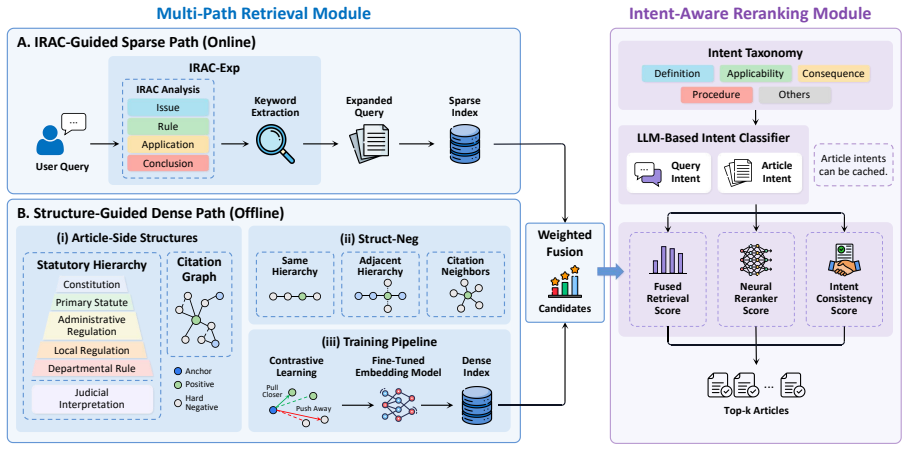
LexPath combines IRAC-guided sparse retrieval, hierarchy-based dense paths, and intent reranking to better match legally relevant articles than standard methods.
A machine-rendered reading of the paper's core claim, the machinery that carries it, and where it could break.
Core claim
The central claim is that the multi-path retrieval module (IRAC-guided sparse path plus structure-guided dense path with hierarchy-derived hard negatives) followed by an intent-aware reranking module produces candidate rankings that more reliably identify legally applicable articles than surface-similarity baselines.
What carries the argument
The multi-path retrieval module that runs an IRAC-guided sparse path in parallel with a structure-guided dense path, followed by the intent consistency reranking module.
If this is right
- Legal AI systems can ground conclusions in specific articles more reliably across both public and professional query types.
- Retrieval performance improves when hard negatives are chosen from legal hierarchy and citation relations rather than random or surface-similar negatives.
- Intent consistency between query and article provides an additional signal that refines rankings beyond initial retrieval scores.
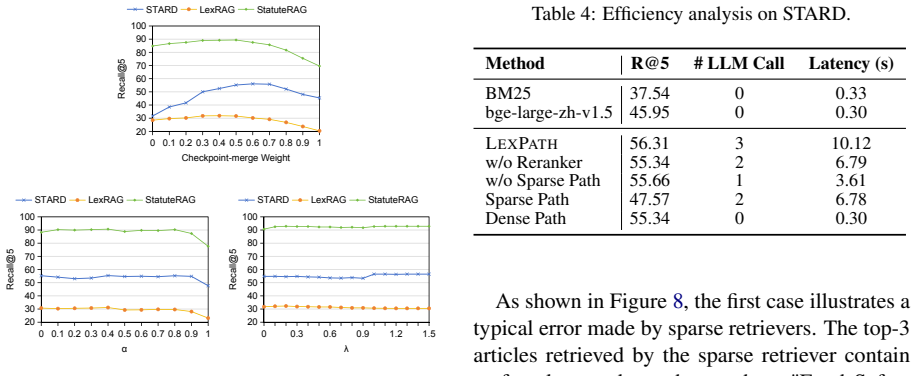
- Ablation results indicate that removing any one of the three components reduces performance on the reported benchmarks.
Where Pith is reading between the lines
- The same two-path design could be tested in other domains that have explicit hierarchical structures and citation graphs, such as regulatory compliance or medical guidelines.
- If the intent reranker proves robust, it could be adapted to surface cases where a retrieved article is textually close but contradicts the query's underlying goal.
- The self-constructed professional benchmark suggests that domain-specific test sets are needed to measure progress beyond general-public queries.
Load-bearing premise
The improvements on the benchmarks arise because the IRAC keywords, hierarchy hard negatives, and intent scores actually capture legal relevance distinctions that standard methods miss.
What would settle it
A new legal retrieval benchmark, especially one with professional queries, on which LexPath shows no statistically significant gain over the strongest adaptive RAG baseline would falsify the central claim.
Figures

read the original abstract
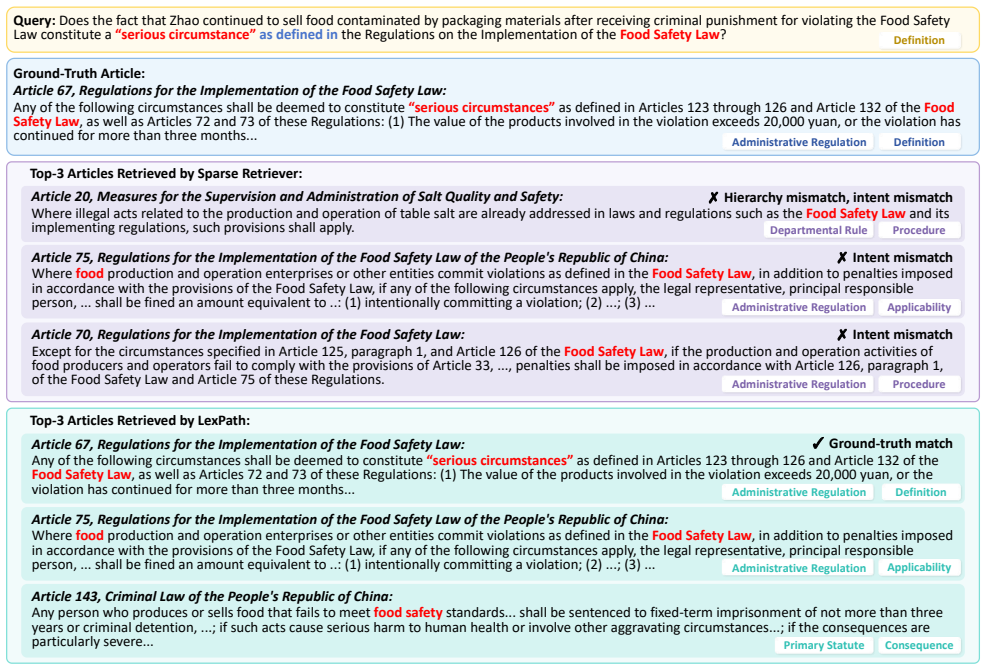
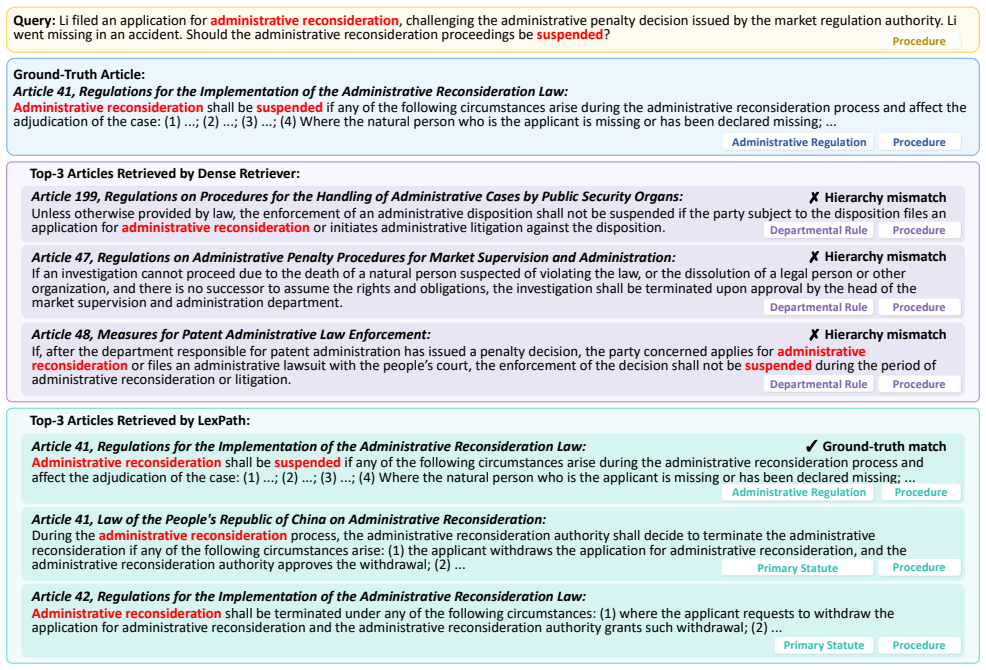
Legal article retrieval is critical for building traceable and reliable legal AI systems, where conclusions must be grounded in specific legal articles. However, existing open-domain retrieval methods rely heavily on surface-level lexical or semantic similarity, making it difficult for them to distinguish legally relevant articles from those that are textually similar but legally inapplicable or misaligned with the user's underlying intent. To bridge this gap, we propose \textsc{LexPath}, a domain-oriented multi-path framework comprising a multi-path retrieval module and an intent-aware reranking module. The retrieval module combines two complementary legal-specific paths to collect candidate articles: an IRAC-guided sparse path that expands queries with legally informative keywords, and a structure-guided dense path trained with hard negatives derived from legal hierarchy and citation relations. Then, the reranking module further refines the candidate ranking by incorporating the intent consistency score between queries and legal articles. We evaluate \textsc{LexPath} on two publicly available benchmarks focusing on general-public queries and a self-constructed benchmark targeting domain-professional scenarios. Experimental results demonstrate that \textsc{LexPath} consistently outperforms lexical, dense, hybrid, and adaptive retrieval-augmented generation (RAG) baselines. Ablation studies further verify the effectiveness of each component.
Editorial analysis
A structured set of objections, weighed in public.
Referee Report
Summary. The paper proposes LexPath, a domain-oriented multi-path framework for legal article retrieval. It includes a retrieval module with an IRAC-guided sparse path (expanding queries with legal keywords) and a structure-guided dense path (trained with hard negatives from legal hierarchy and citations), plus an intent-aware reranking module using intent consistency scores. Experiments on two public benchmarks (general-public queries) and one self-constructed benchmark (domain-professional scenarios) claim consistent outperformance over lexical, dense, hybrid, and adaptive RAG baselines, with ablations supporting each component.
Significance. If the empirical claims hold with proper validation, LexPath could meaningfully advance legal IR by moving beyond surface similarity to incorporate domain structures like IRAC and hierarchy relations, aiding traceable legal AI. The multi-path design and hard-negative strategy are promising for domain-specific retrieval, but the abstract alone provides insufficient detail on methods, data, or results to gauge real impact or reproducibility.
major comments (2)
- [Abstract] Abstract: The central claim of consistent outperformance and effective ablations cannot be evaluated, as the abstract supplies no methods details, dataset statistics, error bars, statistical significance tests, or full experimental setup (including how baselines were implemented or how the self-constructed benchmark was built).
- [Evaluation] Evaluation section (inferred from abstract): The self-constructed benchmark targeting domain-professional scenarios is load-bearing for the domain-oriented claim, yet no description of its size, query construction, annotation process, or inter-annotator agreement is provided, undermining the ability to assess whether improvements reflect legal relevance rather than benchmark artifacts.
minor comments (3)
- [Abstract] Abstract: Define 'IRAC-guided' more precisely and give at least one concrete example of keyword expansion for a sample query.
- [Abstract] Abstract: Specify the public benchmarks by name and citation, and clarify the exact metrics used (e.g., nDCG@10, Recall@100).
- [Abstract] Abstract: The phrase 'adaptive retrieval-augmented generation (RAG) baselines' is vague; list the specific RAG methods compared.
Simulated Author's Rebuttal
We thank the referee for the detailed feedback. We address each major comment below and indicate where revisions will be made to strengthen the manuscript.
read point-by-point responses
-
Referee: [Abstract] Abstract: The central claim of consistent outperformance and effective ablations cannot be evaluated, as the abstract supplies no methods details, dataset statistics, error bars, statistical significance tests, or full experimental setup (including how baselines were implemented or how the self-constructed benchmark was built).
Authors: We agree the abstract is high-level by design and omits these specifics due to length limits. The full manuscript provides methods details in Section 3 (IRAC-guided sparse path with legal keyword expansion, structure-guided dense path using hierarchy/citation hard negatives, and intent-aware reranking), benchmark statistics and construction in Section 4, baseline implementations, error bars, and significance tests in Section 5. To improve evaluability from the abstract, we will add concise mentions of key dataset sizes and note that full experimental protocols appear in the body. revision: partial
-
Referee: [Evaluation] Evaluation section (inferred from abstract): The self-constructed benchmark targeting domain-professional scenarios is load-bearing for the domain-oriented claim, yet no description of its size, query construction, annotation process, or inter-annotator agreement is provided, undermining the ability to assess whether improvements reflect legal relevance rather than benchmark artifacts.
Authors: The abstract does not contain these details. The full manuscript describes the self-constructed benchmark in Section 4, covering size, professional query construction, annotation process, and inter-annotator agreement. If the existing description remains insufficient to evaluate legal relevance versus artifacts, we will expand it with additional statistics, query examples, and validation metrics. revision: yes
Circularity Check
No significant circularity
full rationale
The paper is an empirical proposal of a multi-path legal retrieval framework (IRAC-guided sparse path + structure-guided dense path + intent reranking) whose central claims rest on benchmark outperformance versus lexical/dense/hybrid/RAG baselines. No equations, first-principles derivations, fitted parameters renamed as predictions, or load-bearing self-citations appear in the abstract or described method; the evaluation is externally falsifiable on public benchmarks and does not reduce to self-definition or construction.
Axiom & Free-Parameter Ledger
Reference graph
Works this paper leans on
-
[1]
ChatGLM: A Family of Large Language Models from GLM-130B to GLM-4 All Tools
Precise zero-shot dense retrieval without rel- evance labels. InProceedings of the 61st Annual Meeting of the Association for Computational Lin- guistics (Volume 1: Long Papers), pages 1762–1777. Team GLM, Aohan Zeng, Bin Xu, Bowen Wang, Chen- hui Zhang, Da Yin, Diego Rojas, Guanyu Feng, Han- lin Zhao, Hanyu Lai, Hao Yu, Hongning Wang, Jiadai Sun, Jiajie ...
work page internal anchor Pith review Pith/arXiv arXiv 2024
-
[2]
Summary of the competition on legal infor- mation, extraction/entailment (coliee) 2023. InPro- ceedings of the nineteenth international conference on artificial intelligence and law, pages 472–480. 9 Abe Bohan Hou, Orion Weller, Guanghui Qin, Eugene Yang, Dawn Lawrie, Nils Holzenberger, Andrew Blair-Stanek, and Benjamin Van Durme. 2025. Clerc: A dataset f...
-
[3]
Legalbench-RAG: A benchmark for retrieval-augmented generation in the legal domain,
An annotation language for semantic search of legal sources. InProceedings of the Eleventh International Conference on Language Resources and Evaluation (LREC 2018). OpenAI. 2026a. GPT-5.5. https://platform. openai.com/docs/models. Accessed: 2026-05-23. OpenAI. 2026b. Openai python api library. https:// github.com/openai/openai-python. Accessed: 2026-05-1...
-
[4]
1 你是一位经验丰富的法律顾问。请针对 下面的法律问题,使用IRAC方法进行分 析并回答,即:
Corrective retrieval augmented generation. 1 你是一位经验丰富的法律顾问。请针对 下面的法律问题,使用IRAC方法进行分 析并回答,即:
-
[5]
然后分析事实如何适用这些规则 (Application)
-
[6]
Please analyze and answer the following legal question using the IRAC method:
最后给出结论(Conclusion) 问题: {question} English translation: You are an experienced legal advisor. Please analyze and answer the following legal question using the IRAC method:
-
[7]
First, identify the issue
-
[8]
Next, state the relevant legal rules
-
[9]
Then, analyze how the facts apply to these rules
-
[10]
Question: {question} Prompts for IRAC Analysis Fangyi Yu, Lee Quartey, and Frank Schilder
Finally, draw a conclusion. Question: {question} Prompts for IRAC Analysis Fangyi Yu, Lee Quartey, and Frank Schilder. 2022. Le- gal prompting: Teaching a language model to think like a lawyer.arXiv preprint arXiv:2212.01326. A Prompt for LEXPATH The prompts used in IRAC-Exp are shown in Fig- ure 4 for IRAC analysis and Figure 5 for keyword extraction. Th...
-
[11]
used for training legal professionals. The manual focuses on market supervision and admin- istration laws and contains 500 single-choice ques- tions, together with explanatory analysis and legal articles reference for each option. The process of constructing a query dataset is as follows: 11 1 任务:
-
[12]
理解问题的语义并改写为更专业的法 律术语。
-
[13]
执行同义词替换,确保问题的核心法 律含义不变。
-
[14]
请直接以[关键词1, 关键词2,...]的格式 输出关键词列表,不要有多余的内容。 问题:{question} 关键词列表: English translation: Task:
-
[15]
Understand the meaning of the question and rephrase it using more professional legal terminology
-
[16]
Replace words with synonyms while ensuring the core legal meaning of the question remains unchanged
-
[17]
Extract keywords to be used for searching relevant legal provisions
-
[18]
Please provide as many keywords as possible
-
[19]
定义类"、"适用类
Please output the keyword list directly in the format [Keyword 1, Keyword 2, ...] without any additional content. Question: {question} Keyword list: Prompts for Keyword Extraction • Exclude questions that are overly trivial, am- biguous, overly dependent, incomplete con- text, or lack a clear legal article reference, and use the remaining ones as seed que...
2024
-
[20]
serious circumstance
and GPT-5.5 (OpenAI, 2026a), under four retriever settings: zero-shot, BM25, bge-large-zh- v1.5, and LEXPATH. Following (Li et al., 2025c), keyword accuracy is adopted as the metric for short-answer queries in LexRAG. For StatuteRAG, which consists entirely of true-or-false queries, an- swer accuracy is reported. STARD is excluded because it does not prov...
discussion (0)
Sign in with ORCID, Apple, or X to comment. Anyone can read and Pith papers without signing in.