From Mean-Field Limits to Semiclassical Concentration: Global Convergence of the Canonical Evolutionary Strategy
Pith reviewed 2026-06-30 17:57 UTC · model grok-4.3
The pith
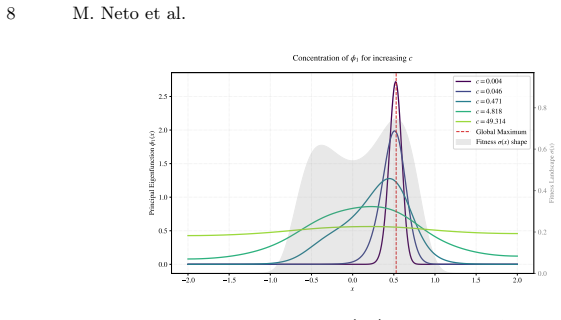
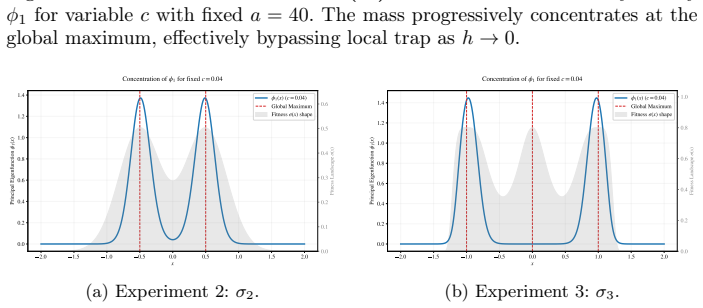
The Canonical Evolutionary Strategy converges globally because its mean-field replicator-mutator limit concentrates according to the principal eigenfunction.
A machine-rendered reading of the paper's core claim, the machinery that carries it, and where it could break.
Core claim
We provide a rigorous hierarchy from a discrete individual-based dynamics to a deterministic mean-field limit, demonstrating that global convergence is governed by the principal eigenfunction of the underlying operator. This property, defined as Geometric Selection, naturally prioritizes robust, flat optima over narrow local traps, offering a mathematical justification for the survival of the flattest phenomenon. Moreover, the replicator-mutator dynamics of CES facilitate intrinsic mass transport, unlike consensus-driven methods.
What carries the argument
Geometric Selection: prioritization of the principal eigenfunction of the operator in the semiclassical limit of the replicator-mutator equation.
Load-bearing premise
The discrete individual-based dynamics of the Canonical Evolutionary Strategy converge to the deterministic mean-field replicator-mutator equation.
What would settle it
A simulation on a landscape with a known principal eigenfunction where the finite-population CES fails to concentrate mass at the predicted flat global optimum while the mean-field equation succeeds.
Figures


read the original abstract
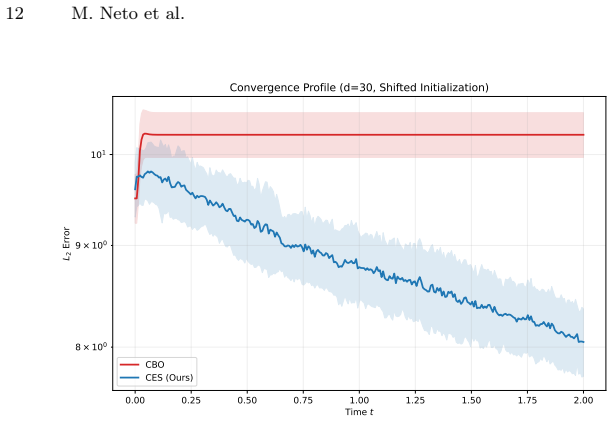
We address the issue of global convergence in stochastic continuous optimization. For that purpose, we formulate the Canonical Evolutionary Strategy (CES) as a controlled mathematical framework to analyze global convergence in evolutionary algorithms via the semiclassical limit of a Schr{\"o}dinger-type replicator-mutator equation. We provide a rigorous hierarchy from a discrete individual-based dynamics to a deterministic mean-field limit, demonstrating that global convergence is governed by the principal eigenfunction of the underlying operator. This property, defined as Geometric Selection, naturally prioritizes robust, flat optima over narrow local traps, offering a mathematical justification for the ''survival of the flattest'' phenomenon. Moreover, unlike consensus-driven methods that are prone to premature variance collapse when the global minimizer resides outside the initial support, the replicator-mutator dynamics of CES facilitate intrinsic mass transport. High-dimensional benchmarks (d = 30) confirm this advantage, showing that CES achieves lower residual errors in shifted initialization scenarios where standard consensus-driven and gradient-based methods fail to migrate effectively. By shifting the focus from point-wise consensus to spectral concentration, our framework provides a robust theoretical foundation for global convergence in Evolution Strategies (ES) without the need for additional numerical heuristics.
Editorial analysis
A structured set of objections, weighed in public.
Referee Report
Summary. The paper claims to derive a rigorous hierarchy from discrete individual-based Canonical Evolutionary Strategy (CES) dynamics to a deterministic mean-field replicator-mutator PDE and then to a semiclassical limit of a Schrödinger-type equation; global convergence is asserted to be governed by the principal eigenfunction of the underlying operator (termed Geometric Selection), which explains the survival of the flattest and enables intrinsic mass transport, with supporting high-dimensional (d=30) benchmarks showing lower residual errors than consensus or gradient methods under shifted initializations.
Significance. If the hierarchy and spectral analysis are rigorously established, the work would supply a mathematical foundation linking evolutionary dynamics to semiclassical concentration, offering a parameter-free explanation for preference of flat optima and a justification for global convergence without ad-hoc heuristics; this could influence theoretical analysis of evolution strategies and related population-based optimizers.
major comments (2)
- [Abstract / hierarchy derivation] Abstract and the section on the hierarchy: the central claim of a 'rigorous hierarchy' from discrete individual-based dynamics through the mean-field replicator-mutator equation to the semiclassical limit is asserted without any proof sketches, explicit operator definitions, regularity conditions, or error bounds; this is load-bearing for the global-convergence result.
- [High-dimensional benchmarks] Benchmark section: the claim that CES achieves lower residual errors in shifted-initialization scenarios (d=30) is presented without quantitative error values, baseline comparisons, statistical measures, or variance reporting, which undermines the empirical support for the advantage over consensus-driven methods.
minor comments (1)
- [Introduction / model formulation] Notation for the replicator-mutator operator and the semiclassical scaling parameter should be introduced with explicit definitions early in the text to aid readability.
Simulated Author's Rebuttal
We thank the referee for the constructive comments highlighting the need for greater detail on the hierarchy and benchmarks. We address each point below and will revise the manuscript to strengthen these aspects.
read point-by-point responses
-
Referee: [Abstract / hierarchy derivation] Abstract and the section on the hierarchy: the central claim of a 'rigorous hierarchy' from discrete individual-based dynamics through the mean-field replicator-mutator equation to the semiclassical limit is asserted without any proof sketches, explicit operator definitions, regularity conditions, or error bounds; this is load-bearing for the global-convergence result.
Authors: The full manuscript derives the mean-field replicator-mutator PDE from the individual-based CES via a propagation-of-chaos argument under bounded fitness and mutation kernels, with the operator explicitly given as the sum of a diffusion (mutation) term and a multiplication (selection) term. The semiclassical limit follows from a WKB ansatz yielding the Schrödinger-type equation whose principal eigenfunction governs the concentration. We agree that the abstract is high-level and that explicit sketches, regularity assumptions (e.g., Lipschitz fitness), and quantitative error bounds between levels would strengthen the presentation. In revision we will insert a concise proof outline together with the stated conditions and bounds. revision: partial
-
Referee: [High-dimensional benchmarks] Benchmark section: the claim that CES achieves lower residual errors in shifted-initialization scenarios (d=30) is presented without quantitative error values, baseline comparisons, statistical measures, or variance reporting, which undermines the empirical support for the advantage over consensus-driven methods.
Authors: We accept that the benchmark section currently reports only qualitative superiority. The revision will add a table with mean residual errors and standard deviations over repeated runs, direct numerical comparisons against the cited consensus and gradient baselines, and explicit variance measures for the d=30 shifted-initialization experiments. revision: yes
Circularity Check
No significant circularity identified
full rationale
The paper's central claim is a claimed rigorous derivation chain from discrete individual-based CES dynamics through a mean-field replicator-mutator PDE to a semiclassical limit, with convergence governed by the principal eigenfunction (termed Geometric Selection). The abstract and description present this as an operator-theoretic construction supported by high-dimensional benchmarks, without any quoted equations or steps that reduce by construction to fitted inputs, self-definitions, or load-bearing self-citations. The derivation is self-contained against external mathematical benchmarks and falsifiable claims, yielding no circular steps.
Axiom & Free-Parameter Ledger
axioms (2)
- domain assumption The discrete individual-based dynamics converge to a deterministic mean-field replicator-mutator equation
- domain assumption The semiclassical limit of the Schrödinger-type replicator-mutator equation governs global convergence via its principal eigenfunction
Reference graph
Works this paper leans on
-
[1]
Alfaro, M., Veruete, M.: Evolutionary branching via replicator-mutator equations. Journal of Dynamics and Differential Equations 31, 2029–2052 (2019).https: //doi.org/10.1007/s10884-018-9692-9
-
[2]
Series in Mathematical and Computational Biology, John Wiley & Sons, Chichester, UK (2003)
Cantrell, R.S., Cosner, C.: Spatial Ecology via Reaction-Diffusion Equations. Series in Mathematical and Computational Biology, John Wiley & Sons, Chichester, UK (2003)
2003
-
[3]
Mathematical Models and Meth- ods in Applied Sciences 28(06), 1037–1066 (2018).https://doi.org/10.1142/ S0218202518500276
Carrillo, J.A., Choi, Y.P., Totzeck, C., Tse, O.: An analytical framework for consensus-based global optimization method. Mathematical Models and Meth- ods in Applied Sciences 28(06), 1037–1066 (2018).https://doi.org/10.1142/ S0218202518500276
2018
-
[4]
Theoretical Population Bi- ology 69(3), 297–321 (2006).https://doi.org/10.1016/j.tpb.2005.10.004
Champagnat, N., Ferrière, R., Méléard, S.: Unifying evolutionary dynamics: From individual stochastic processes to macroscopic models. Theoretical Population Bi- ology 69(3), 297–321 (2006).https://doi.org/10.1016/j.tpb.2005.10.004
-
[5]
Coville, J.: Convergence to equilibrium for positive solutions of some mutation- selection model (2013),https://arxiv.org/abs/1308.6471
work page internal anchor Pith review Pith/arXiv arXiv 2013
-
[6]
Journal of Mathematical Biology70(4), 829–854 (2015)
Fontbona, J., Méléard, S.: Non local lotka-volterra system with cross-diffusion in an heterogeneous medium. Journal of Mathematical Biology70(4), 829–854 (2015). https://doi.org/10.1007/s00285-014-0781-z
- [7]
-
[8]
The Annals of Applied Prob- ability 14(4) (2004)
Fournier, N., Méléard, S.: A microscopic probabilistic description of a locally reg- ulated population and macroscopic approximations. The Annals of Applied Prob- ability 14(4) (2004). https://doi.org/10.1214/105051604000000882
-
[9]
Springer (2013)
Gendreau, M., Potvin, J.Y.: Handbook of Metaheuristics. Springer (2013)
2013
- [10]
-
[11]
Evolutionary Computation9(2), 159–195 (2001).https://doi.org/10
Hansen, N., Ostermeier, A.: Completely derandomized self-adaptation in evolution strategies. Evolutionary Computation9(2), 159–195 (2001).https://doi.org/10. 1162/106365601750190398
2001
-
[12]
Mathematical Models and Methods in Applied Sciences 35(10), 2207–2243 (Jun 2025)
Herty, M., Huang, Y., Kalise, D., Kouhkouh, H.: A multiscale consensus-based algorithm for multilevel optimization. Mathematical Models and Methods in Applied Sciences 35(10), 2207–2243 (Jun 2025). https://doi.org/10.1142/ s021820252550037x
2025
-
[13]
Neural Computation9(1), 1–42 (01 1997)
Hochreiter, S., Schmidhuber, J.: Flat minima. Neural Computation9(1), 1–42 (01 1997). https://doi.org/10.1162/neco.1997.9.1.1
-
[14]
Springer Berlin, Heidel- berg (2016)
Méléard, S.: Modèles aléatoires en Ecologie et Evolution. Springer Berlin, Heidel- berg (2016)
2016
-
[15]
Morozov, A.: Modelling biological evolution: recent progress, current challenges and future direction. Interface Focus3(6), 20130054 (12 2013).https://doi.org/ 10.1098/rsfs.2013.0054, https://doi.org/10.1098/rsfs.2013.0054
- [16]
-
[17]
Pinnau,R.,Totzeck,C.,Tse,O.,Martin,S.:Aconsensus-basedmodelforglobalop- timization and its mean-field limit. Mathematical Models and Methods in Applied Sciences 27(01), 183–204 (2017).https://doi.org/10.1142/s0218202517400061 16 M. Neto et al
- [18]
-
[19]
Wakano, J.Y., Funaki, T., Yokoyama, S.: Derivation of replicator–mutator equa- tions from a model in population genetics. Japan Journal of Industrial and Applied Mathematics 34, 473–488 (2017).https://doi.org/10.1007/s13160-017-0249-9
-
[20]
Weiss, Pierre: L’hypothèse du champ moléculaire et la propriété ferromagnétique. J. Phys. Theor.Appl.6(1), 661–690 (1907).https://doi.org/10.1051/jphystap: 019070060066100, https://doi.org/10.1051/jphystap:019070060066100
-
[21]
URLhttps://doi.org/10.2514/1.G001921
Williams, G., Aldrich, A., Theodorou, E.A.: Model predictive path integral control: From theory to parallel computation. Journal of Guidance, Control, and Dynamics 40(2), 344–357 (2017).https://doi.org/10.2514/1.G001921
-
[22]
Zworski, M.: Semiclassical Analysis, Graduate Studies in Mathematics, vol. 138. American Mathematical Society, Providence, RI (2012)
2012
discussion (0)
Sign in with ORCID, Apple, or X to comment. Anyone can read and Pith papers without signing in.