VeriGate: Verifier-Gated Step-Level Supervision for GRPO
Pith reviewed 2026-06-29 08:45 UTC · model grok-4.3
The pith
VeriGate switches to process supervision only when verifier rewards are identical across trajectories to maintain informative gradients in GRPO.
A machine-rendered reading of the paper's core claim, the machinery that carries it, and where it could break.
Core claim
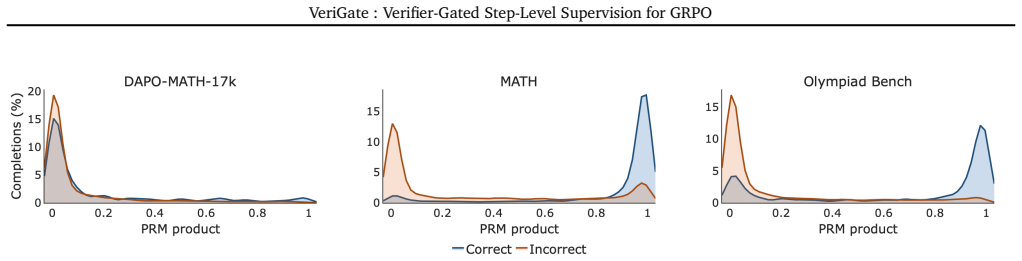
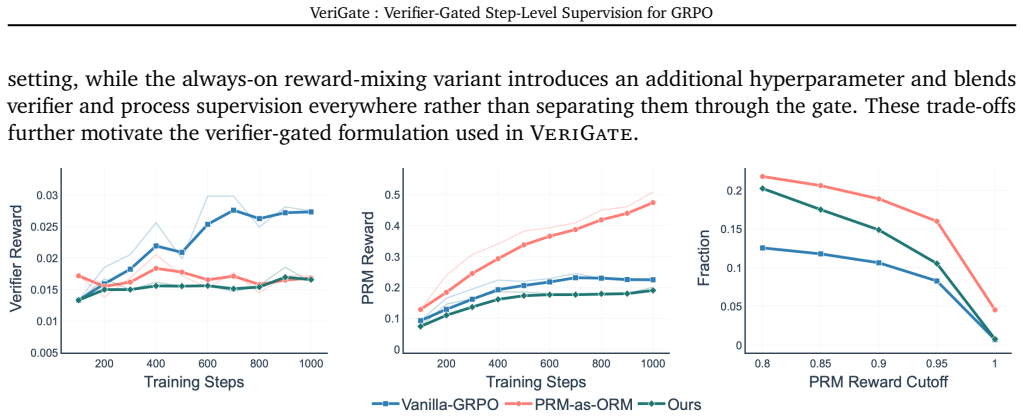
VeriGate keeps the verifier in charge whenever verifier rewards induce a meaningful preference among sampled trajectories, and uses process supervision only when verifier rewards are degenerate; it converts process reward model step scores into future-cumulated rewards to assign continuation-aware credit and transforms these rewards into group-normalized token-level advantages, restoring informative gradients and fine-grained credit assignment while remaining less susceptible to reward hacking than methods that optimize aggregated PRM scores.
What carries the argument
The verifier-gated switch that invokes process rewards only on degenerate verifier cases, together with future-cumulated reward conversion and token-level group normalization.
If this is right
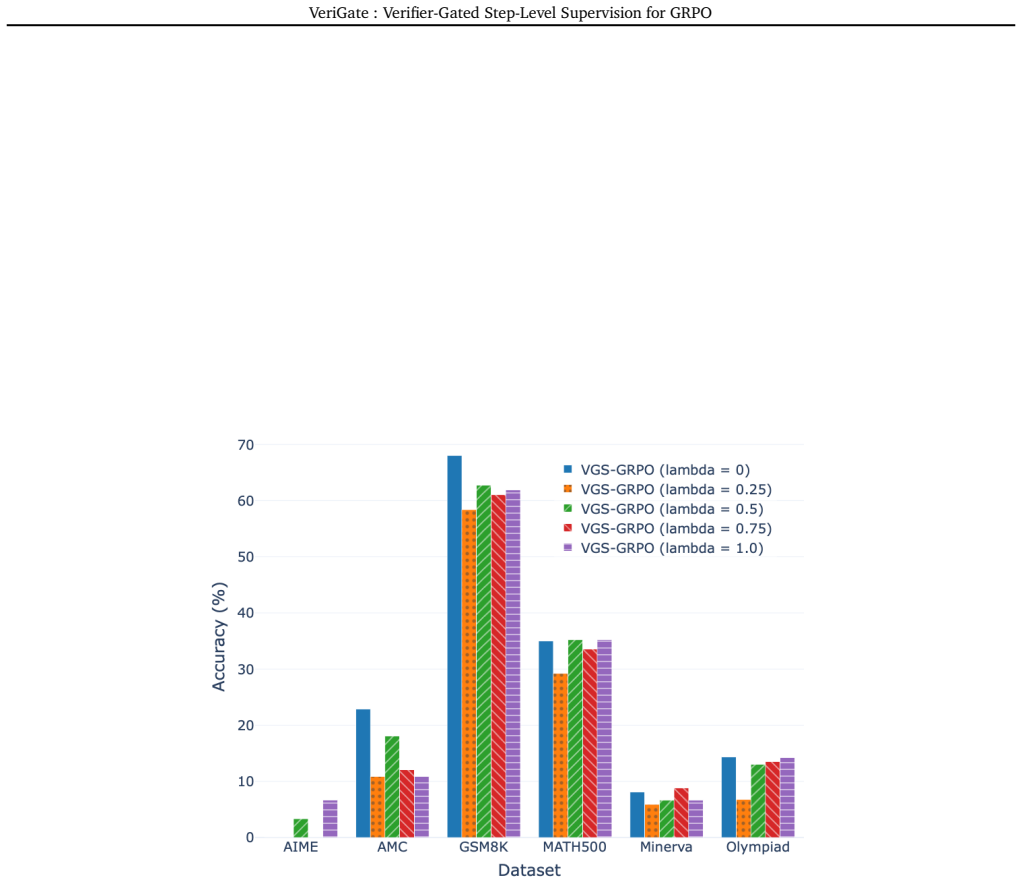
- Training 1.5B and 7B models on MATH yields average accuracy gains of about 20% and 12% across six reasoning benchmarks.
- Zero-gradient failures are substantially reduced compared with outcome-only GRPO.
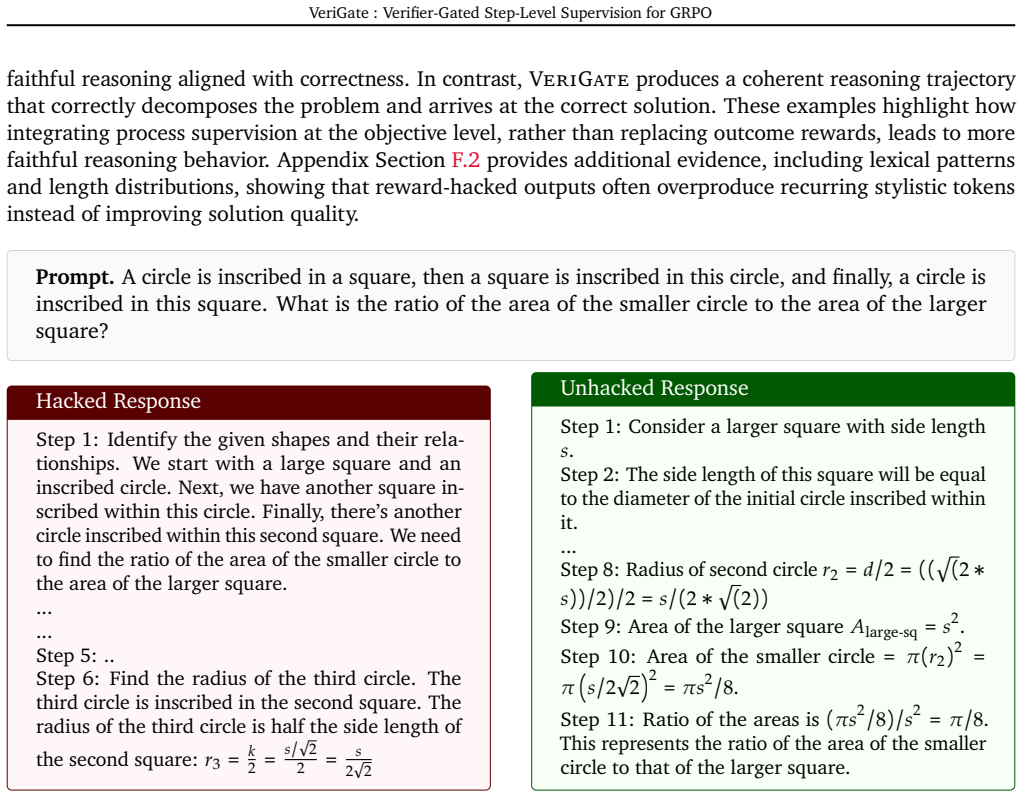
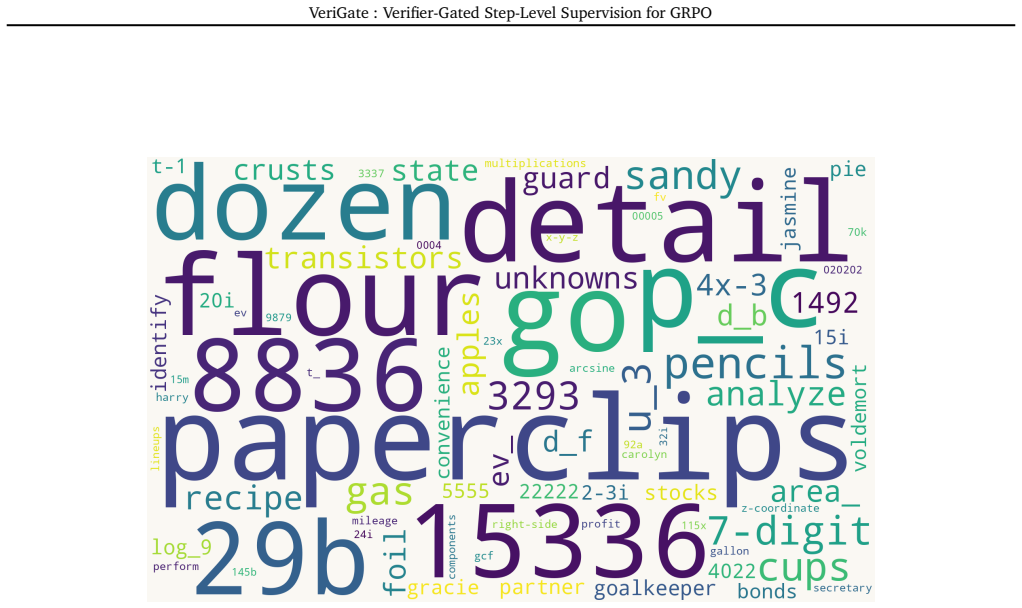
- Reward-hacking behavior decreases relative to PRM-as-outcome baselines.
- Reasoning quality improves while keeping supervision tied to the verifier whenever possible.
Where Pith is reading between the lines
- The gating rule could be tested on other policy optimization algorithms that suffer from sparse advantages.
- Future experiments might measure whether future-cumulated rewards improve performance on problems requiring longer reasoning chains.
- Adopting this hybrid approach may reduce the need for fully annotated step-level datasets in large-scale training.
Load-bearing premise
Invoking the process reward model on only degenerate verifier cases introduces no new reward-hacking surfaces or systematic bias in the advantages.
What would settle it
Running the same training setup but applying process rewards on all cases, including non-degenerate verifier outcomes, and checking whether accuracy gains disappear or reward hacking increases.
Figures


read the original abstract
Group Relative Policy Optimization (GRPO) is an effective recipe for training reasoning models with verifier-based outcome rewards, but its supervision is sparse: when all sampled trajectories for a prompt receive the same verifier reward, the group-relative advantage collapses to zero and learning stalls. Outcome-only rewards also provide no step-level credit assignment, limiting exploration and making it harder to learn robust reasoning. We present VeriGate (Verifier-Gated Step-Level GRPO), a verifier-gated extension of GRPO that addresses these limitations with three design choices. First, VeriGate keeps the verifier in charge whenever verifier rewards induce a meaningful preference among sampled trajectories, and uses process supervision only when verifier rewards are degenerate. Second, instead of collapsing Process Reward Model (PRM) step scores into a single trajectory reward, VeriGate converts them into future-cumulated rewards to assign continuation-aware credit. Third, VeriGate transforms these rewards into group-normalized token-level advantages, restoring informative gradients and fine-grained credit assignment while remaining less susceptible to reward hacking than methods that optimize aggregated PRM scores. Empirically, training on MATH with 1.5B and 7B Qwen2.5-Instruct models and evaluating on six reasoning benchmarks, VeriGate improves average accuracy by about 20% and 12% for 1.5B and 7B models respectively, substantially reduces zero-gradient failures, decreases reward-hacking behavior, and improves reasoning quality relative to outcome-only GRPO and PRM-as-outcome baselines.
Editorial analysis
A structured set of objections, weighed in public.
Referee Report
Summary. The paper introduces VeriGate, a verifier-gated extension of Group Relative Policy Optimization (GRPO) for training reasoning models. It addresses sparse outcome supervision and zero-gradient issues via three design choices: (1) retain verifier control unless all sampled trajectories receive identical rewards (degenerate case), (2) convert PRM step scores into future-cumulated token rewards rather than a single trajectory score, and (3) produce group-normalized token-level advantages. Training on MATH with 1.5B and 7B Qwen2.5-Instruct models yields reported average accuracy gains of ~20% and ~12% across six reasoning benchmarks, plus reductions in zero-gradient failures and reward-hacking relative to outcome-only GRPO and PRM-as-outcome baselines.
Significance. If the central empirical claims hold after addressing the noted gaps, VeriGate would supply a practical hybrid supervision recipe that preserves verifier reliability while adding step-level credit assignment only where needed, potentially improving stability and reasoning quality in RL for language models. The evaluation on two model scales and multiple external benchmarks is a positive aspect of the work.
major comments (1)
- [Abstract, first design choice] Abstract, first design choice: the premise that invoking the PRM only on degenerate verifier cases (all trajectories receive identical outcome reward) safely avoids systematic bias in cumulated advantages or new reward-hacking surfaces is asserted without argument, robustness analysis of degeneracy detection, or ablation; this assumption is load-bearing for the claims of reduced zero-gradient failures and lower reward-hacking relative to baselines, as imperfect gating could still propagate PRM errors into the hybrid advantages.
minor comments (1)
- [Abstract] Abstract: reported accuracy improvements are stated only as 'about 20%' and '12%' without exact deltas, standard deviations, confidence intervals, or the precise list of the six evaluation benchmarks.
Simulated Author's Rebuttal
We thank the referee for the thoughtful review and for highlighting the need for stronger justification of the gating mechanism. We address the major comment below and commit to revisions that strengthen the manuscript.
read point-by-point responses
-
Referee: [Abstract, first design choice] Abstract, first design choice: the premise that invoking the PRM only on degenerate verifier cases (all trajectories receive identical outcome reward) safely avoids systematic bias in cumulated advantages or new reward-hacking surfaces is asserted without argument, robustness analysis of degeneracy detection, or ablation; this assumption is load-bearing for the claims of reduced zero-gradient failures and lower reward-hacking relative to baselines, as imperfect gating could still propagate PRM errors into the hybrid advantages.
Authors: We agree that the current presentation asserts the safety of the verifier-gated design without sufficient supporting argument or analysis. The manuscript motivates the choice by noting that the verifier remains in control whenever it produces a non-degenerate preference among trajectories, thereby limiting PRM exposure to cases where outcome supervision provides no gradient signal. However, we acknowledge the absence of explicit robustness checks on degeneracy detection (e.g., sensitivity to near-degenerate reward distributions) and the lack of an ablation isolating the gate's contribution to the reported reductions in zero-gradient failures and reward-hacking. In the revised version we will add: (1) a dedicated paragraph in Section 3.1 formalizing the rationale and bounding the scope of PRM influence; (2) empirical statistics on degeneracy frequency across training prompts; and (3) an ablation that disables the gate (always using PRM) and measures changes in advantage bias, zero-gradient rate, and downstream accuracy. These additions will directly address the load-bearing nature of the assumption for the stability and hacking claims. revision: yes
Circularity Check
No significant circularity; method is an independent algorithmic extension evaluated on external benchmarks
full rationale
The paper introduces VeriGate as a verifier-gated extension of GRPO defined by three explicit design choices for handling degenerate verifier rewards and converting PRM scores to cumulated token-level advantages. No equations, fitted parameters, or self-citations are shown that would make the reported accuracy gains or reductions in zero-gradient failures reduce to the inputs by construction. The empirical evaluation on MATH training and six external reasoning benchmarks provides independent content, so the derivation chain remains self-contained against external results.
Axiom & Free-Parameter Ledger
axioms (1)
- domain assumption Verifier rewards induce a meaningful preference among trajectories whenever they are not all identical.
Reference graph
Works this paper leans on
-
[1]
Monitoring Reasoning Models for Misbehavior and the Risks of Promoting Obfuscation
Bowen Baker, Joost Huizinga, Leo Gao, Zehao Dou, Melody Y Guan, Aleksander Madry, Wojciech Zaremba, Jakub Pachocki, and David Farhi. Monitoring reasoning models for misbehavior and the risks of promoting obfuscation.arXiv preprint arXiv:2503.11926,
work page internal anchor Pith review Pith/arXiv arXiv
-
[2]
Peter Chen, Xiaopeng Li, Ziniu Li, Wotao Yin, Xi Chen, and Tianyi Lin. Exploration vs exploitation: Rethinking RLVR through clipping, entropy, and spurious reward.arXiv preprint arXiv:2512.16912,
-
[3]
Training Verifiers to Solve Math Word Problems
Karl Cobbe, Vineet Kosaraju, Mohammad Bavarian, Mark Chen, Heewoo Jun, Lukasz Kaiser, Matthias Plappert, Jerry Tworek, Jacob Hilton, Reiichiro Nakano, et al. Training verifiers to solve math word problems.arXiv preprint arXiv:2110.14168,
work page internal anchor Pith review Pith/arXiv arXiv
-
[4]
Sycophancy to Subterfuge: Investigating Reward-Tampering in Large Language Models
Carson Denison, Monte MacDiarmid, Fazl Barez, David Duvenaud, Shauna Kravec, Samuel Marks, Nicholas Schiefer, Ryan Soklaski, Alex Tamkin, Jared Kaplan, et al. Sycophancy to subterfuge: Investigating reward-tampering in large language models.arXiv preprint arXiv:2406.10162,
work page internal anchor Pith review Pith/arXiv arXiv
-
[5]
DeepSeek-R1: Incentivizing Reasoning Capability in LLMs via Reinforcement Learning
Daya Guo, Dejian Yang, Haowei Zhang, Junxiao Song, Ruoyu Zhang, Runxin Xu, Qihao Zhu, Shirong Ma, Peiyi Wang, Xiao Bi, et al. DeepSeek-R1: Incentivizing reasoning capability in LLMs via reinforcement learning.arXiv preprint arXiv:2501.12948,
work page internal anchor Pith review Pith/arXiv arXiv
-
[6]
Measuring Mathematical Problem Solving With the MATH Dataset
Dan Hendrycks, Collin Burns, Saurav Kadavath, Akul Arora, Steven Basart, Eric Tang, Dawn Song, and Jacob Steinhardt. Measuring mathematical problem solving with the math dataset.arXiv preprint arXiv:2103.03874,
work page internal anchor Pith review Pith/arXiv arXiv
-
[7]
Aaron Jaech, Adam Kalai, Adam Lerer, Adam Richardson, Ahmed El-Kishky, Aiden Low, Alec Helyar, Alek- sander Madry, Alex Beutel, Alex Carney, et al. OpenAI o1 system card.arXiv preprint arXiv:2412.16720,
work page internal anchor Pith review Pith/arXiv arXiv
-
[8]
Process reward models that think.arXiv preprint arXiv:2504.16828,
Muhammad Khalifa, Rishabh Agarwal, Lajanugen Logeswaran, Jaekyeom Kim, Hao Peng, Moontae Lee, Honglak Lee, and Lu Wang. Process reward models that think.arXiv preprint arXiv:2504.16828,
-
[9]
Tulu 3: Pushing Frontiers in Open Language Model Post-Training
Nathan Lambert, Jacob Morrison, Valentina Pyatkin, Shengyi Huang, Hamish Ivison, Faeze Brahman, Lester James V Miranda, Alisa Liu, Nouha Dziri, Shane Lyu, et al. Tulu 3: Pushing frontiers in open language model post-training.arXiv preprint arXiv:2411.15124,
work page internal anchor Pith review Pith/arXiv arXiv
-
[10]
Understanding R1-Zero-Like Training: A Critical Perspective
Zichen Liu, Changyu Chen, Wenjun Li, Penghui Qi, Tianyu Pang, Chao Du, Wee Sun Lee, and Min Lin. Understanding R1-Zero-like training: A critical perspective.arXiv preprint arXiv:2503.20783,
work page internal anchor Pith review Pith/arXiv arXiv
-
[11]
Improve Mathematical Reasoning in Language Models by Automated Process Supervision
Liangchen Luo, Yinxiao Liu, Rosanne Liu, Samrat Phatale, Meiqi Guo, Harsh Lara, Yunxuan Li, Lei Shu, Yun Zhu, Lei Meng, et al. Improve mathematical reasoning in language models by automated process supervision.arXiv preprint arXiv:2406.06592,
work page internal anchor Pith review Pith/arXiv arXiv
-
[12]
Unveiling over-memorization in finetuning llms for reasoning tasks.arXiv preprint arXiv:2508.04117,
Zhiwen Ruan, Yun Chen, Yutao Hou, Peng Li, Yang Liu, and Guanhua Chen. Unveiling over-memorization in finetuning llms for reasoning tasks.arXiv preprint arXiv:2508.04117,
-
[13]
Proximal Policy Optimization Algorithms
John Schulman, Filip Wolski, Prafulla Dhariwal, Alec Radford, and Oleg Klimov. Proximal policy optimization algorithms.arXiv preprint arXiv:1707.06347,
work page internal anchor Pith review Pith/arXiv arXiv
-
[14]
DeepSeekMath: Pushing the Limits of Mathematical Reasoning in Open Language Models
Zhihong Shao, Peiyi Wang, Qihao Zhu, Runxin Xu, Junxiao Song, Xiao Bi, Haowei Zhang, Mingchuan Zhang, YK Li, Yang Wu, et al. DeepSeekMath: Pushing the limits of mathematical reasoning in open language models.arXiv preprint arXiv:2402.03300,
work page internal anchor Pith review Pith/arXiv arXiv
-
[15]
Yiyou Sun, Yuhan Cao, Pohao Huang, Haoyue Bai, Hannaneh Hajishirzi, Nouha Dziri, and Dawn Song. RL grokking recipe: How does RL unlock and transfer new algorithms in LLMs?arXiv preprint arXiv:2509.21016,
-
[16]
Kimi k1.5: Scaling Reinforcement Learning with LLMs
Kimi Team, Angang Du, Bofei Gao, Bowei Xing, Changjiu Jiang, Cheng Chen, Cheng Li, Chenjun Xiao, Chenzhuang Du, Chonghua Liao, et al. Kimi k1.5: Scaling reinforcement learning with LLMs.arXiv preprint arXiv:2501.12599,
work page internal anchor Pith review Pith/arXiv arXiv
-
[17]
Solving math word problems with process- and outcome-based feedback
Jonathan Uesato, Nate Kushman, Ramana Kumar, Francis Song, Noah Siegel, Lisa Wang, Antonia Creswell, Geoffrey Irving, and Irina Higgins. Solving math word problems with process-and outcome-based feedback. arXiv preprint arXiv:2211.14275,
work page internal anchor Pith review Pith/arXiv arXiv
-
[18]
Lecheng Yan, Ruizhe Li, Guanhua Chen, Qing Li, Jiahui Geng, Wenxi Li, Vincent Wang, and Chris Lee. Spurious rewards paradox: Mechanistically understanding how rlvr activates memorization shortcuts in llms.arXiv preprint arXiv:2601.11061,
work page internal anchor Pith review Pith/arXiv arXiv
-
[19]
Qwen2.5-Math Technical Report: Toward Mathematical Expert Model via Self-Improvement
An Yang, Beichen Zhang, Binyuan Hui, Bofei Gao, Bowen Yu, Chengpeng Li, Dayiheng Liu, Jianhong Tu, Jingren Zhou, Junyang Lin, Keming Lu, Mingfeng Xue, Runji Lin, Tianyu Liu, Xingzhang Ren, and Zhenru Zhang. Qwen2.5-math technical report: Toward mathematical expert model via self-improvement.arXiv preprint arXiv:2409.12122,
work page internal anchor Pith review Pith/arXiv arXiv
-
[20]
Treerpo: Tree relative policy optimization.arXiv preprint arXiv:2506.05183,
13 VeriGate : Verifier-Gated Step-Level Supervision for GRPO Zhicheng Yang, Zhijiang Guo, Yinya Huang, Xiaodan Liang, Yiwei Wang, and Jing Tang. Treerpo: Tree relative policy optimization.arXiv preprint arXiv:2506.05183,
-
[21]
DAPO: An Open-Source LLM Reinforcement Learning System at Scale
QiyingYu, ZhengZhang, RuofeiZhu, YufengYuan, XiaochenZuo, YuYue, WeinanDai, TiantianFan, Gaohong Liu, Lingjun Liu, et al. DAPO: An open-source LLM reinforcement learning system at scale.arXiv preprint arXiv:2503.14476,
work page internal anchor Pith review Pith/arXiv arXiv
-
[22]
Does Reinforcement Learning Really Incentivize Reasoning Capacity in LLMs Beyond the Base Model?
Yang Yue, Zhiqi Chen, Rui Lu, Andrew Zhao, Zhaokai Wang, Shiji Song, and Gao Huang. Does reinforce- ment learning really incentivize reasoning capacity in LLMs beyond the base model?arXiv preprint arXiv:2504.13837,
work page internal anchor Pith review Pith/arXiv arXiv
-
[23]
Charlie Zhang, Graham Neubig, and Xiang Yue. On the interplay of pre-training, mid-training, and RL on reasoning language models.arXiv preprint arXiv:2512.07783, 2025a. Dan Zhang, Sining Zhoubian, Ziniu Hu, Yisong Yue, Yuxiao Dong, and Jie Tang. REST-MCTS*: LLM self- training via process reward guided tree search.Advances in Neural Information Processing ...
-
[24]
American invitational mathematics examination (aime) 2024,
Yifan Zhang and Team Math-AI. American invitational mathematics examination (aime) 2024,
2024
-
[25]
The Lessons of Developing Process Reward Models in Mathematical Reasoning
Zhenru Zhang, Chujie Zheng, Yangzhen Wu, Beichen Zhang, Runji Lin, Bowen Yu, Dayiheng Liu, Jingren Zhou, and Junyang Lin. The lessons of developing process reward models in mathematical reasoning. arXiv preprint arXiv:2501.07301, 2025b. Zhenru Zhang, Chujie Zheng, Yangzhen Wu, Beichen Zhang, Runji Lin, Bowen Yu, Dayiheng Liu, Jingren Zhou, and Junyang Lin...
work page internal anchor Pith review Pith/arXiv arXiv
-
[26]
Limitations and Future Work Limitations.VeriGatestill depends on the availability and quality of process reward models
A. Limitations and Future Work Limitations.VeriGatestill depends on the availability and quality of process reward models. Although verifier-gating limits over-reliance on imperfect PRMs, systematic PRM biases can still shape updates on degenerate prompts. Our formulation also treats reasoning steps as units defined by the model’s generation format, so su...
2048
-
[27]
is an actor-critic RL method used for training an LLM policy. It stabilizes learning by constraining the update between the current policyπθ, the behavior policyπold used to generate 15 VeriGate : Verifier-Gated Step-Level Supervision for GRPO sampled trajectories, and a fixed reference policyπref used for KL regularization. Given a promptx, PPO samples a...
2024
-
[28]
Outcome Rewards and Process Rewards Reasoning-focused reinforcement learning uses two common kinds of feedback that differ in granularity
C.3. Outcome Rewards and Process Rewards Reasoning-focused reinforcement learning uses two common kinds of feedback that differ in granularity. Outcome rewards.Outcome rewards assign a single scalar to the full trajectory,Rout(x,y). In RLVR, this reward typically depends only on whether the final answer is correct. Outcome rewards are attractive because t...
2021
-
[29]
However, outcome-only supervision is inherently sparse
builds on this paradigm by using group-relative normalization to eliminate the need for learned reward or value models, yielding strong robustness to reward hacking and favorable scalability. However, outcome-only supervision is inherently sparse. GRPO assigns a single scalar reward to an entire reasoning trajectory and applies the same learning signal un...
2025
-
[30]
have been shown to improve credit assignment and learning efficiency. Despite their promise, PRMs are learned models trained on imperfect supervision and are therefore vulnerable to bias and distributional mismatch. Policies optimized directly using PRM outputs can exploit systematic artifacts in the reward model, leading to reward hacking behaviors that ...
discussion (0)
Sign in with ORCID, Apple, or X to comment. Anyone can read and Pith papers without signing in.