A Novel Global Context-aware Deep Neural Network for Enhanced Brain Tumor Segmentation using Magnetic Resonance Images
Pith reviewed 2026-06-29 07:57 UTC · model grok-4.3
The pith
GCSER-UNet adds global context attention to a residual UNet and raises Dice scores for brain tumor segmentation on MRI above prior best results.
A machine-rendered reading of the paper's core claim, the machinery that carries it, and where it could break.
Core claim
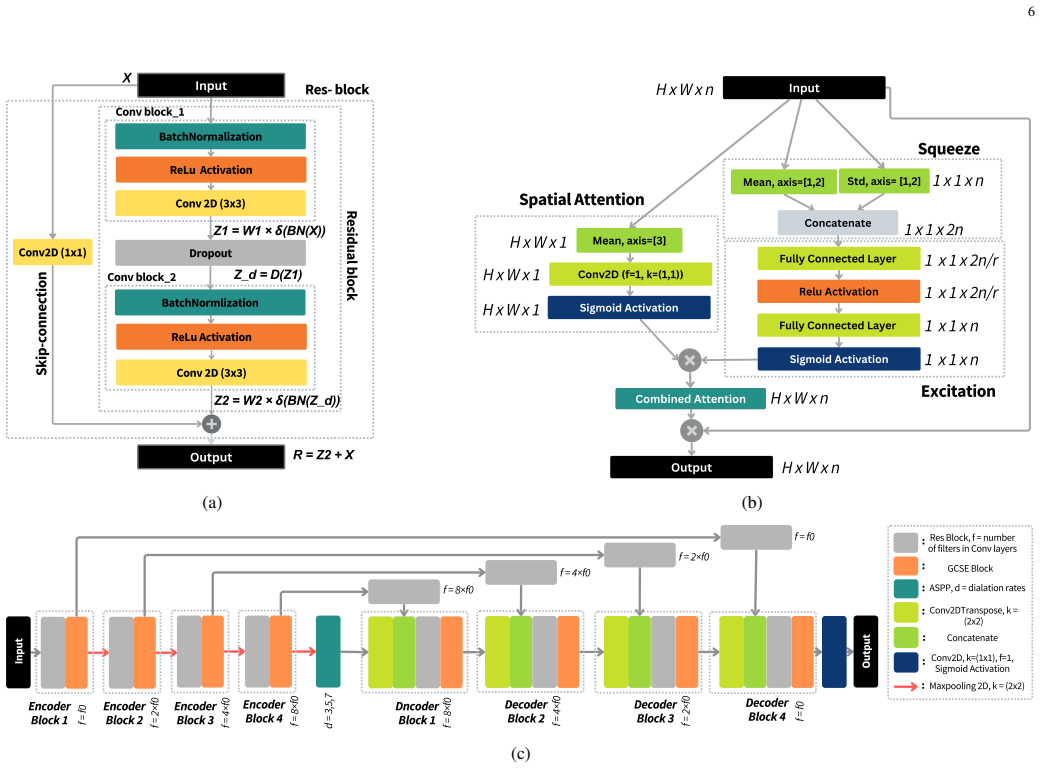
The GCSER-UNet fuses spatial and channel-wise attention inside a residual UNet backbone so that the network extracts tumor segments from multimodal MRI slices with higher accuracy than earlier models, as measured by Dice scores on the TCGA LGG and BraTS 2020 benchmarks.
What carries the argument
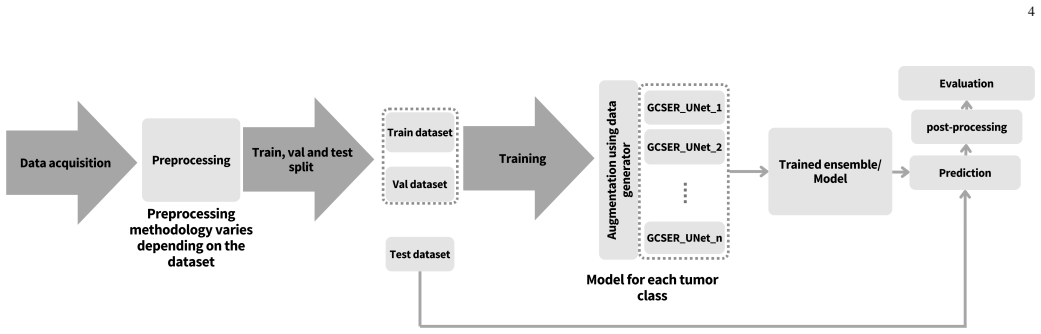
GCSER-UNet: a Global Context-aware Squeeze and Excite Residual UNet that adds squeeze-and-excite attention blocks to the standard residual UNet to integrate spatial and channel information during feature extraction.
If this is right
- The model produces 94 percent Dice on TCGA LGG, exceeding the prior record of 91.8 percent.
- On BraTS 2020 the ensemble yields 95 percent whole-tumor, 92 percent tumor-core, and 90 percent enhancing-tumor Dice, each above the listed state-of-the-art values.
- The added attention fusion increases the network's ability to model intricate spatial dependencies in MRI volumes.
- The resulting segmentations can support neurologists in diagnosis and treatment planning for brain cancer.
Where Pith is reading between the lines
- The same attention pattern could be inserted into other encoder-decoder architectures for different medical segmentation tasks.
- If the gains hold under matched training conditions, the blocks offer a modular way to upgrade existing UNet variants without redesigning the entire network.
- Clinical workflows that still rely on manual contouring could reduce time and variability by adopting the automated outputs once validation on new scanner types is complete.
Load-bearing premise
The measured gains arise from the GCSER-UNet architecture itself rather than from unstated differences in data preprocessing, augmentation, or training details versus the baselines.
What would settle it
Re-training the GCSER-UNet and the prior best models on identical data splits, preprocessing pipelines, and hyper-parameters, then finding no Dice improvement or a reversal of the reported ranking.
Figures





read the original abstract
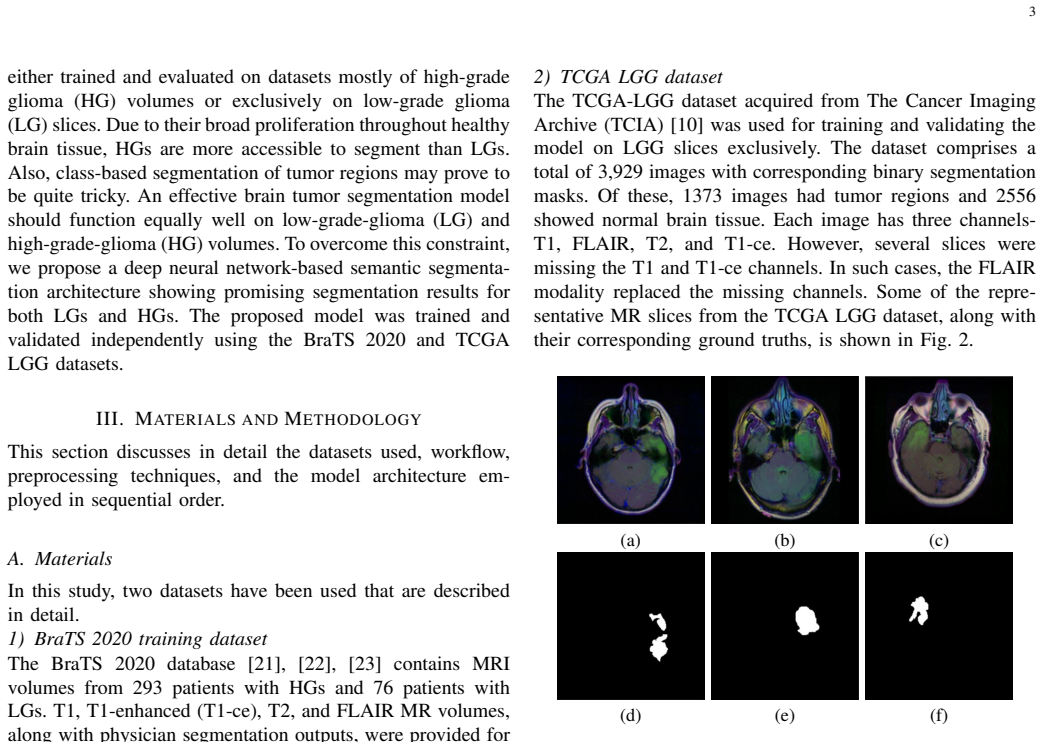
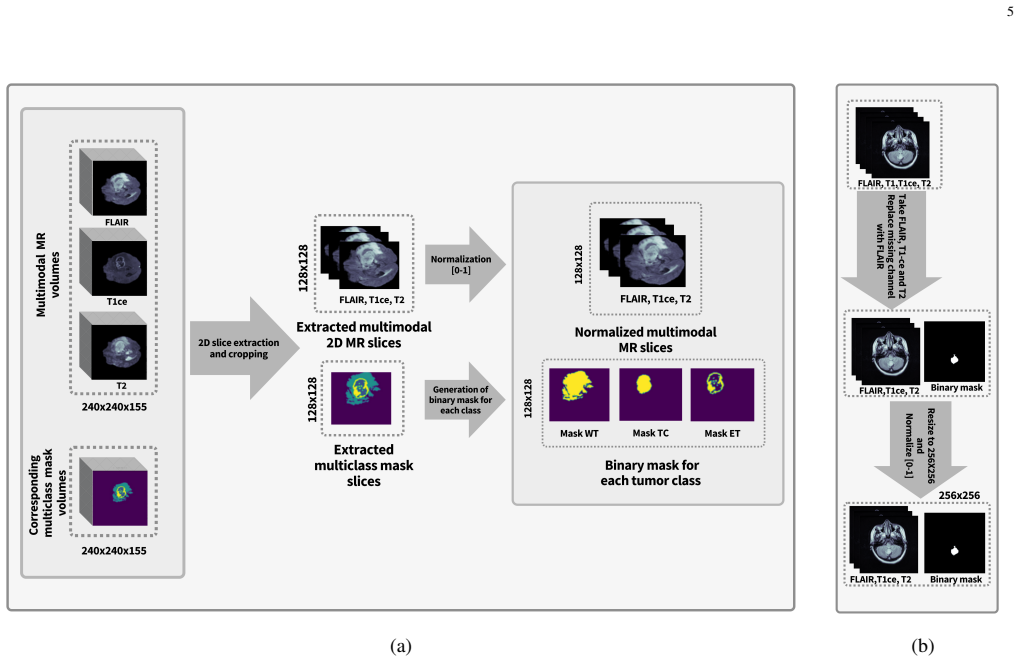
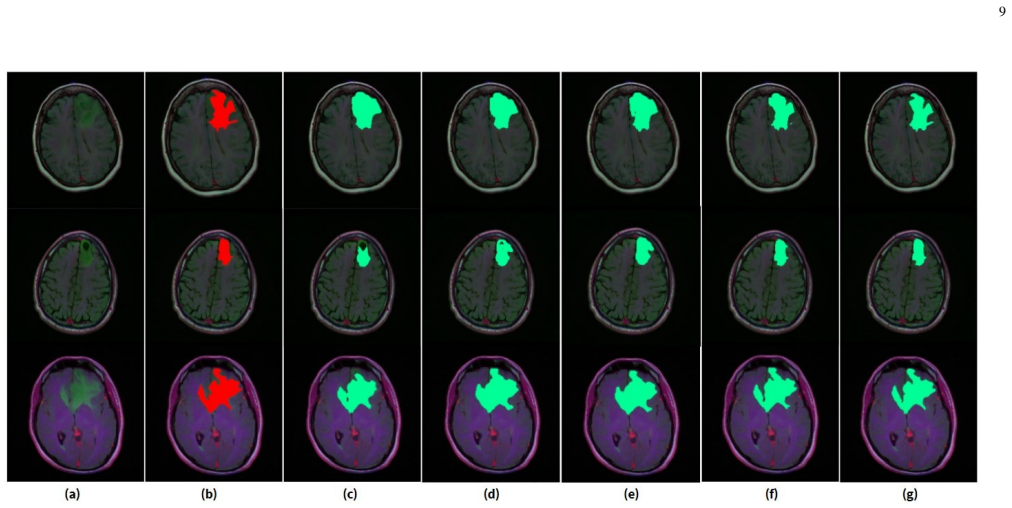
Brain cancer's severity necessitates precise brain tumor segmentation, which is crucial for effective brain tumor diagnosis. Manual identification, burdened by high costs, labor, and error risks, highlights the need for automated methods. In this study, we introduce the Global Context-aware Squeeze and Excite Residual UNet (GCSER-UNet), which facilitates a fusion of spatial and channel-wise attention and thus enhances the model's capacity to capture intricate spatial dependencies and contextual information. GCSER-UNet efficiently extracts tumor segments from multimodal MRI slices, delivering exceptional performance. Evaluations on benchmark databases exhibit its superiority, achieving a notable 94 percent dice score on the TCGA LGG dataset, surpassing the state-of-the-art dice score of 91.8 percent. In the BraTS 2020 dataset, the proposed GCSER-UNet ensemble approach yielded dice scores of 95 percent, 92 percent, and 90 percent for the tumor regions - Whole Tumor (W), Tumor Core (T), and Enhancing Tumor (E), respectively. The current state-of-the-art dice scores were 94 percent, 93 percent, and 88 percent. These compelling outcomes highlight the efficacy of GCSER-UNet in precise brain tumor segmentation and thus can aid neurologists in effective brain cancer management and treatment planning.
Editorial analysis
A structured set of objections, weighed in public.
Referee Report
Summary. The manuscript proposes the Global Context-aware Squeeze and Excite Residual UNet (GCSER-UNet) for multimodal MRI brain tumor segmentation. It claims that the architecture's fusion of spatial and channel-wise attention yields superior performance, with Dice scores of 94% on the TCGA LGG dataset (vs. prior SOTA 91.8%) and 95/92/90% for Whole Tumor/Tumor Core/Enhancing Tumor on BraTS 2020 (vs. prior 94/93/88%), using an ensemble approach.
Significance. If the reported Dice gains can be attributed to the GCSER-UNet design rather than unstated protocol differences, the work would represent a useful incremental advance in automated segmentation for brain tumor diagnosis. No machine-checked proofs, reproducible code, or parameter-free derivations are provided.
major comments (2)
- [Abstract] Abstract: The superiority claims rest on specific Dice deltas (94% vs 91.8% on TCGA LGG; 95/92/90% vs 94/93/88% on BraTS 2020). The manuscript supplies no experimental protocol, data splits, intensity normalization, augmentation schedule, hyperparameter search details, or statement that prior baselines were re-run under identical conditions, rendering the attribution of gains to the squeeze-excite residual blocks and ensemble unverified.
- [Results] Results (benchmark evaluations): No ablation studies, statistical significance tests, or variance across runs are reported to support that the performance deltas arise from the proposed global context-aware components rather than implementation differences.
minor comments (1)
- [Abstract] The abstract writes out '94 percent' rather than using the conventional '%' symbol for numerical reporting.
Simulated Author's Rebuttal
We thank the referee for the constructive feedback. We address each major comment below and will revise the manuscript accordingly to improve clarity on experimental protocols and validation of results.
read point-by-point responses
-
Referee: [Abstract] Abstract: The superiority claims rest on specific Dice deltas (94% vs 91.8% on TCGA LGG; 95/92/90% vs 94/93/88% on BraTS 2020). The manuscript supplies no experimental protocol, data splits, intensity normalization, augmentation schedule, hyperparameter search details, or statement that prior baselines were re-run under identical conditions, rendering the attribution of gains to the squeeze-excite residual blocks and ensemble unverified.
Authors: We agree the abstract omits these details. The full manuscript describes the datasets and overall evaluation but lacks a complete protocol section. In revision we will add a dedicated Experimental Setup subsection covering: patient-wise data splits (70/15/15 for TCGA LGG; standard BraTS splits), z-score intensity normalization per modality, augmentation schedule (random flips, rotations, scaling with probabilities), hyperparameter search (grid search over learning rate, batch size, optimizer), and explicit statement that SOTA baselines are cited from original papers (with note that we did not re-implement all under identical conditions). This will clarify attribution to the proposed components. revision: yes
-
Referee: [Results] Results (benchmark evaluations): No ablation studies, statistical significance tests, or variance across runs are reported to support that the performance deltas arise from the proposed global context-aware components rather than implementation differences.
Authors: We acknowledge the absence of these analyses. In the revised manuscript we will include ablation studies (e.g., baseline UNet vs. UNet + squeeze-excite residual blocks vs. full GCSER-UNet, and single model vs. ensemble) with quantitative Dice differences. We will also report mean and standard deviation over at least three independent runs with different seeds, and add statistical significance tests (paired t-test or Wilcoxon test) against baselines. These additions will help isolate the contribution of the global context-aware design. revision: yes
Circularity Check
No circularity detected; empirical results are standard post-training evaluations on public benchmarks.
full rationale
The manuscript proposes the GCSER-UNet architecture and reports Dice scores (94% on TCGA LGG; 95/92/90% on BraTS 2020) as direct evaluations after training. No derivation chain, equations, or first-principles claims are present that reduce to inputs by construction. No self-citations, fitted parameters renamed as predictions, or ansatzes smuggled via prior work are quoted. The performance comparisons raise questions of protocol equivalence versus baselines, but this is a methodological attribution issue rather than circularity under the enumerated patterns. The derivation is self-contained as an empirical ML contribution.
Axiom & Free-Parameter Ledger
free parameters (1)
- network hyperparameters and training schedule
axioms (1)
- domain assumption Attention modules improve capture of spatial and channel dependencies in MRI tumor segmentation
Reference graph
Works this paper leans on
-
[1]
Immunotherapy for brain metastases and primary brain tumors.European Journal of Cancer, 179:113–120, 2023
Anna M Di Giacomo, Maximilian J Mair, Michele Ceccarelli, Andrea Anichini, Ramy Ibrahim, Michael Weller, Michael Lahn, Alexander MM Eggermont, Bernard Fox, and Michele Maio. Immunotherapy for brain metastases and primary brain tumors.European Journal of Cancer, 179:113–120, 2023
2023
-
[2]
Immune surveillance of brain metastatic cancer cells is mediated by ifitm1.The EMBO Journal, page e111112, 2023
Xiaofei She, Shijun Shen, Guang Chen, Yaqun Gao, Junxian Ma, Yaohui Gao, Yingdi Liu, Guoli Gao, Yan Zhao, Chunyan Wang, et al. Immune surveillance of brain metastatic cancer cells is mediated by ifitm1.The EMBO Journal, page e111112, 2023. 11
2023
-
[3]
Hanne Blakstad, Jorunn Brekke, Mohummad Aminur Rahman, Vic- toria Smith Arnesen, Hrvoje Miletic, Petter Brandal, Stein Atle Lie, Martha Chekenya, and Dorota Goplen. Survival in a consecutive series of 467 glioblastoma patients: Association with prognostic factors and treatment at recurrence at two independent institutions.PloS one, 18(2):e0281166, 2023
2023
-
[4]
Recent progress in nanomedicines for imaging and therapy of brain tumors.Biomaterials Science, 2023
Ikram Hasan, Shubham Roy, Bing Guo, Shiwei Du, Tao Wei, and Chunqi Chang. Recent progress in nanomedicines for imaging and therapy of brain tumors.Biomaterials Science, 2023
2023
-
[5]
Radiation necrosis or tumor progression? a review of the radiographic modalities used in the diagnosis of cerebral radiation necrosis.Journal of Neuro-Oncology, pages 1–9, 2023
Zachary S Mayo, Ahmed Halima, James R Broughman, Timothy D Smile, Martin C Tom, Erin S Murphy, John H Suh, Simon S Lo, Gene H Barnett, Guiyun Wu, et al. Radiation necrosis or tumor progression? a review of the radiographic modalities used in the diagnosis of cerebral radiation necrosis.Journal of Neuro-Oncology, pages 1–9, 2023
2023
-
[6]
Deep learning based brain tumor segmentation: a survey.Complex & Intelli- gent Systems, 9(1):1001–1026, 2023
Zhihua Liu, Lei Tong, Long Chen, Zheheng Jiang, Feixiang Zhou, Qianni Zhang, Xiangrong Zhang, Yaochu Jin, and Huiyu Zhou. Deep learning based brain tumor segmentation: a survey.Complex & Intelli- gent Systems, 9(1):1001–1026, 2023
2023
-
[7]
A survey of deep learning for mri brain tumor segmentation methods: Trends, challenges, and future directions.Health and Technology, pages 1–21, 2023
Srigiri Krishnapriya and Yepuganti Karuna. A survey of deep learning for mri brain tumor segmentation methods: Trends, challenges, and future directions.Health and Technology, pages 1–21, 2023
2023
-
[8]
U-net: Con- volutional networks for biomedical image segmentation
Olaf Ronneberger, Philipp Fischer, and Thomas Brox. U-net: Con- volutional networks for biomedical image segmentation. InMedical Image Computing and Computer-Assisted Intervention–MICCAI 2015: 18th International Conference, Munich, Germany, October 5-9, 2015, Proceedings, Part III 18, pages 234–241. Springer, 2015
2015
-
[9]
Deep residual learning for image recognition
Kaiming He, Xiangyu Zhang, Shaoqing Ren, and Jian Sun. Deep residual learning for image recognition. InProceedings of the IEEE conference on computer vision and pattern recognition, pages 770–778, 2016
2016
-
[10]
Squeeze-and-excitation networks
Jie Hu, Li Shen, and Gang Sun. Squeeze-and-excitation networks. In Proceedings of the IEEE conference on computer vision and pattern recognition, pages 7132–7141, 2018
2018
-
[11]
Liang-Chieh Chen, George Papandreou, Iasonas Kokkinos, Kevin Mur- phy, and Alan L Yuille. Deeplab: Semantic image segmentation with deep convolutional nets, atrous convolution, and fully connected crfs.IEEE transactions on pattern analysis and machine intelligence, 40(4):834–848, 2017
2017
-
[12]
Brain tumour segmentation using a triplanar ensemble of u-nets on mr im- ages
Vaanathi Sundaresan, Ludovica Griffanti, and Mark Jenkinson. Brain tumour segmentation using a triplanar ensemble of u-nets on mr im- ages. InInternational MICCAI Brainlesion Workshop, pages 340–353. Springer, 2021
2021
-
[13]
Multi-scale masked 3-d u-net for brain tumor segmentation
Yanwu Xu, Mingming Gong, Huan Fu, Dacheng Tao, Kun Zhang, and Kayhan Batmanghelich. Multi-scale masked 3-d u-net for brain tumor segmentation. InInternational MICCAI Brainlesion Workshop, pages 222–233. Springer, 2019
2019
-
[14]
Automatic segmentation and overall survival prediction in gliomas using fully convolutional neural network and texture analysis
Varghese Alex, Mohammed Safwan, and Ganapathy Krishnamurthi. Automatic segmentation and overall survival prediction in gliomas using fully convolutional neural network and texture analysis. InInternational MICCAI Brainlesion Workshop, pages 216–225. Springer, 2017
2017
-
[15]
A stacked multi-connection simple reducing net for brain tumor segmentation.IEEE Access, 7:104011–104024, 2019
Yi Ding, Fujuan Chen, Yang Zhao, Zhixing Wu, Chao Zhang, and Dongyuan Wu. A stacked multi-connection simple reducing net for brain tumor segmentation.IEEE Access, 7:104011–104024, 2019
2019
-
[16]
Attention gate resu-net for automatic mri brain tumor segmentation
Jianxin Zhang, Zongkang Jiang, Jing Dong, Yaqing Hou, and Bin Liu. Attention gate resu-net for automatic mri brain tumor segmentation. IEEE Access, 8:58533–58545, 2020
2020
-
[17]
Hybrid- danet: An encoder-decoder based hybrid weights alignment with multi- dilated attention network for automatic brain tumor segmentation.IEEE Access, 10:122658–122669, 2022
Naveed Ilyas, Yoonguu Song, Aamir Raja, and Boreom Lee. Hybrid- danet: An encoder-decoder based hybrid weights alignment with multi- dilated attention network for automatic brain tumor segmentation.IEEE Access, 10:122658–122669, 2022
2022
-
[18]
Znet: deep learning approach for 2d mri brain tumor segmentation.IEEE Journal of Translational Engineering in Health and Medicine, 10:1–8, 2022
Mohammad Ashraf Ottom, Hanif Abdul Rahman, and Ivo D Dinov. Znet: deep learning approach for 2d mri brain tumor segmentation.IEEE Journal of Translational Engineering in Health and Medicine, 10:1–8, 2022
2022
-
[19]
Brain tu- mor segmentation of the flair mri images using novel resunet.Biomedical Signal Processing and Control, 82:104586, 2023
P Santosh Kumar, VP Sakthivel, Manda Raju, and PD Satya. Brain tu- mor segmentation of the flair mri images using novel resunet.Biomedical Signal Processing and Control, 82:104586, 2023
2023
-
[20]
Improved u-net architecture with vgg-16 for brain tumor segmentation.Physical and Engineering Sciences in Medicine, 44(3):703–712, 2021
Sourodip Ghosh, Aunkit Chaki, and KC Santosh. Improved u-net architecture with vgg-16 for brain tumor segmentation.Physical and Engineering Sciences in Medicine, 44(3):703–712, 2021
2021
-
[21]
The multimodal brain tumor image segmentation benchmark (brats).IEEE Trans
H Menze Bjoern, Jakab Andras, Bauer Stefan, Kalpathy-Cramer Jayashree, Farahani Keyvan, Kirby Justin, et al. The multimodal brain tumor image segmentation benchmark (brats).IEEE Trans. Med. Imaging, 34(10):1993–2024, 2015
1993
-
[22]
High resolution global gridded data for use in population studies.Scientific data, 4(1):1–17, 2017
Christopher T Lloyd, Alessandro Sorichetta, and Andrew J Tatem. High resolution global gridded data for use in population studies.Scientific data, 4(1):1–17, 2017
2017
-
[23]
Spyridon Bakas, Mauricio Reyes, Andras Jakab, Stefan Bauer, Markus Rempfler, Alessandro Crimi, Russell Takeshi Shinohara, Christoph Berger, Sung Min Ha, Martin Rozycki, et al. Identifying the best machine learning algorithms for brain tumor segmentation, progression assessment, and overall survival prediction in the brats challenge.arXiv preprint arXiv:18...
work page internal anchor Pith review Pith/arXiv arXiv 2018
-
[24]
Mateusz Buda, Ashirbani Saha, and Maciej A Mazurowski. Association of genomic subtypes of lower-grade gliomas with shape features auto- matically extracted by a deep learning algorithm.Computers in biology and medicine, 109:218–225, 2019
2019
-
[25]
Deep learning-based brain tumour segmentation.IETE Journal of Research, pages 1–9, 2021
Pattabiraman Ventakasubbu and Parvathi Ramasubramanian. Deep learning-based brain tumour segmentation.IETE Journal of Research, pages 1–9, 2021
2021
-
[26]
V ox2vox: 3d-gan for brain tumour segmentation
Marco Domenico Cirillo, David Abramian, and Anders Eklund. V ox2vox: 3d-gan for brain tumour segmentation. InBrainlesion: Glioma, Multiple Sclerosis, Stroke and Traumatic Brain Injuries: 6th International Workshop, BrainLes 2020, Held in Conjunction with MICCAI 2020, Lima, Peru, October 4, 2020, Revised Selected Papers, Part I 6, pages 274–284. Springer, 2021
2020
-
[27]
Mri brain tumor segmen- tation and uncertainty estimation using 3d-unet architectures
Laura Mora Ballestar and Veronica Vilaplana. Mri brain tumor segmen- tation and uncertainty estimation using 3d-unet architectures. InBrain- lesion: Glioma, Multiple Sclerosis, Stroke and Traumatic Brain Injuries: 6th International Workshop, BrainLes 2020, Held in Conjunction with MICCAI 2020, Lima, Peru, October 4, 2020, Revised Selected Papers, Part I 6...
2020
-
[28]
Generalized wasserstein dice score, distributionally robust deep learning, and ranger for brain tumor segmentation: Brats 2020 challenge
Lucas Fidon, S ´ebastien Ourselin, and Tom Vercauteren. Generalized wasserstein dice score, distributionally robust deep learning, and ranger for brain tumor segmentation: Brats 2020 challenge. InBrainlesion: Glioma, Multiple Sclerosis, Stroke and Traumatic Brain Injuries: 6th International Workshop, BrainLes 2020, Held in Conjunction with MICCAI 2020, Li...
2020
-
[29]
Irdnu-net: Inception residual dense nested u-net for brain tumor segmentation
Nagwa M AboElenein, Piao Songhao, and Ahmed Afifi. Irdnu-net: Inception residual dense nested u-net for brain tumor segmentation. Multimedia Tools and Applications, 81(17):24041–24057, 2022
2022
-
[30]
Diffraction block in extended nn-unet for brain tumor segmentation
Qingfan Hou, Zhuofei Wang, Jiao Wang, Jian Jiang, and Yanjun Peng. Diffraction block in extended nn-unet for brain tumor segmentation. In International MICCAI Brainlesion Workshop, pages 174–185. Springer, 2022
2022
discussion (0)
Sign in with ORCID, Apple, or X to comment. Anyone can read and Pith papers without signing in.