Neurodiversity in Agile Teams: Obstacles and Inclusion Barriers
Pith reviewed 2026-06-29 06:05 UTC · model grok-4.3
The pith
Agile practices support neurodivergent inclusion in software teams only when organizations adapt beyond rigid structures and one-size-fits-all methods.
A machine-rendered reading of the paper's core claim, the machinery that carries it, and where it could break.
Core claim
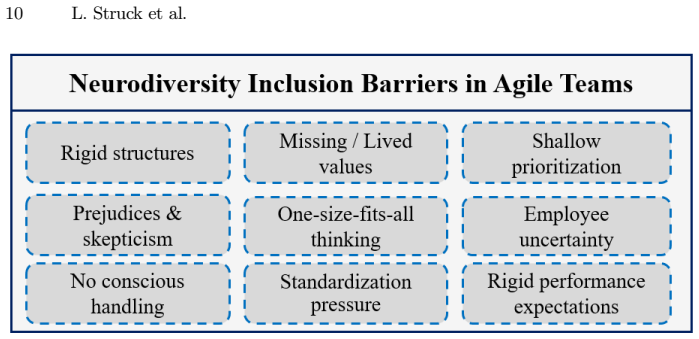
The analysis shows that teamwork practices are highly fragmented and shaped by individual adaptation rather than a shared standard. While agile practices and supportive tools can enable neurodivergent participation, rigid structures, stereotypes, and one-size-fits-all approaches often undermine inclusion. Organizational awareness and tailored adjustments remain insufficient.
What carries the argument
Mixed-method identification of barriers to neurodiversity inclusion, centered on the mismatch between agile flexibility and rigid organizational structures.
If this is right
- Agile practices promote inclusive teamwork only under flexible organizational conditions.
- Harnessing neurodiverse strengths requires tailored support and adjustments beyond standard agile methods.
- One-size-fits-all approaches in organizations limit the inclusion benefits of agile practices.
- Supportive tools enable participation but remain insufficient without addressing stereotypes and awareness gaps.
Where Pith is reading between the lines
- The identified barriers may extend to non-agile collaborative settings where similar rigidity exists.
- Targeted awareness training could be tested as a direct intervention in agile team environments.
- Patterns from this single-organization sample might indicate wider challenges in tech workplaces adopting agile methods.
Load-bearing premise
The 11 interviews from one German corporate network plus Reddit and LinkedIn content are sufficient to identify general barriers to inclusion in agile teams.
What would settle it
A study of agile teams in multiple organizations finding consistent high inclusion of neurodivergent developers without structural adaptations or awareness programs would falsify the claim.
Figures

read the original abstract
Context: Neurodiversity is increasingly recognized as a valuable dimension of workplace diversity. However, in agile software development teams, the interplay between teamwork practices and the inclusion of neurodivergent employees remains underexplored. Objective: The study aims to explore how teamwork quality in agile software development is currently practiced and discussed in the context of neurodiversity, and to identify organizational barriers that hinder the effective inclusion of neurodivergent developers. Method: We applied a mixed-method approach combining a web content analysis covering Reddit and LinkedIn with 11 semi-structured expert interviews from a corporate neurodiversity network in a German organization. Results: The analysis shows that teamwork practices are highly fragmented and shaped by individual adaptation rather than a shared standard. While agile practices and supportive tools can enable neurodivergent participation, rigid structures, stereotypes, and one-size-fits-all approaches often undermine inclusion. Organizational awareness and tailored adjustments remain insufficient. Conclusion: Agile practices can promote inclusive teamwork, yet their benefits are constrained by rigid organizational structures and limited awareness of neurodiversity. Harnessing neurodiverse strengths demands flexible organizational conditions and tailored support.
Editorial analysis
A structured set of objections, weighed in public.
Referee Report
Summary. The paper claims that agile software development practices can enable neurodivergent participation through supportive tools and flexibility, but are undermined by fragmented implementation, rigid organizational structures, stereotypes, and one-size-fits-all approaches. Based on a mixed-methods study combining web content analysis of Reddit and LinkedIn posts with 11 semi-structured interviews from a single German corporate neurodiversity network, it concludes that harnessing neurodiverse strengths requires flexible conditions and tailored support rather than standard agile practices alone.
Significance. If the barriers identified are not artifacts of the narrow sample, the work addresses an underexplored intersection of neurodiversity and agile teamwork in software engineering, providing concrete themes that could guide organizational interventions. The mixed-methods design and focus on real-world practitioner discussions add value to the literature on inclusive software teams.
major comments (2)
- [Method] Method section: The 11 interviews are recruited exclusively through one German corporate neurodiversity network, with additional data from Reddit and LinkedIn. No saturation argument, cross-site comparison, or justification for transferability is supplied to support generalizing the themes of fragmentation, stereotypes, and rigid structures to agile teams broadly, as done in the Conclusion. This narrow geography, organization type, and recruitment channel makes the central claim about organizational barriers under-supported.
- [Results and Conclusion] Results and Conclusion: High-level themes are reported (e.g., 'teamwork practices are highly fragmented'), but without details on coding procedures, inter-rater reliability, or how specific quotes map to the identified barriers, it is difficult to evaluate whether the evidence robustly supports the generalization that agile benefits are 'constrained by rigid organizational structures and limited awareness.'
minor comments (1)
- [Abstract] Abstract: The Method paragraph provides no information on analysis procedures, sample selection criteria, or how conclusions were drawn, which reduces clarity even if the full text expands on these.
Simulated Author's Rebuttal
We thank the referee for the constructive feedback on our manuscript. The comments highlight important issues regarding sample scope and analytical transparency, which we address point by point below. We propose targeted revisions to qualify our claims and improve methodological detail while preserving the exploratory contribution of the mixed-methods study.
read point-by-point responses
-
Referee: [Method] Method section: The 11 interviews are recruited exclusively through one German corporate neurodiversity network, with additional data from Reddit and LinkedIn. No saturation argument, cross-site comparison, or justification for transferability is supplied to support generalizing the themes of fragmentation, stereotypes, and rigid structures to agile teams broadly, as done in the Conclusion. This narrow geography, organization type, and recruitment channel makes the central claim about organizational barriers under-supported.
Authors: We agree that the interview sample is limited to a single German organization and recruitment channel, which constrains claims about broad generalizability. The Reddit and LinkedIn data were included to capture wider practitioner discourse, but this does not fully mitigate the single-site limitation. We will revise the Conclusion to emphasize the exploratory character of the findings and add an explicit Limitations section discussing geography, organization type, recruitment via a neurodiversity network, and implications for transferability. No saturation argument will be added because the study employs reflexive thematic analysis rather than grounded theory; instead, we will justify the sample on the basis of information richness obtained through the combined data sources. revision: partial
-
Referee: [Results and Conclusion] Results and Conclusion: High-level themes are reported (e.g., 'teamwork practices are highly fragmented'), but without details on coding procedures, inter-rater reliability, or how specific quotes map to the identified barriers, it is difficult to evaluate whether the evidence robustly supports the generalization that agile benefits are 'constrained by rigid organizational structures and limited awareness.'
Authors: We will expand the Methods section to describe the thematic analysis process in greater detail, including the iterative coding steps applied to both web content and interview transcripts, the development of themes from initial codes, and the reflexive stance adopted. Because analysis was performed by a single researcher, inter-rater reliability statistics were not computed; we will explicitly state this and outline the measures taken to support rigor (e.g., repeated review of transcripts and theme refinement). We will also add an appendix or table that maps representative quotes to each reported barrier, thereby making the evidential basis for the claims more transparent. revision: yes
Circularity Check
Empirical qualitative study with no derivation chain or self-referential structure
full rationale
The paper presents a mixed-methods empirical study based on new data collection (web content analysis of Reddit/LinkedIn plus 11 semi-structured interviews). No mathematical derivations, fitted parameters, predictions, or equations are present. The central claims emerge directly from thematic analysis of the collected data rather than reducing to prior self-citations, ansatzes, or input-output equivalences. Self-citations, if any, are not load-bearing for any claimed derivation. This is a standard non-circular empirical report.
Axiom & Free-Parameter Ledger
axioms (1)
- domain assumption The selected online content and interview sample adequately capture typical obstacles and inclusion barriers in agile software development teams.
Reference graph
Works this paper leans on
-
[1]
Automated Software Engineering23(2), 147–190 (2016)
Bagheri, E., Ensan, F.: Semantic tagging and linking of software engineer- ing social content. Automated Software Engineering23(2), 147–190 (2016). https://doi.org/10.1007/s10515-014-0146-2
-
[2]
Qualitative Research in Psychology3(2), 77–101 (2006)
Braun, V., Clarke, V.: Using thematic analysis in psychology. Qualitative Research in Psychology3(2), 77–101 (2006). https://doi.org/10.1191/1478088706qp063oa
-
[3]
In: Proceedings of the 3rd Annual Meeting of the Symposium on Human-Computer Interaction for Work
Burtscher, S., Gerling, K.: Neurodivergence and work in human-computer in- teraction: Mapping the research landscape. In: Proceedings of the 3rd Annual Meeting of the Symposium on Human-Computer Interaction for Work. CHI- WORK ’24, Association for Computing Machinery, New York, NY, USA (2024). https://doi.org/10.1145/3663384.3663386, https://doi.org/10.11...
-
[4]
In: Yilmaz, M., Clarke, P., Messnarz, R., Reiner, M
Costello, E., Kilbride, S., Milne, Z., Clarke, P., Yilmaz, M., MacMahon, S.T.: A professional career with autism: Findings from a literature review in the software engineering domain. In: Yilmaz, M., Clarke, P., Messnarz, R., Reiner, M. (eds.) Systems, Software and Services Process Improvement. pp. 349–360. Springer International Publishing, Cham (2021)
2021
-
[5]
Das, M., Tang, J., Ringland, K.E., Piper, A.M.: Towards accessible remote work: Understanding work-from-home practices of neurodivergent professionals. Proc. ACM Hum.-Comput. Interact.5(CSCW1) (Apr 2021). https://doi.org/10.1145/3449282
-
[6]
British Medical Bulletin135(1), 108–125 (09 2020)
Doyle, N.: Neurodiversity at work: a biopsychosocial model and the im- pact on working adults. British Medical Bulletin135(1), 108–125 (09 2020). https://doi.org/10.1093/bmb/ldaa021
-
[7]
Journal of Neural Transmission128, 1021–1031 (2021)
Fuermaier, A.B., Tucha, L., Butzbach, M., Weisbrod, M., Aschenbrenner, S., Tucha, O.: Adhd at the workplace: Adhd symptoms, diagnostic status, and work-related functioning. Journal of Neural Transmission128, 1021–1031 (2021)
2021
-
[8]
In: Proceedings of the XXXVII Brazilian Symposium on Software Engineering
Gama, K., Lacerda, A.: Understanding and supporting neurodiverse software developers in agile teams. In: Proceedings of the XXXVII Brazilian Symposium on Software Engineering. p. 497–502. SBES ’23 (2023). https://doi.org/10.1145/3613372.3613384 Neurodiversity in Agile Teams 15
-
[9]
In: Proceedings of the 47th International Conference on Software Engineering
Gama, K., Liebel, G., Goul˜ ao, M., Lacerda, A., Lacerda, C.: A socio-technical grounded theory on the effect of cognitive dysfunctions in the performance of software developers with adhd and autism. In: Proceedings of the 47th International Conference on Software Engineering. pp. 1–12 (2025). https://doi.org/10.1109/ICSE-SEIS66351.2025.00006
-
[10]
Empirical Software Engineering25(3), 1687–1754 (2020)
Garousi, V., Borg, M., Oivo, M.: Practical relevance of software engineering research: synthesizing the community’s voice. Empirical Software Engineering25(3), 1687–1754 (2020). https://doi.org/10.1007/s10664-020-09803-0
-
[11]
Gerling, K., Rauschenberger, M., Tannert, B., Weber, G.: The next decade in accessibility research. i-com23, 231–237 (7 2024). https://doi.org/10.1515/icom-2024-0015
-
[12]
Human Resource Management64(1), 229–245 (2025)
Kersten, A., Scholz, F., van Woerkom, M., Krabbenborg, M., Smeets, L.: A strengths-based human resource management approach to neurodiversity: A multi- actor qualitative study. Human Resource Management64(1), 229–245 (2025). https://doi.org/https://doi.org/10.1002/hrm.22261
-
[13]
Group & Organization Manage- ment48(5), 1339–1386 (2023)
Khan, M.H., Grabarski, M.K., Ali, M., Buckmaster, S.: Insights into cre- ating and managing an inclusive neurodiverse workplace for positive out- comes: A multistaged theoretical framework. Group & Organization Manage- ment48(5), 1339–1386 (2023). https://doi.org/10.1177/10596011221133583, https://doi.org/10.1177/10596011221133583
-
[14]
Journal of Computing and Information Technology18(4), 369–375 (2010)
Kim, I., Kuljis, J.: Applying content analysis to web-based content. Journal of Computing and Information Technology18(4), 369–375 (2010)
2010
-
[15]
Industrial and Organizational Psychology16(1), 1–19 (2023)
LeFevre-Levy, R., Melson-Silimon, A., Harmata, R., Hulett, A.L., Carter, N.T.: Neuro- diversity in the workplace: Considering neuroatypicality as a form of diversity. Industrial and Organizational Psychology16(1), 1–19 (2023). https://doi.org/10.1017/iop.2022.86
-
[16]
Liebel, G., Langlois, N., Gama, K.: Challenges, strengths, and strategies of software engineers with adhd: A case study. In: Proceedings of the 46th International Conference on Software Engineering: Software Engineering in Society. p. 57–68 (2024). https://doi.org/10.1145/3639475.3640107
-
[17]
i felt pressured to give 100% all the time
Menezes, N., Rocha, T., Camelo, L., Mota, M.: “i felt pressured to give 100% all the time”: How are neurodivergent professionals being included in software development teams? In: Anais do XXI Simp´ osio Brasileiro de Sistemas de Informa¸ c˜ ao. pp. 525–534 (2025). https://doi.org/10.5753/sbsi.2025.246560
-
[18]
In: Proceedings of the 17th International ACM SIGACCESS Conference on Computers & Accessibility
Morris, M.R., Begel, A., Wiedermann, B.: Understanding the challenges faced by neurodi- verse software engineering employees: Towards a more inclusive and productive technical workforce. In: Proceedings of the 17th International ACM SIGACCESS Conference on Computers & Accessibility. p. 173–184 (2015). https://doi.org/10.1145/2700648.2809841
-
[19]
Social Media + Society7(2) (2021)
Proferes, N., Jones, N., Gilbert, S., Fiesler, C., Zimmer, M.: Studying reddit: A systematic overview of disciplines, approaches, methods, and ethics. Social Media + Society7(2) (2021). https://doi.org/10.1177/20563051211019004
-
[20]
da Rocha, T.A., de Souza, C., Teran, L., Mota, M.: Effective inclusion of people with disabilities in software development teams. In: Proceedings of the 18th ACM/IEEE International Symposium on Empirical Software Engineering and Measurement. p. 447–453 (2024). https://doi.org/10.1145/3674805.3690749
-
[21]
Sustainability 16(15), 147–190 (2024)
Rollnik-Sadowska, E., Grabi´ nska, V.: Managing neurodiversity in workplaces: A review and future research agenda for sustainable human resource management. Sustainability 16(15), 147–190 (2024). https://doi.org/10.3390/su16156594
-
[22]
Empirical Software Engineering14(2), 131–164 (2009)
Runeson, P., H¨ ost, M.: Guidelines for conducting and reporting case study research in software engineering. Empirical Software Engineering14(2), 131–164 (2009). https://doi.org/https://doi.org/10.1007/s10664-008-9102-8
-
[23]
Stray, V., Stabell, I., Sæter, G.E., Barbala, A., Lindsjørn, Y.: Teamwork in agile software development: A mixed-method study of gender diversity and col- 16 L. Struck et al. laboration dynamics. Information and Software Technology187, 107840 (2025). https://doi.org/https://doi.org/10.1016/j.infsof.2025.107840
-
[24]
Struck, L., Veenaas, C., Wiedekind, R., Riechmann, J., Rauschenberger, M., Dogu, S., Neumann, M.: Research protocol (2025),https://doi.org/10.5281/zenodo.17716013
-
[25]
VersionOne, Collabnet: 17th annual state of agile survey (2023), stateofagile.com
2023
-
[26]
IEEE Software29(2), 67–73 (2012)
Wohlin, C., Aurum, A., Angelis, L., Phillips, L., Dittrich, Y., Gorschek, T., Grahn, H., Henningsson, K., Kagstrom, S., Low, G., Rovegard, P., Tomaszewski, P., van Toorn, C., Winter, J.: The success factors powering industry-academia collaboration. IEEE Software29(2), 67–73 (2012). https://doi.org/10.1109/MS.2011.92
-
[27]
World Health Organization: International Classification of Diseases 11th Revision (2019),https://icd.who.int/
2019
-
[28]
Yin, R.K.: Case study research: Design and methods, Applied social research methods series, vol. 5. Sage, Los Angeles, 4. ed. edn. (2009)
2009
discussion (0)
Sign in with ORCID, Apple, or X to comment. Anyone can read and Pith papers without signing in.