Binary Amplitude Modulation Suppresses Noise Up-Conversion in Coherent Diffractive Optical Networks
Pith reviewed 2026-06-28 21:30 UTC · model grok-4.3
The pith
Binary amplitude masks in diffractive networks suppress noise up-conversion while preserving classification accuracy.
A machine-rendered reading of the paper's core claim, the machinery that carries it, and where it could break.
Core claim
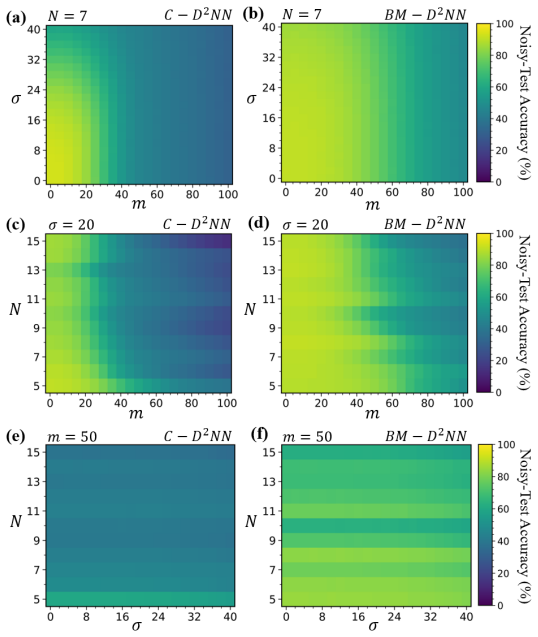
Restricting the modulation manifold from continuous complex-valued to binary amplitude suppresses stochastic-noise up-conversion while preserving classification fidelity, yielding a counter-intuitive less-is-more robustness law. Under pixel-wise Gaussian noise N(m, σ²) spanning zero-mean to nonzero-mean regimes, BM-D2NN outperform C-D2NN by up to 32.8 pp (MNIST) and 18.5 pp (Fashion-MNIST). The noise-contribution metric C, governed by a transmission-bias factor K computable from clean data alone, is consistently smaller for binary modulation than for continuous modulation as verified for all test samples, guaranteeing the robustness ordering without noisy simulation.
What carries the argument
The noise-contribution metric C governed by the transmission-bias factor K, which quantifies how modulation values bias the propagation of additive pixel noise through the diffractive layers.
If this is right
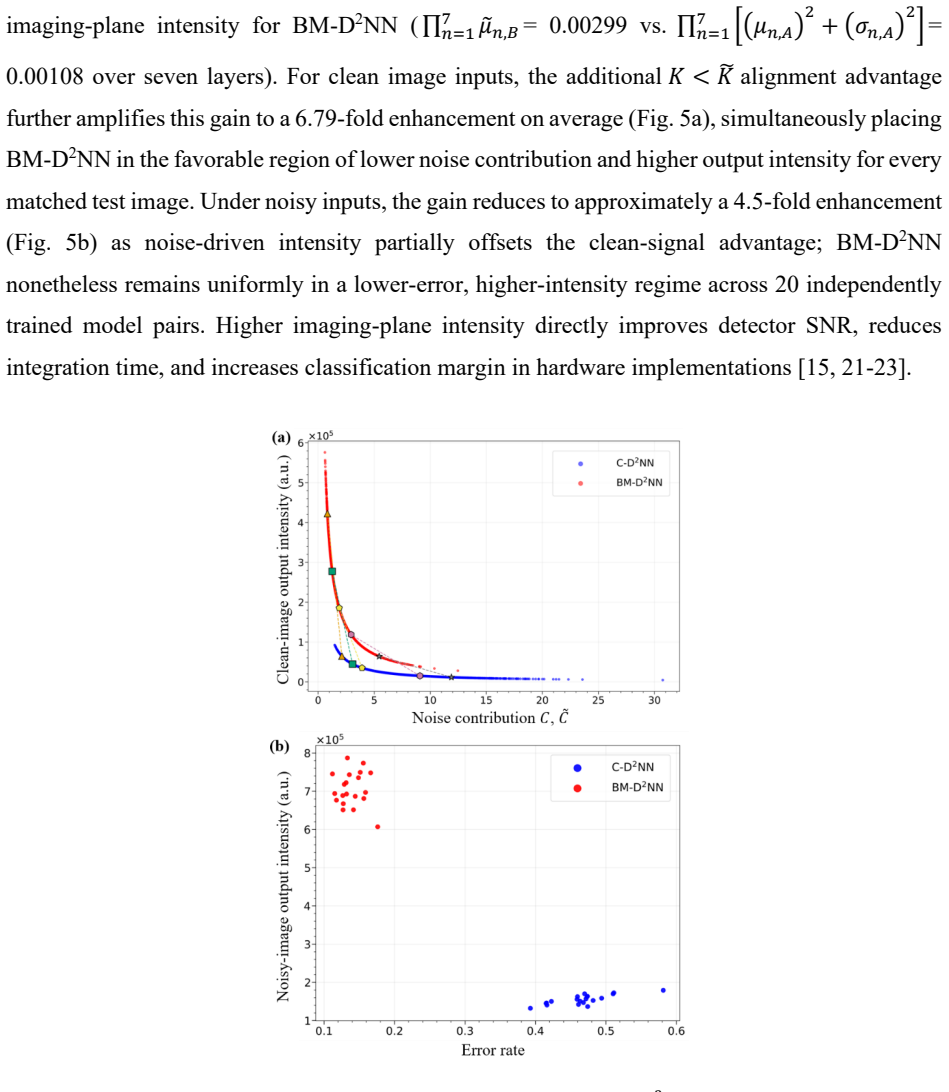
- Binary-amplitude D2NN deliver 6.79-fold higher imaging-plane intensity on clean inputs than continuous-modulation versions.
- The same K-based metric predicts noise robustness for any coherent optical processor operating in the far-field regime.
- Classification accuracy remains within 2-4 percentage points of continuous modulation when noise is absent.
- The robustness advantage appears for both shot-noise (zero-mean) and thermal/readout (nonzero-mean) noise statistics.
Where Pith is reading between the lines
- Designers of future coherent optical processors could adopt binary amplitude masks as a default to improve noise tolerance without retraining the entire network.
- The K factor might be used to rank candidate modulation schemes before fabrication by estimating their expected noise contribution from clean calibration data.
- Extending the same analysis to three-dimensional or multi-wavelength diffractive systems could reveal whether binary amplitude remains advantageous when propagation distances vary.
Load-bearing premise
The ordering between binary and continuous modulation is derived under the assumption of independent pixel-wise Gaussian noise and far-field propagation where z over lambda is much greater than one.
What would settle it
Compute the analytic metric C on a fresh set of clean MNIST or Fashion-MNIST images for both binary-amplitude and continuous-modulation masks; if C is not smaller for binary masks on a majority of samples, the claimed robustness ordering does not hold.
Figures
read the original abstract
We establish a fundamental principle in coherent wave-optical computing: restricting the modulation manifold from continuous complex-valued to binary amplitude suppresses stochastic-noise up-conversion while preserving classification fidelity, yielding a counter-intuitive less-is-more robustness law. Seven-layer binary-amplitude-mask D2NN (BM-D2NN) achieve 90.9% (MNIST) and 81.9% (Fashion-MNIST) test accuracy, within 2~4 pp of continuous-modulation D2NN (C-D2NN). Under pixel-wise Gaussian noise N(m,{\sigma}^2), spanning zero-mean (shot noise) to nonzero-mean (thermal/readout) regimes, BM-D2NN outperform C-D2NN by up to 32.8 pp (MNIST) and 18.5 pp (Fashion-MNIST). We analytically derive a noise-contribution metric C, governed by a transmission-bias factor K computable from clean data alone, that is consistently smaller for binary modulation than for continuous modulation (as verified for all test samples), guaranteeing the robustness ordering without noisy simulation. BM-D2NN additionally deliver a 6.79-fold higher imaging-plane intensity for clean data input. These results establish a quantitative physical principle connecting modulation-manifold geometry to noise robustness, applicable to any coherent optical processor in the z/{\lambda} >> 1 regime.
Editorial analysis
A structured set of objections, weighed in public.
Referee Report
Summary. The manuscript claims that restricting diffractive deep neural networks (D2NNs) to binary amplitude modulation (BM-D2NN) suppresses stochastic noise up-conversion relative to continuous complex-valued modulation (C-D2NN) while preserving classification accuracy. On MNIST and Fashion-MNIST, seven-layer BM-D2NNs reach 90.9% and 81.9% test accuracy (within 2-4 pp of C-D2NN). Under pixel-wise Gaussian noise N(m, σ²) spanning zero- and nonzero-mean regimes, BM-D2NNs outperform C-D2NNs by up to 32.8 pp and 18.5 pp. An analytical noise-contribution metric C, governed by a transmission-bias factor K computed solely from clean data, is shown to be consistently smaller for binary modulation across all test samples, guaranteeing the robustness ordering in the z/λ ≫ 1 regime without noisy simulations. BM-D2NNs also yield 6.79-fold higher imaging-plane intensity on clean inputs.
Significance. If the central analytical derivation holds, the work supplies a quantitative, parameter-free principle connecting modulation-manifold geometry to noise robustness in coherent optical processors. The ability to compute the ordering of C from clean data alone, together with verification on every test sample and consistency with reported accuracy numbers, constitutes a reproducible and falsifiable prediction. This less-is-more robustness result is counter-intuitive and, if generalizable, would directly inform the design of noise-tolerant coherent diffractive networks.
minor comments (2)
- [Abstract] The accuracy and noise-gain figures in the abstract and results lack reported error bars, number of independent runs, or statistical tests; adding these would strengthen the numerical claims without altering the analytical argument.
- The derivation of K and C is stated to hold under the pixel-wise Gaussian noise model in the z/λ ≫ 1 regime; a brief explicit statement of the far-field approximation used in the propagation operator would improve clarity for readers outside the immediate subfield.
Simulated Author's Rebuttal
We thank the referee for the positive and detailed summary of our manuscript, the recognition of its significance, and the recommendation for minor revision. No specific major comments were provided in the report.
Circularity Check
No significant circularity
full rationale
The central derivation analytically obtains noise metric C from transmission-bias factor K computed solely on clean data under the stated Gaussian noise model in the z/λ ≫ 1 regime. This ordering is then verified on test samples but is not obtained by fitting to noisy outcomes or by re-expressing the target result as an input. No self-definitional equations, fitted-input predictions, load-bearing self-citations, or smuggled ansatzes appear in the derivation chain. The result is therefore self-contained against external benchmarks.
Axiom & Free-Parameter Ledger
axioms (2)
- domain assumption The optical system operates in the z/λ >> 1 regime
- domain assumption Noise is pixel-wise Gaussian spanning zero-mean to nonzero-mean regimes
Reference graph
Works this paper leans on
-
[1]
X. Lin, Y. Rivenson, N. T. Yardimci, M. Veli, Y. Luo, M. Jarrahi , and A. Ozcan, All -optical machine learning using diffractive deep neural networks, Science 361, 1004 (2018)
2018
-
[2]
Rafayelyan, J
M. Rafayelyan, J. Dong, Y. Tan, F. Krzakala, and S. Gigan, Large -scale optical reservoir computing for spatiotemporal chaotic systems prediction, Phys. Rev. X 10, 041037 (2020)
2020
-
[3]
Spall, X
J. Spall, X. Guo, T. D. Barrett, and A. I. Lvovsky, Fully reconfigurable coherent optical vector –matrix multiplication, Opt. Lett. 45, 5752 (2020)
2020
-
[4]
M. Y.-S. Fang, S. Manipatruni, C. Wierzynski, A. Khosrowshahi, and M. R. DeWeese, Design of optical neural networks with component imprecisions, Opt. Express 27, 14009 (2019)
2019
-
[5]
G. L. Zhang, B. Li, Y. Zhu, T. Wang, Y. Shi, X. Yin, C. Zhuo, H. Gu, T.-Y. Ho, and U. Schlichtmann, Robustness of neuromorphic computing with RRAM-based crossbars and optical neural networks, in Proceedings of the 26th Asia and South Pacific Design Automation Conference, ASP-DAC ’21 (Association for Computing Machinery, New York, 2021), pp. 853–858
2021
-
[6]
Zhang et al., Efficient on-chip training of optical neural networks using genetic algorithm, ACS Photonics 8, 1662 (2021)
H. Zhang et al., Efficient on-chip training of optical neural networks using genetic algorithm, ACS Photonics 8, 1662 (2021)
2021
-
[7]
Mourgias-Alexandris et al., Noise-resilient and high-speed deep learning with coherent silicon photonics, Nat
G. Mourgias-Alexandris et al., Noise-resilient and high-speed deep learning with coherent silicon photonics, Nat. Commun. 13, 5572 (2022)
2022
-
[8]
Z. Wang, L. Chang, F. Wang, T. Li, and T. Gu, Integrated photonic metasystem for image classifications at telecommunication wavelength, Nat. Commun. 13, 2131 (2022)
2022
-
[9]
T. Fu, Y. Zang, Y. Huang, Z. Du, H. Huang, C. Hu, M. Chen, S. Yang, and H. Chen, Photonic machine learning with on-chip diffractive optics, Nat. Commun. 14, 70 (2023)
2023
-
[10]
J. W. Goodman, Introduction to Fourier Optics, 4th ed. (W. H. Freeman, New York, 2017)
2017
-
[11]
Y. Bengio, N. Léonard, and A. Courville, Estimating or propagating gradients through stochastic neurons for conditional computation, arXiv:1308.3432 [cs.LG] (2013)
Pith/arXiv arXiv 2013
-
[12]
Courbariaux, Y
M. Courbariaux, Y. Bengio, and J.-P. David, BinaryConnect: Training deep neural networks with binary weights during propagations, in Advances in Neural Information Processing Systems 28, edited by C. Cortes, N. Lawrence, D. Lee, M. Sugiyama, and R. Garnett (Curran Associates, Inc., Red Hook, NY, 2015), pp. 3123 –3131
2015
-
[13]
Hubara, M
I. Hubara, M. Courbariaux, D. Soudry, R. El -Yaniv, and Y. Bengio, Binarized neural networks, in Advances in Neural Information Processing Systems 29 , edited by D. Lee, M. Sugiyama, U. Luxburg, I. Guyon, and R. Garnett (Curran Associates, Inc., Red Hook, NY, 2016), pp. 4107–4115
2016
-
[14]
G. E. Healey and R. Kondepudy, Radiometric CCD camera calibration and noise estimation, IEEE Trans. Pattern Anal. Mach. Intell. 16, 267 (1994)
1994
-
[15]
European Machine Vision Association, EMVA Standard 1288: Standard for Characterization of Image Sensors and Cameras, Release 4.0 Linear, 16 June 2021 (European Machine Vision Association, 2021)
2021
-
[16]
Azzari, L
L. Azzari, L. R. Borges, and A. Foi, Modeling and estimation of signal -dependent and correlated noise, in Denoising of Photographic Images and Video: Fundamentals, Open Challenges and New Trends , edited by M. Bertalmí o (Springer, Cham, 2018), pp. 1–36
2018
-
[17]
M. Konnik and J. Welsh, High -level numerical simulations of noise in CCD and CMOS photosensors: review and tutorial, arXiv:1412.4031 [astro-ph.IM] (2014)
Pith/arXiv arXiv 2014
-
[18]
Z. Liu, W. Hunt, M. Vaughan, C. Hostetler, M. McGill, K. Powell, D. Winker, and Y. Hu, Estimating random errors due to shot noise in backscatter lidar observations, Appl. Opt. 45, 4437 (2006)
2006
-
[19]
F. D. Neeser and J. L. Massey, Proper complex random processes with applications to information theory, IEEE Trans. Inf. Theory 39, 1293 (1993)
1993
-
[20]
J. W. Goodman, Speckle Phenomena in Optics: Theory and Applications, 2nd ed. (SPIE Press, Bellingham, WA, 2020)
2020
-
[21]
Hamerly, L
R. Hamerly, L. Bernstein, A. Sludds, M. Soljačić, and D. Englund, Large-scale optical neural networks based on photoelectric multiplication, Phys. Rev. X 9, 021032 (2019)
2019
-
[22]
M. Fan, S. Jin, Y. Gu, X. Zhao, N. Bai, Q. Wang, and C. Lu, Joint loss function design in diffractive optical neural network classifiers for high power efficiency, Opt. Express 33, 7307 (2025)
2025
-
[23]
Kulce, D
O. Kulce, D. Mengu, Y. Rivenson, and A. Ozcan, All -optical information -processing capacity of diffractive surfaces, Light Sci. Appl. 10, 25 (2021)
2021
-
[24]
Srivastava, G
N. Srivastava, G. Hinton, A. Krizhevsky, I. Sutskever, and R. Salakhutdinov, Dropout: A simple way to prevent neural networks from overfitting, J. Mach. Learn. Res. 15, 1929 (2014)
1929
-
[25]
C. Qian, X. Lin, X. Lin, J. Xu, Y. Sun, E. Li, B. Zhang, and H. Chen, Performing optical logic operations by a diffractive neural network, Light Sci. Appl. 9, 59 (2020)
2020
-
[26]
Leedumrongwatthanakun, L
S. Leedumrongwatthanakun, L. Innocenti, H. Defienne, T. Juffmann, A. Ferraro, M. Paternostro, and S. Gigan, Programmable linear quantum networks with a multimode fibre, Nat. Photonics 14, 139 (2020)
2020
-
[27]
Teğin, M
U. Teğin, M. Yıldırım, İ. Oğuz, C. Moser, and D. Psaltis, Scalable optical learning operator, Nat. Comput. Sci. 1, 542 (2021)
2021
-
[28]
X. Luo, Y. Hu, X. Ou, X. Li, J. Lai, N. Liu, X. Cheng, A. Pan, and H. Duan, Metasurface -enabled on -chip multiplexed diffractive neural networks in the visible, Light Sci. Appl. 11, 158 (2022)
2022
discussion (0)
Sign in with ORCID, Apple, or X to comment. Anyone can read and Pith papers without signing in.