On the Application of Hybrid Mixed Domain Decomposition Methods to Permanent Magnet Synchronous Machines
Pith reviewed 2026-06-28 20:44 UTC · model grok-4.3
The pith
The finite element method for rotor-stator coupling in permanent magnet synchronous machines fits exactly inside an existing hybrid mixed domain decomposition framework.
A machine-rendered reading of the paper's core claim, the machinery that carries it, and where it could break.
Core claim
By constructing the variational form for the electric machine, the resulting finite element method sits inside the HMDD framework, so that its well-posedness and error estimates carry over immediately.
What carries the argument
The hybrid mixed domain decomposition (HMDD) framework that supplies abstract well-posedness and error estimates for hybridized methods.
If this is right
- Well-posedness of the discrete problem for the permanent magnet synchronous machine follows from the abstract theory.
- A priori error estimates for the magnetic flux density and scalar potential apply without further proof.
- The method inherits stability properties of the HMDD framework while remaining compatible with standard finite-element assembly.
Where Pith is reading between the lines
- The same embedding argument could apply to other rotating machines whose interface conditions admit an analogous mixed formulation.
- Hybridization may enable domain-decomposition-based parallel solvers that treat rotor and stator subdomains separately.
- The comparison with iso-geometric analysis hints at possible mixed discretizations that combine finite elements in one region with splines in another.
Load-bearing premise
The specific variational formulation for the rotor-stator coupling with affine material law and symmetry boundary conditions fits exactly inside the abstract HMDD framework without any additional analysis or modification.
What would settle it
A direct verification that every hypothesis of the abstract HMDD theorem is satisfied by the derived spaces and bilinear forms; failure of any hypothesis would block the transfer of well-posedness and error estimates.
Figures
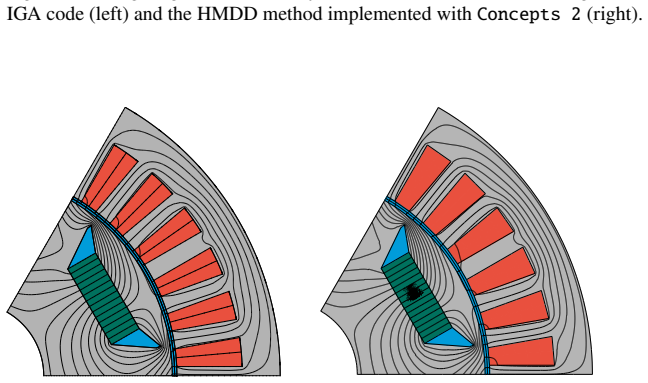
read the original abstract
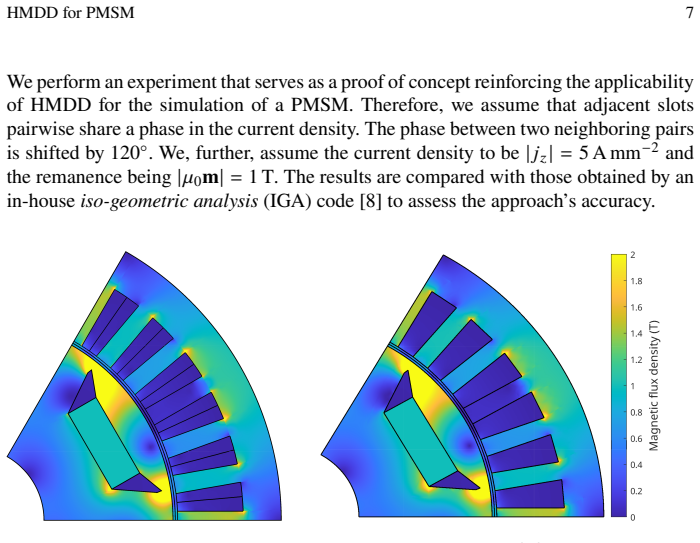
In this work, we study the application of a hybrid mixed domain decomposition (HMDD) method for the rotor-stator coupling of a permanent magnet synchronous machine. For this, we derive a variational formulation on the electric machine inspired by hybridized discontinuous Galerkin methods using a mixed magnetostatics problem, an affine material law and boundary conditions respecting the symmetry of the motor. We are then able to locate the resulting finite element method within the HMDD framework presented in arXiv:2604.22543. This enables us naturally to transfer the well-posedness results and error estimates for the HMDD method to the finite element method considered in this work. Lastly, as a proof of concept, we consider an academic example and compare the resulting magnetic flux density and potential lines to their counterparts obtained by a well-established in-house code using iso-geometric analysis.
Editorial analysis
A structured set of objections, weighed in public.
Referee Report
Summary. The paper derives a variational formulation for the magnetostatics problem in a permanent magnet synchronous machine using a mixed approach inspired by hybridized discontinuous Galerkin methods, with an affine material law and symmetry boundary conditions. It locates the resulting finite element method within the hybrid mixed domain decomposition (HMDD) framework of arXiv:2604.22543 to transfer well-posedness and error estimates, and validates it on an academic example by visual comparison of magnetic flux density and potential lines to an iso-geometric analysis code.
Significance. If the location of the derived formulation within the abstract HMDD framework is rigorously verified, this work would successfully apply the theoretical results from the prior framework to a practical problem in electrical machine simulation, providing a stable and convergent method for rotor-stator coupling. The proof-of-concept example demonstrates feasibility, though quantitative metrics are absent.
major comments (1)
- [Section on variational formulation and framework location] The central claim that the derived finite element method 'locates' inside the HMDD framework of arXiv:2604.22543, enabling direct transfer of well-posedness and error estimates, is asserted in the abstract and main text but without a detailed side-by-side verification that the function spaces, trace operators, interface conditions from the rotor-stator coupling, symmetry boundary conditions, and permanent magnet source term satisfy all hypotheses of the abstract framework exactly. This verification is load-bearing for the transfer of results and is not exhibited in the provided text.
minor comments (1)
- [Numerical example section] The academic example provides only visual comparison; adding quantitative error norms or convergence rates would improve the validation of the method.
Simulated Author's Rebuttal
We thank the referee for the constructive comment on the need for explicit verification of the formulation's placement in the HMDD framework. We agree that a detailed side-by-side mapping strengthens the central claim and will incorporate this in the revision.
read point-by-point responses
-
Referee: The central claim that the derived finite element method 'locates' inside the HMDD framework of arXiv:2604.22543, enabling direct transfer of well-posedness and error estimates, is asserted in the abstract and main text but without a detailed side-by-side verification that the function spaces, trace operators, interface conditions from the rotor-stator coupling, symmetry boundary conditions, and permanent magnet source term satisfy all hypotheses of the abstract framework exactly. This verification is load-bearing for the transfer of results and is not exhibited in the provided text.
Authors: We acknowledge that the manuscript asserts the location of our derived finite element method within the HMDD framework of arXiv:2604.22543 without exhibiting an explicit, itemized verification of all hypotheses. This includes mapping the function spaces, trace operators, rotor-stator interface conditions, symmetry boundary conditions, and the permanent magnet source term (under the affine material law) to the abstract framework's assumptions. In the revised manuscript, we will add a dedicated subsection providing this side-by-side comparison. This will rigorously confirm that the hypotheses hold, thereby justifying the direct transfer of well-posedness and error estimates to our application. revision: yes
Circularity Check
Well-posedness and error estimates transferred via asserted exact membership in authors' prior HMDD framework (arXiv:2604.22543)
specific steps
-
self citation load bearing
[Abstract]
"We are then able to locate the resulting finite element method within the HMDD framework presented in arXiv:2604.22543. This enables us naturally to transfer the well-posedness results and error estimates for the HMDD method to the finite element method considered in this work."
The paper's primary theoretical contribution (well-posedness and error estimates for the PMSM FEM) is obtained solely by claiming that the derived mixed formulation with affine material law and symmetry BCs is an instance of the abstract framework from the cited paper; no independent derivation or explicit verification of framework hypotheses is shown, so the result is justified by the self-citation.
full rationale
The paper derives a specific variational formulation for the rotor-stator coupling and then asserts that the resulting FEM lies inside the abstract HMDD framework of the cited prior work, directly importing all well-posedness and error estimates. This is the load-bearing step for the main theoretical claim. While the numerical example provides independent content, the central theoretical result reduces to the self-citation of framework membership without exhibited side-by-side verification of all abstract assumptions (spaces, operators, constants) for the affine law, symmetry BCs, and PM source term. This qualifies as self-citation load-bearing per the enumerated patterns but is not fully forced by definition, hence score 6 rather than 8-10.
Axiom & Free-Parameter Ledger
axioms (2)
- domain assumption Affine material law in the mixed magnetostatics problem
- domain assumption Boundary conditions that respect the symmetry of the motor
Reference graph
Works this paper leans on
-
[1]
On a Hybrid Mixed Domain Decomposition Method
K. Schmidt, T. Seibel, and S. Sch ¨ops,On a hybrid mixed domain decomposition method, Preprint, arxiv:2604.22543, 2026
work page internal anchor Pith review Pith/arXiv arXiv 2026
-
[2]
Cockburn, J
B. Cockburn, J. Gopalakrishnan, and R. Lazarov,Unified Hybridization of Discontinuous Galerkin, Mixed, and Continuous Galerkin Methods for Second Order Elliptic Problems, SIAM J. Numer. Anal., vol. 47, pp. 1319–1365, 2009
2009
-
[3]
S. J. Salon,Finite Element Analysis of Electrical Machines, Kluwer, 1995
1995
-
[4]
M. Wiesheu, T. Komann, M. Merkel, S. Sch ¨ops, S. Ulbrich, and I. Cortes Garcia,Combined parameter and shape optimization of electric machines with isogeometric analysis, Optim. Eng., arxiv:2311.06046, 2024
-
[5]
Moree, J
G. Moree, J. Sjolund, and M. Leijon,A Review of Permanent Magnet Models Used for Designing Electrical Machines, IEEE Trans. Magn., vol. 58, pp. 1–19, 2022
2022
-
[6]
Concepts Development Team,Webpage of the Numerical C++-Library Concepts 2, https://concepts.mathematik.tu-darmstadt.de, 2026
2026
-
[7]
Schmidt and P
K. Schmidt and P. Kauf,Computation of the band structure of two-dimensional photonic crystals withhpfinite elements, Comput. Meth. Appl. Mech. Eng., vol. 198, pp. 1249–1259, 2009
2009
-
[8]
M. Wiesheu,MotorOptimization, In-house isogeometric analysis Matlab code, https://doi.org/10.5281/zenodo.19451085, 2023
discussion (0)
Sign in with ORCID, Apple, or X to comment. Anyone can read and Pith papers without signing in.