Extending the UXR Point of View Pyramid: A Generative AI-Augmented Methodology for Human-Centred AI Systems
Pith reviewed 2026-06-28 21:13 UTC · model grok-4.3
The pith
The UXR Points of View pyramid extends into an AI-augmented framework that adds structured prompt architectures and playbook cards for human-centered debt management AI.
A machine-rendered reading of the paper's core claim, the machinery that carries it, and where it could break.
Core claim
The paper claims that extending the UXR PoV pyramid produces an AI-Augmented PoV Pyramid, a structured prompt architecture for synthesis and hypothesis generation, and an AI-enabled Playbook Card system. These elements embed generative AI into UXR workflows for debt management technologies, including affordability assessment, repayment planning, and financial stress prediction, while positioning generative AI strictly as an epistemic support mechanism subject to human validation and regulatory awareness rather than an analytic authority.
What carries the argument
The AI-Augmented PoV Pyramid together with its structured prompt architecture and AI-enabled Playbook Card system, which add generative AI layers to the original UXR PoV pyramid for traceable synthesis in financial AI contexts.
If this is right
- UXR methods can now support product and governance decisions in AI-mediated financial services with maintained interpretability and accountability.
- Generative AI functions as a subordinate synthesis aid rather than a replacement for human judgment in regulated debt technologies.
- The playbook card system provides a reusable mechanism to document AI-assisted evidence chains for regulatory review.
- The approach advances responsible AI-powered UXR practice specifically for high-stakes environments such as affordability assessment and repayment structuring.
Where Pith is reading between the lines
- The same pyramid extension could be tested in adjacent regulated domains like insurance pricing or welfare eligibility where similar opacity and vulnerability concerns arise.
- Empirical measurement of whether the prompt architecture measurably reduces synthesis time while preserving evidence traceability would provide a direct test of the framework's practicality.
- If the playbook cards are adopted, downstream governance audits could compare decision traceability before and after the AI augmentation to quantify oversight gains.
Load-bearing premise
The existing UXR PoV framework can be directly extended with generative AI components while preserving traceability and ethical oversight in high-stakes financial contexts without introducing new risks of opacity or bias.
What would settle it
A controlled deployment of the AI-Augmented PoV Pyramid in a debt management team that produces a decision violating fairness or regulatory standards despite documented human validation steps would falsify the preservation of ethical oversight.
Figures

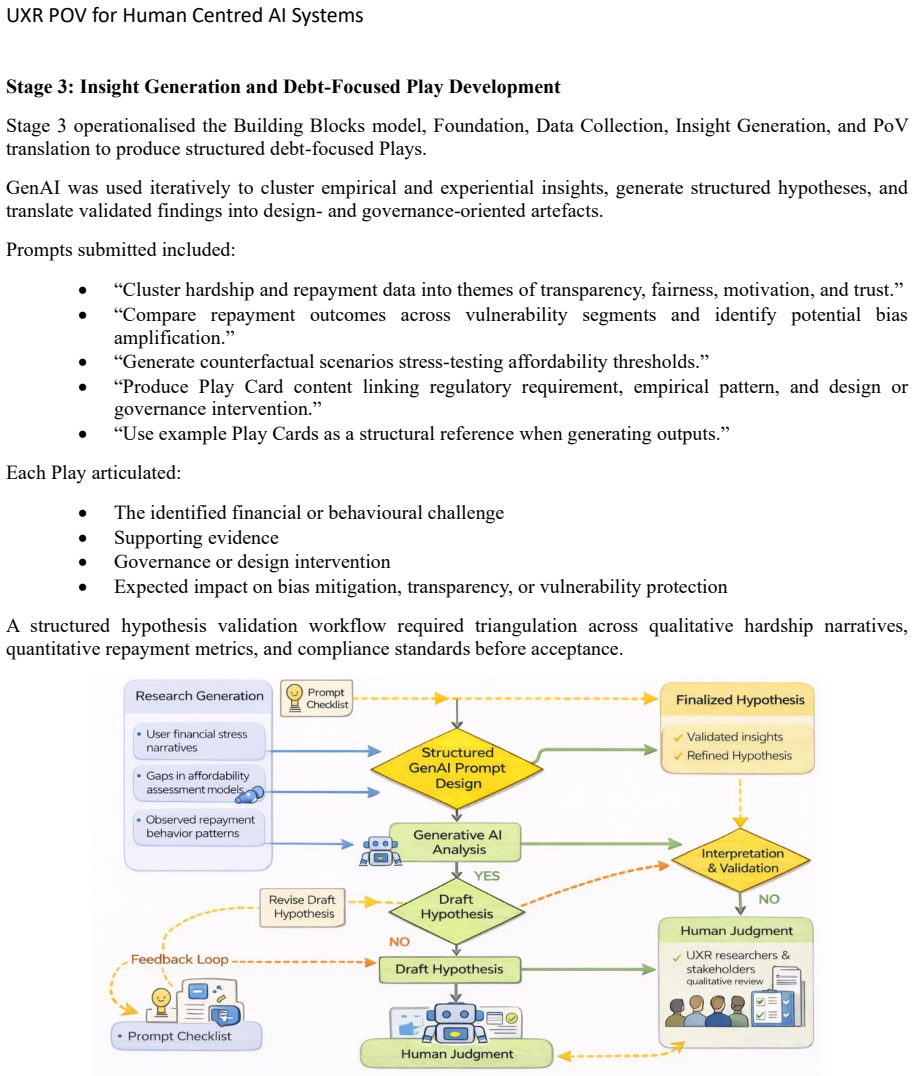
read the original abstract
Rising household debt and cost-of-living pressures in the United Kingdom have intensified the role of AI-driven financial technologies in mediating credit assessment, repayment structuring, and debt support services. These systems increasingly shape consequential financial decisions, yet they operate within complex socio-technical environments characterised by regulatory constraint, algorithmic opacity, and heightened vulnerability risk. User Experience Research (UXR) Points of View (PoVs) are critical in translating heterogeneous research evidence into strategic direction for product and governance decisions. However, the existing UXR PoV framework was not designed for AI-mediated financial systems where interpretability, fairness, and accountability are central. This paper extends the UXR PoV pyramid into an AI-augmented methodological framework for Human-Centred AI debt management technologies in the UK financial services context. We formalise (1) an AI-Augmented PoV Pyramid, (2) a structured prompt architecture for synthesis and hypothesis generation, and (3) an AI-enabled Playbook Card system that embeds Generative AI into UXR workflows while preserving traceability and ethical oversight. Generative AI is positioned not as an analytic authority, but as an epistemic support mechanism subject to human validation and regulatory awareness. By grounding the framework in debt management technologies, including affordability assessment, repayment planning, and financial stress prediction systems, this work advances UXR methodology for high-stakes financial AI environments and contributes to the evolution of responsible, AI-powered UXR practice within the CHI community.
Editorial analysis
A structured set of objections, weighed in public.
Referee Report
Summary. The paper proposes extending the existing UXR Points of View (PoV) Pyramid into an AI-Augmented PoV Pyramid for human-centred AI systems in UK debt management. It formalises three artifacts: (1) the AI-Augmented PoV Pyramid, (2) a structured prompt architecture for synthesis and hypothesis generation, and (3) an AI-enabled Playbook Card system. Generative AI is positioned strictly as epistemic support subject to human validation and regulatory awareness, with the framework grounded in applications such as affordability assessment, repayment planning, and financial stress prediction.
Significance. If the proposed extensions can be shown to maintain traceability and ethical oversight without introducing new opacity or bias risks, the work would offer a concrete methodological contribution to UXR practice in regulated, high-stakes AI domains. The explicit framing of GenAI as non-authoritative support is a strength, but the absence of any validation data, worked examples, or comparison to the original pyramid leaves the preservation claim unsubstantiated.
major comments (3)
- [Abstract] Abstract: The central claim that the AI-enabled Playbook Card system and structured prompt architecture 'embed Generative AI into UXR workflows while preserving traceability and ethical oversight' is asserted without any concrete mechanisms, traceability mappings, or scale-appropriate human-validation procedures. No section supplies even a single worked prompt template or debt-management example demonstrating how validation would operate under UK regulatory constraints.
- [Abstract] Abstract and grounding section: The framework is positioned as an advance for debt-management technologies (affordability assessment, repayment planning, stress prediction), yet the manuscript supplies neither a comparison against the original UXR PoV pyramid nor any validation data or independent benchmarks. The claimed improvements therefore reduce to the authors' framing of the new components.
- [Abstract] The paper states that GenAI is 'subject to human validation and regulatory awareness' but provides no analysis of how this validation would function at scale in high-stakes financial contexts or how it would mitigate new risks of opacity or bias. This leaves the preservation property as an untested assertion rather than a demonstrated property of the artifacts.
minor comments (1)
- [Abstract] The abstract refers to 'the CHI community' without specifying which CHI venues or prior UXR PoV literature is being extended; a brief citation list would improve context.
Simulated Author's Rebuttal
We thank the referee for their constructive comments, which highlight important areas for strengthening the manuscript. We respond to each major comment below, indicating where revisions will be incorporated.
read point-by-point responses
-
Referee: [Abstract] Abstract: The central claim that the AI-enabled Playbook Card system and structured prompt architecture 'embed Generative AI into UXR workflows while preserving traceability and ethical oversight' is asserted without any concrete mechanisms, traceability mappings, or scale-appropriate human-validation procedures. No section supplies even a single worked prompt template or debt-management example demonstrating how validation would operate under UK regulatory constraints.
Authors: We agree that the abstract asserts the preservation of traceability and oversight without sufficient concrete illustration. The manuscript describes the prompt architecture and playbook cards in Sections 4 and 5 as mechanisms for traceability (via explicit human review checkpoints and logging), but no worked example is provided. In revision we will add a dedicated subsection with a worked prompt template and debt-management example (affordability assessment under FCA guidelines) showing the human validation steps. revision: yes
-
Referee: [Abstract] Abstract and grounding section: The framework is positioned as an advance for debt-management technologies (affordability assessment, repayment planning, stress prediction), yet the manuscript supplies neither a comparison against the original UXR PoV pyramid nor any validation data or independent benchmarks. The claimed improvements therefore reduce to the authors' framing of the new components.
Authors: This manuscript presents a conceptual methodological proposal rather than an empirical evaluation; therefore no validation data or benchmarks are included, as these would require a separate study. We will add a comparison table in the revision that explicitly contrasts the AI-augmented pyramid against the original UXR PoV pyramid to clarify the extensions and avoid reliance on framing alone. revision: partial
-
Referee: [Abstract] The paper states that GenAI is 'subject to human validation and regulatory awareness' but provides no analysis of how this validation would function at scale in high-stakes financial contexts or how it would mitigate new risks of opacity or bias. This leaves the preservation property as an untested assertion rather than a demonstrated property of the artifacts.
Authors: We will expand the discussion section to analyse scalability considerations for human validation in high-stakes UK financial contexts, referencing existing human-AI oversight literature and potential bias/opacity risks. The framework positions GenAI strictly as epistemic support; full empirical demonstration of risk mitigation at scale lies beyond the scope of this proposal paper. revision: yes
Circularity Check
Preservation of traceability and oversight is included by definition in the formalized AI-augmented components
specific steps
-
self definitional
[Abstract]
"We formalise (1) an AI-Augmented PoV Pyramid, (2) a structured prompt architecture for synthesis and hypothesis generation, and (3) an AI-enabled Playbook Card system that embeds Generative AI into UXR workflows while preserving traceability and ethical oversight. Generative AI is positioned not as an analytic authority, but as an epistemic support mechanism subject to human validation and regulatory awareness."
The desired outcome (preserving traceability/oversight) is stated as part of the definition of the three formalized artifacts. The extension is therefore claimed to achieve the property by how the components are constructed and named, with no separate derivation or evidence that the property holds independently of the definition.
full rationale
The paper's central contribution is the formalization of an AI-Augmented PoV Pyramid and related artifacts that are explicitly defined to embed GenAI 'while preserving traceability and ethical oversight' with GenAI as 'epistemic support subject to human validation.' This makes the key property (preservation without new opacity/bias risks) true by construction of the authors' definitions rather than demonstrated via independent mechanisms, examples, or external validation. The derivation chain therefore reduces the claimed advance to the input framing of the new components themselves.
Axiom & Free-Parameter Ledger
axioms (1)
- domain assumption The original UXR PoV pyramid provides a sound base that can be augmented without loss of interpretability or accountability.
invented entities (2)
-
AI-Augmented PoV Pyramid
no independent evidence
-
AI-enabled Playbook Card system
no independent evidence
Reference graph
Works this paper leans on
-
[1]
RELATED WORK Human-Centred AI conceptualises AI systems as socio -technical infrastructures embedded in institutional, regulatory, and lived contexts [2]. In UK financial services, AI increasingly mediates affordability assessment, repayment restructuring, risk segmenta tion, and vulnerability detection, shaping repayment flexibility, credit rehabilitatio...
-
[2]
Analyse current uses of Generative AI in UK debt management research and identify recurring analytical patterns
METHOD This study employed a Generative AI -augmented UXR PoV workshop methodology to extend the UXR PoV Playbook into UK AI -driven debt management systems [1 ,7]. It integrates practitioner expertise, structured prompt architecture, and regulatory governance principles to produce design -actionable and compliance - defensible outputs for affordability a...
1995
-
[3]
Traceability: Every AI-supported insight must be auditable and source-linked
-
[4]
Fairness Sensitivity: Affordability modelling must account for income volatility and structural disadvantage
-
[5]
Interpretability: Model outputs must be communicable across risk, UX, and compliance teams
-
[6]
M., Giff, S., Dix, A., & Churchill, E
Ethical Stress Testing: Counterfactual simulation must be embedded before deployment. Stakeholder-aligned PoV Template emphases included: Stakeholder Core Need Primary Challenge PoV Narrative Focus GenAI-Supported Contribution Financially Vulnerable Customers Transparent, fair affordability and repayment decisions Opaque AI-driven assessments that may inc...
-
[7]
Selbst A.D., Boyd D., Friedler S.A., Venkatasubramanian S., and Vertesi J
https://doi.org/10.1145/3351095.3372873 [16]. Selbst A.D., Boyd D., Friedler S.A., Venkatasubramanian S., and Vertesi J. 2019. Fairness and Abstraction in Sociotechnical Systems. In Proceedings of the 2019 Conference on Fairness, Accountability, and Transparency (FAccT ’19) , January 29 –31, 2019, Atlanta, GA, USA. ACM, New York, NY, USA, 59–68. https://d...
discussion (0)
Sign in with ORCID, Apple, or X to comment. Anyone can read and Pith papers without signing in.