From Evidence to Design: Developing an AI-Augmented UX Research Point of View for Digital Wellbeing in Emergency and Public Safety Contexts
Pith reviewed 2026-06-28 21:11 UTC · model grok-4.3
The pith
Effective wellbeing systems for emergency and public safety personnel must minimise cognitive effort, adapt to operational context, and prioritise psychological safety.
A machine-rendered reading of the paper's core claim, the machinery that carries it, and where it could break.
Core claim
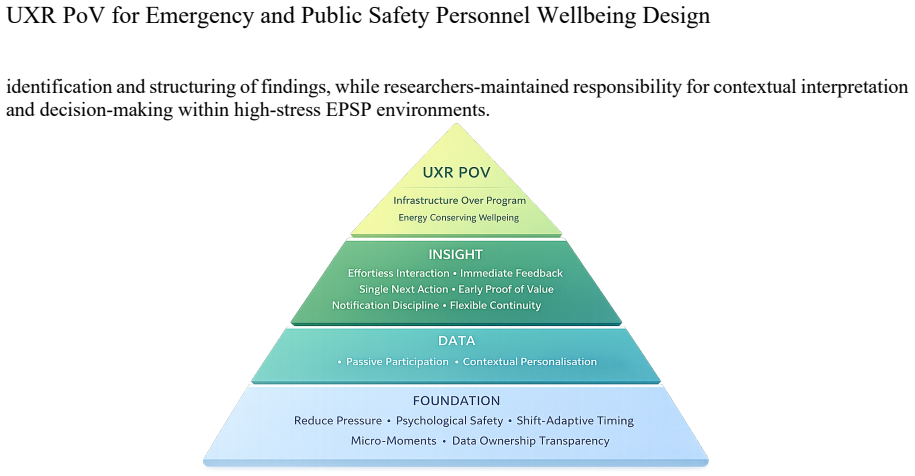
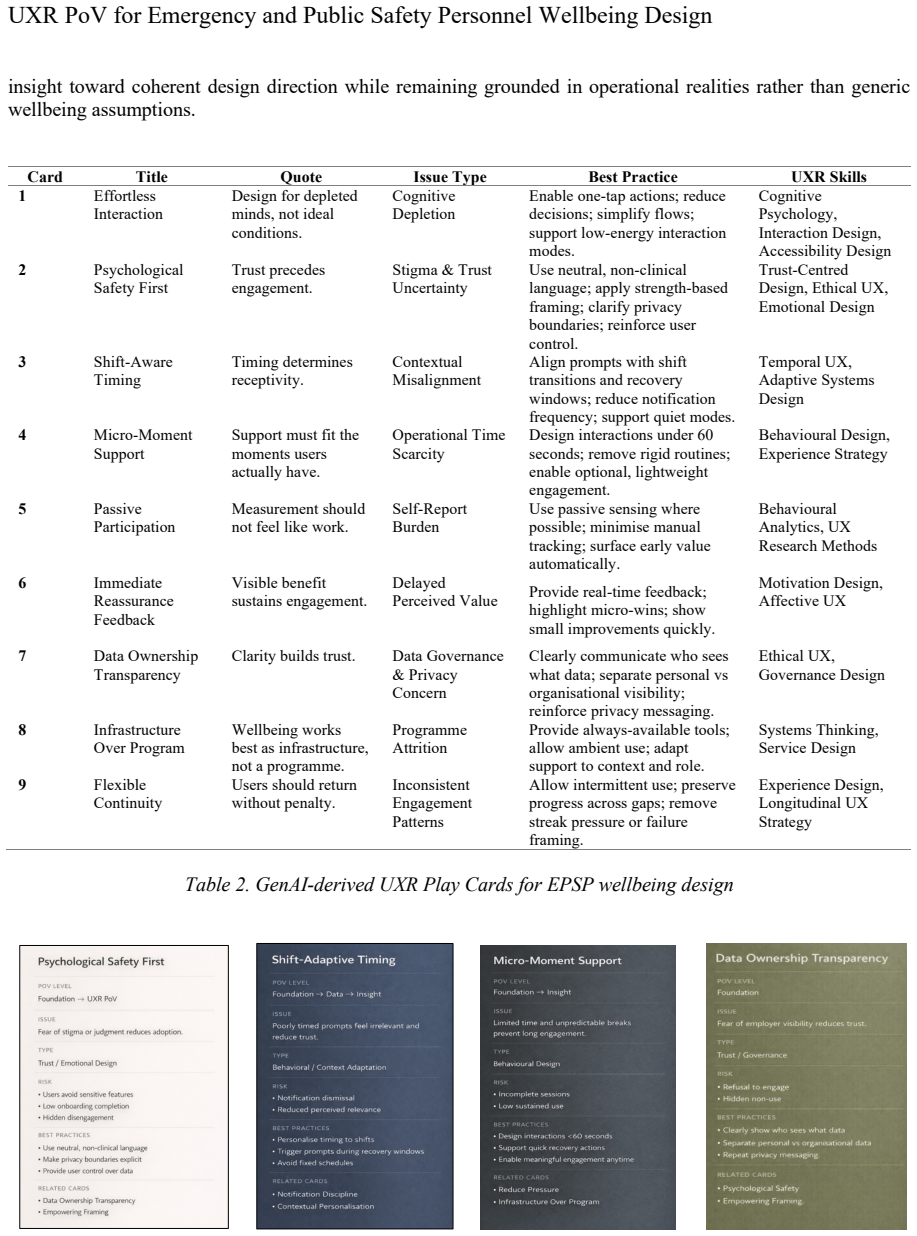
Applying the UXR Point-of-View framework with AI-assisted analysis of psychological, behavioural and design patterns produces a PoV Pyramid, nine UXR Play Cards and stakeholder narratives. The work shows that wellbeing systems for EPSP must minimise cognitive effort, adapt to operational context and prioritise psychological safety, while demonstrating that AI can scale evidence interpretation provided human researchers retain responsibility for contextual judgement and final design direction.
What carries the argument
The UXR Point-of-View (PoV) framework, which organises recurring patterns from literature into a pyramid structure, play cards and narratives that translate evidence into actionable design reasoning.
If this is right
- Designers must create wellbeing interventions that require minimal cognitive effort from users working in high-stress environments.
- Tools must flexibly accommodate unpredictable schedules and operational demands rather than assuming fixed routines.
- Psychological safety must be embedded as a core design priority rather than treated as an add-on feature.
- AI can assist large-scale evidence review while human researchers preserve responsibility for contextual judgement in the final outputs.
Where Pith is reading between the lines
- The play cards and pyramid could be evaluated by measuring actual adoption rates when introduced in real EPSP organisations.
- The same AI-augmented evidence-to-design process might be applied to other high-stress shift-based roles such as healthcare or transport.
- Direct comparison of pattern identification by AI versus fully manual review would test the assumption of reduced bias.
Load-bearing premise
The AI-supported literature analysis process accurately and without bias identifies recurring psychological, behavioural, and design patterns that can be directly translated into actionable design direction via the UXR PoV framework.
What would settle it
A deployment study of wellbeing tools built from the UXR PoV outputs that measures no increase in engagement or reduction in cognitive fatigue and psychological strain among EPSP compared with conventional tools.
Figures
read the original abstract
This paper investigates how User Experience Research (UXR) methods can be combined with AI-supported analysis to develop clearer design direction for digital wellbeing interventions targeting Emergency and Public Safety Personnel (EPSP). EPSP work in high-stress, shift-based environments where cognitive fatigue and unpredictable schedules reduce engagement with conventional wellbeing tools. Using the UXR Point-of-View (PoV) framework, this study applied an AI-supported literature analysis process to identify recurring psychological, behavioural, and design patterns. Behaviour Change Techniques and Persuasive Technology principles were integrated throughout interpretation to connect evidence with practical design reasoning. The process resulted in a UXR PoV Pyramid, nine UXR Play Cards, and stakeholder focused PoV narratives. Findings show that effective wellbeing systems for EPSP must minimise cognitive effort, adapt to operational context, and prioritise psychological safety. The work demonstrates how AI can assist large-scale evidence interpretation while human researchers maintain responsibility for contextual judgement and design direction.
Editorial analysis
A structured set of objections, weighed in public.
Referee Report
Summary. The paper proposes combining UXR methods with AI-supported literature analysis to create a Point-of-View framework for digital wellbeing tools aimed at Emergency and Public Safety Personnel (EPSP). It applies this process to identify recurring psychological, behavioural, and design patterns from the literature, integrates Behaviour Change Techniques and Persuasive Technology principles, and produces artifacts including a UXR PoV Pyramid, nine UXR Play Cards, and stakeholder PoV narratives. The central finding is that effective wellbeing systems for EPSP must minimise cognitive effort, adapt to operational context, and prioritise psychological safety.
Significance. The work illustrates a process for scaling evidence synthesis in UXR via AI assistance while retaining human oversight for design judgement. If the inference from patterns to prescriptive requirements were validated, it could inform context-specific design in high-stress domains; however, the current contribution is primarily methodological and artifact-oriented rather than empirically tested.
major comments (2)
- [Abstract] Abstract: The prescriptive claim that effective wellbeing systems 'must' minimise cognitive effort, adapt to operational context, and prioritise psychological safety is presented as a finding from the AI-supported literature analysis. The described method yields descriptive patterns and design artifacts but includes no primary EPSP data collection, outcome measurement, or comparative testing, so the step from recurring patterns to necessary conditions for effectiveness lacks evidential support and is load-bearing for the stated findings.
- [Process description] Process description (literature analysis and interpretation steps): The integration of BCT/PT principles with AI-identified patterns is used to generate the PoV Pyramid and Play Cards, yet no details are provided on selection criteria, inter-rater reliability for pattern extraction, or how post-hoc interpretation was guarded against bias. This directly affects the defensibility of translating the three requirements into actionable design direction.
minor comments (2)
- [Abstract] The abstract states that nine UXR Play Cards were produced but provides no examples of their content, structure, or mapping to the identified patterns; including one or two concrete examples would clarify the output of the framework.
- [Discussion] The manuscript would benefit from explicit discussion of the limitations of literature-synthesis-only approaches when making design prescriptions for operational contexts.
Simulated Author's Rebuttal
We thank the referee for their constructive comments, which help clarify the scope and transparency of our methodological contribution. We respond to each major comment below.
read point-by-point responses
-
Referee: [Abstract] The prescriptive claim that effective wellbeing systems 'must' minimise cognitive effort, adapt to operational context, and prioritise psychological safety is presented as a finding from the AI-supported literature analysis. The described method yields descriptive patterns and design artifacts but includes no primary EPSP data collection, outcome measurement, or comparative testing, so the step from recurring patterns to necessary conditions for effectiveness lacks evidential support and is load-bearing for the stated findings.
Authors: We agree that the phrasing 'must' presents the requirements as stronger prescriptive findings than the literature synthesis supports. The analysis identifies recurring patterns integrated with BCT and PT principles but does not include primary EPSP validation. We will revise the abstract and findings to use 'suggest' or 'indicate' and explicitly frame these as synthesized design considerations rather than empirically validated necessities, aligning the language with the methodological and artifact-oriented nature of the work. revision: yes
-
Referee: [Process description] The integration of BCT/PT principles with AI-identified patterns is used to generate the PoV Pyramid and Play Cards, yet no details are provided on selection criteria, inter-rater reliability for pattern extraction, or how post-hoc interpretation was guarded against bias. This directly affects the defensibility of translating the three requirements into actionable design direction.
Authors: The pattern extraction was AI-assisted with human oversight for contextual integration; traditional multi-rater reliability was not applied. We will expand the methods section to specify the AI prompt strategies, recurrence-based selection criteria, and bias-mitigation steps such as iterative human cross-referencing with BCT/PT frameworks. This addition will improve process transparency while reflecting the actual hybrid approach used. revision: partial
Circularity Check
No circularity; derivation is interpretive synthesis from external literature
full rationale
The paper's chain consists of AI-supported literature review to extract recurring patterns, followed by integration of BCT/PT principles and application of the UXR PoV framework to produce design artifacts (Pyramid, Play Cards, narratives). The 'must' statements are presented as interpretive findings from that synthesis rather than derived via equations, fitted parameters, or self-referential definitions. No load-bearing self-citations, uniqueness theorems, or ansatzes imported from prior author work are described. The process remains self-contained against external benchmarks with no reduction of outputs to inputs by construction.
Axiom & Free-Parameter Ledger
axioms (1)
- domain assumption The UXR Point-of-View framework can be extended with AI-supported analysis to produce actionable design outputs for specialized populations.
Reference graph
Works this paper leans on
-
[1]
Supporting Police Well-Being Through an Adaptive Shift Management System: Co-Design Study
Ayorinde OT, Dogan H, Adedoyin FF, Jiang N, Bitters F, Dempsey S. Supporting Police Well-Being Through an Adaptive Shift Management System: Co-Design Study. JMIR Form Res. 2025;9:e69986. Published 2025 Aug
2025
-
[2]
Shift work and long-term injury among police officers
Violanti JM, Fekedulegn D, Andrew ME, et al. Shift work and long-term injury among police officers. Scandinavian Journal of Work, Environment & Health. 2013;39(4):361-368. doi:10.5271/sjweh.3342
-
[3]
Shift work and occupational stress in police officers
Ma CC, Andrew ME, Fekedulegn D, et al. Shift work and occupational stress in police officers. Safety and Health at Work. 2015;6(1):25-29. doi:10.1016/j.shaw.2014.10.001
-
[4]
From Digital Health to Digital Well-being: Systematic Scoping Review
Smits M, Kim CM, van Goor H, Ludden GDS. From Digital Health to Digital Well-being: Systematic Scoping Review. J Med Internet Res. 2022;24(4):e33787. Published 2022 Apr
2022
-
[5]
Use and Acceptance of Innovative Digital Health Solutions Among Patients and Professionals: Survey Study
Seidl F, Hinterwimmer F, Vogt F, et al. Use and Acceptance of Innovative Digital Health Solutions Among Patients and Professionals: Survey Study. JMIR Hum Factors. 2025;12:e60779. Published 2025 May
2025
-
[6]
Widjaja, Anna & Sanjaya, Mira & Fitriati, Retno & Fitriana, Fevi & Keloko, Alam. (2024). Digital Health Technologies in Improving Access to Care for Underserved Populations. The Journal of Academic Science
2024
- [7]
-
[8]
Lowery, A., & Cassidy, T. (2022). Health and well-being of first responders: The role of psychological capital, self-compassion, social support, relationship satisfaction, and physical activity. Journal of Workplace Behavioral Health, 37(2), 87–105. https://doi.org/10.1080/15555240.2021.1990776
-
[9]
King’s College London
Assessing the mental health and wellbeing of the Emergency Responder Community in the UK [online]. King’s College London. Available from: https://kclpure.kcl.ac.uk/portal/en/publications/assessing-the-mental-health-and-wellbeing-of-the-emergency-respon [Accessed 6 Feb 2024]
2024
-
[10]
Martín-Martín J, Roldán-Jiménez C, De-Torres I, Muro-Culebras A, Escriche-Escuder A, Gonzalez-Sanchez M, Ruiz-Muñoz M, Mayoral-Cleries F, Biró A, Tang W, Nikolova B, Salvatore A and Cuesta-Vargas AI (2021) Behavior Change Techniques and the Effects Associated With Digital Behavior Change Interventions in Sedentary Behavior in the Clinical Population: A Sy...
-
[11]
In Extended Abstracts of the CHI Conference on Human Factors in Computing Systems (CHI EA ’24)
User Experience Research: Point of View Playbook. In Extended Abstracts of the CHI Conference on Human Factors in Computing Systems (CHI EA ’24). ACM, New York, NY, USA. https://doi.org/10.1145/3613905.3637136
-
[12]
Adedoyin, Festus & Dogan, Huseyin. (2025). Human-Centred AI in FinTech: Developing a User Experience (UX) Research Point of View (PoV) Playbook. 10.48550/arXiv.2506.15325
-
[13]
M., Giff, S., Dix, A., & Churchill, E
Dogan, H., Barsoum, R. M., Giff, S., Dix, A., & Churchill, E. (2025). Defining a UX Research Point of View (POV). In CHI EA 2025 - Extended Abstracts of the CHI Conference. ACM. https://doi.org/10.1145/3706599.3706712
-
[14]
N., & Dix, A
Dogan, H., Giff, S., Barsoum, R. N., & Dix, A. (2026). Developing an AI-Powered UX Research Point of View (POV). In CHI EA
2026
-
[15]
https://doi.org/10.1145/3772363.3778773
ACM. https://doi.org/10.1145/3772363.3778773
discussion (0)
Sign in with ORCID, Apple, or X to comment. Anyone can read and Pith papers without signing in.