Latent Geometric Chords for Query-Efficient Decision-Based Adversarial Attacks
Pith reviewed 2026-06-28 23:06 UTC · model grok-4.3
The pith
Latent Geometric Chords enable high-fidelity decision-based adversarial attacks by searching in semantic manifolds and overlaying perturbations directly.
A machine-rendered reading of the paper's core claim, the machinery that carries it, and where it could break.
Core claim
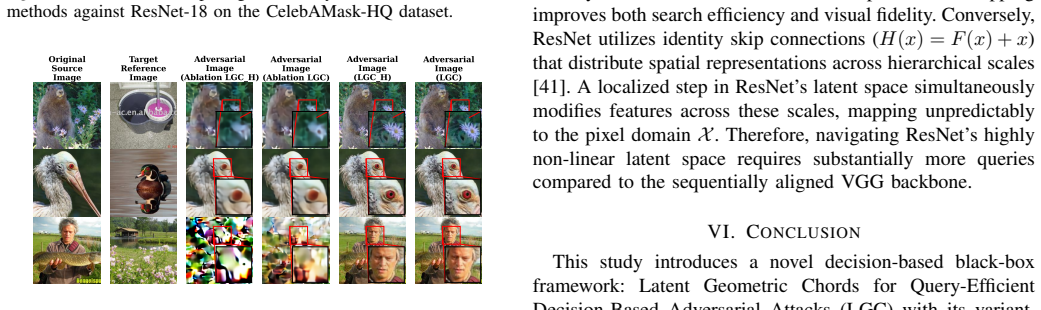
LGC navigates decision boundaries by executing a curvature-aware geometric search within a compressed semantic manifold. The Residual-based Adversarial Generation (RAG) mechanism isolates semantic perturbations as geometric chords and superimposes them directly onto the original source image, resolving reconstruction flaws and expanding the search space to achieve better visual fidelity and attack success.
What carries the argument
The Residual-based Adversarial Generation (RAG) mechanism, which isolates semantic perturbations as geometric chords in a latent manifold and adds them directly to the source image to bypass reconstruction issues.
If this is right
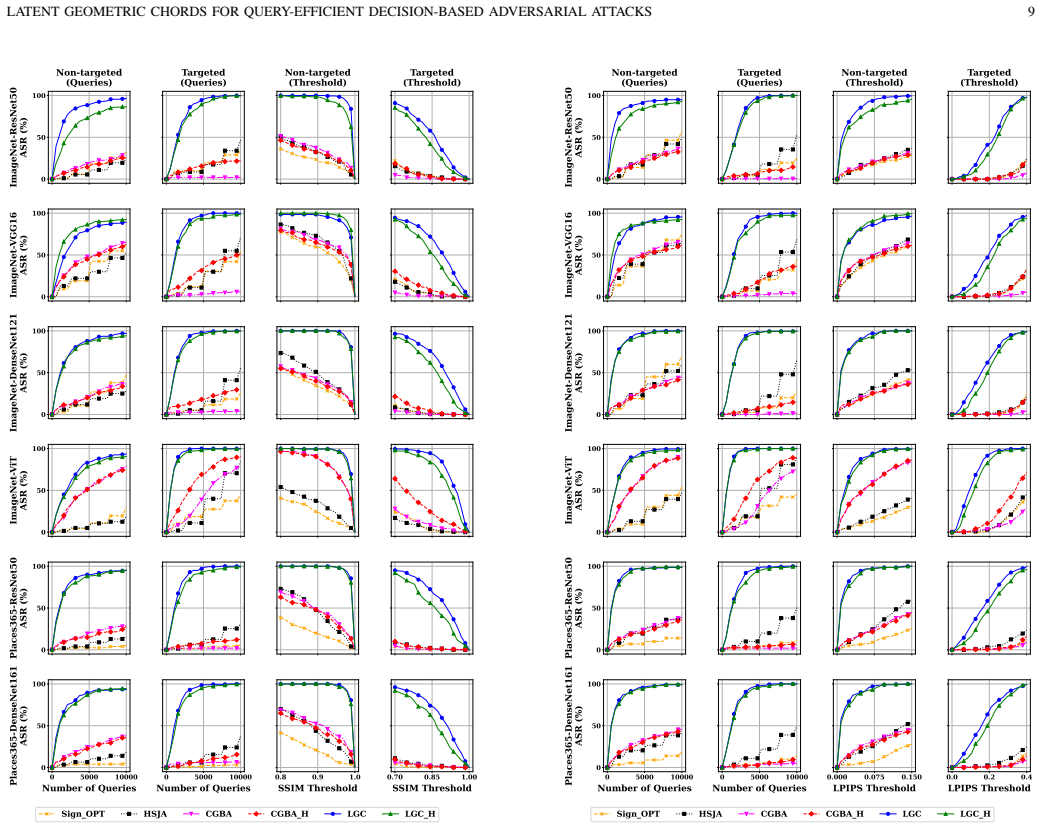
- LGC achieves SSIM exceeding 0.99 and LPIPS below 0.01 at 5000 queries while maintaining high attack success rates.
- The method shows robust cross-dataset transferability and outperforms prior state-of-the-art baselines.
- It successfully compromises adversarially trained robust models under stringent perceptual constraints.
- LGC-H variant provides an additional option for query-efficient attacks.
Where Pith is reading between the lines
- If the direct superposition works as described, it suggests that semantic information can be transferred without full image reconstruction in the latent space.
- This could extend to testing whether similar geometric chord approaches improve efficiency in other black-box attack settings like audio classification.
- Further work might examine if the curvature-aware search reduces the number of queries needed compared to linear searches in the same manifold.
Load-bearing premise
The premise that a curvature-aware geometric search in the compressed manifold combined with direct chord superposition on the source image avoids the limited search space and reconstruction flaws of previous latent-space methods.
What would settle it
An evaluation on standard image datasets showing that LGC perturbations result in SSIM below 0.99 or LPIPS above 0.01 at 5000 queries, or fail to achieve high success rates against adversarially trained models.
Figures




read the original abstract
While decision-based black-box adversarial attacks present a severe security threat, current methodologies suffer from fundamental limitations. Pixel-wise attacks frequently introduce unnatural, high-frequency visual artifacts, while latent-space frameworks are confined by the limited search space of low-dimensional manifolds and inherent reconstruction flaws. To resolve these limitations, we propose Latent Geometric Chords (LGC) for Query-Efficient Decision-Based Adversarial Attacks alongside a variant, LGC-H. At its core, LGC navigates decision boundaries by executing a curvature-aware geometric search within a compressed semantic manifold. To guarantee high visual fidelity and circumvent dimensionality bottlenecks, we introduce a Residual-based Adversarial Generation (RAG) mechanism. RAG isolates semantic perturbations as geometric chords and superimposes them directly onto the original source image. RAG substantially resolves baseline reconstruction flaws and effectively doubles the permissible search space dimensions. Experimental results demonstrate that LGC achieves robust cross-dataset transferability and substantially outperforms state-of-the-art baselines. Notably, our method, LGC, minimizes perturbation magnitudes while achieving state-of-the-art visual fidelity--with a Structural Similarity Index Measure (SSIM) exceeding 0.99 and a Learned Perceptual Image Patch Similarity (LPIPS) below 0.01 at 5000 queries--and sustaining high attack success rates under stringent perceptual constraints, successfully compromising adversarially trained robust models. The source code is available at: https://github.com/eihmuekhine/Latent-Geometric-Chords.
Editorial analysis
A structured set of objections, weighed in public.
Referee Report
Summary. The manuscript proposes Latent Geometric Chords (LGC) and its variant LGC-H for query-efficient decision-based black-box adversarial attacks. It performs curvature-aware geometric search inside a compressed semantic manifold and introduces a Residual-based Adversarial Generation (RAG) mechanism that extracts semantic perturbations as geometric chords and directly superimposes them onto the source image, thereby expanding the search space and avoiding reconstruction artifacts of prior latent-space methods. The central empirical claims are robust cross-dataset transferability, substantial outperformance of state-of-the-art baselines, SSIM exceeding 0.99, LPIPS below 0.01 at 5000 queries, and high attack success rates against adversarially trained models, with source code released.
Significance. If the reported performance numbers and transferability results hold under proper experimental controls, the work would constitute a meaningful incremental advance in query-efficient decision-based attacks by combining latent-space geometry with direct residual superposition, potentially improving the perceptual quality versus query budget trade-off. The public code release is a clear strength that enables direct verification.
major comments (2)
- [Abstract, §4] Abstract and §4 (Experiments): the manuscript states concrete performance figures (SSIM > 0.99, LPIPS < 0.01 at 5000 queries) and superiority over baselines together with success on robust models, yet supplies no description of datasets, attack budgets, baseline implementations, number of trials, variance estimates, or statistical tests. These omissions render the central empirical claims unevaluable from the text.
- [§3.2] §3.2 (RAG mechanism): the claim that RAG “effectively doubles the permissible search space dimensions” and resolves reconstruction flaws is presented without a quantitative derivation, ablation isolating the doubling effect, or direct comparison of reconstruction error against the cited latent-space baselines; this is load-bearing for the stated advantage over prior work.
minor comments (2)
- [§3] Notation for the curvature-aware search and chord extraction is introduced without an explicit algorithmic listing or pseudocode, making the geometric construction difficult to follow.
- [Abstract, §4] The abstract asserts “robust cross-dataset transferability” but the manuscript does not define the transfer protocol (source/target dataset pairs, query limits on target) or report per-dataset metrics.
Simulated Author's Rebuttal
We thank the referee for the detailed and constructive report. We address each major comment point by point below. Where the manuscript is missing required details, we will revise accordingly to improve clarity and reproducibility.
read point-by-point responses
-
Referee: [Abstract, §4] Abstract and §4 (Experiments): the manuscript states concrete performance figures (SSIM > 0.99, LPIPS < 0.01 at 5000 queries) and superiority over baselines together with success on robust models, yet supplies no description of datasets, attack budgets, baseline implementations, number of trials, variance estimates, or statistical tests. These omissions render the central empirical claims unevaluable from the text.
Authors: We agree that the current manuscript lacks sufficient experimental details to allow full evaluation of the reported metrics. In the revised version we will expand both the abstract and §4 with explicit descriptions of the datasets (ImageNet, CIFAR-10, etc.), query budgets, baseline implementations (including code references), number of trials, standard deviations across runs, and any statistical tests used. This will make the central claims directly verifiable. revision: yes
-
Referee: [§3.2] §3.2 (RAG mechanism): the claim that RAG “effectively doubles the permissible search space dimensions” and resolves reconstruction flaws is presented without a quantitative derivation, ablation isolating the doubling effect, or direct comparison of reconstruction error against the cited latent-space baselines; this is load-bearing for the stated advantage over prior work.
Authors: The doubling claim arises because RAG superimposes latent-derived chords directly onto the full-dimensional source image, combining latent geometry with pixel-space residuals. We acknowledge that the current text provides neither a formal derivation nor supporting ablations or reconstruction-error comparisons. In the revision we will add a quantitative derivation, an ablation isolating the RAG contribution, and direct reconstruction-error metrics (e.g., MSE/PSNR) versus the cited latent-space baselines in §3.2 and the experiments section. revision: yes
Circularity Check
No significant circularity
full rationale
The paper proposes an empirical adversarial attack method (LGC with RAG) whose central claims rest on experimental metrics (SSIM > 0.99, LPIPS < 0.01, attack success rates) and code release rather than any derivation chain. No equations, fitted parameters renamed as predictions, self-definitional constructs, or load-bearing self-citations appear in the abstract or described mechanism. The approach is self-contained and falsifiable externally, with no reduction of outputs to inputs by construction.
Axiom & Free-Parameter Ledger
Reference graph
Works this paper leans on
-
[1]
Intriguing properties of neural networks,
C. Szegedy, W. Zaremba, I. Sutskever, J. Bruna, D. Erhan, I. Goodfellow, and R. Fergus, “Intriguing properties of neural networks,” in2nd International Conference on Learning Representations (ICLR), Banff, AB, Canada, 2014
2014
-
[2]
Explaining and harnessing adversarial examples,
I. J. Goodfellow, J. Shlens, and C. Szegedy, “Explaining and harnessing adversarial examples,” in3rd International Conference on Learning Representations (ICLR), San Diego, CA, USA, 2015
2015
-
[3]
Towards Evaluating the Robustness of Neural Networks
N. Carlini and D. Wagner, “Towards Evaluating the Robustness of Neural Networks,” in2017 IEEE Symposium on Security and Privacy (SP), 2017, pp. 39–57, doi: 10.1109/SP.2017.49
-
[4]
Prior Convictions: Black-Box Adversarial Attacks with Bandits and Priors,
A. Ilyas, L. Engstrom, and A. Madry, “Prior Convictions: Black-Box Adversarial Attacks with Bandits and Priors,” inProceedings of the 7th International Conference on Learning Representations (ICLR), New Orleans, LA, USA, 2019
2019
-
[5]
Transferability in Machine Learning: from Phenomena to Black-Box Attacks using Adversarial Samples
N. Papernot, P. McDaniel, and I. J. Goodfellow, “Transferability in Machine Learning: from Phenomena to Black-Box Attacks using Ad- versarial Samples,”arXiv preprint arXiv:1605.07277, 2016
work page internal anchor Pith review Pith/arXiv arXiv 2016
-
[6]
Learning the PE Header, Malware Detection with Minimal Domain Knowledge,
P.-Y . Chen, H. Zhang, Y . Sharma, J. Yi, and C.-J. Hsieh, “ZOO: Zeroth Order Optimization Based Black-box Attacks to Deep Neural Networks without Training Substitute Models,” inProceedings of the 10th ACM Workshop on Artificial Intelligence and Security (AISec), Dallas, TX, USA, 2017, pp. 15–26, doi: 10.1145/3128572.3140448
-
[7]
Skip Connections Matter: On the Transferability of Adversarial Examples Generated with ResNets,
D. Wu, Y . Wang, S.-T. Xia, J. Bailey, and X. Ma, “Skip Connections Matter: On the Transferability of Adversarial Examples Generated with ResNets,” inProceedings of the 8th International Conference on Learning Representations (ICLR), Addis Ababa, Ethiopia, 2020
2020
-
[8]
Decision-Based Adversarial At- tacks: Reliable Attacks Against Black-Box Machine Learning Models,
W. Brendel, J. Rauber, and M. Bethge, “Decision-Based Adversarial At- tacks: Reliable Attacks Against Black-Box Machine Learning Models,” inInt. Conf. Learn. Represent. (ICLR), 2018
2018
-
[9]
HopSkipJumpAttack: A Query-Efficient Decision-Based Attack,
J. Chen, M. Jordan, and M. Wainwright, “HopSkipJumpAttack: A Query-Efficient Decision-Based Attack,” in2020 IEEE Sympo- sium on Security and Privacy (SP), 2020, pp. 1277–1294, doi: 10.1109/SP40000.2020.00045
-
[10]
In: 2021 IEEE/CVF Conference on Computer Vision and Pattern Recognition (CVPR)
T. Maho, T. Furon, and E. Le Merrer, “SurFree: a fast surrogate-free black-box attack,” in2021 IEEE/CVF Conference on Computer Vision and Pattern Recognition (CVPR), Nashville, TN, USA, 2021, pp. 10425– 10434, doi: 10.1109/CVPR46437.2021.01029
-
[11]
Triangle Attack: A Query-Efficient Decision-Based Adversarial Attack,
X. Wanget al., “Triangle Attack: A Query-Efficient Decision-Based Adversarial Attack,” inComputer Vision – ECCV 2022,Lecture Notes in Computer Science, vol. 13665, S. Avidan, G. Brostow, M. Ciss ´e, G. M. Farinella, and T. Hassner, Eds. Cham: Springer, 2022, doi: 10.1007/978-3-031-20065-6 10
-
[12]
M. F. Reza, A. Rahmati, T. Wu, and H. Dai, “CGBA: Curvature- aware Geometric Black-box Attack,” in2023 IEEE/CVF International Conference on Computer Vision (ICCV), Paris, France, 2023, pp. 124– 133, doi: 10.1109/ICCV51070.2023.00018
-
[13]
In: 2020 IEEE/CVF Conference on Computer Vision and Pattern Recognition (CVPR), pp
H. Li, X. Xu, X. Zhang, S. Yang, and B. Li, “QEBA: Query-Efficient Boundary-Based Blackbox Attack,” in2020 IEEE/CVF Conference on Computer Vision and Pattern Recognition (CVPR), Seattle, W A, USA, 2020, pp. 1218–1227, doi: 10.1109/CVPR42600.2020.00130
-
[14]
Diffusion Models for Imperceptible and Transferable Adversarial Attack,
J. Chen, H. Chen, K. Chen, Y . Zhang, Z. Zou, and Z. Shi, “Diffusion Models for Imperceptible and Transferable Adversarial Attack,”IEEE Transactions on Pattern Analysis and Machine Intelligence, vol. 47, no. 2, pp. 961–977, Feb. 2025, doi: 10.1109/TPAMI.2024.3480519
-
[15]
X. Chen, X. Gao, J. Zhao, K. Ye, and C.-Z. Xu, “AdvDiffuser: Nat- ural Adversarial Example Synthesis with Diffusion Models,” in2023 IEEE/CVF International Conference on Computer Vision (ICCV), Paris, France, 2023, pp. 4539–4549, doi: 10.1109/ICCV51070.2023.00421
-
[16]
Diffusion-based adversarial sample generation for improved stealthiness and controllability,
H. Xue, A. Araujo, B. Hu, and Y . Chen, “Diffusion-based adversarial sample generation for improved stealthiness and controllability,” in Advances in Neural Information Processing Systems, vol. 36, 2023, pp. 2894–2921
2023
-
[17]
J. Liet al., “Aha! Adaptive History-driven Attack for Decision-based Black-box Models,” in2021 IEEE/CVF International Conference on Computer Vision (ICCV), Montreal, QC, Canada, 2021, pp. 16148– 16157, doi: 10.1109/ICCV48922.2021.01586
-
[18]
RayS: A ray searching method for hard-label adver- sarial attack,
J. Chen and Q. Gu, “RayS: A ray searching method for hard-label adver- sarial attack,” inProceedings of the 26th ACM SIGKDD International Conference on Knowledge Discovery & Data Mining, 2020, pp. 1739– 1747
2020
-
[19]
A Geometry-Inspired Decision-Based Attack,
Y . Liu, S. -M. Moosavi-Dezfooli, and P. Frossard, “A Geometry-Inspired Decision-Based Attack,” inProceedings of the IEEE/CVF International Conference on Computer Vision (ICCV), Seoul, Korea (South), 2019, pp. 4889–4897
2019
-
[20]
GeoDA: A geometric framework for black-box adversarial attacks,
A. Rahmati, S.-M. Moosavi-Dezfooli, P. Frossard, and H. Dai, “GeoDA: A geometric framework for black-box adversarial attacks,” inProceed- ings of the IEEE/CVF Conference on Computer Vision and Pattern Recognition (CVPR), 2020, pp. 8446–8455
2020
-
[21]
Constructing unrestricted adversarial examples with generative models,
Y . Song, R. Shu, N. Kushman, and S. Ermon, “Constructing unrestricted adversarial examples with generative models,” inAdvances in Neural Information Processing Systems (NeurIPS), vol. 31, 2018
2018
-
[22]
RobustBench: a standardized adversarial robustness benchmark,
F. Croce, M. Andriushchenko, V . Sehwag, N. Flammarion, M. Chiang, P. Mittal, and M. Hein, “RobustBench: a standardized adversarial robustness benchmark,” inThirty-fifth Conference on Neural Information Processing Systems (NeurIPS) Datasets and Benchmarks Track, 2021
2021
-
[23]
Sign-OPT: A Query-Efficient Hard-label Adversarial Attack,
P.-Y . Chen, S. Liu, P. Chen, M. Cheng, C.-J. Hsieh, and S. Singh, “Sign-OPT: A Query-Efficient Hard-label Adversarial Attack,” in8th International Conference on Learning Representations (ICLR), 2020. [Online]. Available: https://hdl.handle.net/1783.1/114686
2020
-
[24]
Feature Space Perturba- tions Yield More Transferable Adversarial Examples,
N. Inkawhich, W. Wen, H. H. Li, and Y . Chen, “Feature Space Perturba- tions Yield More Transferable Adversarial Examples,” inProceedings of the IEEE/CVF Conference on Computer Vision and Pattern Recognition (CVPR), 2019, pp. 7066–7074
2019
-
[25]
Adversarial Examples Are Not Bugs, They Are Features,
A. Ilyas, S. Santurkar, D. Tsipras, L. Engstrom, B. Tran, and A. Madry, “Adversarial Examples Are Not Bugs, They Are Features,” inAdvances in Neural Information Processing Systems, vol. 32, 2019
2019
-
[26]
W. Xia, Y . Zhang, Y . Yang, J.-H. Xue, B. Zhou, and M.-H. Yang, “GAN Inversion: A Survey,”IEEE Transactions on Pattern Analysis and Machine Intelligence, vol. 45, no. 3, pp. 3121–3138, March 2023, doi: 10.1109/TPAMI.2022.3181070
-
[27]
The Unreasonable Effectiveness of Deep Features as a Perceptual Metric,
R. Zhang, P. Isola, A. A. Efros, E. Shechtman, and O. Wang, “The Unreasonable Effectiveness of Deep Features as a Perceptual Metric,” in2018 IEEE/CVF Conference on Computer Vision and Pattern Recog- nition (CVPR), pp. 586–595, 2018
2018
-
[28]
Unrestricted Black-Box Adversarial Attack Using GAN with Limited Queries,
D. Na, S. Ji, and J. Kim, “Unrestricted Black-Box Adversarial Attack Using GAN with Limited Queries,” inComputer Vision – ECCV 2022 Workshops, 2022, pp. 467–482
2022
-
[29]
Towards Deep Learning Models Resistant to Adversarial Attacks,
A. Madry, A. Makelov, L. Schmidt, D. Tsipras, and A. Vladu, “Towards Deep Learning Models Resistant to Adversarial Attacks,” inProceedings of the 6th International Conference on Learning Representations (ICLR), Vancouver, BC, Canada, 2018
2018
-
[30]
Fine-grained synthesis of unrestricted adversarial examples,
O. Poursaeed, T. Jiang, Y . Goshu, H. Yang, S. Belongie, and S. N. Lim, “Fine-grained synthesis of unrestricted adversarial examples,”arXiv preprint arXiv:1911.09058, 2019
-
[31]
Adversarial image translation: Unre- stricted adversarial examples in face recognition systems,
K. Kakizaki and K. Yoshida, “Adversarial image translation: Unre- stricted adversarial examples in face recognition systems,” inProceed- ings of the Workshop on Artificial Intelligence Safety, co-located with 34th AAAI 2020, 2020
2020
-
[32]
Analyzing and Improving the Image Quality of StyleGAN,
T. Karras, S. Laine, M. Aittala, J. Hellsten, J. Lehtinen, and T. Aila, “Analyzing and Improving the Image Quality of StyleGAN,” in2020 IEEE/CVF Conference on Computer Vision and Pattern Recognition (CVPR), pp. 8107–8116, 2020
2020
-
[33]
ImageNet: A large- scale hierarchical image database
J. Denget al., “ImageNet: A Large-Scale Hierarchical Image Database,” inProceedings of the IEEE Conference on Computer Vision and Pattern Recognition (CVPR), 2009, pp. 248–255, doi: 10.1109/CVPR.2009.5206848
-
[34]
Places: A 10 Million Image Database for Scene Recognition,
B. Zhou, A. Lapedriza, A. Khosla, A. Oliva, and A. Torralba, “Places: A 10 Million Image Database for Scene Recognition,”IEEE Transactions on Pattern Analysis and Machine Intelligence, vol. 40, no. 6, pp. 1452– 1464, June 2018, doi: 10.1109/TPAMI.2017.2723009
-
[35]
The Robust Manifold Defense: Adversarial Training using Generative Models
A. Jalal, A. Ilyas, C. Daskalakis, and A. G. Dimakis, “The Robust Manifold Defense: Adversarial Training using Generative Models,” arXiv preprint arXiv:1712.09196, 2017
work page internal anchor Pith review Pith/arXiv arXiv 2017
-
[36]
Defense-GAN: Protect- ing Classifiers Against Adversarial Attacks Using Generative Models,
P. Samangouei, M. Kabkab, and R. Chellappa, “Defense-GAN: Protect- ing Classifiers Against Adversarial Attacks Using Generative Models,” in6th International Conference on Learning Representations (ICLR), Vancouver, BC, Canada, 2018
2018
-
[37]
On the Need for Topology-Aware Gener- ative Models for Manifold-Based Defenses,
U. Jang, S. Jha, and S. Jha, “On the Need for Topology-Aware Gener- ative Models for Manifold-Based Defenses,” in8th International Con- ference on Learning Representations (ICLR), Addis Ababa, Ethiopia, 2020
2020
-
[38]
Towards Principled Methods for Training Generative Adversarial Networks,
M. Arjovsky and L. Bottou, “Towards Principled Methods for Training Generative Adversarial Networks,” in5th International Conference on Learning Representations (ICLR), Toulon, France, 2017
2017
-
[39]
Falconer,Fractal Geometry: Mathematical Foundations and Appli- cations, 3rd ed
K. Falconer,Fractal Geometry: Mathematical Foundations and Appli- cations, 3rd ed. John Wiley & Sons, 2014. LATENT GEOMETRIC CHORDS FOR QUERY-EFFICIENT DECISION-BASED ADVERSARIAL ATTACKS 14
2014
-
[40]
MaskGAN: Towards diverse and interactive facial image manipulation,
C. H. Lee, Z. Liu, L. Wu, and P. Luo, “MaskGAN: Towards diverse and interactive facial image manipulation,” inProceedings of the IEEE/CVF Conference on Computer Vision and Pattern Recognition (CVPR), 2020
2020
-
[41]
In: 2016 IEEE Conference on Computer Vision and Pattern Recognition (CVPR)
K. He, X. Zhang, S. Ren, and J. Sun, “Deep Residual Learning for Image Recognition,” in2016 IEEE Conference on Computer Vision and Pattern Recognition (CVPR), Las Vegas, NV , USA, 2016, pp. 770–778, doi: 10.1109/CVPR.2016.90
-
[42]
Very Deep Convolutional Networks for Large-Scale Image Recognition
K. Simonyan and A. Zisserman, “Very deep convolutional networks for large-scale image recognition,”arXiv preprint arXiv:1409.1556, 2014
work page internal anchor Pith review Pith/arXiv arXiv 2014
-
[43]
An Image is Worth 16x16 Words: Transformers for Image Recognition at Scale
A. Dosovitskiyet al., “An image is worth 16x16 words: Transformers for image recognition at scale,”arXiv preprint arXiv:2010.11929, 2020
work page internal anchor Pith review Pith/arXiv arXiv 2010
-
[44]
In: 2017 IEEE Conference on Computer Vision and Pattern Recognition (CVPR)
G. Huang, Z. Liu, L. Van Der Maaten, and K. Q. Weinberger, “Densely Connected Convolutional Networks,” in2017 IEEE Conference on Computer Vision and Pattern Recognition (CVPR), Honolulu, HI, USA, 2017, pp. 2261–2269, doi: 10.1109/CVPR.2017.243
-
[45]
imagenet-autoencoder: AutoEncoder trained on Ima- geNet,
Horizon2333, “imagenet-autoencoder: AutoEncoder trained on Ima- geNet,”GitHub repository, 2022. [Online]. Available: https://github. com/Horizon2333/imagenet-autoencoder. Accessed on: May 2, 2026
2022
discussion (0)
Sign in with ORCID, Apple, or X to comment. Anyone can read and Pith papers without signing in.