A holomorphic neural network framework for 3D boundary value problems governed by harmonic potentials
Pith reviewed 2026-06-28 21:29 UTC · model grok-4.3
The pith
Holomorphic neural networks solve 3D boundary value problems for harmonic potentials by satisfying the governing PDEs exactly through construction.
A machine-rendered reading of the paper's core claim, the machinery that carries it, and where it could break.
Core claim
Solutions to the three-dimensional boundary value problems are represented through functions holomorphic with respect to a suitable complex variable via the Whittaker integral formula. These functions are approximated by holomorphic neural networks that enforce the holomorphicity condition exactly. As a direct consequence the governing partial differential equations hold identically everywhere in the domain, so that the training procedure operates exclusively on boundary collocation points.
What carries the argument
Holomorphic neural networks that approximate the holomorphic functions supplied by the Whittaker integral formula, thereby guaranteeing exact satisfaction of the harmonic-potential PDEs.
If this is right
- The PDE residuals remain identically zero without any interior collocation or loss term.
- Optimization uses boundary data exclusively, reducing the number of required training points.
- The same construction supplies both scalar fields for Laplace problems and vector fields for elasticity via Papkovich-Neuber potentials.
- Pointwise errors stay controlled throughout the interior in the reported numerical tests.
Where Pith is reading between the lines
- The exact interior satisfaction may allow reliable extrapolation beyond the training boundary with smaller data sets than standard residual-based networks.
- If similar integral representations exist for other linear operators, the same holomorphic-network construction could apply without modification.
- The approach supplies a natural interface between analytical potential theory and meshless numerical solvers.
Load-bearing premise
The solution must be expressible in terms of harmonic potentials that admit a representation through functions holomorphic in a suitable complex variable via the Whittaker integral formula.
What would settle it
Train the network on boundary values of a known closed-form harmonic function and observe whether the network output deviates from the true interior values by more than floating-point tolerance.
Figures

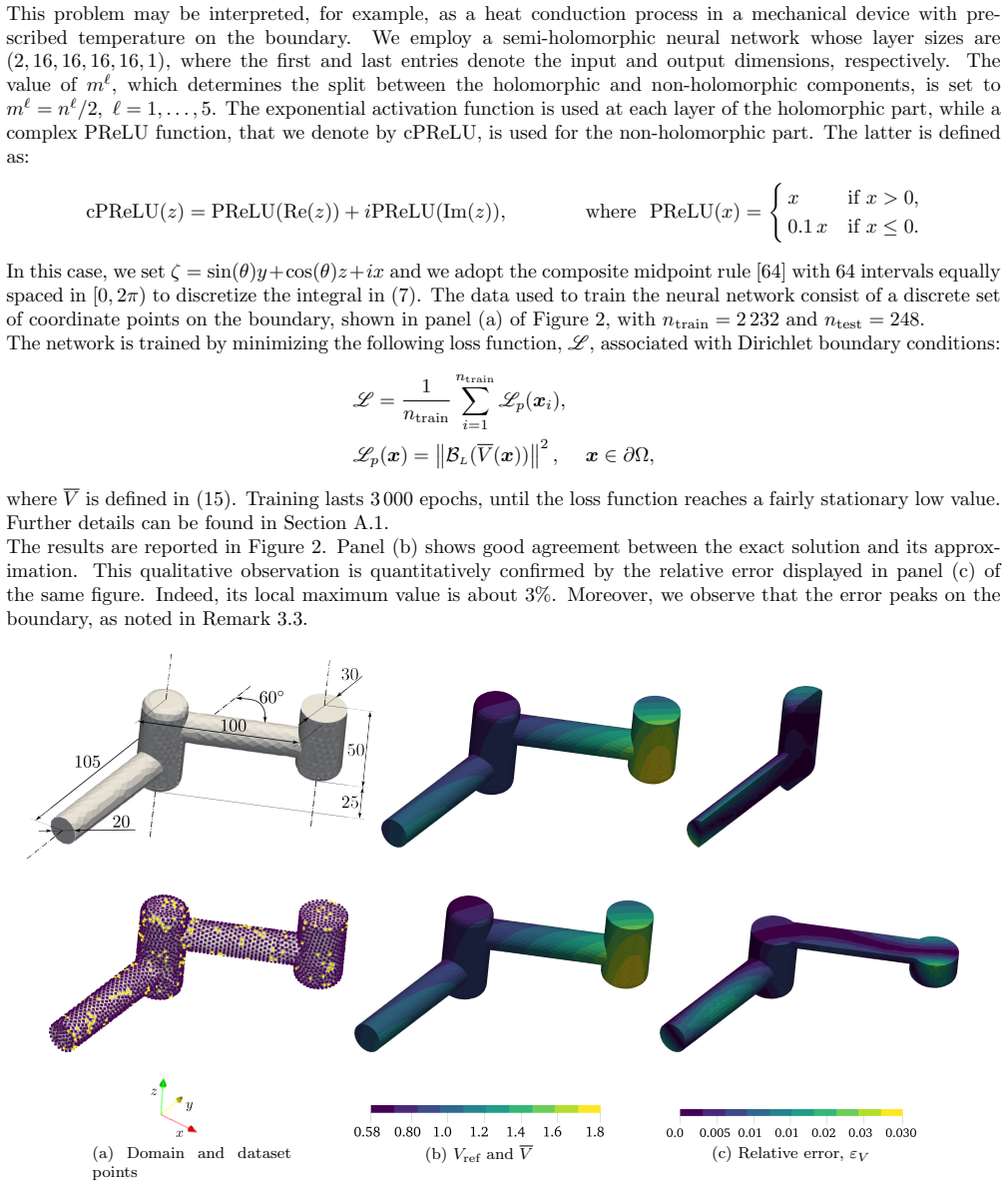
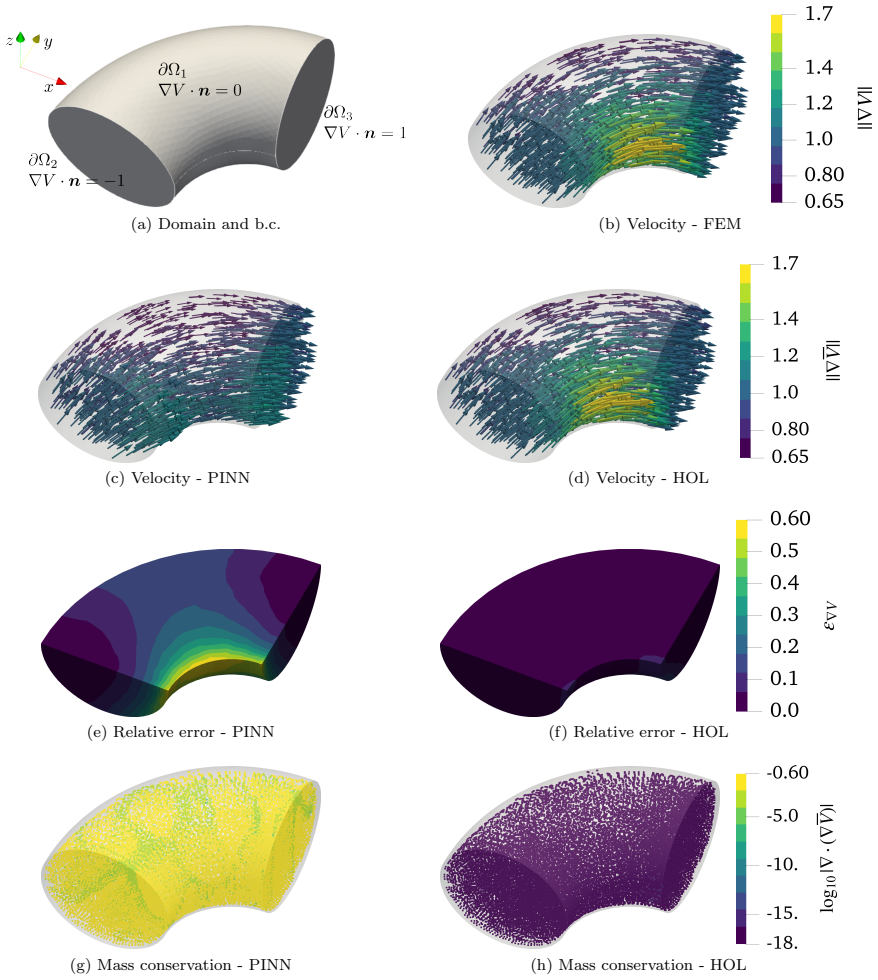




read the original abstract
We present a neural-network-based framework for the solution of three-dimensional boundary value problems where the solution is expressible in terms of harmonic potentials. The approach leverages the Whittaker integral formula, which allows representing the solution through functions that are holomorphic with respect to a suitable complex variable. These functions are subsequently approximated using holomorphic neural networks, which guaranty fulfillment of the holomorphicity requirement. A key feature of the proposed formulation is that the governing partial differential equations (PDEs) are satisfied exactly by construction. Therefore, in contrast to standard physics-informed neural networks, no residual minimization of PDEs is required in the interior of the domain, and training is based exclusively on boundary collocation points. The method is validated against three-dimensional Laplace and linear elasticity problems, where, in the latter case, displacement and stress fields are expressed via the Papkovich-Neuber potentials. The numerical results show an accurate approximation of both scalar and vector fields, with errors remaining controlled throughout the domain. Overall, the work demonstrates that the incorporation of analytical structures into neural network architectures provides a natural and effective framework for the meshless approximation of three-dimensional boundary value problems while preserving the underlying properties of the governing equations.
Editorial analysis
A structured set of objections, weighed in public.
Referee Report
Summary. The manuscript proposes a neural-network framework for 3D boundary-value problems whose solutions admit representation via harmonic potentials. Using the Whittaker integral formula, the potentials are expressed through holomorphic functions of a suitable complex variable; these functions are approximated by holomorphic neural networks that enforce holomorphicity exactly. Consequently the governing PDEs (Laplace or the Papkovich–Neuber system for linear elasticity) are satisfied identically for any network output, so that training reduces to boundary collocation only. Numerical results on scalar Laplace and vector elasticity test cases are reported to keep domain-wide errors controlled.
Significance. If the central construction holds, the work supplies a concrete route to exact interior PDE satisfaction within a neural-network solver for the important class of problems governed by harmonic potentials. The explicit incorporation of the Whittaker representation and holomorphic-network architecture is a genuine strength; it converts an analytic identity into an architectural constraint rather than a soft penalty. The reported boundary-only training and controlled domain errors on both scalar and vector problems indicate practical utility for meshless 3D potential and elasticity calculations.
minor comments (3)
- [§3.2] §3.2, Eq. (8): the precise definition of the holomorphic activation and the complex-variable mapping should be stated explicitly; the current description leaves open whether the network output is guaranteed holomorphic for finite-width networks or only in the limit.
- [Figure 4, Table 2] Figure 4 and Table 2: axis labels and legend entries use inconsistent font sizes and omit units for the stress components; this impairs direct comparison of the reported L² and L^∞ errors.
- The manuscript cites the classical Whittaker formula but does not reference recent complex-variable neural-network literature (e.g., works on holomorphic activations in complex analysis); adding two or three targeted citations would strengthen the positioning.
Simulated Author's Rebuttal
We thank the referee for the careful reading and the positive overall assessment of the manuscript. The referee's summary and significance statements accurately reflect the central contribution: the exact enforcement of the governing PDEs via the Whittaker representation and holomorphic network architecture, reducing training to boundary collocation only. The recommendation for minor revision is noted. No major comments were provided in the report, so we have no specific points requiring rebuttal or clarification at this stage. We remain available to address any editorial requests for minor changes.
Circularity Check
No significant circularity; derivation is self-contained
full rationale
The paper invokes the standard Whittaker integral formula (an external mathematical fact) to represent harmonic potentials via holomorphic functions, then uses holomorphic neural networks to enforce holomorphicity exactly. This makes the governing PDEs (Laplace or Papkovich-Neuber) vanish identically by construction for any network output, without fitting parameters to the interior solution or renaming a known result. No load-bearing self-citations, uniqueness theorems, or fitted-input predictions appear in the provided text; validation remains on external test cases. The scope is explicitly limited to problems admitting such representations, avoiding hidden circularity.
Axiom & Free-Parameter Ledger
axioms (1)
- domain assumption Solutions of the target boundary-value problems can be represented via the Whittaker integral formula using functions holomorphic in a suitable complex variable.
Reference graph
Works this paper leans on
-
[1]
Fluid Mechanics
Landau, L.D., Lifshitz, E.M., 1987. Fluid Mechanics. volume 6 ofCourse of Theoretical Physics. Pergamon Press
1987
-
[2]
Fast hydrodynamics on heteroge- neous many-core hardware, in: Couturier, R
Engsig-Karup, A.P., Glimberg, S.L., Nielsen, A.S., Lindberg, O., 2013. Fast hydrodynamics on heteroge- neous many-core hardware, in: Couturier, R. (Ed.), Designing Scientific Applications on GPUs, Chapman & Hall/CRC. doi:10.1201/b16051-20
-
[3]
Numerical Approximation of Partial Differential Equations
Quarteroni, A., Valli, A., 1994. Numerical Approximation of Partial Differential Equations. Springer Berlin Heidelberg. doi:10.1007/978-3-540-85268-1
-
[4]
Elasticity Theory, Applications, and Numerics
Sadd, M.H., 2021. Elasticity Theory, Applications, and Numerics. 4th ed., Elsevier. doi:10.1016/ c2017-0-03720-5
2021
-
[5]
Selected topics in the history of the two-dimensional biharmonic problem
Meleshko, V., 2003. Selected topics in the history of the two-dimensional biharmonic problem. Texts in Applied MathematicsApplied Mechanics Reviews 56, 33–85. doi:10.1115/1.1521166
-
[6]
A Guide to First-Passage Processes
Redner, S., 2001. A Guide to First-Passage Processes. Cambridge University Press. doi:10.1017/ cbo9780511606014
2001
-
[7]
A stabilised nodal spectral element method for fully nonlinear water waves
Engsig-Karup, A.P., Eskilsson, C., Bigoni, D., 2016. A stabilised nodal spectral element method for fully nonlinear water waves. Journal of Computational Physics 318. doi:10.1016/j.jcp.2016.04.060
-
[8]
Spectral/hp element methods: Recent developments, applications, and perspectives
Xu, H., Cantwell, C.D., Monteserin, C., Eskilsson, C., Engsig-Karup, A.P., Sherwin, S.J., 2018. Spectral/hp element methods: Recent developments, applications, and perspectives. Journal of Hydrodynamics 30, 1–22. doi:10.1007/s42241-018-0001-1
-
[9]
Isogeometric analysis: CAD, finite elements, NURBS, exact geometry and mesh refinement
Hughes, T., Cottrell, J., Bazilevs, Y., 2005. Isogeometric analysis: CAD, finite elements, NURBS, exact geometry and mesh refinement. Computer Methods in Applied Mechanics and Engineering 194, 4135–4195. doi:10.1016/j.cma.2004.10.008
-
[10]
A coupled element free Galerkin/boundary element method for stress analysis of two- dimensional solids
Gu, Y., Liu, G., 2001. A coupled element free Galerkin/boundary element method for stress analysis of two- dimensional solids. Computer Methods in Applied Mechanics and Engineering 190, 4405–4419. doi:10.1016/ s0045-7825(00)00324-8
2001
-
[11]
Neural algorithm for solving differential equations
Lee, H., Kang, I.S., 1990. Neural algorithm for solving differential equations. Journal of Computational Physics 91, 110–131. doi:10.1016/0021-9991(90)90007-N
-
[12]
AIChE Journal38, 10 (1992), 1499–1511
Psichogios, D.C., Ungar, L.H., 1992. A hybrid neural network-first principles approach to process modeling. AIChE Journal 38, 1499–1511. doi:10.1002/aic.690381003
-
[13]
Neural-network-based approximations for solving partial differential equations
Dissanayake, M.W.M.G., Phan-Thien, N., 1994. Neural-network-based approximations for solving partial differential equations. Communications in Numerical Methods in Engineering 10, 195–201. doi:10.1002/cnm. 1640100303
work page doi:10.1002/cnm 1994
-
[14]
Artificial neural networks for solving ordinary and partial differential equations
Lagaris, I., Likas, A., Fotiadis, D., 1998. Artificial neural networks for solving ordinary and partial differential equations. IEEE Transactions on Neural Networks 9, 987–1000. doi:10.1109/72.712178
-
[15]
Neural-network meth- ods for boundary value problems with irregular boundaries
Lagaris, I.E., Likas, A.C., Papageorgiou, D.G., 2000. Neural-network methods for boundary value problems with irregular boundaries. IEEE Transactions on Neural Networks 11, 1041–1049. doi:10.1109/72.870037
-
[16]
Solving Partial Differential Equations Using Artificial Neural Networks
Rudd, K., 2013. Solving Partial Differential Equations Using Artificial Neural Networks. Ph.D. thesis. Duke University. Durham, NC, USA
2013
-
[17]
Berg, J., Nystr¨ om, K., 2018. A unified deep artificial neural network approach to partial differential equations in complex geometries. Neurocomputing 317, 28–41. doi:10.1016/j.neucom.2018.06.056
-
[18]
Raissi, M., Perdikaris, P., Karniadakis, G., 2019. Physics-informed neural networks: A deep learning frame- work for solving forward and inverse problems involving nonlinear partial differential equations. Journal of Computational Physics 378, 686–707. doi:10.1016/j.jcp.2018.10.045. 21
-
[19]
Toscano, J.D., Oommen, V., Varghese, A.J., Zou, Z., Ahmadi Daryakenari, N., Wu, C., Karniadakis, G.E.,
-
[20]
Machine Learning for Computational Science and Engineering 1
From PINNs to PIKANs: recent advances in physics-informed machine learning. Machine Learning for Computational Science and Engineering 1. doi:10.1007/s44379-025-00015-1
-
[21]
Physics-informed neural networks for inviscid transonic flows around an airfoil
Wassing, S., Langer, S., Bekemeyer, P., 2025. Physics-informed neural networks for inviscid transonic flows around an airfoil. Physics of Fluids 37. doi:10.1063/5.0276518
-
[22]
Enhanced solution for the advection–diffusion–reaction equation using the physics-informed neural network technique
Lekaba, T., Ndou, N., Muzhinji, K., Moyo, S., 2026. Enhanced solution for the advection–diffusion–reaction equation using the physics-informed neural network technique. Mathematics 14, 1194. doi:10.3390/ math14071194
2026
-
[23]
Physics-informed neural networks for advection–diffusion–langmuir adsorption processes
Huang, B., Hua, H., Han, H., He, S., Zhou, Y., Liu, S., Zuo, Z., 2024. Physics-informed neural networks for advection–diffusion–langmuir adsorption processes. Physics of Fluids 36. doi:10.1063/5.0221924
-
[24]
Shallow neural networks and laplace’s equation on the half-space with dirichlet boundary data
Vaishampayan, M., 2024. Shallow neural networks and laplace’s equation on the half-space with dirichlet boundary data. Pittsburgh Interdisciplinary Mathematics Review 2, 59–70. doi:10.5195/pimr.2024.39
-
[25]
Deep learning in computational mechanics: a review
Herrmann, L., Kollmannsberger, S., 2024. Deep learning in computational mechanics: a review. Computational Mechanics 74, 281–331. doi:10.1007/s00466-023-02434-4
-
[26]
Hu, H., Qi, L., Chao, X., 2024. Physics-informed neural networks (PINN) for computational solid mechanics: Numerical frameworks and applications. Thin-Walled Structures 205, 112495. doi:10.1016/j.tws.2024. 112495
-
[27]
Physics informed neural networks for continuum micromechanics
Henkes, A., Wessels, H., Mahnken, R., 2022. Physics informed neural networks for continuum micromechanics. Computer Methods in Applied Mechanics and Engineering 393, 114790. doi:10.1016/j.cma.2022.114790
-
[28]
Vahab, M., Haghighat, E., Khaleghi, M., Khalili, N., 2022. A physics-informed neural network approach to solution and identification of biharmonic equations of elasticity. Journal of Engineering Mechanics 148. doi:10.1061/(asce)em.1943-7889.0002062
-
[29]
Rezaei, S., Harandi, A., Moeineddin, A., Xu, B.X., Reese, S., 2022. A mixed formulation for physics-informed neural networks as a potential solver for engineering problems in heterogeneous domains: Comparison with finite element method. Computer Methods in Applied Mechanics and Engineering 401, 115616. doi:10.1016/ j.cma.2022.115616
arXiv 2022
-
[30]
Roy, A.M., Bose, R., Sundararaghavan, V., Arr´ oyave, R., 2023. Deep learning-accelerated computational framework based on physics informed neural network for the solution of linear elasticity. Neural Networks 162, 472–489. doi:10.1016/j.neunet.2023.03.014
-
[31]
On the performance and convergence of PINNs for problems in linear elasticity
Kadlag, D., Birk, C., Natarajan, S., Gravenkamp, H., 2026. On the performance and convergence of PINNs for problems in linear elasticity. Proceedings in Applied Mathematics and Mechanics 26. doi:10.1002/pamm.70113
-
[32]
Xu, C., Cao, B.T., Yuan, Y., Meschke, G., 2023. Transfer learning based physics-informed neural networks for solving inverse problems in engineering structures under different loading scenarios. Computer Methods in Applied Mechanics and Engineering 405, 115852. doi:10.1016/j.cma.2022.115852
-
[33]
Zhang, E., Dao, M., Karniadakis, G.E., Suresh, S., 2022. Analyses of internal structures and defects in materials using physics-informed neural networks. Science Advances 8. doi:10.1126/sciadv.abk0644
-
[34]
In: Medical Imaging with Deep Learning (MIDL)
Park, S., Yun, C., Lee, J., Shin, J., 2020. Minimum width for universal approximation doi:10.48550/ARXIV. 2006.08859,arXiv:2006.08859
work page internal anchor Pith review doi:10.48550/arxiv 2020
-
[35]
Cai, Y., 2022. Achieve the minimum width of neural networks for universal approximation doi:10.48550/ ARXIV.2209.11395,arXiv:2209.11395
arXiv 2022
-
[36]
Li, L., Duan, Y., Ji, G., Cai, Y., 2023. Minimum width of leaky-relu neural networks for uniform universal approximation doi:10.48550/ARXIV.2305.18460,arXiv:2305.18460
-
[37]
Approximating continuous functions by ReLU nets of minimal width doi:10
Hanin, B., Sellke, M., 2017. Approximating continuous functions by ReLU nets of minimal width doi:10. 48550/ARXIV.1710.11278,arXiv:1710.11278. 22
Pith/arXiv arXiv 2017
-
[38]
Estimates on the generalization error of physics-informed neural networks for approximating pdes
Mishra, S., Molinaro, R., 2022. Estimates on the generalization error of physics-informed neural networks for approximating PDEs. IMA Journal of Numerical Analysis 43, 1–43. doi:10.1093/imanum/drab093
-
[39]
1980, Biological Cybernetics, 36, 193, doi: 10.1007/BF00344251
Fukushima, K., 1980. Neocognitron: A self-organizing neural network model for a mechanism of pattern recognition unaffected by shift in position. Biological Cybernetics 36, 193–202. doi:10.1007/bf00344251
-
[40]
Attention is all you need, in: Advances in Neural Information Processing Systems 30 (NeurIPS 2017), pp
Vaswani, A., Shazeer, N., Parmar, N., Uszkoreit, J., Jones, L., Gomez, A.N., Kaiser, L., Polosukhin, I., 2017. Attention is all you need, in: Advances in Neural Information Processing Systems 30 (NeurIPS 2017), pp. 5998–6008
2017
-
[41]
Samaniego, E., Anitescu, C., Goswami, S., Nguyen-Thanh, V., Guo, H., Hamdia, K., Zhuang, X., Rabczuk, T., 2020. An energy approach to the solution of partial differential equations in computational mechanics via machine learning: Concepts, implementation and applications. Computer Methods in Applied Mechanics and Engineering 362, 112790. doi:10.1016/j.cma...
-
[42]
Dcem: A deep complementary energy method for linear elasticity
Wang, Y., Sun, J., Rabczuk, T., Liu, Y., 2024. Dcem: A deep complementary energy method for linear elasticity. International Journal for Numerical Methods in Engineering 125. doi:10.1002/nme.7585
-
[43]
von Tresckow, M., Kurz, S., De Gersem, H., Loukrezis, D., 2022. A neural solver for variational problems on cad geometries with application to electric machine simulation. Journal of Machine Learning for Modeling and Computing 3, 49–75. doi:10.1615/jmachlearnmodelcomput.2022041753
-
[44]
Variational physics- informed neural networks for solving partial differential equations
Kharazmi, E., Zhang, Z., Karniadakis, G.E., 2019. Variational physics-informed neural networks for solving partial differential equations doi:10.48550/ARXIV.1912.00873,arXiv:1912.00873
-
[45]
hp-vpinns: Variational physics-informed neural networks with domain decomposition
Kharazmi, E., Zhang, Z., Karniadakis, G.E., 2021. hp-vpinns: Variational physics-informed neural networks with domain decomposition. Computer Methods in Applied Mechanics and Engineering 374, 113547. doi:10. 1016/j.cma.2020.113547
arXiv 2021
-
[46]
Sun, J., Liu, Y., Wang, Y., Yao, Z., Zheng, X., 2023. Binn: A deep learning approach for computational mechanics problems based on boundary integral equations. Computer Methods in Applied Mechanics and Engineering 410, 116012. doi:10.1016/j.cma.2023.116012
-
[47]
Harmonic neural networks, in: Krause, A., Brunskill, E., Cho, K., Engelhardt, B., Sabato, S., Scarlett, J
Ghosh, A., Gentile, A.A., Dagrada, M., Lee, C., Kim, S.H.S., Cha, H., Choi, Y., Kim, D., Kye, J.I., Elfving, V.E., 2023. Harmonic neural networks, in: Krause, A., Brunskill, E., Cho, K., Engelhardt, B., Sabato, S., Scarlett, J. (Eds.), Proceedings of the 40th International Conference on Machine Learning, PMLR. pp. 11340– 11359
2023
-
[48]
Physics-informed holomorphic neural networks (PIHNNs): Solving 2D linear elasticity problems
Calaf` a, M., Hovad, E., Engsig-Karup, A.P., Andriollo, T., 2024. Physics-informed holomorphic neural networks (PIHNNs): Solving 2D linear elasticity problems. Computer Methods in Applied Mechanics and Engineering 432, 117406. doi:10.1016/j.cma.2024.117406
-
[49]
Calaf` a, M., Andriollo, T., Engsig-Karup, A.P., Jeong, C.H., 2025a. A holomorphic Kolmogorov-Arnold network framework for solving elliptic problems on arbitrary 2D domains doi:10.48550/ARXIV.2507.22678, arXiv:2507.22678
-
[50]
Solving plane crack problems via enriched holomorphic neural networks
Calaf` a, M., Jensen, H.M., Andriollo, T., 2025b. Solving plane crack problems via enriched holomorphic neural networks. Engineering Fracture Mechanics 322, 111133. doi:10.1016/j.engfracmech.2025.111133
-
[51]
A Variational Kolosov--Muskhelishvili Network for Elasticity and Fracture
Zhou, S., H¨ affner, C., Stebner, S., Fehlemann, N., Wei, Z., M¨ unstermann, S., 2026a. A variational Kolosov– Muskhelishvili network for elasticity and fracture doi:10.48550/ARXIV.2605.02310,arXiv:2605.02310
work page internal anchor Pith review Pith/arXiv arXiv doi:10.48550/arxiv.2605.02310
-
[52]
Transfer- learned Kolosov–Muskhelishvili informed neural networks for fracture mechanics
Zhou, S., H¨ affner, C., Wang, S., Stebner, S., Liao, Z., Yang, B., Wei, Z., M¨ unstermann, S., 2026b. Transfer- learned Kolosov–Muskhelishvili informed neural networks for fracture mechanics. Theoretical and Applied Fracture Mechanics 144, 105582. doi:10.1016/j.tafmec.2026.105582
-
[53]
On the partial differential equations of mathematical physics
Whittaker, E.T., 1903. On the partial differential equations of mathematical physics. Mathematische Annalen 57, 333–355. doi:10.1007/bf01444290. 23
-
[54]
Complex Analysis
Stein, E.M., 2003. Complex Analysis. 1st ed. ed., Princeton University Press, Princeton. Description based on publisher supplied metadata and other sources
2003
-
[55]
Complex Analysis An Introduction to the Theory of Analytic Functions of One Complex Variable
Ahlfors, L.V., 2021. Complex Analysis An Introduction to the Theory of Analytic Functions of One Complex Variable. American Mathematical Society
2021
-
[56]
Analytic functions of hypercomplex variables
Ketchum, P.W., 1928. Analytic functions of hypercomplex variables. Transactions of the American Mathe- matical Society 30, 641–667. doi:10.1090/s0002-9947-1928-1501452-7
-
[57]
The use of complex valued functions for the solution of three-dimensional elasticity problems
Piltner, R., 1987. The use of complex valued functions for the solution of three-dimensional elasticity problems. Journal of Elasticity 18, 191–225. doi:10.1007/bf00044194
-
[58]
Monogenic functions in a finite-dimensional semi-simple commu- tative algebra
Plaksa, S.A., Pukhtaievych, R.P., 2014. Monogenic functions in a finite-dimensional semi-simple commu- tative algebra. Analele Universitatii “Ovidius” Constanta - Seria Matematica 22, 221–235. doi:10.2478/ auom-2014-0018
2014
-
[59]
On the completeness of the Papkovich–Neuber solution
Tran-Cong, T., 1989. On the completeness of the Papkovich–Neuber solution. Quarterly of Applied Mathe- matics 47, 645–659. doi:10.1090/qam/1031682
-
[60]
Geuchen, P., 2025. Approximation properties of complex-valued neural networks: An overview, in: 2025 International Conference on Sampling Theory and Applications (SampTA), IEEE. pp. 1–5. doi:10.1109/ sampta64769.2025.11133560
arXiv 2025
-
[61]
Introductory Functional Analysis: With Applications to Boundary Value Problems and Finite Elements
Reddy, B.D., 1998. Introductory Functional Analysis: With Applications to Boundary Value Problems and Finite Elements. Springer New York. doi:10.1007/978-1-4612-0575-3
-
[62]
Partial differential equations
Evans, L.C., 2022. Partial differential equations. Number 19 in Graduate studies in mathematics. second ed., American Mathematical Society, Providence, Rhode Island. Literaturverzeichnis: Seite 689-701
2022
-
[63]
Adam: A Method for Stochastic Optimization
Kingma, D.P., Ba, J., 2014. Adam: A method for stochastic optimization doi:10.48550/ARXIV.1412.6980, arXiv:1412.6980
work page internal anchor Pith review Pith/arXiv arXiv doi:10.48550/arxiv.1412.6980 2014
-
[64]
McGreivy, N., Hakim, A., 2024. Weak baselines and reporting biases lead to overoptimism in ma- chine learning for fluid-related partial differential equations. Nature Machine Intelligence 6, 1256–1269. doi:10.1038/s42256-024-00897-5
-
[65]
Numerical Analysis
Burden, R.L., Faires, J.D., 2011. Numerical Analysis. 9 ed., Brooks/Cole, Cengage Learning
2011
-
[66]
Ballini, E., Muscarnera, L., Fumagalli, A., Scotti, A., Regazzoni, F., 2026. Elimination-compensation pruning for fully-connected neural networks doi:10.48550/ARXIV.2602.20467,arXiv:2602.20467
-
[67]
Piltner, R., 2001. Overview about solution representations for elasticity problems and some selected particular solutions. Mathematics and Mechanics of Solids 6, 193–220. doi:10.1177/108128650100600205
-
[68]
´A.L., Abarca Jim´ enez, G.S., 2021
Mares Carre˜ no, J., Ortega Herrera, J. ´A.L., Abarca Jim´ enez, G.S., 2021. A displacement potential function using complex variables for numerical computations of three-dimensional elasticity problems. Archive of Applied Mechanics 91, 2331–2344. doi:10.1007/s00419-021-01885-6
-
[69]
JAX: composable transformations of Python+NumPy programs
Bradbury, J., Frostig, R., Hawkins, P., Johnson, M.J., Katariya, Y., Leary, C., Maclaurin, D., Necula, G., Paszke, A., VanderPlas, J., Wanderman-Milne, S., Zhang, Q., 2018. JAX: composable transformations of Python+NumPy programs. Open-source software
2018
-
[70]
CUDA Toolkit.https://developer.nvidia.com/cuda-toolkit
NVIDIA, . CUDA Toolkit.https://developer.nvidia.com/cuda-toolkit
-
[71]
On the convergence of Adam and beyond, in: International Conference on Learning Representations
Reddi, S.J., Kale, S., Kumar, S., 2018. On the convergence of Adam and beyond, in: International Conference on Learning Representations
2018
-
[72]
On the limited memory BFGS method for large scale optimization
Liu, D.C., Nocedal, J., 1989. On the limited memory BFGS method for large scale optimization. Mathematical Programming 45, 503–528. 24
1989
-
[73]
Understanding the difficulty of training deep feedforward neural networks
Glorot, X., Bengio, Y., 2010. Understanding the difficulty of training deep feedforward neural networks. Journal of Machine Learning Research 9, 249–256
2010
-
[74]
Delving deep into rectifiers: Surpassing human-level performance on ImageNet classification, in: 2015 IEEE International Conference on Computer Vision (ICCV)
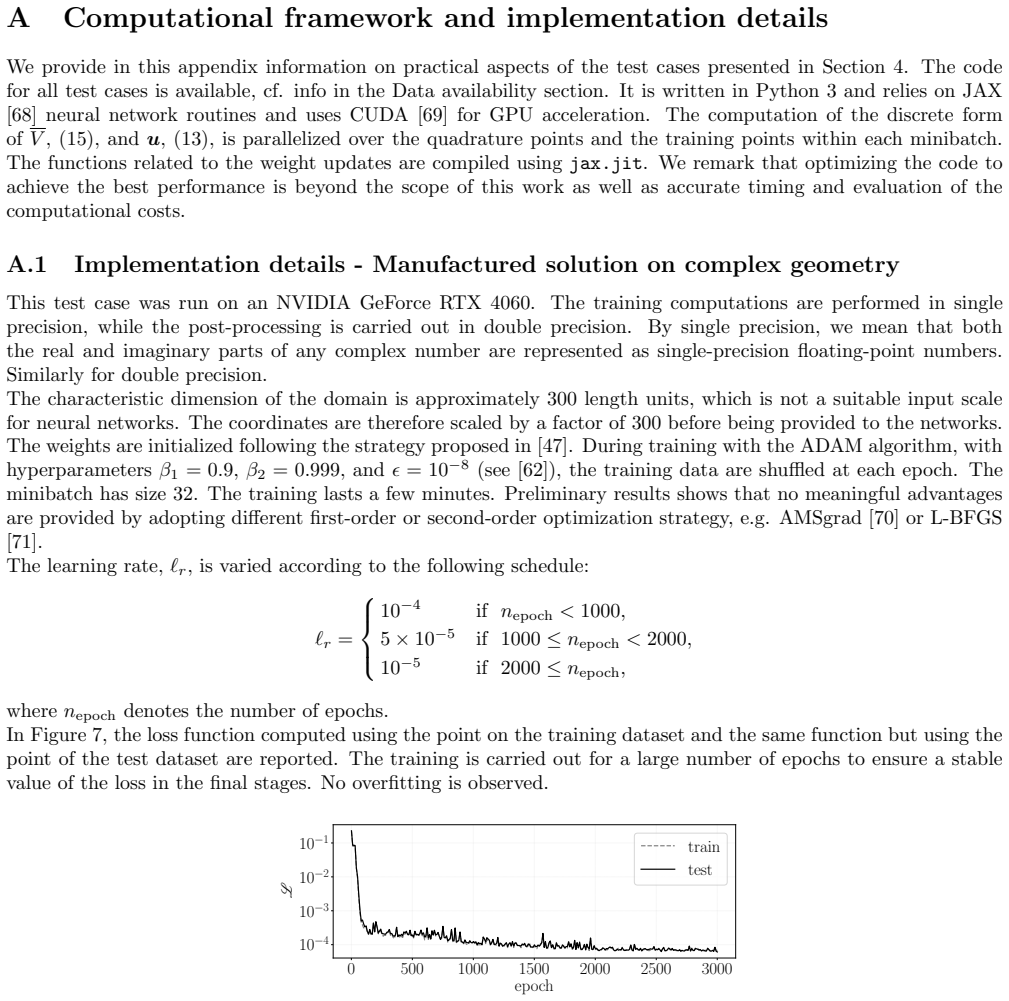
He, K., Zhang, X., Ren, S., Sun, J., 2015. Delving deep into rectifiers: Surpassing human-level performance on ImageNet classification, in: 2015 IEEE International Conference on Computer Vision (ICCV). doi:10.1109/ iccv.2015.123. 25 A Computational framework and implementation details We provide in this appendix information on practical aspects of the tes...
2015
-
[75]
The computation of the discrete form of V, (15), andu, (13), is parallelized over the quadrature points and the training points within each minibatch
neural network routines and uses CUDA [69] for GPU acceleration. The computation of the discrete form of V, (15), andu, (13), is parallelized over the quadrature points and the training points within each minibatch. The functions related to the weight updates are compiled usingjax.jit. We remark that optimizing the code to achieve the best performance is ...
2000
discussion (0)
Sign in with ORCID, Apple, or X to comment. Anyone can read and Pith papers without signing in.