Functional Multi-Target Detection via Bispectrum Inversion
Pith reviewed 2026-06-28 21:20 UTC · model grok-4.3
The pith
A compactly supported signal is recovered from one noisy observation containing many unknown continuous translations by estimating and inverting its bispectrum.
A machine-rendered reading of the paper's core claim, the machinery that carries it, and where it could break.
Core claim
For compactly supported signals observed in a single record that contains many unknown continuous translations and is corrupted by correlated stationary Gaussian noise, the debiased third-order empirical autocorrelation yields a sufficiently accurate bispectrum estimate; this estimate is then inverted by either a functional frequency-marching scheme or a Kotlarski-type formula to produce a recovered signal whose error is controlled by the smoothness of the true signal and the quality of the bispectrum estimate, without any band-limiting requirement.
What carries the argument
Debiased third-order empirical autocorrelation used to estimate the bispectrum, inverted via frequency marching or Kotlarski-type deconvolution formula.
If this is right
- Recovery guarantees hold without band-limiting the signal.
- Error decreases as the number of signal occurrences increases or as the noise correlation structure is accounted for in the estimation step.
- Both the frequency-marching and Kotlarski routes produce explicit non-asymptotic bounds once the bispectrum accuracy is controlled.
- The same framework applies to low-SNR regimes once the bispectrum estimate is accurate enough.
- The approach extends prior discrete-grid, white-noise analyses to continuous translations and correlated noise.
Where Pith is reading between the lines
- The same bispectrum route could be tested on real radar or ultrasound records where target positions are truly off-grid.
- If the bispectrum estimate remains stable under mild deviations from stationarity, the method might apply to slowly varying noise backgrounds.
- The frequency-marching and Kotlarski routes could be compared on the same data set to see which bound is tighter for a given smoothness class.
- The error analysis suggests that collecting more independent records would tighten the bispectrum estimate in the same way that increasing the number of occurrences does.
Load-bearing premise
The debiased third-order empirical autocorrelation must produce a sufficiently accurate bispectrum estimate despite unknown continuous translations and correlated stationary Gaussian noise.
What would settle it
A concrete counter-example or numerical trial in which the recovered-signal error exceeds the derived bound for a known smooth compactly supported signal, fixed noise variance, and known number of occurrences.
Figures


read the original abstract
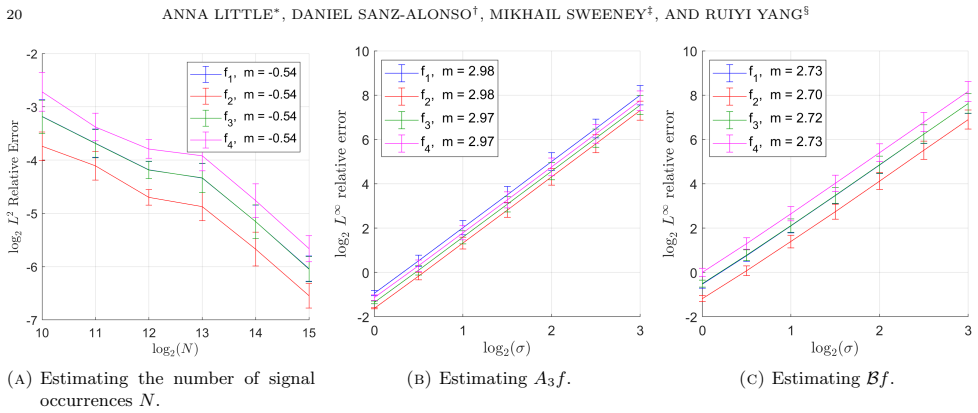
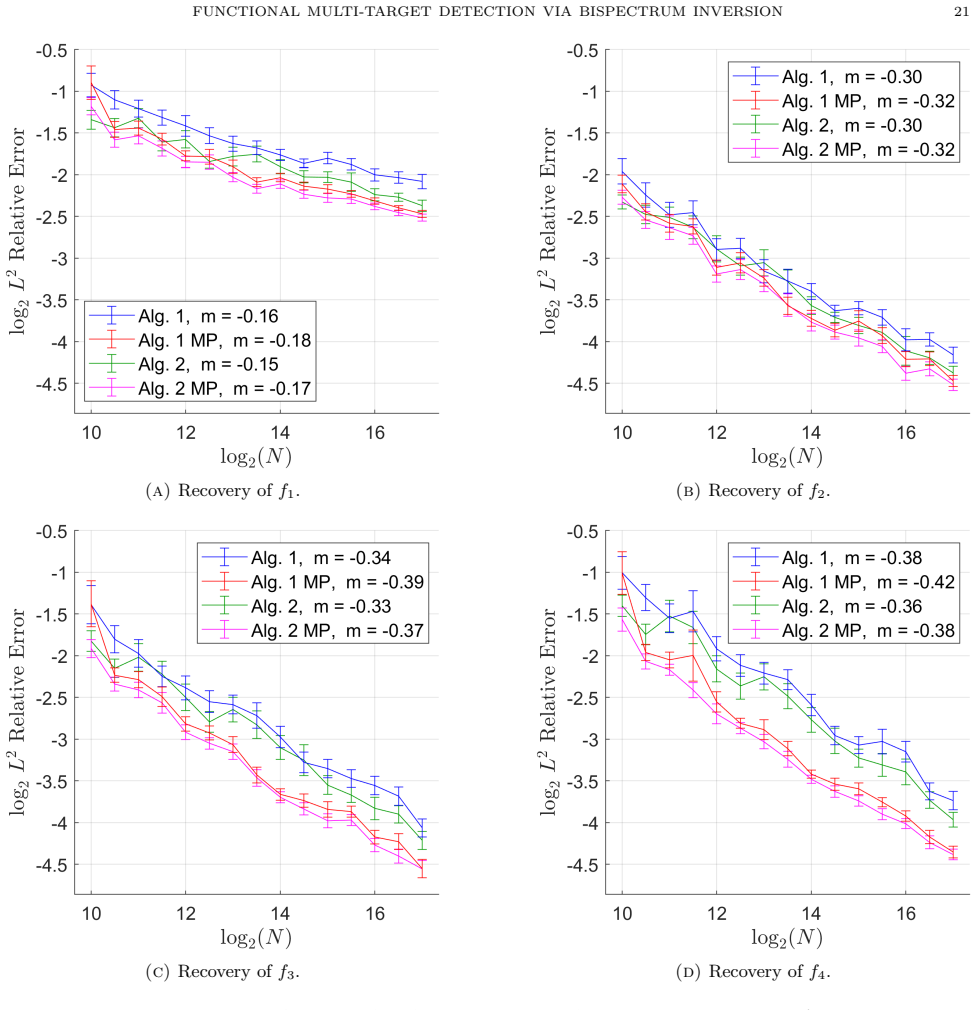
This paper develops a functional theory for multi-target detection, where a compactly supported signal is recovered from a single noisy observation containing many unknown translations of the signal. Our formulation allows continuous, off-grid translations and correlated stationary Gaussian process noise, extending beyond the discrete, grid-aligned, white-noise models common in prior work. We analyze two uninitialized recovery algorithms based on autocorrelation analysis; in particular, both algorithms first estimate the signal's bispectrum via a debiased third-order empirical autocorrelation. The signal is then recovered from the estimated bispectrum using either a functional frequency marching scheme or a Kotlarski-type deconvolution formula. For both algorithms, we prove non-asymptotic recovery guarantees for compactly supported signals without bandlimiting assumptions. The resulting error bounds depend on the smoothness of the signal and the accuracy of bispectrum estimation, with the latter governed by the noise characteristics and the number of signal occurrences. Numerical experiments validate our theory and demonstrate accurate recovery in low-SNR regimes.
Editorial analysis
A structured set of objections, weighed in public.
Referee Report
Summary. The paper develops a functional theory for multi-target detection, recovering a compactly supported signal from one noisy observation containing many unknown continuous (off-grid) translations of the signal in correlated stationary Gaussian noise. Two uninitialized algorithms are analyzed: both estimate the bispectrum from a debiased third-order empirical autocorrelation, then invert via a functional frequency-marching scheme or a Kotlarski-type deconvolution formula. Non-asymptotic recovery guarantees are claimed for compactly supported signals without bandlimiting assumptions; the error bounds depend on signal smoothness and bispectrum estimation accuracy governed by noise and the number of occurrences.
Significance. If the guarantees hold, the work meaningfully extends discrete/grid/white-noise models to continuous translations and correlated noise, supplying non-asymptotic bounds that could support applications in radar or imaging. The explicit dependence of rates on smoothness and bispectrum accuracy, together with the two inversion routes, is a positive feature.
major comments (1)
- [Abstract] Abstract: the non-asymptotic recovery guarantees rest on the debiased third-order empirical autocorrelation converging to the true bispectrum at a rate sufficient for the subsequent inversion. No explicit control is given on the remainder arising from the mismatch between the continuous unknown shift distribution and the finite-sample empirical measure, nor on propagation of covariance-estimation error (required for debiasing under correlated stationary Gaussian noise) into the bispectrum. This step is load-bearing for the claimed error bounds.
minor comments (1)
- The abstract mentions numerical experiments validating the theory but does not indicate the range of SNR or number of occurrences tested; adding this would help readers assess the practical regime.
Simulated Author's Rebuttal
We thank the referee for the careful reading and positive assessment of the work's potential significance in extending multi-target detection theory. We address the single major comment below.
read point-by-point responses
-
Referee: [Abstract] Abstract: the non-asymptotic recovery guarantees rest on the debiased third-order empirical autocorrelation converging to the true bispectrum at a rate sufficient for the subsequent inversion. No explicit control is given on the remainder arising from the mismatch between the continuous unknown shift distribution and the finite-sample empirical measure, nor on propagation of covariance-estimation error (required for debiasing under correlated stationary Gaussian noise) into the bispectrum. This step is load-bearing for the claimed error bounds.
Authors: We agree that explicit control on these terms is essential for the claimed non-asymptotic bounds and that the abstract does not reference them. The full analysis (Theorem 3.1 and its proof, supported by Lemma 4.2 on empirical-process concentration for the unknown shift distribution and Proposition 5.3 on covariance estimation under stationary Gaussian noise) does bound both the empirical-measure mismatch remainder and the propagation of covariance error into the bispectrum estimator via Lipschitz continuity of the third-order moment functional. However, these controls are not highlighted in the abstract or theorem statement. We will revise the abstract to note the dependence on bispectrum estimation accuracy (including these terms) and add a short clarifying remark after Theorem 3.1. This is a presentation improvement rather than a change to the underlying analysis. revision: yes
Circularity Check
No significant circularity; derivation relies on standard bispectrum properties
full rationale
The paper's central claims consist of non-asymptotic recovery bounds for two inversion algorithms (frequency marching and Kotlarski-type) that take a debiased third-order autocorrelation estimate as input and produce signal recovery error controlled by bispectrum accuracy plus signal smoothness. These bounds are derived from the estimation error of the bispectrum under the stated noise and translation model; the estimation step itself is not shown to reduce to a fitted parameter or self-referential definition. No load-bearing self-citations, uniqueness theorems imported from the authors' prior work, or ansatzes smuggled via citation appear in the abstract or derivation outline. The approach is self-contained against external benchmarks of bispectrum inversion theory.
Axiom & Free-Parameter Ledger
axioms (2)
- domain assumption The observed signal consists of multiple unknown translations of a compactly supported function plus correlated stationary Gaussian noise
- domain assumption The third-order empirical autocorrelation can be debiased to yield a consistent bispectrum estimate
Reference graph
Works this paper leans on
-
[1]
A. Abas, T. Bendory, and N. Sharon , The generalized method of moments for multi-reference alignment , IEEE Transactions on Signal Processing, 70 (2022), pp. 1377--1388
2022
-
[2]
E. Abbe, T. Bendory, W. Leeb, J. M. Pereira, N. Sharon, and A. Singer , Multireference alignment is easier with an aperiodic translation distribution , IEEE Transactions on Information Theory, 65 (2018), pp. 3565--3584
2018
-
[3]
K. Abraham, A. Balanov, T. Bendory, and C. Esteve-Yag \"u e , Sample complexity analysis of multi-target detection via Markovian and hard-core multi-reference alignment , arXiv preprint arXiv:2510.17775, (2025)
arXiv 2025
-
[4]
Aguerrebere, M
C. Aguerrebere, M. Delbracio, A. Bartesaghi, and G. Sapiro , Fundamental limits in multi-image alignment , 02 2016
2016
-
[5]
Al-Ghattas, A
O. Al-Ghattas, A. Little, D. Sanz-Alonso, and M. Sweeney , Functional multi-reference alignment via deconvolution , SIAM Journal on Mathematics of Data Science, (2025). To appear
2025
-
[6]
A. Balanov, T. Bendory, and D. Edidin , Orbit recovery under the rigid motions group , arXiv preprint arXiv:2512.07405, (2025)
arXiv 2025
-
[7]
height 2pt depth -1.6pt width 23pt, Group-invariant moments under tomographic projections , arXiv preprint arXiv:2604.08330, (2026)
Pith/arXiv arXiv 2026
-
[8]
A. Balanov, W. Huleihel, and T. Bendory , Expectation-maximization for multi-reference alignment: Two pitfalls and one remedy , arXiv preprint arXiv:2505.21435, (2025)
arXiv 2025
-
[9]
height 2pt depth -1.6pt width 23pt, Einstein from noise: Statistical analysis , IEEE Transactions on Signal Processing, (2026)
2026
-
[10]
Balanov, S
A. Balanov, S. Kreymer, and T. Bendory , A note on the sample complexity of multi-target detection , in 2025 International Conference on Sampling Theory and Applications (SampTA), IEEE, 2025, pp. 1--5
2025
-
[11]
Bandeira, Y
A. Bandeira, Y. Chen, R. R. Lederman, and A. Singer , Non-unique games over compact groups and orientation estimation in cryo-EM , Inverse Problems, (2020)
2020
-
[12]
V. R. Bejjanki, R. A. Da Silveira, J. D. Cohen, and N. B. Turk-Browne , Noise correlations in the human brain and their impact on pattern classification , PLoS Computational Biology, 13 (2017), p. e1005674
2017
-
[13]
Bendory, N
T. Bendory, N. Boumal, W. Leeb, E. Levin, and A. Singer , Multi-target detection with application to cryo-electron microscopy , Inverse Problems, 35 (2019), p. 104003
2019
-
[14]
886--910
height 2pt depth -1.6pt width 23pt, Toward single particle reconstruction without particle picking: Breaking the detection limit , SIAM Journal on Imaging Sciences, 16 (2023), pp. 886--910
2023
-
[15]
Bendory, N
T. Bendory, N. Boumal, C. Ma, Z. Zhao, and A. Singer , Bispectrum inversion with application to multireference alignment , IEEE Transactions on Signal Processing, 66 (2017), pp. 1037--1050
2017
-
[16]
1037–1050
height 2pt depth -1.6pt width 23pt, Bispectrum inversion with application to multireference alignment , IEEE Transactions on Signal Processing, 66 (2018), p. 1037–1050
2018
-
[17]
T. Bendory, D. Edidin, J. Katz, S. Kreymer, and N. Sharon , Provable orbit recovery over so(3) from the non-uniform second moment , arXiv preprint arXiv:2602.20590, (2026)
arXiv 2026
-
[18]
Bendory, T.-Y
T. Bendory, T.-Y. Lan, N. Marshall, I. Rukshin, and A. Singer , Multi-target detection with rotations , Inverse Problems and Imaging, 17 (2022)
2022
-
[19]
Bepler, K
T. Bepler, K. Kelley, A. Noble, and B. Berger , Topaz-denoise: general deep denoising models for cryoem and cryoet , Nature Communications, 11 (2020)
2020
-
[20]
T. A. M. Bharat and S. H. W. Scheres , Resolving macromolecular structures from electron cryo-tomography data using subtomogram averaging in RELION , Nature Protocols, 11 (2016), pp. 2054--2065
2016
-
[21]
C. J. Cameron, S. J. Seager, F. J. Sigworth, H. D. Tagare, and M. B. Gerstein , REliable PIcking by Consensus (REPIC): a consensus methodology for harnessing multiple cryo-EM particle pickers , Communications Biology, 7 (2024), p. 1421
2024
-
[22]
H. Chen, M. Zehni, and Z. Zhao , A spectral method for stable bispectrum inversion with application to multireference alignment , IEEE Signal Processing Letters, 25 (2018), p. 911–915
2018
-
[23]
Collis, P
W. Collis, P. White, and J. Hammond , Higher-order spectra: the bispectrum and trispectrum , Mechanical Systems and Signal Processing, 12 (1998), pp. 375--394
1998
-
[24]
Comte and J
F. Comte and J. Kappus , Density deconvolution from repeated measurements without symmetry assumption on the errors , Journal of Multivariate Analysis, 140 (2015), pp. 31--46
2015
-
[25]
A. P. Dempster, N. M. Laird, and D. B. Rubin , Maximum likelihood from incomplete data via the EM algorithm , Journal of the Royal Statistical Society: Series B (Methodological), 39 (1977), pp. 1--22
1977
-
[26]
Z. Dou, Z. Fan, and H. H. Zhou , Rates of estimation for high-dimensional multireference alignment , The Annals of Statistics, 52 (2024), pp. 261--284
2024
-
[27]
Drozatz, T
G. Drozatz, T. Bendory, and N. Sharon , Provable algorithms for multi-reference alignment over SO (2) , in 2025 33rd European Signal Processing Conference (EUSIPCO), IEEE, 2025, pp. 2762--2766
2025
-
[28]
Foucart and H
S. Foucart and H. Rauhut , A Mathematical Introduction to Compressive Sensing , Springer Birkh\" a user, 2013
2013
-
[29]
Glaeser , Review: Electron crystallography: Present excitement, a nod to the past, anticipating the future , Journal of structural biology, 128 (2000), pp
R. Glaeser , Review: Electron crystallography: Present excitement, a nod to the past, anticipating the future , Journal of structural biology, 128 (2000), pp. 3--14
2000
-
[30]
Gogineni, P
S. Gogineni, P. Setlur, M. Rangaswamy, and R. R. Nadakuditi , Passive radar detection with noisy reference channel using principal subspace similarity , IEEE Transactions on Aerospace and Electronic Systems, 54 (2018), pp. 18--36
2018
-
[31]
L. P. Hansen , Large sample properties of generalized method of moments estimators , Econometrica: Journal of the Econometric Society, (1982), pp. 1029--1054
1982
-
[32]
Hazon, V
O. Hazon, V. H. Minces, D. P. Tom \`a s, S. Ganguli, M. J. Schnitzer, and P. E. Jercog , Noise correlations in neural ensemble activity limit the accuracy of hippocampal spatial representations , Nature Communications, 13 (2022), p. 4276
2022
-
[33]
Henderson , Avoiding the pitfalls of single particle cryo-electron microscopy: Einstein from noise , Proceedings of the National Academy of Sciences, 110 (2013), pp
R. Henderson , Avoiding the pitfalls of single particle cryo-electron microscopy: Einstein from noise , Proceedings of the National Academy of Sciences, 110 (2013), pp. 18037--18041
2013
-
[34]
Hirn and A
M. Hirn and A. Little , Wavelet invariants for statistically robust multi-reference alignment , Information and Inference: A Journal of the IMA, 10 (2021), pp. 1287--1351
2021
-
[35]
height 2pt depth -1.6pt width 23pt, Power spectrum unbiasing for dilation-invariant multi-reference alignment , Journal of Fourier Analysis and Applications, 29 (2023), p. 43
2023
-
[36]
Huang and S
X. Huang and S. G. Lisberger , Noise correlations in cortical area mt and their potential impact on trial-by-trial variation in the direction and speed of smooth-pursuit eye movements , Journal of Neurophysiology, 101 (2009), pp. 3012--3030
2009
-
[37]
Kallenberg , Foundations of modern probability , Springer, 1997
O. Kallenberg , Foundations of modern probability , Springer, 1997
1997
-
[38]
Kam , The reconstruction of structure from electron micrographs of randomly oriented particles , in Electron Microscopy at Molecular Dimensions, Springer, 1980, pp
Z. Kam , The reconstruction of structure from electron micrographs of randomly oriented particles , in Electron Microscopy at Molecular Dimensions, Springer, 1980, pp. 270--277
1980
-
[39]
Kam , The reconstruction of structure from electron micrographs of randomly oriented particles , Journal of Theoretical Biology, 82 (1980), pp
Z. Kam , The reconstruction of structure from electron micrographs of randomly oriented particles , Journal of Theoretical Biology, 82 (1980), pp. 15--39
1980
-
[40]
Kotlarski , On characterizing the gamma and the normal distribution , Pacific Journal of Mathematics, 20 (1967), pp
I. Kotlarski , On characterizing the gamma and the normal distribution , Pacific Journal of Mathematics, 20 (1967), pp. 69--76
1967
-
[41]
Kreymer and T
S. Kreymer and T. Bendory , Two-dimensional multi-target detection: An autocorrelation analysis approach , IEEE Transactions on Signal Processing, 70 (2022), p. 835–849
2022
-
[42]
Kreymer, A
S. Kreymer, A. Singer, and T. Bendory , An approximate expectation-maximization for two-dimensional multi-target detection , IEEE Signal Processing Letters, 29 (2022), pp. 1087--1091
2022
-
[43]
S. Kreymer, A. Singer, and T. Bendory , Expectation-maximization for structure determination directly from cryo-EM micrographs , arXiv:2303.02157, (2026)
arXiv 2026
-
[44]
Kurisu and T
D. Kurisu and T. Otsu , On the uniform convergence of deconvolution estimators from repeated measurements , Econometric Theory, 38 (2022), pp. 172--193
2022
-
[45]
T.-Y. Lan, T. Bendory, N. Boumal, and A. Singer , Multi-target detection with an arbitrary spacing distribution , IEEE Transactions on Signal Processing, 68 (2020), pp. 1589--1601
2020
-
[46]
M. S. Lewicki , A review of methods for spike sorting: the detection and classification of neural action potentials , Network: Computation in Neural Systems, 9 (1998), pp. R53--R78
1998
-
[47]
Li and Q
T. Li and Q. Vuong , Nonparametric estimation of the measurement error model using multiple indicators , Journal of Multivariate Analysis, 65 (1998), pp. 139--165
1998
-
[48]
Major , , in Multiple Wiener-It \^o Integrals: With Applications to Limit Theorems, Springer, 2006, pp
P. Major , , in Multiple Wiener-It \^o Integrals: With Applications to Limit Theorems, Springer, 2006, pp. 22--37
2006
-
[49]
N. F. Marshall, T.-Y. Lan, T. Bendory, and A. Singer , Image recovery from rotational and translational invariants , in ICASSP 2020 - 2020 IEEE International Conference on Acoustics, Speech and Signal Processing (ICASSP), IEEE, May 2020, p. 5780–5784
2020
-
[50]
Meister , Deconvolution Problems in Nonparametric Statistics , vol
A. Meister , Deconvolution Problems in Nonparametric Statistics , vol. 193, Lecture Notes in Statistics. Springer-Verlag, 2007
2007
-
[51]
Nualart , The Malliavin Calculus and Related Topics , Springer, 2006
D. Nualart , The Malliavin Calculus and Related Topics , Springer, 2006
2006
-
[52]
Perry, J
A. Perry, J. Weed, A. S. Bandeira, P. Rigollet, and A. Singer , The sample complexity of multireference alignment , SIAM Journal on Mathematics of Data Science, 1 (2019), pp. 497--517
2019
-
[53]
B. L. S. P. Rao , Identifiability in Stochastic Models , Academic Press, 1992
1992
-
[54]
B. M. Sadler and G. B. Giannakis , Shift- and rotation-invariant object reconstruction using the bispectrum , J. Opt. Soc. Am. A, 9 (1992), pp. 57--69
1992
-
[55]
Shalit, R
Y. Shalit, R. Weber, A. Abas, S. Kreymer, and T. Bendory , Generalized autocorrelation analysis for multi-target detection , in ICASSP 2022 - 2022 IEEE International Conference on Acoustics, Speech and Signal Processing (ICASSP), IEEE, May 2022, p. 5907–5911
2022
-
[56]
Sharon, J
N. Sharon, J. Kileel, Y. Khoo, B. Landa, and A. Singer , Method of moments for 3-D single particle ab initio modeling with non-uniform distribution of viewing angles , Inverse Problems, 36 (2020), p. 044003
2020
-
[57]
F. G. Viens and A. B. Vizcarra , Supremum concentration inequality and modulus of continuity for sub-nth chaos processes , Journal of Functional Analysis, 248 (2007), pp. 1--26
2007
-
[58]
N. Voss, C. Yoshioka, M. Radermacher, C. Potter, and B. Carragher , Dog picker and tiltpicker: Software tools to facilitate particle selection in single particle electron microscopy , Journal of structural biology, 166 (2009), pp. 205--13
2009
-
[59]
Wendland , Scattered Data Approximation , Cambridge Monographs on Applied and Computational Mathematics, Cambridge University Press, 2004
H. Wendland , Scattered Data Approximation , Cambridge Monographs on Applied and Computational Mathematics, Cambridge University Press, 2004
2004
-
[60]
A. Zabatani, S. Kreymer, and T. Bendory , Score-based diffusion priors for multi-target detection , arXiv:2312.08500, (2023)
arXiv 2023
discussion (0)
Sign in with ORCID, Apple, or X to comment. Anyone can read and Pith papers without signing in.