Viability of Tensor Train Methods for Geophysical Fluid Dynamics
Pith reviewed 2026-06-30 18:06 UTC · model grok-4.3
The pith
Tensor train methods compress and accelerate simple geophysical flows but struggle with complex realistic states.
A machine-rendered reading of the paper's core claim, the machinery that carries it, and where it could break.
Core claim
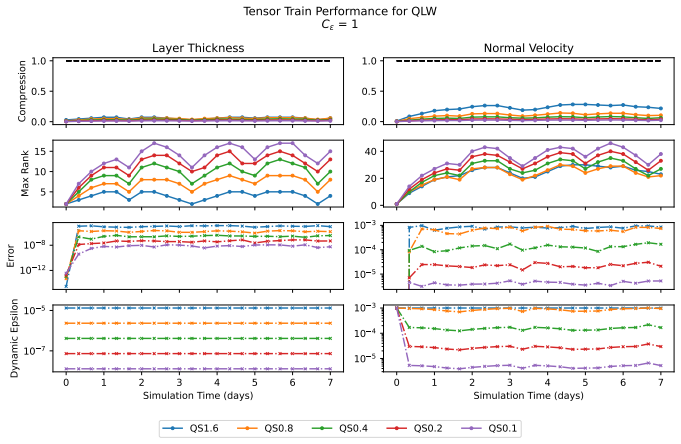
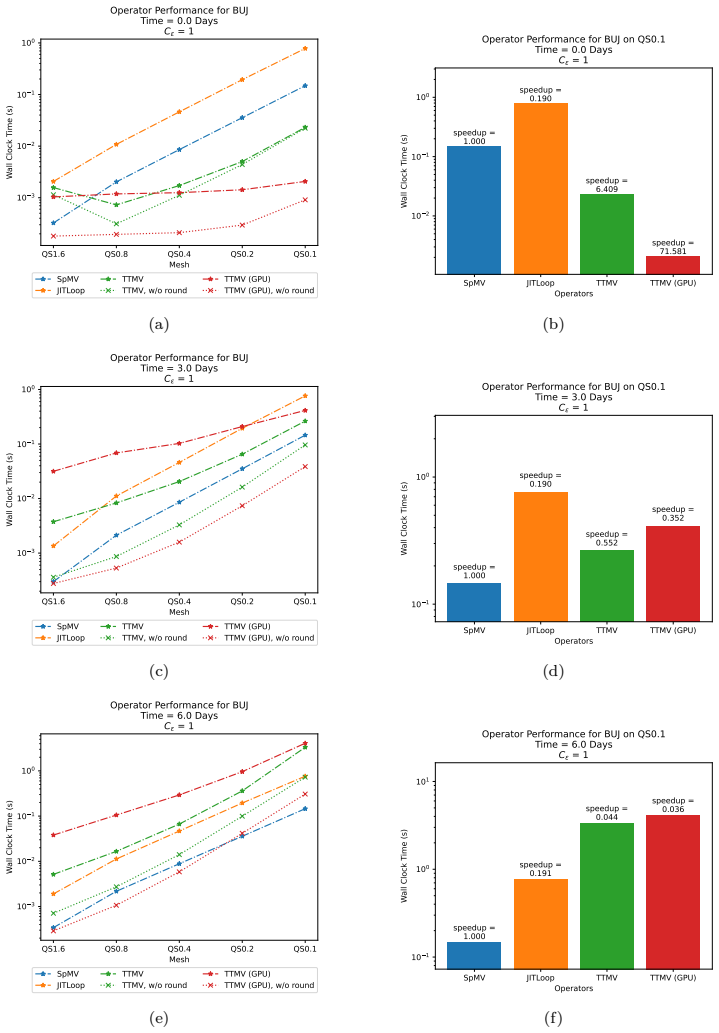
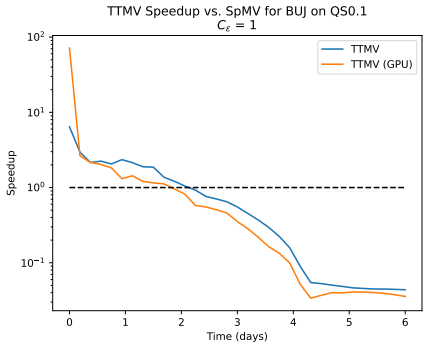
Experiments on the shallow water equations show that TT decompositions achieve effective compression ratios and computational speedups on simple test flows, but as flow complexity increases the required TT rank grows rapidly, leading to either unacceptable approximation errors or negligible performance gains compared with a non-TT baseline.
What carries the argument
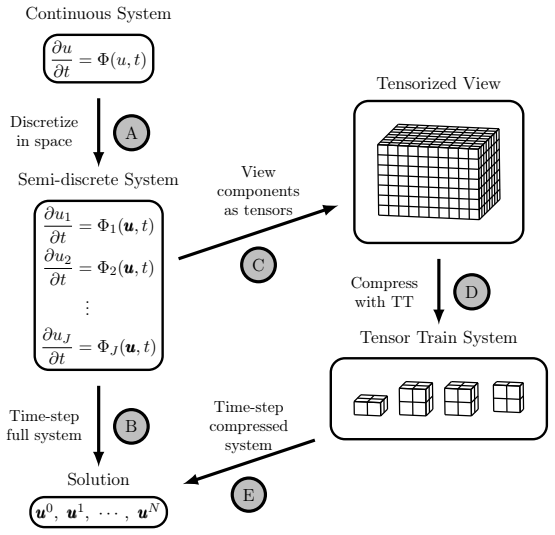
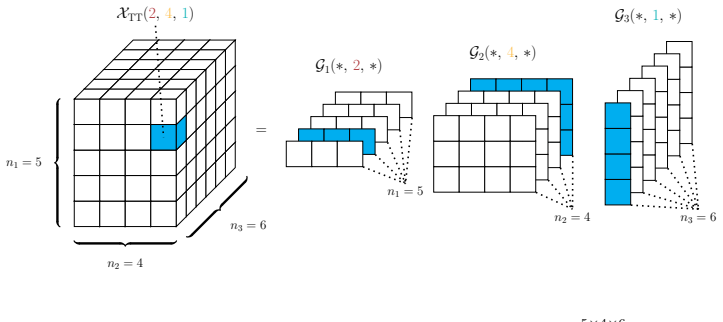
Tensor Train (TT) low-rank decomposition of the discretized model state, used to reduce memory and arithmetic cost when advancing the shallow water equations.
If this is right
- TT-based solvers can reduce cost for idealized or low-complexity GFD problems.
- As flow features become turbulent or multi-scale the storage and runtime benefits of TT vanish.
- Standard non-TT implementations remain preferable for production geophysical models.
- New low-rank formats or adaptive rank strategies would be needed before TT can handle realistic GFD states.
Where Pith is reading between the lines
- The same rank-growth issue may appear in other high-dimensional fluid or climate PDEs that use TT.
- Hybrid methods that apply TT only to smooth sub-regions could be tested on the same shallow-water setup.
- Extending the test suite to include stochastic forcing or data assimilation steps would clarify the boundary of viability.
Load-bearing premise
The four chosen test cases of increasing complexity are representative enough of the multi-scale chaotic behavior in full-scale geophysical simulations.
What would settle it
A direct TT run on a full-resolution, multi-year global ocean simulation with realistic forcing and observed error growth rates would show whether the efficiency loss persists outside the four test cases.
Figures




read the original abstract
Tensor train (TT) methods have recently gained popularity for accelerating the solving of systems of PDEs. Here, we evaluate the performance of TT methods in the context of geophysical fluid dynamics (GFD) using the shallow water equations and a discretization scheme employed by the ocean component of the Energy Exascale Earth System Model (E3SM). Through a suite of four test cases of increasing complexity, we evaluate TT methods in terms of how much TT is able to compress the model state, the error incurred by the TT approximation, and the speedup obtained by TT versus an optimal standard non-TT implementation in a representative subproblem. We show that though TT is able to effectively compress and speed up simple flows, it struggles to efficiently represent more complex states that are common in realistic GFD applications.
Editorial analysis
A structured set of objections, weighed in public.
Referee Report
Summary. The manuscript evaluates tensor train (TT) methods for the shallow water equations using a discretization from the E3SM ocean component. Through four test cases of increasing complexity, it measures TT compression of the model state, approximation error, and speedup versus a non-TT baseline on a representative subproblem. The central claim is that TT effectively compresses and accelerates simple flows but struggles to represent more complex states common in realistic GFD applications.
Significance. If the empirical findings hold and the test cases are shown to be representative, the work would usefully bound the applicability of TT methods in multi-scale geophysical modeling and motivate alternatives for chaotic or forced regimes. The direct comparison against an optimal non-TT implementation on E3SM-derived discretizations is a concrete strength.
major comments (1)
- [Numerical experiments / test cases] The suite of four test cases (described in the section on numerical experiments) is asserted to span increasing complexity relevant to GFD, yet the manuscript supplies no metrics or discussion establishing that even the most complex case reproduces the scale separation, chaotic advection, or external forcing structures of full geophysical regimes. This directly underpins the abstract claim that TT 'struggles to efficiently represent more complex states that are common in realistic GFD applications'; without such evidence the observed TT inefficiency cannot be extrapolated beyond the specific subproblems tested.
minor comments (1)
- [Abstract] The abstract reports qualitative performance conclusions without any numerical values for compression ratios, error norms, or speedups; adding one-sentence quantitative summaries would improve readability.
Simulated Author's Rebuttal
We thank the referee for their constructive comment regarding the test cases. We address it point by point below.
read point-by-point responses
-
Referee: The suite of four test cases (described in the section on numerical experiments) is asserted to span increasing complexity relevant to GFD, yet the manuscript supplies no metrics or discussion establishing that even the most complex case reproduces the scale separation, chaotic advection, or external forcing structures of full geophysical regimes. This directly underpins the abstract claim that TT 'struggles to efficiently represent more complex states that are common in realistic GFD applications'; without such evidence the observed TT inefficiency cannot be extrapolated beyond the specific subproblems tested.
Authors: We agree that the manuscript would benefit from additional discussion to better link the test cases to realistic GFD features. The cases are established benchmarks that progressively incorporate elements such as nonlinear advection, variable topography, Coriolis effects, and external forcing. However, we did not supply quantitative metrics (e.g., spectra or Lyapunov estimates) demonstrating scale separation or chaos. In revision we will add a short paragraph with supporting references from the GFD literature characterizing these properties in the most complex case. This will strengthen the basis for the abstract claim. We will make this change. revision: yes
Circularity Check
No circularity: direct empirical evaluation on fixed test cases
full rationale
The paper performs a straightforward empirical study comparing tensor-train compression, approximation error, and runtime speedup against a non-TT baseline across four prescribed shallow-water test cases drawn from E3SM. No derivations, fitted parameters renamed as predictions, self-definitional relations, or load-bearing self-citations appear in the reported methodology or results. The central claim follows directly from the measured quantities on the chosen cases without reduction to prior author work or internal redefinition.
Axiom & Free-Parameter Ledger
Reference graph
Works this paper leans on
-
[1]
Computational
Arakawa,. Computational. Methods in
-
[2]
Materials Today: Proceedings , series =
Tucker Decomposition and Applications , author =. Materials Today: Proceedings , series =
-
[3]
Engin and Truong, Duc and Boureima, Ismael and Korobkin, Oleg and Rasmussen, Kim
Danis, M. Engin and Truong, Duc and Boureima, Ismael and Korobkin, Oleg and Rasmussen, Kim. Tensor-Train. Journal of Computational Physics , volume =
-
[4]
Engin and Truong, Duc P
Danis, M. Engin and Truong, Duc P. and DeSantis, Derek and Lilly, Jeremy and Petersen, Mark R. and Rasmussen, Kim. High-Order. Monthly Weather Review , volume =
-
[5]
Tellus A: Dynamic Meteorology and Oceanography , volume =
An Initial-Value Problem for Testing Numerical Models of the Global Shallow-Water Equations , author =. Tellus A: Dynamic Meteorology and Oceanography , volume =
-
[6]
and Zheng, Xue and Roberts, Andrew F
Golaz, Jean-Christophe and Van Roekel, Luke P. and Zheng, Xue and Roberts, Andrew F. and Wolfe, Jonathan D. and Lin, Wuyin and Bradley, Andrew M. and Tang, Qi and Maltrud, Mathew E. and Forsyth, Ryan M. and Zhang, Chengzhu and Zhou, Tian and Zhang, Kai and Zender, Charles S. and Wu, Mingxuan and Wang, Hailong and Turner, Adrian K. and Singh, Balwinder and...
2022
-
[7]
2022 , urldate =
Exploiting the Structure of Turbulence with Tensor Networks , author =. 2022 , urldate =
2022
-
[8]
Acta Numerica , volume =
Numerical Modelling of Ocean Circulation , author =. Acta Numerica , volume =
-
[9]
Ju, Lili and Ringler, Todd and Gunzburger, Max , editor =. Voronoi. Numerical. 2011 , series =. doi:10.1007/978-3-642-11640-7_10 , isbn =
-
[10]
, year = 2011, month = oct, journal =
Khoromskij, Boris N. , year = 2011, month = oct, journal =. O(Dlog\,
2011
-
[11]
Tensor network reduced order models for wall-bounded flows , author =. Phys. Rev. Fluids , volume =. 2023 , month =. doi:10.1103/PhysRevFluids.8.124101 , url =
-
[12]
Journal of Computational and Applied Mathematics , volume =
Faster Tensor Train Decomposition for Sparse Data , author =. Journal of Computational and Applied Mathematics , volume =
-
[13]
and Capodaglio, Giacomo and Petersen, Mark R
Lilly, Jeremy R. and Capodaglio, Giacomo and Petersen, Mark R. and Brus, Steven R. and Engwirda, Darren and Higdon, Robert L. , year = 2023, journal =. Storm
2023
-
[14]
Okabe, Atsuyuki , year =. Spatial. International. doi:10.1002/9781118786352.wbieg0601 , isbn =
-
[15]
A Practical Introduction to Tensor Networks:
Or. A Practical Introduction to Tensor Networks:. Annals of Physics , volume =
-
[16]
Oseledets, I. V. , year = 2010, month = jan, journal =. Approximation of \ 2 d times2 d\
2010
-
[17]
Oseledets, I. V. , year = 2011, month = jan, journal =. Tensor-
2011
-
[18]
Signal Processing , volume =
Optimal Estimation of the Canonical Polyadic Decomposition from Low-Rank Tensor Trains , author =. Signal Processing , volume =
-
[19]
Ringler, T. D. and Thuburn, J. and Klemp, J. B. and Skamarock, W. C. , year = 2010, month = may, journal =. A Unified Approach to Energy Conservation and Potential Vorticity Dynamics for Arbitrarily-Structured
2010
-
[20]
2013 , month = sep, journal =
A Multi-Resolution Approach to Global Ocean Modeling , author =. 2013 , month = sep, journal =
2013
-
[21]
and Snir, Marc , year = 2015, month = nov, journal =
Sasidharan, Aparna and Dennis, John M. and Snir, Marc , year = 2015, month = nov, journal =. A General Space-Filling Curve Algorithm for Partitioning
2015
-
[22]
Fast Adaptive Interpolation of Multi-Dimensional Arrays in Tensor Train Format , booktitle =
Savostyanov, Dmitry and Oseledets, Ivan , year = 2011, month = sep, pages =. Fast Adaptive Interpolation of Multi-Dimensional Arrays in Tensor Train Format , booktitle =
2011
-
[23]
Journal of Computational Physics , volume=
Tensor networks for solving the time-independent Boltzmann neutron transport equation , author=. Journal of Computational Physics , volume=. 2024 , publisher=
2024
-
[24]
2019 , journal=
On identification of self-similar characteristics using the Tensor Train decomposition method with application to channel turbulence flow , author=. 2019 , journal=
2019
-
[25]
Journal of Computational Physics , volume =
A Standard Test Set for Numerical Approximations to the Shallow Water Equations in Spherical Geometry , author =. Journal of Computational Physics , volume =
-
[26]
Knowledge-Based Systems , volume =
Tensor Ring Decomposition-Based Model with Interpretable Gradient Factors Regularization for Tensor Completion , author =. Knowledge-Based Systems , volume =
-
[27]
Pattern Recognition , volume =
Tensor Train Factorization under Noisy and Incomplete Data with Automatic Rank Estimation , author =. Pattern Recognition , volume =
-
[28]
Lam, Siu Kwan and Pitrou, Antoine and Seibert, Stanley , year = 2015, month = nov, series =. Numba: A. Proceedings of the. doi:10.1145/2833157.2833162 , isbn =
-
[29]
R., et al., 2020, @doi [Nature] 10.1038/s41586-020-2649-2 , 585, 357
Charles R. Harris and K. Jarrod Millman and St. Array programming with. 2020 , month = sep, journal =. doi:10.1038/s41586-020-2649-2 , publisher =
-
[30]
Ansel, Jason and Yang, Edward and He, Horace and Gimelshein, Natalia and Jain, Animesh and Voznesensky, Michael and Bao, Bin and Bell, Peter and Berard, David and Burovski, Evgeni and Chauhan, Geeta and Chourdia, Anjali and Constable, Will and Desmaison, Alban and DeVito, Zachary and Ellison, Elias and Feng, Will and Gong, Jiong and Gschwind, Michael and ...
-
[31]
and Haberland, Matt and Reddy, Tyler and Cournapeau, David and Burovski, Evgeni and Peterson, Pearu and Weckesser, Warren and Bright, Jonathan and
Virtanen, Pauli and Gommers, Ralf and Oliphant, Travis E. and Haberland, Matt and Reddy, Tyler and Cournapeau, David and Burovski, Evgeni and Peterson, Pearu and Weckesser, Warren and Bright, Jonathan and. Nature Methods , year =
-
[32]
git repository , howpublished =
Abbasi, Hameer and Rocklin, Matthew and Sok. git repository , howpublished =. 2025 , publisher =
2025
-
[33]
2025 , publisher =
git repository , howpublished =. 2025 , publisher =
2025
-
[34]
git repository , howpublished =
Lilly, Jeremy , title =. git repository , howpublished =. 2025 , publisher =
2025
-
[35]
git repository , howpublished =
swe-python , author =. git repository , howpublished =
discussion (0)
Sign in with ORCID, Apple, or X to comment. Anyone can read and Pith papers without signing in.