Social learning community detection with nonlinear interaction
Pith reviewed 2026-06-28 19:24 UTC · model grok-4.3
The pith
Exchanging saturated signals in nonlinear opinion dynamics causes networks to partition along their sparsest cuts through local interactions alone.
A machine-rendered reading of the paper's core claim, the machinery that carries it, and where it could break.
Core claim
We demonstrate that macroscopic graph partitioning can emerge purely from strictly local, privacy preserving interactions driven by social learning. By reframing clustering as a symmetry-breaking process within nonlinear opinion dynamics, we show that exchanging saturated state dependent signal forces a network to naturally fracture along its sparsest cuts. We mathematically establish the spectral conditions under which dense core communities lock into stable, polarized states, robustly resisting external influence. To apply this mechanism, we propose three decentralized algorithms, leading up to the Score-based Edge Reliability framework.
What carries the argument
The symmetry-breaking process in nonlinear opinion dynamics driven by saturated state-dependent signals, which forces partitioning along sparsest cuts.
If this is right
- Decentralized community detection becomes possible without access to centralized network data.
- Evaluating edges across multiple independent topics statistically reduces errors compared to single-topic greedy bisections.
- Structurally ambiguous frontier nodes are isolated by the statistical reliability scoring.
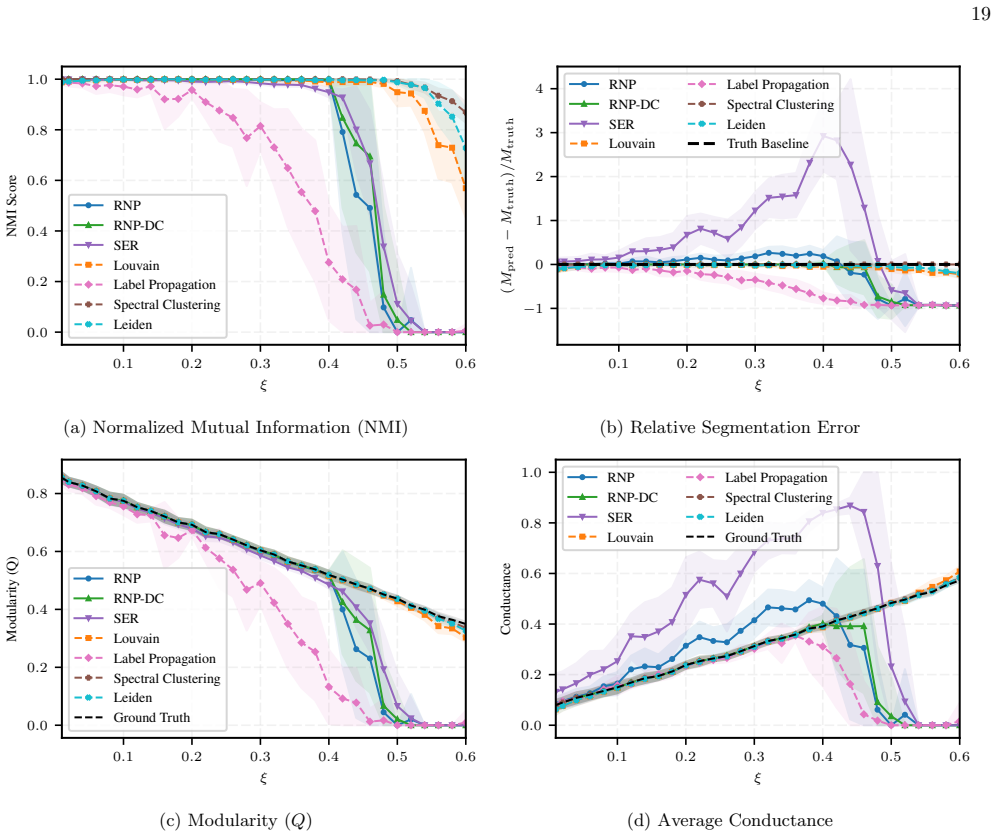
- The resulting partitions match the accuracy of globally optimized methods such as Louvain and Leiden up to the theoretical detectability limit.
Where Pith is reading between the lines
- The same local mechanism could generate observed polarization patterns in real social networks without any central coordinator.
- The spectral conditions derived here might be testable as predictors of community stability in other networked dynamical systems.
- Extending the model to time-varying networks could show how communities form or dissolve as edge weights change.
Load-bearing premise
The nonlinear opinion dynamics model with saturated signals accurately captures real interaction processes and the network meets the spectral properties needed for polarization to arise from local updates.
What would settle it
Simulating the dynamics on a graph whose sparsest cuts are known in advance and checking whether polarization occurs exactly along those cuts under the derived spectral conditions.
Figures




read the original abstract
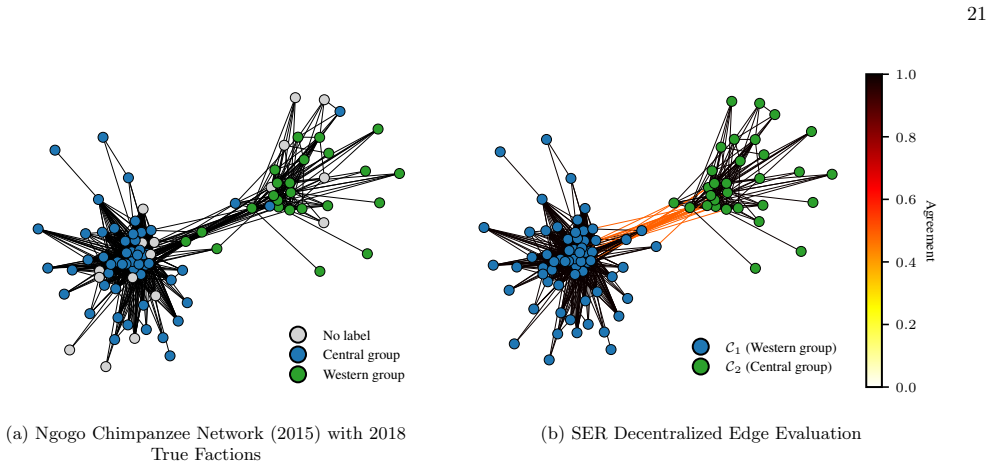
Conventional community detection requires centralized network data, making it unsuitable for distributed or privacy-preserving systems. In this paper, we demonstrate that macroscopic graph partitioning can emerge purely from strictly local, privacy preserving interactions driven by social learning. By reframing clustering as a symmetry-breaking process within nonlinear opinion dynamics, we show that exchanging saturated state dependent signal (like public actions) forces a network to naturally fracture along its sparsest cuts. We mathematically establish the spectral conditions under which dense core communities lock into stable, polarized states, robustly resisting external influence. To apply this mechanism, we propose three decentralized algorithms, leading up to the Score-based Edge Reliability (SER) framework. By evaluating network ties across multiple independent discussion topics, SER statistically bypasses the errors of traditional greedy bisections and naturally isolates structurally ambiguous frontier nodes. Validations on the ABCD benchmark and the real-world Ngogo chimpanzee network confirm that our fully decentralized approach matches the accuracy of globally optimized heuristics (e.g., Louvain, Leiden) up to a theoretical limit of detectable graphs.
Editorial analysis
A structured set of objections, weighed in public.
Referee Report
Summary. The paper claims that community detection emerges from strictly local nonlinear opinion dynamics with saturated state-dependent signals (e.g., public actions), causing networks to fracture along sparsest cuts. It mathematically establishes spectral conditions under which dense-core communities reach stable polarized states resistant to external influence. Three decentralized algorithms are proposed, culminating in the Score-based Edge Reliability (SER) framework that evaluates ties across multiple topics to isolate ambiguous nodes. Validations on the ABCD benchmark and Ngogo chimpanzee network show SER matches the accuracy of centralized heuristics such as Louvain and Leiden up to a theoretical detectability limit.
Significance. If the spectral conditions and stability analysis hold, the work offers a privacy-preserving, fully distributed alternative to centralized community detection by linking nonlinear opinion dynamics to graph partitioning. The multi-topic edge-reliability approach and real-world validation on the chimpanzee network are concrete strengths. The absence of visible derivations, error analysis, or stability proofs in the supplied material, however, prevents confirmation that the central claims are load-bearing or free of hidden assumptions in the saturated-signal model.
major comments (1)
- Abstract: the claim that 'spectral conditions under which dense core communities lock into stable, polarized states' are mathematically established cannot be assessed because no equations, stability analysis, or proof outline are provided; without these the central derivation remains unverifiable.
Simulated Author's Rebuttal
We thank the referee for their review and for highlighting the need for greater verifiability of the central claims. We respond to the single major comment below.
read point-by-point responses
-
Referee: [—] Abstract: the claim that 'spectral conditions under which dense core communities lock into stable, polarized states' are mathematically established cannot be assessed because no equations, stability analysis, or proof outline are provided; without these the central derivation remains unverifiable.
Authors: We agree that the abstract asserts a mathematical result without including equations or a proof sketch, which limits immediate assessment from the abstract alone. The spectral conditions (involving the algebraic connectivity of the graph Laplacian) and the associated Lyapunov-based stability analysis for the saturated nonlinear dynamics are derived in the main text. To address the concern directly, the revised manuscript will expand the abstract with a one-sentence outline of the key spectral threshold and will add an explicit proof sketch (or reference to the relevant theorem) in the introduction or a new appendix. revision: yes
Circularity Check
No significant circularity
full rationale
The provided abstract and context contain no equations, fitting procedures, self-citations, or derivation steps that could be inspected for reduction to inputs by construction. The central claim is described as a mathematical establishment of spectral conditions for polarization in nonlinear dynamics, but without visible formulas, proofs, or parameter-fitting steps, no load-bearing circularity of any enumerated kind can be identified. The derivation is treated as self-contained against external benchmarks in the absence of any exhibited reduction.
Axiom & Free-Parameter Ledger
axioms (2)
- domain assumption Interactions are strictly local and privacy-preserving with saturated state-dependent signals
- domain assumption Spectral conditions exist that guarantee stable polarized states for dense cores
Reference graph
Works this paper leans on
-
[1]
Action):Comparing the observable signals of adjacent agents yields the tension ∆ ij =|s i −s j|
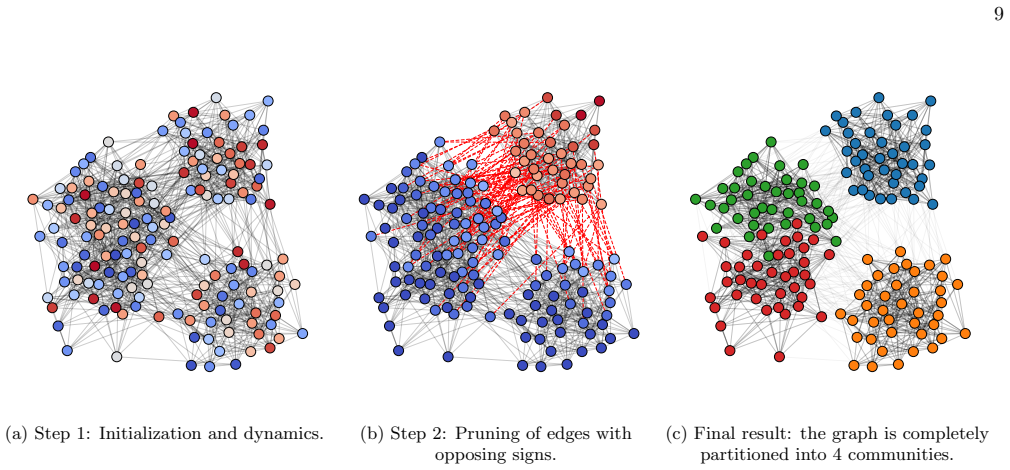
Symmetric Alignment (Action vs. Action):Comparing the observable signals of adjacent agents yields the tension ∆ ij =|s i −s j|. If ∆ ij < ε, the agents pulled each other into the same invariant hypercube. OverM independent realizations, this yields a symmetric probability scoreP ij =P ji ∈[0,1]. Figure 4 shows this filters out weak boundary edges. Edges ...
-
[2]
Action):To achieve a higher-resolution map of the community 16 TABLE I: Methodological comparison of social learning community detection algorithms
Asymmetric Alignment (Opinion vs. Action):To achieve a higher-resolution map of the community 16 TABLE I: Methodological comparison of social learning community detection algorithms. Name Recursive Neighbor Pruning (RNP) RNP with Decaying Confidence (RNP-DC) Score-based Edge Reliability (SER) FocusAsymptotic agreement. Transient speed of persuasion. Resil...
2015
-
[3]
Independent
has already been utilized in Section V (see Figs. 4 and 5) to illustrate the foundational mechanics of the SER algorithm. Having established the ability of the algorithm to identify the true structural partition and properly isolate frontier nodes in such foundational benchmarks, we now deploy the framework on two larger, highly nuanced real-world topolog...
2015
-
[4]
Fortunato, Community detection in graphs, Physics Reports486, 75 (2010)
S. Fortunato, Community detection in graphs, Physics Reports486, 75 (2010)
2010
-
[5]
J. Li, S. Lai, Z. Shuai, Y. Tan, Y. Jia, M. Yu, Z. Song, X. Peng, Z. Xu, Y. Ni, H. Qiu, J. Yang, Y. Liu, and Y. Lu, A comprehensive review of community detection in graphs, Neurocomputing600, 128169 (2024)
2024
-
[6]
A. Pothen, H. D. Simon, and K.-P. Liou, Partitioning sparse matrices with eigenvectors of graphs, SIAM J. Matrix Anal. Appl.11, 10.1137/0611030 (1990)
-
[7]
D. A. Spielman and S.-H. Teng, Spectral partitioning works: Planar graphs and finite element meshes, Linear Algebra and its Applications Special Issue in Honor of Miroslav Fiedler,421, 284 (2007)
2007
-
[8]
V. D. Blondel, J.-L. Guillaume, R. Lambiotte, and E. Lefebvre, Fast unfolding of communities in large networks, J. Stat. Mech.2008, P10008 (2008)
2008
-
[9]
Seifikar, S
M. Seifikar, S. Farzi, and M. Barati, C-Blondel: An Efficient Louvain-Based Dynamic Community Detection Algorithm, IEEE Trans. Comput. Soc. Syst.7, 308 (2020)
2020
-
[10]
A. P. Dempster, N. M. Laird, and D. B. Rubin, Maximum Likelihood from Incomplete Data via the EM Algorithm, J. R. Stat. Soc. Ser. B Methodol.39, 1 (1977), 2984875
1977
-
[11]
Stochastic Block Models and Reconstruction
E. Mossel, J. Neeman, and A. Sly, Stochastic Block Models and Reconstruction (2012), arXiv:1202.1499 [math]
work page internal anchor Pith review Pith/arXiv arXiv 2012
-
[12]
J. R. P. French, A formal theory of social power., Psychological Review63, 181 (1956)
1956
-
[13]
M. H. Degroot, Reaching a Consensus, J. Am. Stat. Assoc.69, 118 (1974)
1974
-
[14]
R. L. Berger, A Necessary and Sufficient Condition for Reaching a Consensus Using DeGroot’s Method, J. Am. Stat. Assoc.76, 415 (1981), 2287844
1981
-
[15]
Deffuant, D
G. Deffuant, D. Neau, F. Amblard, and G. Weisbuch, Mixing beliefs among interacting agents, Advs. Complex Syst.03, 87 (2000)
2000
-
[16]
Hegselmann and U
R. Hegselmann and U. Krause, Opinion dynamics and bounded confidence models, analysis, and simulation, J. Artif. Soc. Soc. Simul.5(2002). 24
2002
-
[17]
Morarescu and A
I.-C. Morarescu and A. Girard, Opinion Dynamics With Decaying Confidence: Application to Community Detection in Graphs, IEEE Trans. Autom. Control56, 1862 (2011)
2011
-
[18]
Altafini, Consensus Problems on Networks With Antagonistic Interactions, IEEE Trans
C. Altafini, Consensus Problems on Networks With Antagonistic Interactions, IEEE Trans. Autom. Control58, 935 (2013)
2013
-
[19]
A. C. R. Martins, Continuous opinions and discrete actions in opinion dynamics problems, Int. J. Mod. Phys. C19, 617 (2008)
2008
-
[20]
N. R. Chowdhury, I.-C. Mor˘ arescu, S. Martin, and S. Srikant, Continuous opinions and discrete actions in social networks: A multi-agent system approach, in2016 IEEE 55th Conf. Decis. Control CDC(2016) pp. 1739–1744
2016
-
[21]
R. Gray, A. Franci, V. Srivastava, and N. E. Leonard, Multiagent Decision-Making Dynamics Inspired by Honeybees, IEEE Trans. Control Netw. Syst.5, 793 (2018)
2018
-
[22]
Baumann, P
F. Baumann, P. Lorenz-Spreen, I. M. Sokolov, and M. Starnini, Modeling Echo Chambers and Polarization Dynamics in Social Networks, Phys. Rev. Lett.124, 048301 (2020)
2020
-
[23]
Bizyaeva, A
A. Bizyaeva, A. Franci, and N. E. Leonard, Nonlinear Opinion Dynamics With Tunable Sensitivity, IEEE Trans. Automat. Contr.68, 1415 (2023)
2023
-
[24]
Bizyaeva, A
A. Bizyaeva, A. Franci, and N. E. Leonard, Multitopic Belief Formation Through Bifurcations Over Signed Social Networks, IEEE Trans. Autom. Control70, 5082 (2025)
2025
-
[25]
N. E. Leonard, K. Lipsitz, A. Bizyaeva, A. Franci, and Y. Lelkes, The nonlinear feedback dynamics of asymmetric political polarization, Proc. Natl. Acad. Sci. U.S.A.118, e2102149118 (2021)
2021
-
[26]
Baumann, P
F. Baumann, P. Lorenz-Spreen, I. M. Sokolov, and M. Starnini, Emergence of Polarized Ideological Opinions in Multidi- mensional Topic Spaces, Phys. Rev. X11, 011012 (2021)
2021
-
[27]
Fontan and C
A. Fontan and C. Altafini, Multiequilibria Analysis for a Class of Collective Decision-Making Networked Systems, IEEE Trans. Control Netw. Syst.5, 1931 (2018)
1931
-
[28]
Couthures, V
A. Couthures, V. S. Varma, S. Lasaulce, and I.-C. Mor˘ arescu, Global Synchronization of Multi-Agent Systems With Nonlinear Interactions, IEEE Control Syst. Lett.9, 354 (2025)
2025
-
[29]
U. N. Raghavan, R. Albert, and S. Kumara, Near linear time algorithm to detect community structures in large-scale networks, Phys. Rev. E76, 036106 (2007)
2007
-
[30]
Gregory, Finding overlapping communities in networks by label propagation, New J
S. Gregory, Finding overlapping communities in networks by label propagation, New J. Phys.12, 103018 (2010)
2010
-
[31]
J. Xie, B. K. Szymanski, and X. Liu, SLPA: Uncovering Overlapping Communities in Social Networks via a Speaker-Listener Interaction Dynamic Process, in2011 IEEE 11th Int. Conf. Data Min. Workshop(2011) pp. 344–349
2011
- [32]
-
[33]
N. E. Friedkin and E. C. Johnsen, Social influence and opinions, J. Math. Sociol.15, 193 (1990)
1990
-
[34]
Hirsch and H
M. Hirsch and H. Smith, Chapter 4 Monotone Dynamical Systems, inHandbook of Differential Equations: Ordinary Differential Equations, Vol. 2 (Elsevier, 2006) pp. 239–357
2006
-
[35]
A. Couthures, G. Bainier, V. S. Varma, S. Lasaulce, and I.-C. Morarescu, From Consensus to Robust Clustering: Multi- Agent Systems with Nonlinear Interactions (2025), arXiv:2511.21228 [eess]
-
[36]
W. W. Zachary, An Information Flow Model for Conflict and Fission in Small Groups, J. Anthropol. Res.33, 452 (1977), 3629752
1977
-
[37]
Lancichinetti, S
A. Lancichinetti, S. Fortunato, and F. Radicchi, Benchmark graphs for testing community detection algorithms, Phys. Rev. E78, 046110 (2008)
2008
-
[38]
Kami´ nski, P
B. Kami´ nski, P. Pra lat, and F. Th´ eberge, Artificial Benchmark for Community Detection (ABCD)—Fast random graph model with community structure, Netw. Sci.9, 153 (2021)
2021
-
[39]
V. A. Traag, L. Waltman, and N. J. van Eck, From Louvain to Leiden: Guaranteeing well-connected communities, Sci Rep 9, 5233 (2019)
2019
-
[40]
A. A. Sandel, Y. He, J. Ren, Y. L. Kei, K. C. Lee, I. R. Clark, R. B. Reddy, J. D. Negrey, C. Birungi, B. A. Apamaku, D. Kanweri, D. Kalunga, C. Aliganyira, S. Ram´ ırez-Amaya, P. Nakayima, R. Katumba, B. Kamugyisha, D. Acosta-Florez, B. van Boekholt, G. Mbabazi, E. Akamumpa, S. Namaganda, A. Tumusiime, S. Angedakin, G. Reinert, O. Madrid-Padilla, M. Cucu...
2026
-
[41]
Sandel, J
A. Sandel, J. Mitani, K. Langergraber, I. R. Clark, K. Lee, J. Ren, Y. L. Kei, Y. He, R. B. Reddy, J. Negrey, C. Birungi, B. A. Apamaku, D. Kanweri, D. Wipf, D. Kalunga, P. Nakayima, R. Katumba, B. Kamugyisha, D. Acosta-Florez, B. van Boekholt, G. Mbabazi, E. Akamumpa, S. Namaganda, C. Aliganyira, A. Tumusiime, S. Angedakin, O. Madrid-Padilla, G. Reinert,...
2026
-
[42]
Girvan and M
M. Girvan and M. E. J. Newman, Community structure in social and biological networks, Proc. Natl. Acad. Sci.99, 7821 (2002)
2002
-
[43]
Letm∈ V ′ be the index of the agent realizing this maximum at timet+ 1, such thatV(t+ 1) =|e m(t+ 1)|
Proof of Proposition 1 Proof.Consider the sequenceV(t) = max i∈V ′ |xi(t)−c|=δ(t). Letm∈ V ′ be the index of the agent realizing this maximum at timet+ 1, such thatV(t+ 1) =|e m(t+ 1)|. 25 Using the discrete-time dynamics (1) and substitutingx j(t) =c+e j(t), the update fore m is: em(t+ 1) =e m(t) +h 1 dm X j∈Nm∩V ′ amj s(c+e j(t))−c + 1 dm X j∈Nm\V ′...
-
[44]
We must show that for any agenti∈ V ′, xi(t+ 1)∈[c−ε, c+ε]
Proof of Proposition 2 Proof.Suppose at time stept, the sub-state vector lies withinH(c, ε). We must show that for any agenti∈ V ′, xi(t+ 1)∈[c−ε, c+ε]. The discrete update equation can be rewritten as a strict convex combination: xi(t+ 1) = (1−h)x i(t) +h¯si(t), where ¯si(t) = 1 di P j aijs(xj(t)) is the average neighborhood signal. Sinceh∈(0,1],x i(t+ 1...
discussion (0)
Sign in with ORCID, Apple, or X to comment. Anyone can read and Pith papers without signing in.