Clustering-enhanced adaptive Benders decomposition for energy systems planning optimization
Pith reviewed 2026-06-28 21:02 UTC · model grok-4.3
The pith
Adaptive clustering of subproblems generates aggregated Benders cuts that reduce master problem time in energy capacity expansion models under weak inter-temporal coupling.
A machine-rendered reading of the paper's core claim, the machinery that carries it, and where it could break.
Core claim
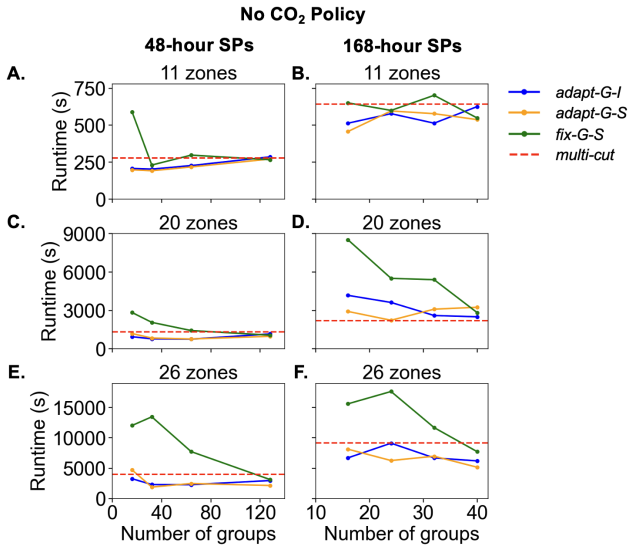
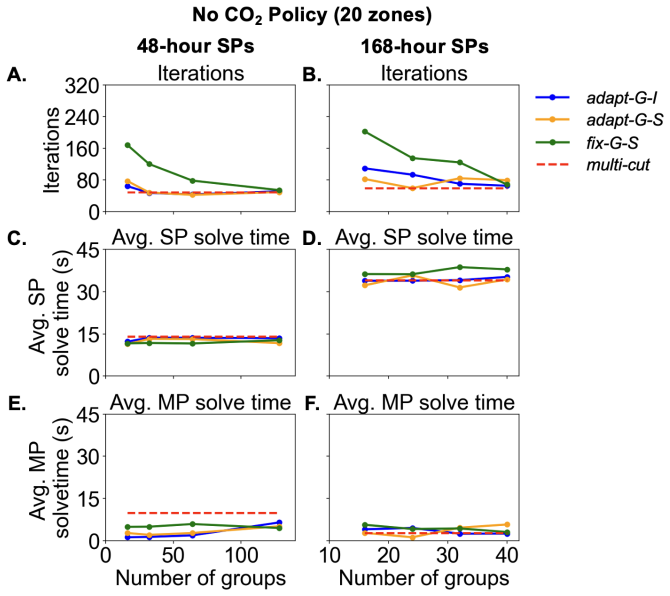
Adaptive grouped Benders cuts formed by clustering subproblems according to dual variable profiles outperform both fixed-grouping and benchmark multi-cut formulations. The clustered cuts limit the number added per iteration while preserving validity, shifting computational effort away from the master problem in cases with weak inter-temporal linkages.
What carries the argument
Clustering of subproblems by dual variables or exogenous inputs to build aggregated Benders cuts for the master problem.
If this is right
- Solve times drop substantially relative to the multi-cut benchmark when inter-temporal coupling is weak.
- Larger systems with short subproblem horizons gain the most because the master problem accounts for a bigger share of total runtime.
- The representative-subproblem approach improves performance when subproblem solves dominate due to limited parallel CPUs.
- The advantage disappears under strong coupling such as binding annual CO2 caps, where the benchmark performs best.
Where Pith is reading between the lines
- The same clustering idea could extend to other decomposition schemes for planning models that face similar master-problem bottlenecks.
- Further experiments with different stochastic structures might show whether dual-based clustering remains stable under uncertainty.
- Replacing the current clustering features with learned representations could tighten the cuts without extra manual tuning.
Load-bearing premise
That grouping subproblems by similarity in duals or inputs produces aggregated cuts that stay valid and tight enough for the master problem to reach the correct optimum.
What would settle it
A test on a new large CEM instance where the clustered-cut method returns a different investment plan than the benchmark or fails to converge in fewer iterations.
Figures



read the original abstract
High-resolution energy system capacity expansion models (CEMs) for energy transition planning often result in large-scale mixed-integer linear programming (MILP) formulations. Benders decomposition (BD) offers a scalable solution approach by iteratively solving a master problem (MP) for investment decisions and multiple subproblems (SPs) for operational decisions. However, accumulated Benders cuts generated by the SPs can make MP solution a major computational bottleneck. Incomplete SP parallelization can also introduce further bottlenecks when SPs exceed available CPUs. We develop clustering-enhanced BD methods to address these challenges, by using clustering to group similar SPs for: a) aggregated Benders cut construction and b) identification of representative SPs to be solved most frequently. For grouped-cuts, we examine two adaptive formulations based on dual variables and a fixed-grouping formulation based on exogenous time-series inputs. We evaluate these methods in an electricity-sector CEM across varying system sizes, temporal SP lengths, inter-SP coupling strengths represented by CO2 policy, computational resources, and stochastic settings. Relative to a benchmark regularized multi-cut formulation, adaptive grouped cuts outperform fixed grouping and provide substantial benefits under weak inter-temporal coupling. The largest gains occur in larger systems with shorter SP horizons, where the MP accounts for a greater share of runtime. Their effectiveness declines under strong inter-temporal coupling, such as annual CO2 emissions limits, where the benchmark multi-cut performs best. The representative-SP method outperforms the benchmark under limited parallelization when SP solution dominates runtime. Overall, the preferred BD strategy depends on inter-SP coupling strength and whether computational burden lies in the MP or the SPs.
Editorial analysis
A structured set of objections, weighed in public.
Referee Report
Summary. The manuscript develops clustering-enhanced adaptive Benders decomposition (BD) methods for large-scale MILP capacity expansion models in energy systems. Subproblems are clustered either adaptively (by dual variables) or fixed (by exogenous time-series) to generate aggregated Benders cuts and to identify representative subproblems solved most frequently. These are compared to a regularized multi-cut BD benchmark on an electricity-sector CEM across system sizes, SP horizons, inter-temporal coupling strengths (via CO2 policy), computational resources, and stochastic settings. The central claims are that adaptive grouped cuts outperform fixed grouping and the benchmark under weak coupling, with largest gains in large systems with short SP horizons where the master problem dominates runtime, while representative-SP selection helps under limited parallelization.
Significance. If the aggregated cuts remain valid and the runtime gains prove robust, the work would offer a practical route to scale BD for high-resolution energy transition models by mitigating master-problem bottlenecks and incomplete parallelization. The evaluation across multiple dimensions (size, horizon, coupling) is a strength, as is the explicit dependence of preferred strategy on coupling strength and where the computational burden lies.
major comments (2)
- [Abstract] Abstract and methods description: no formal proof or per-iteration numerical check is described that the aggregation operator (averaging duals or scaling a representative cut) produces a valid supporting hyperplane that underestimates the recourse function for every subproblem in the cluster. Benders convergence requires this property; without it the reported outperformance relative to the multi-cut baseline could be an artifact of invalid or overly loose cuts.
- [Abstract] Abstract: performance claims (largest gains in larger systems with shorter SP horizons) rest on the assumption that clustering by dual vectors or exogenous inputs yields sufficiently tight cuts across the tested policy settings, yet no data-exclusion rules, error-bar statistics, or sensitivity to clustering metric are reported, making it impossible to assess whether post-hoc choices affect the central comparative results.
minor comments (2)
- Notation for the clustering metric and aggregation operator should be introduced with explicit equations rather than descriptive text only.
- The manuscript would benefit from a small illustrative example (e.g., 2-3 subproblems) showing the aggregated cut versus individual cuts to clarify validity.
Simulated Author's Rebuttal
We thank the referee for the constructive and detailed comments. We address each major comment below and indicate planned revisions to improve the manuscript.
read point-by-point responses
-
Referee: [Abstract] Abstract and methods description: no formal proof or per-iteration numerical check is described that the aggregation operator (averaging duals or scaling a representative cut) produces a valid supporting hyperplane that underestimates the recourse function for every subproblem in the cluster. Benders convergence requires this property; without it the reported outperformance relative to the multi-cut baseline could be an artifact of invalid or overly loose cuts.
Authors: We agree that an explicit argument for validity of the aggregated cuts is necessary. The manuscript derives aggregated cuts from dual solutions of the clustered subproblems but does not provide a dedicated proof or per-iteration verification. In the revision we will add a short subsection (in Section 3) showing that, because each individual cut is a valid supporting hyperplane to a convex recourse function and the aggregation is a convex combination (via averaged duals), the resulting cut remains valid for every subproblem in the cluster. We will also add a table of per-iteration checks confirming that the cuts never overestimate the true subproblem values across the reported experiments. revision: yes
-
Referee: [Abstract] Abstract: performance claims (largest gains in larger systems with shorter SP horizons) rest on the assumption that clustering by dual vectors or exogenous inputs yields sufficiently tight cuts across the tested policy settings, yet no data-exclusion rules, error-bar statistics, or sensitivity to clustering metric are reported, making it impossible to assess whether post-hoc choices affect the central comparative results.
Authors: All reported results use the complete set of instances with no post-hoc data exclusion. To strengthen the claims we will revise the computational section to include (i) error bars computed from five independent runs that differ only in clustering random seeds and (ii) a sensitivity table comparing the primary Euclidean dual-distance metric against an alternative (time-series correlation) metric. These additions will allow readers to evaluate the stability of the reported performance ordering. revision: yes
Circularity Check
No circularity: empirical algorithmic evaluation against external benchmark
full rationale
The paper develops clustering-enhanced Benders decomposition variants and reports runtime and solution quality gains from computational experiments on electricity-sector CEM instances. No equations, parameters, or performance metrics are shown to reduce by construction to quantities fitted inside the same run or to self-citations. The reported outperformance is measured relative to an independent regularized multi-cut baseline; validity of aggregated cuts is treated as a methodological assumption rather than derived from prior self-referential results. The derivation chain is therefore self-contained and externally falsifiable via the benchmark comparisons.
Axiom & Free-Parameter Ledger
Reference graph
Works this paper leans on
-
[1]
Sector coupling. Energy Environ. Sci. , author =. 2021 , langid =. doi:10.1039/D1EE00627D , abstract =
-
[2]
Levelized cost of. Energy Environ. Sci. , author =. 2019 , langid =. doi:10.1039/C8EE02079E , abstract =
-
[3]
Cell Reports Physical Science , author =
Can Industrial-Scale Solar Hydrogen Supplied from Commodity Technologies Be Cost Competitive by 2030? , volume =. Cell Reports Physical Science , author =. 2020 , langid =. doi:10.1016/j.xcrp.2020.100174 , pages =
-
[4]
Design Space for. Ind. Eng. Chem. Res. , author =. 2024-04-15 , langid =. doi:10.1021/acs.iecr.4c00123 , pages =
-
[5]
Cost Competitiveness of Electrolytic Hydrogen , volume =. Joule , author =. 2019-10 , langid =. doi:10.1016/j.joule.2019.07.006 , pages =
-
[6]
Williams, James H. and Jones, Ryan A. and Haley, Ben and Kwok, Gabe and Hargreaves, Jeremy and Farbes, Jamil and Torn, Margaret S. , urldate =. Carbon‐Neutral Pathways for the United States , volume =. 2021-03 , langid =. doi:10.1029/2020AV000284 , abstract =
-
[7]
Net-Zero America: Potential Pathways, Infrastructure, and Impacts , institution =
Larson, E and Greig, C and Jenkins, J and Mayfield, E and Pascale, A and Zhang, C and Drossman, J and Williams, R and Pacala, S and Socolow, R and Baik,. Net-Zero America: Potential Pathways, Infrastructure, and Impacts , institution =. 2021 , url =
2021
-
[8]
An Open Energy Outlook: Decarbonization Pathways for the
Venkatesh, Aranya and Jordan, Katherine and Sinha, Aditya and Johnson, Jeremiah and Jaramillo, Paulina , year =. An Open Energy Outlook: Decarbonization Pathways for the
-
[9]
The potential role of a hydrogen network in Europe , volume =. Joule , author =. 2023-08 , langid =. doi:10.1016/j.joule.2023.06.016 , pages =
-
[10]
What is needed to deliver carbon-neutral heat using hydrogen and. Energy Environ. Sci. , author =. 2020 , langid =. doi:10.1039/D0EE02016H , abstract =
-
[11]
International Journal of Hydrogen Energy , author =
Decarbonization synergies from joint planning of electricity and hydrogen production: A Texas case study , volume =. International Journal of Hydrogen Energy , author =. 2020-11 , langid =. doi:10.1016/j.ijhydene.2020.09.127 , shorttitle =
-
[12]
Ramping up the hydrogen sector: An energy system modeling framework , volume =. Applied Energy , author =. 2024-02 , langid =. doi:10.1016/j.apenergy.2023.122264 , shorttitle =
-
[13]
International Journal of Hydrogen Energy , author =
On capital utilization in the hydrogen economy: The quest to minimize idle capacity in renewables-rich energy systems , volume =. International Journal of Hydrogen Energy , author =. 2021-01 , langid =. doi:10.1016/j.ijhydene.2020.09.197 , shorttitle =
-
[14]
System-friendly process design: Optimizing blue hydrogen production for future energy systems , volume =. Energy , author =. 2022-11 , langid =. doi:10.1016/j.energy.2022.124954 , shorttitle =
-
[15]
Cleaner Production Letters , author =
Optimal pathways for the decarbonisation of the transport sector: Trade-offs between battery and hydrogen technologies using a whole energy system perspective , volume =. Cleaner Production Letters , author =. 2023-12 , langid =. doi:10.1016/j.clpl.2023.100044 , shorttitle =
-
[16]
Are green and blue hydrogen competitive or complementary? Insights from a decarbonized European power system analysis , volume =. Energy , author =. 2023-11 , langid =. doi:10.1016/j.energy.2023.128282 , shorttitle =
-
[17]
Supply and Demand Drivers of Global Hydrogen Deployment in the Transition toward a Decarbonized Energy System , volume =. Environ. Sci. Technol. , author =. 2023-12-05 , langid =. doi:10.1021/acs.est.3c03751 , pages =
-
[18]
Narayanan, Thaneer Malai and He, Guannan and Gençer, Emre and Shao-Horn, Yang and Mallapragada, Dharik S. , urldate =. Role of Liquid Hydrogen Carriers in Deeply Decarbonized Energy Systems , volume =. 2022-08-22 , langid =. doi:10.1021/acssuschemeng.2c00909 , pages =
-
[19]
Long-run system value of battery energy storage in future grids with increasing wind and solar generation , volume =. Applied Energy , author =. 2020 , langid =. doi:10.1016/j.apenergy.2020.115390 , pages =
-
[20]
Electrification Futures Study Load Profiles , url =
Mai, Trieu and Jadun, Paige and Logan, Jeffrey and. Electrification Futures Study Load Profiles , url =. 2020 , langid =. doi:10.7799/1593122 , abstract =
-
[21]
Assumptions to the Annual Energy Outlook 2023 , url =
2023
-
[22]
The Wind Integration National Dataset (. Applied Energy , author =. 2015 , langid =. doi:10.1016/j.apenergy.2015.03.121 , pages =
-
[23]
Renewable and Sustainable Energy Reviews , author =
The National Solar Radiation Data Base (. Renewable and Sustainable Energy Reviews , author =. 2018 , langid =. doi:10.1016/j.rser.2018.03.003 , pages =
-
[24]
Regional Energy Deployment System (. 2021 , file =. doi:10.2172/1788425 , pages =
-
[25]
2021 Annual Technology Baseline (
Vimmerstedt, Laura and Akar, Sertac and Beiter, Philipp and Cole, Wesley and Feldman, David and Kurup, Parthiv and Turchi, Craig and Oladosu, Gbadebo and Rhodes, Greg and Augustine, Chad and Murphy, Caitlin and Schleifer, Anna and Cohen, Stuart and Hoffmann, Jeffrey and Schwabe, Paul and Bolinger, Mark and Mirletz, Brian and Bannister, Mike and Stright, D...
-
[26]
Examining Supply-Side Options to Achieve 100\ url =
Denholm, Paul and Brown, Patrick and Cole, Wesley and Mai, Trieu and Sergi, Brian and Brown, Maxwell and Jadun, Paige and Ho, Jonathan and Mayernik, Jack and. Examining Supply-Side Options to Achieve 100\ url =. 2022-09-06 , file =. doi:10.2172/1885591 , pages =
-
[27]
Brown, Patrick , year =
-
[28]
The Future of Hydrogen , url =
-
[29]
International Journal of Hydrogen Energy , author =
Estimating future costs of power-to-gas – a component-based approach for technological learning , volume =. International Journal of Hydrogen Energy , author =. 2019-11 , langid =. doi:10.1016/j.ijhydene.2019.09.230 , pages =
-
[30]
2021 , url =
Net Zero by 2050 , institution =. 2021 , url =
2050
-
[31]
Transportation Research Record , author =
Hydrogen Delivery Scenario Analysis Model for Hydrogen Distribution Options , volume =. Transportation Research Record , author =. 2006-01 , langid =. doi:10.1177/0361198106198300116 , abstract =
-
[32]
Performance of Polymer Electrolyte Membrane Water Electrolysis Systems: Configuration, Stack Materials, Turndown and Efficiency , volume =. Energies , author =. 2023-06-26 , langid =. doi:10.3390/en16134964 , shorttitle =
-
[33]
Advanced Sustainable Systems , author =
Decarbonization of the Electric Power Sector and Implications for Low‐Cost Hydrogen Production from Water Electrolysis , issn =. Advanced Sustainable Systems , author =. 2023-08-16 , langid =. doi:10.1002/adsu.202300091 , abstract =
-
[34]
Direct Air Capture Case Studies: Sorbent System , url =
Valentine, Jessica and Zoelle, Alexander and Homsy, Sally and Mantripragada, Hari and Woods, Mark and Roy, Naksha and Kilstofte, Aaron and Sturdivan, Mike and Steutermann, Mark and Fout, Timothy , urldate =. Direct Air Capture Case Studies: Sorbent System , url =. doi:10.2172/1879535 , shorttitle =
-
[35]
Direct Air Capture Case Studies: Solvent System , url =
Valentine, Jessica and Zoelle, Alexander and Homsy, Sally and Mantripragada, Hari and Kilstofte, Aaron and Sturdivan, Mike and Steutermann, Mark and Fout, Timothy , urldate =. Direct Air Capture Case Studies: Solvent System , url =. doi:10.2172/1893369 , shorttitle =
-
[36]
Comparison of Commercial, State-of-the-Art, Fossil-Based Hydrogen Production Technologies , url =
Lewis, Eric and. Comparison of Commercial, State-of-the-Art, Fossil-Based Hydrogen Production Technologies , url =
-
[37]
Negative Emissions Technologies and Reliable Sequestration: A Research Agenda , isbn =. 2019-03-08 , note =. doi:10.17226/25259 , shorttitle =
-
[38]
Department of Energy , urldate =
U.S. Department of Energy , urldate =. 2016 Billion-Ton Report: Advancing Domestic Resources for a Thriving Bioeconomy, Volume 1: Economic Availability of Feedstocks , url =. 2016-07-01 , langid =. doi:10.2172/1435342 , shorttitle =
-
[39]
Technical, economic, and. Energy , author =. 2023-09 , langid =. doi:10.1016/j.energy.2023.127981 , shorttitle =
-
[40]
How flexible electricity demand stabilizes wind and solar market values: The case of hydrogen electrolyzers , volume =. Applied Energy , author =. 2022-02 , langid =. doi:10.1016/j.apenergy.2021.118194 , shorttitle =
-
[41]
Treating Demand Equivalent to Supply in Wholesale Markets , institution =
O’Neill, Richard and Lew, Debra and Ela, Erik , year =. Treating Demand Equivalent to Supply in Wholesale Markets , institution =
-
[42]
U.S. U.S. Natural Gas Total Consumption , url =
-
[43]
Underground Natural Gas Storage Capacity , url =
U.S. Underground Natural Gas Storage Capacity , url =
-
[44]
Schofield, Landon and Paren, Benjamin and Macdonald, Ruaridh and Shao-Horn, Yang and Mallapragada, Dharik , urldate =. Dynamic Optimization of Proton Exchange Membrane Water Electrolyzers Considering Usage-Based Degradation , rights =. 2024 , keywords =. doi:10.48550/ARXIV.2405.06766 , abstract =
-
[45]
2023 , url =
Assessing Lifecycle Greenhouse Gas Emissions Associated with Electricity Use for the Section 45V Clean Hydrogen Production Tax Credit , author =. 2023 , url =
2023
-
[46]
doi:10.5281/ZENODO.8329515 , shorttitle =
Schivley, Greg and Welty, Ethan and Patankar, Neha and Jacobson, Anna and Xu, Qingyu and. doi:10.5281/ZENODO.8329515 , shorttitle =
-
[47]
2020 , url =
Annual Energy Outlook 2020 , institution =. 2020 , url =
2020
-
[48]
2018 , url =
Documentation for. 2018 , url =
2018
-
[49]
Temporal regulation of renewable supply for electrolytic hydrogen , volume =. Environ. Res. Lett. , author =. doi:10.1088/1748-9326/ad2239 , abstract =
-
[50]
Minimizing emissions from grid-based hydrogen production in the United States , volume =. Environ. Res. Lett. , author =. 2023-01-01 , file =. doi:10.1088/1748-9326/acacb5 , abstract =
-
[51]
Clean electricity procurement for electrolytic hydrogen: A framework for determining time-matching requirements , institution =
Giovanniello, Michael and Cybulsky, Anna and Schittekatte, Tim and Mallapragada, Dharik , year =. Clean electricity procurement for electrolytic hydrogen: A framework for determining time-matching requirements , institution =
-
[52]
International Journal of Hydrogen Energy , author =
H2 production through natural gas reforming and carbon capture: A techno-economic and life cycle analysis comparison , volume =. International Journal of Hydrogen Energy , author =. 2024-01 , langid =. doi:10.1016/j.ijhydene.2023.09.230 , shorttitle =
-
[53]
Vallejo, Valeria and Nguyen, Quoc and Ravikumar, Arvind , urldate =. Geospatial Variation in Carbon Accounting of Low-Carbon Hydrogen Production Pathways: Implications for the Inflation Reduction Act , url =. 2023-11-22 , file =. doi:10.31223/X5R389 , shorttitle =
-
[54]
On the cost competitiveness of blue and green hydrogen , volume =. Joule , author =. 2024-01 , langid =. doi:10.1016/j.joule.2023.12.004 , pages =
-
[55]
Endogenous learning for green hydrogen in a sector-coupled energy model for Europe , volume =. Nat Commun , author =. 2023-06-23 , langid =. doi:10.1038/s41467-023-39397-2 , abstract =
-
[56]
Tries, C. and Hofmann, F. and Brown, T. , urldate =. Benefits from islanding hydrogen production in renewable energy systems , volume =. 2023-01-25 , langid =. doi:10.1049/icp.2022.2767 , pages =
-
[57]
National priorities in the power system transition to net-zero: No one size fits all , volume =
Pratama, Yoga Wienda and Patrizio, Piera and Mac Dowell, Niall , urldate =. National priorities in the power system transition to net-zero: No one size fits all , volume =. 2022-10 , langid =. doi:10.1016/j.isci.2022.105260 , shorttitle =
-
[58]
International Journal of Greenhouse Gas Control , author =
Profitability and the use of flexible. International Journal of Greenhouse Gas Control , author =. 2022-10 , langid =. doi:10.1016/j.ijggc.2022.103767 , pages =
-
[59]
The Role of Firm Low-Carbon Electricity Resources in Deep Decarbonization of Power Generation , volume =. Joule , author =. 2018 , langid =. doi:10.1016/j.joule.2018.08.006 , pages =
-
[60]
Role and value of flexibility in facilitating cost-effective energy system decarbonisation , volume =. Prog. Energy , author =. 2020-10-01 , file =. doi:10.1088/2516-1083/abb216 , abstract =
-
[61]
The Role of Flexibility in the Integrated Operation of Low-Carbon Gas and Electricity Systems: A Review , volume =. Energies , author =. 2024-05-02 , langid =. doi:10.3390/en17092187 , shorttitle =
-
[62]
Integration of Hydrogen into Multi-Energy Systems Optimisation , volume =. Energies , author =. 2020 , langid =. doi:10.3390/en13071606 , abstract =
-
[63]
Power-to-hydrogen as seasonal energy storage: an uncertainty analysis for optimal design of low-carbon multi-energy systems , volume =. Applied Energy , author =. 2020 , langid =. doi:10.1016/j.apenergy.2020.115197 , shorttitle =
-
[64]
Hydrogen as Short-Term Flexibility and Seasonal Storage in a Sector-Coupled Electricity Market , volume =. Energies , author =. 2023-07-12 , langid =. doi:10.3390/en16145333 , abstract =
-
[65]
Investments in green hydrogen as a flexibility source for the European power system by 2050: Does it pay off? , volume =. Applied Energy , author =. 2025-01 , langid =. doi:10.1016/j.apenergy.2024.124656 , shorttitle =
-
[66]
Armstrong, Les and Hager, Bradford and Coyle, Sarah and Bergmann, Kristin and Fukumoto, Caitlin and Mallapragada, Dharik , urldate =. A Novel Methodology to Map Hydrogen Storage Potential in Salt Caverns: A Case Study of the Midwestern and Appalachian Regions of the United States , rights =. doi:10.31223/X52D9K , shorttitle =
-
[67]
Journal of Energy Storage , author =
Hydrogen storage potential of salt domes in the Gulf Coast of the United States , volume =. Journal of Energy Storage , author =. 2024-03 , langid =. doi:10.1016/j.est.2024.110585 , pages =
-
[68]
Chemical Engineering Journal , author =
Electrified steam methane reforming of biogas for sustainable syngas manufacturing and next-generation of plant design: A pilot plant study , volume =. Chemical Engineering Journal , author =. 2024-01 , langid =. doi:10.1016/j.cej.2023.147205 , shorttitle =
-
[69]
Quantifying value and representing competitiveness of electricity system technologies in economic models , volume =. Applied Energy , author =. 2023-01 , langid =. doi:10.1016/j.apenergy.2022.120132 , pages =
-
[70]
Renewable and Sustainable Energy Reviews , author =
Time-series aggregation for the optimization of energy systems: Goals, challenges, approaches, and opportunities , volume =. Renewable and Sustainable Energy Reviews , author =. 2022-04 , langid =. doi:10.1016/j.rser.2021.111984 , shorttitle =
-
[71]
A hierarchical clustering decomposition algorithm for optimizing renewable power systems with storage , volume =. Applied Energy , author =. 2020 , langid =. doi:10.1016/j.apenergy.2020.115190 , pages =
-
[72]
and Song, Jie and He, Guannan , urldate =
Zhang, Yuheng and Cheng, Vivian and Mallapragada, Dharik S. and Song, Jie and He, Guannan , urldate =. A Model-Adaptive Clustering-Based Time Aggregation Method for Low-Carbon Energy System Optimization , volume =. doi:10.1109/TSTE.2022.3199571 , pages =
-
[73]
The benefits of nuclear flexibility in power system operations with renewable energy , volume =. Applied Energy , author =. 2018 , langid =. doi:10.1016/j.apenergy.2018.03.002 , pages =
-
[74]
The Value of Inter-Regional Coordination and Transmission in Decarbonizing the. Joule , author =. 2021-01 , langid =. doi:10.1016/j.joule.2020.11.013 , pages =
-
[75]
Nature Communications , author =
Drivers and implications of alternative routes to fuels decarbonization in net-zero energy systems , volume =. Nature Communications , author =. 2024 , langid =. doi:10.1038/s41467-024-47059-0 , abstract =
-
[76]
The influence of additionality and time-matching requirements on the emissions from grid-connected hydrogen production , volume =. Nature Energy , author =. 2024 , langid =. doi:10.1038/s41560-023-01435-0 , abstract =
-
[77]
Are biofuel mandates cost-effective? - An analysis of transport fuels and biomass usage to achieve emissions targets in the European energy system , volume =. Applied Energy , author =. 2022 , keywords =. doi:10.1016/j.apenergy.2022.120016 , shorttitle =
-
[78]
He, Guannan and Mallapragada, Dharik and Macdonald, Ruaridh and Law, Jun Wen and Shaker, Youssef and Zhang, Yuheng and Cybulsky, Anna and Chakraborty, Shantanu and Giovanniello, Michael , urldate =
-
[79]
Chan, Tina , urldate =
-
[80]
2022 , langid =
How to Avoid Gas Shortages in the European Union in 2023 – Analysis , url =. 2022 , langid =
2023
discussion (0)
Sign in with ORCID, Apple, or X to comment. Anyone can read and Pith papers without signing in.