Analog photonic simulator for large-scale transport
Pith reviewed 2026-06-28 18:50 UTC · model grok-4.3
The pith
Continuous-variable photonics encodes advection solutions into optical modes for direct analog evolution.
A machine-rendered reading of the paper's core claim, the machinery that carries it, and where it could break.
Core claim
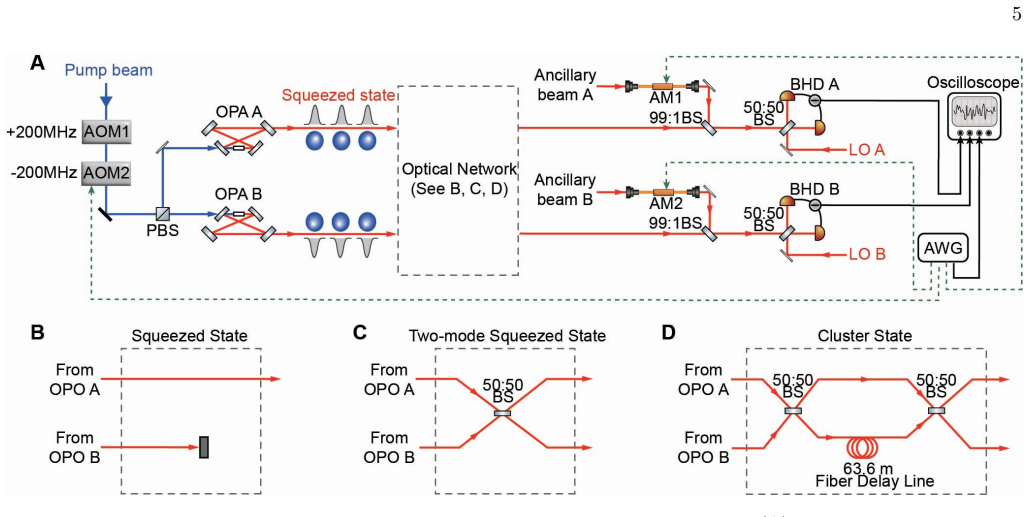
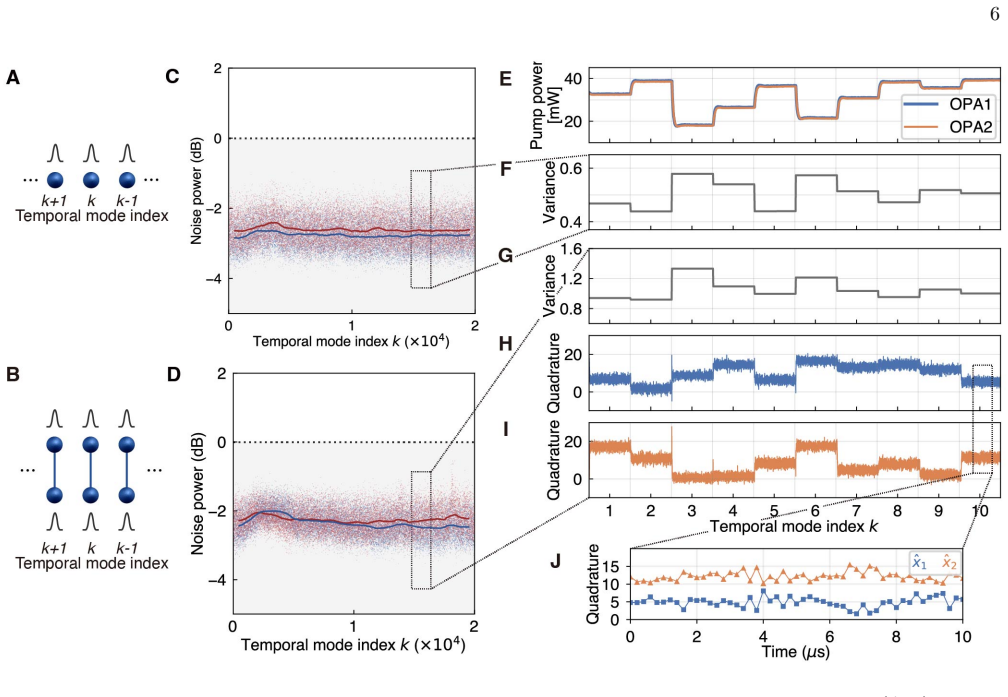
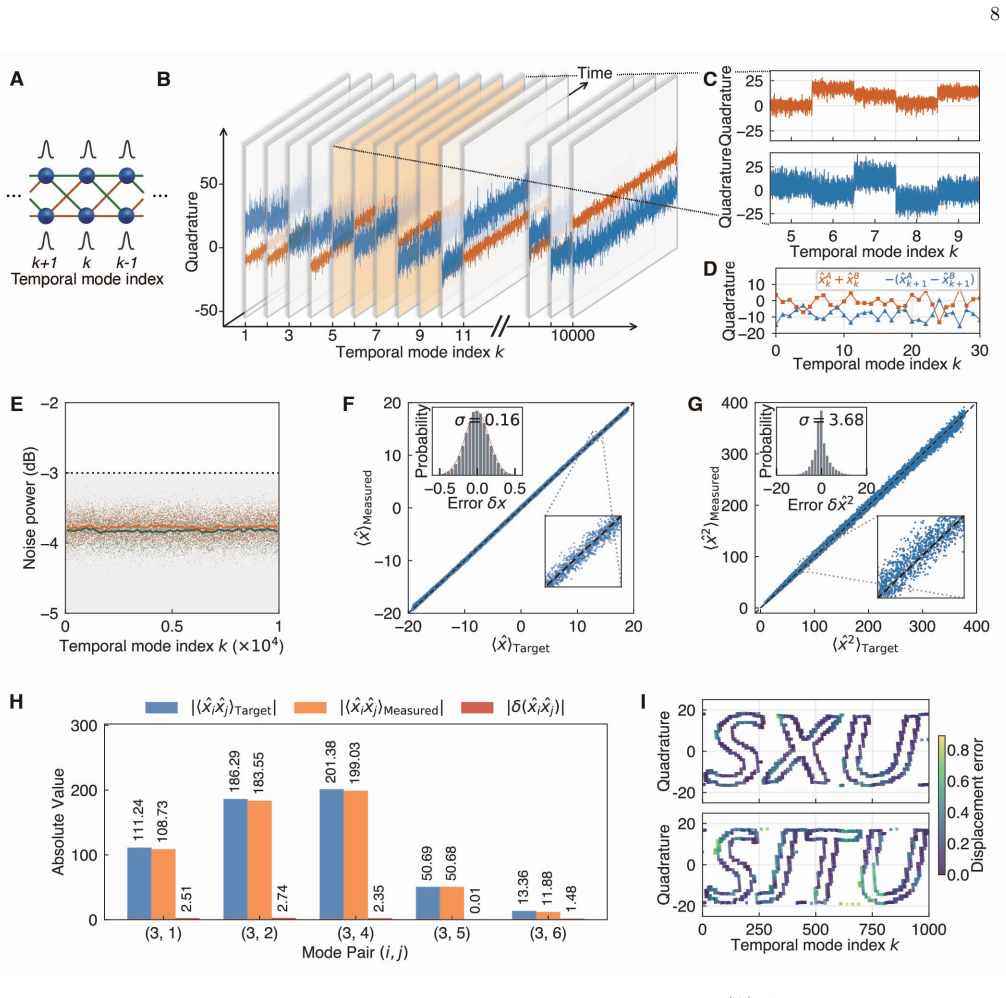
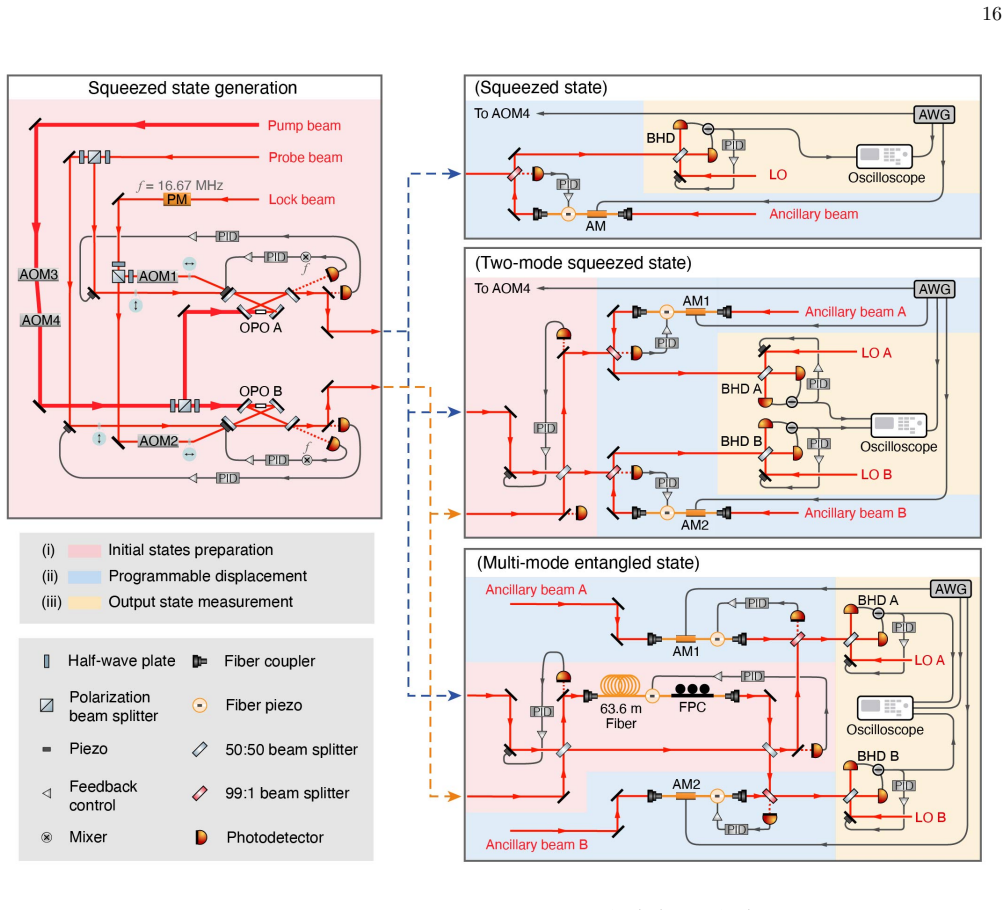
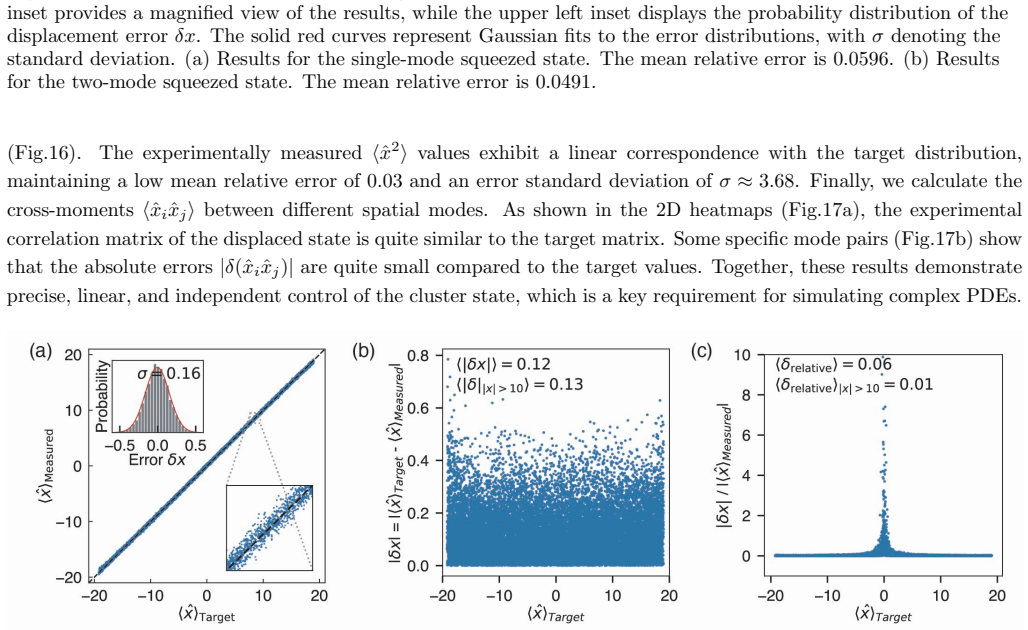
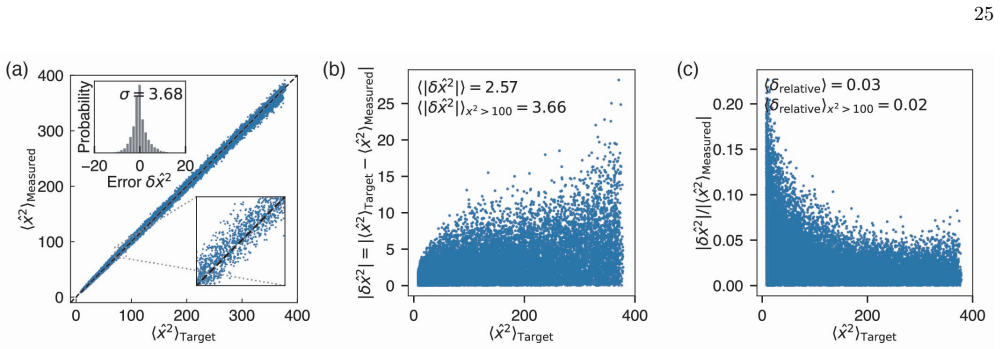
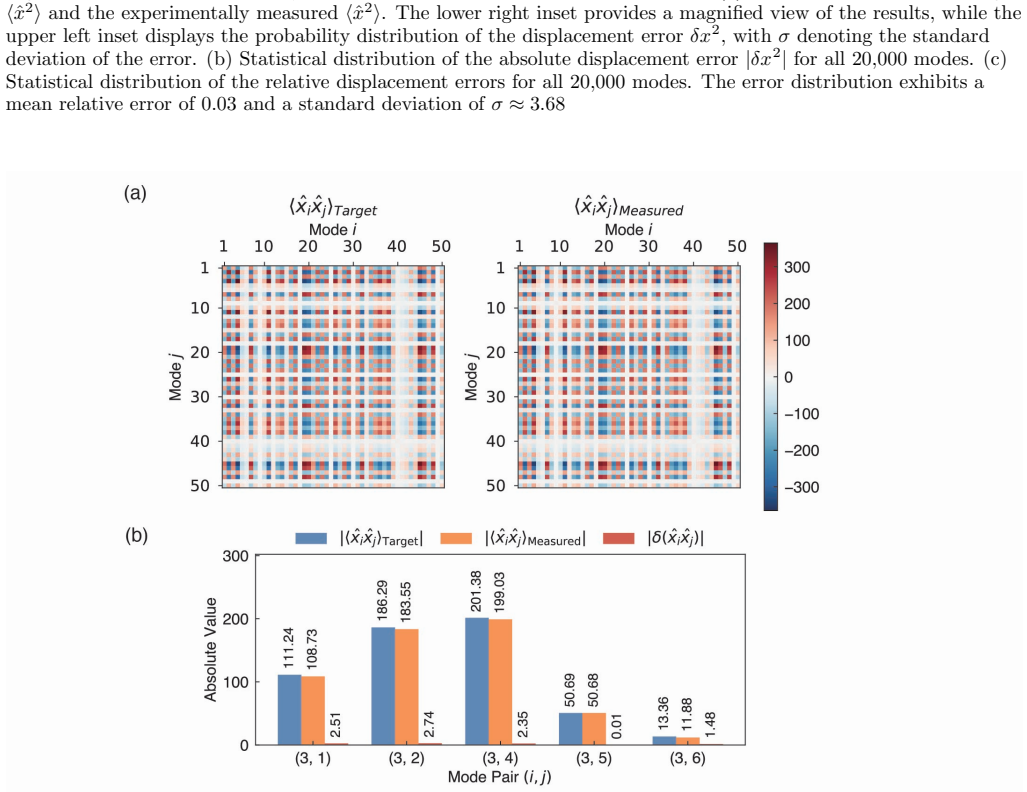
We demonstrate a large-scale analog photonic simulator for the constant-coefficient advection equation. The solution of a d-variable advection equation is encoded into d optical modes, so that the partial differential equation evolution maps directly to programmable phase-space displacements generated by optical quadrature momenta. Using a time-domain continuous-variable quantum photonic platform, we validate programmable control with 20,000 single-mode squeezed states and 20,000 two-mode squeezed states, and implement transport dynamics on a 20,000-mode cluster-state resource. Homodyne measurements then verify mode-resolved displacement control, which can provide first and second-order mome
What carries the argument
Encoding each variable of the d-dimensional advection equation into a separate optical mode so that PDE evolution maps to phase-space displacements controlled by quadrature momenta on a cluster-state resource.
If this is right
- Programmable displacement control on 20,000 modes supplies first- and second-order moment data for the advection solution without spatial discretization.
- Both single-mode and two-mode squeezed states can be used to prepare the required cluster-state resource for the simulation.
- The same encoding converts constant-coefficient advection into linear optical operations that scale with the number of modes rather than with a grid size.
- Homodyne detection directly extracts the observable moments that characterize the transported quantity.
Where Pith is reading between the lines
- The same phase-space displacement mechanism may apply to other linear transport or wave equations whose evolution remains affine in the field variables.
- Hybrid quantum-classical pipelines could use the photonic output moments as initial conditions for nonlinear corrections computed on conventional hardware.
- Error scaling with mode number could be tested by repeating the 20,000-mode experiment at successively larger cluster sizes while holding squeezing level fixed.
Load-bearing premise
The solution of a d-variable advection equation can be encoded into d optical modes such that its evolution reduces exactly to programmable phase-space displacements.
What would settle it
Homodyne readout on the 20,000-mode cluster state yielding relative error above 5 percent for first-order moment observables of the transported field.
Figures







read the original abstract
Transport equations describe how physical quantities -- such as mass, energy, momentum, concentration, probability, or fields -- are carried, propagated, or redistributed through space and time, forming a foundational class of partial differential equations across science and engineering. However, high-dimensional partial differential equations are difficult to represent on digital grids because the number of degrees of freedom grows exponentially with dimension. Continuous-variable quantum photonics on the other hand can represent and evolve these large-scale fields without first discretizing space into a discrete grid. We demonstrate a large-scale analog photonic simulator for the constant-coefficient advection equation, a transport equation that is a fundamental benchmark for scientific computing. The solution of a $d$-variable advection equation is encoded into $d$ optical modes, so that the partial differential equation evolution maps directly to programmable phase-space displacements generated by optical quadrature momenta. Using a time-domain continuous-variable quantum photonic platform, we validate programmable control with $20,000$ single-mode squeezed states and $20,000$ two-mode squeezed states, and implement transport dynamics on a $20,000$-mode cluster-state resource. Homodyne measurements then verifies mode-resolved displacement control, which can provide first and second-order moment information of the solution to the advection equation, with final achievable relative error as low as $0.8\%$ and $0.92\%$ for first and second-order moment observables respectively. Our results establish continuous-variable photonics as a suitable programmable analog platform for large-scale advection equations.
Editorial analysis
A structured set of objections, weighed in public.
Referee Report
Summary. The manuscript claims to demonstrate a large-scale analog photonic simulator for the constant-coefficient advection equation on a time-domain continuous-variable quantum photonic platform. The solution of a d-variable advection equation is encoded into d optical modes such that the PDE evolution maps directly to programmable phase-space displacements generated by optical quadrature momenta. Programmable control is validated using 20,000 single-mode squeezed states and 20,000 two-mode squeezed states to implement transport dynamics on a 20,000-mode cluster-state resource, with homodyne measurements verifying mode-resolved displacement control and recovering first- and second-order moment observables to relative errors as low as 0.8% and 0.92%, respectively.
Significance. If the experimental results hold, the work would establish continuous-variable photonics as a programmable analog platform capable of handling high-dimensional transport equations without exponential discretization costs. The explicit encoding of the advection equation into optical modes, the scale of the 20,000-mode resource, and the direct mapping to quadrature displacements represent a concrete advance for analog simulation of PDEs in science and engineering.
major comments (1)
- [Abstract] Abstract: The reported relative errors (0.8% for first-order moments and 0.92% for second-order moments) and the scale (20,000 states) are presented as concrete experimental outcomes, yet the abstract supplies no methods section, error budget, raw data, or description of calibration/post-selection procedures. This is load-bearing for the central claim because it prevents assessment of whether unstated assumptions affect the quoted precision.
Simulated Author's Rebuttal
We thank the referee for their detailed review and for highlighting the need for greater transparency in the abstract. We address the single major comment below and will revise the manuscript to improve accessibility of the reported results.
read point-by-point responses
-
Referee: [Abstract] Abstract: The reported relative errors (0.8% for first-order moments and 0.92% for second-order moments) and the scale (20,000 states) are presented as concrete experimental outcomes, yet the abstract supplies no methods section, error budget, raw data, or description of calibration/post-selection procedures. This is load-bearing for the central claim because it prevents assessment of whether unstated assumptions affect the quoted precision.
Authors: We agree that the abstract, while intended as a high-level summary, should better contextualize the quoted performance metrics. The full manuscript already contains dedicated sections on the experimental platform, homodyne detection calibration, post-selection criteria, and a complete error budget (including statistical and systematic contributions) that support the 0.8% and 0.92% relative errors. To address the referee's concern directly, we will revise the abstract to include a concise clause noting the use of calibrated homodyne readout on a time-domain cluster-state resource and that detailed error analysis appears in the main text. This revision will be kept within standard abstract length limits while improving standalone readability. revision: yes
Circularity Check
No significant circularity; experimental demonstration is self-contained
full rationale
The paper reports an experimental implementation on a time-domain continuous-variable quantum photonic platform. It encodes the d-variable constant-coefficient advection equation solution into d optical modes via direct mapping to quadrature displacements, generates 20,000 single- and two-mode squeezed states, implements dynamics on a 20,000-mode cluster state, and measures first- and second-moment observables with reported relative errors of 0.8% and 0.92%. These are hardware-verified quantities, not outputs of any fitted parameter renamed as prediction, self-definitional loop, or self-citation chain. No equations in the provided text reduce the claimed results to their own inputs by construction, and the constant-coefficient restriction is stated explicitly. The derivation chain consists of physical encoding and measurement steps that remain independent of the target observables.
Axiom & Free-Parameter Ledger
axioms (1)
- domain assumption The advection equation evolution maps directly to programmable phase-space displacements generated by optical quadrature momenta.
Reference graph
Works this paper leans on
-
[1]
Feynman and computation , pages=
Simulating physics with computers , author=. Feynman and computation , pages=. 2018 , publisher=
2018
-
[2]
Gaussian quantum information , author =. Rev. Mod. Phys. , volume =. 2012 , month =. doi:10.1103/RevModPhys.84.621 , url =
-
[3]
Gate-Based Quantum Simulation of Gaussian Bosonic Circuits on Exponentially Many Modes , author =. Phys. Rev. Lett. , volume =. 2025 , month =. doi:10.1103/PhysRevLett.134.070604 , url =
-
[4]
Quantum algorithms for solving a drift-diffusion equation: A complexity analysis , author =. Phys. Rev. A , volume =. 2025 , month =. doi:10.1103/1fw9-h14w , url =
-
[5]
, title =
LeVeque, Randall J. , title =. 2007 , doi =
2007
-
[6]
and Barends, Rami and Biswas, Rupak and Boixo, Sergio and Brandao, Fernando G
Arute, Frank and Arya, Kunal and Babbush, Ryan and Bacon, Dave and Bardin, Joseph C. and Barends, Rami and Biswas, Rupak and Boixo, Sergio and Brandao, Fernando G. S. L. and Buell, David A. and Burkett, Brian and Chen, Yu and Chen, Zijun and Chiaro, Ben and Collins, Roberto and Courtney, William and Dunsworth, Andrew and Farhi, Edward and Foxen, Brooks an...
2019
-
[7]
Over, Paul and Bengoechea, Sergio and Brearley, Peter and Laizet, Sylvain and Rung, Thomas , year=. Quantum algorithm for the advection-diffusion equation by direct block encoding of the time-marching operator , volume=. Physical Review A , publisher=. doi:10.1103/d8hb-fv93 , number=
-
[8]
2024 , eprint=
Optimal high-precision shadow estimation , author=. 2024 , eprint=
2024
-
[9]
2025 , eprint=
Hamiltonian Simulation for Advection-Diffusion Equation with arbitrary transport field , author=. 2025 , eprint=
2025
-
[10]
Error Correcting Codes in Quantum Theory , author =. Phys. Rev. Lett. , volume =. 1996 , month =. doi:10.1103/PhysRevLett.77.793 , url =
-
[11]
and Bluvstein, Dolev and Kalinowski, Marcin and Ebadi, Sepehr and Manovitz, Tom and Zhou, Hengyun and Li, Sophie H
Evered, Simon J. and Bluvstein, Dolev and Kalinowski, Marcin and Ebadi, Sepehr and Manovitz, Tom and Zhou, Hengyun and Li, Sophie H. and et al. , title =. Nature , volume =. 2023 , doi =
2023
-
[12]
Bluvstein, Dolev and Evered, Simon J. and Geim, Alexandra A. and others , title =. Nature , year =. doi:10.1038/s41586-023-06927-3 , url =
-
[13]
A tweezer array with 6100 highly coherent atomic qubits
A tweezer array with 6100 highly coherent atomic qubits , author =. 2025 , month =. doi:10.48550/arXiv.2403.12021 , url =. 2403.12021 , archivePrefix =
work page internal anchor Pith review Pith/arXiv arXiv doi:10.48550/arxiv.2403.12021 2025
-
[14]
Quantum circuits for partial differential equations via Schr
Hu, Junpeng and Jin, Shi and Liu, Nana and Zhang, Lei , journal=. Quantum circuits for partial differential equations via Schr. 2024 , publisher=
2024
-
[15]
Acharya, Rajeev and Abanin, Dmitry A. and Google Quantum AI and Collaborators , title =. Nature , year =. doi:10.1038/s41586-024-08449-y , url =
-
[16]
and Ji, Zhengfeng and Wu, Xiaodi and Yu, Nengkun , journal=
Haah, Jeongwan and Harrow, Aram W. and Ji, Zhengfeng and Wu, Xiaodi and Yu, Nengkun , journal=. Sample-Optimal Tomography of Quantum States , year=
-
[17]
Optimal Hamiltonian Simulation by Quantum Signal Processing , author =. Phys. Rev. Lett. , volume =. 2017 , month =. doi:10.1103/PhysRevLett.118.010501 , url =
-
[18]
and Wiebe, Nathan , title =
Childs, Andrew M. and Wiebe, Nathan , title =. Quantum Information & Computation , volume =. 2012 , eprint =
2012
-
[19]
and Childs, Andrew M
Berry, Dominic W. and Childs, Andrew M. and Kothari, Robin , booktitle=. Hamiltonian Simulation with Nearly Optimal Dependence on all Parameters , year=
-
[20]
Physical review letters , volume=
Optimal Hamiltonian simulation by quantum signal processing , author=. Physical review letters , volume=. 2017 , publisher=
2017
-
[21]
Hamiltonian Simulation Using Linear Combinations of Unitary Operations
Hamiltonian simulation using linear combinations of unitary operations , author=. arXiv preprint arXiv:1202.5822 , year=
work page internal anchor Pith review Pith/arXiv arXiv
-
[22]
Limitations on the simulation of non-sparse Hamiltonians
Limitations on the simulation of non-sparse Hamiltonians , author=. arXiv preprint arXiv:0908.4398 , year=
work page internal anchor Pith review Pith/arXiv arXiv
-
[23]
arXiv preprint arXiv:2308.00646 , year=
Analog quantum simulation of partial differential equations , author=. arXiv preprint arXiv:2308.00646 , year=
-
[24]
Proceedings of the forty-sixth annual ACM symposium on Theory of computing , pages=
Exponential improvement in precision for simulating sparse Hamiltonians , author=. Proceedings of the forty-sixth annual ACM symposium on Theory of computing , pages=
-
[25]
2015 IEEE 56th annual symposium on foundations of computer science , pages=
Hamiltonian simulation with nearly optimal dependence on all parameters , author=. 2015 IEEE 56th annual symposium on foundations of computer science , pages=. 2015 , organization=
2015
-
[26]
1968 , publisher=
Handbook of mathematical functions with formulas, graphs, and mathematical tables , author=. 1968 , publisher=
1968
-
[27]
Mathematical proceedings of the Cambridge philosophical society , volume=
A practical method for numerical evaluation of solutions of partial differential equations of the heat-conduction type , author=. Mathematical proceedings of the Cambridge philosophical society , volume=. 1947 , organization=
1947
-
[28]
Communications on pure and applied mathematics , volume=
On the solution of nonlinear hyperbolic differential equations by finite differences , author=. Communications on pure and applied mathematics , volume=. 1952 , publisher=
1952
-
[29]
Proceedings of the national academy of sciences , volume=
The theory of everything , author=. Proceedings of the national academy of sciences , volume=. 2000 , publisher=
2000
-
[30]
Journal of Computational Physics , volume=
Time complexity analysis of quantum algorithms via linear representations for nonlinear ordinary and partial differential equations , author=. Journal of Computational Physics , volume=. 2023 , publisher=
2023
-
[31]
classical algorithms for solving the heat equation , author=
Quantum vs. classical algorithms for solving the heat equation , author=. Communications in Mathematical Physics , volume=. 2022 , publisher=
2022
-
[32]
Physical Review A , volume=
Quantum algorithm for simulating the wave equation , author=. Physical Review A , volume=. 2019 , publisher=
2019
-
[33]
npj Quantum Information , volume=
Finding flows of a Navier--Stokes fluid through quantum computing , author=. npj Quantum Information , volume=. 2020 , publisher=
2020
-
[34]
Physical Review Research , volume=
Efficient Hamiltonian simulation for solving option price dynamics , author=. Physical Review Research , volume=. 2023 , publisher=
2023
-
[35]
2019 , school=
Quantum singular value transformation & its algorithmic applications , author=. 2019 , school=
2019
-
[36]
Quantum , volume=
Option pricing using quantum computers , author=. Quantum , volume=. 2020 , publisher=
2020
-
[37]
Physical review letters , volume=
Quantum algorithm for linear systems of equations , author=. Physical review letters , volume=. 2009 , publisher=
2009
-
[38]
45th Annual IEEE symposium on foundations of computer science , pages=
Quantum speed-up of Markov chain based algorithms , author=. 45th Annual IEEE symposium on foundations of computer science , pages=. 2004 , organization=
2004
-
[39]
Science , volume=
Simulated quantum computation of molecular energies , author=. Science , volume=. 2005 , publisher=
2005
-
[40]
The American Mathematical Monthly , volume=
The story of the binomial theorem , author=. The American Mathematical Monthly , volume=. 1949 , publisher=
1949
-
[41]
arXiv preprint arXiv:2107.10764 , year=
Nonlinear transformation of complex amplitudes via quantum singular value transformation , author=. arXiv preprint arXiv:2107.10764 , year=
-
[42]
Non-Linear Transformations of Quantum Amplitudes: Exponential Improvement, Generalization, and Applications , author=. arXiv preprint arXiv:2309.09839 , year=
-
[43]
Physical Review A , volume=
Minimal universal two-qubit controlled-NOT-based circuits , author=. Physical Review A , volume=. 2004 , publisher=
2004
-
[44]
Physical Review A , volume=
Quantum circuits with uniformly controlled one-qubit gates , author=. Physical Review A , volume=. 2005 , publisher=
2005
-
[45]
A logarithmic-depth quantum carry-lookahead adder
A logarithmic-depth quantum carry-lookahead adder , author=. arXiv preprint quant-ph/0406142 , year=
work page internal anchor Pith review Pith/arXiv arXiv
-
[46]
Physical Review A , volume=
Quantum-state preparation with universal gate decompositions , author=. Physical Review A , volume=. 2011 , publisher=
2011
-
[47]
Proceedings of the 51st Annual ACM SIGACT Symposium on Theory of Computing , pages=
Quantum singular value transformation and beyond: exponential improvements for quantum matrix arithmetics , author=. Proceedings of the 51st Annual ACM SIGACT Symposium on Theory of Computing , pages=
-
[48]
American Journal of Mathematics , volume=
A closed set of normal orthogonal functions , author=. American Journal of Mathematics , volume=. 1923 , publisher=
1923
-
[49]
Physical review letters , volume=
Quantum circuits for general multiqubit gates , author=. Physical review letters , volume=. 2004 , publisher=
2004
-
[50]
arXiv preprint arXiv:2203.10236 , year=
Explicit quantum circuits for block encodings of certain sparse matrices (2022) , author=. arXiv preprint arXiv:2203.10236 , year=
-
[51]
2022 IEEE International Conference on Quantum Computing and Engineering (QCE) , pages=
Fable: Fast approximate quantum circuits for block-encodings , author=. 2022 IEEE International Conference on Quantum Computing and Engineering (QCE) , pages=. 2022 , organization=
2022
-
[52]
Addition on a Quantum Computer
Addition on a quantum computer , author=. arXiv preprint quant-ph/0008033 , year=
work page internal anchor Pith review Pith/arXiv arXiv
-
[53]
arXiv preprint arXiv:2310.03011 , year=
Quantum algorithms: A survey of applications and end-to-end complexities , author=. arXiv preprint arXiv:2310.03011 , year=
-
[54]
arXiv preprint arXiv:2312.02817 , year=
Quantum simulation for time-dependent Hamiltonians--with applications to non-autonomous ordinary and partial differential equations , author=. arXiv preprint arXiv:2312.02817 , year=
-
[55]
Nature , volume=
Evidence for the utility of quantum computing before fault tolerance , author=. Nature , volume=. 2023 , publisher=
2023
-
[56]
IBM Research Blog (September 2020) , year=
IBM’s roadmap for scaling quantum technology , author=. IBM Research Blog (September 2020) , year=
2020
-
[57]
J Appl Phys , volume=
The future of quantum computing with superconducting qubits , author=. J Appl Phys , volume=. 2022 , publisher=
2022
-
[58]
Nature Reviews Physics , volume=
Variational quantum algorithms , author=. Nature Reviews Physics , volume=. 2021 , publisher=
2021
-
[59]
Nat Commun , volume=
Efficient arbitrary simultaneously entangling gates on a trapped-ion quantum computer , author=. Nat Commun , volume=. 2020 , publisher=
2020
-
[60]
Nature , volume=
Demonstration of the trapped-ion quantum CCD computer architecture , author=. Nature , volume=. 2021 , publisher=
2021
-
[61]
Surface codes: Towards practical large-scale quantum computation , author=. Phys. Rev. A , volume=. 2012 , publisher=
2012
-
[62]
Quantum error correction for beginners , author=. Rep. Prog. Phys. , volume=. 2013 , publisher=
2013
-
[63]
Preconditioned quantum linear system algorithm , author=. Phys. Rev. Lett. , volume=. 2013 , publisher=
2013
-
[64]
SIAM Journal on Computing , volume=
Quantum algorithm for systems of linear equations with exponentially improved dependence on precision , author=. SIAM Journal on Computing , volume=. 2017 , publisher=
2017
-
[65]
A survey on HHL algorithm: From theory to application in quantum machine learning , author=. Phys. Lett. A , volume=. 2020 , publisher=
2020
-
[66]
TPAMI , volume=
Scale-space and edge detection using anisotropic diffusion , author=. TPAMI , volume=. 1990 , publisher=
1990
-
[67]
1995 , publisher=
The mathematics of financial derivatives: a student introduction , author=. 1995 , publisher=
1995
-
[68]
New York , volume=
Conduction of heat in solids: Oxford University Press , author=. New York , volume=
-
[69]
Hybrid classical-quantum approach to solve the heat equation using quantum annealers , author=. Phys. Rev. A , volume=. 2021 , publisher=
2021
-
[70]
2020 , publisher=
Forthcoming applications of quantum computing: peeking into the future , author=. 2020 , publisher=
2020
-
[71]
ChemBioChem , volume=
Quantum computing for molecular biology , author=. ChemBioChem , volume=. 2023 , publisher=
2023
-
[72]
Nat Rev Phys , pages=
Quantum computing for finance , author=. Nat Rev Phys , pages=. 2023 , publisher=
2023
-
[73]
arXiv preprint arXiv:2304.02865 , year=
Quantum simulation of discrete linear dynamical systems and simple iterative methods in linear algebra via schrodingerisation , author=. arXiv preprint arXiv:2304.02865 , year=
-
[74]
Quantum Algorithm for Linear Systems of Equations , author =. Phys. Rev. Lett. , volume =. 2009 , month =
2009
-
[75]
Preskill, John , journal =. Quantum
-
[76]
arXiv preprint arXiv:2210.16668 , year=
Advancing Algorithm to Scale and Accurately Solve Quantum Poisson Equation on Near-term Quantum Hardware , author=. arXiv preprint arXiv:2210.16668 , year=
-
[77]
Depth analysis of variational quantum algorithms for the heat equation , author=. Phys. Rev. A , volume=. 2023 , publisher=
2023
-
[78]
New Journal of Physics , abstract =
Hsin-Yuan Huang and Kishor Bharti and Patrick Rebentrost , title =. New Journal of Physics , abstract =. 2021 , month =. doi:10.1088/1367-2630/ac325f , url =
-
[79]
Creating superpositions that correspond to efficiently integrable probability distributions
Creating superpositions that correspond to efficiently integrable probability distributions , author=. arXiv preprint quant-ph/0208112 , year=
work page internal anchor Pith review Pith/arXiv arXiv
-
[80]
arXiv preprint arXiv:2101.04023 , year=
Simulating option price dynamics with exponential quantum speedup , author=. arXiv preprint arXiv:2101.04023 , year=
discussion (0)
Sign in with ORCID, Apple, or X to comment. Anyone can read and Pith papers without signing in.