Coarse-to-Fine Compositional Diffusion for Long-Horizon Planning
Pith reviewed 2026-06-28 18:22 UTC · model grok-4.3
The pith
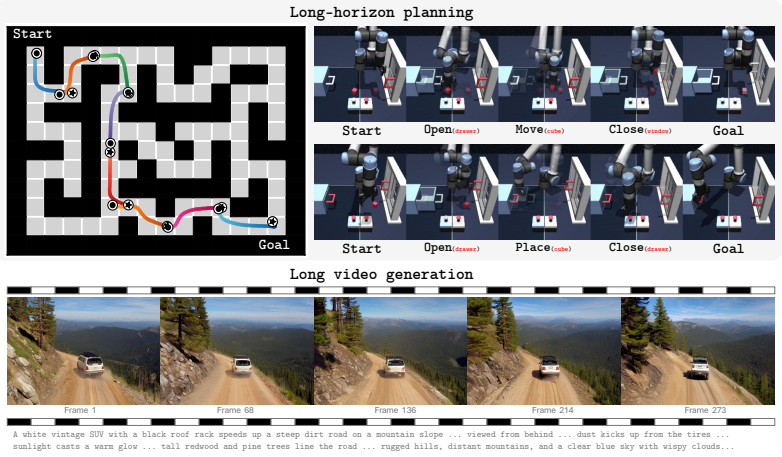
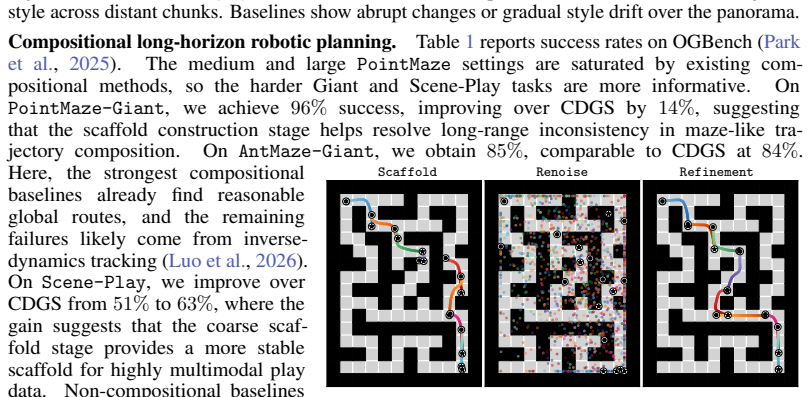
CoFi produces globally coherent long-horizon outputs by first aligning local diffusion estimates into a shared coarse scaffold then restoring fine details at an intermediate noise level with the same pretrained prior.
A machine-rendered reading of the paper's core claim, the machinery that carries it, and where it could break.
Core claim
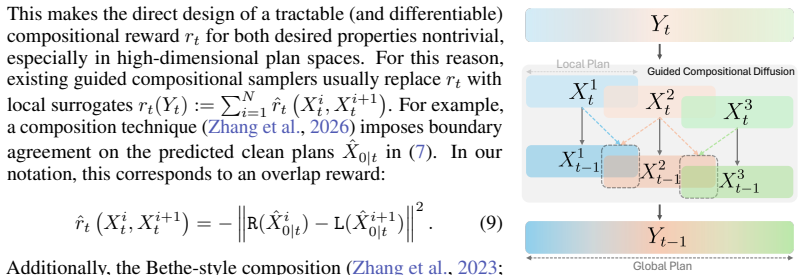
CoFi first aligns local denoised estimates around a shared coarse structure, producing a global scaffold that captures the long-range task-level arrangement. It then diffuses this scaffold to an intermediate noise level and denoises it with the same pretrained local prior, restoring local fine structure while preserving the scaffold-induced global coherence.
What carries the argument
Coarse-to-Fine Compositional Diffusion (CoFi) sampler, which separates global structure formation from local detail refinement at inference time.
If this is right
- Locally compatible plans no longer form implausible global routes or task sequences.
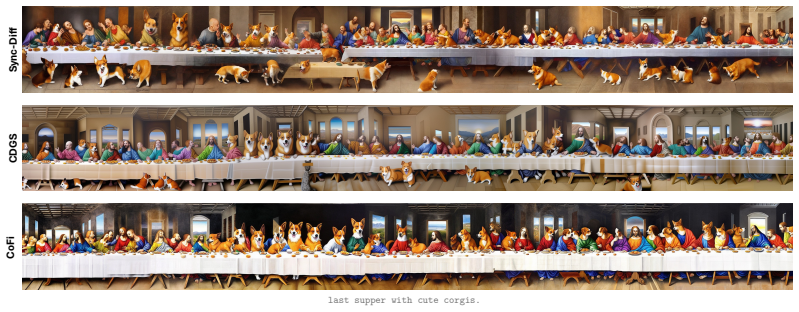
- Global coherence and local sample quality both improve over standard compositional baselines.
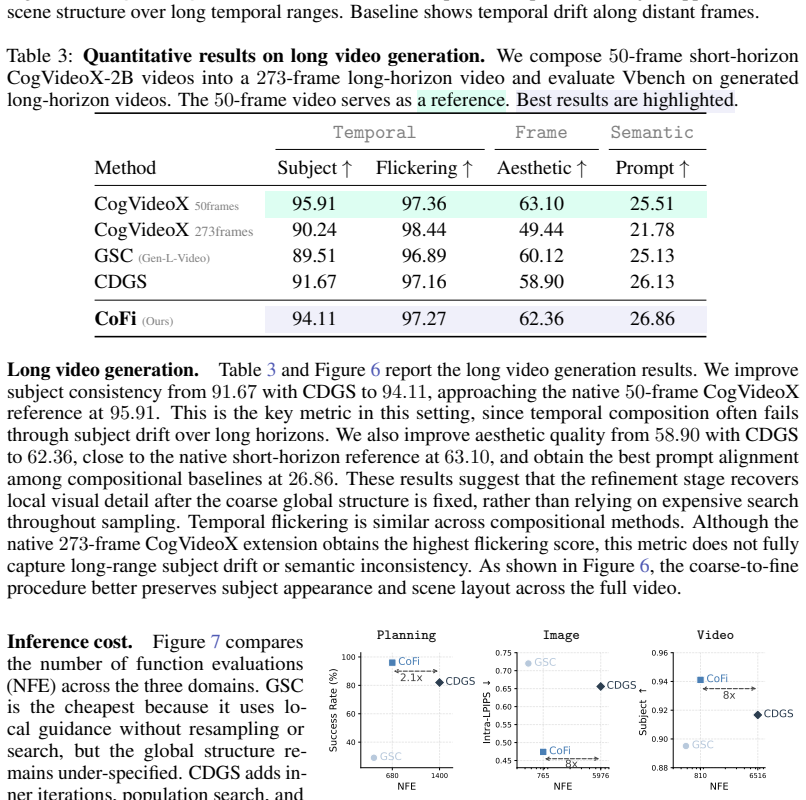
- The method requires 2-8 times fewer denoiser evaluations than repeated propagation or optimization approaches.
- The same procedure applies without modification to robotic planning, panoramic images, and long video generation.
Where Pith is reading between the lines
- The two-stage separation could be applied to any pretrained diffusion prior whose training horizon is shorter than the target output length.
- Choosing the intermediate noise level might be automated by monitoring when global scaffold statistics stabilize during the first stage.
- The approach suggests that global structure can be imposed without retraining if the prior already encodes the right local statistics.
Load-bearing premise
Forcing alignment around a shared coarse structure will not destroy the local consistency properties of the pretrained short-horizon prior, and an intermediate noise level exists that lets the same prior restore fine details without erasing the imposed global scaffold.
What would settle it
Running the alignment stage on a short-horizon prior and measuring whether local consistency metrics drop sharply, or testing whether denoising the scaffold at the chosen intermediate noise level erases the global arrangement in held-out long-horizon examples.
Figures




read the original abstract
Diffusion models provide strong priors for generating structured data, but many tasks require outputs beyond the scale on which these models are typically trained. Compositional generation addresses this by composing overlapping local plans from a pretrained short-horizon prior into a long-horizon output. However, standard composition primarily enforces agreement between neighboring local plans, yielding local consistency without directly specifying the global structure of the full composition. As a result, locally compatible plans may still form an implausible route, task sequence, or temporal evolution. Existing methods improve global coherence by repeatedly propagating local consistency signals or by adding inference-time optimization, but these procedures become expensive as the number or dimensionality of local plans increases. We propose Coarse-to-Fine Compositional Diffusion (CoFi), an inference-time sampler that separates global structure formation from local detail refinement. CoFi first aligns local denoised estimates around a shared coarse structure, producing a global scaffold that captures the long-range task-level arrangement. It then diffuses this scaffold to an intermediate noise level and denoises it with the same pretrained local prior, restoring local fine structure while preserving the scaffold-induced global coherence. Across long-horizon robotic planning, panoramic image generation, and long video generation, CoFi not only improves both global coherence and local sample quality over prior compositional baselines, but also requires 2-8x fewer denoiser evaluations.
Editorial analysis
A structured set of objections, weighed in public.
Referee Report
Summary. The manuscript proposes Coarse-to-Fine Compositional Diffusion (CoFi), an inference-time sampler that first aligns local denoised estimates from a pretrained short-horizon diffusion prior around a shared coarse structure to form a global scaffold, then diffuses this scaffold to an intermediate noise level and reapplies the same prior to restore fine details while preserving global coherence. It claims this yields better global coherence and local sample quality than prior compositional baselines across long-horizon robotic planning, panoramic image generation, and long video generation, while requiring 2-8x fewer denoiser evaluations.
Significance. If the intermediate noise level can be shown to reliably exist and generalize, the approach would provide an efficient way to extend short-horizon diffusion priors to long-horizon tasks without retraining or expensive inference-time optimization, addressing a practical bottleneck in compositional generation for robotics and sequential data.
major comments (1)
- [Abstract] Abstract (method description): The second stage relies on the existence of an intermediate noise level at which the pretrained local prior can add fine structure without erasing the imposed global scaffold; no equation, noise schedule, selection procedure, or ablation is supplied to characterize this level, demonstrate its stability under perturbation, or show that a single choice works across tasks without retuning.
minor comments (1)
- [Abstract] The abstract states performance and efficiency gains but supplies no quantitative tables, error analysis, or baseline comparisons that would allow verification of the 2-8x claim or assessment of variance.
Simulated Author's Rebuttal
We thank the referee for the careful review and constructive comment. We address the concern about the intermediate noise level below.
read point-by-point responses
-
Referee: [Abstract] Abstract (method description): The second stage relies on the existence of an intermediate noise level at which the pretrained local prior can add fine structure without erasing the imposed global scaffold; no equation, noise schedule, selection procedure, or ablation is supplied to characterize this level, demonstrate its stability under perturbation, or show that a single choice works across tasks without retuning.
Authors: We agree that the manuscript does not supply an explicit equation, noise schedule, selection procedure, or ablation study characterizing the intermediate noise level used in the second stage. In the revised version we will add these elements to the method section and abstract: an equation defining the target noise level, the fixed schedule employed, the selection procedure (based on matching scaffold scale to the prior's effective receptive field on a small validation set), and an ablation demonstrating stability under small perturbations as well as consistency of the same level across the three evaluated tasks. revision: yes
Circularity Check
No circularity; CoFi is a novel inference-time procedure
full rationale
The paper presents CoFi as a new two-stage sampling algorithm that first aligns local denoised estimates to form a global scaffold and then diffuses to an intermediate noise level for refinement with the pretrained prior. No equations, fitted parameters, or self-citations are shown that reduce the claimed global coherence or efficiency gains to a self-referential definition or input by construction. The intermediate noise level is an explicit design choice whose existence is assumed rather than derived from prior results in the paper itself. This is a standard non-circular presentation of a sampling method.
Axiom & Free-Parameter Ledger
axioms (1)
- domain assumption A pretrained short-horizon diffusion prior can be reused effectively at an intermediate noise level to restore local structure after global alignment.
Reference graph
Works this paper leans on
-
[1]
Omer Bar-Tal, Lior Yariv, Yaron Lipman, and Tali Dekel. Multidiffusion: Fusing diffusion paths for controlled image generation.arXiv preprint arXiv:2302.08113,
-
[2]
Offline Reinforcement Learning with Implicit Q-Learning
Ilya Kostrikov, Ashvin Nair, and Sergey Levine. Offline reinforcement learning with implicit q-learning.arXiv preprint arXiv:2110.06169,
work page internal anchor Pith review Pith/arXiv arXiv
-
[3]
Yaron Lipman, Ricky T. Q. Chen, Heli Ben-Hamu, Maximilian Nickel, and Matthew Le. Flow matching for generative modeling. InThe Eleventh International Conference on Learning Repre- sentations, 2023.https://openreview.net/forum?id=PqvMRDCJT9t. Yunhao Luo, Utkarsh Aashu Mishra, Yilun Du, and Danfei Xu. Generative trajectory stitching through diffusion compos...
2023
-
[4]
Compositional diffusion with guided search for long-horizon planning
Utkarsh Aashu Mishra, David He, Yongxin Chen, and Danfei Xu. Compositional diffusion with guided search for long-horizon planning. InThe Fourteenth International Conference on Learning Representations, 2026.https://openreview.net/forum?id=b8avf4F2hn. 10 Seohong Park, Dibya Ghosh, Benjamin Eysenbach, and Sergey Levine. Hiql: Offline goal-conditioned rl wit...
2026
-
[5]
OGBench: Benchmarking offline goal-conditioned RL
Seohong Park, Kevin Frans, Benjamin Eysenbach, and Sergey Levine. OGBench: Benchmarking offline goal-conditioned RL. InThe Thirteenth International Conference on Learning Representa- tions, 2025.https://openreview.net/forum?id=M992mjgKzI. Alec Radford, Jong Wook Kim, Chris Hallacy, Aditya Ramesh, Gabriel Goh, Sandhini Agarwal, Girish Sastry, Amanda Askell...
2025
-
[6]
https://openreview.net/forum?id= St1giarCHLP. Fu-Yun Wang, Wenshuo Chen, Guanglu Song, Han-Jia Ye, Yu Liu, and Hongsheng Li. Gen-l-video: Multi-text to long video generation via temporal co-denoising.arXiv preprint arXiv:2305.18264,
-
[7]
Cogvideox: Text-to-video diffusion models with an expert transformer
Zhuoyi Yang, Jiayan Teng, Wendi Zheng, Ming Ding, Shiyu Huang, Jiazheng Xu, Yuanming Yang, Wenyi Hong, Xiaohan Zhang, Guanyu Feng, Da Yin, Yuxuan.Zhang, Weihan Wang, Yean Cheng, Bin Xu, Xiaotao Gu, Yuxiao Dong, and Jie Tang. Cogvideox: Text-to-video diffusion models with an expert transformer. InThe Thirteenth International Conference on Learning Represen...
2025
-
[8]
11 A Derivation of the Closed-Form Coarse Estimate We derive the closed-form solution of the coarse alignment objective in (12)
https://openreview.net/forum?id= EEONns7ae4. 11 A Derivation of the Closed-Form Coarse Estimate We derive the closed-form solution of the coarse alignment objective in (12). For notational clarity, we drop the time index t and write ˆX i := ˆX i 0|t for the Tweedie estimate of the i-th local plan. Let γ >0denote the regularization strength and define f(Z ...
2026
-
[9]
After each denoising step, the composed global trajectory is obtained by exponentially blending adjacent segments in their overlap regions (Luo et al., 2026)
and the refinement stage (Algorithm 2). After each denoising step, the composed global trajectory is obtained by exponentially blending adjacent segments in their overlap regions (Luo et al., 2026). Concretely, 13 Table 4: Environment specifications for robotic planning. Environment obs dim goal dim horizon overlapNreplan thres max steps PointMaze-Medium2...
2026
-
[10]
Each color denotes a distinct local plan segment
Figure 12:AntMaze trajectory examples.Each row shows five evaluation tasks at increasing maze scale. Each color denotes a distinct local plan segment. global plan factorizes over the factor graph as pt(Yt)∝ NY i=1 pt(X i t).(24) Since the local plans overlap, this product double-counts the shared boundary variables. The Bethe free energy (Yedidia et al., 2000,
2000
-
[11]
to evaluate long video quality across four dimensions. Subject consistencymeasures the mean pairwise DINO feature similarity of the main subject across uniformly sampled frame pairs, capturing whether the subject’s appearance is preserved over the full video duration.Temporal flickeringevaluates frame-to-frame visual stability by measuring the mean absolu...
2026
-
[12]
SyncDiffusion 3 (Lee et al.,
and Gen-L-Video (Wang et al., 2023)) applies local guidance without resampling or search. SyncDiffusion 3 (Lee et al.,
2023
discussion (0)
Sign in with ORCID, Apple, or X to comment. Anyone can read and Pith papers without signing in.