The First Glimpse of Water Ice Absorption Map in the Milky Way
Pith reviewed 2026-06-28 17:11 UTC · model grok-4.3
The pith
Photometric corrections to WISE and 2MASS colors produce the first Milky Way-scale map of water ice absorption.
A machine-rendered reading of the paper's core claim, the machinery that carries it, and where it could break.
Core claim
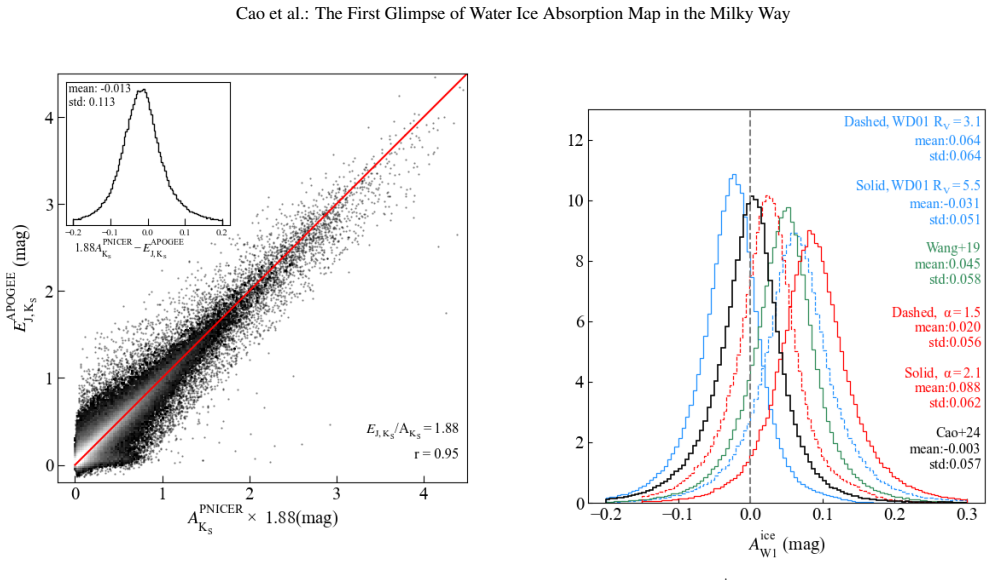
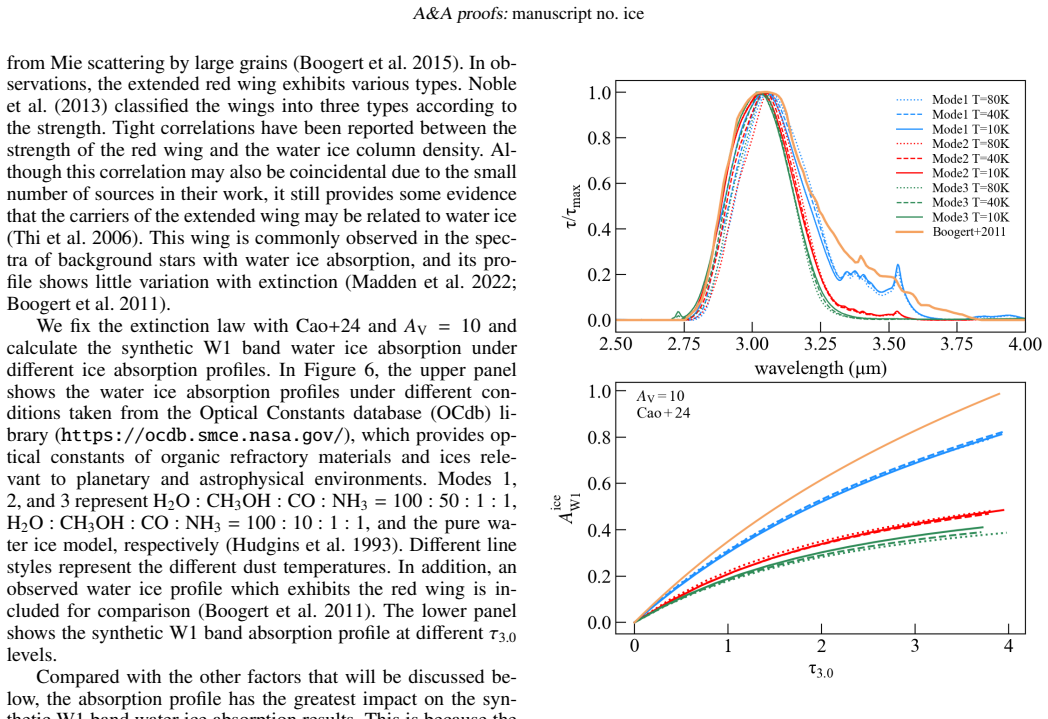
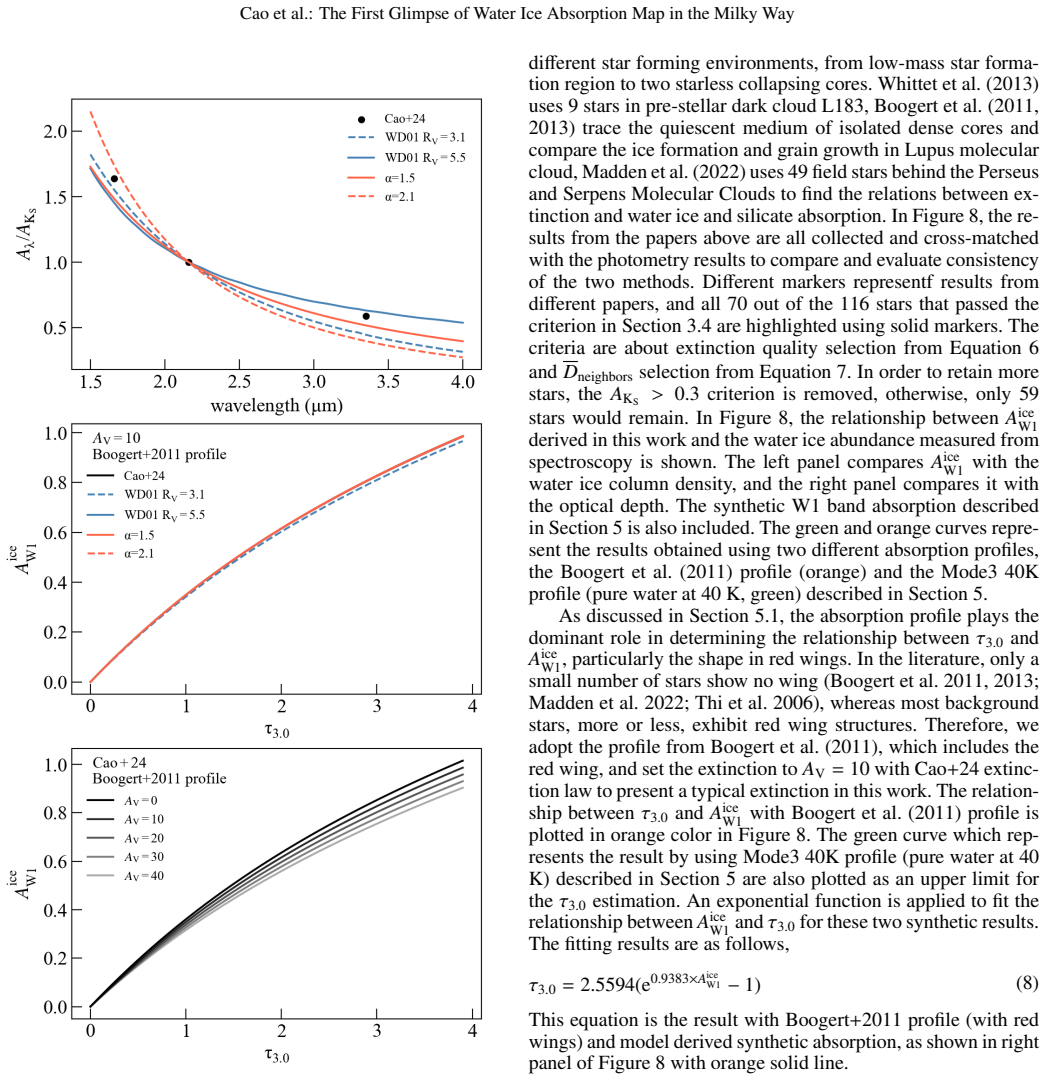
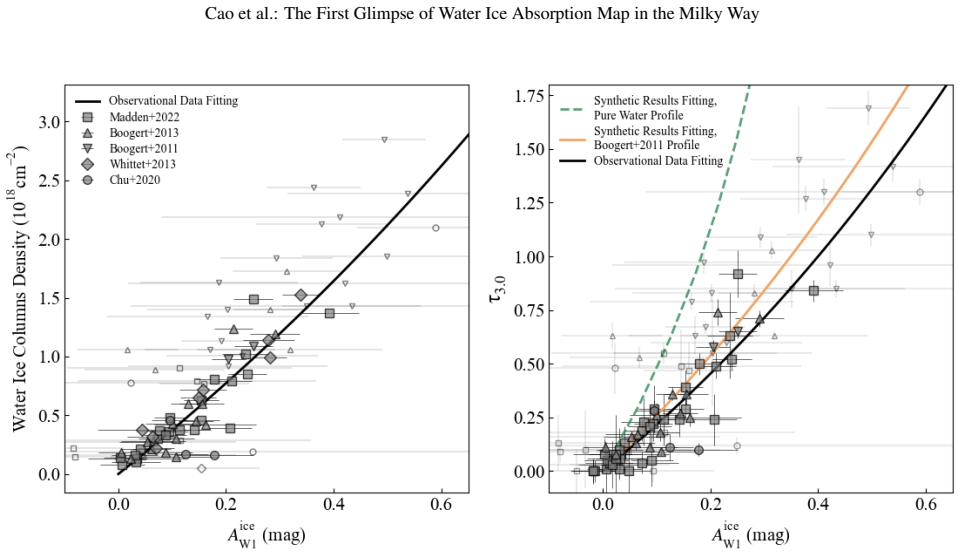
We present the first Milky Way-scale map of water ice distribution. The strong correlation between the measurement from photometric method and spectroscopic water ice abundance confirms that the W1 band signature originates from the 3 μm ice feature. We present the relationship between ice absorption in W1 band and water ice optical depth from theory and observations.
What carries the argument
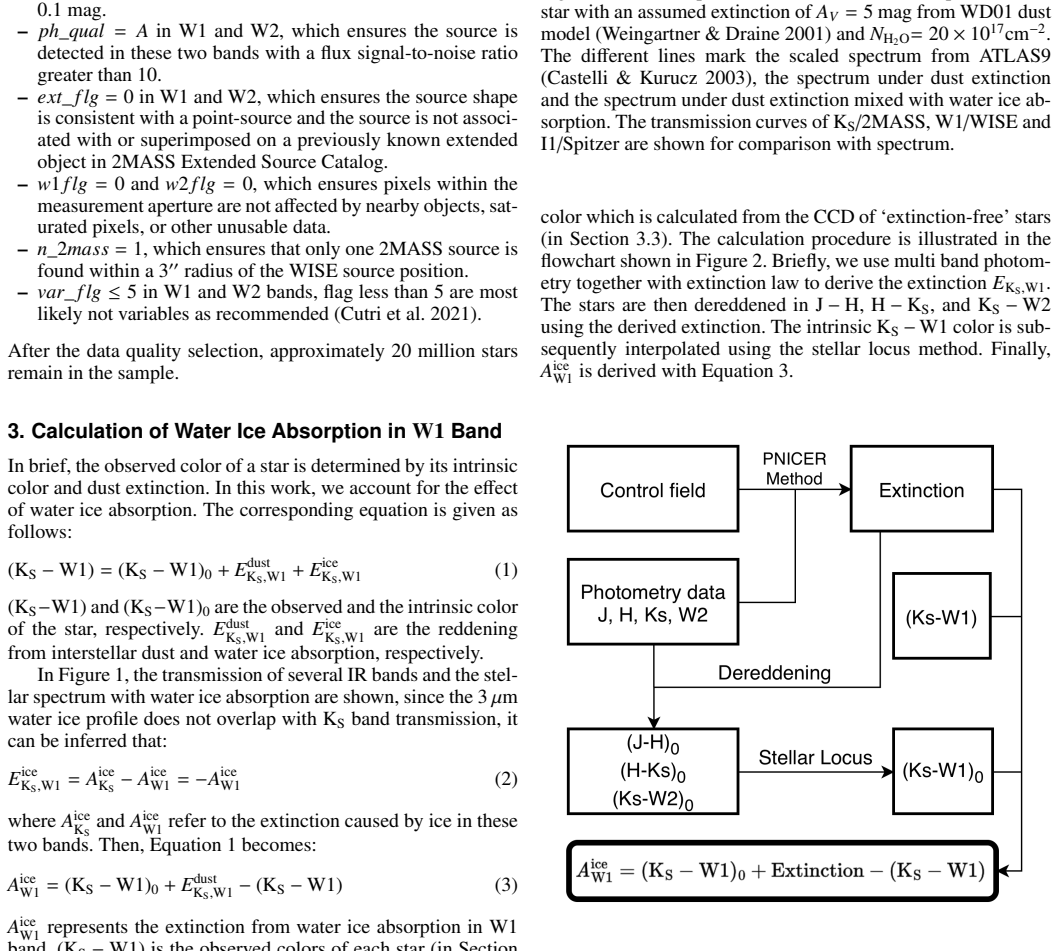
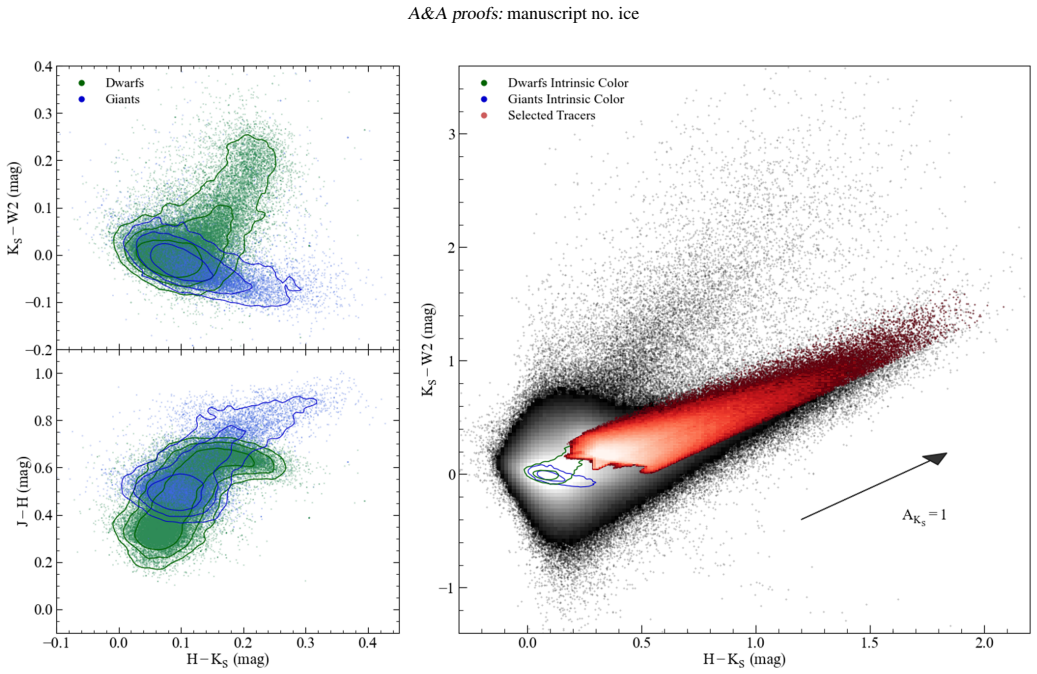
W1-band water ice absorption isolated by correcting observed colors for reddening and intrinsic stellar colors.
If this is right
- Varying input parameters shows the extinction law as the dominant uncertainty in the derived map.
- Synthetic photometry quantifies how physical and observational parameters affect the W1 absorption measurement.
- The established relation links W1 ice absorption directly to water ice optical depth.
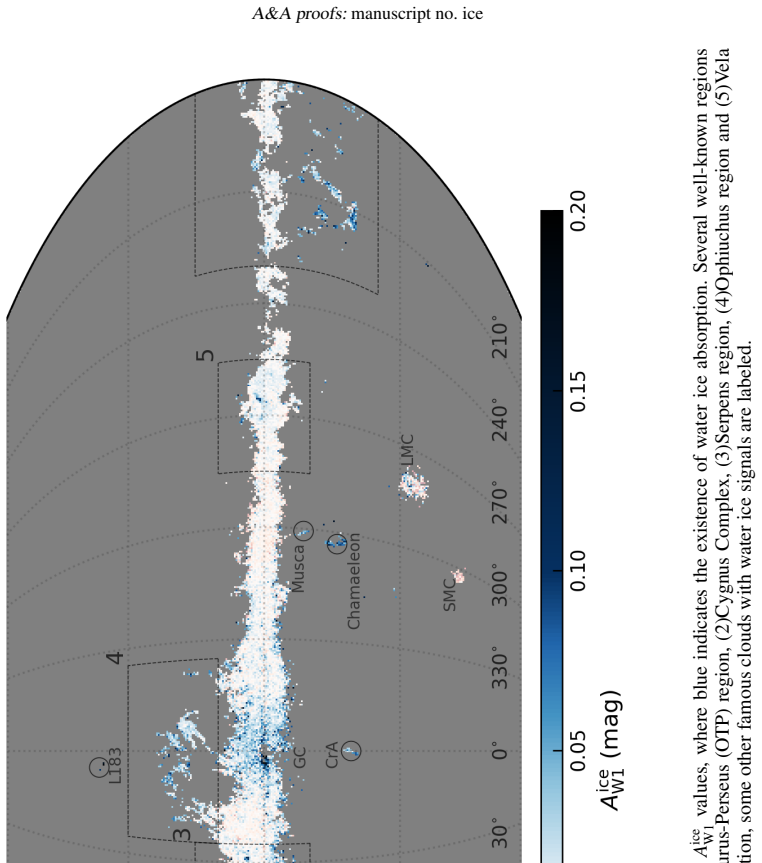
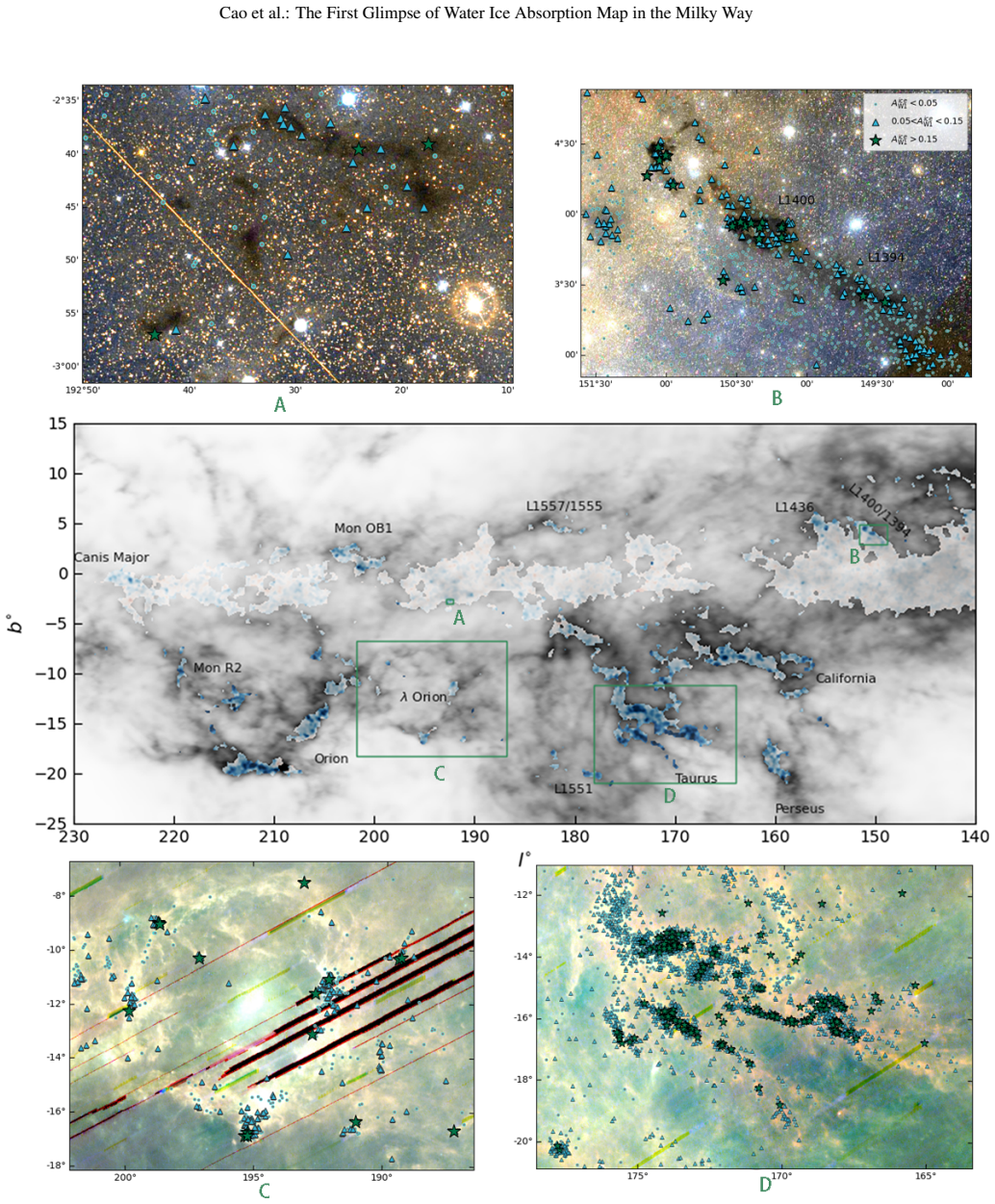
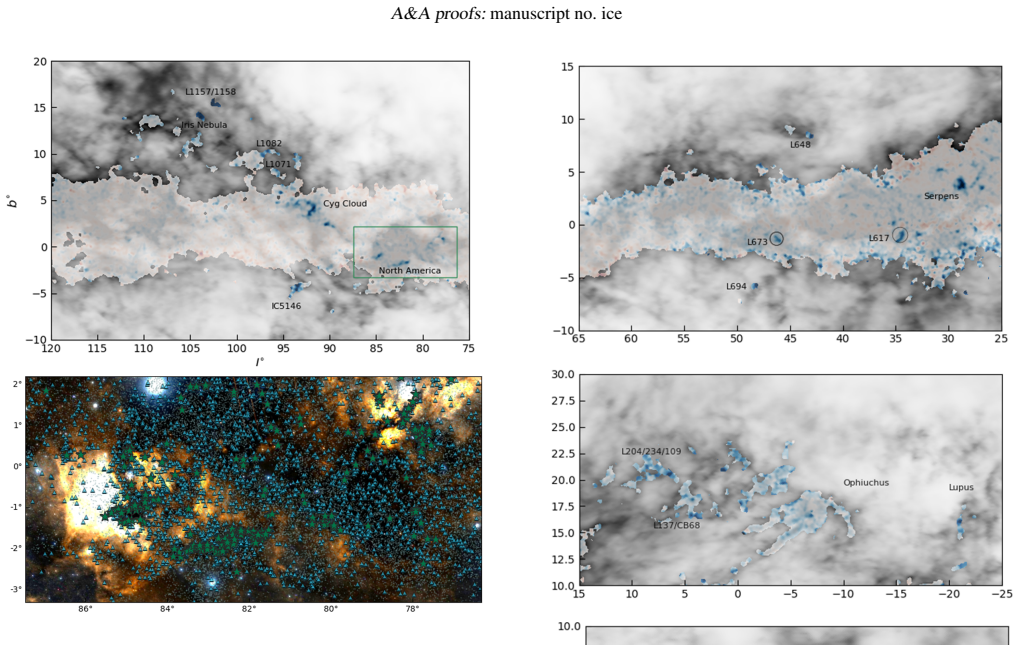
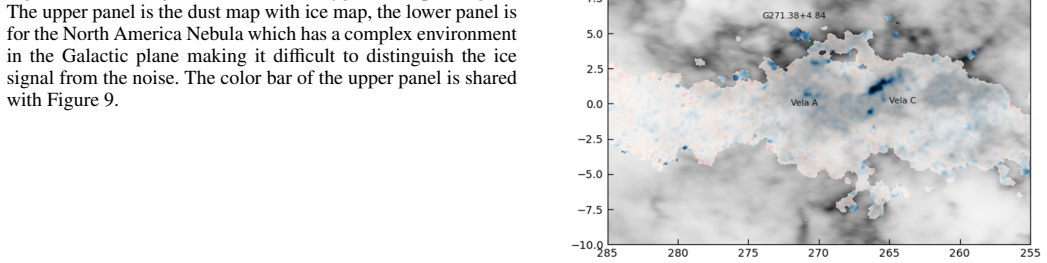
- The preliminary map reveals the large-scale distribution of water ice throughout the Milky Way.
Where Pith is reading between the lines
- The map could be combined with molecular cloud catalogs to test whether ice abundance tracks total gas column density.
- High-absorption regions identified in the map are natural targets for targeted infrared spectroscopy to refine the photometric calibration.
- If the extinction law changes systematically with galactic radius or density, the outer-disk portions of the map would require separate recalibration.
Load-bearing premise
The extinction law used for reddening corrections accurately represents the wavelength-dependent absorption along each line of sight.
What would settle it
Absence of correlation between the photometric W1 ice estimates and independent spectroscopic measurements of 3 μm water ice optical depth across the same sightlines would falsify the origin of the W1 signature.
Figures

read the original abstract
Interstellar ice plays a key role in the thermal evolution of the interstellar medium and in astrochemical pathways, yet its large-scale distribution remains poorly constrained. We use ALLWISE and 2MASS photometry to estimate water ice absorption in the $\Wi$/WISE band by correcting the observed colors for reddening and intrinsic stellar colors. This allows us to construct a first Milky Way water ice map. By varying input parameters, we test the stability of the method and identify the extinction law as the dominant source of uncertainty. Using synthetic photometry, we also quantify how different physical and observational parameters influence the $\Wi$ band water ice absorption. The strong correlation between the measurement from photometric method and spectroscopic water ice abundance confirms that the $\Wi$ band signature originates from the 3 $\mu$m ice feature. We present the relationship between ice absorption in $\Wi$ band and water ice optical depth from theory and observations. Finally, we provide a preliminary Milky Way-scale map of water ice distribution.
Editorial analysis
A structured set of objections, weighed in public.
Referee Report
Summary. The manuscript presents a photometric method using ALLWISE W1 and 2MASS photometry to isolate water ice absorption after correcting observed colors for reddening and intrinsic stellar colors. It constructs the first Milky Way-scale map of water ice, performs stability tests by varying input parameters, identifies the extinction law as the dominant uncertainty, reports a strong correlation between the photometric W1 excess and spectroscopic water ice optical depth to confirm the 3 μm ice feature origin, derives a relationship between W1 absorption and ice optical depth, and provides a preliminary large-scale map.
Significance. If validated, the result would be significant as the first all-sky map of interstellar water ice distribution, enabling new constraints on ISM thermal evolution, astrochemical pathways, and dust properties at Galactic scales. The use of public survey data and the reported spectroscopic correlation are strengths, but the unquantified impact of the extinction law assumption limits the current reliability of the map and correlation claims.
major comments (2)
- [Abstract] Abstract: the extinction law is stated to be the dominant source of uncertainty when input parameters are varied, yet no quantified error propagation, sensitivity analysis on the final map, or independent validation of the adopted law on the same sightlines is described; because the correction is applied line-of-sight by line-of-sight, any spatial mismatch in the law directly aliases into the derived ice map and the reported photometric-spectroscopic correlation.
- [Abstract] Abstract: the claim of a 'strong correlation' between the photometric W1 measurement and spectroscopic water ice abundance is presented as confirmation that the W1 signature originates from the 3 μm feature, but without reported sample size, correlation coefficient, or assessment of how extinction-law variations affect the correlation strength, the validation remains incomplete.
minor comments (1)
- [Abstract] The abstract mentions 'synthetic photometry' to quantify parameter influences but does not specify which physical or observational parameters were varied or how the results are presented (e.g., in a table or figure).
Simulated Author's Rebuttal
We thank the referee for the constructive comments and for recognizing the potential significance of the first all-sky water ice map. We address each major comment below and will revise the manuscript to improve the quantification and transparency of uncertainties.
read point-by-point responses
-
Referee: [Abstract] Abstract: the extinction law is stated to be the dominant source of uncertainty when input parameters are varied, yet no quantified error propagation, sensitivity analysis on the final map, or independent validation of the adopted law on the same sightlines is described; because the correction is applied line-of-sight by line-of-sight, any spatial mismatch in the law directly aliases into the derived ice map and the reported photometric-spectroscopic correlation.
Authors: We agree that the manuscript would benefit from explicit quantification of how extinction-law variations propagate into the final map. While we varied input parameters to identify the extinction law as dominant, we did not include a dedicated sensitivity analysis or error maps for the derived ice distribution. We will add this analysis in revision, including line-of-sight error estimates and discussion of potential spatial mismatches. Independent validation against the adopted law on identical sightlines is not feasible with the current public data sets and will be noted as a limitation. revision: yes
-
Referee: [Abstract] Abstract: the claim of a 'strong correlation' between the photometric W1 measurement and spectroscopic water ice abundance is presented as confirmation that the W1 signature originates from the 3 μm feature, but without reported sample size, correlation coefficient, or assessment of how extinction-law variations affect the correlation strength, the validation remains incomplete.
Authors: The correlation is shown in the body of the paper, but we accept that the abstract and validation section lack the requested statistics and robustness checks. We will report the sample size, Pearson/Spearman coefficient, and p-value, and will add an explicit test of how changes in the extinction law affect the correlation strength. These additions will be included in the revised manuscript. revision: yes
Circularity Check
No significant circularity; map derived from independent photometry and validated externally
full rationale
The derivation uses public ALLWISE/2MASS photometry to estimate W1 excess after applying reddening and intrinsic-color corrections drawn from standard extinction laws and stellar models. The resulting map values are then compared to independent spectroscopic ice optical depths for confirmation. No equation in the provided text defines the ice absorption as a fitted parameter from the same dataset, renames a known result, or reduces the output to a self-citation chain. The extinction law is explicitly treated as an external assumption whose variation affects the map, not as a quantity derived from the map itself. This satisfies the criteria for a self-contained, non-circular construction.
Axiom & Free-Parameter Ledger
free parameters (1)
- extinction law
axioms (1)
- domain assumption Observed colors can be corrected for reddening and intrinsic stellar colors to isolate water ice absorption in the W1 band
Reference graph
Works this paper leans on
-
[1]
VizieR Online Data Catalog , keywords =
VizieR Online Data Catalog: AllWISE Data Release (Cutri+ 2013). VizieR Online Data Catalog , keywords =
2013
-
[2]
The Two Micron All Sky Survey (2MASS). , keywords =. doi:10.1086/498708 , adsurl =
-
[3]
Extinction of Taurus, Orion, Perseus and California Molecular Clouds Based on the LAMOST, 2MASS, and Gaia Surveys. II. The Extinction Law. , keywords =. doi:10.3847/1538-3881/ad813e , archivePrefix =. 2410.02731 , primaryClass =
-
[4]
2022, ApJS, 259, 35, doi: 10.3847/1538-4365/ac4414
The Seventeenth Data Release of the Sloan Digital Sky Surveys: Complete Release of MaNGA, MaStar, and APOGEE-2 Data. , keywords =. doi:10.3847/1538-4365/ac4414 , archivePrefix =. 2112.02026 , primaryClass =
-
[5]
2024, A&A, 685, A82, doi: 10.1051/0004-6361/202347628
A parsec-scale Galactic 3D dust map out to 1.25 kpc from the Sun. , keywords =. doi:10.1051/0004-6361/202347628 , archivePrefix =. 2308.01295 , primaryClass =
-
[6]
VISION - Vienna Survey in Orion. II. Infrared extinction in Orion A. , keywords =. doi:10.1051/0004-6361/201731396 , archivePrefix =. 1803.01004 , primaryClass =
work page internal anchor Pith review Pith/arXiv arXiv doi:10.1051/0004-6361/201731396
-
[7]
Estimating Extinction using Unsupervised Machine Learning
Estimating extinction using unsupervised machine learning. , keywords =. doi:10.1051/0004-6361/201630032 , archivePrefix =. 1702.08456 , primaryClass =
work page internal anchor Pith review Pith/arXiv arXiv doi:10.1051/0004-6361/201630032
-
[8]
Distances to Nearby Molecular Clouds Traced by Young Stars. , keywords =. doi:10.3847/1538-4365/acc1e8 , archivePrefix =. 2303.01053 , primaryClass =
-
[9]
Ice and Dust in the Quiescent Medium of Isolated Dense Cores
Ice and Dust in the Quiescent Medium of Isolated Dense Cores. , keywords =. doi:10.1088/0004-637X/729/2/92 , archivePrefix =. 1101.2486 , primaryClass =
work page internal anchor Pith review Pith/arXiv arXiv doi:10.1088/0004-637x/729/2/92
-
[10]
Ice and Dust in the Prestellar Dark Cloud Lynds 183: Preplanetary Matter at the Lowest Temperatures. , keywords =. doi:10.1088/0004-637X/774/2/102 , adsurl =
-
[11]
Infrared Spectroscopic Survey of the Quiescent Medium of Nearby Clouds. I. Ice Formation and Grain Growth in Lupus. , keywords =. doi:10.1088/0004-637X/777/1/73 , archivePrefix =. 1309.2999 , primaryClass =
work page internal anchor Pith review Pith/arXiv arXiv doi:10.1088/0004-637x/777/1/73
-
[12]
Observations of the Onset of Complex Organic Molecule Formation in Interstellar Ices. , keywords =. doi:10.3847/1538-4357/abbfa5 , archivePrefix =. 2010.05917 , primaryClass =
-
[13]
Infrared Spectroscopic Survey of the Quiescent Medium of Nearby Clouds. II. Ice Formation and Grain Growth in Perseus and Serpens. , keywords =. doi:10.3847/1538-4357/ac617d , archivePrefix =. 2210.12672 , primaryClass =
-
[14]
New Grids of ATLAS9 Model Atmospheres
New Grids of ATLAS9 Model Atmospheres. Modelling of Stellar Atmospheres , year = 2003, editor =. doi:10.48550/arXiv.astro-ph/0405087 , archivePrefix =. astro-ph/0405087 , primaryClass =
work page internal anchor Pith review Pith/arXiv arXiv doi:10.48550/arxiv.astro-ph/0405087 2003
-
[15]
Dust Grain Size Distributions and Extinction in the Milky Way, LMC, and SMC
Dust Grain-Size Distributions and Extinction in the Milky Way, Large Magellanic Cloud, and Small Magellanic Cloud. , keywords =. doi:10.1086/318651 , archivePrefix =. astro-ph/0008146 , primaryClass =
work page internal anchor Pith review Pith/arXiv arXiv doi:10.1086/318651
-
[16]
Extinction of Taurus, Orion, Perseus, and California Molecular Clouds Based on the LAMOST, 2MASS, and Gaia Surveys. I. 3D Extinction and Structure. , keywords =. doi:10.3847/1538-4357/acbbc7 , archivePrefix =. 2302.06306 , primaryClass =
-
[17]
A compendium of distances to molecular clouds in the Star Formation Handbook. , keywords =. doi:10.1051/0004-6361/201936145 , archivePrefix =. 2001.00591 , primaryClass =
-
[18]
Observations of the Icy Universe
Observations of the icy universe. , keywords =. doi:10.1146/annurev-astro-082214-122348 , archivePrefix =. 1501.05317 , primaryClass =
work page internal anchor Pith review Pith/arXiv arXiv doi:10.1146/annurev-astro-082214-122348
-
[19]
An Ice Age JWST inventory of dense molecular cloud ices. Nature Astronomy , keywords =. doi:10.1038/s41550-022-01875-w , archivePrefix =. 2301.09140 , primaryClass =
-
[20]
JWST Observations of Young protoStars (JOYS+): Detecting icy complex organic molecules and ions. I. CH _ 4 , SO _ 2 , HCOO ^ - , OCN ^ - , H _ 2 CO, HCOOH, CH _ 3 CH _ 2 OH, CH _ 3 CHO, CH _ 3 OCHO, and CH _ 3 COOH. , keywords =. doi:10.1051/0004-6361/202348427 , archivePrefix =. 2312.06834 , primaryClass =
-
[21]
, year = 2009, month = sep, volume =
Complex Organic Interstellar Molecules. , year = 2009, month = sep, volume =. doi:10.1146/annurev-astro-082708-101654 , adsurl =
-
[22]
Interstellar Ice: The Infrared Space Observatory Legacy. , keywords =. doi:10.1086/381182 , adsurl =
-
[23]
The Spitzer ice legacy: Ice evolution from cores to protostars
The Spitzer Ice Legacy: Ice Evolution from Cores to Protostars. , keywords =. doi:10.1088/0004-637X/740/2/109 , archivePrefix =. 1107.5825 , primaryClass =
work page internal anchor Pith review Pith/arXiv arXiv doi:10.1088/0004-637x/740/2/109
-
[24]
The c2d Spitzer Spectroscopic Survey of Ices around Low-Mass Young Stellar Objects. I. H _ 2 O and the 5-8 m Bands. , keywords =. doi:10.1086/533425 , archivePrefix =. 0801.1167 , primaryClass =
work page internal anchor Pith review Pith/arXiv arXiv doi:10.1086/533425
-
[25]
JWST Reveals Widespread CO Ice and Gas Absorption in the Galactic Center Cloud G0.253+0.016. , keywords =. doi:10.3847/1538-4357/acfc34 , archivePrefix =. 2308.16050 , primaryClass =
-
[26]
The Composition and Distribution of Dust Along the Line of Sight Towards the Galactic Center
The Composition and Distribution of Dust along the Line of Sight toward the Galactic Center. , keywords =. doi:10.1086/309047 , archivePrefix =. astro-ph/0002421 , primaryClass =
work page internal anchor Pith review Pith/arXiv arXiv doi:10.1086/309047
-
[27]
The Optical to Mid-infrared Extinction Law Based on the APOGEE, Gaia DR2, Pan-STARRS1, SDSS, APASS, 2MASS, and WISE Surveys. , keywords =. doi:10.3847/1538-4357/ab1c61 , archivePrefix =. 1904.04575 , primaryClass =
work page internal anchor Pith review Pith/arXiv arXiv doi:10.3847/1538-4357/ab1c61 1904
-
[28]
Revision of Stellar Intrinsic Colors in the Infrared by the Spectroscopic Surveys
Revision of Stellar Intrinsic Colors in the Infrared by Spectroscopic Surveys. , keywords =. doi:10.3847/1538-3881/153/1/5 , archivePrefix =. 1609.05290 , primaryClass =
work page internal anchor Pith review Pith/arXiv arXiv doi:10.3847/1538-3881/153/1/5
-
[29]
Intrinsic Colors of Stars in the Near-Infrared. , keywords =. doi:10.1086/322439 , adsurl =
-
[30]
The Optical to Infrared 0.6 5.3 m Dust Extinction Law of the Milky Way with JWST NIRSpec: Westerlund 2. , keywords =. doi:10.3847/2041-8213/ad2e98 , archivePrefix =. 2402.17239 , primaryClass =
-
[31]
Mapping water ice with infrared broadband photometry. arXiv e-prints , keywords =. doi:10.48550/arXiv.2507.18688 , archivePrefix =. 2507.18688 , primaryClass =
-
[32]
The Interstellar Oxygen Crisis, or Where Have All the Oxygen Atoms Gone?
The interstellar oxygen crisis, or where have all the oxygen atoms gone?. , keywords =. doi:10.1093/mnras/stv1900 , archivePrefix =. 1508.03404 , primaryClass =
work page internal anchor Pith review Pith/arXiv arXiv doi:10.1093/mnras/stv1900
-
[33]
The Infrared Spectrograph on the Spitzer Space Telescope
The Infrared Spectrograph (IRS) on the Spitzer Space Telescope. , keywords =. doi:10.1086/423134 , archivePrefix =. astro-ph/0406167 , primaryClass =
work page internal anchor Pith review Pith/arXiv arXiv doi:10.1086/423134
-
[34]
The Spitzer Space Telescope Mission
The Spitzer Space Telescope Mission. , keywords =. doi:10.1086/422992 , archivePrefix =. astro-ph/0406223 , primaryClass =
work page internal anchor Pith review Pith/arXiv arXiv doi:10.1086/422992
-
[35]
The UKIRT Infrared Deep Sky Survey (UKIDSS). , keywords =. doi:10.1111/j.1365-2966.2007.12040.x , archivePrefix =. astro-ph/0604426 , primaryClass =
-
[36]
VISIONS: the VISTA Star Formation Atlas. I. Survey overview. , keywords =. doi:10.1051/0004-6361/202245771 , archivePrefix =. 2303.08831 , primaryClass =
-
[37]
VVV DR1: The first data release of the Milky Way bulge and southern plane from the near-infrared ESO public survey VISTA variables in the V \' a L \'a ctea. , keywords =. doi:10.1051/0004-6361/201118407 , archivePrefix =. 1111.5511 , primaryClass =
work page internal anchor Pith review Pith/arXiv arXiv doi:10.1051/0004-6361/201118407
-
[38]
Red Supergiants in M31 and M33. I. The Complete Sample. , keywords =. doi:10.3847/1538-4357/abcda5 , archivePrefix =. 2011.12051 , primaryClass =
-
[39]
JHKLM Photometry: Standard Systems, Passbands, and Intrinsic Colors. , keywords =. doi:10.1086/132281 , adsurl =
-
[40]
Model Atmospheres for M (Sub)Dwarf Stars. I. The Base Model Grid. , keywords =. doi:10.1086/175708 , archivePrefix =. astro-ph/9601150 , primaryClass =
work page internal anchor Pith review Pith/arXiv arXiv doi:10.1086/175708
-
[41]
A three dimensional extinction map of the Galactic Anticentre from multi-band photometry
A three-dimensional extinction map of the Galactic anticentre from multiband photometry. , keywords =. doi:10.1093/mnras/stu1192 , archivePrefix =. 1406.3996 , primaryClass =
work page internal anchor Pith review Pith/arXiv arXiv doi:10.1093/mnras/stu1192
-
[42]
Stellar Loci. V. Photometric Metallicities of 27 Million FGK Stars Based on Gaia Early Data Release 3. , keywords =. doi:10.3847/1538-4365/ac3df6 , archivePrefix =. 2111.11725 , primaryClass =
-
[43]
and Varoquaux, G
Pedregosa, F. and Varoquaux, G. and Gramfort, A. and Michel, V. and Thirion, B. and Grisel, O. and Blondel, M. and Prettenhofer, P. and Weiss, R. and Dubourg, V. and Vanderplas, J. and Passos, A. and Cournapeau, D. and Brucher, M. and Perrot, M. and Duchesnay, E. , journal=. Scikit-learn: Machine Learning in
-
[44]
A Survey of H _ 2 O, CO _ 2 , and CO Ice Features toward Background Stars and low-mass Young Stellar Objects Using AKARI. , keywords =. doi:10.1088/0004-637X/775/2/85 , archivePrefix =. 1307.1527 , primaryClass =
work page internal anchor Pith review Pith/arXiv arXiv doi:10.1088/0004-637x/775/2/85
-
[45]
VLT-ISAAC 3-5 m spectroscopy of embedded young low-mass stars. III. Intermediate-mass sources in Vela. , keywords =. doi:10.1051/0004-6361:20052931 , archivePrefix =. astro-ph/0512186 , primaryClass =
work page internal anchor Pith review Pith/arXiv arXiv doi:10.1051/0004-6361:20052931
-
[46]
Mid- and Far-Infrared Spectroscopy of Ices: Optical Constants and Integrated Absorbances. , keywords =. doi:10.1086/191796 , adsurl =
-
[47]
doi:10.5281/zenodo.3971036 , version =
synphot. doi:10.5281/zenodo.3971036 , version =
-
[48]
Extinction, the elephant in the room that hinders optical Galactic observations. arXiv e-prints , keywords =. doi:10.48550/arXiv.2401.01116 , archivePrefix =. 2401.01116 , primaryClass =
-
[49]
A global NIR analysis with 2MASS photometry
Galactic extinction laws - I. A global NIR analysis with 2MASS photometry. , keywords =. doi:10.1093/mnras/staa1790 , archivePrefix =. 2006.09206 , primaryClass =
-
[50]
The empirical Gaia G-band extinction coefficient
The empirical Gaia G-band extinction coefficient. , keywords =. doi:10.1051/0004-6361/201732327 , archivePrefix =. 1802.01670 , primaryClass =
work page internal anchor Pith review Pith/arXiv arXiv doi:10.1051/0004-6361/201732327
-
[51]
A Large Catalog of Accurate Distances to Local Molecular Clouds: The Gaia DR2 Edition
A Large Catalog of Accurate Distances to Local Molecular Clouds: The Gaia DR2 Edition. , keywords =. doi:10.3847/1538-4357/ab2388 , archivePrefix =. 1902.01425 , primaryClass =
work page internal anchor Pith review Pith/arXiv arXiv doi:10.3847/1538-4357/ab2388 1902
-
[52]
Ices in the Quiescent IC 5146 Dense Cloud
Ices in the Quiescent IC 5146 Dense Cloud. , keywords =. doi:10.1088/0004-637X/731/1/9 , archivePrefix =. 1102.2488 , primaryClass =
work page internal anchor Pith review Pith/arXiv arXiv doi:10.1088/0004-637x/731/1/9
-
[53]
A reference tool for identification of astronomical sources
The ALADIN interactive sky atlas. A reference tool for identification of astronomical sources. , keywords =. doi:10.1051/aas:2000331 , adsurl =
-
[54]
The Far-Infrared Surveyor (FIS) for AKARI
The Far-Infrared Surveyor (FIS) for AKARI. , keywords =. doi:10.1093/pasj/59.sp2.S389 , archivePrefix =. 0708.3004 , primaryClass =
work page internal anchor Pith review Pith/arXiv arXiv doi:10.1093/pasj/59.sp2.s389
-
[55]
The Colors of Ices: Measuring ice column density through photometry
The Colors of Ices: Measuring ice column density through photometry. arXiv e-prints , keywords =. doi:10.48550/arXiv.2510.00292 , archivePrefix =. 2510.00292 , primaryClass =
work page internal anchor Pith review Pith/arXiv arXiv doi:10.48550/arxiv.2510.00292
-
[56]
2MASS wide field extinction maps. IV. The Orion, Monoceros R2, Rosette, and Canis Major star forming regions. , keywords =. doi:10.1051/0004-6361/201116915 , archivePrefix =. 1107.5096 , primaryClass =
work page internal anchor Pith review Pith/arXiv arXiv doi:10.1051/0004-6361/201116915
-
[57]
The Infrared Extinction Law in the Ophiuchus Molecular Cloud Based on the UKIDSS and Spitzer c2d Surveys. Universe , keywords =. doi:10.3390/universe9080364 , archivePrefix =. 2308.00488 , primaryClass =
-
[58]
Observational 5-20 m Interstellar Extinction Curves Toward Star-Forming Regions Derived From Spitzer IRS Spectra. ApJ , keywords =. doi:10.1088/0004-637X/693/2/L81 , archivePrefix =. 0810.4561 , primaryClass =
work page internal anchor Pith review Pith/arXiv arXiv doi:10.1088/0004-637x/693/2/l81
-
[59]
Lifting the Dusty Veil with Near- and Mid-Infrared Photometry. II. A Large-Scale Study of the Galactic Infrared Extinction Law. ApJ , keywords =. doi:10.1088/0004-637X/707/1/510 , archivePrefix =. 0910.4403 , primaryClass =
work page internal anchor Pith review Pith/arXiv arXiv doi:10.1088/0004-637x/707/1/510
discussion (0)
Sign in with ORCID, Apple, or X to comment. Anyone can read and Pith papers without signing in.