Deep Optical Follow-up Observations to IceCube Cosmic Neutrinos: a case for IC230724A with Subaru/HSC and prospects with Rubin/LSST
Pith reviewed 2026-06-28 16:38 UTC · model grok-4.3
The pith
Deep Subaru imaging of IceCube neutrino IC230724A found no tidal disruption event after blind analysis of backgrounds and selection rates.
A machine-rendered reading of the paper's core claim, the machinery that carries it, and where it could break.
Core claim
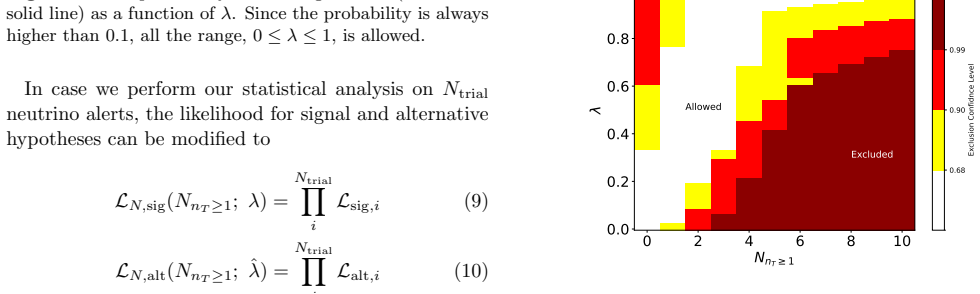
No tidal disruption event candidate was found in the localization region of IceCube event IC230724A after Subaru/HSC deep imaging and a blind analysis that evaluated background rates and true-positive rates. Rubin/LSST coverage of ten neutrino error regions would constrain the TDE contribution to the high-energy neutrino background to either ≲60 percent in the case of non-detections or ≳30 percent in the case of detections.
What carries the argument
Blind analysis of optical transients inside neutrino error regions, using measured background rates and true-positive efficiencies to test for tidal disruption events.
If this is right
- The neutrino IC230724A is unlikely to have been produced by a tidal disruption event.
- Non-detection of TDEs in ten Rubin/LSST-covered neutrino regions would imply that TDEs account for at most 60 percent of the cosmic high-energy neutrino background.
- Detection of TDEs in a comparable sample would imply that TDEs account for at least 30 percent of the background.
- The statistical constraint arises directly from accumulating multiple well-localized alerts rather than from any single event.
Where Pith is reading between the lines
- The same follow-up approach could be applied to other candidate source classes once their expected optical signatures are modeled.
- If TDEs are ultimately shown to be sub-dominant, the remaining neutrino flux would have to be supplied by a different population whose optical counterparts can be searched with the same wide-field strategy.
- Coordinated scheduling between neutrino alerts and Rubin/LSST visits would tighten the fractional bounds faster than the ten-event baseline examined here.
Load-bearing premise
Any tidal disruption event inside the observed field and brighter than the magnitude limit would have been detected and correctly classified by the analysis.
What would settle it
Discovery of an optical transient whose light curve and spectrum match a tidal disruption event inside the IC230724A error region near the neutrino arrival time.
Figures


read the original abstract
IceCube has been detecting cosmic high-energy neutrinos for more than 10 years, but their major sources are still under debate. To identify them, IceCube is issuing neutrino alerts, which enable us to perform electromagnetic follow-up observations. In this paper, we present our Subaru/HSC deep optical follow-up observations down to 25.5 mag to a well-localized neutrino event, IceCube 230724A. We conduct a dedicated analysis with extensive evaluation of background rates and true positive rates adopting the blind analysis policy to identify or disfavor tidal disruption events (TDEs) as cosmic neutrino sources. Our analysis found no TDE candidate in the region of interest. Rubin/LSST survey will enable us to constrain their fractional contribution to the cosmic high-energy neutrino background, either $\lesssim 60\%$ or $\gtrsim30\%$ for non-detection and detection, respectively, if Rubin covers the error regions of 10 neutrino events.
Editorial analysis
A structured set of objections, weighed in public.
Referee Report
Summary. The manuscript reports Subaru/HSC deep optical follow-up observations to 25.5 mag of the well-localized IceCube neutrino alert IC230724A. A dedicated blind analysis with background rate and true-positive rate evaluations finds no TDE candidates in the region of interest. It further forecasts that Rubin/LSST coverage of error regions for 10 neutrino events would constrain the TDE fractional contribution to the cosmic high-energy neutrino background at the level of ≲60% (non-detection) or ≳30% (detection).
Significance. If the localization completeness and background/efficiency modeling assumptions hold, the non-detection adds a data point to the sample of neutrino follow-ups lacking electromagnetic counterparts, while the LSST projection supplies a concrete, falsifiable statistical test for the TDE hypothesis at the population level. The adoption of a blind analysis policy is a methodological strength that enhances credibility.
major comments (1)
- [Abstract (methods description)] The non-detection result and the Rubin/LSST fractional-contribution bounds (≲60% or ≳30% after 10 events) both require that the reported neutrino localization error region is complete for any TDE detectable at 25.5 mag and that the blind-analysis background and true-positive rate evaluations correctly capture all contaminants and selection effects. The abstract states that extensive background/true-positive evaluations were performed, but without the quantitative details, validation tests, or efficiency curves, it is not possible to assess whether this load-bearing assumption holds; failure of either the localization or the rate modeling would render the constraint and forecast invalid.
Simulated Author's Rebuttal
We thank the referee for the positive assessment of our work and for highlighting the importance of the localization completeness and rate-modeling assumptions. We address the single major comment below.
read point-by-point responses
-
Referee: [Abstract (methods description)] The non-detection result and the Rubin/LSST fractional-contribution bounds (≲60% or ≳30% after 10 events) both require that the reported neutrino localization error region is complete for any TDE detectable at 25.5 mag and that the blind-analysis background and true-positive rate evaluations correctly capture all contaminants and selection effects. The abstract states that extensive background/true-positive evaluations were performed, but without the quantitative details, validation tests, or efficiency curves, it is not possible to assess whether this load-bearing assumption holds; failure of either the localization or the rate modeling would render the constraint and forecast invalid.
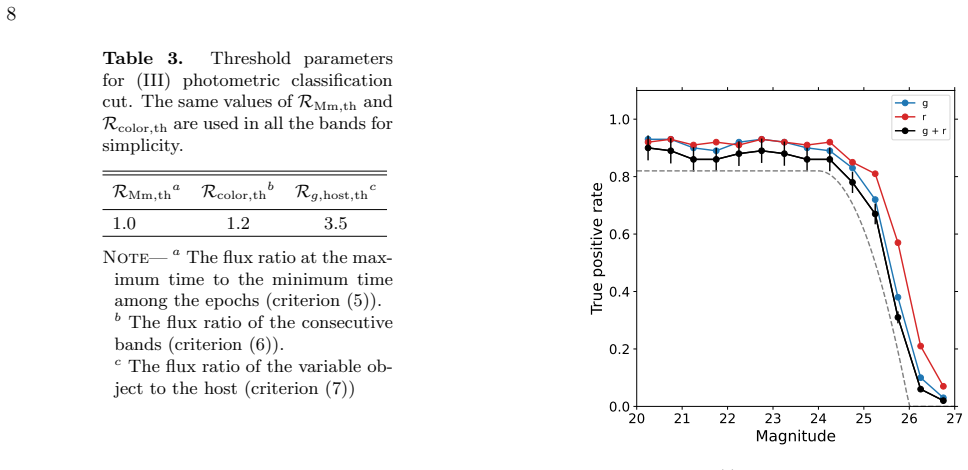
Authors: We agree that the validity of both the non-detection and the LSST forecast rests on localization completeness for TDEs to 25.5 mag and on the fidelity of the blind-analysis background and efficiency modeling. These elements are quantified in the full manuscript (background rates and contaminants in Section 3, true-positive rate and validation tests in Section 4, efficiency curves and selection effects in Section 5, and localization completeness assessment in Section 2). The abstract is intentionally concise, but we will revise it to include a brief clause referencing the key quantitative validations and efficiency results so that readers can more readily evaluate the load-bearing assumptions without first consulting the body text. revision: yes
Circularity Check
No circularity: direct observational non-detection and scaled projections
full rationale
The paper reports a blind-analysis search for TDEs in the error region of IC230724A using Subaru/HSC data down to 25.5 mag, states that no candidates were found, and scales the non-detection to forecast Rubin/LSST constraints on the TDE fraction after 10 events. These steps are empirical outcomes and straightforward extrapolation; they contain no fitted parameters renamed as predictions, no self-definitional relations, and no load-bearing self-citations that reduce the central claims to prior author work. The localization-completeness and background-rate assumptions are external to the derivation and do not create internal circularity.
Axiom & Free-Parameter Ledger
Reference graph
Works this paper leans on
-
[1]
Neutrinos from Gamma-Ray Bursts. The Encyclopedia of Cosmology. Set 2: Frontiers in Cosmology. Volume 2: Neutrino Physics and Astrophysics , year = 2023, editor =. doi:10.1142/9789811282645_0009 , adsurl =
-
[2]
High-Energy Neutrinos from Active Galactic Nuclei. The Encyclopedia of Cosmology. Set 2: Frontiers in Cosmology. Volume 2: Neutrino Physics and Astrophysics , year = 2023, editor =. doi:10.1142/9789811282645_0010 , adsurl =
-
[3]
IceCube and High-Energy Cosmic Neutrinos. The Encyclopedia of Cosmology. Set 2: Frontiers in Cosmology. Volume 2: Neutrino Physics and Astrophysics , year = 2023, editor =. doi:10.1142/9789811282645_0005 , adsurl =
-
[4]
Two Candidate Obscured Tidal Disruption Events Coincident with High-energy Neutrinos. , keywords =. doi:10.3847/2041-8213/acebe3 , archivePrefix =. 2307.16667 , primaryClass =
-
[5]
AT2021lwx: Another Neutrino-coincident Tidal Disruption Event with a Strong Dust Echo?. , keywords =. doi:10.3847/1538-4357/ad50a9 , archivePrefix =. 2401.09320 , primaryClass =
-
[6]
Annual Review of Nuclear and Particle Science , year = 2005, month = dec, volume =
Blind Analysis in Nuclear and Particle Physics. Annual Review of Nuclear and Particle Science , year = 2005, month = dec, volume =. doi:10.1146/annurev.nucl.55.090704.151521 , adsurl =
-
[7]
SNCosmo: Python library for supernova cosmology
-
[8]
Optimization of the Observing Cadence for the Rubin Observatory Legacy Survey of Space and Time: A Pioneering Process of Community-focused Experimental Design. , keywords =. doi:10.3847/1538-4365/ac3e72 , archivePrefix =. 2108.01683 , primaryClass =
-
[9]
Investigating the Correlation between ZTF Tidal Disruption Events and IceCube High-energy Neutrinos. , keywords =. doi:10.3847/1538-4357/adef54 , adsurl =
-
[10]
The Hyper Suprime-Cam Software Pipeline
The Hyper Suprime-Cam software pipeline. , keywords =. doi:10.1093/pasj/psx080 , archivePrefix =. 1705.06766 , primaryClass =
work page internal anchor Pith review Pith/arXiv arXiv doi:10.1093/pasj/psx080
-
[11]
Hyper Suprime-Cam: System design and verification of image quality. , keywords =. doi:10.1093/pasj/psx063 , adsurl =
-
[12]
A photometric classifier for tidal disruption events in Rubin LSST. , keywords =. doi:10.1051/0004-6361/202556839 , archivePrefix =. 2509.25902 , primaryClass =
-
[13]
tdescore: An Accurate Photometric Classifier for Tidal Disruption Events. , keywords =. doi:10.3847/2041-8213/ad3337 , archivePrefix =. 2312.00139 , primaryClass =
-
[14]
Establishing accretion flares from supermassive black holes as a source of high-energy neutrinos. , keywords =. doi:10.1093/mnras/stae610 , archivePrefix =. 2111.09391 , primaryClass =
-
[15]
LSST: from Science Drivers to Reference Design and Anticipated Data Products
LSST: From Science Drivers to Reference Design and Anticipated Data Products. , keywords =. doi:10.3847/1538-4357/ab042c , archivePrefix =. 0805.2366 , primaryClass =
work page internal anchor Pith review Pith/arXiv arXiv doi:10.3847/1538-4357/ab042c
-
[16]
The Detection of a Type IIn Supernova in Optical Follow-up Observations of IceCube Neutrino Events. , keywords =. doi:10.1088/0004-637X/811/1/52 , archivePrefix =. 1506.03115 , primaryClass =
-
[17]
A Family Tree of Optical Transients from Narrow-line Seyfert 1 Galaxies. , keywords =. doi:10.3847/1538-4357/ac110f , archivePrefix =. 2010.08554 , primaryClass =
-
[18]
New class of high-energy transients from crashes of supernova ejecta with massive circumstellar material shells. , keywords =. doi:10.1103/PhysRevD.84.043003 , archivePrefix =. 1012.2834 , primaryClass =
work page internal anchor Pith review Pith/arXiv arXiv doi:10.1103/physrevd.84.043003
-
[19]
Testing the Newborn Pulsar Origin of Ultrahigh Energy Cosmic Rays with EeV Neutrinos
Testing the newborn pulsar origin of ultrahigh energy cosmic rays with EeV neutrinos. , keywords =. doi:10.1103/PhysRevD.90.103005 , archivePrefix =. 1311.2044 , primaryClass =
work page internal anchor Pith review Pith/arXiv arXiv doi:10.1103/physrevd.90.103005 2044
-
[20]
Point-source and diffuse high-energy neutrino emission from Type IIn supernovae
Point-source and diffuse high-energy neutrino emission from Type IIn supernovae. , keywords =. doi:10.1093/mnras/stx1251 , archivePrefix =. 1705.06752 , primaryClass =
work page internal anchor Pith review Pith/arXiv arXiv doi:10.1093/mnras/stx1251
-
[21]
Interpretation of the Observed Neutrino Emission from Three Tidal Disruption Events. , keywords =. doi:10.3847/1538-4357/acbe9e , archivePrefix =. 2205.11538 , primaryClass =
-
[22]
Could TDE outflows produce the PeV neutrino events?. , keywords =. doi:10.1093/mnras/stac1621 , archivePrefix =. 2112.01748 , primaryClass =
-
[23]
Prime Focus Spectrograph (PFS) for the Subaru telescope: overview, recent progress, and future perspectives. Ground-based and Airborne Instrumentation for Astronomy VI , year = 2016, editor =. doi:10.1117/12.2232103 , archivePrefix =. 1608.01075 , primaryClass =
work page internal anchor Pith review Pith/arXiv arXiv doi:10.1117/12.2232103 2016
-
[24]
European Physical Journal C , keywords =
Astronomy potential of KM3NeT/ARCA. European Physical Journal C , keywords =. doi:10.1140/epjc/s10052-024-13137-2 , archivePrefix =. 2402.08363 , primaryClass =
-
[25]
The Pacific Ocean Neutrino Experiment. Nature Astronomy , keywords =. doi:10.1038/s41550-020-1182-4 , archivePrefix =. 2005.09493 , primaryClass =
-
[26]
Nature Astronomy , year = 2023, month = dec, volume =
A multi-cubic-kilometre neutrino telescope in the western Pacific Ocean. Nature Astronomy , year = 2023, month = dec, volume =. doi:10.1038/s41550-023-02087-6 , adsurl =
-
[27]
Search for Neutrino Doublets and Triplets Using 11.4 yr of IceCube Data. , keywords =. doi:10.3847/1538-4357/adb312 , archivePrefix =. 2501.09276 , primaryClass =
-
[28]
A DECam Search for Explosive Optical Transients Associated with IceCube Neutrino Alerts. , keywords =. doi:10.3847/1538-4357/ab3a45 , archivePrefix =. 1907.07193 , primaryClass =
-
[29]
Search for transient optical counterparts to high-energy IceCube neutrinos with Pan-STARRS1. , keywords =. doi:10.1051/0004-6361/201935171 , archivePrefix =. 1901.11080 , primaryClass =
-
[31]
A tidal disruption event coincident with a high-energy neutrino. Nature Astronomy , keywords =. doi:10.1038/s41550-020-01295-8 , archivePrefix =. 2005.05340 , primaryClass =
-
[32]
Candidate Tidal Disruption Event AT2019fdr Coincident with a High-Energy Neutrino. , keywords =. doi:10.1103/PhysRevLett.128.221101 , archivePrefix =. 2111.09390 , primaryClass =
-
[33]
Neutrino follow-up with the Zwicky transient facility: results from the first 24 campaigns. , keywords =. doi:10.1093/mnras/stad767 , archivePrefix =. 2203.17135 , primaryClass =
-
[34]
ASAS-SN follow-up of IceCube high-energy neutrino alerts. , keywords =. doi:10.1093/mnras/stac2261 , archivePrefix =. 2204.00500 , primaryClass =
-
[35]
The Type IIn SN 2025cbj coincidence with the high-energy neutrino IceCube-250421A
The Type IIn SN 2025cbj coincidence with the high-energy neutrino IceCube-250421A. , keywords =. doi:10.1051/0004-6361/202558356 , archivePrefix =. 2512.07936 , primaryClass =
work page internal anchor Pith review Pith/arXiv arXiv doi:10.1051/0004-6361/202558356
-
[36]
The First Search for Optical Transient as a Counterpart of a Month-timescale IceCube Neutrino Multiplet Event. , keywords =. doi:10.3847/1538-4357/adfedf , archivePrefix =. 2504.04741 , primaryClass =
-
[37]
The Final Season Reimagined: 30 Tidal Disruption Events from the ZTF-I Survey. , keywords =. doi:10.3847/1538-4357/aca283 , archivePrefix =. 2203.01461 , primaryClass =
-
[38]
Galaxy Luminosity Functions to z~1: DEEP2 vs. COMBO-17 and Implications for Red Galaxy Formation
Galaxy Luminosity Functions to z -0.5ex 1 from DEEP2 and COMBO-17: Implications for Red Galaxy Formation. , keywords =. doi:10.1086/519294 , archivePrefix =. astro-ph/0506044 , primaryClass =
work page internal anchor Pith review Pith/arXiv arXiv doi:10.1086/519294
-
[39]
Spectral Energy Distributions of Hard X-ray selected AGNs in the XMDS Survey
Spectral Energy Distributions of Hard X-Ray Selected Active Galactic Nuclei in the XMM-Newton Medium Deep Survey. , keywords =. doi:10.1086/518113 , archivePrefix =. astro-ph/0703255 , primaryClass =
work page internal anchor Pith review Pith/arXiv arXiv doi:10.1086/518113
-
[40]
Flaires: A comprehensive catalog of dust echo-like infrared flares. , keywords =. doi:10.1051/0004-6361/202451340 , archivePrefix =. 2407.01039 , primaryClass =
-
[41]
34 The 10-15 GHz radio continuum survey of the GP with SKAO A
Gaia Data Release 3. All-sky classification of 12.4 million variable sources into 25 classes. , keywords =. doi:10.1051/0004-6361/202245591 , archivePrefix =. 2211.17238 , primaryClass =
-
[42]
A Unified Approach to the Classical Statistical Analysis of Small Signals
Unified approach to the classical statistical analysis of small signals. , keywords =. doi:10.1103/PhysRevD.57.3873 , archivePrefix =. physics/9711021 , primaryClass =
work page internal anchor Pith review Pith/arXiv arXiv doi:10.1103/physrevd.57.3873
-
[43]
Tidal Disruption Event Demographics with the Zwicky Transient Facility: Volumetric Rates, Luminosity Function, and Implications for the Local Black Hole Mass Function. , keywords =. doi:10.3847/2041-8213/acf216 , archivePrefix =. 2303.06523 , primaryClass =
-
[44]
Identifying High-energy Neutrino Transients by Neutrino Multiplet-triggered Follow-ups. , keywords =. doi:10.3847/1538-4357/ac8dfd , archivePrefix =. 2206.13719 , primaryClass =
-
[45]
Extra-galactic high-energy transients: event rate densities and luminosity functions
Extragalactic High-energy Transients: Event Rate Densities and Luminosity Functions. , keywords =. doi:10.1088/0004-637X/812/1/33 , archivePrefix =. 1509.01592 , primaryClass =
work page internal anchor Pith review Pith/arXiv arXiv doi:10.1088/0004-637x/812/1/33
-
[46]
The Astropy Project: Building an inclusive, open-science project and status of the v2.0 core package
The Astropy Project: Building an Open-science Project and Status of the v2.0 Core Package. , keywords =. doi:10.3847/1538-3881/aabc4f , archivePrefix =. 1801.02634 , primaryClass =
work page internal anchor Pith review Pith/arXiv arXiv doi:10.3847/1538-3881/aabc4f
-
[47]
Astropy: A Community Python Package for Astronomy
Astropy: A community Python package for astronomy. , keywords =. 2013. doi:10.1051/0004-6361/201322068 , archivePrefix =. 1307.6212 , primaryClass =
work page internal anchor Pith review Pith/arXiv arXiv doi:10.1051/0004-6361/201322068 2013
-
[48]
1996, A&AS, 117, 393, doi: 10.1051/aas:1996164
SExtractor: Software for source extraction. , keywords =. 1996. doi:10.1051/aas:1996164 , adsurl =
-
[49]
Quantifying the Observational Effort Required for the Radial Velocity Characterization of TESS Planets. , keywords =. 2018. doi:10.3847/1538-3881/aacea9 , archivePrefix =. 1807.01263 , primaryClass =
work page internal anchor Pith review Pith/arXiv arXiv doi:10.3847/1538-3881/aacea9 2018
-
[50]
X-Ray Scattering Echoes and Ghost Halos from the Intergalactic Medium: Relation to the Nature of AGN Variability. , keywords =. 2015. doi:10.1088/0004-637X/805/1/23 , archivePrefix =. 1503.01475 , primaryClass =
work page internal anchor Pith review Pith/arXiv arXiv doi:10.1088/0004-637x/805/1/23 2015
-
[51]
, keywords =
The 2013 Release of Cloudy. , keywords =. 2013
2013
-
[52]
1989", month =
T _ E X and LAT _ E X Macro Definition Files for Astronomical Publications. , year = "1989", month = "Mar", pages =
1989
-
[53]
LaTeX: A Document Preparation System. 1994
1994
-
[54]
Quasi-periodic Fast Propagating Magnetoacoustic Waves during the Magnetic Reconnection Between Solar Coronal Loops. , keywords =. 2018. doi:10.3847/2041-8213/aaf167 , archivePrefix =. 1811.08553 , primaryClass =
work page internal anchor Pith review Pith/arXiv arXiv doi:10.3847/2041-8213/aaf167 2018
-
[55]
Nominal values for selected solar and planetary quantities: IAU 2015 Resolution B3
Nominal Values for Selected Solar and Planetary Quantities: IAU 2015 Resolution B3. , keywords =. 2016. doi:10.3847/0004-6256/152/2/41 , archivePrefix =. 1605.09788 , primaryClass =
work page internal anchor Pith review Pith/arXiv arXiv doi:10.3847/0004-6256/152/2/41 2015
-
[56]
Swift X-Ray Observations of Classical Novae. II. The Super Soft Source Sample. , keywords =. 2011. doi:10.1088/0067-0049/197/2/31 , archivePrefix =. 1110.6224 , primaryClass =
work page internal anchor Pith review Pith/arXiv arXiv doi:10.1088/0067-0049/197/2/31 2011
-
[57]
Galaxy emission line classification using 3D line ratio diagrams
Galaxy Emission Line Classification Using Three-dimensional Line Ratio Diagrams. , keywords =. 2014. doi:10.1088/0004-637X/793/2/127 , archivePrefix =. 1406.5186 , primaryClass =
work page internal anchor Pith review Pith/arXiv arXiv doi:10.1088/0004-637x/793/2/127 2014
-
[58]
The Hyper Suprime-Cam SSP Survey: Overview and Survey Design
The Hyper Suprime-Cam SSP Survey: Overview and survey design. , keywords =. doi:10.1093/pasj/psx066 , archivePrefix =. 1704.05858 , primaryClass =
work page internal anchor Pith review Pith/arXiv arXiv doi:10.1093/pasj/psx066
-
[59]
Society of Photo-Optical Instrumentation Engineers (SPIE) Conference Series , year = 2006, series =
HyperSuprime: project overview. Society of Photo-Optical Instrumentation Engineers (SPIE) Conference Series , year = 2006, series =. doi:10.1117/12.672739 , adsurl =
-
[60]
GRB Coordinates Network , year = 2023, month = jul, volume =
IceCube-230724A - IceCube observation of a high-energy neutrino candidate track-like event. GRB Coordinates Network , year = 2023, month = jul, volume =
2023
-
[61]
Serbian Astronomical Journal , keywords =
Large Synoptic Survey Telescope: From Science Drivers To Reference Design. Serbian Astronomical Journal , keywords =. doi:10.2298/SAJ0876001I , adsurl =
-
[62]
Software and Cyberinfrastructure for Astronomy , year = 2010, editor =
An open source application framework for astronomical imaging pipelines. Software and Cyberinfrastructure for Astronomy , year = 2010, editor =. doi:10.1117/12.857297 , adsurl =
-
[63]
The Pan-STARRS1 Surveys. arXiv e-prints , keywords =. doi:10.48550/arXiv.1612.05560 , archivePrefix =. 1612.05560 , primaryClass =
work page internal anchor Pith review Pith/arXiv arXiv doi:10.48550/arxiv.1612.05560
-
[64]
A Method for Optimal Image Subtraction. , eprint =. doi:10.1086/305984 , adsurl =
-
[65]
Image subtraction using a space-varying kernel. , keywords =. doi:10.1051/aas:2000214 , adsurl =
-
[66]
Optical follow-up observation for GW event S190510g using Subaru/Hyper Suprime-Cam. , keywords =. doi:10.1093/pasj/psab002 , archivePrefix =. 2101.00800 , primaryClass =
-
[67]
Follow-up Survey for the Binary Black Hole Merger GW200224\_222234 Using Subaru/HSC and GTC/OSIRIS. , keywords =. doi:10.3847/1538-4357/acbd42 , archivePrefix =. 2302.09269 , primaryClass =
-
[68]
Evidence for neutrino emission from the nearby active galaxy NGC 1068 , volume=
Evidence for neutrino emission from the nearby active galaxy NGC 1068. Science , keywords =. doi:10.1126/science.abg3395 , archivePrefix =. 2211.09972 , primaryClass =
-
[69]
Multimessenger observations of a flaring blazar coincident with high-energy neutrino IceCube-170922A
IceCube-Collaboration and Fermi-LAT and MAGIC and AGILE and ASAS-SN and HAWC and H.E.S.S and INTEGRAL and Kanata and Kiso and Kapteyn and Liverpool Telescope and Subaru and Swift/NuSTAR and VERITAS and VLA/17B-403 teams and others. Multimessenger observations of a flaring blazar coincident with high-energy neutrino IceCube-170922A. Science. 2018. arXiv:1807.08816
arXiv 2018
-
[70]
Neutrino emission from the direction of the blazar TXS 0506+056 prior to the IceCube-170922A alert
IceCube-Collaboration. Neutrino emission from the direction of the blazar TXS 0506+056 prior to the IceCube-170922A alert. Science. 2018. arXiv:1807.08794
Pith/arXiv arXiv 2018
-
[71]
Physical Review Letters , archivePrefix = "arXiv", eprint =
First Observation of PeV-Energy Neutrinos with IceCube. Physical Review Letters , archivePrefix = "arXiv", eprint =. doi:10.1103/PhysRevLett.111.021103 , adsurl =
-
[72]
Planck 2013 results. XVI. Cosmological parameters. , keywords =. doi:10.1051/0004-6361/201321591 , archivePrefix =. 1303.5076 , primaryClass =
work page internal anchor Pith review Pith/arXiv arXiv doi:10.1051/0004-6361/201321591 2013
-
[73]
Observation of high-energy neutrinos from the Galactic plane. Science , keywords =. doi:10.1126/science.adc9818 , archivePrefix =. 2307.04427 , primaryClass =
-
[74]
Evidence for High-Energy Extraterrestrial Neutrinos at the IceCube Detector , volume=
Evidence for High-Energy Extraterrestrial Neutrinos at the IceCube Detector. Science , archivePrefix = "arXiv", eprint =. doi:10.1126/science.1242856 , adsurl =
-
[75]
High-Energy Neutrino and Gamma-Ray Emission from Tidal Disruption Events.Astrophys
Murase, Kohta and Kimura, Shigeo S. and Zhang, B. Theodore and Oikonomou, Foteini and Petropoulou, Maria. High-Energy Neutrino and Gamma-Ray Emission from Tidal Disruption Events. Astrophys. J. 2020. doi:10.3847/1538-4357/abb3c0. arXiv:2005.08937
-
[76]
Neutrino Emissions from Tidal Disruption Remnants. , keywords =. 2019. doi:10.3847/1538-4357/ab44ca , adsurl =
-
[77]
Neutrino emission from an off-axis jet driven by the tidal disruption event AT2019dsg. , keywords =. doi:10.1103/PhysRevD.102.083028 , archivePrefix =. 2011.03773 , primaryClass =
-
[78]
New prospects for detecting high-energy neutrinos from nearby supernovae. , keywords =. 2018. doi:10.1103/PhysRevD.97.081301 , archivePrefix =. 1705.04750 , primaryClass =
-
[79]
Astroparticle Physics , archivePrefix = "arXiv", eprint =
Type IIn supernovae as sources of high energy astrophysical neutrinos. Astroparticle Physics , archivePrefix = "arXiv", eprint =. doi:10.1016/j.astropartphys.2016.02.004 , adsurl =
-
[80]
TeV-PeV Neutrinos from Low-Power Gamma-Ray Burst Jets inside Stars
doi:10.1103/PhysRevLett.111.121102 , Eid =. arXiv , Author =:1306.2274 , Journal =
work page internal anchor Pith review Pith/arXiv arXiv doi:10.1103/physrevlett.111.121102
-
[81]
High-energy Gamma-Ray and Neutrino Emissions from Interacting Supernovae Based on Radiation Hydrodynamic Simulations: A Case of SN 2023ixf. , keywords =. doi:10.3847/1538-4357/adc716 , archivePrefix =. 2409.18935 , primaryClass =
discussion (0)
Sign in with ORCID, Apple, or X to comment. Anyone can read and Pith papers without signing in.