Morphology of Optical Changing-Look AGN-host Galaxies: Evidence for an Important Role of Mergers
Pith reviewed 2026-06-28 14:17 UTC · model grok-4.3
The pith
Changing-look AGN host galaxies show about twice the merger rate of matched non-CL-AGN samples.
A machine-rendered reading of the paper's core claim, the machinery that carries it, and where it could break.
Core claim
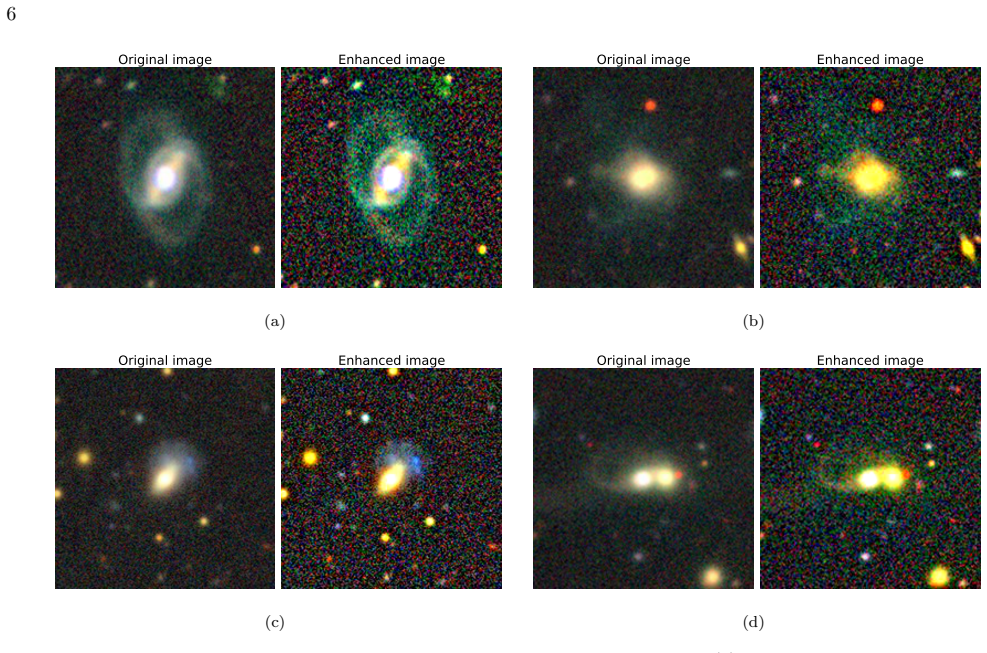
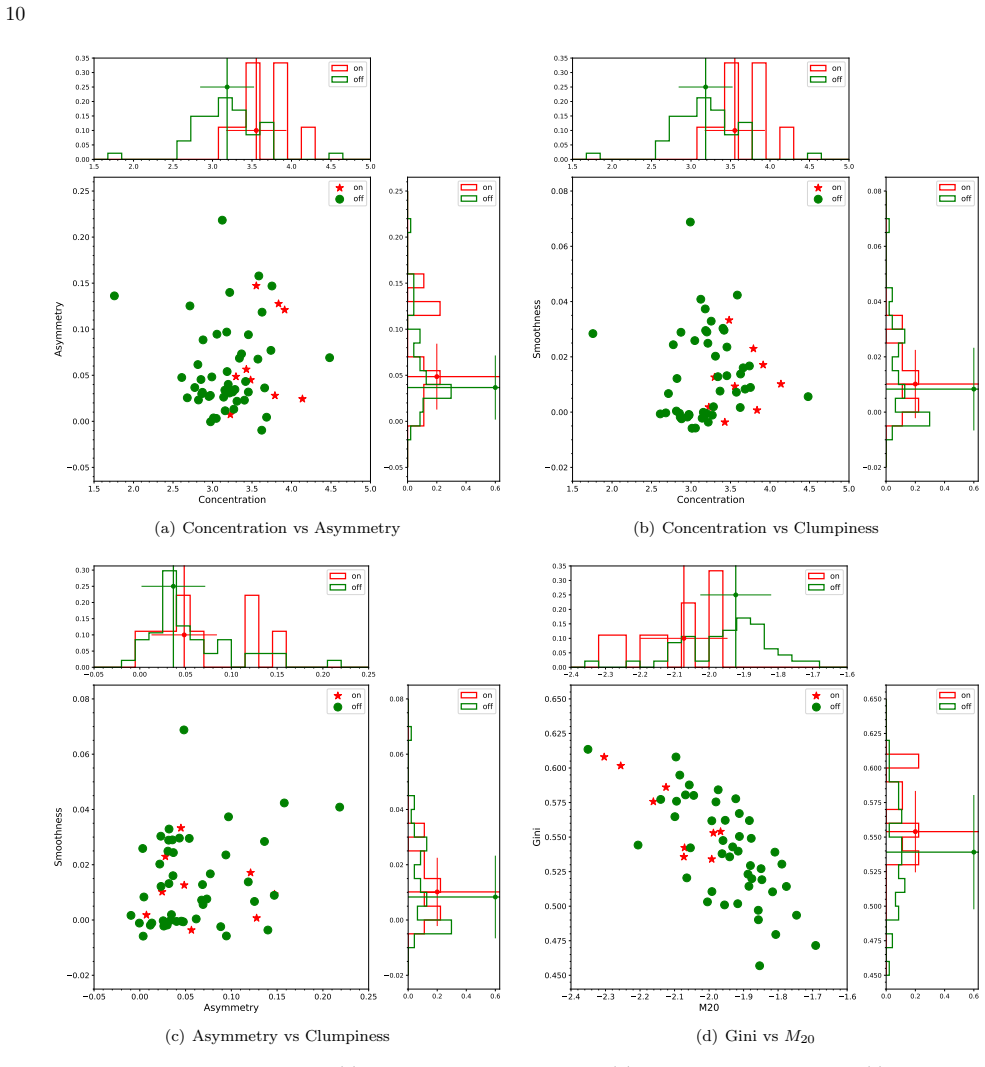
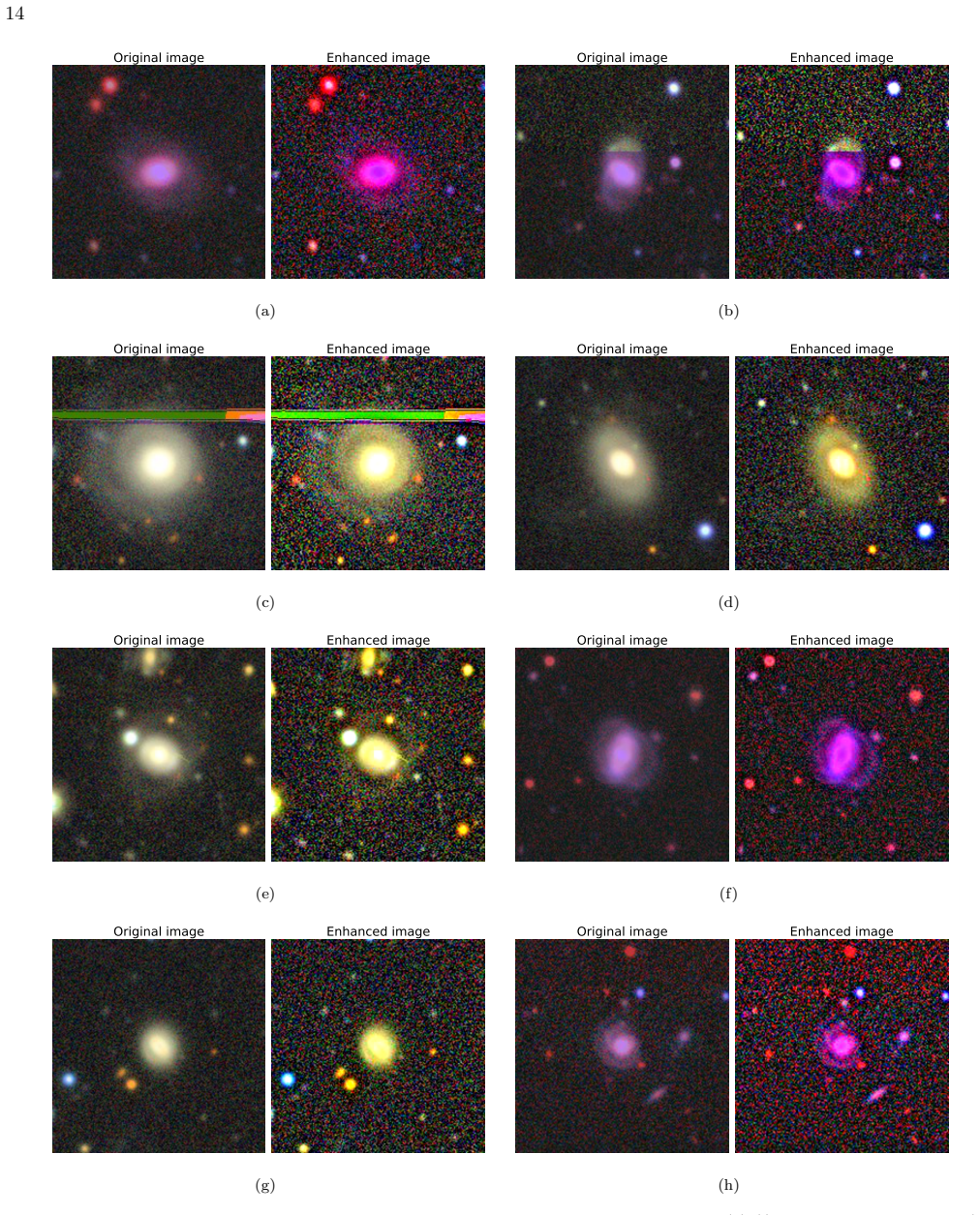
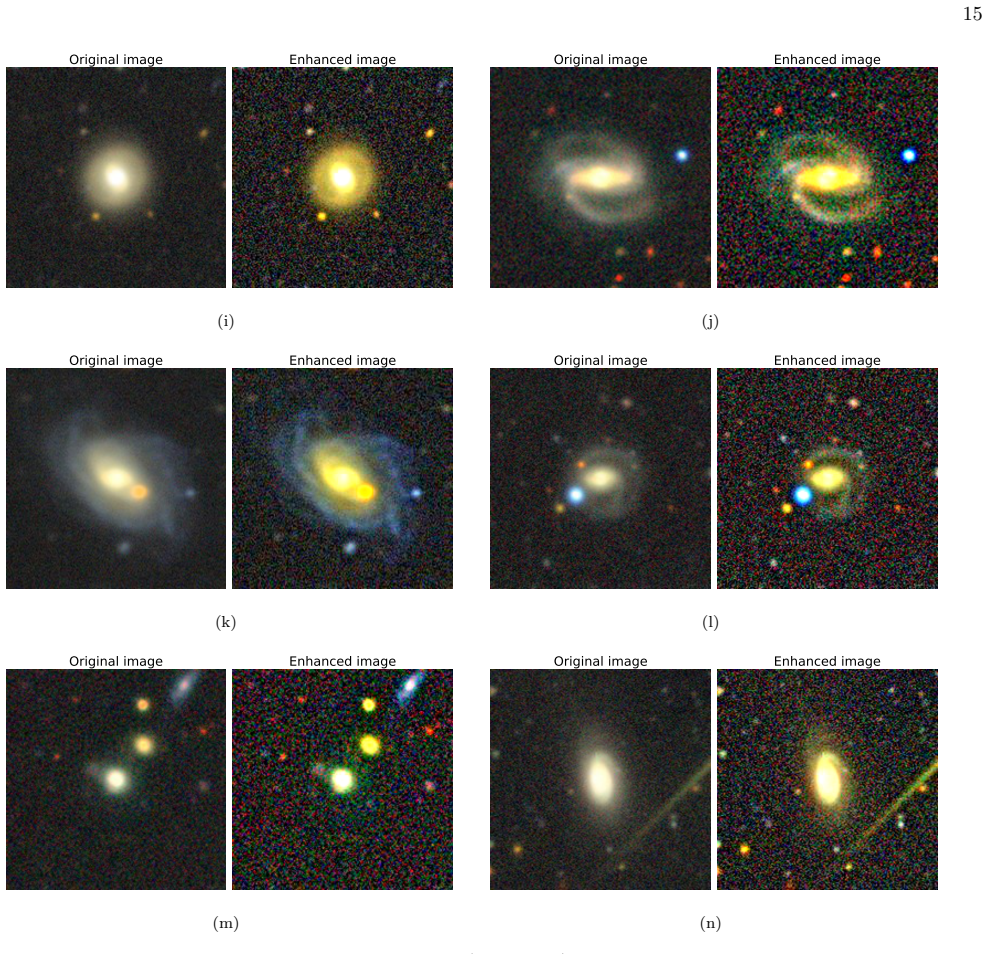
Analysis of 63 low-redshift CL-AGNs finds that 18 (29 percent) are merging systems according to visual inspection, with roughly 56 percent of those showing shell features. CL-AGN hosts have a higher (~2 times) possibility of being merging systems than different non-CL-AGN samples. The galaxies exhibit concentration like late-type spirals, asymmetry like early-type spirals, and smoothness like ellipticals; their Gini-M20 coefficients indicate weak or modest disturbances. These findings indicate that mergers or interactions may play an important role in driving the changing-look behavior.
What carries the argument
Merger fraction measured by visual inspection of DESI DR10 images combined with non-parametric morphology metrics such as Gini-M20 coefficients.
If this is right
- Mergers or interactions may often trigger the rapid appearance or disappearance of broad emission lines in AGNs.
- CL-AGN hosts are more likely to show signs of recent galaxy interactions than typical AGN hosts.
- Shell features appear in more than half of the identified merging CL-AGN systems.
- External galaxy interactions can influence AGN variability on unexpectedly short timescales.
Where Pith is reading between the lines
- Surveys that target merging galaxies could increase the discovery rate of changing-look AGNs.
- Some changing-look events might still occur without mergers, so other internal mechanisms would need to be tested separately in non-merging hosts.
- Future wide-field imaging could check whether merger-driven CL-AGNs show different timescales or amplitudes of spectral change compared with isolated ones.
Load-bearing premise
The non-CL-AGN comparison samples are matched closely enough to the CL-AGN sample in redshift, luminosity, and selection criteria that the reported factor-of-two difference in merger fraction is not caused by those unmatched properties.
What would settle it
A larger sample of non-CL-AGNs that is even more closely matched in redshift, luminosity, and selection criteria showing the same merger fraction as the CL-AGN sample.
Figures
read the original abstract
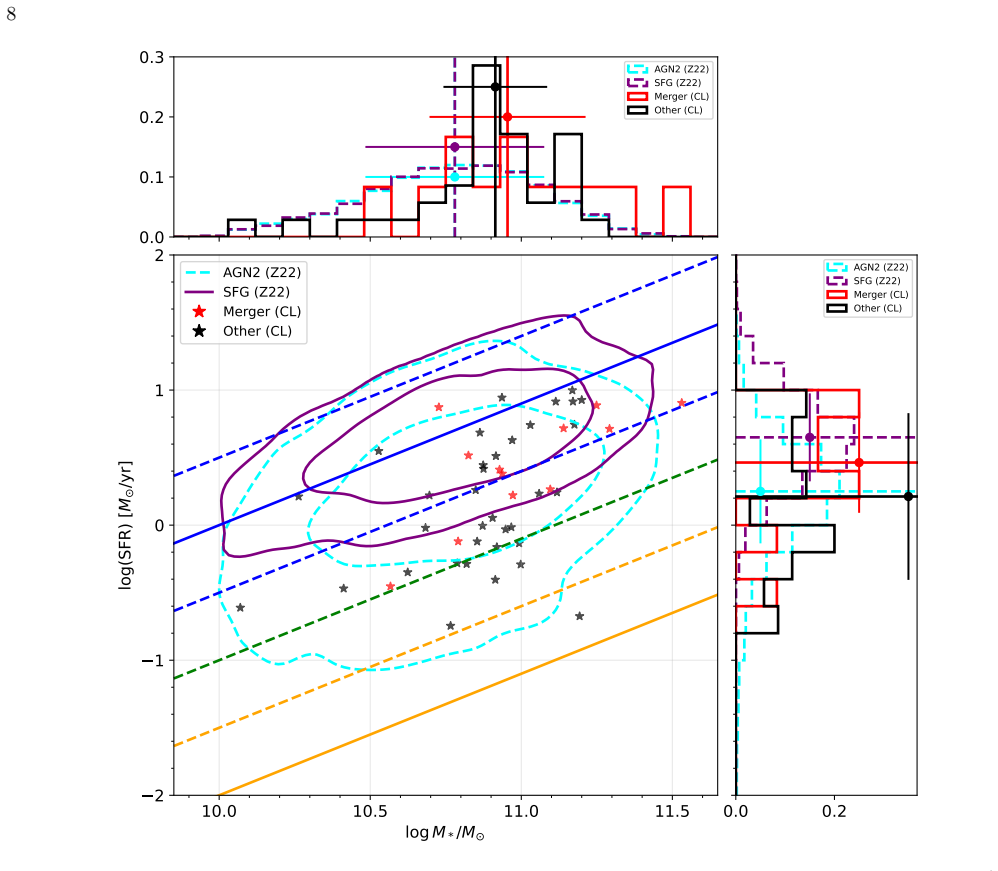
Optical changing-look active galactic nuclei (CL-AGNs) are characterized by the (dis)appearance of broad emission lines on unexpectedly short timescales. However, the underlying mechanisms and their potential connection to host-galaxy properties are still unclear. In this work, we present an analysis of the morphology for 63 low-redshift CL-AGNs (z < 0.15) selected from the largest CL-AGN catalog (Guo et al. 2025) to date, using images from DESI DR10 and employing both non-parametric methods and visual inspection. We find that CL-AGN hosts exhibit a concentration like late-type spirals, asymmetry like early-type spirals, and smoothness like ellipticals. This is confirmed by their Gini-M20 coefficients, suggesting weak/modest disturbances. Based upon our visual inspection, we further identify that 18 (29%) out of 63 sources are mergers, among which ~56% (10/18) show shell features. Compared to different non-CL-AGN samples, CL-AGN hosts have a higher (~2\times) possibility of being merging systems. Our results indicate that mergers/interactions may play an important role in driving the changing-look behavior.
Editorial analysis
A structured set of objections, weighed in public.
Referee Report
Summary. The manuscript analyzes the morphology of 63 low-redshift (z < 0.15) optical changing-look AGN (CL-AGN) host galaxies selected from the Guo et al. (2025) catalog, using DESI DR10 imaging. Non-parametric (Gini-M20) and visual classification methods show CL-AGN hosts have concentrations like late-type spirals, asymmetries like early-type spirals, and smoothness like ellipticals, with weak/modest disturbances. Visual inspection identifies 18/63 (29%) as mergers (~56% with shells). The authors report this merger fraction is ~2× higher than in various non-CL-AGN comparison samples and conclude that mergers/interactions may play an important role in driving changing-look behavior.
Significance. If the differential merger fraction is robust after proper sample matching, the result supplies direct observational evidence connecting galaxy interactions to the CL-AGN phenomenon. The use of a sizable, recently compiled sample and public imaging data offers a concrete empirical anchor for models of AGN variability on short timescales.
major comments (1)
- [Abstract] Abstract: The headline claim of a ~2× higher merger fraction (29% vs. unspecified non-CL-AGN samples) rests on an unquantified comparison. No redshift histograms, luminosity matching tables, stellar-mass cuts, or selection-function corrections are referenced, yet surface-brightness limits and angular-size effects in DESI imaging can alter visual merger detection rates by factors of order two when controls differ systematically in z or host properties. This matching step is load-bearing for the differential conclusion.
minor comments (2)
- [Abstract] Abstract: The 29% merger fraction and the factor-of-two enhancement are stated without uncertainties or bootstrap errors, making it impossible to assess whether the difference is statistically significant.
- [Abstract] Abstract: The phrase 'different non-CL-AGN samples' is too vague; the manuscript should explicitly list the control samples, their sizes, and the exact criteria used for each comparison.
Simulated Author's Rebuttal
We thank the referee for their constructive review and for identifying a key area where the presentation of our comparison can be strengthened. We address the major comment below and will revise the manuscript to improve clarity on sample matching.
read point-by-point responses
-
Referee: [Abstract] Abstract: The headline claim of a ~2× higher merger fraction (29% vs. unspecified non-CL-AGN samples) rests on an unquantified comparison. No redshift histograms, luminosity matching tables, stellar-mass cuts, or selection-function corrections are referenced, yet surface-brightness limits and angular-size effects in DESI imaging can alter visual merger detection rates by factors of order two when controls differ systematically in z or host properties. This matching step is load-bearing for the differential conclusion.
Authors: We agree that explicit quantification of the control-sample matching is essential for the robustness of the ~2× differential merger fraction. The main text (Sections 3.3 and 4.2) already specifies the comparison samples (SDSS AGN hosts at z < 0.15 with comparable r-band magnitudes and a literature compilation of non-AGN galaxies) and notes that all samples are drawn from similar low-redshift regimes. However, the abstract does not reference these details, and we did not include histograms or bias discussions. We will revise the abstract to name the control samples, add a new figure (or appendix) showing redshift and stellar-mass distributions for CL-AGN versus control samples, and include a short discussion of surface-brightness and angular-size selection effects. These changes will make the differential result load-bearing as the referee correctly notes. revision: yes
Circularity Check
No circularity: direct observational counts from imaging data
full rationale
The paper reports a visual merger fraction (18/63) measured directly from DESI DR10 images of a pre-existing CL-AGN catalog and compares it to external non-CL-AGN samples. No equations, fitted parameters, or derivations are present that reduce to the input data by construction. The single self-citation (Guo et al. 2025) supplies the input sample list but does not define the morphology metrics or the differential claim; those steps are independent measurements on public data.
Axiom & Free-Parameter Ledger
free parameters (1)
- merger classification threshold
axioms (1)
- domain assumption Gini-M20 coefficients reliably trace merger-induced disturbances in low-redshift galaxies
Reference graph
Works this paper leans on
-
[1]
The Spectral Energy Distribution of Fermi Bright Blazars.Astrophys
Abdo, A. A., Ackermann, M., Agudo, I., et al. 2010, ApJ, 716, 30, doi: 10.1088/0004-637X/716/1/30
-
[2]
Abraham, R. G., Tanvir, N. R., Santiago, B. X., et al. 1996, MNRAS, 279, L47, doi: 10.1093/mnras/279.3.L47
-
[3]
2020, ApJS, 249, 3, doi: 10.3847/1538-4365/ab929e
Ahumada, R., Allende Prieto, C., Almeida, A., et al. 2020, ApJS, 249, 3, doi: 10.3847/1538-4365/ab929e
-
[4]
Unified models for active galactic nuclei and quasars.Annu
Antonucci, R. 1993, ARA&A, 31, 473, doi: 10.1146/annurev.aa.31.090193.002353
-
[5]
A., Jangren, A., & Conselice, C
Bershady, M. A., Jangren, A., & Conselice, C. J. 2000, AJ, 119, 2645, doi: 10.1086/301386
-
[6]
2011, in Astronomical Society of the Pacific Conference Series, Vol
Bertin, E. 2011, in Astronomical Society of the Pacific Conference Series, Vol. 442, Astronomical Data Analysis Software and Systems XX, ed. I. N. Evans, A. Accomazzi, D. J. Mink, & A. H. Rots, 435
2011
-
[7]
Bertin, E., & Arnouts, S. 1996, A&AS, 117, 393, doi: 10.1051/aas:1996164
-
[8]
2020, astropy/photutils: 1.0.1, 1.0.1 Zenodo, doi: 10.5281/zenodo.4049061
Bradley, L., Sip˝ ocz, B., Robitaille, T., et al. 2020, astropy/photutils: 1.0.1, 1.0.1 Zenodo, doi: 10.5281/zenodo.4049061
-
[9]
2011, Publications of the Astronomical Society of Australia, 28, 128139, doi: 10.1071/AS10046
Cameron, E. 2011, Publications of the Astronomical Society of Australia, 28, 128139, doi: 10.1071/AS10046
-
[10]
Charlton, P. J. L., Ruan, J. J., Haggard, D., et al. 2019, ApJ, 876, 75, doi: 10.3847/1538-4357/ab0ec1
-
[11]
Conselice, C. J. 2003, ApJS, 147, 1, doi: 10.1086/375001
-
[12]
Conselice, C. J., Bershady, M. A., & Jangren, A. 2000, ApJ, 529, 886, doi: 10.1086/308300
-
[13]
Darg, D. W., Kaviraj, S., Lintott, C. J., et al. 2010, MNRAS, 401, 1043, doi: 10.1111/j.1365-2966.2009.15686.x de Albernaz Ferreira, L., & Ferrari, F. 2018, MNRAS, 473, 2701, doi: 10.1093/mnras/stx2266 DESI Collaboration, Abdul Karim, M., Adame, A. G., et al. 2026, AJ, 171, 285, doi: 10.3847/1538-3881/ae4c43
-
[14]
Dey, A., Schlegel, D. J., Lang, D., et al. 2019, AJ, 157, 168, doi: 10.3847/1538-3881/ab089d
-
[15]
Ramirez-Ruiz, E., & Foley, R. J. 2021, ApJL, 907, L21, doi: 10.3847/2041-8213/abd852
-
[16]
Frederick, S., Gezari, S., Graham, M. J., et al. 2019, ApJ, 883, 31, doi: 10.3847/1538-4357/ab3a38
-
[17]
Gallastegui-Aizpun, U., & Sarajedini, V. L. 2014, MNRAS, 444, 3078, doi: 10.1093/mnras/stu1648
-
[18]
Gezari, S., Hung, T., Cenko, S. B., et al. 2017, ApJ, 835, 144, doi: 10.3847/1538-4357/835/2/144
-
[19]
Graham, M. J., Djorgovski, S. G., Drake, A. J., et al. 2017, MNRAS, 470, 4112, doi: 10.1093/mnras/stx1456
-
[20]
J., Pulgarin-Duque, L., Anderson, S
Green, P. J., Pulgarin-Duque, L., Anderson, S. F., et al. 2022, ApJ, 933, 180, doi: 10.3847/1538-4357/ac743f
-
[21]
Guo, W.-J., Zou, H., Fawcett, V. A., et al. 2024, ApJS, 270, 26, doi: 10.3847/1538-4365/ad118a
-
[22]
Guo, W.-J., Zou, H., Greenwell, C. L., et al. 2025, ApJS, 278, 28, doi: 10.3847/1538-4365/adc124
-
[23]
Ho, L. C. 2008, ARA&A, 46, 475, doi: 10.1146/annurev.astro.45.051806.110546
work page internal anchor Pith review Pith/arXiv arXiv doi:10.1146/annurev.astro.45.051806.110546 2008
-
[24]
2022, ApJ, 926, 184, doi: 10.3847/1538-4357/ac410c
Jin, J.-J., Wu, X.-B., & Feng, X.-T. 2022, ApJ, 926, 184, doi: 10.3847/1538-4357/ac410c
-
[25]
Kado-Fong, E., Greene, J. E., Hendel, D., et al. 2018, ApJ, 866, 103, doi: 10.3847/1538-4357/aae0f0
-
[26]
Kauffmann, G., Heckman, T. M., Tremonti, C., et al. 2003, MNRAS, 346, 1055, doi: 10.1111/j.1365-2966.2003.07154.x
-
[27]
Kawaguchi, T., Mineshige, S., Umemura, M., & Turner, E. L. 1998, ApJ, 504, 671, doi: 10.1086/306105
-
[28]
Kormendy, J., & Ho, L. C. 2013, ARA&A, 51, 511, doi: 10.1146/annurev-astro-082708-101811
work page internal anchor Pith review doi:10.1146/annurev-astro-082708-101811 2013
-
[29]
, year = 1995, month = jan, volume =
Kormendy, J., & Richstone, D. 1995, ARA&A, 33, 581, doi: 10.1146/annurev.aa.33.090195.003053
-
[30]
LaMassa, S. M., Cales, S., Moran, E. C., et al. 2015, ApJ, 800, 144, doi: 10.1088/0004-637X/800/2/144
-
[31]
Law-Smith, J., Ramirez-Ruiz, E., Ellison, S. L., & Foley, R. J. 2017, ApJ, 850, 22, doi: 10.3847/1538-4357/aa94c7
-
[32]
Lazar, I., Kaviraj, S., Watkins, A. E., et al. 2024, MNRAS, 529, 499, doi: 10.1093/mnras/stae510
-
[33]
2021, ApJ, 915, 63, doi: 10.3847/1538-4357/abf82c
Liu, W.-J., Lira, P., Yao, S., et al. 2021, ApJ, 915, 63, doi: 10.3847/1538-4357/abf82c
-
[34]
Lotz, J. M., Primack, J., & Madau, P. 2004, AJ, 128, 163, doi: 10.1086/421849
work page internal anchor Pith review doi:10.1086/421849 2004
-
[35]
MacLeod, C. L., Ross, N. P., Lawrence, A., et al. 2016, MNRAS, 457, 389, doi: 10.1093/mnras/stv2997
-
[36]
MacLeod, C. L., Green, P. J., Anderson, S. F., et al. 2019, ApJ, 874, 8, doi: 10.3847/1538-4357/ab05e2
-
[37]
1998, AJ, 115, 2285, doi: 10.1086/300353
Magorrian, J., Tremaine, S., Richstone, D., et al. 1998, AJ, 115, 2285, doi: 10.1086/300353
-
[38]
Malin, D. F. 1977, AAS Photo Bulletin, 16, 10
1977
-
[39]
Malin, D. F., & Carter, D. 1983, ApJ, 274, 534, doi: 10.1086/161467
-
[40]
Mancillas, B., Duc, P.-A., Combes, F., et al. 2019, A&A, 632, A122, doi: 10.1051/0004-6361/201936320 14 Original image Enhanced image (a) Original image Enhanced image (b) Original image Enhanced image (c) Original image Enhanced image (d) Original image Enhanced image (e) Original image Enhanced image (f) Original image Enhanced image (g) Original image ...
-
[41]
Mantha, K. B., McIntosh, D. H., Brennan, R., et al. 2018, MNRAS, 475, 1549, doi: 10.1093/mnras/stx3260
-
[42]
Netzer, H. 2015, ARA&A, 53, 365, doi: 10.1146/annurev-astro-082214-122302 15 Original image Enhanced image (i) Original image Enhanced image (j) Original image Enhanced image (k) Original image Enhanced image (l) Original image Enhanced image (m) Original image Enhanced image (n) Figure 5.(Continued.)
work page internal anchor Pith review doi:10.1146/annurev-astro-082214-122302 2015
-
[43]
2018, MNRAS, 480, 3898, doi: 10.1093/mnras/sty2032
Noda, H., & Done, C. 2018, MNRAS, 480, 3898, doi: 10.1093/mnras/sty2032
-
[44]
Padovani, P., Alexander, D. M., Assef, R. J., et al. 2017, A&A Rv, 25, 2, doi: 10.1007/s00159-017-0102-9
-
[45]
Peng, Y.-j., Lilly, S. J., Kovaˇ c, K., et al. 2010, ApJ, 721, 193, doi: 10.1088/0004-637X/721/1/193
-
[46]
1976, ApJL, 210, L53, doi: 10.1086/18230110.1086/182253
Petrosian, V. 1976, ApJL, 210, L53, doi: 10.1086/18230110.1086/182253
-
[47]
Pop, A.-R., Pillepich, A., Amorisco, N. C., & Hernquist, L. 2018, MNRAS, 480, 1715, doi: 10.1093/mnras/sty1932
-
[48]
Rees, M. J. 1984, ARA&A, 22, 471, doi: 10.1146/annurev.aa.22.090184.002351
-
[49]
2023, Nature Astronomy, 7, 1282, doi: 10.1038/s41550-023-02108-4
Ricci, C., & Trakhtenbrot, B. 2023, Nature Astronomy, 7, 1282, doi: 10.1038/s41550-023-02108-4
-
[50]
Rodriguez-Gomez, V., Snyder, G. F., Lotz, J. M., et al. 2019, MNRAS, 483, 4140, doi: 10.1093/mnras/sty3345
work page internal anchor Pith review doi:10.1093/mnras/sty3345 2019
-
[51]
Runnoe, J. C., Cales, S., Ruan, J. J., et al. 2016, MNRAS, 455, 1691, doi: 10.1093/mnras/stv2385
-
[52]
Salim, S., Boquien, M., & Lee, J. C. 2018, ApJ, 859, 11, doi: 10.3847/1538-4357/aabf3c
-
[53]
Schade, D., Lilly, S. J., Crampton, D., et al. 1995, ApJL, 451, L1, doi: 10.1086/309677
-
[54]
I., Popovi´ c, L.ˇC., Burenkov, A
Shapovalova, A. I., Popovi´ c, L.ˇC., Burenkov, A. N., et al. 2010, A&A, 509, A106, doi: 10.1051/0004-6361/200912311
-
[55]
2025, ApJ, 994, 203, doi: 10.3847/1538-4357/ae1299 16
Shen, Y.-H., Lu, K.-X., Guo, W.-J., et al. 2025, ApJ, 994, 203, doi: 10.3847/1538-4357/ae1299 16
-
[56]
2021, Research Notes of the American Astronomical Society, 5, 144, doi: 10.3847/2515-5172/ac0911
Thibert, N., Sawicki, M., Goulding, A., et al. 2021, Research Notes of the American Astronomical Society, 5, 144, doi: 10.3847/2515-5172/ac0911
-
[57]
2025, ApJ, 986, 66, doi: 10.3847/1538-4357/add140
Tian, J., Zhao, Y., Li, X., & Bai, J. 2025, ApJ, 986, 66, doi: 10.3847/1538-4357/add140
-
[58]
Unified Schemes for Radio-Loud Active Galactic Nuclei.Publ
Urry, C. M., & Padovani, P. 1995, PASP, 107, 803, doi: 10.1086/133630 van der Walt, S., Sch¨ onberger, J. L., Nunez-Iglesias, J., et al. 2014, PeerJ, 2, e453, doi: 10.7717/peerj.453
work page internal anchor Pith review doi:10.1086/133630 1995
-
[59]
Vaughan, S., Edelson, R., Warwick, R. S., & Uttley, P. 2003, MNRAS, 345, 1271, doi: 10.1046/j.1365-2966.2003.07042.x
-
[60]
Verrico, M. E., French, K. D., Suess, K. A., et al. 2025, ApJ, 989, 101, doi: 10.3847/1538-4357/adeb88
-
[61]
Wang, J., Zheng, W. K., Brink, T. G., et al. 2023, ApJ, 956, 137, doi: 10.3847/1538-4357/acf5e0
-
[62]
2024, ApJ, 966, 128, doi: 10.3847/1538-4357/ad3049
Wang, S., Woo, J.-H., Gallo, E., et al. 2024, ApJ, 966, 128, doi: 10.3847/1538-4357/ad3049
-
[63]
Yang, Q., Green, P. J., Wu, X.-B., et al. 2025, ApJ, 980, 91, doi: 10.3847/1538-4357/ad94ed
-
[64]
2018, ApJ, 862, 109, doi: 10.3847/1538-4357/aaca3a
Yang, Q., Wu, X.-B., Fan, X., et al. 2018, ApJ, 862, 109, doi: 10.3847/1538-4357/aaca3a
-
[65]
2020, MNRAS, 498, 3985, doi: 10.1093/mnras/staa2627
Yu, X., Shi, Y., Chen, Y., et al. 2020, MNRAS, 498, 3985, doi: 10.1093/mnras/staa2627
-
[66]
A., Shangguan, J., Zhuang, M.-Y., & Ho, L
Zhao, Y., Li, Y. A., Shangguan, J., Zhuang, M.-Y., & Ho, L. C. 2022, ApJ, 925, 70, doi: 10.3847/1538-4357/ac375b
-
[67]
Zhong, Y., Inoue, A. K., Yamanaka, S., & Yamada, T. 2022, ApJ, 925, 157, doi: 10.3847/1538-4357/ac3edb
discussion (0)
Sign in with ORCID, Apple, or X to comment. Anyone can read and Pith papers without signing in.