Demystifying Multimodal Biomolecular Co-design With Intrinsic Geodesic Coupling
Pith reviewed 2026-06-28 11:56 UTC · model grok-4.3
The pith
Optimizing temporal couplings between generative processes via geodesic alignment produces more consistent and valid biomolecular designs.
A machine-rendered reading of the paper's core claim, the machinery that carries it, and where it could break.
Core claim
The central claim is that inappropriate temporal coupling of marginal generative processes is the primary overlooked source of inconsistent intermediate states and high-variance supervision in multimodal biomolecular co-design, and that optimizing these couplings through intrinsic geodesic alignment yields biomolecules with improved physical validity and diversity across structure-based drug design and unconditional protein design tasks.
What carries the argument
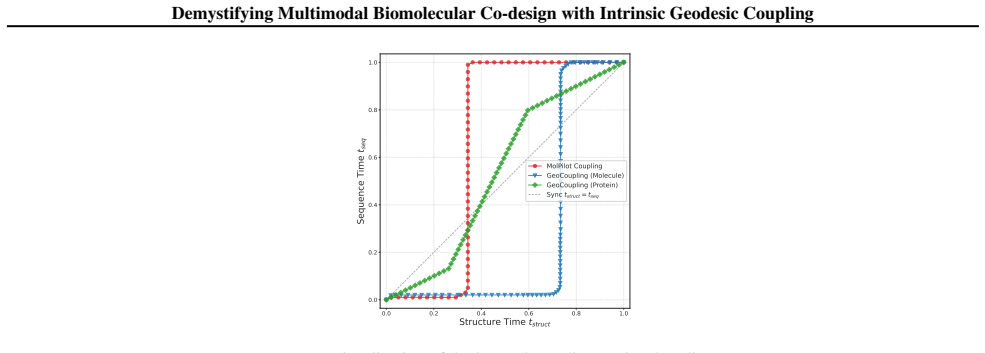
GeoCoupling, a framework that learns temporal couplings between heterogeneous modalities by aligning their generative trajectories along intrinsic geodesics.
If this is right
- Biomolecules generated with learned couplings show higher physical validity than those from fixed synchronous coupling.
- The same couplings increase design diversity while preserving sequence-structure consistency.
- The framework applies equally to conditional tasks such as structure-based drug design and to unconditional protein generation.
- Learned couplings outperform both synchronous and randomly chosen couplings in the reported benchmarks.
Where Pith is reading between the lines
- The same coupling-optimization principle could be tested in other multimodal generative settings such as text-image or audio-video models.
- Analytic derivations of optimal couplings might replace the current learned approach in some cases.
- Modality consistency in generation may depend more on trajectory alignment than on explicit joint modeling alone.
Load-bearing premise
That the choice of temporal coupling is the main overlooked cause of high-variance supervision and inconsistent states that harm modality consistency.
What would settle it
If controlled experiments using the learned couplings produce no measurable gains in physical validity or diversity metrics over synchronous and random baselines on the same tasks and models, the claim would be falsified.
Figures
read the original abstract
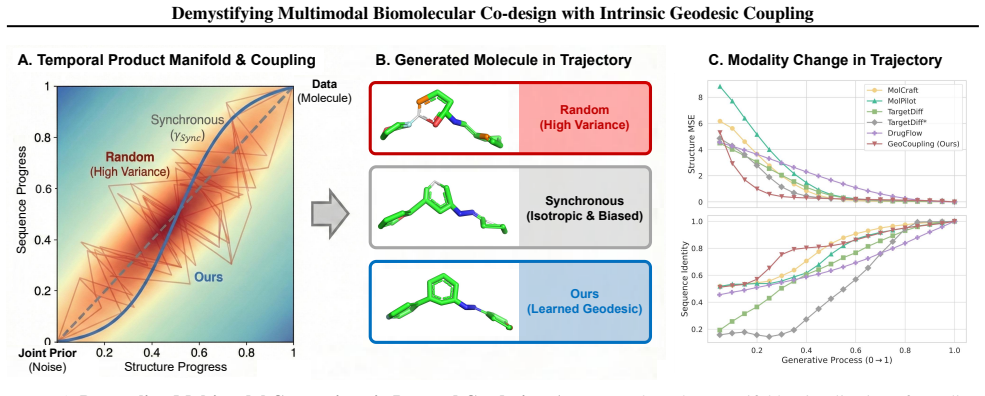
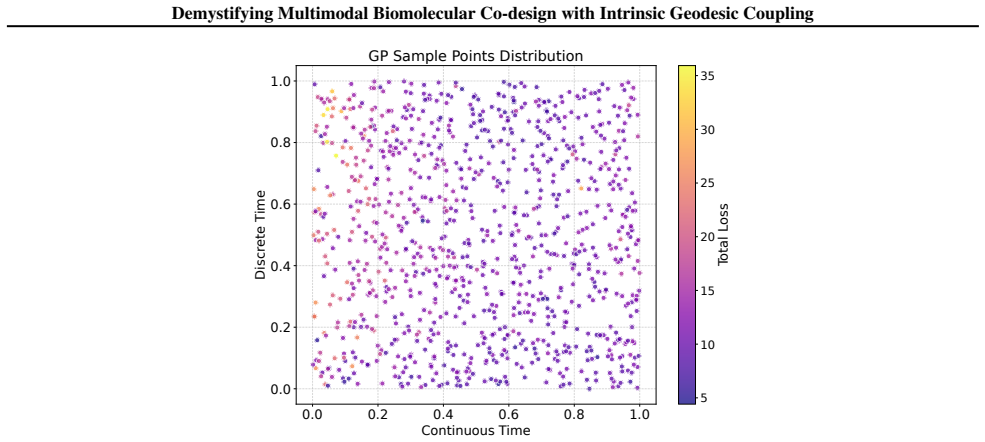
Biomolecules such as proteins and small-molecule ligands play a central role in biological systems, arising from the tight interplay between sequence and three-dimensional structure. Recent generative models for biomolecular co-design aim to capture this interplay by jointly modeling coupled modalities. However, existing approaches largely adopt a parallel execution of marginal generative processes, implicitly enforcing fixed synchronous coupling. We argue that a critical but overlooked degree of freedom lies in how these marginal processes are temporally coupled during training and generation, where inappropriate coupling can introduce high-variance supervision and inconsistent intermediate states, affecting modality consistency. To address this, we introduce GeoCoupling, a systematic framework that optimizes for temporal couplings between heterogeneous modalities. Empirical results across structure-based drug design and unconditional protein design demonstrate the learned couplings consistently outperform synchronous and randomly coupled baselines, yielding biomolecules with improved physical validity and diversity.
Editorial analysis
A structured set of objections, weighed in public.
Referee Report
Summary. The paper argues that multimodal biomolecular co-design models suffer from suboptimal fixed synchronous temporal coupling between modalities, which introduces high-variance supervision and inconsistent states; it introduces GeoCoupling, a framework that learns intrinsic geodesic couplings to optimize this degree of freedom, and reports that the learned couplings outperform synchronous and random baselines on physical validity and diversity metrics in structure-based drug design and unconditional protein design tasks.
Significance. If the empirical results hold, the work identifies and directly tests a previously overlooked modeling choice (temporal coupling) in multimodal generative models for biomolecules, with potential to improve consistency and diversity in co-design applications. The construction of explicit controls for the proposed mechanism strengthens the interpretability of the findings.
minor comments (3)
- [Abstract] The abstract states that learned couplings 'consistently outperform' baselines but provides no quantitative metrics, dataset sizes, or statistical details; the full manuscript should ensure these appear in the results section with error bars or significance tests.
- [Methods] Clarify the precise definition of 'intrinsic geodesic coupling' and how it is optimized (e.g., loss function or parameterization) early in the methods, as the current description risks remaining high-level for readers unfamiliar with the geometric framing.
- [Figures] Figure captions and axis labels should explicitly state the metrics used for validity and diversity (e.g., which validity criteria for small molecules or proteins) to allow direct comparison with prior work.
Simulated Author's Rebuttal
We thank the referee for their supportive review, accurate summary of the work, and recommendation for minor revision. The referee correctly identifies the overlooked modeling choice of temporal coupling and the value of explicit controls in our experiments.
Circularity Check
No significant circularity; empirical comparison stands on external validation
full rationale
The paper's core contribution is an empirical demonstration that a learned temporal coupling (GeoCoupling) outperforms synchronous and random baselines on validity and diversity metrics in two biomolecular design tasks. The argument directly constructs and tests the claimed degree of freedom (temporal coupling choice) via explicit controls. No derivation chain, uniqueness theorem, or self-citation load-bearing premise is present in the abstract or described structure; the result is not forced by definition or by renaming a fitted quantity as a prediction. The claim is falsifiable against the reported baselines and does not reduce to its own inputs.
Axiom & Free-Parameter Ledger
Reference graph
Works this paper leans on
-
[1]
Cell , year=
A generative deep learning approach to de novo antibiotic design , author=. Cell , year=
-
[2]
The Twelfth International Conference on Learning Representations , year=
Unified generative modeling of 3d molecules with bayesian flow networks , author=. The Twelfth International Conference on Learning Representations , year=
-
[3]
Science advances , volume=
The human proteoform project: defining the human proteome , author=. Science advances , volume=. 2021 , publisher=
2021
-
[4]
Nature , volume=
A wealth of discovery built on the Human Genome Project—by the numbers , author=. Nature , volume=. 2021 , publisher=
2021
-
[5]
Nature protocols , volume=
A practical guide to large-scale docking , author=. Nature protocols , volume=. 2021 , publisher=
2021
-
[6]
arXiv preprint arXiv:2403.07902 , year=
DecompDiff: diffusion models with decomposed priors for structure-based drug design , author=. arXiv preprint arXiv:2403.07902 , year=
-
[7]
arXiv preprint arXiv:2303.03543 , year=
3d equivariant diffusion for target-aware molecule generation and affinity prediction , author=. arXiv preprint arXiv:2303.03543 , year=
-
[8]
2024 , publisher=
Schneuing, Arne and Harris, Charles and Du, Yuanqi and Didi, Kieran and Jamasb, Arian and Igashov, Ilia and Du, Weitao and Gomes, Carla and Blundell, Tom L and Lio, Pietro and others , journal=. 2024 , publisher=
2024
-
[9]
Nature , volume=
Ultra-large library docking for discovering new chemotypes , author=. Nature , volume=. 2019 , publisher=
2019
-
[10]
Nature , volume=
Structure-based drug design , author=. Nature , volume=. 1996 , publisher=
1996
-
[11]
Drug Discovery Today , pages=
Caught between a ROCK and a hard place: current challenges in structure-based drug design , author=. Drug Discovery Today , pages=. 2024 , publisher=
2024
-
[12]
Highly accurate protein structure prediction with
Jumper, John and Evans, Richard and Pritzel, Alexander and Green, Tim and Figurnov, Michael and Ronneberger, Olaf and Tunyasuvunakool, Kathryn and Bates, Russ and. Highly accurate protein structure prediction with. Nature , volume=. 2021 , publisher=
2021
-
[13]
Accurate structure prediction of biomolecular interactions with
Abramson, Josh and Adler, Jonas and Dunger, Jack and Evans, Richard and Green, Tim and Pritzel, Alexander and Ronneberger, Olaf and Willmore, Lindsay and Ballard, Andrew J and Bambrick, Joshua and others , journal=. Accurate structure prediction of biomolecular interactions with. 2024 , publisher=
2024
-
[14]
RSC Medicinal Chemistry , volume=
Target 2035--an update on private sector contributions , author=. RSC Medicinal Chemistry , volume=. 2023 , publisher=
2035
-
[15]
Nature Reviews Chemistry , volume=
CACHE (Critical Assessment of Computational Hit-finding Experiments): A public--private partnership benchmarking initiative to enable the development of computational methods for hit-finding , author=. Nature Reviews Chemistry , volume=. 2022 , publisher=
2022
-
[16]
Nature reviews Drug discovery , volume=
Unexplored therapeutic opportunities in the human genome , author=. Nature reviews Drug discovery , volume=. 2018 , publisher=
2018
-
[17]
Wiley Interdisciplinary Reviews: Computational Molecular Science , volume=
Understanding drug-likeness , author=. Wiley Interdisciplinary Reviews: Computational Molecular Science , volume=. 2011 , publisher=
2011
-
[18]
Advanced drug delivery reviews , volume=
The application of in silico drug-likeness predictions in pharmaceutical research , author=. Advanced drug delivery reviews , volume=. 2015 , publisher=
2015
-
[19]
Patrick , title =
Walters, W. Patrick , title =. Journal of Medicinal Chemistry , volume =. 2019 , doi =
2019
-
[20]
and Reymond, Jean-Louis , title =
Ruddigkeit, Lars and van Deursen, Ruud and Blum, Lorenz C. and Reymond, Jean-Louis , title =. Journal of Chemical Information and Modeling , volume =. 2012 , doi =
2012
-
[21]
British journal of pharmacology , volume=
Principles of early drug discovery , author=. British journal of pharmacology , volume=. 2011 , publisher=
2011
-
[22]
Nature Machine Intelligence , pages=
PocketFlow is a data-and-knowledge-driven structure-based molecular generative model , author=. Nature Machine Intelligence , pages=. 2024 , publisher=
2024
-
[23]
Proteins: Structure, Function, and Bioinformatics , volume=
Salt bridges: Geometrically specific, designable interactions , author=. Proteins: Structure, Function, and Bioinformatics , volume=. 2011 , publisher=
2011
-
[24]
Advanced drug delivery reviews , volume=
Experimental and computational approaches to estimate solubility and permeability in drug discovery and development settings , author=. Advanced drug delivery reviews , volume=. 1997 , publisher=
1997
-
[25]
Current Opinion in Structural Biology , author =
Deep learning approaches for de novo drug design:. Current Opinion in Structural Biology , author =. 2022 , pages =. doi:10.1016/j.sbi.2021.10.001 , abstract =
-
[26]
Structure‐based. ChemBioChem , author =. 2023 , pages =. doi:10.1002/cbic.202200776 , language =
-
[27]
Drug Discovery Today , author =
Docking-based generative approaches in the search for new drug candidates , volume =. Drug Discovery Today , author =. 2023 , pages =. doi:10.1016/j.drudis.2022.103439 , language =
-
[28]
Current Opinion in Structural Biology , author =
Integrating structure-based approaches in generative molecular design , volume =. Current Opinion in Structural Biology , author =. 2023 , pages =. doi:10.1016/j.sbi.2023.102559 , abstract =
-
[29]
Cell Reports Medicine , author =
Deep generative molecular design reshapes drug discovery , volume =. Cell Reports Medicine , author =. 2022 , pages =. doi:10.1016/j.xcrm.2022.100794 , abstract =
-
[30]
Pharmaceuticals , volume=
The role of ai in drug discovery: challenges, opportunities, and strategies , author=. Pharmaceuticals , volume=. 2023 , publisher=
2023
-
[31]
arXiv preprint arXiv:2404.19230 , year=
Deep Lead Optimization: Leveraging Generative AI for Structural Modification , author=. arXiv preprint arXiv:2404.19230 , year=
-
[32]
Wiley Interdisciplinary Reviews: Computational Molecular Science , volume=
Generative models for molecular discovery: Recent advances and challenges , author=. Wiley Interdisciplinary Reviews: Computational Molecular Science , volume=. 2022 , publisher=
2022
-
[33]
International conference on machine learning , pages=
Deep unsupervised learning using nonequilibrium thermodynamics , author=. International conference on machine learning , pages=. 2015 , organization=
2015
-
[34]
Advances in neural information processing systems , volume=
Generative modeling by estimating gradients of the data distribution , author=. Advances in neural information processing systems , volume=
-
[35]
Advances in neural information processing systems , volume=
Denoising diffusion probabilistic models , author=. Advances in neural information processing systems , volume=
-
[36]
Advances in neural information processing systems , volume=
Variational diffusion models , author=. Advances in neural information processing systems , volume=
-
[37]
arXiv preprint arXiv:2211.15089 , year=
Continuous diffusion for categorical data , author=. arXiv preprint arXiv:2211.15089 , year=
-
[38]
Advances in Neural Information Processing Systems , volume=
Understanding diffusion objectives as the elbo with simple data augmentation , author=. Advances in Neural Information Processing Systems , volume=
-
[39]
International Conference on Learning Representations , year=
Score-Based Generative Modeling through Stochastic Differential Equations , author=. International Conference on Learning Representations , year=
-
[40]
Advances in neural information processing systems , volume=
Diffusion models beat gans on image synthesis , author=. Advances in neural information processing systems , volume=
-
[41]
Proceedings of the IEEE/CVF conference on computer vision and pattern recognition , pages=
High-resolution image synthesis with latent diffusion models , author=. Proceedings of the IEEE/CVF conference on computer vision and pattern recognition , pages=
-
[42]
International Conference on Machine Learning , pages=
GLIDE: Towards Photorealistic Image Generation and Editing with Text-Guided Diffusion Models , author=. International Conference on Machine Learning , pages=. 2022 , organization=
2022
-
[43]
International conference on machine learning , pages=
Learning transferable visual models from natural language supervision , author=. International conference on machine learning , pages=. 2021 , organization=
2021
-
[44]
International Conference on Learning Representations , year=
GeoDiff: A Geometric Diffusion Model for Molecular Conformation Generation , author=. International Conference on Learning Representations , year=
-
[45]
International Conference on Learning Representations (ICLR) , year=
DiffDock: Diffusion Steps, Twists, and Turns for Molecular Docking , author =. International Conference on Learning Representations (ICLR) , year=
-
[46]
Nature Machine Intelligence , volume=
A geometric deep learning approach to predict binding conformations of bioactive molecules , author=. Nature Machine Intelligence , volume=. 2021 , publisher=
2021
-
[47]
The Eleventh International Conference on Learning Representations , year=
Uni-Mol: A Universal 3D Molecular Representation Learning Framework , author=. The Eleventh International Conference on Learning Representations , year=
-
[48]
Journal of molecular biology , volume=
Development and validation of a genetic algorithm for flexible docking , author=. Journal of molecular biology , volume=. 1997 , publisher=
1997
-
[49]
Journal of cheminformatics , volume=
ProLIF: a library to encode molecular interactions as fingerprints , author=. Journal of cheminformatics , volume=. 2021 , publisher=
2021
-
[50]
Nature biotechnology , volume=
MMseqs2 enables sensitive protein sequence searching for the analysis of massive data sets , author=. Nature biotechnology , volume=. 2017 , publisher=
2017
-
[51]
International conference on machine learning , pages=
Equivariant diffusion for molecule generation in 3d , author=. International conference on machine learning , pages=. 2022 , organization=
2022
-
[52]
arXiv preprint arXiv:2210.05274 , year=
Equivariant 3d-conditional diffusion models for molecular linker design , author=. arXiv preprint arXiv:2210.05274 , year=
-
[53]
International Conference on Machine Learning , pages=
Geometric latent diffusion models for 3d molecule generation , author=. International Conference on Machine Learning , pages=. 2023 , organization=
2023
-
[54]
International Conference on Machine Learning , pages=
MolDiff: Addressing the Atom-Bond Inconsistency Problem in 3D Molecule Diffusion Generation , author=. International Conference on Machine Learning , pages=. 2023 , organization=
2023
-
[55]
Lipman, Yaron and Chen, Ricky T. Q. and Ben-Hamu, Heli and Nickel, Maximilian and Le, Matt , month = feb, year =. Flow. doi:10.48550/arXiv.2210.02747 , abstract =
work page internal anchor Pith review Pith/arXiv arXiv doi:10.48550/arxiv.2210.02747
-
[56]
Advances in Neural Information Processing Systems , volume=
Equivariant Flow Matching with Hybrid Probability Transport for 3D Molecule Generation , author=. Advances in Neural Information Processing Systems , volume=
-
[57]
arXiv preprint arXiv:2403.15441 , year=
Unified Generative Modeling of 3D Molecules via Bayesian Flow Networks , author=. arXiv preprint arXiv:2403.15441 , year=
-
[58]
The Twelfth International Conference on Learning Representations , year=
Training-free Multi-objective Diffusion Model for 3D Molecule Generation , author=. The Twelfth International Conference on Learning Representations , year=
-
[59]
The eleventh international conference on learning representations , year=
Equivariant energy-guided sde for inverse molecular design , author=. The eleventh international conference on learning representations , year=
-
[60]
The Eleventh International Conference on Learning Representations , year=
DiGress: Discrete Denoising diffusion for graph generation , author=. The Eleventh International Conference on Learning Representations , year=
-
[61]
NeurIPS , year=
Zero-Shot 3D Drug Design by Sketching and Generating , author=. NeurIPS , year=
-
[62]
and Masuda, Tomohide and Sunseri, Jocelyn and Jia, Andrew and Iovanisci, Richard B
Francoeur, Paul G. and Masuda, Tomohide and Sunseri, Jocelyn and Jia, Andrew and Iovanisci, Richard B. and Snyder, Ian and Koes, David R. , title =. Journal of Chemical Information and Modeling , volume =. 2020 , doi =
2020
-
[63]
Trott, Oleg and Olson, Arthur J. , title =. Journal of Computational Chemistry , volume =. doi:https://doi.org/10.1002/jcc.21334 , url =. https://onlinelibrary.wiley.com/doi/pdf/10.1002/jcc.21334 , year =
-
[64]
Glide: a new approach for rapid, accurate docking and scoring. 2. Enrichment factors in database screening , author=. Journal of medicinal chemistry , volume=. 2004 , publisher=
2004
-
[65]
Frontiers in pharmacology , volume=
Molecular sets (MOSES): a benchmarking platform for molecular generation models , author=. Frontiers in pharmacology , volume=. 2020 , publisher=
2020
-
[66]
ICLR2022 Machine Learning for Drug Discovery , year=
Fragment-based ligand generation guided by geometric deep learning on protein-ligand structures , author=. ICLR2022 Machine Learning for Drug Discovery , year=
-
[67]
International Conference on Learning Representations , year=
Molecule Generation For Target Protein Binding with Structural Motifs , author=. International Conference on Learning Representations , year=
-
[68]
Forty-first International Conference on Machine Learning , year=
Unifying Bayesian Flow Networks and Diffusion Models through Stochastic Differential Equations , author=. Forty-first International Conference on Machine Learning , year=
-
[69]
Structure-based
Schneuing, Arne and Du, Yuanqi and Harris, Charles and Jamasb, Arian and Igashov, Ilia and Du, Weitao and Blundell, Tom and Lió, Pietro and Gomes, Carla and Welling, Max and Bronstein, Michael and Correia, Bruno , month = oct, year =. Structure-based
-
[70]
Lu, Shuqi and Yao, Lin and Chen, Xi and Zheng, Hang and He, Di and Ke, Guolin , month = feb, year =
-
[71]
International Conference on Machine Learning , year=
Generating 3D Molecules for Target Protein Binding , author=. International Conference on Machine Learning , year=
-
[72]
2022 , editor =
Peng, Xingang and Luo, Shitong and Guan, Jiaqi and Xie, Qi and Peng, Jian and Ma, Jianzhu , booktitle =. 2022 , editor =
2022
-
[73]
Generating
Masuda, Tomohide and Ragoza, Matthew and Koes, David Ryan , month = nov, year =. Generating
-
[74]
Advances in Neural Information Processing Systems , volume=
A. Advances in Neural Information Processing Systems , volume=. 2021 , author =
2021
-
[75]
Current Opinion in Structural Biology , author =
Structure-based drug design with geometric deep learning , volume =. Current Opinion in Structural Biology , author =. 2023 , pages =. doi:10.1016/j.sbi.2023.102548 , language =
-
[76]
The Eleventh International Conference on Learning Representations , year=
3D Equivariant Diffusion for Target-Aware Molecule Generation and Affinity Prediction , author=. The Eleventh International Conference on Learning Representations , year=
-
[77]
2023 , editor =
Guan, Jiaqi and Zhou, Xiangxin and Yang, Yuwei and Bao, Yu and Peng, Jian and Ma, Jianzhu and Liu, Qiang and Wang, Liang and Gu, Quanquan , booktitle =. 2023 , editor =
2023
-
[78]
Learning
Zhang, Zaixi and Liu, Qi , month = may, year =. Learning
-
[79]
Nature Computational Science , author =
Learning on topological surface and geometric structure for. Nature Computational Science , author =. 2023 , file =. doi:10.1038/s43588-023-00530-2 , language =
-
[80]
arXiv preprint arXiv:2308.07413 , year=
Benchmarking Generated Poses: How Rational is Structure-based Drug Design with Generative Models? , author=. arXiv preprint arXiv:2308.07413 , year=
discussion (0)
Sign in with ORCID, Apple, or X to comment. Anyone can read and Pith papers without signing in.