Spatial Capture-Recapture With Penalized Regression Splines to Flexibly Model Wildlife Density and Distribution
Pith reviewed 2026-06-28 13:31 UTC · model grok-4.3
The pith
Penalized regression splines in spatial capture-recapture models improve estimates of animal spatial distributions.
A machine-rendered reading of the paper's core claim, the machinery that carries it, and where it could break.
Core claim
We present a spatial capture-recapture framework that allows penalized regression splines to describe the activity centre distribution, with model fitting via a Laplace-approximate penalized marginal maximum likelihood approach. Our method approximates using a log-Gaussian Cox process for activity centres and allows flexible modelling of nonlinear effects of covariates on density. Simulations and two case studies demonstrate that population size estimates of traditional approaches remain robust to density model misspecification while the spline-based model substantially improves estimation of spatial animal distributions.
What carries the argument
Penalized regression splines for the intensity function of the activity centre point process, fitted with Laplace approximation to the penalized marginal likelihood.
If this is right
- Population size estimates remain reliable even when the density model is misspecified.
- Spatial distribution estimates become substantially more accurate with the spline-based model.
- Nonlinear effects of covariates on animal density can be incorporated directly.
- The framework provides a route to approximate log-Gaussian Cox processes within existing spatial capture-recapture software.
Where Pith is reading between the lines
- More accurate density surfaces could support finer-scale conservation planning for habitat protection.
- The method may reduce bias in studies of species with strong social or territorial structure.
- If the Laplace approximation continues to perform well, the approach could be extended to dynamic or time-varying density surfaces.
- Abundance-focused monitoring programs could adopt the simpler Poisson model while distribution-focused work adopts the spline version.
Load-bearing premise
The Laplace approximation to the penalized marginal likelihood remains accurate enough that the spline-based density surface recovers the true spatial pattern without systematic bias when the true process deviates from a Poisson point process.
What would settle it
A simulation study in which activity centres are generated from a known clustered point process and the fitted spline model shows clear systematic bias in the recovered density surface.
Figures


read the original abstract
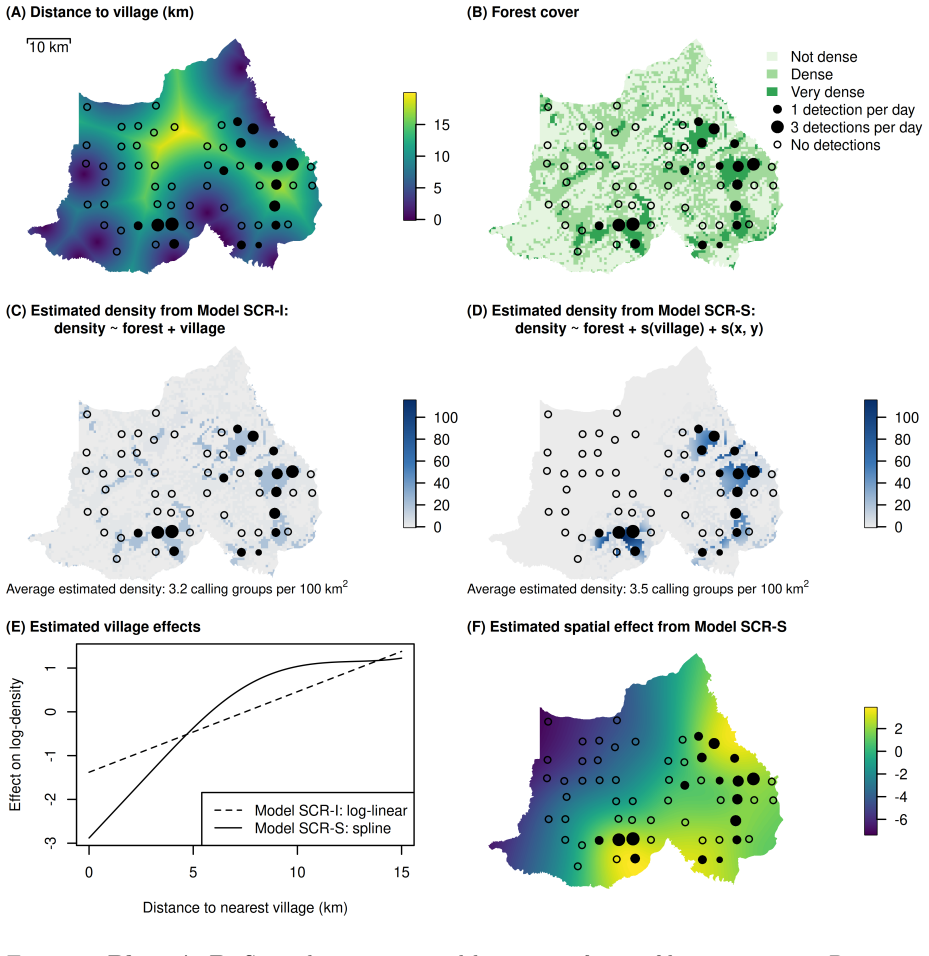
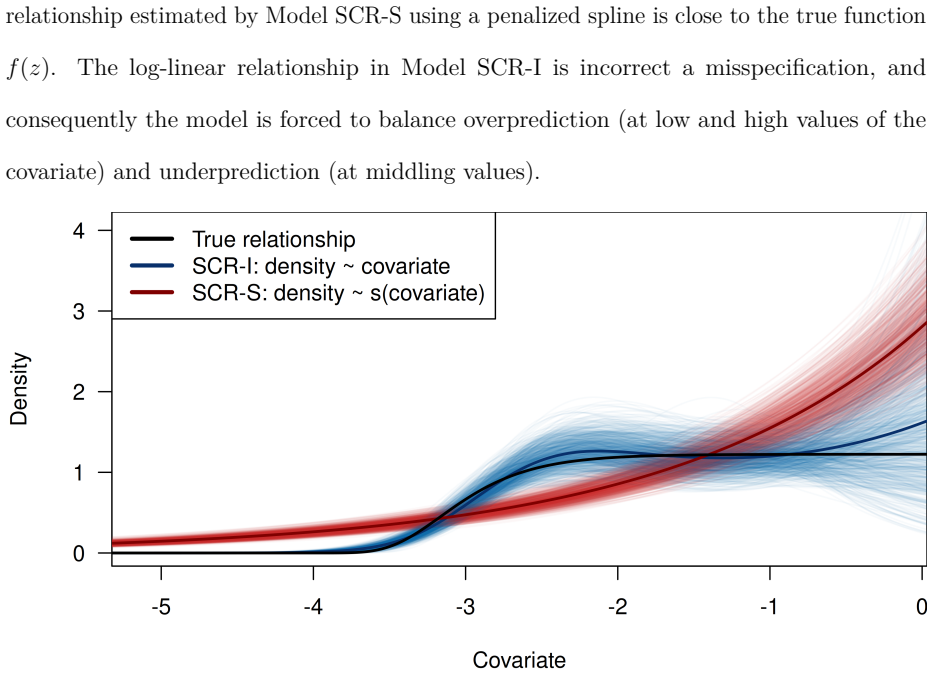
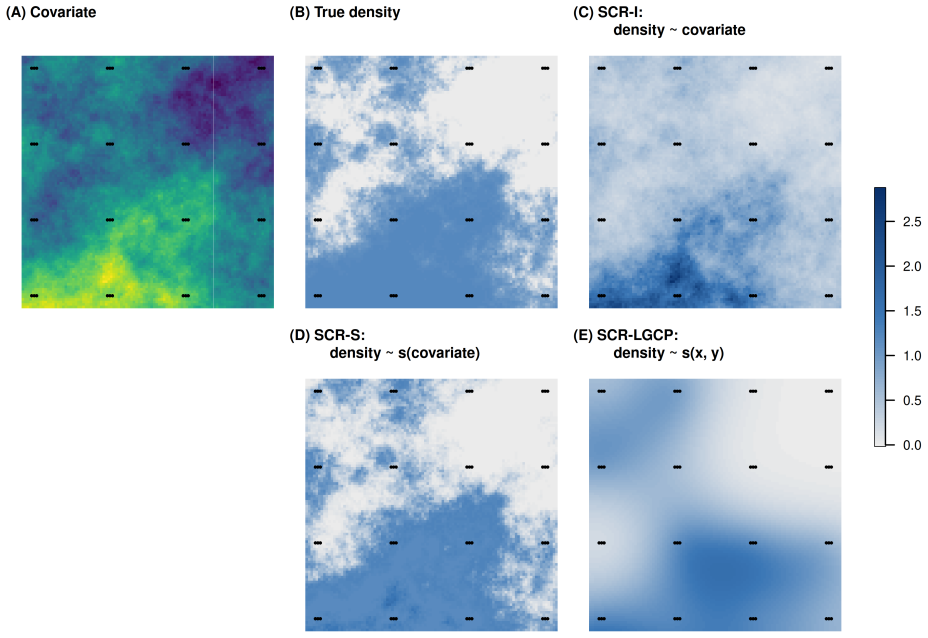
Spatial capture-recapture models are routinely used to estimate the abundance and distribution of wild animal populations and involve a latent spatial point process of animal activity centres that describes the spatial distribution of individuals. While traditional spatial capture-recapture models use a Poisson process, the assumption of conditional independence between points is often violated in practice due to factors not included in the point process, such as social clustering, territoriality, or preferential selection of habitat due to unobserved covariates. Log-Gaussian Cox processes are commonly used in spatial statistics to overcome weaknesses of Poisson processes, but methods to fit them within spatial capture-recapture do not currently exist. Here, we present a spatial capture-recapture framework that allows for the use of penalized regression splines to describe the activity centre distribution, with model fitting via a Laplace-approximate penalized marginal maximum likelihood approach. Our method approximates using a log-Gaussian Cox process for activity centres, and allows flexible modelling of nonlinear effect of covariates on density. We illustrate the use of our method with a simulation study and two case-studies. We demonstrate that, while population size estimates of traditional approaches are robust to density model misspecification, our approach substantially improves the estimation of spatial animal distributions.
Editorial analysis
A structured set of objections, weighed in public.
Referee Report
Summary. The manuscript introduces a spatial capture-recapture (SCR) framework that replaces the standard Poisson point process for activity centres with penalized regression splines, approximating a log-Gaussian Cox process. Fitting proceeds via Laplace-approximate penalized marginal maximum likelihood. Simulations and two case studies are used to argue that traditional SCR abundance estimates remain robust to density misspecification while the spline approach yields substantially improved spatial distribution estimates.
Significance. If the spatial improvements are shown to be free of systematic bias from the Laplace step, the work would supply a practical, flexible tool for modeling nonlinear covariate effects on density in SCR studies, addressing a common violation of the Poisson assumption. The reported robustness of N is a useful secondary result for practitioners. The penalized-spline construction itself is a clear methodological contribution.
major comments (2)
- [Simulation study section] Simulation study section: the reported gains in spatial distribution estimation rest on the claim that the Laplace-approximated penalized marginal likelihood recovers the true spline density surface without systematic bias when the generating process deviates from Poisson (e.g., via clustering or unobserved covariates). No targeted simulation isolating Laplace approximation error from other sources is described, which is load-bearing for the central spatial-improvement claim.
- [Methods section] Methods section on the penalized marginal likelihood: the accuracy of the Laplace approximation for the spline coefficients is asserted to be sufficient for spatial recovery, yet no analytic error bound or diagnostic (e.g., comparison of Laplace mode/curvature against MCMC on a subset of replicates) is provided; this directly affects whether the spline surface can be trusted to reflect true spatial patterns.
minor comments (2)
- [Abstract] The abstract states that population-size estimates are 'robust' but does not quantify the magnitude of bias or coverage under the misspecified models; a table or figure summarizing these metrics would strengthen the robustness claim.
- [Methods] Notation for the spline basis functions and the smoothing penalty parameter is introduced without an explicit reference to the dimension of the basis or the form of the penalty matrix; adding these details would improve reproducibility.
Simulated Author's Rebuttal
We thank the referee for their detailed and constructive review. The comments highlight important aspects of validating the Laplace approximation in our proposed method. We respond to each major comment below and outline revisions to address the concerns.
read point-by-point responses
-
Referee: Simulation study section: the reported gains in spatial distribution estimation rest on the claim that the Laplace-approximated penalized marginal likelihood recovers the true spline density surface without systematic bias when the generating process deviates from Poisson (e.g., via clustering or unobserved covariates). No targeted simulation isolating Laplace approximation error from other sources is described, which is load-bearing for the central spatial-improvement claim.
Authors: We agree that a targeted simulation isolating the Laplace approximation error would strengthen confidence in the spatial recovery claims. Our simulations demonstrate that the fitted spline surfaces closely match the true generating surfaces across various misspecification scenarios, with low bias in spatial distribution estimates. To directly address this, we will add a new simulation component in the revised manuscript that compares Laplace-approximated estimates to full MCMC fits on a subset of replicates to isolate any approximation-induced bias. revision: yes
-
Referee: Methods section on the penalized marginal likelihood: the accuracy of the Laplace approximation for the spline coefficients is asserted to be sufficient for spatial recovery, yet no analytic error bound or diagnostic (e.g., comparison of Laplace mode/curvature against MCMC on a subset of replicates) is provided; this directly affects whether the spline surface can be trusted to reflect true spatial patterns.
Authors: Deriving a general analytic error bound for the Laplace approximation in this penalized marginal likelihood framework is not feasible within the scope of this work due to the complexity of the model and the penalized spline structure. However, we will include an empirical diagnostic by performing MCMC comparisons on a subset of simulation replicates to verify the accuracy of the Laplace mode and curvature for the spline coefficients. revision: partial
- Providing analytic error bounds for the Laplace approximation in the penalized marginal likelihood.
Circularity Check
No circularity; new spline-based SCR framework with independent Laplace fitting and external validation
full rationale
The paper presents a new modeling construction: penalized regression splines for activity-centre density inside an SCR model, fitted via Laplace-approximated penalized marginal likelihood to approximate an LGCP. No equations or claims reduce a reported result to a fitted parameter by definition, nor does any central premise rest on a self-citation chain. Simulation studies and case studies are invoked as external checks rather than tautological outputs. The derivation chain is therefore self-contained against the stated inputs.
Axiom & Free-Parameter Ledger
free parameters (1)
- spline smoothing penalty parameter
axioms (2)
- domain assumption Laplace approximation accurately represents the marginal likelihood for the penalized spline model
- domain assumption Penalized regression splines can represent the intensity surface of a log-Gaussian Cox process sufficiently well for SCR inference
Reference graph
Works this paper leans on
-
[1]
Baddeley, Adrian and Turner, Rolf , year =. Practical. Australian & New Zealand Journal of Statistics , volume =. doi:10.1111/1467-842X.00128 , urldate =
-
[2]
Barrueto, M. and Sawaya, M. A. and Clevenger, A. P. , year =. Low Wolverine (. doi:10.1139/cjz-2019-0165 , journal =
-
[3]
Berman, Mark and Turner, T. Rolf , year =. Approximating. Journal of the Royal Statistical Society: Series C (Applied Statistics) , volume =. doi:10.2307/2347614 , urldate =
-
[4]
Consequences of Ignoring Group Association in Spatial Capture--Recapture Analysis , author =. 2020 , month = mar, journal =. doi:10.2981/wlb.00649 , urldate =
-
[5]
A Vector of Point Processes for Modeling Interactions between and within Species Using Capture-Recapture Data , author =. Environmetrics , volume =. doi:10.1002/env.2781 , urldate =
-
[6]
and Chopara, R
Durbach, I. and Chopara, R. and Borchers, D. L. and Phillip, R. and Sharma, K. and Stevenson, B. C. , year =. That's not the. Biometrics , volume =
-
[7]
Spatially Explicit Maximum Likelihood Methods for Capture-Recapture Studies , author =. 2008 , volume =. doi:10.1111/j.1541-0420.2007.00927.x , journal =
-
[8]
2014 , institution =
Flexible Density Surface Estimation for Spatially Explicit Capture-Recapture Surveys , author =. 2014 , institution =
2014
-
[9]
Journal of the American Statistical Association , number =
A Unifying Model for Capture-Recapture and Distance Sampling Surveys of Wildlife Populations , author =. Journal of the American Statistical Association , number =. 2015 , volume =
2015
-
[10]
Statistical Science , number =
Spatial Capture-Recapture Models , author =. Statistical Science , number =. 2015 , volume =
2015
-
[11]
Proceedings of the National Academy of Sciences , number =
Estimating and forecasting spatial population dynamics of apex predators using transnational genetic monitoring , author =. Proceedings of the National Academy of Sciences , number =. 2020 , volume =
2020
-
[12]
Resource Pulses Influence the Spatio-Temporal Dynamics of a Large Carnivore Population , author =. Ecography , number =. 2021 , volume =. doi:10.1111/ecog.05154 , annotation =
-
[13]
Spatially Explicit Integrated Population Models , author =. 2014 , journal =. doi:10.1111/2041-210X.12153 , urldate =
-
[14]
Clare, John and McKinney, Shawn T. and. Satellite-Detected Forest Disturbance Forecasts. 2019 , volume =. doi:10.1016/j.biocon.2019.02.020 , journal =
-
[15]
2015 , publisher =
Statistics for Spatio-Temporal Data , author =. 2015 , publisher =
2015
-
[16]
Splines Minimizing Rotation-Invariant Semi-Norms in
Duchon, Jean , editor =. Splines Minimizing Rotation-Invariant Semi-Norms in. Constructive. 1977 , pages =. doi:10.1007/BFb0086566 , series =
-
[17]
Oikos , number =
Density Estimation in Live-Trapping Studies , author =. Oikos , number =. 2004 , volume =
2004
-
[18]
Ecology , number =
Population Density Estimated from Locations of Individuals on a Passive Decector Array , author =. Ecology , number =. 2009 , volume =
2009
-
[19]
Spinons and triplons in spatially anisotropic frustrated antiferromagnets
Estimating Population Size by Spatially Explicit Capture Recapture , author =. Oikos , number =. 2013 , volume =. doi:10.1111/j.1600-0706.2012.20440.x , annotation =
work page internal anchor Pith review Pith/arXiv arXiv doi:10.1111/j.1600-0706.2012.20440.x 2013
-
[20]
2026 , note =
secr: Spatially explicit capture-recapture models , author =. 2026 , note =
2026
-
[21]
Furnas, Brett J. and Landers, Russ H. and Paiste, Rhonda G. and Sacks, Benjamin N. , year =. Overabundance of. The Journal of Wildlife Management , volume =. doi:10.1002/jwmg.21849 , urldate =
-
[22]
Investigating Effects of Soil Chemicals on Density of Small Mammal Bioindicators Using Spatial Capture-Recapture Models , author =. Plos One , number =. 2020 , volume =. doi:10.1371/journal.pone.0238870 , annotation =
-
[23]
Reserve Design to Optimize Functional Connectivity and Animal Density , author =. 2019 , journal =. doi:10.1111/cobi.13369 , urldate =
-
[24]
Some characteristics of simple types of predation and parasitism , author =. 1959 , volume =. doi:10.4039/Ent91385-7 , journal =
-
[25]
The Comparison of Usage and Availability Measurements for Evaluating Resource Preference , author =. Ecology , number =. 1980 , volume =. doi:10.2307/1937156 , annotation =
-
[26]
Journal of the Royal Statistical Society: Series C (Applied Statistics) , number =
Geoadditive Models , author =. Journal of the Royal Statistical Society: Series C (Applied Statistics) , number =. 2003 , volume =. doi:10.1111/1467-9876.00385 , annotation =
-
[27]
and Wahba, Grace , year =
Kimeldorf, George S. and Wahba, Grace , year =. A Correspondence between. The Annals of Mathematical Statistics , volume =. 2239347 , eprinttype =
-
[28]
and Skaug, Hans and Bell, Bradley M
Kristensen, Kasper and Nielsen, Anders and Berg, Casper W. and Skaug, Hans and Bell, Bradley M. , year =. doi:10.18637/jss.v070.i05 , journal =
-
[29]
Compounding Effects of Human Development and a Natural Food Shortage on a Black Bear Population along a Human Development-Wildland Interface , author =. 2018 , month = aug, journal =. doi:10.1016/j.biocon.2018.05.004 , urldate =
-
[30]
Integrating Telemetry Data into Spatial Capture-Recapture Modifies Inferences on Multi-Scale Resource Selection , author =. Ecosphere , number =. 2018 , volume =. doi:10.1002/ecs2.2203 , annotation =
-
[31]
Mann, Gareth K. H. and O'Riain, M. Justin and Parker, Daniel M. , year =. A Leopard's Favourite Spots:. doi:10.1016/j.jaridenv.2020.104218 , journal =
-
[32]
Scandinavian Journal of Statistics , number =
Coverage Properties of Confidence Intervals for Generalized Additive Model Components , author =. Scandinavian Journal of Statistics , number =. 2012 , volume =. doi:10.1111/j.1467-9469.2011.00760.x , annotation =
-
[33]
M. Log. 1998 , volume =. doi:10.1111/1467-9469.00115 , journal =
-
[34]
and Wangchuk, Sonam and Tandin, Tandin and Tan, Cedric Kai Wei , year =
Penjor, Ugyen and Macdonald, David W. and Wangchuk, Sonam and Tandin, Tandin and Tan, Cedric Kai Wei , year =. Identifying Important Conservation Areas for the Clouded Leopard. Ecology and Evolution , volume =. doi:10.1002/ece3.3970 , urldate =
-
[35]
Density and Spatial Partitioning of Endangered Sympatric
Rahman, Dede Aulia and Rianti, Puji and Muhiban, Muhiban and Muhtarom, Aom and Rahmat, Ujang Mamat and Santosa, Yanto and Aulagnier, Stephan. Density and Spatial Partitioning of Endangered Sympatric. 2018 , month = dec, journal =. doi:10.25225/fozo.v67.i3-4.a8.2018 , urldate =
-
[36]
Density Estimation of Tiger and Leopard Using Spatially Explicit Capture Recapture Framework , author =. 2021 , volume =. doi:10.7717/peerj.10634 , journal =
-
[37]
A Spatial Capture-Recapture Model for Territorial Species , author =. 2014 , volume =. doi:10.1002/env.2317 , journal =
-
[38]
Royle, J. Andrew and Young, Kevin V. , year =. A Hierarchical Model for Spatial Capture. doi:10.1890/07-0601.1 , journal =
-
[39]
Simpson, D. and Illian, J. B. and Lindgren, F. and S. Going off Grid: Computationally Efficient Inference for Log-. Biometrika , volume =. doi:10.1093/biomet/asv064 , urldate =
-
[40]
Biometrics , pmid =
Spatial Correlation Structures for Detections of Individuals in Spatial Capture-Recapture Models , author =. Biometrics , pmid =. 2021 , doi =
2021
-
[41]
Fast, Scalable Approximations to Posterior Distributions in Extended Latent
Stringer, Alex and Brown, Patrick and Stafford, Jamie , year =. Fast, Scalable Approximations to Posterior Distributions in Extended Latent
-
[42]
Large-Scale Variation in Density of an Aquatic Ecosystem Indicator Species , author =. 2018 , volume =. doi:10.1038/s41598-018-26847-x , journal =
-
[43]
Tobler, Mathias W. and Garcia Anleu, Rony and. Do Responsibly Managed Logging Concessions Adequately Protect Jaguars and Other Large and Medium-Sized Mammals?. 2018 , month = apr, journal =. doi:10.1016/j.biocon.2018.02.015 , urldate =
-
[44]
, year =
Tourani, M. , year =. A Review of Spatial Capture-Recapture:. Ecology and Evolution , number =
-
[45]
Factors Associated with Black Bear Density and Implications for Management , author =. 2019 , journal =. doi:10.1002/jwmg.21744 , urldate =
-
[46]
Fast Stable Restricted Maximum Likelihood and Marginal Likelihood Estimation of Semiparametric Generalized Linear Models , author =. 2011 , volume =. doi:10.1111/j.1467-9868.2010.00749.x , journal =
-
[47]
, year =
Wood, Simon N. , year =. Generalized Additive Models: An Introduction with
-
[48]
Thin Plate Regression Splines , author =. 2003 , volume =. doi:10.1111/1467-9868.00374 , journal =
-
[49]
The Annals of Applied Statistics , volume =
Point Process Models for Spatio-Temporal Distance Sampling Data from a Large-Scale Survey of Blue Whales , author =. The Annals of Applied Statistics , volume =. doi:10.1214/17-AOAS1078 , urldate =
-
[50]
Bayesian Analysis , volume =
Bayesian Adaptive Smoothing Splines Using Stochastic Differential Equations , author =. Bayesian Analysis , volume =
-
[51]
Rawson, B. M. and Hoang, M. D. and Roos, C. and Van, N. T. and Nguyen, M. H. , year =. doi:10.2305/IUCN.UK.2020-2.RLTS.T128073282A17968950.en , journal =
work page doi:10.2305/iucn.uk.2020-2.rlts.t128073282a17968950.en 2020
-
[52]
An Efficient Acoustic Density Estimation Method with Human Detectors Applied to Gibbons in Cambodia , author =. 2016 , volume =. doi:10.1371/journal.pone.0155066 , journal =
-
[53]
McGrath, S. J. and Liu, J. and Stevenson, B. C. and Behie, A. M , year =. Density and Population Size Estimates of the Endangered Northen Yellow-Cheeked Crested Gibbon. doi:10.1371/journal.pone.0292386 , journal =
-
[54]
Hankinson, E. and Korstjens, A. H. and Hill, R. A. and Wich, S. A. and Slater, H. D. and Abdullah, A. and Supradi, S. and Marsh, C. D. and Nijman, V. , year =. Effects of Anthropogenic Disturbance on Group Densities of Thomas' Langurs (. doi:10.1111/1440-1703.12373 , journal =
-
[55]
and Brooks, W
Dovers, E. and Brooks, W. and Popovic, G. C. and Warton, D. I. , year =. Fast, Approximate Maximum Likelihood Estimation of Log-. Journal of Computational and Graphical Statistics , number =
-
[56]
Superconductivity in Tetragonal LaPt_{2-x}Ge_{2+x}
Dovers, E. and Stoklosa, J. and Warton, D. I. , year =. Fitting Log-. doi:10.1080/00031305.2024.2316725 , journal =
work page internal anchor Pith review Pith/arXiv arXiv doi:10.1080/00031305.2024.2316725 2024
-
[57]
and Chipperfield, J
Zhang, W. and Chipperfield, J. D. and Illian, J. B. and Dupont, P. and Milleret, C. and de Valpine, P. and Bischof, R. , year =. A Flexible and Efficient. Ecology , number =
-
[58]
2008 , publisher =
Statistical Analysis and Modelling of Spatial Point Patterns , author =. 2008 , publisher =
2008
-
[59]
Journal of Agricultural, Biological, and Environmental Statistics , number =
Understanding the Stochastic Partial Differential Equation Approach to Smoothing , author =. Journal of Agricultural, Biological, and Environmental Statistics , number =. 2020 , volume =
2020
discussion (0)
Sign in with ORCID, Apple, or X to comment. Anyone can read and Pith papers without signing in.